
Buying Guide · Updated November 2026
Best 10000 Watt Solar Generator: Which Systems Really Deliver 10kW
A 10000 watt solar generator is a whole-home battery system, not a portable. Of the systems we rate, only the EcoFlow DELTA Pro Ultra X holds 10kW continuously from one inverter (12,000W at 120/240V). The Anker SOLIX E10 kit reaches 10,000W for up to 90 minutes, and most of the others get there only by pairing two units through the maker’s hub or panel. Below: which is which, what 10kW runs, and how to connect it safely.
As an Amazon Associate, SolarGenAdvisor earns from qualifying purchases made through links on this page, at no additional cost to you.
 By
10,000 Watt Solar Generator Comparison
Ordered by how directly each system delivers 10kW, not by rating alone. Continuous (W) is what one unit or kit can carry indefinitely; the route to 10kW column says whether that takes one inverter, a time-limited mode or a second unit.
| # | System | Continuous (W), one unit | Route to 10kW | Documented maximum | Capacity (Wh) | Solar In | Weight | Rating | Price |
|---|---|---|---|---|---|---|---|---|---|
| 1 | EcoFlow DELTA Pro Ultra X | 12,000W | One inverter (kit includes two batteries) | 36,000W with three inverters, per EcoFlow | 12,288 Wh | 10,000W | — | 91/100 | $7,899.00 |
| 2 | Anker SOLIX E10 Prime Off-Grid Kit | 7,680W | Turbo mode: 10,000W for up to 90 minutes (two batteries) | Up to three units on one Power Dock (22.8 kW rated, 30 kW turbo), per Anker | 12,000 Wh | 9,000W | 190.6 lb | 92/100 | $5,799.00 |
| 3 | Jackery Solar Generator 5000 Plus | 7,200W | Two units + Jackery Smart Transfer Switch | 14,400W and 60 kWh with two units, per Jackery | 5,040 Wh | 4,000W | 134.5 lb | 90/100 | $3,499.00 |
| 4 | Anker SOLIX F3800 Plus + Home Power Panel | 6,000W | Two stations + Double Power Hub or Home Power Panel | 12,000W with two stations, per Anker | 3,840 Wh | 3,200W | 136.7 lb | Bundle unrated (station 90/100) | Unavailable on Amazon. See the Anker SOLIX F3800 Plus → |
One-unit specs come from our product database. Multi-unit and turbo figures are the manufacturers’ published numbers, not our measurements: EcoFlow DELTA Pro Ultra X, Anker SOLIX E10, Jackery Smart Transfer Switch, Anker F3800 Plus two-unit bundles, EcoFlow Smart Home Panel 2, Pecron F5000LFP. Kit capacity and weight are totals for the pieces in the Amazon listing; a dash means the published weights conflict, so we leave the cell empty. Pairing hardware and second units are separate purchases.
How a Solar Generator Reaches 10kW
Listings for a 10kW solar generator or 10,000 watt power station use the same number for three different things. Which one you are buying decides what arrives in the box and what it costs to reach the headline figure.
1. One inverter, continuous
A single inverter rated for 10,000W or more with no time limit. In our ratings that is the EcoFlow DELTA Pro Ultra X at 12,000W. Nothing to pair, and the rating holds as long as the battery does.
2. A time-limited mode
A lower continuous rating plus a higher output the maker allows for a set period. The Anker SOLIX E10 is 7,680W continuous and 10,000W for up to 90 minutes with two batteries, per Anker’s spec table.
3. Two units paired
Two 6,000–7,200W stations joined by the maker’s hub or panel: two Jackery 5000 Plus units reach 14,400W, two Anker F3800 Plus stations 12,000W. You pay for two stations and the pairing hardware.
And some have no route
OUPES states that the OUPES Guardian 6000 V2 “does not support parallel connection” (OUPES support FAQ), so it stays a 6,000W unit. We found no published two-unit figure for the Pecron F5000LFP either.
Each pairing works only with the hardware its maker names; stations from different brands, or different models from one brand, are not documented to combine. And remember that “10kW” is output, not storage. If you came here looking for a 10 kWh battery, the question is capacity instead: our best whole-home solar generators guide ranks systems by capacity and expandability. For what the whole project costs with panels and installation, see whole house solar generator cost.
The Best 10,000 Watt Solar Generators, Reviewed
Ratings are our editorial scores, synthesized from published specifications and Amazon customer reviews. Each card says plainly how the system gets to 10kW and who should pass on it.

#1 · 10kW+ From One Inverter · 91/100
EcoFlow DELTA Pro Ultra X
12,000W continuous · 12,288 Wh · 10,000W solar · LiFePO4 · One inverter
Whole-home LiFePO4 system sold on Amazon with 12,288Wh (one inverter plus two 6,144Wh batteries), 12,000W of 120/240V output, 10,000W of solar input and expansion to 180kWh, though it is a heavy multi-piece system that stays in one place.
How it reaches 10kW: The only system in our ratings that clears 10,000W continuously from a single inverter: 12,000W at 120/240V (EcoFlow; Homecrux). EcoFlow quotes 36,000W for three inverters. One caveat from a single source: The Solar Lab reports output is capped at 6,000W with only one battery connected, so the full rating needs the two batteries this kit ships with.
Buy it if: You want central AC, an electric range or a 240V EV charger on battery power without pairing two stations. Skip it if: Your backed-up loads fit under 7,200W, where the paired-unit and 7kW picks below start with less hardware.
Estimated runtime at a 1,000W average load: about 10.4 hours (rated capacity × 0.85 ÷ load; a formula estimate).

#2 · 10kW Turbo, 7,680W Continuous · 92/100
Anker SOLIX E10 Prime Off-Grid Kit
7,680W continuous · 12,000 Wh · 9,000W solar · 190.6 lb · LiFePO4 · Time-limited 10kW mode
12kWh whole-home stackable system with 10kW turbo output, expandable to 90kWh — true off-grid replacement.
How it reaches 10kW: Read the two numbers carefully. Continuous output is 7,680W; the 10,000W figure is Anker’s “Turbo Backup Output,” listed as 41.6A for 90 minutes with two batteries, which this kit includes (Anker E10 spec table). Anker notes the 90-minute figure is at 86°F. For motor starts Anker separately claims 37.2 kW (155 LRA) of surge per unit with two or more batteries; that is a manufacturer figure we found no second source for.
Buy it if: Your heavy loads come in bursts (an oven for an hour, AC cycling) and you want 12,000 Wh of storage and 9,000W of solar input in the base kit. Skip it if: You need 10kW held for hours at a stretch; that is continuous-rating territory.
Estimated runtime at a 1,000W average load: about 10.2 hours (rated capacity × 0.85 ÷ load; a formula estimate).
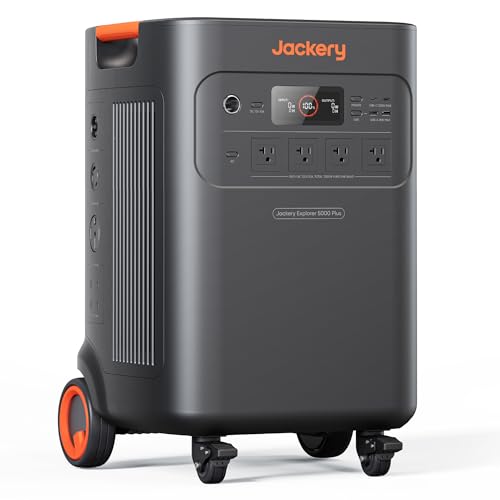
#3 · Two Units for 14.4kW · 90/100
Jackery Solar Generator 5000 Plus
7,200W continuous · 5,040 Wh · 4,000W solar · 134.5 lb · LiFePO4 · 10kW by pairing units
5,040Wh whole-home system with 7,200W 120/240V output, expandable to about 30kWh per unit (60kWh with two units) — Jackery's flagship power station.
How it reaches 10kW: One unit is a 7,200W station, not a 10kW one. Jackery’s route to 10kW is two units joined through its Smart Transfer Switch, which its listing rates at 14,400W and up to 60 kWh with two 5000 Plus units (Jackery; Outbound Power). The switch works only with the 5000 Plus series, and you buy two stations plus the switch.
Buy it if: You want to start at 7,200W now and add a second unit later, with one brand supplying station, batteries and switch. Skip it if: You need 10kW on day one from a single purchase.
Estimated runtime at a 1,000W average load: about 4.3 hours (rated capacity × 0.85 ÷ load; a formula estimate).

#4 · Two Stations for 12kW · Bundle unrated (station 90/100)
Anker SOLIX F3800 Plus + Home Power Panel
6,000W continuous · 3,840 Wh · 3,200W solar · 136.7 lb · LiFePO4 · 10kW by pairing units
Bundle of the 3,840Wh, 6,000W Anker SOLIX F3800 Plus with Anker's Home Power Panel kit (panel, subpanel and ground bar) for backing up selected home circuits; Amazon says the items ship separately and installation by a licensed electrician is required.
How it reaches 10kW: This Amazon bundle is one 6,000W F3800 Plus with Anker’s Home Power Panel, so out of the box it is a 6kW system. Anker lists two F3800 Plus stations at 12,000W, sold with either its Double Power Hub or its home panel kit (Anker two-unit bundles). Reaching 12kW therefore means adding a second station. The bundle itself is not rated; the station inside it scores 90/100 in our scoring.
Buy it if: You want the home panel included from the start and plan to add a second station when you need more than 6,000W. Skip it if: You want a single-inverter 10kW system with no pairing step.
Estimated runtime at a 1,000W average load: about 3.3 hours (rated capacity × 0.85 ÷ load; a formula estimate).
Step-down options if you do not need 10kW
EcoFlow Delta Pro 3 (95/100)
Our highest-rated home backup station is a 4,000W, 4,096 Wh unit with 120/240V output: enough for a well pump, furnace and the 120V essentials through a transfer switch. EcoFlow lists two units on its 50 Amp Hub at 8,000W and three units with its Smart Home Panel 2 at 12,000W, so it can grow toward this class in steps. Setup options are in our Delta Pro 3 home backup setup guide.
OUPES Guardian 6000 V2 (89/100)
A 6,000W, 4,608 Wh station with 120/240V output from one unit at 95 lb. It is a fixed 6,000W system: OUPES says two units cannot be paralleled, so choose it only if your loads will stay under that figure.
What Can a 10,000 Watt Solar Generator Run?
The reason to buy 10kW is the big 240V loads, and running more than one of them at a time. The figures below are typical ranges from the sources cited under the table; rows that rest on one source are marked. Your appliance’s nameplate is the number that counts.
| Load | Voltage | Typical Draw | On a 10kW System? |
|---|---|---|---|
| Central air conditioner (3-ton) | 240V | ~3,500–5,000W running; up to 15,000–18,000W to start [1] (single source) | Running: yes. Starting depends on the compressor’s locked-rotor amps (LRA) against the system’s surge rating |
| Electric clothes dryer | 240V | ~1,800–5,000W [2] | Yes, with room for other loads |
| Electric water heater (tank) | 240V | ~4,500–5,500W [3] | Yes, but it takes about half the budget while heating |
| Electric range | 240V | Oven ~2,000–5,000W; cooktop ~1,000–3,000W [4] (single source) | Yes; an oven and cooktop together can pass 6,000W |
| Well pump | 120V or 240V | ~1,000W running plus ~2,000W extra to start (1/3 HP) [5] | Yes at this size; larger deep-well pumps draw more, so read the nameplate |
| Level 2 EV charger | 240V | 7,200W at 30A is typical at home; units range 2,900–19,200W [6] (single source) | Yes at 30–40A, but 7,200W empties a 12 kWh battery in under two hours (formula estimate) |
| 50 amp RV service | 120/240V | Up to 12,000W (240V × 50A) | Mostly; the full service needs a 12,000W system |
[1] Generac sizing guide, which also says starting watts are often two to three times running watts. [2] Virginia Cooperative Extension (1,800–5,000W); EnergySage gives 1,500–5,000W. [3] Virginia Cooperative Extension (40-gallon, 4,500–5,500W); EWEB generator sizing sheet (4,500W). [4] EnergySage. [5] EWEB generator sizing sheet (1/3 HP: 1,000 running, 2,000 additional starting watts); Virginia Cooperative Extension lists deep-well pumps at 250–1,100W. [6] U.S. DOE Alternative Fuels Data Center.
10kW is not “everything at once”
Add the top of three rows above: a dryer (5,000W), a water heater (5,500W) and an oven (5,000W) come to 15,500W before the air conditioner or a single light is on. That is why whole-home battery systems are sold with smart panels that can manage circuits, and why a load list matters more than the headline number. Total the running watts of what must run together, then add the largest single motor’s starting watts. Our appliance wattage chart and solar generator size calculator do that arithmetic for you, and our guide to what a 10000 watt generator can run works through three whole-home-essentials plans, each built around one big 240V load.
Central AC needs its own check. A conventional compressor’s start is the hardest thing a battery inverter is asked to do. Manufacturers publish their own claims here (Anker, for example, says one E10 with two or more batteries supplies 37.2 kW, or 155 LRA, of surge for a 5-ton system), but those are manufacturer figures, and a start depends on your specific condenser. Compare the LRA on the nameplate, and ask an HVAC contractor about a soft-start kit before you rely on battery power for cooling. More in can a solar generator run an air conditioner.
7,500, 8,000 and 12,000 Watt Solar Generators
Battery systems are not built at every round number gas generators use. If you searched for a neighbouring size, this is the closest match among the systems above, using each unit’s continuous rating from our database and the makers’ paired-unit figures.
| You searched for | Closest real systems |
|---|---|
| 7,000–7,500 watt solar generator | The 7,200W class from one unit: Jackery Solar Generator 5000 Plus, EcoFlow DELTA Pro Ultra and Pecron F5000LFP Power Station. The Anker E10 kit is rated 7,680W continuous. |
| 8,000 watt solar generator | Two EcoFlow Delta Pro 3 units on EcoFlow’s 50 Amp Hub (8,000W per EcoFlow), or the Anker E10 kit (7,680W continuous, 10,000W turbo). |
| 9,000–10,000 watt solar generator | No system we rate is built at exactly this rating. Step up to the EcoFlow DELTA Pro Ultra X (12,000W), or use the E10’s 90-minute turbo mode for short peaks. |
| 12,000 watt solar generator | EcoFlow DELTA Pro Ultra X from one inverter (12,000W); two Anker F3800 Plus stations (12,000W per Anker); or three Delta Pro 3 units on a Smart Home Panel 2 (12,000W per EcoFlow). |
| 15,000–20,000 watt solar generator | Multi-unit only: two Jackery 5000 Plus units (14,400W per Jackery), three DELTA Pro Ultra inverters (21,600W per EcoFlow), or additional Ultra X inverters (EcoFlow quotes 36,000W for three). |
Comparing with a gas model? Portable generators are often named for their starting watts, with a lower running figure. Battery systems are named for continuous output, so compare running watts with continuous watts. See battery backup vs generator.
How Long Does a 10kW Solar Generator Last?
Runtime comes from capacity (Wh), not output. Every figure below is a formula estimate, not a measured result: rated capacity × 0.85 (an assumed inverter efficiency) ÷ a steady load. Real homes cycle loads on and off, so actual hours vary.
| System | Capacity | 1,000W avg | 3,000W | 5,000W | At its full continuous rating |
|---|---|---|---|---|---|
| EcoFlow DELTA Pro Ultra X | 12,288 Wh | ~10.4 hrs | ~3.5 hrs | ~2.1 hrs | ~52 min at 12,000W |
| Anker SOLIX E10 Prime Off-Grid Kit | 12,000 Wh | ~10.2 hrs | ~3.4 hrs | ~2.0 hrs | ~80 min at 7,680W |
| Jackery Solar Generator 5000 Plus | 5,040 Wh | ~4.3 hrs | ~1.4 hrs | ~0.9 hrs | ~36 min at 7,200W |
| Anker SOLIX F3800 Plus + Home Power Panel | 3,840 Wh | ~3.3 hrs | ~1.1 hrs | ~0.7 hrs | ~33 min at 6,000W |
Capacity as sold in the Amazon listing. The takeaway: a system that can deliver 10kW empties a 12 kWh battery in about an hour at that rate, so high output and long runtime are separate purchases. Expansion batteries and daytime solar extend every figure; average household use is covered in how much electricity does a house use.
Connecting 10kW to Your Home Safely
A 10kW system only earns its price when it feeds your panel, because central AC, water heaters, ranges and most well pumps are hardwired. That makes installation part of the purchase, not an afterthought.
Never backfeed
Do not connect a power station to your house through a dryer outlet, a range outlet or any wall receptacle. The U.S. Consumer Product Safety Commission calls this “extremely dangerous” because it presents an electrocution risk to utility workers and to neighbors served by the same transformer (CPSC Safety Alert 5123). OSHA’s guidance is to never attach a generator directly to a building’s electrical system unless a qualified electrician has installed it with a transfer switch (OSHA fact sheet).
- Transfer equipment is required. The National Electrical Code (NFPA 70) covers home backup sources under Article 702, optional standby systems, and calls for a transfer switch whenever a fixed or portable standby source is connected to premises wiring (EC&M on Article 702). In practice that is a manual transfer switch, a panel interlock kit with an inlet, or the maker’s own panel.
- Use a licensed electrician, and a permit where required. The manufacturers say the same thing. Anker states that “a professional electrician is required to install Smart Inlet Box or Power Dock and handle the main grid connection” for the E10 (Anker), and EcoFlow recommends a certified electrician for its Smart Home Panel 2 (EcoFlow). Permit and inspection rules are set locally, so ask your building department or your electrician before work starts.
- Size the connection for the watts. At 240V, 10,000W is about 42 amps and 12,000W is 50 amps. A 30A inlet such as an L14-30 tops out at 7,200W (240V × 30A), so the full output of a 10kW system needs 50A-class equipment or the maker’s hardwired panel. Your electrician sizes the breaker, wire and inlet.
- The station picks the panel. Smart panels are brand-specific: EcoFlow’s Smart Home Panel 2 and 3, Jackery’s Smart Transfer Switch and Anker’s Home Power Panel and Power Dock each work only with named models. Our smart home panel guide lists which fits which.
10,000 Watt vs 5,000 Watt: Which Do You Need?
The difference is how many 240V loads run at the same moment. A 5,000–7,200W system runs one large 240V appliance at a time alongside the 120V essentials: the well pump and the fridge, or the dryer, but not the dryer while the water heater recovers and the air conditioner cycles. A 10kW system lets two or three of those overlap. Our best 5000 watt solar generator guide ranks every unit rated 5,000W and up by editorial rating; most of those are single 6,000–7,200W stations, a simpler purchase than a paired or 12,000W system.
Stay at 5,000–7,200W if
You back up essential circuits plus one 240V load (a well pump or a dryer), you heat water and cook with gas, or you are willing to stagger the big appliances by hand during an outage.
Step up to 10kW if
Your home is all-electric, you want central AC running while other 240V appliances are in use, you plan to charge an EV from the system, or you want the house to behave normally without managing loads. How many miles a battery or rooftop array actually adds is worked out in can you charge an electric car with solar panels.
Smaller still? The best 3000 watt solar generators cover 120V essentials and 30 amp RVs. Unsure whether a battery system suits your house at all? Start with can a solar generator power a house.
Tax credit note: the 30% federal Residential Clean Energy Credit no longer applies to systems bought and installed in 2026. Our solar generator tax credit guide explains what changed.
Related Buying Guides
Best 5000 Watt Solar Generator
Single 5,000–7,200W stations with 120/240V output
Best Whole-Home Solar Generators
Whole-home systems ranked by capacity and expandability
Whole House Solar Generator Cost
Battery, panels and hookup priced by tier
Smart Home Panel Guide
Which panel fits which power station
Home Battery Backup Guide
Installed batteries compared with plug-in systems
Solar Generator Size Calculator
Add your appliances to get watts and watt-hours
Frequently Asked Questions
What is the best 10000 watt solar generator in 2026?
For 10,000 watts of continuous output from one inverter, our pick is the EcoFlow DELTA Pro Ultra X (91/100): 12,000W at 120/240V with 12,288 Wh in the Amazon kit. The Anker SOLIX E10 Prime Off-Grid Kit (92/100) is rated 7,680W continuous and 10,000W in a turbo mode Anker limits to 90 minutes. Other systems on this page reach 10kW only by pairing two units.
Can a single solar generator really put out 10,000 watts?
A few can. Among the systems we rate, the EcoFlow DELTA Pro Ultra X is the only one with a continuous rating above 10,000W from one inverter (12,000W). Most "10kW" claims describe two units joined through the manufacturer's hub or panel, such as two Jackery Solar Generator 5000 Plus units through the Jackery Smart Transfer Switch (14,400W per Jackery), or a time-limited mode such as the Anker SOLIX E10's 90-minute turbo output.
Is a 10kW solar generator the same as a 10kWh battery?
No. Kilowatts (kW) measure output: how much the system can power at one moment. Kilowatt-hours (kWh) measure stored energy: how long it lasts. A 10kW system with a 12 kWh battery runs a full 10kW load for roughly an hour. If you are shopping by storage, a 10kWh battery figure tells you nothing about whether it can start a central air conditioner; check the continuous and surge watts separately.
What can a 10,000 watt solar generator run?
Several large 240V loads together: for example a central air conditioner, a well pump and an electric water heater, plus the 120V circuits. It cannot run everything in an all-electric home at the same moment. A dryer (up to about 5,000W), a water heater (4,500 to 5,500W) and an oven (2,000 to 5,000W) together can exceed 10,000W, so large systems rely on load management through a smart panel or on not running those appliances at once.
Can a 10,000 watt power station run central air conditioning?
Running it is usually within reach: Generac puts a 3-ton central AC at about 3.5 to 5 kW while running. Starting it is the hard part, because the same source cites up to 15 to 18 kW of starting power. Compare the locked-rotor amps (LRA) on your condenser nameplate with the system's published surge or LRA figure, and ask your HVAC contractor about a soft-start kit.
Can a 10kW solar generator charge an electric car?
Yes, on a 240V circuit, but it uses the battery quickly. The U.S. Department of Energy's Alternative Fuels Data Center says most home Level 2 chargers run at up to 30 amps, or 7.2 kW. At that rate a 12 kWh battery system is drained in under two hours by our formula estimate, so treat EV charging from a battery as an emergency top-up, or do it while solar is producing.
Is there an 8,000 watt or 12,000 watt solar generator?
Yes. Around 8,000 watts, the Anker SOLIX E10 Prime Off-Grid Kit is rated 7,680W continuous, and EcoFlow lists two Delta Pro 3 units on its 50 Amp Hub at 8,000W. At 12,000 watts, the EcoFlow DELTA Pro Ultra X delivers 12,000W from one inverter, and Anker lists two F3800 Plus stations at 12,000W. For 7,500 watts, look at the 7,200W class: the Jackery 5000 Plus, EcoFlow DELTA Pro Ultra and Pecron F5000LFP.
Do I need an electrician to install a 10,000 watt solar generator?
Yes, to power your home's circuits. A system this size connects through a transfer switch, a panel interlock with an inlet, or the manufacturer's smart panel, and that work should be done by a licensed electrician with a permit where your jurisdiction requires one. Never plug a power station into a wall or dryer outlet to feed the house: the CPSC calls backfeeding extremely dangerous because it can electrocute utility workers and neighbors.
How long will a 10,000 watt solar generator run a house?
It depends on capacity, not the watt rating. Using rated capacity and an assumed 85% inverter efficiency, the EcoFlow DELTA Pro Ultra X kit (12,288 Wh) runs a 1,000W average load for about 10.4 hours and its full 12,000W output for about 52 minutes. These are formula estimates, not measured runtimes. Extra batteries and daytime solar extend them.