
Sizing & Runtime Hub · Updated October 2026
Appliance Wattage Chart: Running & Starting Watts, Plus a Generator Wattage and Runtime Calculator
The short answer
Most appliances fall into three bands: electronics and lights under 200 W; heating appliances (coffee makers, microwaves, hair dryers, space heaters) at 600–1,800 W with little or no start-up surge; and motor or compressor loads (fridges, pumps, AC) that run at a few hundred to about 1,800 W but need extra watts for a moment to start. Size a generator or power station as all running watts + the single largest starting watts. Size its battery with Wh = watts × hours; runtime ≈ Wh × 0.85 ÷ watts.
Below: a sourced chart of 60 appliances grouped by room, how to read a nameplate, the watt-hour math, a calculator that adds up your own list, and the power stations that match each load profile.
As an Amazon Associate, SolarGenAdvisor earns from qualifying purchases made through links on this page, at no additional cost to you.
 By
On this page: Calculator · Wattage chart · Reading a nameplate · Running vs starting watts · Watts to watt-hours · Runtime formula · Which size station · FAQ
Generator Wattage & Watt-Hour Calculator
List what you want to run at the same time. Pick an appliance to fill in typical figures from the chart below, or type the numbers from your own nameplate. The calculator adds running watts, adds the single biggest starting surge, converts to watt-hours per day, and estimates runtime on a battery using the same 85% planning factor as the rest of this page.
Estimates only. Presets use typical figures from the chart; cycling loads (fridges, 12V fridges) use realistic hours of compressor run time rather than 24. For panel sizing and a full load profile, use the solar size calculator.
Appliance Wattage Chart: Running and Starting Watts for 60 Appliances
Running watts are what the appliance draws once it is going; starting watts are the extra it needs for a moment at switch-on, which is how the Champion, DR Power and EWEB generator charts all present it. Figures are typical ranges from the sources numbered in each row, not specs for your model. Your appliance’s own label always wins. The last column is a planning estimate: runtime on a 1,000 Wh power station at 85% efficiency, using the average draw for cycling loads.
| Appliance | Running watts | Starting watts (extra) | On a 1,000 Wh station | Sources |
|---|---|---|---|---|
| Kitchen | ||||
| Refrigerator / freezer (full-size)615–619 kWh/yr on EnergyGuide labels ≈ 1.7 kWh/day (~70 W average). DOE-program guidance: compressor runs about a third of the time. | ~200 while running (charts: 400–700) | +2,200 (chart figure) | ~12 h | [5][6][1][2][4] |
| Microwave ovenUse the input wattage on the label, not the cooking power. | 625–1,500 | — (Champion lists +2,000) | ~43 min | [1][4][3][2] |
| Coffee maker (drip) | 800–1,200 | — | ~51 min | [1][2][3][4] |
| Toaster | 800–1,400 | — | ~46 min | [1][2][3][4] |
| Toaster oven | 1,200–1,225 | — | ~43 min | [1][4] |
| Air fryerSingle chart figure; check your model’s label. | ~1,500 | — | ~34 min | [2] |
| Blender | 500–1,000 | +700 | ~1.1 h | [2][3] |
| Slow cookerSingle chart figure. | ~250 | — | ~3.4 h | [3] |
| Electric burner / hot plate / skilletSingle chart; it is the only one of the three to give heating items a start figure. Calculator preset uses none. | 1,000–2,000 | +2,000–3,000 (Champion) | ~34 min | [2] |
| Portable induction cooktop | Up to 1,800 (adjustable) | — | ~34 min | [21][22] |
| DishwasherHeated dry raises energy use (DOE-program note). | 1,200–2,400 | +1,500 | ~43 min | [1][2] |
| Living room & home office | ||||
| LED / LCD TV | 80–120 | — | ~8.5 h | [2][3][1] |
| Desktop computer + monitor | 100–400 | — | ~3.4 h | [2][3][1] |
| Laptop (charging) | 50–75 | — | ~14 h | [1][4][3] |
| Wi-Fi routerAdd a separate modem if you have one. | 5–20 | — | ~57 h | [18] |
| Phone charger | 10–20 | — | ~57 h | [3][4] |
| Tablet (charging) | ~20 | — | ~43 h | [3] |
| Ceiling fan | 65–175 | — | ~11 h | [1] |
| Window / box fan | 55–250 | — | ~8.5 h | [1] |
| Light bulb (LED / incandescent) | 15 LED; 60–75 incandescent | — | ~57 h | [4] |
| Stereo / radio | 70–400 (radio ~100) | — | ~8.5 h | [1][4] |
| DVD / Blu-ray player | 15–25 | — | ~43 h | [1][3] |
| Aquarium (pump, lights, heater)Huge range depending on equipment; read your labels. | 50–1,210 | — | ~8.5 h | [1] |
| Bedroom, bathroom & laundry | ||||
| CPAP machine (ResMed AirSense 11)Humidifier and heated tube are the big variables. | 56 typical, 73 max | — | ~15 h | [15][14] |
| Electric blanket (single / double)Some makers, including Sunbeam, say not to run their electric blankets on generator or inverter power. Check your manual, or use a 12V or USB blanket (see our battery heated blanket guide). | 60 / 100 | — | ~8.5 h | [1] |
| Hair dryer | 1,200–1,875 | — | ~34 min | [1][3] |
| Clothes iron | 1,000–1,800 | — | ~43 min | [1] |
| Vacuum cleaner | 1,000–1,440 | — | ~43 min | [1] |
| Washing machine | 350–500 | +1,200 | ~1.7 h | [1][2] |
| Electric clothes dryer (240 V) | 1,800–5,000 | varies | 240 V load | [1] |
| Space heater | 750–1,500 | — | ~34 min | [1][4] |
| DehumidifierSingle source; check your unit’s label. | ~785 (nameplate) | — | ~1.1 h | [1] |
| Heating, cooling & utility | ||||
| Furnace blower fan (1/3 HP) | 700–750 | +1,400 | ~1.2 h | [4][1] |
| Window AC, 5,000–8,000 BTUInverter models ramp up gently and avoid most of the start-up spike. | ~410–710 | up to +2,000 (non-inverter) | ~1.2 h | [7][8][2] |
| Window AC, 12,000 BTU | ~800–1,140 (EWEB chart: 3,250) | +2,000 to +3,950 (charts) | ~46 min | [7][9][4][2] |
| Portable AC, 10,000 BTU | ~920–1,125 | ~2–3× running (estimate) | ~46 min | [10][11][12] |
| Sump pump, 1/3 HPDR Power’s worksheet uses a more conservative 2,100 W running. | ~800 | +1,300 | ~1.1 h | [4][3] |
| Sump pump, 1/2 HPSingle utility chart figure. | ~1,050 | +2,200 | ~49 min | [4] |
| Well pump, 1/3 HP (120 V)Many deep-well pumps are 240 V. | ~1,000 (deep-well range 250–1,100) | +2,000 | ~51 min | [4][1] |
| Electric water heater (240 V) | 4,500–5,500 | — | 240 V load | [1][4] |
| RV, camping & outdoor | ||||
| RV rooftop AC, 13,500 BTUA soft starter cuts the start-up spike. | ~1,500 | up to 2,800 total at start | ~34 min | [13] |
| RV rooftop AC, 15,000 BTU | ~1,800 | up to 3,500 total at start | ~28 min | [13][3] |
| 12V compressor fridge / coolerDometic CFX3 35: 0.98 Ah/h at 90°F ≈ 11.8 W average. | 45–60 while running; ~12 average | — | ~71 h | [20][19][2] |
| Starlink Standard (dish + router) | 75–100 average | — | ~9.4 h | [16][17] |
| Starlink Mini | 25–40 average | — | ~24 h | [16] |
| Projector (LED / lamp) | ~200 LED; 235–345 lamp | — | ~3.4 h | [24][23] |
| Electric / heated lunch box | 45–60 | — | ~17 h | [25][26] |
| Electric grillSingle chart figure; calculator preset uses no start figure for this resistive load. | ~1,500 | +3,000 (Champion) | ~34 min | [2] |
| Air pump (inflatables)Single chart figure. | ~500 | +1,500 | ~1.7 h | [2] |
| Car battery charger (10 A) | up to ~150 | — | ~5.7 h | [29] |
| Workshop, yard & job site | ||||
| Tool battery charger | 210–550 (DR: 360) | — | ~2.4 h | [27][28][3] |
| Circular saw | 1,400–1,500 | +2,000 | ~36 min | [2][3] |
| Drill (corded) | ~600 | +850 | ~1.4 h | [2][3] |
| Table saw | ~1,800 | +2,500 | ~28 min | [2][3] |
| Reciprocating saw | 1,000–1,440 | — | ~43 min | [2][3] |
| Angle grinder | ~800 | +2,400 | ~1.1 h | [2] |
| Air compressor (small) | ~1,000 | about 2× running | ~51 min | [3] |
| Wet/dry vac | ~900 | — | ~57 min | [3] |
| Work light (quartz halogen)Single chart figure. LED work lights draw far less; check the label. | ~1,000 | — | ~51 min | [3] |
| Corded lawn mower (13 A) | ~1,560 (13 A × 120 V) | — | ~33 min | [30] |
How to use it: total the running watts of everything you will run at once, then add the largest single starting figure. That is the generator-chart method published by Champion, EWEB and DR Power [2][4][3]. Generator charts are deliberately conservative; the refrigerator’s 400–700 W chart figure, for example, is well above the ~70 W a modern full-size fridge averages over a day on its EnergyGuide label [5][6]. “240 V load” means it needs split-phase 240 V output, which most portable stations don’t have.
How to Read an Appliance Nameplate: Watts = Volts × Amps
The wattage of most appliances is stamped on the bottom or back, or printed on a nameplate sticker. If the label lists only amps, multiply amps by the voltage. Most U.S. appliances run on 120 V; clothes dryers and electric cooktops use 240 V [1]. DR Power’s worksheet gives the same rule with the example 20 A × 120 V = 2,400 W [3].
Watts = Volts × Amps
A 13 A corded mower: 13 × 120 = 1,560 W. A 12V device drawing 5 A: 12 × 5 = 60 W.
Three things the label doesn’t tell you
- It’s a maximum, not an average. Many appliances have settings, and actual draw depends on the setting in use [1]. A 1,800 W induction burner at a lower setting draws much less.
- Cycling loads run part-time. DOE-program guidance is to divide a refrigerator’s plugged-in time by three to estimate hours at full draw [1]. Freezers, AC units and sump pumps cycle too.
- Motors spike at start-up. A clamp meter on a motor shows roughly three times the running current while it starts [1]. That spike is why the chart has a separate starting column.
For a fridge or freezer, the yellow EnergyGuide label is the better number for battery sizing: it gives kWh per year under a standard U.S. government test. Two 25 cu ft side-by-side models list 615 and 619 kWh/year [5][6], or about 1.7 kWh a day. The refrigerator runtime guide has the full math for fridges.
Running Watts vs Starting Watts (and How to Size for Both)
Running watts are the steady power an appliance needs once it’s going. Starting watts are the extra burst some devices, mostly anything with a motor or compressor, need to turn on [2]. The charts disagree on how big that burst is. Champion puts it at 1–2× running watts, DR Power says typically 2×, and the DOE-program fact sheet notes about 3× the current at motor start [2][3][1]. Simple heating appliances such as toasters and coffee makers carry no starting figure in any of the three charts, though Champion adds a starting allowance for a few cooking and heating items like electric grills and burners.
The sizing rule is the same in every chart: add up the running watts of everything that will be on at once, then add the single highest starting figure. That assumes you start one motor at a time, so stagger start-ups [2][4][3].
Worked example: an outage essentials list
Fridge 200 W + furnace blower 700 W + TV 100 W + router 15 W + three LED bulbs 45 W = 1,060 W running.
Largest single starting figure: the fridge’s +2,200 W chart figure. Peak = 1,060 + 2,200 = 3,260 W.
Compare with a power station’s two output numbers: the continuous rating must clear 1,060 W and the surge (peak) rating should clear 3,260 W. A 2,600 W / 3,900 W Bluetti Elite 200 V2 does both on paper; a 1,500 W / 3,000 W Jackery Explorer 1000 V2 covers the running load but not the conservative peak.
Inverter-driven (variable-speed) compressors in newer window ACs ramp up gradually instead of slamming on, so they need far less start-up headroom. Our air conditioner guide shows the difference by BTU size. Pumps are the opposite: a sump or well pump’s start-up is usually the hardest number to clear. See the sump pump and well pump guides.
Watts to Watt-Hours: How Much Energy an Appliance Uses
Watts are a rate; watt-hours are the amount of energy used over time. That second number is what empties a battery. The DOE-program formula is wattage × hours used per day ÷ 1,000 = daily kWh [1]. Skip the ÷ 1,000 and you have watt-hours, the unit power station batteries are rated in.
Watt-hours = Watts × Hours of use
| Appliance | Watts × hours | Wh per day |
|---|---|---|
| CPAP, one night | 56 W × 8 h | 448 Wh |
| Wi-Fi router, all day | 15 W × 24 h | 360 Wh |
| LED TV, an evening | 100 W × 4 h | 400 Wh |
| Microwave, 15 minutes | 1,200 W × 0.25 h | 300 Wh |
| Full-size fridge (EnergyGuide) | 615 kWh ÷ 365 days | ~1,685 Wh |
| Space heater, 2 hours | 1,500 W × 2 h | 3,000 Wh |
That last row is why heat is the hardest job for a battery: two hours of a 1,500 W heater uses more energy than a fridge does all day. Our space heater guide covers lower-watt ways to stay warm. Your daily total is what a battery has to hold. If you’re working backward from a battery to a total, what size solar generator do I need walks through the full sizing process.
Power Station Runtime Calculator Formula: Wh × 0.85 ÷ Watts
Runtime (hours) = Battery Wh × 0.85 ÷ Load watts
The 0.85 is our planning assumption, not a measured figure. It allows roughly 15% for inverter and conversion losses between the battery and the AC outlet, and it’s the same factor we use on every runtime page on this site. Real efficiency varies by model and load. Devices you can run from a 12V or USB-C port skip the inverter, so they usually do a little better. For cycling appliances, use the average draw, not the running watts, or the estimate will be far too pessimistic.
Here’s the formula applied to the five stations we match to load profiles below. Capacities and output limits come from our product database; “Over limit” means the load exceeds the station’s continuous AC rating.
| Station | CPAP~56 W | 12V fridge (avg)~12 W | Full-size fridge (avg)~70 W | Starlink Std~90 W | Furnace blower~700 W | 1,200 W microwave~1,200 W |
|---|---|---|---|---|---|---|
| EcoFlow River 3 Plus286 Wh · 600 W | ~4.3 h | ~20 h | ~3.5 h | ~2.7 h | Over limit | Over limit |
| Jackery Explorer 1000 V21,070 Wh · 1,500 W | ~16 h | ~76 h | ~13 h | ~10 h | ~1.3 h | ~45 min |
| Anker SOLIX C1000 Gen 21,024 Wh · 2,000 W | ~16 h | ~73 h | ~12 h | ~9.7 h | ~1.2 h | ~44 min |
| Bluetti Elite 200 V22,074 Wh · 2,600 W | ~31 h | ~147 h | ~25 h | ~20 h | ~2.5 h | ~1.5 h |
| EcoFlow Delta Pro 34,096 Wh · 4,000 W | ~62 h | ~290 h | ~50 h | ~39 h | ~5.0 h | ~2.9 h |
Load figures: CPAP 56 W typical [15]; 12V fridge ~12 W average [19]; full-size fridge ~70 W average from EnergyGuide kWh/year [5][6]; Starlink Standard 75–100 W average [16][17]; furnace blower 700 W [4]; microwave input up to 1,500 W [3]. The 12V fridge figure assumes it runs from the station’s 12V port, so the 0.85 factor makes it a conservative estimate. Continuous running; a single load at a time.
Which Size Power Station Do You Need? Load Profiles Matched to Stations
Use your calculator totals: the station’s continuous watts must clear your running total, its surge should clear your peak, and its Wh × 0.85 should cover the hours you need. Each station below is rated in our 2026 scoring, which is synthesized from published specs, logged Amazon prices and Amazon customer reviews.
| Load profile | Station | Wh / continuous / surge | Price | Link |
|---|---|---|---|---|
| Phones, LED lights, router, laptop, a 12V fridgeUnder ~500 W at once; a few hundred Wh a day | EcoFlow River 3 Plus | 286 Wh / 600 W / 1,200 W | $299.00 | View on Amazon → |
| CPAP for a night or two, TV + router + lights, short bursts of a coffee maker or microwaveUp to 1,500 W running; about 1 kWh a day | Jackery Explorer 1000 V2 | 1,070 Wh / 1,500 W / 3,000 W | $559.00 | View on Amazon → |
| The same loads plus 1,500–2,000 W appliances: air fryer, hair dryer, induction burner, corded toolsUp to 2,000 W running; about 1 kWh a day | Anker SOLIX C1000 Gen 2 | 1,024 Wh / 2,000 W / 3,000 W | $529.99 | View on Amazon → |
| An outage day: full-size fridge, router, lights, CPAP; a small window AC or a 13,500 BTU RV ACUp to 2,600 W running, 3,900 W surge; about 2 kWh a day | Bluetti Elite 200 V2 | 2,074 Wh / 2,600 W / 3,900 W | $899.00 | View on Amazon → |
| Sump or well pump, furnace blower, fridge and freezer together; 120/240 V loadsUp to 4,000 W running, 8,000 W surge; about 4 kWh, expandable | EcoFlow Delta Pro 3 | 4,096 Wh / 4,000 W / 8,000 W | $2,799.00 | View on Amazon → |
Phones, LED lights, router, laptop, a 12V fridge

EcoFlow River 3 Plus · Our score 86/100
286 Wh · 600 W continuous · 1,200 W surge · 10.4 lb
Price on Amazon: $299.00
The smallest sensible station: enough for a Wi-Fi router through an evening outage, a 12V compressor fridge for most of a day, or phones and lights on a camping weekend. It is not a CPAP-all-night or kitchen-appliance station.
Runtime check: a 56 W CPAP runs ~4.3 h; a fridge averaging 70 W runs ~3.5 h.
CPAP for a night or two, TV + router + lights, short bursts of a coffee maker or microwave

Jackery Explorer 1000 V2 · Our score 93/100
1,070 Wh · 1,500 W continuous · 3,000 W surge · 23.8 lb
Price on Amazon: $559.00
The everyday 1 kWh station. Its 1,500 W limit covers a coffee maker, a 1,000 W-class microwave and most small kitchen gear one at a time, and the 1,070 Wh battery runs a 56 W CPAP for around two nights.
Runtime check: a 56 W CPAP runs ~16 h; a fridge averaging 70 W runs ~13 h.
The same loads plus 1,500–2,000 W appliances: air fryer, hair dryer, induction burner, corded tools
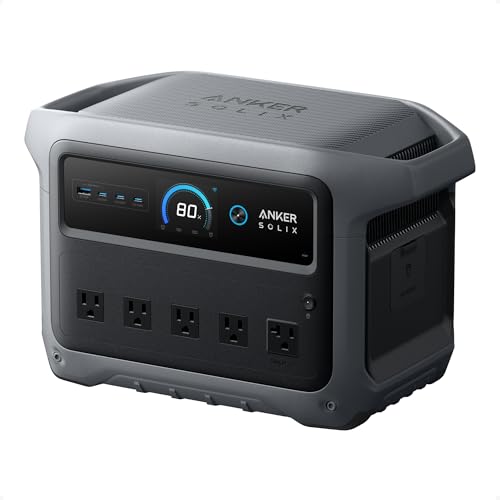
Anker SOLIX C1000 Gen 2 · Our score 92/100
1,024 Wh · 2,000 W continuous · 3,000 W surge · 24.9 lb
Price on Amazon: $529.99
Same capacity class as the Jackery but with 2,000 W of continuous output, which is the difference between running a 1,500–1,800 W air fryer, hair dryer or induction burner with headroom and running it at or over the limit. Runtime is still about 1 kWh worth, so high-watt loads are short bursts.
Runtime check: a 56 W CPAP runs ~16 h; a fridge averaging 70 W runs ~12 h.
An outage day: full-size fridge, router, lights, CPAP; a small window AC or a 13,500 BTU RV AC

Bluetti Elite 200 V2 · Our score 91/100
2,074 Wh · 2,600 W continuous · 3,900 W surge · 48.5 lb
Price on Amazon: $899.00
Two kilowatt-hours is where a full-size fridge stops being a gamble: its ~1.7 kWh a day just fits, and the 3,900 W surge rating clears the conservative +2,200 W compressor start figure with room to spare.
Runtime check: a 56 W CPAP runs ~31 h; a fridge averaging 70 W runs ~25 h.
Sump or well pump, furnace blower, fridge and freezer together; 120/240 V loads

EcoFlow Delta Pro 3 · Our score 95/100
4,096 Wh · 4,000 W continuous · 8,000 W surge · 113.5 lb
Price on Amazon: $2,799.00
The pump-and-furnace tier: 4,000 W continuous and a 4,096 Wh battery that expands, with 120/240 V output per its listing. Anything wired into home circuits needs a transfer switch installed by a licensed electrician.
Runtime check: a 56 W CPAP runs ~62 h; a fridge averaging 70 W runs ~50 h.
Need a different capacity? Compare more options in our best 1,000 Wh and best 2,000 Wh roundups, or the 3,000 W picks if starting watts are your constraint.
When a Portable Power Station Is the Wrong Tool
- 240 V appliances. Electric water heaters (4,500–5,500 W) and clothes dryers (1,800–5,000 W) [1][4] need split-phase output and a lot of energy. That points to a whole-home battery system with a transfer switch installed by a licensed electrician, not a plug-in station.
- Hours of heating or cooling. A 1,500 W heater empties a 1,000 Wh battery in ~34 min. For days of heavy loads, compare the trade-offs in solar generator vs gas generator. If fuel wins, size it with the same running and starting totals from this chart and see our best inverter generator picks; any gas generator must run outdoors, at least 20 feet from the house, with CO alarms inside (CPSC).
- Whole-house coverage. If your list includes central AC or an electric range, start with can a solar generator power a house.
Can a Solar Generator Run It? Appliance-by-Appliance Guides
The chart gives you the numbers. These guides cover the details a table row can’t, like surge behavior, duty cycles, DC options and which stations clear each load. For a broader runtime overview, start with what can a solar generator run.
Refrigerator
Duty cycle, compressor start and runtime by battery size
CPAP machine
Humidifier on or off, DC vs AC, nights per charge
Air conditioner
Window vs portable vs inverter AC, BTU to watts
Sump pump
Running vs surge by horsepower, storm runtime
Well pump
120 V vs 240 V pumps and pressure-tank cycling
Washing machine
Why motor surge trips undersized inverters
Furnace
Blower draw and the safe way to connect it
Freezer
Chest vs upright, and the garage problem
RV air conditioner
13,500 vs 15,000 BTU, soft starters, 30 vs 50 amp
Starlink
Dish and router draw, overnight runtime
12V fridge
Compressor coolers that sip power from a 12V port
Power tools
Saws, compressors and the hardest start-ups
Appliance Wattage FAQ
How many watts does a refrigerator use?
Generator sizing charts list a full-size refrigerator at 400–700 running watts with about 2,200 extra watts to start, which are deliberately conservative figures. For energy, use the EnergyGuide label: two 25 cubic foot side-by-side models list 615 and 619 kWh a year, about 1.7 kWh a day or roughly 70 W averaged over 24 hours, because the compressor cycles on and off.
How do I calculate what size generator I need?
Add the running watts of everything you want on at the same time, then add the single largest starting-watt figure among them. That is the method Champion, EWEB and DR Power all publish. For example, 1,060 W of running loads plus a refrigerator’s 2,200 W start figure means a generator or power station rated about 1,060 W continuous and 3,260 W peak.
How do I convert watts to watt-hours?
Multiply watts by the hours of use: watt-hours = watts × hours. A 100 W TV for 4 hours uses 400 Wh; a 56 W CPAP for 8 hours uses 448 Wh. Divide by 1,000 for kilowatt-hours, the unit on your utility bill.
How long will a 1,000 Wh power station run a 100 W appliance?
About 8.5 hours: 1,000 Wh × 0.85 ÷ 100 W. The 0.85 is a planning allowance for inverter and conversion losses; real efficiency varies by model. Loads that cycle, like fridges, run longer than this continuous-draw estimate.
What is the difference between running watts and starting watts?
Running watts are the steady power an appliance needs once it is on. Starting watts are the extra burst a motor or compressor needs for a moment at switch-on. Generator charts estimate it at roughly 1 to 3 times running watts. Simple heating appliances such as toasters and coffee makers have no starting figure in generator charts.
How do I find an appliance’s wattage if the label only shows amps?
Multiply amps by volts. Most U.S. household appliances run on 120 V, so a 10 A appliance draws about 1,200 W and a 13 A one about 1,560 W. Clothes dryers and electric cooktops typically use 240 V. The label figure is a maximum; actual draw depends on the setting in use.
Can a portable power station run a 240 V appliance?
Most cannot: they only have 120 V outlets. A few larger units, such as the EcoFlow Delta Pro 3, list 120/240 V output. Even then, 240 V loads like water heaters (4,500–5,500 W) and dryers (1,800–5,000 W) use energy very quickly. Anything wired into home circuits needs a transfer switch installed by a licensed electrician.
Sources
Figures were compiled from published charts, spec sheets and labels, not from our own measurements. Station specs come from our product database. Last reviewed October 31, 2026.
- Virginia Cooperative Extension, “Estimating Appliance and Home Electronic Energy Use” (developed with the DOE Building Science Community of Practice) — nameplate wattage ranges
- Champion Power Equipment, “Choosing a Generator” quick-reference wattage chart
- DR Power, Generator Wattage Worksheet (CHP Inc.)
- EWEB (Eugene Water & Electric Board), Generator Sizing Considerations
- EnergyGuide label, GE GSS25QGT 25.4 cu ft side-by-side: 615 kWh/year
- EnergyGuide label, Whirlpool GS6NBE 25.7 cu ft side-by-side: 619 kWh/year
- ENERGY STAR certified room air conditioners (product finder)
- Midea MAW08V1QWT 8,000 BTU window AC spec listing (AJ Madison)
- Midea MAW12V1QWT 12,000 BTU window AC spec listing (AJ Madison)
- Frigidaire FFPA1022R1 10,000 BTU portable AC spec sheet
- Frigidaire FHPC102AB1 portable AC spec listing (AJ Madison)
- SMPS locked-rotor amps / surge current reference
- Micro-Air, “What size generator do you need to run an RV air conditioner?”
- ResMed AirSense 11 65 W power supply (powers device, humidifier and heated tubing)
- ResMed AirSense 11 AutoSet spec listing: 56 W typical, 73 W maximum
- Starlink hardware specifications
- DishyTech, “How Much Power Does Starlink Use?”
- EnergySage, “How many watts does a Wi-Fi router use?”
- Dometic CFX3 35 specifications: 0.98 Ah/h at 90°F, 50 W AC rated input
- BougeRV CRPRO30 12V fridge: 60 W Max / 45 W Eco
- Tablecraft CW40195 1,800 W portable induction range
- Iwatani IWA-1800 portable induction stove
- Epson Home Cinema 880 projector: 345 W normal / 235 W eco (Greentoe listing)
- TechPowerUp, XGIMI Horizon LED projector review (power draw)
- HotLogic Mini 45 W listing
- CrockpotGo 60 W electric lunch box (Kohl’s listing)
- EGO CH2100E 210 W standard charger
- EGO CH5500E 550 W rapid charger
- NOCO GENIUS10 10 A battery charger spec listing
- Sun Joe MJ401E-PRO 13 A corded mower (Tractor Supply)
Most lists land here: 1 kWh and 1,500 W covers the essentials of most first-time buyers. The Jackery Explorer 1000 V2 is currently $559.00 on Amazon.
Check Price on Amazon →