
Home Backup Guide · Updated November 2026
Generator Interlock Kit Guide: Panel-Specific Kits, Inlet Box and Generator Cord
Short answer
A generator interlock kit is a plate that mounts on your main panel so the main breaker and a back-fed generator breaker can never be on together. With an outdoor inlet box and a matching generator cord, it lets a portable generator or 240V power station run any circuit in the house. Kits are panel-specific: buy one made for your panel's brand, main breaker and breaker spacing. The panel maker's own kit, such as the UL-listed Siemens ECSBPK01, is the safest bet at inspection; third-party plates cost less but claim no UL listing. A licensed electrician and a permit are required.
As an Amazon Associate, SolarGenAdvisor earns from qualifying purchases made through links on this page, at no additional cost to you. Scores are AI-synthesized from manufacturer documents, listings and logged Amazon prices; we did not test or install these products.
 By Morgan Chen
Reviewed & approved by Juhi Sahni
|
Published: 2026-11-01
|
Updated:
|
Transfer switch guide
Read this before you buy an interlock
- Backfeeding kills line workers. The CPSC warns that powering house wiring by plugging a generator into a wall outlet is extremely dangerous and puts utility workers and neighbors on the same transformer at risk of electrocution (CPSC Safety Alert 5123). Utilities and state fire officials give the same warning (Lake Country Power; Minnesota State Fire Marshal). An interlock exists to prevent exactly that.
- It is licensed-electrician work. An interlock involves the main panel, a back-fed breaker and an inlet box. OSHA advises never connecting a generator to a building's wiring unless a qualified electrician has installed it with transfer equipment (OSHA FS-3286). Plan on a permit. We give no installation steps.
- Code and inspector. NEC Article 702 requires transfer equipment that keeps the normal and standby supplies from ever being connected together (EC&M on Article 702). Mechanical interlocks are a recognized type of transfer equipment (IAEI Magazine), but your inspector decides whether a given kit is accepted, and some may require one listed for your panel.
- Gas generators run outdoors only. CPSC and CDC say at least 20 feet from the house, exhaust away from doors, windows and vents, with battery-backed CO alarms inside (CPSC; CDC).
What Is a Generator Interlock Kit?
An interlock is a mechanical lockout. A plate or slide on the panel cover sits between the main breaker and a 2-pole breaker that your electrician dedicates to the generator feed. When the main is on, the plate blocks the generator breaker; to use backup power, the main has to be off first. Because both breakers can never be on together, generator power cannot flow back out to the utility lines. You then choose which branch circuits to switch on.
A complete interlock setup has four parts, and all four have to match:
1. Interlock plate
Made for one panel brand and main-breaker style. It only works with the panel cover installed (InspectAPedia).
2. Back-fed generator breaker
A 2-pole breaker in the slot the kit specifies, held in place by a retainer. Square D's QO kit lists a retaining bracket among its parts. None of the kits on this page include the breaker itself.
3. Power inlet box
A weatherproof socket with male pins on the outside wall, so the generator cord plugs into the house. Its rating (30A or 50A, 120V or 120/240V) sets the limit for the whole hookup.
4. Generator cord
A locking cord whose plug matches your generator's outlet and whose connector matches the inlet, long enough to keep a gas generator 20 feet from the house.
Interlock Kit vs Transfer Switch vs Smart Home Panel
All three stop backfeed. They differ in which circuits you get, what has to match, and how the changeover happens. For switch kits, see our generator transfer switch guide; for automatic changeover from a battery, see the smart home panel guide.
| Interlock kit + inlet | Manual transfer switch | Smart home panel | |
|---|---|---|---|
| How it prevents backfeed | Mechanical plate: main and generator breaker can't both be on | Each circuit switch selects Line or Gen, never both | Built-in automatic transfer, isolates from the grid on outage |
| Circuits available | Any circuit in the panel (you manage the load) | Fixed set, e.g. 6 or 10 on Reliance Pro/Tran 2 | Fixed set, e.g. 12 on EcoFlow Smart Home Panel 2 |
| Works with | Gas generators and power stations with a matching outlet | Gas generators and power stations with a matching outlet | Only the brand's own power stations |
| Must match | Your exact panel brand, main breaker and spacing | Most panels; mounts beside the load center | The brand's stations; separate enclosure |
| Overload risk on a small source | Higher: easy to switch on too much | Lower: only pre-selected circuits | Low: app shows and prioritizes loads |
| Panel space needed | A 2-pole slot next to the main for the generator breaker | None in the panel; separate enclosure | Separate enclosure, often larger |
| Electrician + permit | Yes | Yes | Yes |
Cost: in parts, the interlock plates on this page are listed on Amazon for a fraction of a transfer switch kit (compare the live prices below with the switch kits in our transfer switch guide). We don't publish installed-cost ranges, because labor, permit fees and panel condition vary too much from one house to the next. Ask your electrician to quote the interlock, breaker, inlet, wiring and permit as separate lines.
Generator Interlock Kit Compatibility by Panel Brand
This table uses only what each panel maker or product listing documents. "Listing claim" means the seller says it fits; we could not confirm it with the panel maker. Before ordering, photograph your panel's label and main breaker, measure the space between the main and the breaker below it, and let your electrician confirm the match.
| Panel | Kit | Documented fit | Source | Amazon |
|---|---|---|---|---|
| Square D QO (indoor) | Square D QOCGK2C (panel maker) | Series G and S convertible QO main-breaker load centers with a QOM2 main (150–225A) and a QO 2-pole generator breaker up to 125A. Not for the QO160M200P/QO160M200PC; no kit for 60-space QO. | Schneider Electric FAQ | Not linked: the Amazon listing showed no availability on Nov 1, 2026 |
| Square D QO (outdoor, NEMA 3R) | Square D QORBGK2C (panel maker) | Series S2 and S6 NEMA 3R convertible QO main-breaker load centers with a QOM2 main | Schneider Electric FAQ | — |
| Square D QO or Homeline 150/200A | Mowabi Generator Interlock Kit for Square D QO / Homeline 150-200A | 1-3/8 in between main and generator breaker (listing claim) | Amazon listing | $15.99 Check Price → |
| Siemens / Murray, QP-type main | Siemens ECSBPK01 (panel maker) | Main is a double-pole QP (QP/QPH/HQPH) breaker opposite the standby breaker (QP or MP); UL Listed per listing | Amazon listing; North Coast Electric | $38.33 Check Price → |
| Siemens / Murray 150/200A | XMK Generator Interlock Kit for Siemens / Murray 150-200A | 7/8 to 1-1/4 in between main and branch breaker (listing claim) | Amazon listing | $19.99 Check Price → |
| Eaton / Cutler-Hammer BR 150/200A | EXCELFU Generator Interlock Kit for Eaton / Cutler-Hammer BR 150-200A | Single-handle main, horizontal throw; 1-1/4 to 1-7/16 in spacing; BR and CH plug-in-neutral panels (listing claim) | Amazon listing | $19.99 Check Price → |
| Eaton BR (back-fed main) | Eaton BRMIKBR (panel maker) | Mechanical interlock for back-fed Type BR load centers. Distributors disagree on the amperage (one lists 100A load centers), so confirm with Eaton. | Elliott Electric; Platt | Not linked (third-party seller, specs unconfirmed) |
| Eaton / Cutler-Hammer CH | Third-party CH kits | Amazon listings split CH kits by breaker type and throw (for example, "TAN breaker" kits at 1-1/2 in spacing, vertical-throw kits at 2-1/4 in). We found none we could confirm, so we don't recommend one. | Amazon listing titles | — |
| GE, Leviton, others | Not covered | We could not verify a kit's fit from the panel maker or a listing. Ask your electrician; a transfer switch is the fallback. | — | — |
Siemens also sells other ECSBPK interlocks for different load-center lines; your electrician can match the part number to your panel label. Many third-party kits are not UL-listed for a specific panel. Where a listing makes no UL claim, we say so.
The Generator Interlock Kits We Point Readers To
Pick by panel first and score second: a kit that doesn't fit your panel is worthless at any score. Scores use the accessory rubric explained below. Square D's own QO kit is in the compatibility table but not here, because its Amazon listing showed no availability when we checked.
Panel maker's own kit: Siemens & Murray · 48/100

Siemens ECSBPK01 Generator Standby Power Mechanical Interlock
Siemens or Murray load centers where the main is a 2-pole QP-type breaker opposite the standby breaker (QP or MP)
Current price on Amazon: $38.33
This is Siemens' own mechanical interlock, sold and shipped by Amazon. The listing says it is UL Listed, fits Siemens or Murray panels where the main is a double-pole QP breaker and the standby breaker is a QP or MP type, requires no panel modification, and does not include breakers. A distributor lists it for QP, QPH and HQPH main breakers (North Coast Electric). It works on panels where those two breakers sit opposite each other, so it is not a universal Siemens kit. The amperage range differs between sources (the Amazon listing says 15–125A mains; a distributor labels it 225A), so let your electrician match it against the panel label.
- Siemens part, UL Listed per listing
- Sold by Amazon
- No panel modification (listing)
- Fits one breaker arrangement only
- Amp range differs between sources
- Breakers not included
In the box (per listing): Interlock only (breakers not included).
Budget plate: Square D QO / Homeline · 60/100

Mowabi Generator Interlock Kit for Square D QO / Homeline 150-200A
Square D QO or Homeline 150 or 200A panels (listing claim) · 1-3/8 in between main and generator breaker
Current price on Amazon: $15.99
A third-party aluminium plate with stainless shoulder screws and nuts, a cobalt drill bit, labels and instructions. Its listing says it fits Square D QO or Homeline 150 or 200 amp panels with 1-3/8 in between the main and generator breaker. Its listing makes no UL-listing claim. Square D sells its own QO interlock (QOCGK2C) for panels with a QOM2 main, which some inspectors may prefer; see the compatibility table.
- Lowest price here
- Full hardware set incl. drill bit
- Stainless fasteners (listing)
- No UL listing claimed
- Third-party seller
- Fit depends on exact breaker spacing
In the box (per listing): Plate, stainless shoulder screws and nuts, cobalt drill bit, labels, zip ties, instructions.
Eaton / Cutler-Hammer BR 150-200A · 53/100

EXCELFU Generator Interlock Kit for Eaton / Cutler-Hammer BR 150-200A
Eaton / Cutler-Hammer BR 150 and 200A, including BR and CH plug-in-neutral panels, horizontal-throw main (listing claim) · 1-1/4 to 1-7/16 in between main and branch breaker
Current price on Amazon: $19.99
A third-party plate whose listing says it fits Eaton and Cutler-Hammer BR 150 and 200 amp panels, including BR and CH plug-in-neutral panels, with a single-handle main that throws horizontally (left on, right off) and 1-1/4 to 1-7/16 in between the main and branch breakers. It ships with screws, nuts, a drill bit and labels. No UL listing is claimed, and the listing does not state the plate material.
- Covers common 150/200A BR panels
- Hardware, drill bit and labels included
- No UL listing claimed
- Horizontal-throw mains only
- Third-party seller
In the box (per listing): Plate, 3 shoulder screws, 3 nuts, drill bit, labels, zip ties, instructions.
Siemens / Murray 150-200A · 53/100

XMK Generator Interlock Kit for Siemens / Murray 150-200A
Siemens or Murray 150 or 200A panels (listing claim) · 7/8 to 1-1/4 in between main and branch breaker
Current price on Amazon: $19.99
A third-party plate whose listing says it fits Siemens and Murray 150 or 200 amp panels with 7/8 to 1-1/4 in between the main and branch breakers, with screws, nuts, a matching drill bit and labels. Use it only if Siemens' own kit does not fit your breaker layout and your inspector accepts an unlisted plate.
- Covers 150/200A Siemens and Murray panels
- Hardware and drill bit included
- No UL listing claimed
- Spacing must match exactly
In the box (per listing): Plate, 3 shoulder screws, 3 nuts, drill bit, labels, zip ties, instructions.
Generator Inlet Box and Cord: Pairing Them With Your Interlock
The interlock only handles the panel side. The power reaches the panel through an inlet box on the outside wall and a generator cord, and those two set the capacity of the whole hookup. Match them to the outlet on your generator or station:
| Your generator / station outlet | Inlet box | Generator cord | What it can feed |
|---|---|---|---|
| L14-30R (30A, 120/240V) | 30A L14-30 inlet, e.g. Reliance PB30 | L14-30P to L14-30R, 10-gauge | 120V and 240V circuits; generators up to 7,500 running watts |
| 50A (14-50R or CS6364) | 50A inlet | 50A cord with matching ends | 120V and 240V circuits; Reliance rates its 50A transfer gear for up to 12,500 running watts |
| TT-30R (30A RV, 120V only) | 120V inlet (e.g. L5-30) | TT-30P to L5-30R | 120V circuits only |
The 7,500 and 12,500 running-watt figures are Reliance's ratings for its 30A and 50A gear (Reliance spec sheet), consistent with 30A or 50A at 250V. Your electrician sizes the generator breaker to the inlet. Don't improvise with adapters between a 120V outlet and a 240V inlet.
30 amp vs 50 amp generator cord
Buy the cord your generator's largest locking outlet takes, not the biggest one available. A 30A L14-30 cord serves generators and stations up to about 7,500 running watts, which covers most portable units and the 240V power stations we track. A 50A cord only helps if the generator has a 50A outlet and your inlet, breaker and wiring are 50A. Length matters for gas generators: a 25 or 30 ft cord is what lets the generator sit at least 20 feet from the house, as CPSC advises.
| Inlet / cord | Plugs | Rating | Build | Score | Amazon price |
|---|---|---|---|---|---|
| Reliance Controls PB30 30A Power Inlet Box (L14-30) | L14-30P inlet | 30A, 125/250V (7,500W) | NEMA 3R powder-coated steel | 68/100 | $59.99 Check Price → |
| Champion 25 ft 30A L14-30 Generator Power Cord (100395) | L14-30P to L14-30R | 30A, 125/250V (7,500W) | 25 ft, 10 AWG SJTW | 63/100 | $75.59 Check Price → |
| Conntek 20601 25 ft 30A L14-30 Generator Cord | L14-30P to L14-30R | 30A, 125/250V (7,500W) | 25 ft, 10/4 STW | 75/100 | $51.95 Check Price → |
| Champion 30 ft 30A TT-30P to L5-30R Generator Cord (100827) | TT-30P to L5-30R | 30A, 125V (3,750W) | 30 ft, 10/3 STW | 65/100 | $84.00 Check Price → |
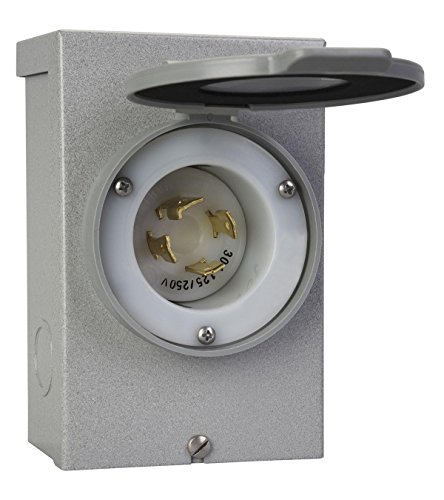
30A inlet box · 68/100
Reliance Controls PB30 30A Power Inlet Box (L14-30)
Current price on Amazon: $59.99
Reliance's 30A, 125/250V L14-30 outdoor power inlet box in a NEMA 3R powder-coated steel housing, rated for generators up to 7,500 running watts, that pairs with a transfer switch or interlocked breaker; sold by Amazon.
Specs: Elliott Electric, Amazon listing.
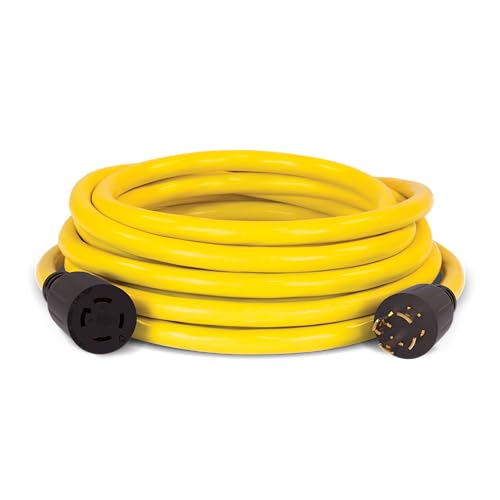
240V L14-30 cord, sold by Amazon · 63/100
Champion 25 ft 30A L14-30 Generator Power Cord (100395)
Current price on Amazon: $75.59
Champion's 25 ft, 10-gauge SJTW L14-30 generator cord rated 30A at 250V for generators up to 7,500 watts, made to run from a generator's L14-30 outlet to a transfer switch or inlet box; sold by Amazon with a 1-year warranty.
Specs: Champion product page, Amazon listing.

240V L14-30 cord, lowest price · 75/100
Conntek 20601 25 ft 30A L14-30 Generator Cord
Current price on Amazon: $51.95
Lower-cost 25 ft L14-30 generator cord with 10/4 STW cable, rated 30A at 125/250V (7,500W maximum per the listing) and UL/C-UL plug and connector per Conntek, usually sold by a third-party seller.
Specs: Conntek product release, Amazon listing.

120V TT-30 cord · 65/100
Champion 30 ft 30A TT-30P to L5-30R Generator Cord (100827)
Current price on Amazon: $84.00
Champion's 30 ft, 10/3 STW cord with a TT-30P plug and an L5-30R twist-lock connector, rated 30A at 125V, for a 120V-only generator or power station with a TT-30R RV outlet; it carries a single 120V leg, so it suits only 120V inlets and switches.
Specs: Champion product page, Amazon listing.
Warranty note: Amazon's product data lists a 5-year warranty for the PB30 while a Reliance dealer lists 1 year, so confirm the term with Reliance. Champion and Conntek list 1-year limited warranties on these cords.
Using an Interlock With a Gas Generator or a Power Station
The interlock does not care what feeds the inlet, but the inlet does. Gas generators with a 120/240V L14-30R outlet pair directly with an L14-30 inlet. Most 2,000–4,000W inverter generators, like the five in our best inverter generator comparison, are 120V only, so they need a 120V inlet and can only feed 120V circuits. Larger dual and tri fuel units are compared in our best propane generator guide.
Power stations pair with a 240V L14-30 inlet only if they have 120/240V split-phase output on a matching outlet. The EcoFlow Delta Pro 3 has a built-in L14-30R (Explorist.life), and the Anker SOLIX S5000 has an L14-30R meant for an inlet or transfer switch. A station runs silently indoors with no exhaust, but it holds a fixed amount of energy. Runtime is capacity × 0.85 ÷ load:
| Circuits on backup (steady load) | EcoFlow Delta Pro 3 (4,096 Wh) | Anker SOLIX S5000 (5,024 Wh) | Anker SOLIX F3800 Plus (3,840 Wh) |
|---|---|---|---|
| Fridge + router + LED lighting circuit (~300W) | 11.6 h | 14.2 h | 10.9 h |
| Above + gas furnace blower (~800W) | 4.4 h | 5.3 h | 4.1 h |
| Above + well or sump pump running (~1,500W) | 2.3 h | 2.8 h | 2.2 h |
| Price | $2,799.00 Check Price → | $2,939.00 Check Price → | Check price at Amazon → |
Fridges and furnaces cycle, so real runtime on these loads is usually longer. Station scores use our power-station matrix: read the EcoFlow Delta Pro 3 review, Anker SOLIX S5000 review or Anker SOLIX F3800 Plus review before you match one to an inlet, and ask your electrician to confirm the F3800 Plus outlet you would use. For bigger battery systems, see our best whole-home solar generators.
Permits, Inspectors and Listed Interlocks
Three things decide whether an interlock passes inspection where you live: the code edition your jurisdiction has adopted, any local amendments, and the inspector. NEC Article 702 sets the requirement that standby transfer equipment must prevent the utility and the generator from ever being connected together (EC&M). A mechanical interlock is one recognized way to meet it (IAEI Magazine).
- Listing matters. Some inspectors may require an interlock listed for use with your specific panel, which usually means the panel maker's own kit. Of our picks, only the Siemens ECSBPK01 is described as UL Listed; the third-party plates claim no listing.
- Ask before you buy. Call your local inspection office or ask your electrician which interlocks they accept. It costs nothing and avoids buying a kit that fails inspection.
- Labels. The third-party kits here list reminder or start-up labels among their parts; your electrician applies whatever labeling the inspector requires.
Code references on this page are for orientation only. We don't claim any interlock is required or banned in a particular state.
Who Should Use an Interlock Kit, and Who Should Skip It
An interlock fits if you…
- Have a panel with a kit from the panel maker, or one your inspector accepts.
- Want any circuit available during an outage, and are comfortable switching loads on and off to stay within the generator's output.
- Have a free 2-pole slot beside the main breaker.
- Own a 240V generator or station with an L14-30R or 50A outlet.
Choose a transfer switch or smart panel if you…
- Have a panel no listed interlock fits, or a full panel with no slot by the main.
- Want backup limited to a few circuits so a small generator or station can't be overloaded: see the manual transfer switch kits.
- Want automatic changeover from a battery while you're away: see the smart home panel guide.
- Only need a fridge and a lamp for a few hours: plug them straight into a power station instead.
How We Score Interlock Kits, Inlet Boxes and Cords
Hookup hardware gets a separate accessory rubric, because our power-station matrix scores batteries and solar charging. Scores are AI-synthesized from manufacturer documents, Amazon listings and Amazon prices logged on November 1, 2026. We did not test or install these products, and specs a maker does not publish earn no credit. Each product is compared only within its group (interlocks, inlet boxes, cords). Fit matters more than any score: always choose the kit made for your panel.
- Safety listing, 30%: 90 if the manufacturer documents a listing such as UL; 80 for a panel maker's own part, or a listing confirmed by two independent sources; 60 if one source claims a listing; 30 if none is claimed.
- Capacity, 20%: 90 × this product ÷ the best in its group (largest documented panel amperage for interlocks, rated watts for cords). Conflicting or unpublished figures score 30.
- Completeness or reach, 15%: 30 plus 20 for each documented included part (mounting hardware, drill bit, labels, retaining bracket), up to 90; cords score on length.
- Build and weather rating, 15%: 90 for a documented outdoor rating (NEMA 3R, SJTW/STW jacket), 60 for documented metal or stainless construction, 30 if unpublished.
- Warranty, 10%: 5 years 90, 3 years 75, 2 years 65, 1 year 50, unstated 30 (where sources conflict, we use the lower figure).
- Value, 10%: 90 × the lowest price in the group ÷ this price.
Generator Interlock Kit FAQ
What is a generator interlock kit?
A generator interlock kit is a metal plate or slide that mounts on the front of your main electrical panel. It makes it physically impossible to switch on the main breaker and the breaker fed by your generator at the same time. Paired with an outdoor power inlet box and a generator cord, it lets a portable generator or a 240V power station feed any circuit in the panel without backfeeding the utility lines.
Is a generator interlock kit legal and up to code?
Mechanical interlocks are a recognized type of transfer equipment, and NEC Article 702 requires transfer equipment that keeps the utility and a standby source from ever being connected together. Whether a specific kit is accepted is up to your local inspector. Some inspectors may want a kit listed for your panel, such as the panel maker's own interlock, rather than a third-party plate. Ask your inspection office before buying, and have a licensed electrician install it under a permit.
Generator interlock kit vs transfer switch: which is better?
An interlock usually costs less in parts and leaves every circuit in the panel available, but you must manage the load yourself and the kit must match your exact panel. A manual transfer switch mounts beside almost any panel and limits backup to a pre-wired set of circuits, often six or ten, which makes overloading a smaller generator or station harder. Our generator transfer switch guide compares switch kits.
Will any generator interlock kit fit my panel?
No. Interlock kits are made for specific panel brands, models, main-breaker types and breaker spacing. Square D, for example, says its QOCGK2C kit fits Series G and S convertible QO main-breaker load centers with a QOM2 main, but not the QO160M200P, and that no interlock is available for 60-space QO load centers. Photograph your panel label and give it to your electrician before ordering.
What inlet box and generator cord do I need with an interlock kit?
Match all three to your generator's outlet. A generator or station with a 4-prong L14-30R outlet pairs with a 30A L14-30 inlet box such as the Reliance PB30 and an L14-30P to L14-30R cord rated 125/250V; that combination is rated for generators up to 7,500 running watts. A 50A generator needs a 50A inlet and cord. A 120V-only source with a TT-30R outlet needs a 120V inlet and a TT-30P to L5-30R cord, and it can only power 120V circuits.
Can I use a generator interlock kit with a portable power station?
Yes, if the station has a 120/240V split-phase outlet that matches the inlet, such as the L14-30R on the EcoFlow Delta Pro 3 or Anker SOLIX S5000. A 120V-only station needs a 120V inlet and can only feed 120V circuits. Give your electrician the station's manual, because some stations specify how neutral and ground must be handled.
Do I need an electrician to install a generator interlock kit?
Yes. An interlock installation involves working inside your main panel, adding a back-fed generator breaker and wiring an inlet box, which is licensed-electrician work that usually needs a permit. OSHA advises never connecting a generator to a building's wiring unless a qualified electrician has installed it with transfer equipment, and the CPSC warns that backfeeding endangers utility workers. We do not publish installation steps.
Panel label photographed? Electrician booked?
Then check current prices on the interlock made for your panel, plus the inlet box and cord that match your generator's outlet. Prefer a fixed set of circuits? Compare generator transfer switch kits instead.