
Sizing Guide · Updated October 2026
What Size Solar Generator Do I Need?
Buying a solar generator starts with one question: how much power do you actually need? Too small and you'll trip the inverter mid-outage. Too large and you've wasted money on capacity you'll never use. This guide walks you through a simple five-step sizing method, then matches you to the right size tier with real product recommendations.
As an Amazon Associate, SolarGenAdvisor earns from qualifying purchases made through links on this page, at no additional cost to you.
Skip the math — use our free Solar Size Calculator
Pick your appliances and get your recommended battery size, inverter size, and matching 2026 units in seconds.
How to Size a Solar Generator in 5 Steps
Sizing a solar generator comes down to four numbers: running watts, surge watts, daily watt-hours, and a 20% safety buffer. Here's the exact method we use for every recommendation on this site.
List your appliances — running watts + surge watts
Make a list of everything you plan to power simultaneously. For each appliance, find two numbers on the nameplate or spec sheet:
- Running (rated) watts — what the device draws during normal operation.
- Surge (startup) watts — the brief spike when a motor, compressor, or heating element kicks on. Refrigerators, sump pumps, and AC units all have surges. LED lights and phone chargers do not.
Use the appliance wattage reference table below for typical values. If your specific appliance is listed there, you can use those numbers as a starting point — but checking the actual nameplate is always more accurate.
Calculate your peak load (surge + running watts)
Add up the running watts of all devices that will be on simultaneously. Then identify the single largest surge wattage in your list and add it to the total running watts. This is your peak load — the minimum AC output your generator must deliver to start everything:
Peak Load = (Sum of all running watts) + (Largest single surge wattage)
Example: Fridge (150 W running, 800 W surge) + router (15 W) + 4 LED bulbs (40 W total) + furnace fan (400 W running, 1,200 W surge) = 605 W running + 1,200 W largest surge = 1,805 W peak load. You need a generator with at least 1,800 W continuous AC output.
Calculate your daily watt-hour budget
Watt-hours tell you how long your generator will last — not just whether it can start everything. Multiply each appliance's running watts by the number of hours per day you'll actually run it, then add them up:
Daily Wh = ∑ (Appliance running watts × Hours per day)
Example (camping scenario): Mini fridge (60 W × 24 h = 1,440 Wh — but compressor cycles ~35% duty cycle, so ~504 Wh) + laptop (45 W × 4 h = 180 Wh) + LED lights (10 W × 5 h = 50 Wh) + phone charging (15 W × 3 h = 45 Wh) = ~780 Wh/day. A 1,000 Wh unit covers this with room to spare.
Example (home backup scenario): Fridge (150 W × 8 h cycling = 1,200 Wh) + router (15 W × 24 h = 360 Wh) + LED lights (30 W × 6 h = 180 Wh) + CPAP (50 W × 8 h = 400 Wh) = ~2,140 Wh/day. A 3,000 Wh unit gives you ~1.4 days; a 5,000 Wh unit gives you ~2.3 days.
Add a 20% buffer
Real-world consumption almost always exceeds your estimates. Appliances age and draw more power. You might add an extra device mid-trip. The inverter efficiency isn't 100%. Multiply both your peak load and your daily Wh budget by 1.2 to build in a safety margin:
Target AC Output = Peak Load × 1.2
Target Capacity = Daily Wh × 1.2
This buffer also accounts for the industry practice where some brands list "peak" surge durations as short as 10–100 ms — not enough for some motor loads to fully spin up. The extra headroom gives you real-world reliability.
Match to a generator size tier
Now take your target numbers and find the tier below that fits. If your numbers fall between two tiers, size up — running a generator at 80–90% of its rated output is fine; running it at 105% will trip the inverter or damage the unit over time.
| Tier | Capacity | Typical AC Output | Best For |
|---|---|---|---|
| Under 500 Wh | 288–500 Wh | 300 W | Phones, lights, small electronics |
| 500–1,500 Wh | 500–1,500 Wh | 1,000–1,500 W | CPAP, mini fridge, TV, camping |
| 1,500–3,000 Wh | 1,500–3,000 Wh | 2,600–3,600 W | Full fridge, freezer, RV trips |
| 3,000–5,000 Wh | 3,000–5,000 Wh | 3,000–4,000 W | Fridge + sump + furnace, home backup |
| 5,000–10,000 Wh | 5,000–10,000 Wh | 7,000+ W | Whole-home backup, multi-day autonomy |
| 10,000 Wh+ | 10,000–90,000 Wh | 7,600+ W | Full off-grid living |
Jump to the full size tier recommendations below for specific product picks in each range.
Appliance Wattage Reference Table
Use this table to look up typical running watts, surge watts, and estimated runtime on a 1,000 Wh battery for each appliance. Always check your specific appliance nameplate — actual values vary by model, age, and settings.
Note: Appliances with "None" listed under surge (LED lights, phone chargers, resistive heaters) draw their full load immediately with no startup spike. Motor-driven devices (fridges, pumps, AC units) spike 2–3x on startup.
Smartphone
Tablet / laptop
LED light bulb (10W eq.)
Wi-Fi router + modem
CPAP machine (no humidifier)
CPAP machine (with humidifier)
TV (42" LED)
Mini fridge (3.2 cu. ft.)
Full-size refrigerator
Freezer (chest)
Microwave (1,000 W)
Electric kettle
Coffee maker (drip)
Toaster / toaster oven
Window AC unit (5,000 BTU)
Portable AC unit (10,000 BTU)
Sump pump (1/3 HP)
Well pump (1/2 HP)
Furnace fan / blower
Space heater (1,500 W)
Electric blanket
Box fan
Electric grill / griddle
Rice cooker (5-cup)
Figures are typical ranges based on manufacturer/EnergyStar data, not measurements of a specific appliance model. Runtime estimates assume ~85% inverter efficiency and reflect the running wattage middle of each range.
Solar Generator Size Tiers — Full Recommendations
Each tier below covers a real-world capacity range with specific product recommendations. Your target numbers from the 5-step method should map neatly into one of these buckets.
Under 500 Wh
288–500 Wh · $–$$Best for: Phones, tablets, LED lights, small electronics, CPAP (short trips).
The pocket-size tier. These units are ultra-portable — often under 10 lbs — and fit in a duffel bag or car cupholder. They'll charge your phone 20+ times, run a CPAP for one night with no humidifier, or keep a Wi-Fi router going for days. They are not designed to run a refrigerator or microwave.

Anker SOLIX C300 DC
Capacity
288 Wh
AC Output
0 W
Surge
0 W
Best all-around value with 288 Wh, 300 W of DC output (USB-C and car socket, no AC outlet), and a featherlight 6.2 lbs — the most portable option for weekend trips and emergency phone charging.
500–1,500 Wh
500–1,500 Wh · $$Best for: CPAP with humidifier, mini fridge, TV, router, lights, weekend camping.
This is the sweet spot for most campers and light home backup. A 1,000 Wh unit can run a mini fridge for 6–10 hours, keep a CPAP running for 2–3 nights, or power a TV + lights + device charging for a full weekend. Most units in this tier weigh 15–25 lbs — still portable enough to carry from car to campsite.

Jackery Explorer 1000 V2
Capacity
1,070 Wh
AC Output
1,500 W
Surge
3,000 W
1,070 Wh capacity, 1,500 W AC output (3,000 W surge), and 23 lbs — the best balance of power and portability for campers and light home backup.
1,500–3,000 Wh
1,500–3,000 Wh · $$–$$$Best for: Full-size fridge, freezer, CPAP, lights, router, TV, RV trips.
The mid-capacity workhorse. A 2,000+ Wh unit can keep a full-size refrigerator running for 12–18 hours, power a freezer + fridge combo through an overnight outage, or serve as the primary power source for an RV for 1–2 days. These units are heavier (40–50 lbs) but often include wheeled carts or sturdy handles.

Anker SOLIX F3000
Capacity
3,072 Wh
AC Output
3,600 W
Surge
4,860 W
3,072 Wh expandable to 24 kWh, 3,600 W AC output, 6,000 W fast recharge — the high-capacity champion for serious home backup.

Bluetti Elite 200 V2
Capacity
2,074 Wh
AC Output
2,600 W
Surge
3,900 W
2,074 Wh with 50-minute AC fast charging and 1,200 W solar input — ideal for those who need quick top-ups between loads.
3,000–5,000 Wh
3,000–5,000 Wh · $$$–$$$$Best for: Fridge + sump pump + well pump + furnace fan, partial home backup.
This is where solar generators start competing with gas generators for home backup. A 3,000–5,000 Wh system can simultaneously power a refrigerator, sump pump, furnace fan, lights, and router — the essential circuits most homeowners need during an outage. Many units in this tier support 240 V split-phase output for transfer switch connection.

EcoFlow Delta Pro 3
Capacity
4,096 Wh
AC Output
4,000 W
Surge
8,000 W
4,096 Wh with 4,000 W AC output, 240 V split-phase, and expandable batteries — the gold standard for whole-home partial backup.

Jackery Explorer 2000 Plus
Capacity
2,042 Wh
AC Output
3,000 W
Surge
6,000 W
2,042 Wh base (expandable to 24 kWh), 3,000 W AC, 6,000 W surge — start small and scale up as your budget grows.
5,000–10,000 Wh
5,000–10,000 Wh · $$$$–$$$$$Best for: Whole-home backup (well pump, sump, fridge, lights, router, furnace), multi-day autonomy.
Whole-home territory. These systems provide enough capacity to run a home's essential circuits for 1–3 days without solar recharge, or indefinitely with adequate solar panels. They typically include 120/240 V split-phase output for direct transfer switch connection, 5,000+ W continuous AC output, and expandable battery stacks reaching 30–60 kWh.
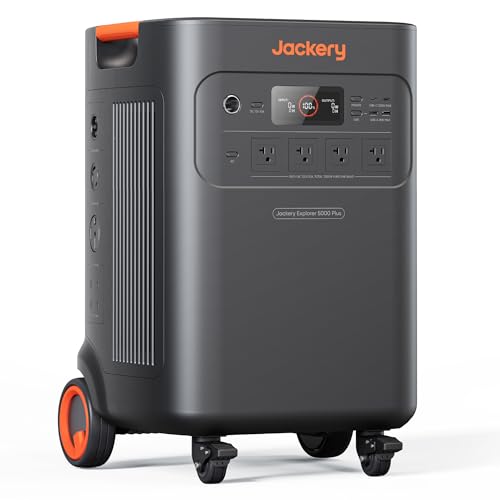
Jackery Solar Generator 5000 Plus
Capacity
5,040 Wh
AC Output
7,200 W
Surge
14,400 W
5,040 Wh with 7,200 W 120/240 V output, expandable to 60 kWh — Jackery's flagship whole-home system with proven reliability.

Pecron F5000LFP Power Station
Capacity
5,120 Wh
AC Output
7,200 W
Surge
7,200 W
5,120 Wh, 7,200 W dual-voltage output, 6,400 W solar input, expandable to 35.8 kWh — impressive specs at a competitive price point.
10,000 Wh+
10,000–90,000 Wh · $$$$$Best for: Full off-grid living, replacing gas generators entirely, multi-week autonomy.
Off-grid replacement tier. A 10,000+ Wh system with substantial solar input can power an entire off-grid home — lights, refrigerator, well pump, furnace, internet, entertainment, and workshop tools — without ever needing a gas generator. These are stationary installations that require planning, adequate solar array sizing, and often professional setup.

Anker SOLIX E10 Prime Off-Grid Kit
Capacity
12,000 Wh
AC Output
7,680 W
Surge
10,000 W
12,000 Wh with 7,680 W AC output (10,000 W turbo), 9,000 W solar input, expandable to 90 kWh — a true grid-replacement system for serious off-grid living.
Use Case Quick-Reference
If you already know your use case but not your numbers, this table maps each scenario to the recommended size tier and explains why.
Camping / Tailgating
500–1,500 WhYou need portability (under 25 lbs) plus enough juice for a mini fridge, phone charging, lights, and maybe a laptop for the weekend.
CPAP / Medical Device
500–1,500 WhA CPAP with humidifier draws 60–100 W per night — a 1,000 Wh unit gives you 2–3 nights. Add solar panels for indefinite use.
RV / Van Life
1,500–3,000 WhMost RV fridges, lights, water pump, and entertainment loads fit this range. You'll typically pair it with roof or portable solar panels.
Home Backup (Essentials)
3,000–5,000 WhFridge, sump pump, furnace fan, router, and lights — the must-run circuits during a typical outage. A transfer switch is recommended.
Home Backup (Whole-Home)
5,000–10,000 WhNear-whole-home coverage including well pump, multiple appliance circuits, and extended multi-day autonomy without external recharging.
Off-Grid Living
10,000 Wh+Full grid replacement. You need enough battery capacity to cover 2–3 overcast days plus enough solar input to recharge in 4–6 hours of peak sun.
Still Not Sure?
If you're between two tiers, size up. The price step from a 1,500 Wh unit to a 2,000 Wh unit is usually modest, and that extra headroom means you can run an unexpected load, survive a longer-than-expected outage, or add solar panels later without outgrowing the battery. You can't add capacity to a unit that's already maxed out — buy the next tier up if your budget allows.
Frequently Asked Questions About Solar Generator Sizing
What size solar generator do I need to run a refrigerator?
A full-size refrigerator draws 100–250 W running with a 600–1,200 W startup surge. You need a generator that can handle the surge — at least 1,200 W peak output — and enough capacity to cover the fridge's daily consumption. A typical fridge uses ~1,200–2,000 Wh per day depending on size and efficiency. For a fridge alone, a 1,500–2,000 Wh unit works for about a day. For fridge + other essentials, go with 3,000+ Wh.
What size solar generator do I need for a CPAP machine?
A CPAP without a humidifier draws 30–60 W per night — a 300 Wh unit (like the Anker SOLIX C300 DC, using the CPAP maker's 12V DC cord since it has no AC outlet) gives you about one night. With a humidifier, consumption jumps to 60–100 W per night, so a 500–1,000 Wh unit is safer. If you also need to run a fan, lights, or phone charging alongside the CPAP, go with 1,000+ Wh. Some CPAP users also need a pure sine wave inverter — all modern solar generators use pure sine wave, so this isn't a concern with any of the units recommended here.
What size solar generator do I need for camping?
For weekend car camping with a mini fridge, phone charging, lights, and a laptop, a 500–1,500 Wh unit is the sweet spot. The Jackery Explorer 1000 V2 (1,070 Wh) is our top pick for this use case — it's 23 lbs, powers a mini fridge for 6–10 hours, and has enough overhead for charging multiple devices. For backpacking or tent camping where weight matters more than capacity, look at the under-500 Wh tier (288 Wh units like the DC-only Anker SOLIX C300 DC at 6.2 lbs).
What size solar generator do I need for an RV or van?
Most RV setups — 12 V fridge, LED lights, water pump, TV, laptop charging — consume 1,000–2,000 Wh per day. The 1,500–3,000 Wh tier is the right fit for 1–2 days of autonomy. If you boondock (no hookups) for extended periods, pair the generator with 400–800 W of portable solar panels. For larger RVs with residential refrigerators, air conditioning, or electric cooking, step up to the 3,000–5,000 Wh tier or supplement with a gas generator for AC loads.
What size solar generator do I need for home backup?
For essential circuits only — fridge, router, a few lights, and device charging — a 1,500–3,000 Wh unit works for up to 24 hours. For partial home backup that includes a sump pump, well pump, or furnace fan, go with 3,000–5,000 Wh. For whole-home backup covering multiple appliance circuits through a transfer switch, look at the 5,000–10,000 Wh tier or even 10,000 Wh+ if you want multi-day autonomy without solar recharging. Use the 5-step method above to calculate your exact needs.
How many solar panels do I need to recharge a solar generator?
It depends on your generator's solar input rating and your daily consumption. A 1,000 Wh unit with a 200 W solar input can fully recharge from dead in about 5 hours of peak sun (200 W × 5 h = 1,000 Wh). A good rule of thumb: match your solar array wattage to 20–30% of your battery capacity. So for a 1,000 Wh unit, 200–300 W of solar panels is a practical minimum. For a 5,000 Wh system, aim for 1,000–1,500 W. Most generators limit solar input, so check the spec before buying panels — oversized panels won't damage the unit but won't charge faster than the max input allows.
Can I run a solar generator and a gas generator together?
Not directly — you can't plug one generator into another. However, you can use both in a complementary setup: run the gas generator during the day to power heavy loads and recharge your solar generator's battery, then switch to the silent solar generator at night for lights, router, and CPAP. This hybrid approach gives you the runtime of gas with the quiet, emission-free overnight experience of solar. Some advanced setups use a transfer switch to select between generator inputs, but never physically connect two generators to the same circuit simultaneously.
How do I know if my solar generator can handle a motor surge?
Compare the generator's peak/surge output (usually listed in the specs) to the appliance's surge watts. Most fridge compressors surge to 600–1,200 W; sump pumps can surge to 1,300–2,500 W; well pumps may surge to 2,000–4,000 W or more. If the generator's surge rating is below the appliance's surge, it won't start. Some generators list peak output for only 10–100 ms, which may not be long enough for some motor loads — a 20–30% buffer above the appliance surge is a safer bet. If in doubt, choose a higher wattage unit or test with a kill-a-watt meter before relying on it in an emergency.
 Written by Morgan Chen · Updated · Power & Energy Editor