
Product Review · Updated September 2026
OUPES Guardian 6000 Review: The Value Challenger Worth Taking Seriously
Most whole-home power stations are heavy, expensive, or both. The Guardian 6000 is neither as heavy as it should be for 4,608Wh: 95 lb puts it at roughly 48.5 watt-hours per pound, essentially tied with the Jackery 5000 Plus and nearly double the Anker F3800 Plus. Add 6,000W of output and a 41kWh expansion ceiling, and it becomes the spec-sheet winner in this class.
 By
By 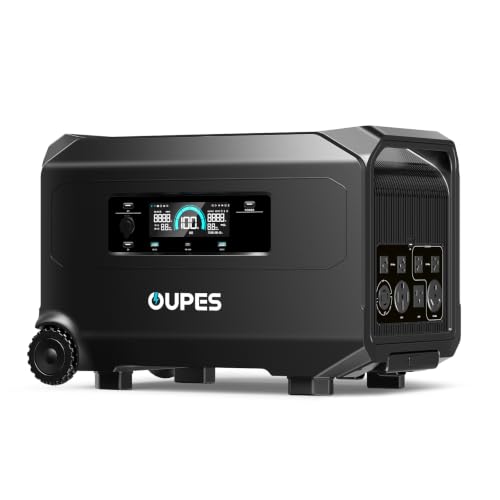
Capacity
4,608
Wh → 41 kWh
AC Output
6,000
Watts continuous
Solar Input
2,400
Watts max
Weight
95
Lbs
Our editorial score: 87/100 · Live price: see current price on Amazon
Overview: Best Specs, Least-Known Brand
Our scoring for this unit reflects exactly that tension. On hardware the Guardian 6000 is arguably the strongest value in the whole-home category: 4,608Wh, 6,000W continuous output, 2,400W solar input, expansion to 41kWh, and a design intended to connect to a transfer switch rather than rely on extension cords. It scores 87 rather than higher because OUPES does not yet have the track record, service network or app ecosystem that Anker and Jackery have built.
That is a real consideration, not a formality. When a four-figure power station fails, what matters is whether you can get it repaired or replaced without a fight. Established brands have more service history to judge them by. What we can say is that the specification is honest and the hardware is well-matched to the job: 6,000W is the output class that starts well pumps and furnace blowers, not just fridges.
If you are comfortable being an early adopter in exchange for materially better specs per dollar, this is the most interesting unit in the category. If warranty confidence is your priority, the Anker F3800 Plus and Jackery HomePower 3600 Plus cost more for less capacity but come with stronger support.
Key Features
4,608Wh at 95 lb — 48.5 Wh per Pound
Capacity per pound is the fairest single measure of engineering quality in this category, and the Guardian 6000 does well at 48.5 Wh/lb. For comparison, the Anker F3800 Plus manages about 25 Wh/lb at 154 lb, and the EcoFlow Delta Pro 3 about 36 at 113.5 lb. Practically, that means more backup energy for the same installation effort — and it makes the unit realistically movable for two people.
6,000W Continuous Output
This is the spec that separates whole-home units from large portable ones. 6,000W clears the startup surge of a well pump, a sump pump and a furnace blower, which are the loads that force homeowners into a gas generator. OUPES lists the surge rating as the same 6,000W figure, so size against 6,000W and do not assume headroom above it for the hardest-starting motors.
Expandable to 41kWh
The highest expansion ceiling in our database. At 41kWh the system moves from "a day of essentials" to genuinely whole-home, multi-day capability without a recharge. As always with expansion figures, the ceiling is not the purchase price — each battery is a separate cost, and reaching 41kWh is a substantial investment. Confirm current battery SKUs and compatibility with OUPES before planning around it.
Transfer-Switch Ready
Built for a wired installation rather than a nest of extension cords. That is the correct design for a unit this size, and it means the Guardian 6000 can back up a defined set of circuits at the panel. It also means installation requires an electrician and hardware the unit does not include — see our transfer switch guide before you buy.
2,400W Solar Input
Second only to the Anker F3800 Plus's 3,200W among whole-home units we list. At full input, 4,608Wh refills in about 1.9 hours theoretically; expect 3–5 hours of decent real-world sun. A large array is what turns this from a one-day battery into an indefinite-outage solution.
Pros & Cons
What We Like
- • 48.5 Wh per pound — among the best efficiency in the whole-home class
- • 6,000W continuous — starts well pumps, sump pumps and furnace blowers
- • 41kWh expansion ceiling — the highest we list, enabling true multi-day backup
- • 2,400W solar input — fast refill from a large array
- • Transfer-switch ready — designed for a proper installation, not extension cords
- • Best price per watt-hour in its class — materially undercuts the established brands
What Could Be Better
- • Younger brand, thinner service history — the main reason our score is 87 rather than higher
- • Surge equals continuous — no headroom above 6,000W for the hardest motor starts
- • 95 lb — a two-person lift, and not something you relocate casually
- • Sold separately from expansion batteries — the 41kWh figure is not the purchase price
- • Transfer switch not included — budget for an electrician and hardware
Realistic Runtime From 4,608Wh
Estimates divide capacity by typical running draw. Fridges, freezers and furnace blowers cycle, so they stretch further in practice than the arithmetic suggests.
| Load | Typical Draw | Est. Runtime |
|---|---|---|
| Refrigerator (cycling) | 150–200W average | ~23–31 hrs |
| Chest freezer | 150–250W | ~18–31 hrs |
| Furnace blower | 500W | ~9 hrs |
| Sump pump | 900W | ~5 hrs of run time |
| Window AC unit | 1,000W | ~4.5 hrs |
| LED lights + router + phones | ~65W | ~3 days |
A realistic essential-circuit load — fridge, furnace blower cycling, lights, router and device charging — averages roughly 350W, giving about 13 hours from a full charge and indefinite coverage once 600W or more of solar is connected.
Specifications
Verified specs from our product database. We omit outlet counts, dimensions, warranty terms and cycle-life ratings we cannot independently confirm — check the manufacturer's current listing.
| Battery Capacity | 4,608 Wh (expandable to 41 kWh) |
| Chemistry | LiFePO4 |
| AC Output (Continuous) | 6,000 W |
| Surge Rating (as listed) | 6,000 W |
| Max Solar Input | 2,400 W |
| Solar Refill (theoretical max) | ~1.9 hrs; expect 3–5 hrs of real sun |
| Weight | 95 lb |
| Capacity per Pound | ~48.5 Wh/lb |
| Home Integration | Transfer-switch ready |
| Primary Use Case | Whole-home essential-circuit backup |
Value Comparison Across the Whole-Home Class
| Model | Capacity | Output | Solar In | Weight | Wh/lb |
|---|---|---|---|---|---|
| OUPES Guardian 6000 | 4,608 Wh | 6,000W | 2,400W | 95 lb | 48.5 |
| Jackery 5000 Plus | 5,040 Wh | 7,200W | 3,000W | 105 lb | 48.0 |
| Jackery HomePower 3600 Plus | 3,584 Wh | 3,600W | 1,200W | 78 lb | 45.9 |
| EcoFlow Delta Pro 3 | 4,096 Wh | 4,000W | 2,600W | 113.5 lb | 36.1 |
| Anker SOLIX F3800 Plus | 3,840 Wh | 6,000W | 3,200W | 154 lb | 24.9 |
The Guardian 6000 and Jackery 5000 Plus are effectively tied on efficiency, with the Jackery offering slightly more output and solar input and the OUPES offering a far higher expansion ceiling at 41kWh. The Anker F3800 Plus trades 24 Wh/lb of efficiency for the fastest solar input in the class and the strongest brand support. Read together, the table says the Guardian 6000 is not a compromise on hardware — the compromise is on brand assurance. See the full field in our whole-home guide.
Who Should Buy the Guardian 6000
Buy it if you…
- ✓ Want the most watt-hours per dollar in the whole-home class
- ✓ Need 6,000W to start a well pump, sump pump or furnace blower
- ✓ Plan to install it permanently and expand over time
- ✓ Are comfortable with a younger brand in exchange for better specs
- ✓ Value capacity per pound — this class has few units as efficient
Skip it if you…
- ✗ Prioritise service history and warranty confidence — buy Anker or Jackery instead
- ✗ Need surge headroom above 6,000W — the listed surge equals the continuous rating
- ✗ Need something portable — 95 lb is a two-person lift
- ✗ Have not budgeted for a transfer switch and an electrician
- ✗ Only need fridge and lights backup — a 2 kWh unit costs far less
Related Reading
Best Whole-Home Solar Generators
Every whole-home system we recommend, ranked
Anker SOLIX F3800 Plus Review
The brand-assurance alternative with 3,200W solar input
Jackery HomePower 3600 Plus Review
7,200W surge at 78 lb — the lightest serious option
Transfer Switch & Home Wiring
What you need before installing a unit this size
Frequently Asked Questions
Is OUPES a reputable brand?
OUPES is a younger entrant than Anker, Jackery or EcoFlow, and it has a correspondingly shorter service history. That is the reason this unit scores 87 with us despite class-leading hardware specs. The practical advice is to buy through a retailer with a clear returns process, and to register the product so warranty claims are straightforward.
Can it really power a whole house?
It can power a set of essential circuits through a transfer switch, which is the realistic goal for any portable station in this class. At 6,000W continuous it handles a well pump, furnace blower, fridge, freezer, lights and electronics. It will not run a central AC, electric range, electric dryer and water heater simultaneously, and it has no headroom above 6,000W because the listed surge equals the continuous rating.
How many expansion batteries does 41kWh represent?
Going from the 4,608Wh base to a 41kWh ceiling is roughly nine times the base capacity, so it requires several expansion batteries — each one a separate purchase. Treat 41kWh as the platform's maximum rather than a typical configuration; most owners will expand once or twice. Confirm current battery SKUs, cabling and pricing with OUPES.
What do I need to install it?
A transfer switch rated for your intended circuits, the appropriate wiring, and a licensed electrician for the panel work. The unit is transfer-switch ready but the switch itself is not included. This is not a DIY job if you are not experienced with mains wiring — see our transfer switch guide for what the installation involves.
How does it compare with the Anker F3800 Plus?
The Guardian 6000 offers 768Wh more capacity and about double the capacity per pound, plus a much higher expansion ceiling, generally for less money. The F3800 Plus offers faster solar input at 3,200W against 2,400W, plus Anker's stronger service network and app ecosystem. Choose the OUPES for value and efficiency, the Anker for support and the fastest possible solar refill.
Is 95 lb manageable?
It is a two-person lift for anything beyond a few feet, and you would not want to carry it up stairs alone. Treat it as an installed unit that stays where you position it. That is normal for this class — the Jackery 5000 Plus is 105 lb and the F3800 Plus 154 lb.