
Buying Guide · Updated October 2026
Best Portable Solar Panels for 2026: Complete Buying Guide
Your solar generator is only as good as the panels you pair it with. The right portable solar panel can mean the difference between a 2-hour recharge and a 6-hour one — and that matters when you're camping off-grid, weathering a power outage, or living the van life. This guide covers the best portable solar panels for every use case: from lightweight foldable panels for backpacking to high-wattage arrays for home backup, with compatibility notes for every major power station brand. Packing for a trip? Our ranking of the best solar panels for camping puts every folding panel in order of watts per pound.
As an Amazon Associate, SolarGenAdvisor earns from qualifying purchases made through links on this page, at no additional cost to you.
 By
By Why Portable Solar Panels Matter in 2026
The portable solar panel market has matured significantly over the past two years. In 2026, the best portable solar panels offer conversion efficiencies above 23%, foldable designs that pack to the size of a large laptop, and universal compatibility that lets you mix and match panels with power stations from different brands. The days of being locked into a single brand's proprietary solar ecosystem are ending — most panels now use standard MC4 connectors, and adapter cables are available for every major power station brand.
For solar generator owners, a good panel setup can reduce recharge time by 50–75% compared to wall charging, and eliminates the need to find a grid outlet entirely. Panels are also the most cost-effective way to extend off-grid runtime — adding a 200W panel costs a fraction of adding a second power station battery, while providing unlimited daytime charging as long as the sun is out. This guide covers the three best portable solar panels on the market in 2026, selected for efficiency, portability, build quality, and brand compatibility.
Quick Comparison
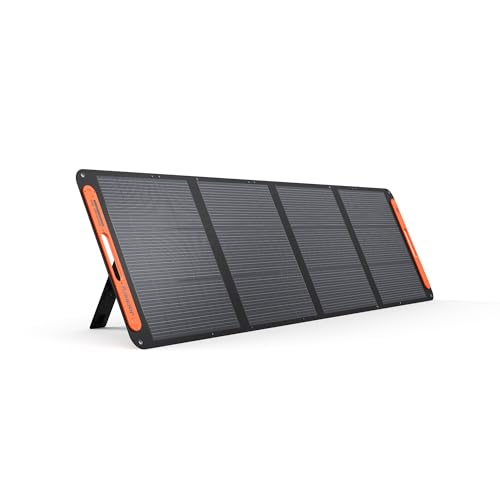


Detailed Reviews
Jackery SolarSaga 200W
True plug-and-play compatibility with all Jackery Explorer models via the 8mm barrel connector. Folds to laptop size at 14.3 lb with a built-in kickstand and carrying case. Pair two in parallel for 400W to charge the Explorer 1000 V2 in ~2.5 hours.
EcoFlow 220W Portable Solar Panel
220W bifacial design captures light from both sides for 25% more energy than traditional panels. High 23% efficiency rating with MC4 connectors works with any brand's power station (adapter may be needed). 20.9 lb with adjustable kickstand.
Bluetti PV200 200W Solar Panel
200W with ETFE coating for superior scratch and weather resistance — lasts longer than standard PET-coated panels. MC4 connectors with universal compatibility. 16.1 lb with a practical foldable design and multiple angle settings.
Panel Compatibility by Power Station Brand
Not all solar panels work with every power station out of the box. Here's what you need to know about connector compatibility across the major brands:
Jackery
Jackery uses a proprietary 8mm barrel connector on its SolarSaga panels and Explorer power stations. For third-party MC4 panels, you need a Jackery adapter cable. Jackery's own SolarSaga panels offer true plug-and-play. The SolarSaga 200W is our recommended pick for Jackery owners.
EcoFlow
EcoFlow uses standard MC4 connectors on its portable panels, making them compatible with most third-party power stations out of the box. EcoFlow's panels also work seamlessly with Delta and River series units. The 220W bifacial panel is our top pick for EcoFlow owners due to its high efficiency and dual-side energy capture.
Anker SOLIX
Anker SOLIX power stations use standard MC4 connectors and are compatible with any MC4-equipped solar panel. Anker also offers its own line of portable panels that pair perfectly with the C1000 and F-series units. Third-party panels work with a simple MC4 adapter if needed.
Bluetti
Bluetti uses standard MC4 connectors with an Anderson Power Pole adapter on some models. Their PV200 panel is designed for direct compatibility with Bluetti power stations, but any MC4 panel with the correct voltage range (12–60V) will work. Bluetti's high solar input limits make them particularly well-suited for larger panel arrays.
How Many Watts of Solar Do You Need?
Sizing your solar panel array depends on your power station's capacity and how fast you want to recharge. Here's a quick reference guide:
| Power Station Capacity | Recommended Panels | Recharge Time (full sun) | Best For |
|---|---|---|---|
| 200–300 Wh (compact) | 1× 100W panel | 3–5 hours | Weekend camping, phone/laptop top-off |
| 1,000–1,100 Wh (mid-range) | 2× 200W panels (400W) | 2.5–3.5 hours | Car camping, RV, light home backup |
| 2,000–4,000 Wh (high-capacity) | 2–3× 200W panels (400–600W) | 3–5 hours | Extended off-grid, RV, home backup |
| 4,000+ Wh (whole-home) | 4–6× 200W panels (800–1,200W) | 3–6 hours | Whole-home backup, off-grid living |
Note: Recharge times assume optimal sun conditions (peak sun hours, panels at correct angle). Real-world performance varies by season, latitude, and weather. Plan for 20–30% less in winter or partly cloudy conditions. See our sizing guide for detailed calculations.
What to Run on Those Panels
Panels only pay off if the loads you are powering are sized correctly. These guides work out the real runtime for specific loads:
Best 200W Portable Solar Panel
Specific picks plus how many panels each station can accept
Solar Panel Setup & Wiring Guide
Voltage limits, series vs parallel, MPPT vs PWM and connectors
Running Starlink Off-Grid
Dish and router draw, runtime per capacity, and the snow-melt surprise
Power Tools & Job Sites
Circular saws, table saws and compressors — the hardest loads to size for
Running a Freezer
Almost exactly the daily energy a 200W panel can replace
Running a Washing Machine
Motor surge, water heating and the honest energy maths
Frequently Asked Questions About Portable Solar Panels
Can I use third-party solar panels with my power station?
In most cases, yes. If your power station has MC4 connectors (used by EcoFlow, Anker, Bluetti, and most brands), any MC4 panel will work. Jackery uses a proprietary 8mm barrel connector, but an inexpensive adapter cable enables compatibility with standard MC4 panels. Always check your power station's voltage range (usually 12–60V) before connecting panels. See the compatibility section above for brand-specific details.
How many solar panels can I connect to my power station?
The limit is determined by your power station's maximum solar input wattage and voltage. Most mid-range units support 200–500W max, while whole-home units support 1,000–3,200W. Panels are connected in parallel to stay within voltage limits. Check your power station's specs for "Max Solar Input" — that's the hard limit for total panel wattage.
What's the difference between monocrystalline and polycrystalline panels?
Monocrystalline panels (used by all three panels in this guide) are more efficient (20–23%) and perform better in low-light conditions than polycrystalline (15–18%). They're also more expensive per watt, but the higher efficiency means you get more power from the same physical panel size — an important consideration for portable use where space is limited.
Do I need a charge controller between my panel and power station?
No — every modern portable power station has a built-in MPPT (Maximum Power Point Tracking) charge controller. Simply connect the solar panel to the power station's solar input port, and the internal controller will handle voltage regulation, overcharge protection, and optimal power harvesting. This is one of the key advantages of all-in-one solar generators vs. DIY solar systems.
Can I leave portable solar panels outside in the rain?
Most portable solar panels have an IP65 or higher rating, meaning they're splash-proof and can handle rain. However, it's best practice to disconnect and store panels during heavy storms. The MC4 connectors are weather-resistant when connected, but the connection points should be kept dry when disconnected. Jackery's SolarSaga panels and the Bluetti PV200 both have weather-resistant designs suitable for occasional rain exposure.
How do I clean and maintain portable solar panels?
Clean panels with a soft cloth and water — avoid abrasive cleaners or pressure washers that can damage the ETFE or PET coating. Dirt and dust can reduce efficiency by 15–25%, so wipe panels down before each trip. Store panels in their included carrying case when not in use, and avoid folding/unfolding them more than necessary to prolong the hinge and cable life.