
Technical Guide · Updated September 2026
Solar Panel Setup Guide: Matching Panels to Your Power Station
Almost every "my solar panels aren't charging as fast as they should" problem comes down to one of four things: the panels are wired in the wrong configuration for the station's voltage limit, the connector is adding resistance, the panel is at the wrong angle, or expectations were set against nameplate wattage rather than real output. This guide covers all four, in the order they actually cause trouble.
 By
By Step 1: Read Your Station's Solar Input Specs Before Buying Anything
Every power station publishes a solar input specification, and it contains three numbers that matter. The wattage is the one people look at; the voltage and amperage limits are the ones that decide whether a panel array will actually work.
Maximum input voltage (sometimes given as Voc)
This is a hard ceiling. Exceeding it can permanently damage the charge controller. Open-circuit voltage (Voc) is higher than the panel's operating voltage, and it rises further in cold weather — so a panel array that sits comfortably under the limit in summer can exceed it on a cold, bright morning. Always allow headroom.
Maximum input current (amps)
Exceeding this is usually harmless: the station clips the extra current and charges no faster. It means you have paid for panel capacity you cannot use, which is a waste of money rather than a safety problem. Add panels in a way that stays near the current limit.
Maximum input wattage
The headline figure, and the one that tells you the realistic upper bound on charging speed. The table below shows this figure for every station in our database.
Solar input ceilings by station
| Power Station | Capacity | Max Solar Input |
|---|---|---|
| Anker SOLIX C1000 Gen 2 | 1,024 Wh | 600 W |
| Anker SOLIX C300 DC | 288 Wh | 100 W |
| Anker SOLIX E10 Prime | 12,000 Wh | 9,000 W |
| Anker SOLIX F3000 | 3,072 Wh | 2,400 W |
| Anker SOLIX F3800 Plus | 3,840 Wh | 3,200 W |
| Bluetti AC200L | 2,048 Wh | 1,200 W |
| Bluetti Elite 200 V2 | 2,074 Wh | 1,200 W |
| EcoFlow Delta 3 Plus | 1,024 Wh | 1,000 W |
| EcoFlow Delta Pro 3 | 4,096 Wh | 2,600 W |
| Jackery Explorer 1000 V2 | 1,070 Wh | 400 W |
| Jackery Explorer 2000 Plus | 2,042 Wh | 1,000 W |
| Jackery Explorer 300 | 292 Wh | 100 W |
| Jackery HomePower 3600 Plus | 3,584 Wh | 1,200 W |
| Jackery Solar Generator 5000 Plus | 5,040 Wh | 3,000 W |
| OUPES Guardian 6000 | 4,608 Wh | 2,400 W |
Note how the ratio shifts with size. A 1 kWh station typically accepts 400–600W of solar; a 2 kWh station 1,000–1,200W; a 4 kWh whole-home unit 2,400–3,200W. That is roughly a 0.5–0.8 ratio of solar watts to stored watt-hours, which is a useful sanity check when sizing an array.
Step 2: Series vs Parallel — What "Daisy Chaining" Actually Does
People say "daisy chain" to mean both things, which is why the topic causes so much confusion. There are two distinct ways to connect panels, and they have opposite effects.
Series — voltage adds
Connect the positive of one panel to the negative of the next. Voltages sum; the amperage stays at a single panel's rating.
Two 200W panels in series (18V, 11A each): 36V at 11A.
Use it when: your station has voltage headroom and you want lower current losses over a long cable run. Series is the standard approach for roof installations where panels sit far from the battery.
Watch out: series is where people break voltage limits. Adding panels adds voltage fast, and cold-weather Voc rise can push a marginal array over the ceiling.
Parallel — amperage adds
Connect all positives together and all negatives together. Amperages sum; the voltage stays at a single panel's level.
Two 200W panels in parallel (18V, 11A each): 18V at 22A.
Use it when: your station has a low voltage ceiling and plenty of current headroom, which is the case for most portable stations. Parallel is also safer for mismatched panels, because a shaded panel drags down a series string much harder than it drags down a parallel bank.
Watch out: higher current means thicker cable matters more, and long parallel runs lose more to voltage drop.
The practical rule
For portable panels on a portable station, parallel is almost always the safer default — the voltage limits on portable stations are usually the binding constraint, and parallel keeps you well clear of them. Switch to series only when you have confirmed your station's voltage ceiling and have room to spare, or when cable length makes current losses the bigger problem.
Step 3: MPPT vs PWM — Why It Matters Less Than You Think on a Power Station
MPPT (maximum power point tracking) is a technique for continuously adjusting the electrical load on a panel so it operates at the voltage that yields the most power. A panel's maximum-power point shifts with light intensity and temperature, so a controller that tracks it captures meaningfully more energy across a day than one that does not.
| Aspect | MPPT | PWM |
|---|---|---|
| Energy captured | Typically 10–30% more | Baseline |
| High panel voltage | Steps it down efficiently | Clamps it down, wasting the difference |
| Partial shade / low light | Handles noticeably better | Struggles |
| Series strings | Suited to them | Poorly suited |
| Cost and complexity | Higher | Lower |
Here is the part most articles skip: nearly every modern power station already contains an MPPT controller, so the question is largely irrelevant when you are pairing portable panels with a station. It becomes relevant in two situations. First, if you are adding a separate charge controller to a DIY battery setup, where MPPT is nearly always the right choice and PWM is a false economy. Second, if you are running panels in series — a series string needs MPPT to be worth doing, because PWM on a high-voltage string wastes most of the available power.
Step 4: Connectors and Cable Runs
The connector is the most common reason a panel will not work with a given station, and it is the last thing most buyers check.
| Connector | Where You Find It | Notes |
|---|---|---|
| MC4 | EcoFlow, Bluetti, virtually all rigid panels | Industry standard, weather-sealed, reliable |
| 8mm barrel | Jackery Explorer stations | Native Jackery panels need no adapter |
| XT60 | Many portable panel kits and some stations | Compact, widely adapted |
| Anderson Powerpole | Larger stations, DC distribution | Robust, high-current capable |
| SAE | Some budget kits and RV wiring | Common but not high-current rated |
Extension cables and voltage drop
Voltage drop is proportional to cable length and current, and inversely proportional to conductor thickness. A short extension is negligible; a 30-foot run carrying 20A will lose real voltage, and thin conductors make it worse. Two rules: keep runs as short as practical, and prefer series wiring for long runs because lower current means less drop for the same cable. Use proper solar-rated cable rather than generic hookup wire with suitable current handling.
Minimise the number of connections
Every adapter is a place for resistance, a loose fit and corrosion. A stack of three adapters to bridge connector families will work, but it introduces three failure points. Where an adapter is unavoidable, use a single well-made MC4-to-your-port cable rather than a chain of conversions.
Step 5: Angle and Positioning — the Free Performance Gain
Angle affects output more than any cable or connector decision, and it costs nothing to get right. A panel lying flat produces meaningfully less than the same panel angled toward the sun, and the gap widens the further you are from the equator and the further you are from midsummer.
For portable panels: track the sun manually
This beats any fixed angle. Aim the panel perpendicular to the sun and reposition it two or three times through the day — morning, midday, mid-afternoon. On a clear day that alone can add 20–30% to your total harvest compared with leaving the panel in one position from dawn to dusk. If you only reposition once, do it at solar noon.
For fixed installations: latitude plus a seasonal offset
A widely used starting approximation is your latitude for a year-round average, then minus 15° in summer and plus 15° in winter. So at 40° latitude you would set roughly 25° in summer, 40° as an annual average, and 55° in winter. Steeper winter angles also help shed snow and reduce the effect of low winter sun.
Shade is not proportional
Partial shading affects output far more than the shaded area suggests. A small shadow across one cell group can cut a panel's output disproportionately because the cells are wired in series internally. Before you commit to a fixed position, check what will shade the panel at different times of day and in different seasons — a bare winter tree casts a shadow that a summer canopy does not.
Heat costs you watts
Solar cells lose efficiency as they heat up, which is why a panel can produce less at 2pm in full sun than it did at 10am with slightly weaker light. There is not much you can do beyond leaving an air gap behind the panel rather than laying it directly on a hot surface — which is another argument for the built-in kickstands that portable panels have.
Step 6: Set Realistic Expectations for Real-World Output
Panel ratings are measured under standard test conditions that rarely occur outdoors. In practice, plan on 75–80% of nameplate in good summer sun, and less whenever conditions are less than ideal. A 200W panel delivering around 155W is performing correctly.
| Panel Rating | Realistic Output (good sun) | Daily Harvest (est.) | Refills This Much Storage |
|---|---|---|---|
| 100W | ~75–80W | ~0.4–0.5 kWh | ~1,000Wh every 2 days |
| 200W | ~150–160W | ~0.8–1 kWh | ~1,000Wh per day |
| 400W | ~300–320W | ~1.6–2 kWh | ~2,000Wh per day |
| 800W | ~600–640W | ~3.2–4 kWh | ~4,000Wh per day |
Read that last column against your actual consumption and the sizing becomes obvious. A fridge cycling at an average 190W uses about 4.6 kWh per day. To run it indefinitely on solar alone you need roughly 900–1,000W of panels, not one 200W panel. Most people who are disappointed with solar charging have sized the array against the station's input ceiling rather than against what they actually consume. For consumption figures, see our runtime guide, and for fridge-specific numbers our refrigerator guide.
Portable Panels That Work With Most Stations
These three are the portable panels in our database, chosen here for how well they tolerate being wired into different station ecosystems rather than for raw wattage.

Best for mixed-brand setups
EcoFlow 220W Portable Solar Panel
· 17.6 lb · SGA rating 88/100
Current price on Amazon: $299.00
MC4 connectors with N-Type cells and a 220W rating — the highest output in the portable 200W class. N-Type cells perform better than conventional cells in heat and low light, which matters more than nameplate wattage on real days. Pairs with any station via the correct adapter.

Widest voltage compatibility
Bluetti PV200 200W Solar Panel
· 15.4 lb · SGA rating 86/100
Current price on Amazon: $399.00
The 12–60V operating range is the useful detail here: it covers the input window of most power stations on the market, so it is the least likely panel to fall outside a station's voltage limits. ETFE coating resists the wear of repeated folding better than cheaper PET coatings.
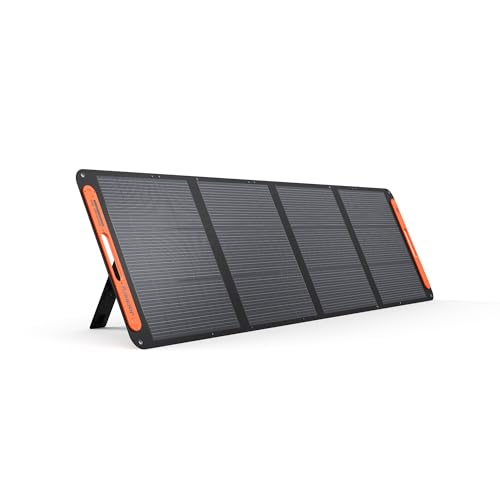
No adapter needed for Jackery
Jackery SolarSaga 200W
· 13.2 lb · SGA rating 88/100
Current price on Amazon: see current price on Amazon
Native 8mm barrel connector for Jackery Explorer stations, so there is no adapter in the chain and no extra connection point to add voltage drop. 13.2 lb and bifacial, so it captures reflected light from below as well as direct sun.
For a panel-by-panel comparison including rigid options, see our best 200W portable solar panel guide.
Troubleshooting: Panels Connected but Charging Is Slow
The station charges, just slower than expected
Check the wattage the station reports while charging. If it is substantially below your panels' rated output, the cause is usually angle, partial shade, or real-world derating rather than a fault. If the reported wattage is capped at exactly your station's maximum input, you have hit the ceiling and adding panels will not help.
Output drops sharply when I add a panel
This is the classic signature of a series string with one shaded or mismatched panel. In series, the weakest panel limits the whole string. Rewire in parallel, or remove the shaded panel from the string. Mismatched panel models in series behave the same way.
The station does not charge at all
Work through the basics in order: confirm the connector is fully seated (MC4 connectors need a deliberate push until they click), check polarity, confirm the panel voltage is inside the station's input range, and try a single panel rather than the full array. If a single panel works, the problem is in the array wiring rather than the equipment.
It worked last summer and now it is much weaker
Compare like with like before assuming degradation. Winter sun is lower and weaker, days are shorter, and the correct panel angle is steeper — those three factors alone can halve output without anything being wrong. Check angle and season first. If output is still poor at the same time of year and angle as before, inspect the panel surface for scratches, delamination or water ingress around the junction box.
Frequently Asked Questions
What happens if I exceed my power station's solar input voltage?
Exceeding the voltage limit is the one mistake that can damage hardware. Most stations specify a maximum input voltage, often as a Voc ceiling, and going above it can destroy the charge controller. Exceeding the amperage limit is usually harmless — the station clips the extra current and charges no faster. Always leave voltage headroom, because Voc rises in cold weather.
Should I wire solar panels in series or parallel?
Parallel adds amperage and keeps voltage at a single panel's level; series adds voltage and keeps amperage at a single panel's level. Parallel is the safer default for portable panels on portable stations, because those stations usually have tight voltage ceilings. Use series when you have confirmed voltage headroom, or when a long cable run makes current losses the bigger concern.
What is the difference between MPPT and PWM?
MPPT continuously adjusts to extract the most power available, typically capturing 10–30% more energy, and it handles high panel voltages efficiently. PWM clamps panel voltage down to battery voltage, wasting the difference. Nearly every modern power station already includes MPPT, so this matters mainly if you are adding a separate charge controller — where MPPT is almost always worth the extra cost.
Do I need an adapter cable?
Only if the panel and station use different connector families. MC4 is the standard for EcoFlow, Bluetti and most rigid panels; Jackery Explorer stations use an 8mm barrel input; XT60 and Anderson Powerpole appear on some kits. Adapters are cheap, but each one adds resistance and a potential loose connection, so prefer a single well-made conversion cable over a chain of adapters.
How much does real-world output differ from the rated wattage?
Plan on 75–80% of nameplate in good summer sun, and less in winter, haze or at a poor angle. A 200W panel delivering about 155W is normal. Heat also reduces cell efficiency, so a panel in direct sun can produce less than the same panel in cooler conditions with similar light. See the derating table above for daily harvest estimates by panel size.
What angle should I set a solar panel at?
For portable panels, aim perpendicular to the sun and reposition two or three times a day — manual tracking beats any fixed angle and can add 20–30% to your daily harvest. For fixed installations, a common starting point is your latitude as a year-round average, minus 15° in summer and plus 15° in winter.