
Buying Guide · Updated October 2026
Best Whole-House Solar Generators (2026)
Standard portable power stations keep a fridge and a few lights running. Whole-home solar generators do something fundamentally different: they replace grid power across multiple circuits, run 120V and 240V appliances simultaneously, and scale to 30–90+ kWh of storage. These are the systems that keep your well pump, furnace, kitchen appliances, and EV charger running through multi-day outages — without a drop of gasoline.
Not sure you need the whole house? Most homes are better served by backing up essential circuits — start with our home backup guide, or for plug-in emergency picks see the best solar generator for power outages. Budgeting? Jump to what a whole-house solar generator costs, installation included.
As an Amazon Associate, SolarGenAdvisor earns from qualifying purchases made through links on this page, at no additional cost to you.
Quick Comparison
How Much Does a Whole-House Solar Generator Cost?
A whole-house solar generator costs the price of the base unit, plus any expansion batteries, solar panels, and the electrician's work to connect it to your panel. The base units on this page are listed below with their current Amazon price. Installation and add-ons are covered after the table, with sourced cost ranges.
| System | Current price | Battery | AC output | Price per kWh of storage |
|---|---|---|---|---|
| Anker SOLIX E10 Prime Off-Grid Kit | $6,499.00 | 12,000 Wh | 7,680 W | $542/kWh |
| EcoFlow Delta Pro 3 | $2,799.00 | 4,096 Wh | 4,000 W | $683/kWh |
| Jackery Solar Generator 5000 Plus | $3,149.00 | 5,040 Wh | 7,200 W | $625/kWh |
| Pecron F5000LFP Power Station | Check price at Amazon → | 5,120 Wh | 7,200 W | — |
| OUPES Guardian 6000 | Check price at Amazon → | 4,608 Wh | 6,000 W | — |
Prices are pulled from Amazon and change often; price per kWh is the live price divided by the base unit's rated capacity, before expansion batteries. A dash means no live price is available right now.
What Adds to the Price
Expansion batteries
The base unit is rarely the whole bill. Each system above takes add-on batteries sold separately, up to its maximum (see “Max Expand” in the comparison table). Most buyers who want multi-day, whole-house coverage end up adding at least one, so price the battery you'll actually need, not just the base unit.
Transfer switch, inlet or smart panel
To power hardwired circuits you need an electrician. Published ranges: about $400–$850 for an inlet and interlock job (HomeGuide data) and $400–$1,300 installed for a manual transfer switch (Angi), both as compiled by ThePricer. One licensed electrical contractor quotes roughly $400 to $2,500+, with many jobs around $1,200–$1,600 (Brandon Electric). For automatic switchover with a manufacturer smart panel, published estimates disagree too much to quote a range. Expect it to cost more than a manual switch, and get an itemized quote.
Permits and inspection
Most jurisdictions require a permit for panel work. Published figures run from about $50–$200 per permit (Bob Vila) to $80–$450 (HomeGuide data via ThePricer). If your panel needs an upgrade, that's a separate and larger line item.
Solar panels and the tax credit
Panels are usually extra unless you buy a kit, and whole-house systems accept thousands of watts of solar input. The federal 30% residential credit no longer applies to 2026 purchases. Our solar generator tax credit guide explains what changed and which state programs remain.
Compared With a Powerwall or a Gas Standby Generator
| Option | Typical cost (published estimates) | What you get |
|---|---|---|
| Whole-house solar generator | Base unit price above + installation ranges above | Freestanding battery you can move with you. Expandable. No fuel. |
| Tesla Powerwall 3 (13.5 kWh, installed) | About $11,500–$16,500 (Joule) | Permanently mounted battery and inverter, installed by a certified installer |
| Gas standby generator (installed) | Estimates vary widely: $7,882–$15,050, average $10,941 (Homeyou); $1,524–$8,658, average $5,090 (Bob Vila, 2024) | Runs as long as fuel lasts. Needs engine service and outdoor placement. |
Published cost figures are national estimates from cost guides and installers, not quotes. Your price depends on region, panel condition, and fuel or wiring runs. Get two or three itemized quotes from licensed electricians.
What Makes a Solar Generator "Whole-Home"?
Not every solar generator that claims "home backup" is actually capable of powering a home. There's a critical difference between a portable power station that can run a fridge for a few hours and a whole-home system that can replace grid power for days or weeks. Here are the defining characteristics:
120/240V Split-Phase Output
Standard portable generators output 120V only. Whole-home systems output both 120V and 240V split-phase power, which is required for well pumps, central air conditioners, electric water heaters, EV chargers, and most hardwired home appliances. If a generator only has 120V outlets, it cannot power a standard home electrical panel without additional equipment.
Transfer Switch or Interlock Ready
Whole-home generators are designed to connect to your home's electrical panel through a transfer switch or interlock kit. This lets you select which circuits receive backup power — fridge, well pump, furnace, lights — without running extension cords through your house. The best systems support both manual and automatic transfer switching.
Expandable Capacity (5–90 kWh)
A true whole-home system starts with at least 3,000–5,000 Wh of battery capacity and offers expansion ports to add extra batteries. Top-tier systems like the Anker SOLIX E10 can scale from 12 kWh to 90 kWh — enough to power the average US home for 3–5 days without solar recharge. The expansion is typically plug-and-play; no rewiring needed.
High Solar Input (2,000–9,000W)
Whole-home systems need massive solar input capability to recharge their large batteries in a reasonable time. A 5,000 Wh battery charged at 300W solar input would take 17+ hours of full sun. Whole-home systems support 2,000–9,000W solar input, letting you recharge in 2–6 hours of good sunlight and extend your backup runtime indefinitely during prolonged outages.
Who Should Buy a Whole-Home Solar Generator?
A whole-home solar generator is a significant investment — a multi-thousand-dollar purchase for the base system alone, plus installation costs if you add a transfer switch. It makes financial sense in specific scenarios:
You Experience Frequent Outages
If your area sees 3–10+ outages per year — from storms, grid instability, or rolling blackouts — a whole-home system pays for itself by preventing food spoilage, pipe freezing, and the cost of hotel stays during extended outages.
You Have Medical or Work Needs
CPAP machines, oxygen concentrators, home dialysis, or a work-from-home setup that loses revenue during outages — these add a non-monetary value to uninterrupted power that justifies the investment.
You Want Off-Grid Capability
For cabins, tiny homes, or rural properties without reliable grid access, a whole-home solar generator with sufficient solar panels can serve as a primary power source — not just backup. The Anker SOLIX E10 and EcoFlow Delta Pro Ultra X are designed for this use case.
You Want to Reduce Grid Dependence
Even without outages, whole-home systems with smart energy management can shift your load to off-peak hours, store solar energy from rooftop panels, and reduce your monthly electric bill through "time-of-use" optimization.
When it doesn't make sense: If you only need to power a fridge, a few lights, and a router during occasional short outages, a standard portable power station under $1,500 (see our home backup guide) will serve you well and save thousands of dollars. Whole-home systems are for power users who need genuine circuit-level coverage.
Whole-Home Solar Generator Specs Comparison
When comparing whole-home systems, capacity (Wh) and output (W) are just the starting point. Pay attention to voltage support, expansion scalability, solar input speed, and transfer switch compatibility — these determine whether a generator can truly replace your grid connection or just supplement it.
| Spec | Anker E10 | EcoFlow DP3 | Jackery 5K+ | Pecron F5000 | OUPES G6000 |
|---|---|---|---|---|---|
| Capacity | 12,000 Wh | 4,096 Wh | 5,040 Wh | 5,120 Wh | 4,608 Wh |
| AC Output | 7,680W (10kW turbo) | 4,000W | 7,200W | 7,200W | 6,000W |
| Voltage | 120/240V | 120/240V | 120/240V | 120/240V | 120/240V |
| Max Expand | 90 kWh | 48 kWh | 60 kWh | 35.8 kWh | 41 kWh |
| Solar Input | 9,000W | 2,600W (1,600W HV + 1,000W LV) | 3,000W | 6,400W | 2,400W |
| Weight | 60.6 + 130 lb | 128 lb | ~105 lb | 123.9 lb | ~95 lb |
| Chemistry | LiFePO4 | LiFePO4 | LiFePO4 | LiFePO4 | LiFePO4 |
| Transfer Switch | Yes (generator-ready) | Yes (240V) | Yes (240V) | Yes (dual voltage) | Yes (built-in compat) |
| Est. Price | $6,499.00 See Price → | $2,799.00 See Price → | $3,149.00 See Price → | Check price at Amazon → | Check price at Amazon → |
How to Size a Whole-Home Solar Generator
Sizing a whole-home system is fundamentally different from sizing a portable power station. You're not just asking "can this run my fridge?" — you're asking "can this replace my grid connection for critical circuits?" Here's a framework:
Step 1: Identify Your Critical Circuits
Walk through your home and identify every appliance you'd want running during an outage. Most homes have 4–8 critical circuits: fridge (150W), freezer (200W), well pump (1,000–2,500W surge), furnace fan (500W), sump pump (800W), lights (200W), router (15W), and one or two convenience circuits for phone charging and a TV. Write down the running watts and surge watts for each.
Step 2: Calculate Peak Surge Load
The most common sizing mistake is underestimating startup surge. A well pump that draws 1,000W running can spike to 2,500W+ on startup. If your generator's peak output can't handle that surge, the pump won't start — even if the generator has plenty of running wattage available. Add the single largest surge to your total running watts to find your minimum peak output requirement.
Step 3: Calculate Daily Watt-Hour Budget
Multiply each appliance's running watts by the hours per day you'll run it. A fridge at 150W running 8 hours/day (cycling) = 1,200 Wh. A well pump at 1,000W running 30 minutes/day = 500 Wh. A furnace fan at 500W running 6 hours/day = 3,000 Wh. Total your daily budget. That number should be no more than 60–70% of your battery capacity to avoid draining below safe levels before solar recharge can occur.
Step 4: Match Solar Input to Your Climate
Solar input capability matters more for whole-home systems than for portable units. In winter or cloudy conditions, you may get only 2–4 hours of effective peak sun per day. If your home needs 5,000 Wh/day and you get 3 peak sun hours, you need at least 1,700W of solar input capability. Systems with 3,000W+ solar input (like the Anker SOLIX E10 at 9,000W or Pecron F5000LFP at 6,400W) can fully recharge in a single sunny afternoon.
Our Picks, In Detail

Anker SOLIX E10 Prime Off-Grid Kit
The Anker SOLIX E10 is a fundamentally different class of product. It's not a portable power station with an expansion port — it's a whole-home energy system designed to replace grid power for extended periods. The starter kit includes the E10 Power Module and a B6000 battery module delivering 12 kWh of capacity and 7,680W continuous output (10kW turbo), all in a stackable, tool-free design that you can expand to 90 kWh.
Capacity
12,000 Wh
AC Output
7,680 W (10K turbo)
Solar Input
9,000 W
What sets the E10 apart is its universal generator compatibility. It works with Anker's Smart Generator 5500 (4,500W DC tri-fuel) and existing 120V/240V gas generators via a 9.6kW bypass. This means during a multi-day winter outage with limited sun, you can recharge from a gas generator while still powering your home. The E10 also features an integrated metal pad for floor mounting, NEMA 4 weather resistance, and a 155–275 LRA startup rating capable of handling central AC units up to 5 tons.
Who it's for: Homeowners who want genuine whole-home backup or off-grid living capability, with the budget to invest in a system that scales to 90 kWh. If you're tired of gas generators and want a permanent, silent, emissions-free power solution that can handle central AC and a well pump simultaneously, this is the gold standard.
▶ Show pros & cons
Pros
- 12 kWh base capacity, expandable to 90 kWh
- 10kW turbo output handles central AC
- 9,000W solar input — fastest solar recharge
- Generator-ready with 9.6kW AC bypass
- Tool-free stacking expansion
- NEMA 4 rated for indoor/outdoor installation
Cons
- $6,499.00 starting price — significant investment
- 190+ lbs total; requires permanent placement
- New platform with limited user reviews yet
- Overkill for partial-home backup needs
- Professional installation recommended

EcoFlow Delta Pro 3
The EcoFlow Delta Pro 3 is the most affordable entry point into genuine whole-home backup. At 4,096 Wh and 4,000W continuous output (120/240V split-phase), it can power a well pump, fridge, furnace fan, and lights simultaneously through a transfer switch. Where it really shines is in value: at roughly half the price of the Jackery 5000 Plus and a third of the Anker E10, it delivers 85% of the capability at 50% of the cost.
Capacity
4,096 Wh
AC Output
4,000 W
Solar Input
2,600 W
The Delta Pro 3 uses LiFePO4 battery chemistry for long cycle life (rated for 3,500+ cycles to 80% capacity), supports expansion up to 48 kWh with extra batteries, and features an integrated Smart Home Panel 3 for automatic transfer switching. It can charge from 0–80% in just 70 minutes on AC power — a critical feature if you need to top off from a generator during an extended outage.
Who it's for: Homeowners who want whole-home backup capability but can't justify spending $5,000+ on a system. The Delta Pro 3 covers the essentials — well pump, fridge, furnace, lights — and can expand as budget allows. It's the smartest entry point into whole-home backup for most American households.
▶ Show pros & cons
Pros
- Best value in whole-home backup
- 240V split-phase for transfer switch
- Fast 70-minute AC recharge
- Expandable to 48 kWh
- Smart Home Panel 3 compatible
- Proven platform with strong reviews
Cons
- 128 lbs — not easily movable
- 2,600W combined solar input (split across two ports) trails the E10, Jackery 5000 Plus, and Pecron on this list
- Expansion batteries are expensive
- Can't run central AC (would need DPU)
Jackery Solar Generator 5000 Plus
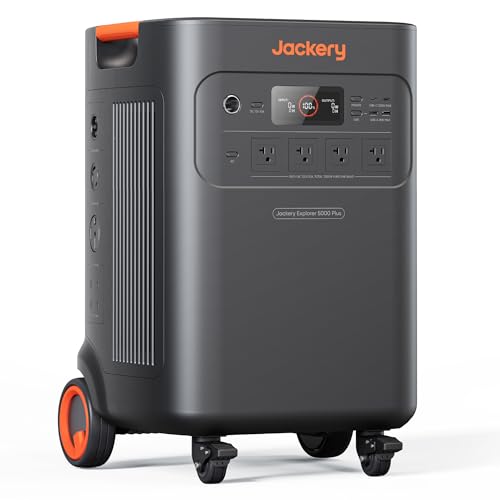
Jackery built its reputation on portable camping generators, but the Solar Generator 5000 Plus is a statement of intent for the whole-home market. Delivering 5,040 Wh of LiFePO4 capacity with 7,200W of 120/240V output, it's Jackery's most powerful system by a wide margin — and it can expand to 60 kWh with additional battery packs. The 10-year lifespan on the LiFePO4 cells ensures this system will still be running strong when cheaper alternatives have been replaced twice over.
Capacity
5,040 Wh
AC Output
7,200 W
Max Expand
60 kWh
What makes the 5000 Plus stand out is Jackery's vertically integrated ecosystem. The system comes with the company's signature ChargeShield technology for optimized battery health, app-based energy management, and compatibility with Jackery's SolarSaga solar panels (up to 3,000W input). The 120/240V dual-voltage output means it can integrate with a standard home transfer switch without special adapters.
Who it's for: Jackery loyalists who want to stay within the brand ecosystem while getting genuine whole-home capability. Also ideal for homeowners who plan to expand gradually — the base 5,040 Wh system covers critical circuits, and adding expansion packs later boosts capacity without replacing existing hardware.
▶ Show pros & cons
Pros
- 5,040 Wh with 7,200W high output
- Expandable to 60 kWh
- 10-year LiFePO4 lifespan
- 120/240V split-phase
- Jackery's trusted brand ecosystem
- ChargeShield battery optimization
Cons
- Premium pricing — $3,149.00 on Amazon
- Heavy system, not portable
- 3,000W solar input is mid-range
- New product with limited user reviews

Pecron F5000LFP Power Station
The Pecron F5000LFP is the value champion of the whole-home category. The base unit delivers 5,120 Wh of capacity and 7,200W of 120/240V dual-voltage output — that's more capacity than the EcoFlow Delta Pro 3 and nearly identical output to the Jackery 5000 Plus, typically at a noticeably lower price than either. It supports expansion up to 35.8 kWh with additional FP5000-48V batteries, and its 6,400W solar input capability far exceeds any competitor at this price point.
Capacity
5,120 Wh
AC Output
7,200 W
Solar Input
6,400 W
The F5000LFP also features 0ms UPS protection on two 20A and one 30A outlet, ensuring seamless power during grid flickers. Its detachable cart makes moving the 124 lb unit more manageable, and the battery heating mode ensures reliable operation in winter conditions. The smart app allows scheduling, solar management, and peak-shaving to optimize energy costs.
Who it's for: Budget-conscious homeowners who want maximum capacity and output per dollar. If you're willing to go with a challenger brand (Pecron is less established than EcoFlow or Jackery but has a strong track record in the power station space), the F5000LFP delivers phenomenal value — more capacity, more output, and faster solar charging than competitors at half the price.
▶ Show pros & cons
Pros
- Best value: 5,120 Wh / 7,200W
- 6,400W solar input — class-leading
- 120/240V dual voltage
- 0ms UPS on dedicated outlets
- Expandable to 35.8 kWh
- Battery heating for winter use
Cons
- Challenger brand — less community support
- Limited availability vs. big brands
- Heavier than comparable units
- Fewer expansion battery options
OUPES Guardian 6000
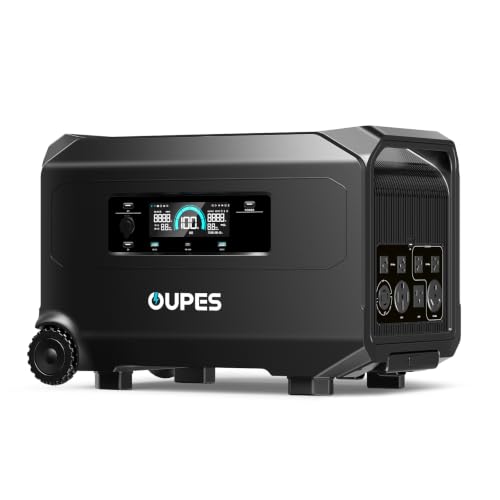
The OUPES Guardian 6000 is purpose-built for homeowners who want a straightforward connection to their electrical panel. With 4,608 Wh of LiFePO4 capacity, 6,000W of 120/240V output, and built-in transfer switch compatibility, it's designed to integrate with a standard home inlet box and interlock kit without proprietary adapters or smart panels. It expands to 41 kWh with additional battery packs.
Capacity
4,608 Wh
AC Output
6,000 W
Max Expand
41 kWh
What we appreciate about the Guardian 6000 is its no-nonsense approach. It doesn't require you to buy into a proprietary smart panel ecosystem — it works with standard 120/240V home electrical infrastructure. The 2,400W solar input is respectable for its class, and the 6,000W continuous output can handle a well pump, fridge, furnace fan, and lighting simultaneously. The OUPES app provides real-time monitoring and scheduling.
Who it's for: Homeowners who already have or plan to install a standard generator transfer switch/interlock kit and want a generator that connects without proprietary hardware. The Guardian 6000 is also a strong choice for those who want challenger-brand pricing without sacrificing capacity — it sits between the EcoFlow Delta Pro 3 and Jackery 5000 Plus in price while offering competitive specs.
▶ Show pros & cons
Pros
- Built for standard transfer switch integration
- 6,000W 120/240V output
- Expandable to 41 kWh
- Competitive pricing for the specs
- No proprietary panel required
- App-based energy management
Cons
- Newer brand with smaller user community
- 2,400W solar input is mid-range
- Limited retail availability
- Heavier than some comparable units
Honorable Mention: EcoFlow Delta Pro Ultra X (12,288 Wh)
We can't talk about whole-home solar generators without mentioning the EcoFlow Delta Pro Ultra X — a 12,288 Wh, 12,000W system that sits in a league of its own. It's essentially a home backup system disguised as a portable power station, capable of powering an entire home including central AC, EV charger, and all kitchen appliances simultaneously. It expands to 180 kWh and supports 10,000W of solar input. It's more expensive than any other unit on this page, but for homes that need uncompromising whole-home backup, it's the ultimate solution.
The Delta Pro Ultra X features EV-grade LiFePO4 cells, dual BMS protection, and a 3-level safety architecture. It integrates with EcoFlow's Smart Home Panel 3 for automatic <20ms transfer switching during outages, and its Storm Guard mode pre-charges the battery to 100% when severe weather is forecast. If budget is no object and you want the most powerful portable whole-home system available, this is the one.
Capacity
12,288 Wh
AC Output
12,000 W
Max Expand
180 kWh
Solar Input
10,000 W
Installation: What You Need to Know
Installing a whole-home solar generator is more involved than setting up a portable power station. Here's what to expect at each integration level:
Level 1: Extension Cords (No Installation)
The simplest approach — run heavy-gauge extension cords from the generator's 120V outlets to your appliances. Works for fridges, freezers, lights, and routers. Cost: just the price of quality heavy-gauge cords. Limitations: only powers plug-in devices, cords through doorways, no hardwired circuits like well pumps or furnaces.
Level 2: Generator Inlet Box + Interlock Kit
A licensed electrician installs an exterior inlet box wired to your panel via a generator interlock — which prevents backfeeding by making it impossible to have both grid and generator power on simultaneously. Cost: varies by home and region — get a quote from a licensed electrician. Benefits: powers hardwired circuits, no extension cords, clean installation. All the generators on this page support 120/240V input for this setup.
Level 3: Automatic Transfer Switch (ATS) + Smart Panel
The premium approach — an ATS detects grid failure and switches to generator power automatically in under 20 milliseconds. Smart panels (like EcoFlow Smart Home Panel 3 or Anker's panel integration) add load management, priority circuit selection, and solar optimization. Cost: substantially more than an inlet box and interlock — get a quote. The Anker SOLIX E10 and EcoFlow Delta Pro 3 support this level of integration.
Safety warning: Never plug a generator directly into a wall outlet (backfeeding). This is dangerous, illegal in most jurisdictions, and can electrocute utility workers repairing lines. Always use a transfer switch or interlock kit installed by a licensed electrician.
Solar Standby Generator: Whole-Home Backup That Switches On by Itself
When people search for a “solar standby generator” or “solar powered standby generator,” they usually mean a battery system that behaves like a Generac-style home standby unit. It's permanently wired to the house, recharged by solar panels and the grid, and takes over automatically when the grid fails, whether or not anyone is home. The battery alone doesn't do that. The automatic part comes from a manufacturer transfer switch or smart panel that an electrician installs at your main panel. Here's how the three biggest systems on this page do it:
Anker SOLIX E10 + Power Dock
Anker calls its Power Dock “the automatic energy gateway” to the E10 and lists a ≤20 ms seamless switchover, 200A whole-home coverage, and 12 smart branch circuits. It works only with the E10. Anker's Smart Inlet Box is the cheaper manual alternative, so if automatic switchover is the goal, the Power Dock is the piece you need. Sources: Anker Power Dock vs Smart Inlet Box; Solar Builder.
EcoFlow Delta Pro 3 + Smart Home Panel 2
EcoFlow's Smart Home Panel 2 is a 12-circuit sub-panel with 20 ms auto switchover, and EcoFlow lists the Delta Pro 3 as compatible (though not at the same time as a Delta Pro Ultra). It requires professional installation. Sources: EcoFlow Smart Home Panel 2; B&H listing.
Jackery Solar Generator 5000 Plus + Smart Transfer Switch
Jackery's Smart Transfer Switch is compatible only with the 5000 Plus series and covers 12 essential circuits. It switches within ≤20 ms with UPS enabled. With UPS off, the switchover takes about 5 seconds, so turn it on in the app if you want standby-style behavior. It must be installed by a licensed electrician, indoors or somewhere protected from rain. Sources: Jackery Smart Transfer Switch spec listing; Best Buy listing.
Solar Standby vs Gas Standby Generator
| Factor | Solar battery standby | Gas standby generator |
|---|---|---|
| Switchover | ≤20 ms with the maker's transfer switch/panel. Lights don't go out. | Engine has to start first. Kohler advertises power restored in about 10 seconds. |
| Fuel | Sunlight and grid recharge. Nothing to store or deliver. | Natural gas line or propane tank |
| Runtime limit | Battery size plus whatever solar you harvest that day. Cloudy multi-day outages are the weak spot. | As long as the fuel lasts. On a utility natural-gas line, effectively continuous. |
| Maintenance | Minimal: firmware updates, keep panels clean | Engine service. Generac says oil changes at least every 2 years, and after every 100 run-hours in extreme heat or cold. |
| Exhaust & noise | None. Can sit in a garage or utility room. | Burns fuel and produces carbon monoxide, so it's installed outdoors |
Sources: Kohler's ~10-second restore claim per Kohler 14RESAL listing and AP Electric; ATS operation per Generac; oil intervals per Generac yearly maintenance guidance; CO hazard per CPSC.
The honest runtime check: at a steady 1,000 W average essential-circuit load (fridge, furnace blower, lights, well pump cycling), and assuming 85% inverter efficiency, the base units run about 10.2 hours (Anker E10 kit, 12,000 Wh), 4.3 hours (Jackery 5000 Plus, 5,040 Wh), and 3.5 hours (Delta Pro 3, 4,096 Wh) before solar recharge. Each system takes expansion batteries, and solar refills them during the day. Still, a solar standby system protects essential circuits through typical outages. If you need central AC and everything else running through a week of storms, a gas standby generator, or a hybrid setup like the E10 paired with a generator, is the more realistic answer.
Wiring details: Transfer switches for solar generators →
When to Buy a Whole-Home Solar Generator vs. Stick with Portable
The lines between portable power stations and whole-home systems are blurring, but the decision still comes down to a few key factors:
| Scenario | Stick with Portable | Go Whole-Home |
|---|---|---|
| Frequency of outages | 1–2 per year, under 4 hours | 3+ per year or multi-day outages |
| Devices to power | Fridge, lights, router, phones | Well pump, furnace, AC, EV charger |
| Budget | Under $1,500 | $3,000+ |
| Portability needed? | Yes — take camping or RV | No — stationary installation |
| Willing to install? | Plug-and-play only | Yes, transfer switch preferred |
| Off-grid interest? | No | Yes — may become primary power |
 Written by Morgan Chen · Updated · Power & Energy Editor
Full Reviews of the Whole-Home Contenders
Specifications only tell you so much. These are our full-length reviews of the units that matter most in this class, including their honest limitations:
Anker SOLIX F3800 Plus Review
3,840Wh, 6,000W output and the fastest 3,200W solar input in the class
Jackery HomePower 3600 Plus Review
3,584Wh expandable to 21kWh with 7,200W surge at just 78 lb
OUPES Guardian 6000 Review
4,608Wh expandable to 41kWh — the value challenger with 48.5 Wh per pound
Transfer Switch & Home Wiring
What you need to wire any of these into your panel safely
Frequently Asked Questions About Whole-Home Solar Generators
How much does a whole house solar generator cost?
Budget for three parts: the base unit, any expansion batteries, and installation. On Amazon right now, the five base units on this page run from $2,799 to $6,499 before expansion batteries. Connecting it to your panel adds roughly $400–$850 for an inlet and interlock or $400–$1,300 for a manual transfer switch, per published cost guides, plus permits. Automatic smart panels cost more. Get itemized quotes from a licensed electrician.
Is a whole house solar generator cheaper than a Tesla Powerwall or a gas standby generator?
Often, once installation is included. A single Tesla Powerwall 3 is quoted at about $11,500–$16,500 installed in published 2026 cost guides. Gas standby averages vary widely by source, from about $5,000 to about $11,000. A solar generator connected through an interlock or manual transfer switch usually has the lowest installation cost, but compare equal battery capacity before comparing prices.
What is the difference between a portable power station and a whole-home solar generator?
Portable power stations typically output 120V only, have capacities under 3,000 Wh, and are designed to power individual appliances via plug-in outlets. Whole-home solar generators output 120/240V split-phase power, start at 3,000–5,000+ Wh capacity, and are designed to connect to your home's electrical panel via a transfer switch — powering multiple circuits simultaneously, including hardwired appliances like well pumps and furnaces.
Can a whole-home solar generator run central air conditioning?
It depends on the generator's peak output and your AC's startup surge. A typical 3–5 ton central AC unit draws 2,000–5,000W running but can surge to 8,000–15,000W on startup. The Anker SOLIX E10 (10kW turbo) can handle smaller central AC units, while the EcoFlow Delta Pro Ultra X (12,000W) can handle most residential systems. Most other whole-home generators in the 4,000–7,200W range can run a window AC or mini-split but not a central AC system.
How much does it cost to install a whole-home solar generator?
With extension cords only, nothing. To power hardwired circuits, published cost guides put an inlet box and interlock at roughly $400–$850 and a manual transfer switch at $400–$1,300 installed, with permits often $50–$450 on top. An automatic transfer switch or manufacturer smart panel costs substantially more. Costs vary by home and region, so get a quote from a licensed electrician.
How many solar panels do I need for a whole-home system?
For a system with 3,000–6,000W solar input capability, you'll need 8–15 standard 400W solar panels. The Anker SOLIX E10 supports up to 9,000W solar input (roughly 22 panels). Your actual solar needs depend on your daily energy consumption, local climate, and desired recharge speed. A good rule of thumb: match your solar input capacity to 1.5–2x your daily watt-hour consumption for reliable year-round recharge.
Do whole-home solar generators qualify for tax credits or incentives?
Not at the federal level for a 2026 purchase. The 30% Residential Clean Energy Credit (Section 25D), which covered home battery storage, ended for expenditures made after December 31, 2025. Some states and utilities still offer battery storage incentives, usually for permanently installed systems — check the DSIRE database for your ZIP code. Our tax credit guide explains what changed.
How long do whole-home solar generators last?
LiFePO4 batteries, used in all the generators on this page, are rated for 3,500–6,000+ charge cycles before reaching 80% capacity. For a homeowner who cycles the battery 200 times per year (roughly every other day), that translates to 17–30+ years of useful life. The electronics (inverter, BMS, charging circuitry) typically last 10–15 years. Most manufacturers offer 5–10 year warranties on their flagship units.
Can I take a whole-home solar generator with me if I move?
Yes — this is one of the biggest advantages over permanently installed systems like Tesla Powerwall. Whole-home solar generators are freestanding units that connect to your panel via a standard inlet box. When you move, you unplug the generator, disconnect the inlet box (or leave it for the next homeowner), and take everything with you. This portability makes whole-home generators a better investment for homeowners who may move within 10 years.
What is a solar standby generator?
It's a battery system, recharged by solar panels and the grid, that is wired into your home through an automatic transfer switch or smart panel, so it takes over by itself when the grid fails, like a gas standby generator. Examples are the Anker SOLIX E10 with Anker's Power Dock (≤20 ms switchover), the EcoFlow Delta Pro 3 with Smart Home Panel 2 (20 ms), and the Jackery 5000 Plus with its Smart Transfer Switch (≤20 ms with UPS enabled). All require installation by a licensed electrician.
Is a solar standby generator better than a gas standby generator?
It depends on the outage. A solar battery system switches over in milliseconds instead of seconds, makes no exhaust or noise, and needs almost no maintenance. Its runtime is limited by battery capacity and the day's solar harvest. A gas standby unit on a natural-gas line can run for as long as the fuel lasts, but it needs engine service (Generac specifies oil changes at least every two years) and must be installed outdoors because it produces carbon monoxide. For essential circuits through typical outages, solar works. For week-long, whole-house loads, gas or a hybrid setup is more realistic.