
Home Integration Guide · Updated September 18, 2026
Transfer Switch for a Solar Generator: How to Wire a Power Station Into Your Home
A large power station only becomes a home backup system once it can feed your household wiring — and that step is where most DIY plans go wrong. You cannot legally or safely connect a battery to house circuits without a transfer device. This guide explains what a transfer switch does, the difference between manual and automatic changeover, when you need 240V split-phase, and which stations are built for this.
As an Amazon Associate, SolarGenAdvisor earns from qualifying purchases made through links on this page, at no additional cost to you.
 By
By Why You Cannot Just Plug a Station Into Your House
The tempting shortcut is a double-male "suicide cord" from the station into a dryer outlet or a wall receptacle. It appears to work. It is also the single most dangerous thing you can do with a portable power source, for two reasons:
It can kill a utility worker
Backfeeding energises the lines outside your house. A crew working a supposedly dead circuit has no way to know your battery is live on it. This is why electrical codes require a transfer device that physically prevents the two sources from being connected at once.
It can destroy your equipment and start a fire
When grid power returns, your station's inverter meets the grid head-on. Inverters are not built to be back-driven by the utility, and the failure mode is not graceful. A transfer switch or interlock removes that possibility entirely.
The practical conclusion: treat the connection as an electrician's job, not an accessory purchase. Everything on this page assumes a licensed electrician installs the transfer device. Our job is to help you specify the right one and choose a station that can actually feed it.
The Three Ways to Connect a Station
From least to most capable. Which one fits depends on whether you want to power plug-in circuits, hardwired appliances, or everything.
| Approach | What it powers | Changeover | Best for |
|---|---|---|---|
| Extension cords | Whatever you plug directly into the station | Manual — plug and unplug | Camping, tailgating, a single appliance. No wiring, no transfer device needed. |
| Inlet box + sub-panel or dedicated circuit | A chosen set of circuits (furnace, fridge, lights) | Manual — move the station's cord to the inlet | Most portable-station owners. Flexible, less invasive, and expandable later. |
| Full transfer switch (or smart home panel) | Almost any circuit, including hardwired 240V loads | Manual or automatic, depending on the switch | Frequent outages, whole-home coverage, or anyone who wants power back without being home. |
Manual vs automatic transfer switch
Manual
You throw a switch (or plug the station into an inlet) when the power goes out. Simpler, mechanically foolproof, and usually the cheaper install. The trade-off is that someone has to be home, and nothing is protected if you are away when the grid drops.
Automatic
The switch senses the outage and changes over on its own. This is what turns a station into something that behaves like a standby system, and it is the reason premium stations sell matching home-panel accessories. It costs more and depends on the station supporting it.
Where the inlet box goes
A generator inlet is typically mounted outside, near where you would park a generator or set down a station — the station stays indoors and off the ground, and a proper cord runs to the inlet. If your plan involves a station that lives in a basement or utility room, the inlet can sometimes be mounted to serve that location instead. Decide this with your electrician before the station gets delivered, not after.
120V or 240V? This Decides What Your Backup Can Run
The most common disappointment in home-integration projects is buying a station without checking voltage. Many power stations output 120V only. That covers plug-in loads — refrigerator, furnace blower, router, lights, TV — but it cannot serve a hardwired 240V appliance such as a well pump, a central air conditioner, an electric range, or a large electric dryer.
If your priority list includes any of those, you need a station with 240V split-phase output, which generally means the 3,000 Wh-and-up tier. Two things worth knowing before you buy:
- •240V output is not the same as 240V throughput on every outlet. Some units produce 240V only through a specific outlet or a paired-battery configuration. Confirm the exact outlet you intend to use.
- •Startup surge decides whether large motors run. A well pump or compressor may need several times its running wattage to start. Surge ratings in the 6,000–8,000W range are what make those loads realistic.
Stations Built for Home Integration
These are the units in our testing that are designed to feed household circuits rather than just be carried to a campsite. We log their Amazon prices daily, so where we have history we show what they have actually sold for.
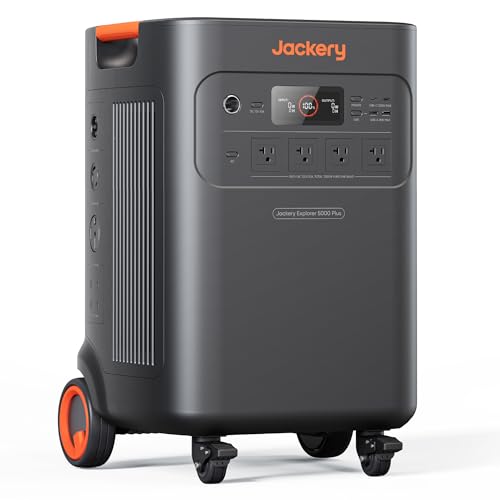
5 kWh class · 120/240V
Jackery Solar Generator 5000 Plus
5,040 Wh · 7,200W output · 7,200W surge · 3,000W solar in · SGA rating 90/100
Current price on Amazon: $3,499.00
Jackery's flagship stationary system: 5,040 Wh expandable to 60 kWh with 7,200W of 120/240V output. The 240V capability is what lets it serve hardwired loads like a well pump or a larger AC unit, not just plug-in circuits. If your transfer-switch plan includes anything hardwired, this is the tier you are shopping in.

4 kWh class · 120/240V
EcoFlow Delta Pro 3
4,096 Wh · 4,000W output · 8,000W surge · 2,600W solar in · SGA rating 95/100
Current price on Amazon: $3,699.00
4,096 Wh with 4,000W output, 8,000W surge, and 240V split-phase support, plus a 2,600W solar input. EcoFlow also sells a dedicated home-panel accessory for automatic changeover on this platform, which is the closest thing to a permanent install a portable station gets.

3.8 kWh class · 120/240V
Anker SOLIX F3800 Plus
3,840 Wh · 6,000W output · 6,000W surge · 3,200W solar in · SGA rating 90/100
Current price on Amazon: $2,699.99
3,840 Wh with a 6,000W output and 3,200W solar input. Anker positions this as a whole-home unit and it carries 240V, making it a genuine alternative to a standby generator for essential circuits — with the advantage that it can also come camping.

3 kWh class · 240V capable
Anker SOLIX F3000
3,072 Wh · 3,600W output · 4,860W surge · 2,400W solar in · SGA rating 93/100
Current price on Amazon: $1,398.98
3,072 Wh expandable to 24 kWh, 3,600W output with 240V split-phase capability and 6,000W AC recharge. The recharge speed is the underrated part of a home-integration build: during a rolling-blackout event you can refill the pack in the windows when grid power returns.

Off-grid class
Anker SOLIX E10 Prime Off-Grid Kit
12,000 Wh · 7,680W output · 10,000W surge · 9,000W solar in · SGA rating 92/100
Current price on Amazon: $7,999.00
12 kWh stackable to 90 kWh with 10 kW turbo output — a true off-grid replacement rather than a backup battery. If you are building toward whole-home independence rather than outage coverage, this is the ceiling of what we cover.
Price pills are drawn from our own daily price log — see the solar generator price tracker. They describe what we observed on the Amazon listing, not a manufacturer claim or a prediction.
How to Plan the Install
List the circuits you actually want
Write down the specific loads: furnace blower, refrigerator or freezer, well pump, sump pump, router, a lighting circuit, medical equipment. Total them with our solar size calculator and note which are 240V. This list, not the station's marketing, determines the switch.
Decide manual or automatic
If someone is usually home when the power fails, a manual inlet is simpler and cheaper. If outages happen while you are at work, or you are protecting a freezer or a medical device, the automatic route is the one that actually helps.
Get the electrician involved before you buy the station
Circumstances, panel capacity, and local codes vary enough that any quoted cost would be misleading. Ask for a quote covering the transfer device, the inlet, the wiring, and the permit — then choose a station whose output and voltage match that installed capacity, not the other way round.
Match the station's recharge plan to your outage length
A battery is a tank, not a well. For anything beyond a day, plan how you refill it: solar input during the day, a generator feeding the station, or a 6,000W-class AC recharge during rolling outages. Our expansion battery guide covers adding capacity instead of adding units.
We deliberately do not publish transfer-switch price ranges or cite specific code articles here: installations vary by panel, jurisdiction, and equipment, and we would rather send you to a licensed electrician with a good specification list than publish a figure we cannot verify against your situation.
Transfer Switch FAQ
Do I need a transfer switch to use a solar generator at home?
You need one if you want to power your household wiring. If you are plugging individual appliances directly into the station's outlets, no transfer device is involved. The moment you want the station to feed a circuit through your panel, the connection has to go through a transfer switch, inlet, or interlock installed by a licensed electrician.
Can I backfeed a power station through a dryer outlet?
No. Backfeeding energises the utility lines outside your home, where a lineworker could contact them believing they are isolated, and it exposes the station's inverter to the grid when power returns. Use a proper transfer device.
How many circuits can a power station back up?
It comes down to capacity and output rather than a circuit count. A 2,000 Wh station realistically covers a furnace blower plus a few small loads; 3,000–4,000 Wh covers essentials like a refrigerator, router, and lighting; 5,000 Wh and up, with 240V output, starts to cover hardwired appliances. Total your own list with our size calculator.
What is the difference between a transfer switch and an interlock kit?
Both prevent the station and the grid from being connected at the same time. A transfer switch moves selected circuits to the backup source; an interlock is a mechanical guard on your main breaker that forces you to switch the main off before the backup inlet can be energised. Which is appropriate depends on your panel and what you want to power — an electrician should decide.
Which power stations support automatic changeover?
Automatic changeover requires both a station platform that supports a matching home panel and, usually, professional installation. EcoFlow sells a home-panel accessory for its Delta Pro line, and the Anker SOLIX F3800 Plus is positioned as a whole-home unit. For most portable stations, changeover is manual by design.
Can I connect a power station to a transfer switch myself?
The station side is plug-in. The household side involves permanent wiring, a panel, and a permit in many jurisdictions. We recommend a licensed electrician for anything on the household side — the consequence of getting it wrong is a fire or an electrocuted utility worker, not a warranty issue.
Is a power station with a transfer switch cheaper than a standby generator?
The equipment can be, and the installation is usually simpler because there are no fuel lines, no exhaust clearance, and no annual maintenance. The trade-off is run time: a battery holds a finite amount of energy, so a multi-day outage needs a plan for recharging it. If your outages routinely last days, compare against our solar generator vs gas generator breakdown.