
Solar Tech Guide · Updated November 2026
Can You Charge an Electric Car With Solar Panels?
Yes, but only rooftop-scale solar can do it day to day. A 6 kW home array makes enough energy for roughly 81 miles a day in a Model 3 on an average Chicago-level day. A portable solar EV charger setup (a 200W panel feeding a power station) adds about 2.3 miles. Big batteries are emergency range: a full 3 kWh station is about 10 miles. The math, by setup, is below.
As an Amazon Associate, SolarGenAdvisor earns from qualifying purchases made through links on this page, at no additional cost to you.
 By
Miles per Day by Solar Setup
Estimated miles of range added per day from solar alone, at 4.5 peak sun hours (Chicago’s annual average). Portable panels go through a power station and a Level 1 cord; rooftop arrays go through the home’s solar inverter to a wall charger. All figures are our arithmetic, explained in the next three sections.
| Setup | Energy to the car per day | Model 3 | Equinox EV | F-150 Lightning |
|---|---|---|---|---|
| One 100W portable panel | ~0.29 kWh | ~1.1 mi | ~0.9 mi | ~0.6 mi |
| One 200W portable panel | ~0.57 kWh | ~2.3 mi | ~1.9 mi | ~1.2 mi |
| Four 200W portable panels (800W) | ~2.30 kWh | ~9.2 mi | ~7.4 mi | ~4.7 mi |
| 6 kW rooftop array | ~20.3 kWh | ~81 mi | ~65 mi | ~41 mi |
| 12 kW rooftop array (median quoted size) | ~40.5 kWh | ~162 mi | ~131 mi | ~83 mi |
Formula (ours): panel watts × 4.5 sun hours × 0.75 (heat, angle and wiring losses) × 0.85 for a power station’s inverter where one is used, then × miles per kWh from EPA ratings. The 12 kW row uses the median system size in EnergySage’s first-half 2026 quotes (EnergySage H1 2026 report; Mercom). Sun hours: NLR Solar Resource API. Your car, climate and charging losses change the result.
The verdict
If you want solar to cover your driving, the answer is rooftop or carport solar feeding a Level 2 charger, with a home battery only if you want to shift daytime solar into evening charging or keep charging through an outage. The EcoFlow TITAN 5000 Plus (91/100) is the one product here whose maker says it can feed an EV charging circuit. Portable panels and power stations are for getting a stranded car to the next charger.
EV Efficiency: Miles per kWh
Every answer on this page starts with how far a car goes on a kilowatt-hour. The EPA publishes that as kWh per 100 miles. We picked three common EVs that span the range, from an efficient sedan to a full-size pickup. A kilowatt-hour is 1,000 watt-hours; if the units are new to you, our watt-hour explainer covers them.
| Vehicle | EPA kWh / 100 mi | Miles per kWh | EPA range | Source |
|---|---|---|---|---|
| 2026 Tesla Model 3 Premium RWD | 25 | 4.0 | 363 mi | fueleconomy.gov, ENERGY STAR |
| 2026 Chevrolet Equinox EV FWD | 31 | 3.2 | 319 mi | fueleconomy.gov, ENERGY STAR |
| 2025 Ford F-150 Lightning 4WD (Standard Range) | 49 | 2.0 | 240 mi | fueleconomy.gov, ENERGY STAR |
Charging levels. Level 1 uses a 120 V household outlet; the DOE’s Alternative Fuels Data Center (AFDC) lists it at about 5 miles of range per hour, assuming 1.9 kW. Level 2 runs on 240 V at 2.9 to 19.2 kW and adds about 25 miles per hour (DOE Alternative Fuels Data Center (charging levels)). Many portable Level 1 cords draw 12 A, which is 120 V × 12 A = 1,440 W, or about 1.4 kW (Lectron Level 1 charger listing; Enphase also sells a 120 V mobile charger). We use 1.44 kW for power stations because it is the lighter of the two common Level 1 draws.
Why Portable Panels Add Only a Few Miles
A portable panel cannot plug into the car. Its output has to charge a power station, and the station’s inverter then runs a Level 1 cord. Every step costs energy, and the starting amount is small. Peak sun hours are the day’s sunlight expressed as hours of full sun; we use annual averages for a panel tilted at the local latitude from the National Solar Radiation Database, via the Solar Resource API of the National Laboratory of the Rockies (NLR), the DOE lab formerly called NREL (DOE).
| Location (sun hours) | 200W panel harvest | After station inverter | Model 3 miles | F-150 Lightning miles |
|---|---|---|---|---|
| Phoenix, AZ (6.68 h) | ~1,002 Wh | ~852 Wh | ~3.4 | ~1.7 |
| Chicago, IL (4.50 h) | ~675 Wh | ~574 Wh | ~2.3 | ~1.2 |
| Seattle, WA (3.98 h) | ~597 Wh | ~507 Wh | ~2.0 | ~1.0 |
| Chicago in December (2.65 h) | ~398 Wh | ~338 Wh | ~1.4 | ~0.7 |
Even the sunniest row is a few miles, while the average US driver covers about 38 miles a day (13,735 miles a year in 2024, per FHWA, Our Nation’s Highways 2026). EcoFlow, which sells both portable panels and EV-ready home batteries, makes the same point: a home array “can generate enough electricity to cover a meaningful share of your daily driving” while car roofs and portable panels cannot (EcoFlow). Want to model your own panel? Our solar panel output calculator runs the same harvest math for any wattage and city.
Who this setup is for: a camper or rural driver who wants a way to crawl to the next charger, or someone topping up a plug-in hybrid’s small battery. Who should skip it: anyone hoping to stop paying for charging. Four panels and a station cost real money and return a sedan-length errand per sunny day.
Rooftop Solar, Home Batteries and Level 2
The setup that actually charges a car is ordinary home solar plus a wall charger. The AFDC says EV owners “may install Level 2 (240 V) charging equipment in their homes,” that permits may be required, and that “some homes might have insufficient electric capacity for Level 2 equipment” until an electrician adds circuits (DOE Alternative Fuels Data Center (charging at home)). The panels don’t connect to the charger directly: they feed the house, and the charger draws from the house.
- Solar only, charging in daytime. A 6 kW array makes about 20.3 kWh on an average Chicago-level day by our formula, more than a typical commute needs. You get the most direct use of it by charging while the sun is up, which suits a car parked at home during the day.
- Solar plus net billing, charging at night. Most commuters charge after dark, so the car runs on grid power while daytime solar is exported. How much that export is worth depends on your utility’s rules.
- Solar plus a home battery. A battery stores afternoon solar for evening charging and keeps the charger running in an outage, if the charger circuit is on the backed-up side. But a 5 kWh battery at a typical 7.2 kW Level 2 rate lasts about 35 minutes and holds roughly 17 miles for a Model 3. EcoFlow’s own figures for its TITAN 5000 Plus agree: about 4.25 kWh usable, “roughly 13 miles” at 3 miles per kWh, and no output left for other loads at full charger draw (EcoFlow). Expansion batteries stretch that; our home battery backup guide compares installed and plug-in systems, and the expandable power station guide shows the cost per added kWh.
Grid-tied panels alone usually stop producing during a blackout; our guide to whether solar panels work in a power outage explains why. Systems that can carry a Level 2 load are 240 V, which is the territory of our 10,000 watt solar generator picks.
Power Stations: Emergency Range Only
A charged power station can run a Level 1 cord for a couple of hours, which is enough to reach a charger, not to commute. Before trying it, check that the maker supports it. The clearest maker statements we found:
- Anker SOLIX F3800 and F3800 Plus. Anker says owners can “avoid complicated grounding accessories and just connect your EV charger cable” to the F3800, charging at 6,000W/240V, and that a full charge is “long enough for around a 12 mile ride” (Anker F3800 page). The F3800 Plus FAQ says to double-press the AC outlet button for EV mode and to set the charging rate below 25A (Anker F3800 Plus page (FAQ); F3800 user guide). Neither model has a card below: when we wrote this page, Anker’s F3800 Plus page showed it sold out and Amazon listed it out of stock. On November 20, 2026, Amazon listed the F3800 Plus as orderable again, with a later ship date.
- EcoFlow TITAN 5000 and 5000 Plus. These are installed home batteries rather than portable stations. EcoFlow says they can supply an EV charging circuit, and the manuals name the PowerPulse 9.6kW charger (EcoFlow; TITAN 5000 Plus user manual).
- Everything else on this page. We did not find maker guidance on EV charging for the other stations listed below. If the manual is silent, ask the maker before plugging in a charging cord.
| Battery (score) | Rated | Hours on Level 1 | Model 3 | Equinox EV | F-150 Lightning | Price |
|---|---|---|---|---|---|---|
| EcoFlow TITAN 5000 Plus (91/100) | 5,017 Wh | ~3.0 h | ~17 mi | ~14 mi | ~8.7 mi | $3,699.00 |
| EcoFlow TITAN 5000 (91/100) | 5,017 Wh | ~3.0 h | ~17 mi | ~14 mi | ~8.7 mi | $3,199.00 |
| Anker SOLIX E10 (6kWh base system) (92/100) | 6,144 Wh | ~3.6 h | ~21 mi | ~17 mi | ~11 mi | $3,799.00 |
| Bluetti Elite 300 (89/100) | 3,014 Wh | ~1.8 h | ~10 mi | ~8.3 mi | ~5.2 mi | $1,299.00 |
| Jackery HomePower 3000 (87/100) | 3,072 Wh | ~1.8 h | ~10 mi | ~8.4 mi | ~5.3 mi | Check price at Amazon → |
| EcoFlow DELTA Pro (87/100) | 3,600 Wh | ~2.1 h | ~12 mi | ~9.9 mi | ~6.2 mi | $1,799.00 |
| FOSSiBOT F3600 Pro (86/100) | 3,840 Wh | ~2.3 h | ~13 mi | ~11 mi | ~6.7 mi | $1,179.00 |
Our formula: rated Wh × 0.85 ÷ 1,440 W for hours; usable kWh × EPA miles per kWh for range. Base units only, no expansion batteries. Amazon prices are live and change often.
Equipment Picks by Type
Specs and summaries come from our product database; scores are our editorial ratings out of 100, synthesized from published specs, Amazon pricing and Amazon customer reviews. None of these turns a portable setup into a daily EV charger.
Home Batteries (120/240V, Installed)
Wired-in batteries that can back a Level 2 circuit. These are the only products here that make sense next to an EV charger, and only alongside rooftop solar.
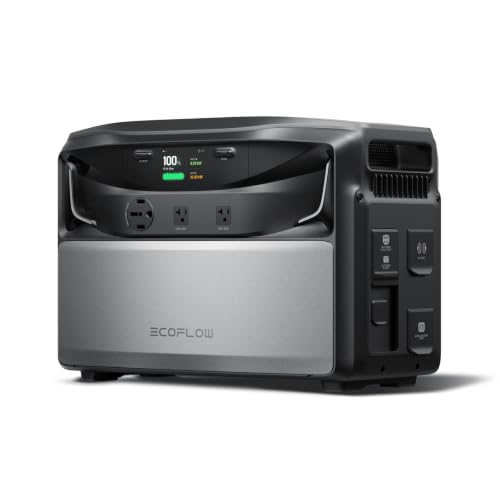
Best for a Solar EV Circuit · 91/100
EcoFlow TITAN 5000 Plus
5,017 Wh · 7,200W AC (120/240V) · 8,000W solar · 121.3 lb
Solar-first version of the installed TITAN home battery: 5 kWh LiFePO4, 7,200W of 120/240V output that rises to 10 kW while solar is feeding it, and two 4 kW solar inputs, expandable to 30 kWh; at 121.3 lb and IP20 it is an indoor, wired-in unit.
EV angle: EcoFlow says the TITAN 5000 Plus “can store that energy and supply compatible home circuits, including an EV charging circuit” (EcoFlow), and the TITAN manual names the EcoFlow PowerPulse 9.6kW charger for EV charging (TITAN 5000 Plus user manual). Its output rises to 10 kW while solar is feeding it (pv magazine USA).

Same Battery, Less Solar Input · 91/100
EcoFlow TITAN 5000
5,017 Wh · 7,200W AC (120/240V) · 4,000W solar
Installed 5 kWh LiFePO4 home battery with 7,200W of 120/240V split-phase output and 4 kW of solar input that expands in 5 kWh steps to 30 kWh and pairs with EcoFlow's Smart Home Panel 10, so it is a wired-in system rather than a portable station.
EV angle: Same 5 kWh battery and 7,200W output as the Plus, with one 4 kW solar input instead of two (pv magazine USA). EcoFlow’s TITAN 5000 manual carries the same PowerPulse EV charging note as the Plus manual.

Biggest Base Battery · 92/100
Anker SOLIX E10 (6kWh base system)
6,144 Wh · 7,600W AC (120/240V) · 9,000W solar
The E10 power module with one 6,144Wh B6000 battery: 7.6kW of continuous 120/240V output, 9kW of solar input and expansion to 90kWh. Its listing says it connects to an existing transfer switch or inlet box and is NEMA 4 rated for outdoor installation.
EV angle: We did not find an Anker statement about running an EV charger from the E10. Treat it as whole-home backup with a large battery, and ask the installer whether the charger circuit belongs on the backed-up side.

Off-Grid Array + Battery Kit · 85/100
ECO-WORTHY 10kW 48V Complete Solar System (20.48kWh Battery, 9 x 590W Panels)
20,480 Wh · 10,000W AC · 5,310W solar
Whole-home-scale 48V system: nine 590W bifacial panels (5,310W), a 10kW all-in-one inverter with 120V/240V split-phase output and dual MPPT inputs, and four 5.12 kWh Cubix server-rack batteries (20.48 kWh). It ships by freight and ECO-WORTHY recommends a qualified installer.
EV angle: A complete 48V system with 5,310W of panels and 20.48 kWh of storage. ECO-WORTHY does not publish EV charging guidance for it that we found, and it recommends a qualified installer.
Large Power Stations (Emergency Range Only)
Plug-in stations with 3 to 4 kWh. A full one adds roughly 10 to 15 miles to an efficient sedan through a Level 1 cord, and only if the maker allows it.

Lightest 3 kWh Station · 89/100
Bluetti Elite 300
3,014 Wh · 2,400W AC · 1,200W solar · 58 lb
Compact 3,014.4Wh LiFePO4 station at about 58 lb with 2,400W of 120V output, a TT-30 RV outlet, a 12V/30A DC port, 1,200W solar input and a 10ms UPS, but it is 120V-only, cannot be expanded and is loud under heavy load.
EV angle: We found no Bluetti statement that the Elite 300 supports EV charging. Check the manual before plugging in a Level 1 cord.

Transfer-Switch Ready · 87/100
Jackery HomePower 3000
3,072 Wh · 3,600W AC · 1,000W solar · 59.5 lb
3,072Wh LiFePO4 station at about 59.5 lb with 3,600W of 120V output (7,200W surge), a TT-30 outlet, a 20ms-or-faster UPS and transfer-switch support for up to six circuits, but it cannot be expanded, has no 240V output and takes only 1,000W of solar.
EV angle: We found no Jackery statement that the HomePower 3000 supports EV charging. Check the manual before plugging in a Level 1 cord.

Expandable to 10.8 kWh · 87/100
EcoFlow DELTA Pro
3,600 Wh · 3,600W AC · 1,600W solar · 99 lb
EcoFlow's original 2021 home battery: 3,600Wh of LiFePO4 with 3,600W of 120V output (7,200W surge), 1,600W of solar input and expansion to 10.8kWh with two extra batteries, but it weighs 99 lb and needs a second unit plus EcoFlow's Double Voltage Hub for 240V.
EV angle: We found no EcoFlow statement that the original DELTA Pro can charge an EV from its outlets. Check the manual before plugging in a Level 1 cord.
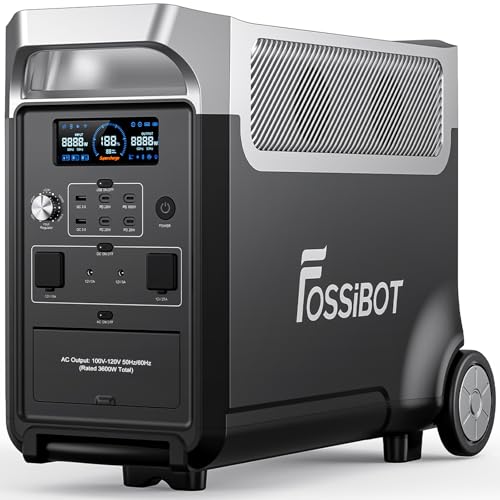
Largest Battery of the Four · 86/100
FOSSiBOT F3600 Pro
3,840 Wh · 3,600W AC · 2,000W solar · 92.6 lb
Value-focused 3,840Wh LiFePO4 station with 3,600W 120V output (7,200W surge), a TT-30 RV outlet, 2,000W solar input and expansion to 11,520Wh — a lot of capacity for its price tier, but it is 120V-only, recharges at just 1,500W from the wall, and its spec sheet lists no UL certification.
EV angle: We found no FOSSiBOT statement that the F3600 Pro supports EV charging. Check the manual before plugging in a Level 1 cord.
Rigid Panels and Panel Kits
Fixed glass panels for a garage roof, shed or ground mount. They charge a battery or power station, not the car directly.

Garage or Shed System · 82/100
ECO-WORTHY 1560W 48V Complete Solar Kit (5.12kWh + 3500W Inverter)
5,120 Wh · 3,500W AC · 1,560W solar
48V cabin or shed system with eight 195W bifacial panels (1,560W), a 3,500W inverter with a built-in 80A MPPT controller and WiFi, and one 5.12 kWh server-rack battery; it arrives in several packages, so check that every part has arrived.
EV angle: 1,560W of panels with a 5.12 kWh battery and a 120V inverter. On an average Chicago day that harvest is about 5.3 kWh before inverter losses (our arithmetic), so plan on it for lights, tools and a battery top-up rather than a commute.

Rigid Pair for a Station · 77/100
Callsun 400W N-Type Bifacial Solar Panel (2 x 200W)
400W of panels · 47.6 lb
Two 200W N-type bifacial glass panels whose series open-circuit voltage of about 54.6V (per Callsun) stays under the 60V solar limit of many power stations; each panel weighs 23.8 lb and is split into two halves to soften partial shading.
EV angle: Two 200W bifacial glass panels. Paired with one of the stations above, they harvest about 1.1 kWh a day after inverter losses on an average Chicago day (our arithmetic), roughly 4.6 miles for a Model 3.

Single Rigid Panel · 77/100
Renogy 200W N-Type Rigid Solar Panel (24V)
200W of panels · 23.4 lb
Single 200W N-type rigid panel (24V-class, 37.44V open-circuit) at 23.4 lb, sized for van and RV roofs; best with an MPPT controller.
EV angle: One 200W rigid panel. Useful for a station or an RV battery; on its own it adds about two miles a day of sedan range (table above).
How Many Panels for a Daily Commute
Panel capacity needed to make one average day of driving (37.6 miles, from the FHWA average of 13,735 miles a year) on an average-sun day. Formula (ours): daily kWh ÷ (sun hours × 0.75). Count is in 400W panels, rounded up.
| Vehicle (kWh/day) | Phoenix, AZ | Chicago, IL | Seattle, WA |
|---|---|---|---|
| Model 3 (9.4) | 1.9 kW · 5 panels | 2.8 kW · 7 panels | 3.2 kW · 8 panels |
| Equinox EV (11.7) | 2.3 kW · 6 panels | 3.5 kW · 9 panels | 3.9 kW · 10 panels |
| F-150 Lightning (18.4) | 3.7 kW · 10 panels | 5.5 kW · 14 panels | 6.2 kW · 16 panels |
That is extra capacity on top of what the house already uses, and winter needs more: Chicago averages 2.65 sun hours in December, so the same Model 3 commute takes about 4.7 kW then. For your exact roof, tilt and shading, run the free PVWatts calculator from NLR.
Solar Carports
A solar carport is a canopy of panels over the parking spot, and the energy math is the same as rooftop solar. GreenLancer notes that “many solar carports integrate EV chargers, letting drivers charge directly off the array above them,” and that they “cost more than rooftop solar because of the steel or aluminum canopy structure and foundation work involved” (GreenLancer). EnergySage puts carports around $3.62 per watt in 2026 against about $2.60 for rooftop (EnergySage). A carport makes sense when the roof is shaded, too small, facing north or due for replacement; otherwise the roof is the lower-cost place for the same panels.
What Solar EV Charging Costs
Costs vary by home, utility and installer, so treat these as published ranges, not quotes.
- Level 2 charger, installed: Sunrun says installing an EV charger at home “typically costs between $800 and $2,500 in 2026,” more if the panel needs an upgrade (Sunrun); Homeyou lists $949 to $2,497, averaging $1,592 (Homeyou). Level 1 usually needs no new wiring when a suitable outlet exists (DOE Alternative Fuels Data Center (charging at home)).
- Rooftop solar: a median of $2.57 per watt in the first half of 2026, or about $30,712 for a 12 kW system before incentives (Mercom, citing EnergySage H1 2026 report).
- Home battery, installed: about $1,130 per kWh in the same EnergySage data. Our whole-house solar generator cost guide breaks battery, panels and hookup down by tier.
- Portable route: a large station plus panels costs less up front but returns only a few miles a day, as the tables above show.
Federal tax credits
The 30% Residential Clean Energy Credit “shall not apply with respect to any expenditures made after December 31, 2025” (26 U.S.C. § 25D(h)), which covers rooftop solar and home batteries installed in 2026. The IRS also says the Alternative Fuel Vehicle Refueling Property Credit (Section 30C), which covered home EV chargers, “will not be allowed for any property placed in service after June 30, 2026” (IRS Fact Sheet FS-2025-05). What still applies to 2025 installs and carryforwards is in our solar generator tax credit guide. Check state and utility programs; the AFDC notes that “state and utility incentives may be available” for charging equipment (DOE Alternative Fuels Data Center (charging at home)).
Who Should Bother, and Who Shouldn’t
Good fit
- Homeowners with a sunny roof who can add 3 to 6 kW of panels and a Level 2 circuit.
- Drivers whose car sits at home during the day (remote workers, retirees, second cars).
- Households that want the EV charger kept running through outages and will pay for an installed battery.
- Rural drivers and campers who want a power station as a get-to-the-next-charger backup.
Skip it
- Renters or shaded homes counting on portable panels for daily driving.
- Anyone buying a power station mainly to charge an EV: a few hours of Level 1 is all a full one gives.
- Pickup owners expecting the same miles as a sedan: a Lightning uses about twice the energy per mile of a Model 3.
- Buyers counting on a 2026 federal credit for solar, batteries or chargers.
Solar EV Charging FAQ
Can you charge an electric car with solar panels?
Yes. A rooftop array of roughly 3 to 6 kW, feeding a Level 1 or Level 2 charger through your home wiring, can supply the energy for an average day of driving on average-sun days. A portable panel cannot: one 200W panel run through a power station adds about 2.3 miles a day to a 2026 Tesla Model 3 Premium RWD in Chicago-level sun, by our arithmetic from EPA efficiency figures and NLR (formerly NREL) sun-hour data.
How many solar panels does it take to charge an electric car?
For the average 37.6 miles a day that FHWA data imply (13,735 miles per driver in 2024), a Model 3 needs about 9.4 kWh a day. With 4.5 peak sun hours and a 0.75 loss factor that is about 2.8 kW of panels, or 7 panels of 400W. An F-150 Lightning needs about 5.5 kW for the same miles. These are our estimates; use PVWatts for your own roof.
Is there a portable solar EV charger that works?
Portable panels can feed a power station that runs a Level 1 charging cord, but the energy is small. A 200W panel harvests roughly 675 Wh on an average Chicago day, which becomes about 2.3 miles in an efficient sedan after inverter losses. Four panels make that about 9.2 miles. That is emergency range, not daily charging.
Can a portable power station charge an electric car?
Some can, if the maker says so. Anker documents an EV charging mode on the F3800 and F3800 Plus and says a full F3800 is enough for around a 12 mile ride. EcoFlow says its installed TITAN 5000 Plus can supply an EV charging circuit. For other stations we did not find maker guidance, so check the manual first. A full 3 kWh station adds about 10 miles to a Model 3 by our formula.
How long does it take to charge an EV from a power station?
On a 12 amp Level 1 cord (about 1.44 kW), a 3 kWh station empties in about 1.8 hours, using 85% of its rated capacity. A 5 kWh home battery feeding a 7.2 kW Level 2 charger lasts about 35 minutes, which matches EcoFlow's own figure for the TITAN 5000 Plus.
Can I plug a solar panel directly into my electric car?
No. An EV's charge port takes power from charging equipment: a Level 1 or Level 2 charger supplying AC, or a DC fast charger. Panel output has to go through an inverter first, either your home's solar inverter or a power station.
Will my rooftop solar charge my EV during a power outage?
Usually not on its own. Most grid-tied solar systems shut down when the grid goes down unless they are paired with a battery or a backup-capable inverter. With a home battery, check that the EV charger circuit is on the backed-up side and that the battery's output can carry it.
Is there a tax credit for solar EV charging in 2026?
Not federally for new installs. The Residential Clean Energy Credit does not apply to expenditures made after December 31, 2025, and the IRS says the Alternative Fuel Vehicle Refueling Property Credit (Section 30C) is not allowed for property placed in service after June 30, 2026. State and utility incentives may still exist.
Is a solar carport worth it for EV charging?
It works the same way as rooftop solar but costs more per watt. EnergySage puts carports around $3.62 per watt in 2026 against about $2.60 for rooftop, and GreenLancer attributes the difference to the canopy structure and foundations. It makes sense when the roof is shaded, too small or facing the wrong way.
Is Level 1 or Level 2 charging better with solar?
Level 2 lets you use more of a sunny afternoon: the DOE Alternative Fuels Data Center lists about 25 miles of range per hour versus about 5 for Level 1. At that Level 1 rate a 10-hour overnight session adds roughly 50 miles, which covers many commutes, but overnight charging uses grid or battery energy, not live solar.
Sources checked November 18, 2026. Efficiency: EPA ratings via fueleconomy.gov and ENERGY STAR. Charging levels: DOE AFDC. Sun hours: NLR (formerly NREL). Mileage and runtime figures are our arithmetic from those sources.