
Buying Guide · Updated September 2026
Best 200W Portable Solar Panel: Three Picks and How Many You Actually Need
200W is the sweet spot for portable solar. It is light enough for one person to carry, large enough to meaningfully recharge a 1–2 kWh power station in a few hours, and cheap enough that buying two is a reasonable decision rather than a major purchase. The problem is that the panels themselves are nearly identical on paper — the differences that matter are connector compatibility, weight and what happens after 200 folds.
 By
By What "200W" Really Means in Practice
A 200W panel produces 200W only under laboratory conditions: full direct sun, 25°C cell temperature, panel perfectly perpendicular to the light. In the real world you should expect 75–80% of nameplate on a clear summer day — call it 150–160W — and considerably less in winter, in haze, or when the panel is sitting flat on the ground rather than angled at the sun.
Two factors do most of the damage. Angle is the first: a panel lying flat at noon in summer loses very little, but the same panel in winter at 45° latitude can lose more than half its potential output. Heat is the second: solar cells lose efficiency as they get hot, so a panel baking in direct sun can produce less than the same panel in cooler morning conditions with the same light intensity.
This is why we size our recommendations around realistic output rather than nameplate. If you need 400W of usable charging, two 200W panels are the right answer, not one — and if you are charging a 2 kWh station from empty, expect that to take most of a good day rather than the 1.7 hours the arithmetic suggests.
The Best 200W Portable Solar Panels
Every panel below outputs 200W or more, uses monocrystalline cells, and is genuinely portable. What separates them is connector compatibility, weight and surface durability — not headline wattage.
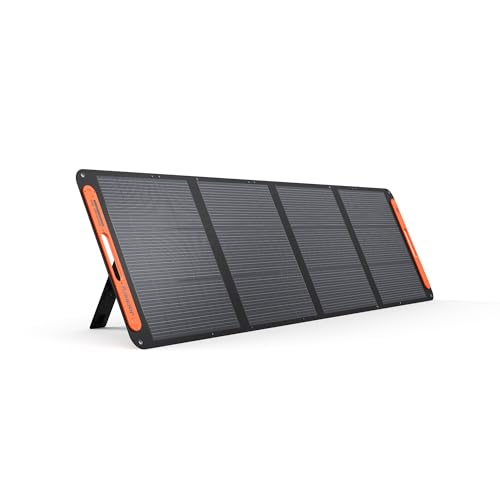
Best for Jackery owners
Jackery SolarSaga 200W
· 13.2 lb · SGA rating 88/100
Current price on Amazon: see current price on Amazon
The only panel here that connects to a Jackery Explorer station with no adapter at all — the 8mm barrel connector is native. At 13.2 lb it is the lightest of the three and folds down to roughly laptop size. Bifacial, so it also collects reflected light from below, and IP68-rated for rain. If you own a Jackery, this removes an entire category of compatibility problems.

Highest wattage
EcoFlow 220W Portable Solar Panel
· 17.6 lb · SGA rating 88/100
Current price on Amazon: $299.00
At 220W this is the highest-output option in the 200W class, with N-Type cells for better low-light and heat performance than conventional panels. Uses MC4 connectors, so it works with any brand provided you have the right adapter, and the adjustable kickstand makes it easier to aim at the sun. 17.6 lb is the trade-off.

Best value, toughest coating
Bluetti PV200 200W Solar Panel
· 15.4 lb · SGA rating 86/100
Current price on Amazon: $399.00
The ETFE surface coating is the reason to pick this one — it resists scratching and UV degradation better than the PET coating used on cheaper panels, which matters if the panel will be folded and unfolded hundreds of times over several seasons. 200W, 15.4 lb, MC4 connectors, adjustable kickstands, and a broad 12-60V compatibility range.
A 200W panel is a nameplate rating. Real output is typically 75–80% of that in good sun, and less in winter or under cloud. Plan capacity around 150–160W of realistic output per panel, not 200W.
Side-by-Side Comparison
| Panel | Output | Weight | Connector | Best For | Our Score |
|---|---|---|---|---|---|
| Jackery SolarSaga 200W | 200W | 13.2 lb | 8mm barrel (native Jackery) | Jackery owners | 88/100 |
| EcoFlow 220W Portable | 220W | 17.6 lb | MC4 (universal + adapter) | Maximum output | 88/100 |
| Bluetti PV200 | 200W | 15.4 lb | MC4 (12–60V range) | Durability, value | 86/100 |
All three are bifacial or near-equivalent in light capture, all fold, and all carry adjustable stands. The honest summary is that the SolarSaga wins on convenience if you own Jackery hardware, the EcoFlow wins on raw output, and the Bluetti wins on surface durability for the price. For a wider field including rigid panels, see our portable solar panel guide.
How Many 200W Panels Does Your Station Need?
The table below uses the maximum solar input of each power station in our database and works out how many 200W panels it would take to approach that ceiling. This is a wiring question as much as a quantity question — your station's voltage and amperage limits may cap you below its wattage ceiling, and that is the single most common reason people buy panels that underperform.
| Power Station | Max Solar Input | 200W Panels to Reach It | Practical Note |
|---|---|---|---|
| Jackery Explorer 1000 V2 | 400W | 2 | Simple parallel pair, no series wiring |
| Anker SOLIX C1000 Gen 2 | 600W | 3 | Check the port's amp limit before adding a third |
| EcoFlow Delta 3 Plus | 1,000W | 5 | Series wiring will be needed to stay under the voltage limit |
| Jackery Explorer 2000 Plus | 1,000W | 5 | Most owners run 2–3 and accept slower charging |
| Bluetti Elite 200 V2 / AC200L | 1,200W | 6 | Diminishing returns past 4 panels in portable use |
| Jackery HomePower 3600 Plus | 1,200W | 6 | Fixed installation suits rigid panels better |
| Anker SOLIX F3000 | 2,400W | 12 | Beyond portable scope — use rigid panels |
| EcoFlow Delta Pro 3 | 2,600W | 13 | Rigid array territory |
| Anker SOLIX F3800 Plus | 3,200W | 16 | Install rigid panels — portable does not scale here |
Past roughly four portable panels, rigging, cabling and setup time stop being worth it and a rigid array becomes the better answer. If you are serious about whole-home backup, see our whole-home guide instead of stacking foldable panels.
Connectors and Compatibility
Panels and power stations are not universal, and the mismatch is almost always at the connector rather than the electrical spec. There are four connector families you will encounter:
MC4 — the industry standard
Used by EcoFlow and Bluetti panels and nearly all rigid panels. Weather-sealed and reliable. To connect an MC4 panel to a station with a different port you need an MC4-to-XT60, MC4-to-Anderson or MC4-to-8mm adapter, depending on the station.
8mm barrel — Jackery's connector
Jackery Explorer stations use an 8mm DC barrel input. A Jackery panel connects with no adapter; a third-party MC4 panel needs an MC4-to-8mm cable. This is the single biggest reason Jackery owners should consider the SolarSaga before comparing wattage figures.
XT60 and Anderson Powerpole
Compact DC connectors used on some stations and on most portable panel kits. Adapters are cheap and widely available, but they add a connection point, and every additional connection is a place for voltage drop and a loose fit.
The limits that actually matter
Two numbers decide whether a panel array will work: the maximum input voltage (often expressed as a Voc ceiling) and the maximum input current in amps. Exceeding the voltage limit can damage the station's charge controller. Exceeding the amperage limit usually just means the station clips the extra current and charges no faster. Our solar panel setup guide walks through reading those specs and wiring series versus parallel correctly.
One Panel or Two? A Decision Rule
Two rules cover most decisions:
If you are adding panels to an existing station, match the panel array to your realistic daily consumption, not to the station's maximum input.
A fridge cycling averages about 190W, which is roughly 4.6 kWh per day. One 200W panel at realistic output generates about 0.8–1 kWh on a good day. You need four or five panels to genuinely keep a fridge running indefinitely on solar alone — or two panels and accept that you are extending runtime rather than replacing it. Buying panels to hit a station's maximum input is usually the wrong target.
If you are buying portable panels, weigh the second panel against a rigid one.
A second foldable 200W panel costs meaningfully more per watt than a rigid panel of the same output. Portable panels earn their premium through folding and carrying. If the panels will live on a roof or in a yard, rigid panels are cheaper per watt, more durable, and produce more per unit area.
Related Reading
Solar Panel Setup Guide
Voltage limits, series vs parallel, MPPT vs PWM, and connectors
Best Portable Solar Panels
The full field, including higher-wattage options
Running Starlink Off-Grid
A load where panel pairing actually pencils out
Solar Panel Deals
Panel pricing through the seasonal sale windows
Frequently Asked Questions
How much power does a 200W panel actually produce?
Expect 75–80% of the nameplate rating in good summer sun — about 150–160W — and less in winter, haze or when the panel is not angled toward the sun. Over a full day in decent conditions, a single 200W panel typically generates roughly 0.8–1 kWh. Heat also reduces cell efficiency, so a panel baking in direct sun can underperform a cooler panel receiving similar light.
Will a 200W panel charge a 1,000Wh power station?
Yes, though not as quickly as the numbers suggest. At realistic output of about 155W, recharging 1,000Wh from empty takes roughly 6.5 hours of good sun, less if you start from a partial charge. Two panels cut that to around 3–3.5 hours, which is why the Jackery Explorer 1000 V2's 400W solar ceiling is well matched to a pair of 200W panels.
Do I need an adapter cable?
It depends entirely on your station's input port. Jackery uses an 8mm barrel connector, while EcoFlow and Bluetti panels use MC4. If the panel and station do not share a connector family you need an adapter, and they are inexpensive. The connector, not the wattage, is the most common reason a panel will not work with a given station — check it before buying.
Can I connect two 200W panels to increase charging speed?
Yes, and it is usually the right move. How you connect them matters: in parallel the amperage adds, in series the voltage adds. Whichever you choose, the combined figures must stay inside your station's input voltage and current limits. Our setup guide explains which wiring suits which station.
Are foldable panels as durable as rigid ones?
No. A rigid panel has a glass front and an aluminium frame, and it will outlast any foldable panel by a wide margin. Foldables earn their place through portability and because they can be repositioned to follow the sun. If your panels will be permanently installed, buy rigid: they cost less per watt, take up less space per watt and last longer. ETFE-coated foldables like the Bluetti PV200 resist the wear of repeated folding better than cheaper PET-coated panels.
What angle should I set the panel at?
As a starting point, set the panel perpendicular to the sun and reposition it a few times a day — for portable panels, tracking the sun manually beats any fixed angle. For a stationary setup, the classic approximation is your latitude for a year-round average, minus 15° in summer and plus 15° in winter. Our setup guide covers tilt in more detail.