
Travel Rules · Updated September 18, 2026
Can You Fly With a Portable Power Station?
Almost certainly not. The lithium battery limits for air travel are set in watt-hours, and they are far lower than most people expect — the ceiling for a battery you can carry on without airline approval is a fraction of the smallest power station we recommend. If you are planning to take a solar generator on a flight, this page will save you an expensive discovery at the security checkpoint.
As an Amazon Associate, SolarGenAdvisor earns from qualifying purchases made through links on this page, at no additional cost to you.
 By
By The Watt-Hour Limits, in Plain Terms
Lithium batteries are regulated by capacity, measured in watt-hours (Wh), which is printed on the device or its label. The widely applied thresholds for US air travel are:
| Battery capacity | Carry-on | Checked baggage |
|---|---|---|
| Up to 100 Wh | Allowed | Typically not permitted as a spare battery |
| 101–160 Wh | Allowed with airline approval, usually a limit of two | Generally not permitted |
| Above 160 Wh | Not permitted | Not permitted |
Two consequences follow, and both catch people out:
- •Every power station we recommend is far over the limit. The smallest unit in our database is 286 Wh — nearly triple the 100 Wh threshold and well above the 160 Wh absolute ceiling, which airline approval cannot lift.
- •Putting it in checked baggage is not a workaround. It is the single thing that will get the battery confiscated, and in some cases the bag removed from the aircraft. Lithium batteries large enough to matter are not allowed in the hold because a fire there cannot be reached or suppressed.
These are the widely applied thresholds, not legal advice, and the rules change. Verify current requirements with your airline and the transport authority before you travel — carriers can be stricter than the minimum, and the airline's decision is final no matter what a regulation says.
What Actually Happens at Security
Being turned away at the checkpoint is the mild version. The realistic scenarios, in order of how disruptive they are:
In carry-on
Screening staff look for the watt-hour marking. Without a visible rating, the battery can be refused regardless of its actual capacity — a common outcome for unbranded or worn units. Best case, you are asked to leave it behind.
In checked baggage
Worse. If a lithium battery is detected in a checked bag, the bag can be pulled from the flight — and you may not find out until you land without it. This is the scenario to actively avoid.
Shipping it separately
Couriers also restrict large lithium batteries, and ground shipping takes days. If you must have a specific unit at a destination, arrange it well before the trip rather than at the airport.
Your Four Realistic Options
Drive instead of fly
The most common answer for campers, RV owners and road-trippers, and the reason most people searching this question end up buying a station anyway. If the destination is reachable by vehicle, your power station can come with you — see the units below.
Forget the station, bring power banks
For phones, tablets, cameras and earbuds, a power bank under 100 Wh is allowed in carry-on with no approval needed — and it weighs almost nothing. If your in-flight power need is charging small electronics, a power bank solves it and a power station was never the right tool.
Buy or rent at the destination
For a one-off trip, renting from an outdoor retailer or buying locally and returning it is often cheaper than fighting the rules. Some destinations — remote lodges, some campgrounds — have power available, which removes the problem entirely.
Leave it at home doing useful work
A power station earns its keep as outage backup while you are away — keeping a freezer, a furnace blower or a sump pump running if the grid fails mid-trip. That is arguably its best use, and it is the one thing it cannot do from an overhead locker.
Whatever you take, remember that folding solar panels contain no lithium cells and travel far more easily than any battery — which is why the panel is often the one piece of a solar kit worth packing.
If You Cannot Fly With It — What to Bring Instead
Every unit below exceeds the airline watt-hour limit, so these are the options for the realistic alternatives: driving to your destination, or keeping a station at home and travelling without it. Specs come from our product database, prices from our daily log.

Best travel unit you can drive with
EcoFlow River 3 Plus
286 Wh · 1,200W output · 2,400W surge · 8.8 lb · SGA rating 88/100
Current price on Amazon: $329.00
286 Wh at 8.8 lb with a surprising 1,200W AC outlet. Too large to fly, and light enough to actually carry in a vehicle or a camper. If your trip involves driving to a destination — a campsite, a cabin, an RV park — this is the smallest genuinely useful unit in our database.

Lightest option
Anker SOLIX C300 DC
288 Wh · 300W output · 600W surge · 7.9 lb · SGA rating 89/100
Current price on Amazon: $249.99
288 Wh at 7.9 lb — our Best Budget and People's Choice 2026 winner. The lightest full-size power station we cover, which makes it the best candidate for a vehicle-based trip where luggage weight matters.

Best for a road trip with real power needs
Jackery Explorer 1000 V2
1,070 Wh · 1,500W output · 3,000W surge · 23 lb · SGA rating 93/100
Current price on Amazon: $559.00
1,070 Wh at 23 lb with 1,500W output. If you are driving to a destination and want to run real appliances — a cooler, a laptop setup, camera batteries, a CPAP — this is the capacity to bring. It also doubles as your home outage backup when you are not travelling.
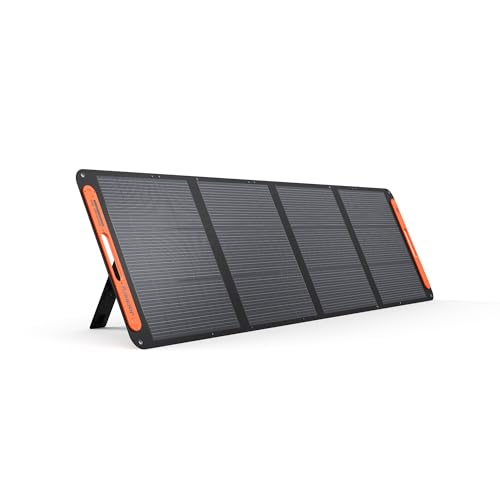
Folds flat, travels well
Jackery SolarSaga 200W
· 13.2 lb · SGA rating 88/100
Current price on Amazon: see current price on Amazon
200W bifacial folding panel, IP68 rated, 13.2 lb. Panels are generally easier to travel with than batteries because they contain no lithium cells, and folding panels pack flat in a vehicle. The right way to keep a station topped up off-grid at your destination.
Airline battery rules change and carriers may apply stricter limits than the regulatory minimum. Always confirm with your airline before travelling, and treat the carrier's decision as final regardless of what the regulations allow.
Related Guides
Best Solar Generators for Camping
The units worth driving to the trailhead with
Storage & Maintenance
How to leave a battery healthy while you are away
Best Portable Solar Panels
Panels have no lithium cells and travel easily
What Can a Solar Generator Run?
Sizing guidance for the destination rather than the journey
Flying With Batteries: FAQ
Can I take a portable power station on a plane?
Almost never. The common thresholds are 100 Wh with no approval, 101–160 Wh with airline approval, and nothing above 160 Wh in either carry-on or checked baggage. Every power station we recommend is 286 Wh or larger, so none of them qualify — and airline approval cannot lift the 160 Wh ceiling.
Can I put it in checked luggage instead?
No. Large lithium batteries are not permitted in checked baggage precisely because a fire in the hold cannot be reached or suppressed. A battery in a checked bag can result in the bag being removed from the flight, and you may not discover it until you land without it.
How do I find my station's watt-hour rating?
It is usually printed on the device label, the underside, or in the manual as “Wh” or “watt-hours”. Some units list only amp-hours and voltage; multiply Ah by V to get Wh. Having the rating clearly visible matters, because security staff look for it and can refuse a battery whose capacity is not marked.
Can I fly with a portable solar panel?
Generally yes, because folding panels contain no lithium cells. They are treated as ordinary luggage, and they pack flat. If you need solar power at a fly-in destination, the panel is the piece of the kit that travels — the battery is not.
What about smaller power banks?
Power banks rated up to 100 Wh are allowed in carry-on without approval and are the practical answer for phones, tablets and cameras in flight. They are a completely different product from a power station, and for in-flight electronics they are what you actually want.
Do the rules differ outside the US?
Yes. Many countries apply similar principles, but the specific limits, approval requirements and screening practices vary, and airlines often apply their own stricter policy on top. If you are flying internationally, confirm the requirement with the operating carrier rather than assuming the US thresholds apply.
Can I ship a power station instead?
Couriers also restrict large lithium batteries, and where shipping is allowed it is typically ground-only and takes several days. If a specific unit must reach a destination, arrange it well in advance rather than treating shipping as an airport-day solution.