
Commercial & Trade Guide · Updated September 18, 2026
Power Station for a Job Site: Running Power Tools on Battery
Corded power tools are the hardest load most people ever put on a battery — not because of their running wattage, which is unremarkable, but because every one of them contains a motor that pulls several times its rated power for the moment it starts. The result is that a station which happily runs a refrigerator will shut down the instant a circular saw bites into a board. Here is what each tool actually demands and which units clear the bar.
As an Amazon Associate, SolarGenAdvisor earns from qualifying purchases made through links on this page, at no additional cost to you.
 By
By The Short Answer
Output you need
3,600W+ continuous
And a surge ceiling of at least 6,000W if you intend to run saws, compressors or a table saw rather than just drills.
Capacity you need
3,000–5,000 Wh
A corded tool day is measured in kilowatt-hours. A 1 kWh station is a few cuts, not a shift.
What kills most setups
Simultaneous motor starts
Two tools idling and a third starting at once is the classic overload. Manage the sequence, not just the total.
Where batteries genuinely win
Indoor, occupied, no-fume sites
A battery is the only option that can run inside a finished home, a basement or a crawlspace. Details below.
What Common Power Tools Actually Draw
Typical ranges for corded tools. Check the nameplate on your own tool — motor design, blade load and age all move these figures, and the surge column is the one that decides whether your station trips.
| Tool | Running draw | Startup surge |
|---|---|---|
| Circular saw | 1,200–1,500W | 2,500–3,500W |
| Miter saw (10–12") | 1,400–1,800W | 3,000–4,500W |
| Table saw | 1,500–2,000W | 4,000–6,000W |
| Air compressor (small) | 1,000–1,500W | 3,000–4,500W |
| Hammer drill / rotary | 600–1,000W | 1,500–2,500W |
| Shop vacuum | 900–1,200W | 2,000–3,000W |
| Reciprocating saw | 700–1,100W | 1,500–2,500W |
| Heat gun | 1,200–1,800W | None (resistive) |
The surge column is the whole story
A circular saw that draws 1,400W while cutting can demand 2,500–3,500W for a fraction of a second as the motor spins up. A station rated at 1,500W continuous will shut down — correctly, because it is protecting its inverter. This is why job-site sizing is driven by surge ratings rather than by adding up running watts, and why the units we recommend all carry surge ceilings of 6,000W or more.
Resistive tools such as heat guns draw close to their rated wattage continuously and have no meaningful surge, which makes them easier on an inverter but harder on capacity.
Where a Battery Genuinely Beats a Gas Generator
For heavy outdoor work all day, a fuel generator is still usually the pragmatic answer, and we will not pretend otherwise — see our solar generator vs gas generator comparison for that side of the argument. But there is a category of work where a battery is not just competitive, it is the only compliant option:
Occupied homes
Interior remodels, trim work and punch lists in a house the owners are living in. Running a fuel generator in or beside an occupied home creates carbon monoxide risk and noise complaints — a battery runs silently indoors with no exhaust at all.
Restricted and no-idle sites
Basements, crawlspaces, garages with the door shut, commercial interiors, hospitals, schools, and any site with a no-idle or emissions restriction. These are common in commercial fit-out work, and a battery sidesteps the entire permit conversation.
Service calls and punch lists
Short bursts of tool use across several locations in a day — plumbing, electrical, appliance repair, punch-list carpentry. No fuel cans, no pull-start, no maintenance, and you can carry it in one hand or two people can lift it into a truck bed.
There is also a running-cost point that surprises people: energy from a battery charged at home or at the shop is usually cheaper per kilowatt-hour than gasoline, and there is no fuel to buy, store, or spill. The economics only favour fuel when the daily energy demand is large and continuous.
Making a Battery Work on Site
Stagger your starts
Let a saw come to full speed before starting a vacuum. Two motors starting in the same second is the single most common way to trip an inverter that is otherwise perfectly adequate for the work.
Charging over lunch beats charging on site
Most of these units recharge in a couple of hours from a wall outlet, and the fastest take under an hour. Charging at the shop or the house overnight and topping up over a break is far more practical than trying to keep one running all day from site power that may not exist.
Use the 240V output if you have it
Several units here support 240V split-phase, which some larger stationary equipment needs. Confirm the specific outlet before you rely on it — see the voltage notes in our transfer switch guide.
Buy surge headroom, not just capacity
When comparing two units at the same capacity, the one with the higher surge ceiling is the one that will run a table saw. Capacity determines how long you can work; surge determines whether you can work at all.
Consider mixing systems
Many crews now run battery platforms for hand tools and keep a station for the few corded tools that need mains-level power. That combination covers far more work per pound than either approach alone, and it is what we would actually buy.
Power Stations Built for Tool Loads
Every unit below clears the surge threshold for corded power tools. Ordered by how they suit job-site duty rather than by price — all figures come from our own product database, and the badges from our daily price log.

Highest continuous output
Anker SOLIX F3800 Plus
3,840 Wh · 6,000W output · 6,000W surge · 154 lb · SGA rating 90/100
Current price on Amazon: $2,699.99
3,840 Wh with a 6,000W continuous output — the highest continuous rating in the class we cover — plus 3,200W of solar input. Continuous output is the spec that matters on a job site, because a table saw or a compressor does not just need to start, it needs to keep running while you work. This is the unit we would put on a truck for a crew that uses corded tools.
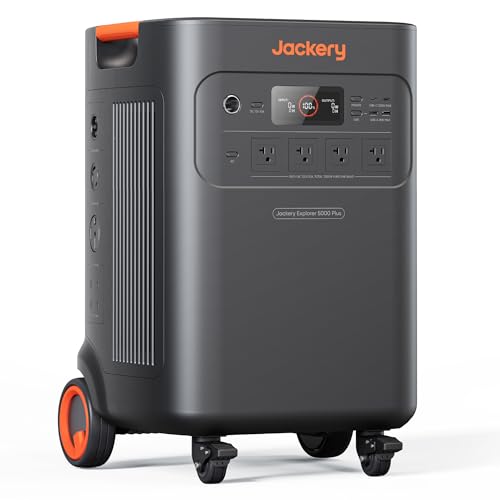
Most capacity for a full shift
Jackery Solar Generator 5000 Plus
5,040 Wh · 7,200W output · 7,200W surge · 105 lb · SGA rating 90/100
Current price on Amazon: $3,499.00
5,040 Wh expandable to 60 kWh with 7,200W of 120/240V output. If the job involves a full day of corded tool use, capacity rather than output becomes the constraint, and this is the largest capacity we cover short of a permanently installed system. The 240V capability opens up larger hardwired equipment too.

Best value for high-output work
Pecron F5000LFP Power Station
5,120 Wh · 7,200W output · 7,200W surge · 123.9 lb · SGA rating 90/100
Current price on Amazon: $2,199.00
5,120 Wh with 7,200W of dual-voltage output and 6,400W of solar input. The challenger-brand alternative to the flagships: comparable capacity and output for materially less money, which matters when you are buying one for a crew rather than for a household. Fewer dealers and less brand history are the trade.

Best all-round high-output unit
EcoFlow Delta Pro 3
4,096 Wh · 4,000W output · 8,000W surge · 113.5 lb · SGA rating 95/100
Current price on Amazon: $3,699.00
4,096 Wh with 4,000W continuous, an 8,000W surge ceiling and 240V split-phase support. The 8,000W surge figure is what lets it start hard-drawing motors that would trip a smaller inverter, and it is our highest-rated product at 95/100. Also flexible enough to serve as home backup when it is not on site.

Best for lighter tool loads
Anker SOLIX F3000
3,072 Wh · 3,600W output · 4,860W surge · 91.5 lb · SGA rating 93/100
Current price on Amazon: $1,398.98
3,072 Wh expandable to 24 kWh with 3,600W output and 240V split-phase capability. Suits a crew running saws, drills and a vacuum rather than a compressor or a table saw. The 6,000W AC recharge is the standout — meaningfully less downtime between charges than anything else at this price.
Prices shown are the current Amazon price. Badges come from our own daily price log — see the solar generator price tracker; they describe what we observed on the listing, not a manufacturer claim or a prediction.
Related Guides
Solar Generator vs Gas Generator
Where fuel still wins, and where it does not
Indoor-Safe Generators
Why battery power is the only indoor option, with the safety data behind it
Expandable Power Stations
Add capacity to a unit you already own instead of replacing it
Best Whole-Home Systems
The highest-output tier, if the job needs more than a portable can give
Job Site Power Station FAQ
Can a power station run a circular saw?
Yes, with enough surge headroom. A circular saw draws roughly 1,200–1,500W while cutting but can demand 2,500–3,500W for a moment at startup. You need a station with a surge ceiling of at least 3,500–4,000W; a 1,500W-continuous unit with a 3,000W surge will usually trip.
What about a table saw or an air compressor?
These are the demanding end of corded tools. A table saw can surge to 4,000–6,000W and a small compressor to 3,000–4,500W, so you need a unit in the 3,600W-continuous / 6,000W-surge class or above. This is where the whole-home tier earns its price on a job site.
How long can I run corded tools on one charge?
Think in tool-hours rather than clock time, because tools are used intermittently. A 3,000 Wh station running a circular saw in bursts supports a long working session; a full day of continuous high-draw tool use is better served by 5,000 Wh or by recharging over a break. If your day is measured in many kilowatt-hours, that is the signal to look at a larger system.
Is a power station better than a gas generator for contractors?
For indoor, occupied, or noise- and emissions-restricted sites, yes — it is often the only compliant option, and it runs with no exhaust at all. For heavy outdoor work with continuous high demand, a fuel generator remains the more practical choice. Many crews run both: battery hand tools plus a station for corded tools, with a generator only for the largest jobs.
Why does my station shut off when I start a saw?
Motor inrush current. The saw's motor briefly draws several times its running wattage, and when that exceeds the inverter's surge ceiling the station shuts down to protect itself. It is not a fault. The fixes are a higher surge ceiling, or starting tools one at a time instead of simultaneously.
Can I charge a job-site power station from a vehicle?
Yes. Most of these units accept a 12V car input, though it is slow relative to a wall outlet — typically a small fraction of the AC recharge rate. For a work truck, charging overnight from mains and topping up via 12V between jobs is the realistic pattern; expecting a full recharge from a vehicle socket during a lunch break is not.
Is a battery station cheaper to run than a gas generator?
Usually, per kilowatt-hour, particularly when you charge from mains at home or at the shop — and there is no fuel to buy, store, or spill, and no oil changes or spark plugs. The economics shift the other way only when daily energy demand is large and continuous enough that battery capacity becomes the limiting factor.