SolarGenAdvisor SolarGenAdvisor

Buying Guide · Updated October 19, 2026

Best Solar Generator for Van Life (2026)

For a weekend or part-time van, a 1 kWh station with a high solar input — the EcoFlow Delta 3 Plus is our pick — is the sweet spot. Full-time and working from the road, step up to 2 kWh. A van is a small, hot, moving space with a roof that only fits a few panels, so the specs that matter are different from an RV's: solar input per pound, weight, and whether it can run the one big load you care about (usually cooking). Below: a realistic van power budget, how many days each station lasts, how fast your roof can refill it, and when a plug-and-play station beats a wired build.

As an Amazon Associate, SolarGenAdvisor earns from qualifying purchases made through links on this page, at no additional cost to you.

How Much Power Does a Van Actually Use?

Typical planning figures for one or two people. Your fridge and climate will move them most, so treat these as a starting point.

Load Typical draw Per day
12V compressor fridge40–60W, cycling~500–800 Wh
Laptops (one or two)60–90W each while charging~200–300 Wh
Roof vent fan overnight15–30W~150–300 Wh
LED lights, phones, water pumpSmall~150–300 Wh
Starlink~60W (varies by model and mode)~300–700 Wh if left on
Induction hob, short cooking~1,200–1,800W while on~100–300 Wh

Rule of thumb: a weekend van without Starlink runs on roughly 800 Wh a day; a full-time remote-work van with Starlink and cooking runs closer to 1,600 Wh or more. See our Starlink power guide for that load in detail.

How Many Days Each Station Lasts — and How Fast Solar Refills It

Days are estimated with no recharging and about 15% lost to conversion. “Sun-hours to refill” assumes you have enough panel to reach the station's solar ceiling, yielding about 70% of its rating — in a van, your roof space is usually the real limit, so read it as a best case.

Station Capacity / weight Days at 800 Wh/day Days at 1,600 Wh/day Solar input Sun-hours to refill
EcoFlow Delta 3 Plus 1,024 Wh / 26 lb ~1.1 ~0.5 1,000W ~1.5
Anker SOLIX C1000 Gen 2 1,024 Wh / 24.9 lb ~1.1 ~0.5 600W ~2.4
Jackery Explorer 1000 V2 1,070 Wh / 23 lb ~1.1 ~0.6 400W ~3.8
Bluetti Elite 200 V2 2,074 Wh / 48.5 lb ~2.2 ~1.1 1,200W ~2.5
Jackery Explorer 2000 Plus 2,042 Wh / 61.5 lb ~2.2 ~1.1 1,400W ~2.1

The practical takeaway: in a van, a smaller battery with a high solar ceiling can outperform a larger one with a low ceiling, because it refills inside a single day of sun. Match the panels to the ceiling with our solar panel setup guide.

Power Station or a Wired House-Battery Build?

Choose a power station when

  • • You want power on day one with no wiring
  • • The van is a weekender or a rental-friendly conversion
  • • You want the battery to come out for camping or home outages
  • • You might sell the van and keep the power

Consider a wired build when

  • • You need well beyond 2–3 kWh
  • • You want alternator charging at high current while driving
  • • Every inch of space is planned around the system
  • • You are comfortable with (or paying for) DC wiring

Many full-timers end up with a hybrid: fixed roof panels and a power station that can be lifted out. An expandable station keeps that option open — see expandable power stations.

Four Van-Specific Things to Get Right

Heat and cold

A parked van in summer gets hotter than the house. LiFePO4 batteries are happiest roughly between freezing and 104°F, and should not be charged below freezing. Keep the station out of direct sun and away from the engine bay.

Securing it

A 25–50 lb box becomes a projectile in a hard stop. Strap it down or build it into a cabinet with ventilation space around the fans.

Charging while driving

A 12V socket typically adds only around 60–120W — useful on long drive days, not a replacement for solar. Faster alternator charging needs dedicated wiring.

Noise at night

Cooling fans can run during fast charging and heavy loads. Schedule fast AC charging for daytime and keep night loads light so the station stays quiet in a small space.

Best Solar Generators for Van Life

Ordered from weekend vans to full-time builds. Specs come from our product database; prices are live from Amazon.

EcoFlow Delta 3 Plus
Best for most van builds

EcoFlow Delta 3 Plus

89/100
1,024 Wh 1,800W output 2,400W surge 1,000W solar in 26 lb

1,024 Wh at 26 lb with 1,000W of solar input — an unusually high solar ceiling for its size. That matters in a van: a few hundred watts of roof panels can refill it in a single good day, so it behaves like a bigger battery than it is.

See today’s price on Amazon
Check Price on Amazon →
Lowest we’ve logged: $654.00 (Sep 24) · our log since Sep 18
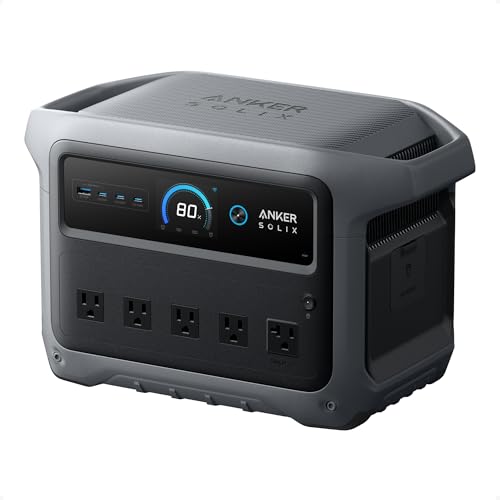
Anker SOLIX C1000 Gen 2
Best if you cook on induction

Anker SOLIX C1000 Gen 2

92/100
1,024 Wh 2,000W output 3,000W surge 600W solar in 24.9 lb

1,024 Wh with 2,000W of continuous output — enough to run a typical single-burner induction hob, which most 1 kWh stations cannot. Cooking eats capacity fast, so treat it as short bursts, not a slow simmer.

$699.99Current price on Amazon
Check Price on Amazon →
Lowest we’ve logged: $669.00 (Oct 13) · our log since Oct 13
Jackery Explorer 1000 V2
Lightest 1 kWh station

Jackery Explorer 1000 V2

93/100
1,070 Wh 1,500W output 3,000W surge 400W solar in 23 lb

1,070 Wh at 23 lb. If the station moves between the van, the campsite and the house, weight is the spec you feel every day, and this is the lightest unit in our database at this capacity.

$499.00Current price on Amazon
Check Price on Amazon →
Lowest we’ve logged: $469.00 (Oct 6) · our log since Sep 18
Bluetti Elite 200 V2
Best for full-time remote work

Bluetti Elite 200 V2

91/100
2,074 Wh 2,600W output 3,900W surge 1,200W solar in 48.5 lb

2,074 Wh with 2,600W output and 1,200W of solar input. Two laptops, a fridge, fans and Starlink add up to a full day’s budget; this is the size where one cloudy day does not end the working week.

$1,399.00Current price on Amazon
Check Price on Amazon →
Lowest we’ve logged: $899.00 (Oct 8) · our log since Oct 8
Jackery Explorer 2000 Plus
Best expandable for long-term builds

Jackery Explorer 2000 Plus

91/100
2,042 Wh 3,000W output 6,000W surge 1,400W solar in 61.5 lb

2,042 Wh with 3,000W output and an expansion path to about 24 kWh. Start with the base unit and add batteries as the build — and the power budget — grows.

See today’s price on Amazon
Check Price on Amazon →
At our lowest logged price — $899.00 · our log since Sep 21

Prices shown are the current Amazon price. Badges come from our own daily price log — see the solar generator price tracker; they describe what we observed on the listing, not a manufacturer claim or a prediction.

Van Life Power FAQ

What size solar generator do I need for van life?

About 1,000 Wh for weekends and part-time use, paired with a high solar input so a sunny day refills it. Full-time living with remote work, Starlink or cooking typically needs 2,000 Wh or more, because daily use can reach 1,600 Wh.

Can a portable power station run a van fridge?

Yes. A 12V compressor fridge typically uses around 500–800 Wh a day, so a 1,000 Wh station runs one for roughly a day on its own and indefinitely with enough solar to replace that each day.

Can I run an induction cooktop in a van on a power station?

Only on a station with enough continuous output, typically 1,800–2,000W for a single-burner hob. Short cooking sessions use around 100–300 Wh a day; long simmering drains a 1 kWh station quickly.

How do you charge a solar generator in a van?

Three ways: roof or portable solar panels (the main source off-grid), the vehicle's 12V socket while driving (typically around 60–120W, so slow), and shore power at campgrounds, which is the fastest.

Is a power station better than a house battery for a van?

For weekend and part-time vans, usually yes: it needs no wiring, works on day one, and comes out for camping or home outages. Wired house-battery systems make more sense for very large capacity or high-current alternator charging.

Is it safe to leave a power station in a hot van?

Keep it out of direct sun and well ventilated. LiFePO4 batteries are happiest roughly between freezing and 104°F, and should not be charged below freezing. A shaded cabinet with airflow around the fans is the safest spot.

Van life pick: Delta 3 Plus ★
Check Amazon →