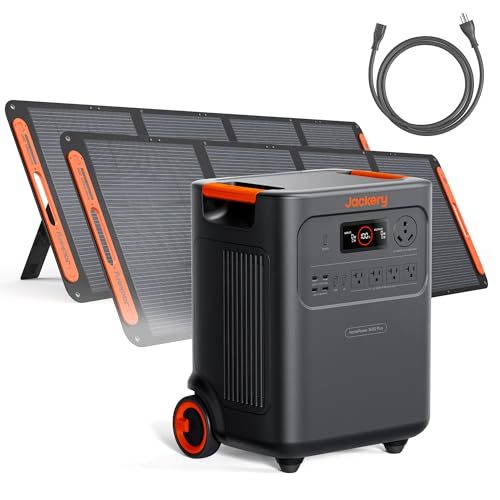
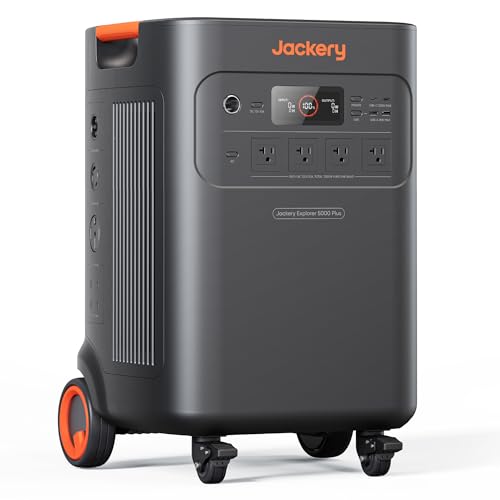
Jackery Explorer 300
Ultralight 292Wh power station with a 300W AC outlet — the small Jackery currently sold on Amazon (listed as LiFePO4) for weekend trips, phones, a CPAP and small electronics. Not the Explorer 300 Plus. Read our full review →
Buying Decision · Updated October 19, 2026
For most people, the Explorer 1000 V2. It is the smallest Jackery that runs a refrigerator overnight, and at 23 lb it still goes camping. Go smaller (the 300-class Explorer) only if you are charging phones, laptops and a CPAP. Go bigger — the Explorer 2000 Plus — if you are planning for multi-day outages or want to add batteries later; the Explorer 2000 v2 is the same capacity without expansion and with far less solar input. The HomePower 3600 Plus and Solar Generator 5000 Plus are home-backup systems, not portable stations. Below: a quick chooser, the “what size do I need” method, and every model side by side.
As an Amazon Associate, SolarGenAdvisor earns from qualifying purchases made through links on this page, at no additional cost to you.
Start with the one load you care about most. The model that covers it is your floor — size up only if you need longer runtime or more simultaneous loads.
Phones, laptops, lights and a CPAP for a night
Jackery Explorer 300
292 Wh · 300W · 7.1 lb
Weekend campers, commuters and anyone who mostly charges small electronics.
A refrigerator overnight, or a full camping weekend
Jackery Explorer 1000 V2
1,070 Wh · 1,500W · 23 lb
Most first-time buyers — the one to pick if you are unsure.
Price: $499.00
A fridge and freezer through an outage, charged from the wall
Jackery Explorer 2000 v2
2,042 Wh · 2,200W · 39.5 lb
Outage planners who want 2 kWh without paying for expansion they will never use.
Price: $899.00
A fridge and freezer through a multi-day outage, or RV power
Jackery Explorer 2000 Plus
2,042 Wh · 3,000W · 61.5 lb
Outage planners and RV owners who may want to add batteries later.
Essential home circuits through a transfer switch
Jackery HomePower 3600 Plus
3,584 Wh · 3,600W · 78 lb
Homeowners backing up a furnace, well pump, fridge and lights.
Whole-home backup with 240V loads
Jackery Solar Generator 5000 Plus
5,040 Wh · 7,200W · 105 lb
Households that need 120/240V for well pumps or central systems.
Price: $3,028.25
Every Jackery decision comes down to two numbers, and most buyers only check one of them.
1. Output (watts)
Can it start and run the load?
Add up everything you want running at the same moment. That total must sit below the station's continuous output, and anything with a motor or compressor also needs surge headroom to start.
2. Capacity (watt-hours)
How long will it last?
Multiply each load's watts by the hours you need it, add them up, then allow roughly 15% for inverter losses. That is the capacity you need between recharges.
The table below runs that arithmetic for two steady loads: about 60W (a CPAP with humidifier, Starlink, or a router plus lights) and about 150W (a refrigerator compressor while running). Real appliances cycle, so treat these as planning figures with margin. For other appliances, our solar size calculator does the maths for you.
| Model | Capacity | ~60W load | ~150W load |
|---|---|---|---|
| Jackery Explorer 300 | 292 Wh | ~4 hrs | ~2 hrs |
| Jackery Explorer 1000 V2 | 1,070 Wh | ~15 hrs | ~6 hrs |
| Jackery Explorer 2000 v2 | 2,042 Wh | ~29 hrs | ~12 hrs |
| Jackery Explorer 2000 Plus | 2,042 Wh | ~29 hrs | ~12 hrs |
| Jackery HomePower 3600 Plus | 3,584 Wh | ~51 hrs | ~20 hrs |
| Jackery Solar Generator 5000 Plus | 5,040 Wh | ~71 hrs | ~29 hrs |
Continuous-draw estimates with ~15% inverter loss. A refrigerator that cycles will run noticeably longer than the 150W column suggests. Full appliance-by-appliance figures are in our runtime table.
The “Wh per lb” column is the one to watch if you will carry the unit: it shows how much energy you get for every pound you lift.
| Model | Capacity | Output / surge | Weight | Wh per lb | Solar input | Price |
|---|---|---|---|---|---|---|
| Jackery Explorer 300 | 292 Wh | 300W / 300W | 7.1 lb | 41 | 100W | Check price at Amazon → |
| Jackery Explorer 1000 V2 | 1,070 Wh | 1,500W / 3,000W | 23 lb | 47 | 400W | $499.00 |
| Jackery Explorer 2000 v2 | 2,042 Wh | 2,200W / 4,400W | 39.5 lb | 52 | 400W | $899.00 |
| Jackery Explorer 2000 Plus | 2,042 Wh | 3,000W / 6,000W | 61.5 lb | 33 | 1,400W | Check price at Amazon → |
| Jackery HomePower 3600 Plus | 3,584 Wh | 3,600W / 7,200W | 78 lb | 46 | 1,200W | Check price at Amazon → |
| Jackery Solar Generator 5000 Plus | 5,040 Wh | 7,200W / 7,200W | 105 lb | 48 | 3,000W | $3,028.25 |
Specs from our product database. We omit outlet counts, dimensions and warranty terms here because we cannot independently confirm them for every model — check the listing before you buy.
Explorer is Jackery's portable power station line, and the number roughly tracks the capacity class (an Explorer 1000 is a ~1 kWh unit, an Explorer 2000 a ~2 kWh unit).
“Solar Generator” in a Jackery product name means a power station sold together with SolarSaga solar panels. If you already own panels, compare against the station-only listing.
HomePower is the home-backup line: heavier units designed to sit in one place and connect to a home through a transfer switch rather than travel.
V2 and Plus mark newer generations of a model. Check the capacity and output figures rather than relying on the suffix — that is what actually determines what the unit can run.
If you think your needs will grow — camping now, outage backup later — the Explorer 2000 Plus is the decision point. Our database lists it as expandable to roughly 24 kWh with add-on batteries, so the same base unit covers both jobs. The HomePower 3600 Plus (expandable to about 21 kWh) and Solar Generator 5000 Plus (about 60 kWh) expand too, but they are home systems from day one. More on that trade-off in expandable power stations.
If you are choosing between brands at the same size rather than between Jackery models, start with our head-to-heads: Explorer 1000 V2 vs Anker C1000 Gen 2, 1000 V2 vs EcoFlow Delta 3 Plus, 2000 Plus vs Bluetti AC200L and Jackery vs EcoFlow.
The count of 200W panels needed to reach each model's solar input ceiling. More than that is clipped; fewer just charges more slowly.
| Model | Max solar input | 200W panels to reach it |
|---|---|---|
| Jackery Explorer 300 | 100W | 1 |
| Jackery Explorer 1000 V2 | 400W | 2 |
| Jackery Explorer 2000 v2 | 400W | 2 |
| Jackery Explorer 2000 Plus | 1,400W | 7 |
| Jackery HomePower 3600 Plus | 1,200W | 6 |
| Jackery Solar Generator 5000 Plus | 3,000W | 15 |
The Jackery SolarSaga 200W is the panel we track for Jackery. Wiring limits per input can cap the real number — see the setup guide.
Smallest to largest. Ratings are our editorial scores; specs come from our product database and prices are live from Amazon.
Ultralight 292Wh power station with a 300W AC outlet — the small Jackery currently sold on Amazon (listed as LiFePO4) for weekend trips, phones, a CPAP and small electronics. Not the Explorer 300 Plus. Read our full review →
The best balance of portability, capacity, and price for most weekend campers. Read our full review →
2,042Wh LiFePO4 with 2,200W output (4,400W surge) at 39.5 lb — a lighter, simpler alternative to the 2000 Plus, but not expandable and limited to 400W of solar input. Read our full review →
Expandable to 24kWh — scales from RV power to full home backup on the same base unit. Read our full review →
3,584Wh expandable to 21kWh with 7,200W surge — Jackery's home backup specialist with essential circuit coverage. Read our full review →
5,040Wh whole-home system with 7,200W 120/240V output, expandable to 60kWh — Jackery's flagship power station. Read our full review →
Prices shown are the current Amazon price. Badges come from our own daily price log — see the solar generator price tracker; they describe what we observed on the listing, not a manufacturer claim or a prediction.
For most people, the Explorer 1000 V2: it runs a refrigerator overnight and still weighs 23 lb. Choose the 300-class Explorer for phones, laptops and a CPAP; the Explorer 2000 Plus for multi-day outages or RV use; and the HomePower 3600 Plus or Solar Generator 5000 Plus for home circuits through a transfer switch.
Check two numbers. Output: the total watts of everything running at once must be below the station's continuous rating. Capacity: multiply each load's watts by the hours you need it, add them, and allow about 15% for losses. Pick the smallest model that clears both.
The Explorer 1000 V2 is the smallest Jackery we would plan around for a refrigerator, roughly overnight. For a fridge and freezer through a multi-day outage, the Explorer 2000 Plus or larger is the realistic choice.
An Explorer is the power station on its own. A Jackery “Solar Generator” is a power station bundled with SolarSaga solar panels. If you already have panels, compare against the station-only price.
For essential circuits through a transfer switch, the HomePower 3600 Plus. For whole-home backup that includes 240V loads such as a well pump, the Solar Generator 5000 Plus. For plugging in a fridge, freezer and lights during an outage without a transfer switch, the Explorer 2000 Plus.
Of the models we track, the Explorer 2000 Plus (to about 24 kWh), the HomePower 3600 Plus (about 21 kWh) and the Solar Generator 5000 Plus (about 60 kWh) accept add-on batteries. The 2000 Plus is the one that starts portable and grows into home backup.
Yes — it is one of the longest-established portable power brands, and our editorial ratings for the Jackery models we track run from 87 to 93 out of 100. Its main trade-off is that some competitors offer more output or faster charging at the same capacity. Our Jackery brand guide covers the full picture.