
Buying Guide · Updated October 2026
Best 5000 Watt Solar Generator: 5 Picks With 5,000W+ Continuous Output
A 5000 watt solar generator is the point where a battery system stops being a camping accessory and starts behaving like a home generator: every pick here delivers at least 5,000W continuous with 120/240V output, enough for well pumps, electric dryers and transfer-switch home backup. Below we rank every 5,000W+ unit we have reviewed, explain watts versus watt-hours, and show real runtimes.
As an Amazon Associate, SolarGenAdvisor earns from qualifying purchases made through links on this page, at no additional cost to you.
 By
5000 Watt Solar Generator Comparison
Ranked by our editorial rating. Continuous output (W) is what it can run at once; capacity (Wh) is how long it lasts.
| # | Model | Continuous (W) | Surge (W) | Capacity (Wh) | Voltage | Solar In | Weight | Rating | Price |
|---|---|---|---|---|---|---|---|---|---|
| 1 | Anker SOLIX E10 Prime Off-Grid Kit | 7,680W | 10,000W | 12,000 Wh | 120/240V split-phase (single system) | 9,000W | 190.6 lb | 92/100 | $6,499.00 |
| 2 | Pecron F5000LFP Power Station | 7,200W | 7,200W | 5,120 Wh | 120/240V split-phase (single unit) | 6,400W | 123.9 lb | 90/100 | Check price at Amazon → |
| 3 | Jackery Solar Generator 5000 Plus | 7,200W | 14,400W | 5,040 Wh | 120/240V split-phase (single unit) | 3,000W | 105 lb | 90/100 | $3,149.00 |
| 4 | Anker SOLIX F3800 Plus | 6,000W | 6,000W | 3,840 Wh | 120/240V split-phase (single unit) | 3,200W | 136.7 lb | 90/100 | $2,599.99 |
| 5 | OUPES Guardian 6000 | 6,000W | 6,000W | 4,608 Wh | 120/240V (single unit) | 2,400W | 95 lb | 87/100 | Check price at Amazon → |
Voltage configurations checked against manufacturer product pages: Anker SOLIX E10, Pecron F5000LFP, Jackery 5000 Plus, Anker SOLIX F3800 Plus, OUPES Guardian 6000. Outlet layouts differ by model and revision — confirm the exact 240V receptacle (L14-30, 14-50 or 6-20) before you buy a cord or transfer switch. Kits like the E10 bundle several modules, so their capacity and weight are system totals.
"5000 Watt" Means Output, Not Capacity
People search for a 5000 watt solar generator meaning two different things. Gas-generator shoppers mean 5,000 watts of output. Others actually mean 5,000 watt-hours of storage. They are not the same, and the difference decides whether a unit fits your house.
Watts (W) = how much at once
Continuous output is the total load the inverter can carry indefinitely. Surge is the brief spike it can supply when a motor or compressor starts. Every pick on this page is rated 5,000W continuous or more (up to 7,680W).
Watt-hours (Wh) = how long
Capacity is the energy stored in the battery. Runtime is roughly usable Wh divided by your load. Among these picks capacity ranges from 3,840 Wh to 12,000 Wh, so two "5000 watt" units can last very different lengths of time.
If you really meant 5,000 Wh of storage, look at our best whole-home solar generators (sorted by capacity and expandability). If you need a smaller output class, see the best 3000 watt solar generators. Not sure which? Run your appliances through the solar generator size calculator.
What Can a 5000 Watt Solar Generator Run?
The 5,000W class is defined by two things smaller units lack: enough continuous output to run several large loads together, and 240V output, which many big household appliances require. Wattages below are typical ranges — your appliance's nameplate is the number that matters.
| Load | Voltage | Typical Draw | On a 5,000W+ Unit? |
|---|---|---|---|
| Electric clothes dryer | 240V | ~1,800–5,000W [1] | Yes, on the 240V outlet — but it can use much of the budget by itself |
| Well pump (1/2 HP) | Often 240V | ~750–1,500W running, 2,000–4,000W start [2] | Yes — check starting watts against surge rating |
| Central air conditioner | 240V | Varies by tonnage; high compressor startup | Depends on the condenser's locked-rotor amps (LRA); a soft-start kit helps |
| 30 amp RV service | 120V | Up to 3,600W [3] | Yes, the full service |
| 50 amp RV service | 120/240V | Up to 12,000W [3] | Partially — you are limited to the unit's continuous rating |
| Essential home circuits (fridge, furnace blower, lights, router) | 120V | ~1,000W average | Yes, with plenty of headroom |
[1] Dryer range as published by the Utah Division of Water Rights appliance wattage chart and EnergySage; the same range appears in the U.S. DOE Energy Saver appliance guidance. [2] Our sizing guide figures; pump guides such as SoftPro put starting draw at roughly 3–5× running watts — read your pump's nameplate. [3] Volts × amps: 120V × 30A and 240V × 50A, as explained by RVtravel and RV Electricity.
How Long Does a 5000 Watt Solar Generator Last?
Runtime comes from capacity. These estimates use each unit's rated capacity, an assumed 85% inverter efficiency, and a steady average load. Real loads cycle on and off, so a fridge-and-furnace house averages far below its peak.
| Model | Capacity | 500W avg (essentials) | 1,000W avg | 3,000W (heavy load) |
|---|---|---|---|---|
| Anker SOLIX E10 Prime Off-Grid Kit | 12,000 Wh | ~20.4 hrs | ~10.2 hrs | ~3.4 hrs |
| Pecron F5000LFP Power Station | 5,120 Wh | ~8.7 hrs | ~4.4 hrs | ~1.5 hrs |
| Jackery Solar Generator 5000 Plus | 5,040 Wh | ~8.6 hrs | ~4.3 hrs | ~1.4 hrs |
| Anker SOLIX F3800 Plus | 3,840 Wh | ~6.5 hrs | ~3.3 hrs | ~1.1 hrs |
| OUPES Guardian 6000 | 4,608 Wh | ~7.8 hrs | ~3.9 hrs | ~1.3 hrs |
Base-unit capacity only. Most of these systems accept expansion batteries, and solar input during the day stretches runtime further.
The Best 5000 Watt Solar Generators, Reviewed

#1 · Highest Rated · 92/100
Anker SOLIX E10 Prime Off-Grid Kit
7,680W continuous · 10,000W surge · 12,000 Wh · 9,000W solar · 190.6 lb · LiFePO4
12kWh whole-home stackable system with 10kW turbo output, expandable to 90kWh — true off-grid replacement. Output: 120/240V split-phase (single system). At a 1,000W average load the base unit runs about 10.2 hours.

#2 · Best 120/240V Value · 90/100
Pecron F5000LFP Power Station
7,200W continuous · 7,200W surge · 5,120 Wh · 6,400W solar · 123.9 lb · LiFePO4
5,120Wh with 7,200W dual-voltage output, 6,400W solar input, expandable to 35.8kWh — challenger brand value. Output: 120/240V split-phase (single unit). At a 1,000W average load the base unit runs about 4.4 hours.
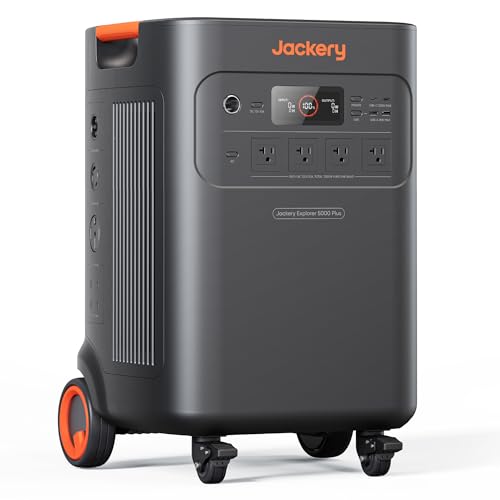
#3 · Best Transfer-Switch Ecosystem · 90/100
Jackery Solar Generator 5000 Plus
7,200W continuous · 14,400W surge · 5,040 Wh · 3,000W solar · 105 lb · LiFePO4
5,040Wh whole-home system with 7,200W 120/240V output, expandable to 60kWh — Jackery's flagship power station. Output: 120/240V split-phase (single unit). At a 1,000W average load the base unit runs about 4.3 hours.

#4 · Best for Growing Systems · 90/100
Anker SOLIX F3800 Plus
6,000W continuous · 6,000W surge · 3,840 Wh · 3,200W solar · 136.7 lb · LiFePO4
Expandable whole-home system with massive 6,000W output and industry-leading solar input. Output: 120/240V split-phase (single unit). At a 1,000W average load the base unit runs about 3.3 hours.
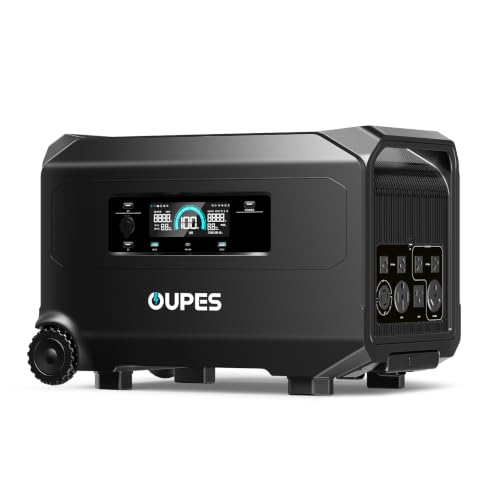
#5 · Lightest 6kW-Class Pick · 87/100
OUPES Guardian 6000
6,000W continuous · 6,000W surge · 4,608 Wh · 2,400W solar · 95 lb · LiFePO4
4,608Wh with 6,000W output, transfer switch ready, expandable to 41kWh — strong challenger for whole-home backup. Output: 120/240V (single unit). At a 1,000W average load the base unit runs about 3.9 hours.
120V vs 240V: Why Split-Phase Matters at 5,000W
US homes are wired for 120/240V split-phase: two 120V legs that together supply 240V for dryers, well pumps, water heaters, ranges and central AC. Most smaller power stations only output 120V. All of the picks above list 120/240V output from a single unit or system, which is what lets them feed a transfer switch and run 240V circuits. (In the 3,000W class, several units need two linked units for 240V — see our 3000 watt guide.)
Surge vs continuous
Continuous watts are the sustained limit. Surge watts cover the split-second spike when a motor starts, which can be several times its running draw. A pump that runs at 1,000W might need 3,000W or more for an instant. Add up the running watts of everything that will be on at once, then make sure the largest single motor's starting draw fits under the surge rating on top of that.
Connecting to your home
To power hardwired circuits (well pump, furnace, central AC), a 5,000W unit connects through a transfer switch or the manufacturer's home panel, installed by a licensed electrician. Never backfeed a dryer outlet. Our home backup guide covers which circuits to prioritize.
5000 Watt Solar Generator vs 5000 Watt Gas Generator
| Factor | 5,000W Solar / Battery | 5,000W Gas Portable |
|---|---|---|
| Indoor use | Yes — no exhaust | Never. Outdoors only, at least 20 ft from the house |
| Noise | Fan noise only | Engine noise; loud enough that neighbors notice |
| Fuel | Sun, wall outlet or a generator | Stored gasoline; needs refueling and stabilizer |
| Runtime limit | Battery capacity plus daily solar harvest | As long as you have fuel |
| Maintenance | Minimal; keep charged | Oil, spark plug, carburetor care |
| Upfront cost | Higher | Lower |
The safety gap is the big one. The U.S. Consumer Product Safety Commission estimates about 85 people die in the US each year from carbon monoxide poisoning caused by gasoline portable generators, and warns that running one in a garage — even with the door open — or relying on open windows does not provide enough ventilation. See also CPSC's Carbon Monoxide Information Center. Many owners pair a battery system with a small gas or dual-fuel generator for recharging during long, cloudy outages.
Tax credit note: the 30% federal Residential Clean Energy Credit no longer applies to systems bought and installed in 2026. Our solar generator tax credit guide explains what changed.
Related Buying Guides
Best 3000 Watt Solar Generator
3,000–4,999W units for partial home backup and RVs
Best Whole-Home Solar Generators
Expandable 120/240V systems for full house backup
Best Solar Generators for Home Backup
Top picks for keeping essentials running during outages
What Size Solar Generator Do I Need?
Sizing guide with an appliance wattage worksheet
Best 2000Wh Solar Generator
Mid-size capacity picks for essentials and RVs
Solar Generator Size Calculator
Add your appliances to get watts and watt-hours
Frequently Asked Questions
What is the best 5000 watt solar generator in 2026?
Our highest-rated 5,000W+ solar generator is the Anker SOLIX E10 Prime Off-Grid Kit (92/100), with 7,680W continuous output and 12,000 Wh of capacity. Every pick on this page delivers at least 5,000W continuous and 120/240V output, so the right choice depends on how much capacity you need and your budget.
Is a 5000 watt solar generator the same as 5000 watt-hours?
No. Watts (W) measure how much power a generator can deliver at one moment, which decides what it can run at once. Watt-hours (Wh) measure stored energy, which decides how long it can run. The units on this page all output 5,000W or more, but their capacity ranges from 3,840 Wh to 12,000 Wh.
Can a 5000 watt solar generator run central air conditioning?
Sometimes. A central AC needs 240V, and the compressor draws a large startup surge, so the unit must have 240V output and enough surge capacity for the compressor's locked-rotor amps (LRA) listed on the condenser nameplate. A soft-start kit lowers that startup spike. Check the nameplate and the manufacturer's compatibility guidance before buying.
Can a 5000 watt solar generator run a well pump or electric dryer?
Yes, if it has 240V output. Electric dryers are typically rated about 1,800 to 5,000 watts and run on 240V, and many well pumps are 240V with a startup surge several times their running watts. Every pick on this page supports 120/240V output, but compare the pump's starting watts with the unit's surge rating.
Can a 5000 watt solar generator power a 50 amp RV?
It can power one, but not at full capacity. A 50 amp RV service is 120/240V and can supply up to 12,000 watts, so a 5,000W-class unit covers a portion of that. A 30 amp RV service tops out at 3,600 watts at 120V, which these units can fully cover. You also need a matching outlet such as a NEMA 14-50 or an adapter.
How long will a 5000 watt solar generator run a house?
It depends on capacity, not the watt rating. At an average 1,000W essential-circuit load and about 85% inverter efficiency, the picks here run roughly 3.3 to 10.2 hours before needing a recharge. Solar input and expansion batteries extend that.
Is a 5000 watt solar generator better than a 5000 watt gas generator?
It depends on the outage. A battery generator is quiet, makes no exhaust, and can run indoors, while the CPSC warns that gas generators must run outdoors at least 20 feet from the house because of carbon monoxide. A gas generator keeps running as long as you have fuel, while a battery system is limited by stored energy and how much solar you can collect.
Is there a federal tax credit for a 5000 watt solar generator in 2026?
Not for systems bought and installed in 2026. The 30% Residential Clean Energy Credit (Section 25D) ended for expenditures made after December 31, 2025. Our solar generator tax credit guide explains what changed and what 2025 buyers can still claim.