
Brand hub · Updated November 2026
Pecron Power Stations and Solar Generators: The Full Range
Pecron power stations run from the 288 Wh E300LFP to the 5,120 Wh F5000LFP, which gives 120/240V from one unit, and every current Pecron uses a LiFePO4 battery. For most buyers the right Pecron solar generator is a 1 kWh model for camping and short outages, or the 3 kWh F3000LFP for home backup and the RV; most of the range takes Pecron expansion batteries. A Pecron “generator” is a battery power station with no engine or fuel. This hub puts the models Amazon US was selling at our last availability check first, with specs from our product database, live Amazon prices and a 30-second picker.
As an Amazon Associate, SolarGenAdvisor earns from qualifying purchases made through links on this page, at no additional cost to you.
9products on Amazon, checked Nov 20
4product lines on Amazon
288–3,072 Whbattery per listing, smallest to largest
90/100top Pecron score in our ratings


Prices are Amazon’s, as of the time shown, and can change. Scores are ours, built from specs, Amazon prices and Amazon customer reviews; we do not bench-test units.
Every Pecron power station, smallest to largest7 models



 By
30-second picker
Which Pecron Should You Buy?
Up to 3 yes-or-no questions, one at a time, and you get one model with its live price. The answers turn on three things: whether you will carry it, how big your loads are, and whether you want to add batteries later.
Question 1
Quick answers by situation:
Your Pecron · Carried, small loads, about 300 Wh
- Choose it if you want the smallest Pecron, 288 Wh with 600 W of AC output from two outlets, for phones, laptops, lights and a fan. It charges from the wall at up to 300 W and takes 100 W of solar. In The Solar Lab’s test of two units, adding a second lamp made the inverter restart, so keep loads modest.
- Capacity: 288 Wh
- AC output: 600 W
- Voltage: 120V
Your Pecron · Carried, small loads, about 600 Wh
- Choose it if you want twice the E300LFP’s battery, 576 Wh, with the same 600 W of output, about 1.5-hour wall charging at up to 500 W and 100 W of solar input, for a CPAP, laptops and lights.
- Capacity: 576 Wh
- AC output: 600 W
Your Pecron · Carried, about 1 kWh, expandable
- Choose it if you want 1 kWh that can grow: 1,024 Wh and 1,800 W of output (3,000 W peak) at 29 lb, about 1.3-hour wall charging, 600 W of solar input and a UPS mode, expanding to about 4.1 kWh with one Pecron battery.
- Capacity: 1,024 Wh
- AC output: 1,800 W (3,000 W surge)
- Expands: To about 4.1 kWh
- Weight: 29 lb
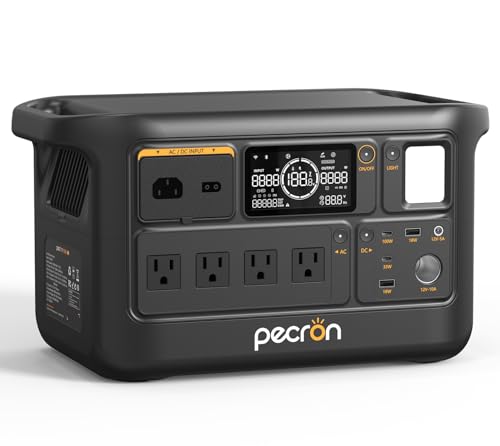
Your Pecron · Carried, about 1 kWh, lightest
- Choose it if you want about 1 kWh at the lowest weight: 960 Wh and 1,500 W of output at 23.9 lb, 600 W of solar input, about 70-minute wall charging at 1,000 W and a 20 ms UPS. It does not expand.
- Capacity: 960 Wh
- AC output: 1,500 W
- Weight: 23.9 lb

Your Pecron · Stays home, 3 kWh or more in one box
- Choose it if you want 3 kWh for a fridge, internet, lights and a furnace blower, or an RV on a 30A hookup: 3,072 Wh and 3,600 W of 120V output at about 63 lb, a 30A outlet, 1,800 W wall charging and 1,600 W of solar input. It expands to 10,752 Wh with two EP3800-48V batteries.
- Capacity: 3,072 Wh
- AC output: 3,600 W (4,500 W surge)
- Voltage: 120V
- Expands: To 10,752 Wh (two EP3800-48V)
Your Pecron · Stays home, about 2 kWh
- Choose it if you want about 2 kWh for outages or the RV: 2,048 Wh and 2,400 W of output at about 45 lb, about 90-minute wall charging, and expansion to 9,728 Wh with two EP3800-48V batteries. Its main solar input uses a Pecron-specific plug, according to The Solar Lab, so check panel compatibility.
- Capacity: 2,048 Wh
- AC output: 2,400 W
- Expands: To 9,728 Wh (two EP3800-48V)
- Weight: 45 lb
The lineup, visualised
The Pecron Lineup at a Glance
Every Pecron power station on Amazon on one chart, colour-coded by line, and how each line is meant to be used. Tap a bar to jump to that model.
Capacity ladder
- E300LFP288 Wh
- E500LFP576 Wh
- F1000LFP960 Wh
- E1000LFP1,024 Wh
- E2400LFP2,048 Wh
- E3600LFP3,072 Wh
- F3000LFP3,072 Wh
Compact
E series
F series
Bars use a log scale so the 288 Wh and 3.1 kWh models fit one chart. Multi-piece systems are shown at the capacity of the listing as sold. Weight bars skip models whose weight we could not confirm.
Carry it by hand
- Wall, car socket or one panel
- Compact Pecron, carried to the load
- Phones, laptops, lights, a CPAP
- Capacity
- 288–960 Wh
- AC output
- Up to 1,500 W
- Weight (where confirmed)
- 23.9 lb
- On Amazon now
- 3 listings
- 600 W of AC output on the E300LFP and E500LFP
- 1,500 W and 600 W of solar input on the F1000LFP
- F1000LFP: 23.9 lb with a 20 ms UPS
Outages and the RV, expandable
- Wall or solar
- E series station at home or in the RV
- Fridge, lights, internet, RV circuits
- Capacity
- 1,024–3,072 Wh
- AC output
- Up to 3,600 W
- Weight
- 29–79 lb
- On Amazon now
- 3 listings
- Each takes the EP3800-48V battery, per its Amazon listing
- 120V from one unit
- E3600LFP: 240V by pairing two units
Home backup beside the house
- Wall or solar
- F3000LFP or F5000LFP by the loads
- Essential circuits, a fridge, a furnace blower
- Capacity
- 3,072 Wh
- AC output
- Up to 3,600 W
- Weight
- 63.3 lb
- On Amazon now
- 1 listing
- F3000LFP: 120V, 30A outlet, about 63 lb
- F5000LFP: 120/240V from one unit
- Both take the FP5000-48V battery, per its listing
Diagrams show how each line is used, not to scale. Capacity, output and weight ranges come from the listings in this hub.
Every listing
Pecron Power Stations and Expansion Batteries on Amazon
Grouped by line, roughly smallest first. Specs come from our product database; prices are live Amazon prices with the time we read them. Scores appear only on models we have rated, and a “Provisional” tag marks a new score that is still awaiting editor approval.
Product prices and availability are accurate as of the date and time indicated and are subject to change. Any price and availability information displayed on Amazon at the time of purchase will apply to the purchase of the product.
9 products
No Pecron listing matches those filters.
Compact
Compact portables: E300LFP, E500LFP and F1000LFP (288 Wh to 960 Wh)
3 on AmazonThe small Pecrons. The E300LFP (288 Wh) and E500LFP (576 Wh) give 600 W of AC output and take 100 W of solar, for electronics, lights and a CPAP rather than appliances. The F1000LFP holds 960 Wh with 1,500 W of output, 600 W of solar input and 1,000 W wall charging at 23.9 lb; it does not take expansion batteries.
Compact
Smallest · 288 Wh
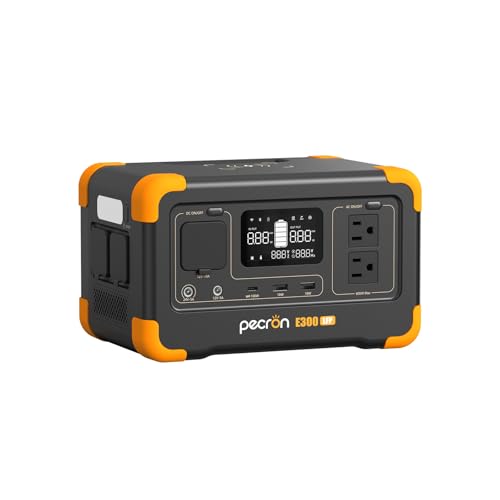
Pecron E300LFP
- Capacity288 Wh
- AC output600 W
- Voltage120V
Choose it if you want the smallest Pecron, 288 Wh with 600 W of AC output from two outlets, for phones, laptops, lights and a fan. It charges from the wall at up to 300 W and takes 100 W of solar. In The Solar Lab’s test of two units, adding a second lamp made the inverter restart, so keep loads modest.
All specs
- Capacity
- 288 Wh
- AC output
- 600 W
- Solar input
- 100 W
- Battery
- LiFePO4
- Voltage
- 120V
See the price on Amazon Check price on Amazon →
Save to Amazon cart
Compact
576 Wh · 600 W
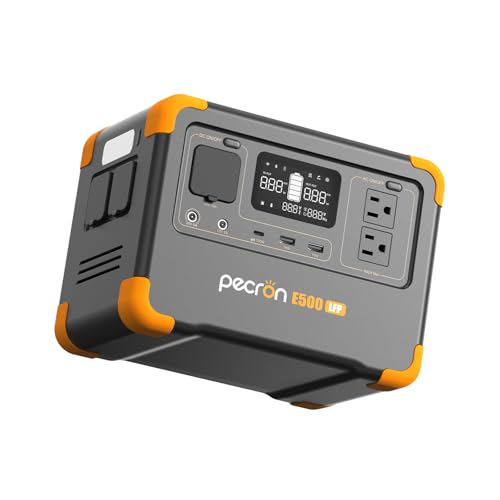
Pecron E500LFP
- Capacity576 Wh
- AC output600 W
Choose it if you want twice the E300LFP’s battery, 576 Wh, with the same 600 W of output, about 1.5-hour wall charging at up to 500 W and 100 W of solar input, for a CPAP, laptops and lights.
All specs
- Capacity
- 576 Wh
- AC output
- 600 W
- Solar input
- 100 W
- Battery
- LiFePO4
See the price on Amazon Check price on Amazon →
Save to Amazon cart
Compact
About 1 kWh · 23.9 lb
Pecron F1000LFP
- Capacity960 Wh
- AC output1,500 W
- ExpandsNo
- Weight23.9 lb
Choose it if you want about 1 kWh at the lowest weight: 960 Wh and 1,500 W of output at 23.9 lb, 600 W of solar input, about 70-minute wall charging at 1,000 W and a 20 ms UPS. It does not expand.
All specs
- Capacity
- 960 Wh
- AC output
- 1,500 W
- Solar input
- 600 W
- Battery
- LiFePO4
- Weight
- 23.9 lb
- Expands
- No
See the price on Amazon Check price on Amazon →
Save to Amazon cart
E series
E series expandable stations: E1000LFP, E2400LFP and E3600LFP (1 to 3 kWh)
3 on AmazonThe expandable E series. The E1000LFP holds 1,024 Wh with 1,800 W of output and expands to about 4.1 kWh. The E2400LFP holds 2,048 Wh with 2,400 W and expands to 9,728 Wh with two EP3800-48V batteries. The E3600LFP holds 3,072 Wh with 3,600 W, 2,400 W of solar input and a TT-30R outlet, expands to 18,432 Wh, and reaches 240V by pairing two units with Pecron’s 240V hub. Our Pecron buying guide compares them for each job.
E series
84
84 1 kWh · expands to 4 kWh
Pecron E1000LFP
- Capacity1,024 Wh
- AC output1,800 W
- ExpandsTo about 4.1 kWh
- Weight29 lb
Choose it if you want 1 kWh that can grow: 1,024 Wh and 1,800 W of output (3,000 W peak) at 29 lb, about 1.3-hour wall charging, 600 W of solar input and a UPS mode, expanding to about 4.1 kWh with one Pecron battery.
All specs
- Capacity
- 1,024 Wh
- AC output
- 1,800 W (3,000 W surge)
- Solar input
- 600 W
- Battery
- LiFePO4
- Weight
- 29 lb
- Expands
- To about 4.1 kWh
See the price on Amazon Check price on Amazon →
Save to Amazon cart
E series
2 kWh · 2,400 W
Pecron E2400LFP
- Capacity2,048 Wh
- AC output2,400 W
- ExpandsTo 9,728 Wh (two EP3800-48V)
- Weight45 lb
Choose it if you want about 2 kWh for outages or the RV: 2,048 Wh and 2,400 W of output at about 45 lb, about 90-minute wall charging, and expansion to 9,728 Wh with two EP3800-48V batteries. Its main solar input uses a Pecron-specific plug, according to The Solar Lab, so check panel compatibility.
All specs
- Capacity
- 2,048 Wh
- AC output
- 2,400 W
- Battery
- LiFePO4
- Weight
- 45 lb
- Expands
- To 9,728 Wh (two EP3800-48V)
See the price on Amazon Check price on Amazon →
Save to Amazon cart
E series
 86
86 Pecron E3600LFP
- Capacity3,072 Wh
- AC output3,600 W
- Voltage120V (240V with two units)
- ExpandsTo 18,432 Wh
- Weight79 lb
3,072Wh LiFePO4 station with 3,600W of 120V output, a TT-30R outlet, 3,200W AC charging, 2,400W of solar input and expansion to 18.4kWh, with 240V only by pairing two units; it weighs about 79 lb with no wheels, and in The Solar Lab's test it held about 4,300W for a minute (Pecron rates 7,000W surge).
All specs
- Capacity
- 3,072 Wh
- AC output
- 3,600 W (7,000 W surge)
- Solar input
- 2,400 W
- Battery
- LiFePO4
- Weight
- 79 lb
- Voltage
- 120V (240V with two units)
- Expands
- To 18,432 Wh
See the price on Amazon Check price on Amazon →
Save to Amazon cart
F series
F3000LFP and F5000LFP: home backup (3 to 5 kWh)
1 on AmazonPecron’s big stations. The F3000LFP holds 3,072 Wh with 3,600 W of 120V output, a 30A outlet, 1,800 W wall charging and 1,600 W of solar input, and expands with EP3800-48V or FP5000-48V batteries. The F5000LFP holds 5,120 Wh with 7,200 W of 120/240V output and 6,400 W of solar input, expands to about 35.8 kWh, and holds our Best High-Capacity 2026 award. Our transfer switch guide explains the home wiring.
F series
86
86 3 kWh · 3,600 W
Pecron F3000LFP
- Capacity3,072 Wh
- AC output3,600 W
- Voltage120V
- ExpandsTo 10,752 Wh (two EP3800-48V)
- Weight63.3 lb
Choose it if you want 3 kWh for a fridge, internet, lights and a furnace blower, or an RV on a 30A hookup: 3,072 Wh and 3,600 W of 120V output at about 63 lb, a 30A outlet, 1,800 W wall charging and 1,600 W of solar input. It expands to 10,752 Wh with two EP3800-48V batteries.
All specs
- Capacity
- 3,072 Wh
- AC output
- 3,600 W (4,500 W surge)
- Solar input
- 1,600 W
- Battery
- LiFePO4
- Weight
- 63.3 lb
- Voltage
- 120V
- Expands
- To 10,752 Wh (two EP3800-48V)
$899.00Amazon price as of Nov 24, 2026, 3:25 AM EST Check price on Amazon →
Save to Amazon cart
Bundle listings: the same hardware sold as a kit under its own Amazon listing. Compare with buying the pieces separately.
- F3000LFP with cart kit →See the price on Amazon
Batteries
Expansion batteries
2 on AmazonPecron sells two 48V expansion batteries on Amazon. The EP3800-48V (3,840 Wh) fits the E series and the F3000LFP; the FP5000-48V (5,120 Wh) fits the F5000LFP and F3000LFP. The F3000LFP needs a separate XT120-M cascade cable for the EP3800-48V, according to both listings. Check the host named in the listing before you buy.
Batteries
 Add-on
 E series and F3000LFP · 3,840 Wh
Pecron EP3800-48V Expansion Battery
- Capacity3,840 Wh
- Weight66.8 lb
Choose it if you own an E1000LFP, E2400LFP, E3600LFP or F3000LFP and want 3,840 Wh more per pack, at about 66.8 lb. The F3000LFP needs a separate XT120-M cascade cable; the listing gives a 12-month warranty.
All specs
- Capacity
- 3,840 Wh
- Fits
- E1000LFP, E2400LFP, E3600LFP, E3800LFP, F3000LFP, E1500LFP
- Weight
- 66.8 lb
See the price on Amazon Check price on Amazon →
Save to Amazon cart
Batteries
 Add-on
 F5000LFP and F3000LFP · 5,120 Wh
Pecron FP5000-48V Expansion Battery
- Capacity5,120 Wh
Choose it if you own an F5000LFP or F3000LFP and want 5,120 Wh more per pack; up to six on one F5000LFP reach about 35.8 kWh. The listing includes the cascade cables and gives a 3+2 year warranty.
All specs
- Capacity
- 5,120 Wh
- Fits
- F5000LFP, F3000LFP
See the price on Amazon Check price on Amazon →
Save to Amazon cart
Side by side
Compare Pecron Models
Pick up to three power stations, or tap “+ Compare” on any card above. A star marks the strongest figure in each row. Runtime is a rough guide: capacity × 0.85 (about 15% inverter loss) ÷ a steady 100 W load, roughly a fridge averaged over a day or a laptop plus lights.
Every Pecron power station in one table
| Model | Capacity | Output | 120V / 240V | Expandable | Weight | Solar input | ≈ Hours at 100 W | Price |
|---|---|---|---|---|---|---|---|---|
| Pecron E300LFP | 288 Wh | 600 W | 120V | — | Not confirmed | 100 W | 2.4 | See the price on Amazon |
| Pecron E500LFP | 576 Wh | 600 W | 120V | — | Not confirmed | 100 W | 4.9 | See the price on Amazon |
| Pecron F1000LFP | 960 Wh | 1,500 W | 120V | No | 23.9 lb | 600 W | 8.2 | See the price on Amazon |
| Pecron E1000LFP | 1,024 Wh | 1,800 W | 120V | To about 4.1 kWh | 29 lb | 600 W | 8.7 | See the price on Amazon |
| Pecron E2400LFP | 2,048 Wh | 2,400 W | 120V | To 9,728 Wh (two EP3800-48V) | 45 lb | — | 17 | See the price on Amazon |
| Pecron E3600LFP | 3,072 Wh | 3,600 W | 120V (240V with two units) | To 18,432 Wh | 79 lb | 2,400 W | 26 | See the price on Amazon |
| Pecron F3000LFP | 3,072 Wh | 3,600 W | 120V | To 10,752 Wh (two EP3800-48V) | 63.3 lb | 1,600 W | 26 | $899.00Amazon price as of Nov 24, 2026, 3:25 AM EST |
“Not confirmed” means we could not find the weight in two independent sources. Multi-piece systems (DELTA Pro Ultra X, TITAN) are listed by the capacity of the listing as sold. Model names link to each card, where the Amazon button is.
Availability check
Not Currently Sold New on Amazon
These Pecron models had no new offer on Amazon at our November 20, 2026 check, so we do not link to their listings. Each has the closest model in the range above.
F series · not sold new
Pecron F5000LFP Power Station: 5,120 Wh station with 7,200 W of 120/240V output, 6,400 W of solar input and expansion to about 35.8 kWh with FP5000-48V batteries. It holds our Best High-Capacity 2026 award. Closest in-range Pecron: Pecron F3000LFP (3,072 Wh and 3,600 W, 120V only; it takes the same FP5000-48V battery. For 240V from one unit, see the best 5000 watt solar generators from other brands). F5000LFP review →
Pecron F5000LFP Power Station: 5,120 Wh station with 7,200 W of 120/240V output, 6,400 W of solar input and expansion to about 35.8 kWh with FP5000-48V batteries. It holds our Best High-Capacity 2026 award. Closest in-range Pecron: Pecron F3000LFP (3,072 Wh and 3,600 W, 120V only; it takes the same FP5000-48V battery. For 240V from one unit, see the best 5000 watt solar generators from other brands). F5000LFP review →
Listing decoder
Reading a Pecron Listing
What the words in a Pecron Amazon title mean, and which number to size by.
The listing says
“LFP” in the model name
What it meansEvery current Pecron model name ends in LFP, for its LiFePO4 (lithium iron phosphate) battery: E300LFP, F3000LFP, F5000LFP and so on. Amazon titles sometimes split it, as in “F1000 LFP”.
The listing says
“Expand Capacity to 10752Wh”
What it meansA total with expansion batteries, not the station alone. The F3000LFP holds 3,072 Wh; 10,752 Wh is the station plus two 3,840 Wh EP3800-48V packs. The E2400LFP’s 9,728 Wh is the same sum with its 2,048 Wh battery.
The listing says
“EP3800-48V” vs “FP5000-48V”
What it meansPecron’s two expansion batteries. The EP3800-48V (3,840 Wh) lists the E1000LFP, E2400LFP, E3600LFP, E3800LFP, E1500LFP and F3000LFP as hosts; the FP5000-48V (5,120 Wh) lists the F5000LFP and F3000LFP.
The listing says
“XT120-M cascade cable (sold separately)”
What it meansThe F3000LFP and EP3800-48V listings both say the F3000LFP needs this cable to connect an EP3800-48V. The FP5000-48V box includes its own cascade cables, per its listing.
The listing says
“2+3 years” or “1+1 year”
What it meansPecron’s warranty wording on Amazon: a base term plus an extension. At our check, the F3000LFP listing said 2+3 years, the E1000LFP and E2400LFP 2+1 years, the E300LFP and E500LFP 1+1 year, the FP5000-48V 3+2 years and the EP3800-48V 12 months.
The listing says
“UPS” and “20ms”
What it meansHow fast the station switches to battery when the grid drops, from Pecron’s listings: within 20 ms on the F1000LFP and 8–20 ms on the F3000LFP. That suits routers and most PCs; check the figure before relying on it for sensitive equipment.
The listing says
“PECRON Direct” or “PECRON Energy”
What it meansThe seller names Amazon showed for Pecron’s own listings at our check. Every Pecron listing in our November 15 Amazon search was sold new by one of the two.
The brand
Is Pecron a Good Brand?
1 awardSolarGenAdvisor 2026 award held by a Pecron model: Best High-Capacity, for the F5000LFP
LiFePO4Battery chemistry in every Pecron station in this hub
LiFePO4battery chemistry of every Pecron station in this hub (our product data)
84–90our scores out of 100 for the 4 Pecron models we rate
Pecron is a value-focused brand: its stations are strong on battery size, solar input and expansion for the money, and its F5000LFP holds our Best High-Capacity 2026 award. CB Insights lists Pecron as founded in 2012 and based in Shenzhen, China. In our scoring, which is built from published specs, logged Amazon prices and Amazon customer reviews (we do not bench-test units), the Pecron models we rate score between 84 and 90 out of 100. Independent reviewers are broadly positive on value: The Solar Lab called the E3600 “really good value for the money” and The Gadgeteer recommended the E1000LFP. The newer listings in this hub are not rated yet; we re-score the range in January 2027.
Warranty. Pecron’s terms differ by model and by listing. On Amazon at our November 15 check, the F3000LFP listing said “2+3 years”, the E1000LFP and E2400LFP “2+1 years”, the E300LFP and E500LFP “1+1 year”, the FP5000-48V battery “3+2 years” and the EP3800-48V battery 12 months. Pecron’s own E1000LFP page has given two different terms, as our Pecron buying guide notes, so read the warranty line on the listing for the model you buy and register the unit with Pecron.
The caveats. Surge headroom: The Solar Lab held about 4,300 W on the E3600 for roughly a minute and saw it shut off near 4,500 W, against Pecron’s 7,000 W rating, so size motor loads such as well pumps against the lower figure. The E2400LFP’s main solar input uses a Pecron-specific plug, according to The Solar Lab. Only the F5000LFP gives 240V from one unit, and at our November 15 check neither it nor the E3600LFP was sold new on Amazon, while the F3000LFP showed a later ship date. For how Pecron compares with the bigger brands, see the brand comparison, or the EcoFlow, Anker SOLIX, Bluetti and Jackery brand hubs.
Where most buyers land: the Pecron E1000LFP.
Check price on Amazon →
Generations
Pecron Model Names and Generations
- Compact
E300LFP (288 Wh) and E500LFP (576 Wh), both 600 W; F1000LFP (960 Wh, 1,500 W), which does not expand.
- E series
The expandable 120V line: E1000LFP (1,024 Wh), E2400LFP (2,048 Wh) and E3600LFP (3,072 Wh), all taking the EP3800-48V battery. Pecron also sells the E1500LFP and the E3800LFP (3,840 Wh); neither appeared in our November 15 Amazon search.
- F series
F3000LFP (3,072 Wh, 120V) and F5000LFP (5,120 Wh, 120/240V), the larger home-backup stations, plus the F1000LFP above.
- Batteries
EP3800-48V (3,840 Wh) for the E series and F3000LFP; FP5000-48V (5,120 Wh) for the F5000LFP and F3000LFP.
Questions
Pecron FAQ
Is Pecron a good brand for solar generators?
For value-minded buyers, yes. Pecron’s stations use LiFePO4 batteries and are strong on capacity, solar input and expansion for the money, and its F5000LFP holds our Best High-Capacity 2026 award. Independent reviewers are broadly positive on value. The trade-offs are surge ratings that tested lower than claimed on the E3600, and warranty terms that differ from listing to listing.
Which Pecron power station should I buy?
Match it to the job. For small loads you carry, the E300LFP (288 Wh) or E500LFP (576 Wh), both 600 W. For camping and short outages, about 1 kWh: the F1000LFP (960 Wh, 1,500 W, 23.9 lb) or the expandable E1000LFP (1,024 Wh, 1,800 W). For bigger outages, the E2400LFP (2,048 Wh, 2,400 W) or the F3000LFP (3,072 Wh, 3,600 W, 30A outlet). The picker at the top of this page asks up to three questions.
Is a Pecron generator the same as a Pecron solar generator?
Yes. Pecron’s “generators” are battery power stations with no engine or fuel, so they make no exhaust. They are called solar generators because they recharge from solar panels as well as the wall and a car socket.
What is the difference between Pecron E series and F series?
In the current range, the E series runs from the 288 Wh E300LFP to the 3,072 Wh E3600LFP, and its larger models (E1000LFP, E2400LFP, E3600LFP) take the EP3800-48V expansion battery. The F series is the F1000LFP (960 Wh, not expandable), the F3000LFP (3,072 Wh, 120V) and the F5000LFP (5,120 Wh, 120/240V); the bigger two take the FP5000-48V battery.
Which Pecron power stations are expandable?
The E1000LFP (to about 4.1 kWh), the E2400LFP (to 9,728 Wh with two EP3800-48V), the E3600LFP (to 18,432 Wh), the F3000LFP (to 10,752 Wh with two EP3800-48V, or with FP5000-48V packs) and the F5000LFP (to about 35.8 kWh). The F1000LFP does not expand.
Does Pecron make a 240V power station?
Yes. The F5000LFP gives 120V and 240V from one unit, with 7,200 W of output. The E3600LFP reaches 240V only when two units are paired through Pecron’s 240V hub. Every other Pecron in this hub is 120V. At our November 15, 2026 check, Amazon was not selling the F5000LFP new.
What is the biggest Pecron power station?
The F5000LFP, at 5,120 Wh and 7,200 W of 120/240V output, with 6,400 W of solar input. It expands to about 35.8 kWh with six FP5000-48V batteries. The biggest Pecron Amazon was selling new at our last check is the 3,072 Wh F3000LFP.
What warranty does Pecron give?
It depends on the model and the listing. On Amazon at our November 15 check, the F3000LFP said 2+3 years, the E1000LFP and E2400LFP 2+1 years, the E300LFP and E500LFP 1+1 year, the FP5000-48V battery 3+2 years and the EP3800-48V battery 12 months. Check the listing for the model you buy and keep the proof of purchase.
Why can’t I find the Pecron F5000LFP or E3600LFP on Amazon?
At our November 15, 2026 check, Amazon had no new offer on either. The closest Pecron on Amazon is the F3000LFP, with the same 3,072 Wh and 3,600 W of 120V output as the E3600LFP, though it has no two-unit 240V option. The “Not currently sold new on Amazon” list on this page updates when we re-check availability.
Sources
- Amazon product data (titles, feature bullets, warranty lines, sellers, prices and availability): Amazon Creators API SearchItems and GetItems, November 15, 2026.
- E300LFP, F1000LFP and E2400LFP: The Solar Lab (E300LFP), The Solar Lab (F1000) and The Solar Lab (E2400LFP) reviews, with Pecron’s product pages. Where sources disagree (E300LFP and E500LFP weight, E2400LFP solar input, F1000LFP capacity), we show the Amazon and Pecron figure or omit the value.
- EP3800-48V and FP5000-48V: Pecron EP3800-48V page and retailer listings (Wellbots, Mighty Generators, Off Grid Source). E3600 surge test: The Solar Lab E3600 review. Company profile: CB Insights.
- Specs for models with their own review on this site are sourced on those reviews and on our Pecron buying guide. Award wins: our 2026 awards. We do not physically test units: ratings are AI-synthesized from published specifications, logged Amazon prices and Amazon customer reviews.