
Product Review · Updated October 2026
Jackery Solar Generator 5000 Plus Review: Jackery's Whole-Home Flagship
Jackery built its reputation on portable solar generators for camping, but the Solar Generator 5000 Plus is a clear statement of intent for the whole-home market. With 5,040 Wh of LiFePO4 capacity, 7,200W of 120/240V output, and expandability to 60 kWh, it's Jackery's most powerful system by a wide margin — and it carries the brand trust and customer support network that challenger brands can't match. Currently $3,149.00 on Amazon for the base system, it commands a premium for the Jackery ecosystem but delivers genuinely whole-home capable specs.
As an Amazon Associate, SolarGenAdvisor earns from qualifying purchases made through links on this page, at no additional cost to you.
 By
By 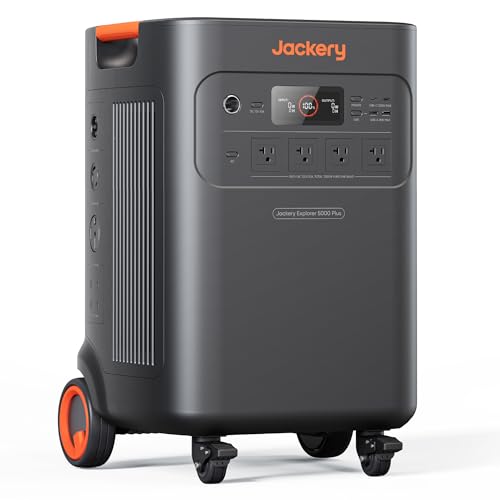
Capacity
5,040
Watt-hours
AC Output
7,200
Watts (120/240V)
Max Expand
60
kWh total
Battery Life
10
Years lifespan
Overview: Jackery Goes Whole-Home
Jackery has been the most recognizable name in portable solar generators for years, thanks to their ubiquitous orange-and-black design and strong Amazon presence. Their product line has historically focused on portable camping generators in the 200–3,000 Wh range. The Solar Generator 5000 Plus represents a significant departure — it's a stationary whole-home system designed to compete with the EcoFlow Delta Pro 3, Anker SOLIX F3800 Plus, and Pecron F5000LFP.
What Jackery brings to this segment that competitors don't is brand trust. Jackery has sold millions of units, has a well-established US-based customer support network, and carries the confidence that comes with being the market leader. For buyers who are hesitant about challenger brands like Pecron or OUPES, the Jackery 5000 Plus offers a premium brand experience at a premium price — currently $3,149.00 for the base system, or about $0.62/Wh.
Key Features
5,040 Wh LiFePO4 with 10-Year Lifespan
Jackery's 5000 Plus uses premium LiFePO4 battery cells rated for 4,000+ cycles to 80% capacity. At typical usage (200 cycles per year), that translates to a 20-year battery lifespan. Jackery backs this with a 5-year full warranty — one of the longest in the industry. The ChargeShield technology optimizes charging patterns to extend battery health further, adjusting voltage and current based on temperature and usage patterns.
7,200W 120/240V Split-Phase Output
The 5000 Plus delivers full split-phase power at 120/240V, with a NEMA 14-30R outlet for direct transfer switch connection. The 7,200W continuous output handles well pumps, furnaces, sump pumps, refrigerators, lights, and home electronics simultaneously. Jackery rates it for a 14,400W surge — double the continuous output — which gives hard-starting motors like well pumps and AC compressors real headroom.
Expandable to 60 kWh
The 5000 Plus supports expansion with additional battery packs to reach a total capacity of 60 kWh — enough to power the average US home for 5–7 days without any solar recharge. With sufficient solar panels, this is a true off-grid solution capable of indefinite power. The expansion batteries connect via plug-in cables, making capacity upgrades a simple process that doesn't require rewiring or professional installation.
Up to 3,000W Solar Input
The 5000 Plus accepts up to 3,000W of solar input through dual solar ports. This is more than the EcoFlow Delta Pro 3 (2,600W combined across its high- and low-voltage ports) but less than the Pecron F5000LFP (6,400W) or Anker SOLIX F3000 (2,400W with combined AC). In practical terms, 3,000W solar input means a full recharge from 0–100% in approximately 2–3 hours of peak sun, or a 1–2 hour top-up after partial discharge.
Jackery Ecosystem Integration
If you already own Jackery products (SolarSaga panels, Explorer series generators), the 5000 Plus integrates seamlessly. The Jackery app provides real-time monitoring, charge scheduling, and load management. SolarSaga panels connect directly without adapters, and the 5000 Plus can charge smaller Jackery units via AC output. For existing Jackery customers, the ecosystem lock-in is a real advantage — everything works together out of the box.
Pros & Cons
What We Love
- • Trusted brand — Jackery's reputation and US-based support
- • 7,200W 120/240V output — true whole-home capability
- • 10-year LiFePO4 lifespan — 4,000+ cycles to 80%
- • Expandable to 60 kWh — grows with your needs
- • ChargeShield technology — optimized battery health
- • Seamless ecosystem — works with existing Jackery gear
- • 5-year warranty — best in its class
What Could Be Better
- • Premium price — $3,149.00 on Amazon at $0.62/Wh
- • 3,000W solar input — less than Pecron (6,400W)
- • Heavy system — not easily portable once installed
- • New product — limited long-term reliability data
- • Proprietary ecosystem — less flexible with third-party gear
- • Requires professional install for transfer switch connection
Full Specifications
| Battery Capacity | 5,040 Wh (LiFePO4) |
| AC Output | 7,200W (120/240V split-phase) |
| AC Surge | 14,400W |
| AC Input | 3,600W max |
| Solar Input | 3,000W max (dual MPPT) |
| Expandable | Yes — up to 60 kWh |
| Battery Cycles | 4,000+ to 80% capacity |
| Warranty | 5 years |
| App Control | Yes (Wi-Fi + Bluetooth) |
| AC Outlets | NEMA 14-30R + multiple 120V outlets |
| Weight | ~105 lb (base unit) |
| Battery Chemistry | LiFePO4 with ChargeShield |
Who Should Buy the Jackery 5000 Plus?
Buy if you…
- ✓ Already own Jackery products and want ecosystem compatibility
- ✓ Value brand trust and US-based customer support
- ✓ Need proven reliability and want a 5-year warranty
- ✓ Want whole-home backup from a company with millions of units sold
- ✓ Plan to expand capacity over time (up to 60 kWh)
- ✓ Want 120/240V split-phase with transfer switch compatibility
Skip if you…
- ✗ Are on a tight budget (Pecron or EcoFlow offer better value)
- ✗ Need the fastest possible solar recharge (6,400W Pecron wins)
- ✗ Want a truly portable unit (105 lbs is stationary)
- ✗ Prefer to mix brands and panels freely
- ✗ Want maximum capacity for minimum money
Bottom line: The Jackery 5000 Plus is the right choice for buyers who prioritize brand trust, warranty coverage, and ecosystem compatibility over raw value. At its current Amazon price, it costs significantly more than competitors with similar specs, but for many homeowners, the peace of mind that comes with Jackery's established reputation and support network is worth the premium.
Real-World Runtime: What 5 kWh of Whole-Home Battery Actually Covers
At this tier the question changes from "what can it run" (nearly everything — 7,200W of 120/240V output) to "for how long." With roughly 4,280 usable watt-hours per charge (85% of 5,040 Wh), here's what realistic outage duty looks like:
| Scenario | Combined Draw | Estimated Runtime | Verdict |
|---|---|---|---|
| Essentials: fridge + freezer + lights + router + phones | ~300W average | ~14 hours | A full day per charge; multi-day with solar or expansion |
| Winter mode: essentials + gas furnace fan | ~700–800W average | ~5–6 hours heat-on time | A heated night — furnace fans cycle, stretching this further |
| Well pump (240V) on demand | 1,000–1,500W in bursts | Days of normal water use | The 240V output is why rural buyers land here |
| Window AC (summer outage) | ~800W cycling | ~7–9 hours | One cool room through a hot night |
| Everything at once (stress case) | ~2,000W sustained | ~2 hours | Triage matters even at 5 kWh — prioritize loads |
Two levers move these numbers dramatically. Solar: 3,000W of input means a good array genuinely offsets daytime consumption — pair it properly and the essentials scenario becomes indefinitely sustainable. Expansion: battery packs take the system to 60 kWh, which converts "a heated night" into "a heated week." Sizing those decisions is exactly what our sizing guide and calculator are for.
Who Should Buy the 5000 Plus — and Who Shouldn't
Buy it if you…
- ✓ Want whole-home backup with Jackery's plug-and-play simplicity — this is the least intimidating 5 kWh system to own
- ✓ Have 240V loads (well pump, mini-split) — the 7,200W split-phase output covers what portable units can't
- ✓ Plan transfer-switch integration for automatic essential-circuit coverage
- ✓ Live somewhere with real outage seasons — Gulf hurricanes, Texas grid events, or ice-storm country
Skip it if you…
- ✗ Are optimizing pure price per kWh — the Pecron F5000LFP undercuts it at the same capacity if brand support matters less to you
- ✗ Want the deepest smart-home integration — the EcoFlow Delta Pro 3 ecosystem (Smart Home Panel) is more mature
- ✗ Ever need to move it alone — 105 lb is a two-person or hand-truck object
- ✗ Only need essential-circuits coverage — the 3 kWh tier (Anker F3000, HomePower 3600) does that for meaningfully less
Living With It: Ownership Notes
Placement is a decision, not an afterthought
At 105 lb this unit picks a permanent home — a garage corner near the panel, a utility room, a basement landing. Being a battery, it's safe indoors with zero exhaust, which is precisely the point: it lives where a gas generator never could. Keep it above freezing for charging (LiFePO4 blocks charge below 32°F).
The transfer-switch question
Extension cords work for day one, but this unit's value unlocks with an electrician-installed transfer switch feeding your essential circuits — furnace, well pump, kitchen. Budget for that install as part of the purchase — and note that the federal battery credit no longer offsets it for 2026 installs (see our tax credit guide).
When to buy
Large-capacity units have historically carried the deepest dollar promotions of the November window — and at this price tier, a percentage promotion is a four-figure difference. Watch it on our Jackery Black Friday tracker.
Frequently Asked Questions About the Jackery 5000 Plus
Is the Jackery 5000 Plus worth the price?
If you value brand trust, US-based customer support, and ecosystem compatibility, yes — the premium over competitors reflects Jackery's established reputation and 5-year warranty. On pure specs-per-dollar, the Pecron F5000LFP offers more capacity and solar input for less than half the price. The right choice depends on whether you're buying specs or buying peace of mind.
Can the Jackery 5000 Plus run central air conditioning?
It can run smaller central AC units up to about 3 tons, depending on the unit's startup surge. A typical 3-ton AC draws 2,500–3,500W running with a startup surge of 6,000–8,000W. With 7,200W continuous and a 14,400W surge rating, the 5000 Plus covers that range. For larger systems (4–5 tons), compare the condenser's nameplate locked-rotor amps (LRA) with the surge rating before relying on it.
What solar panels are compatible with the 5000 Plus?
Jackery's own SolarSaga panels are the recommended option and connect directly without adapters. The 5000 Plus also supports third-party solar panels within its voltage range (dual MPPT, up to 3,000W total). For optimal performance, use two 400W+ panels per MPPT channel for a total of 1,600–3,000W array.
How does the Jackery 5-year warranty work?
Jackery's 5-year warranty covers defects in materials and workmanship for the power station. The battery is covered for 5 years as well, with coverage for capacity degradation below 80% of original spec. To make a claim, you contact Jackery's US-based support team via phone or email. They typically offer replacement or repair within 10–15 business days. The warranty is transferable if you sell the unit.