
Buying Guide · Updated November 2026
Best 2000 Watt Solar Generator: 8 Power Stations Ranked by Output
The best 2000 watt solar generator in our scoring is the Bluetti Elite 200 V2: 2,600W of continuous AC output from a 2,073.6 Wh battery. A 2000 watt power station delivers about what one household wall circuit does, so it runs a fridge plus a microwave, coffee maker or space heater, one heating appliance at a time. Every pick here is rated 2,000–2,600W continuous. This page is about output (watts); if you are shopping by battery size, see the best 2000Wh solar generators.
As an Amazon Associate, SolarGenAdvisor earns from qualifying purchases made through links on this page, at no additional cost to you.
 By
2000 Watt Power Station Comparison
Full-size picks (1,900 Wh or more), ranked by our editorial rating. Continuous output (W) is what it can run at once; surge is the brief peak for motor startups; capacity (Wh) is how long it lasts. Ratings are AI-synthesized from published specs, logged Amazon prices and Amazon customer reviews, not from hands-on use.
| # | Model | Continuous (W) | Surge (W) | Capacity (Wh) | At Full Output | Solar In | Weight | Rating | Price |
|---|---|---|---|---|---|---|---|---|---|
| 1 | Bluetti Elite 200 V2 | 2,600W | 3,900W* | 2,073.6 Wh | ~41 min | 1,000W | 53.4 lb | 91/100 | $999.00 |
| 2 | Anker SOLIX C2000 Gen 2 | 2,400W | 4,000W | 2,048 Wh | ~44 min | 800W | 41.7 lb | 90/100 | $999.99 |
| 3 | Bluetti Elite 300 | 2,400W | 4,800W* | 3,014.4 Wh | ~64 min | 1,200W | 58 lb | 89/100 | $1,299.00 |
| 4 | Jackery Explorer 2000 v2 | 2,200W | 4,400W | 2,042 Wh | ~47 min | 400W | 39.5 lb | 87/100 | $999.00 |
| 5 | Bluetti Elite 400 | 2,600W | 3,900W* | 3,840 Wh | ~75 min | 1,000W | 86 lb | 85/100 | $1,699.00 |
| 6 | EcoFlow Delta 3 Max | 2,400W | 4,800W | 2,048 Wh | ~44 min | 500W | 45 lb | 85/100 | $854.00 |
| 7 | EcoFlow Delta 2 Max | 2,400W | 4,800W | 2,048 Wh | ~44 min | 1,000W | 50 lb | 85/100 | $977.00 |
| 8 | Anker SOLIX F2000 (PowerHouse 767) | 2,400W | 2,800W | 2,048 Wh | ~44 min | 1,000W | 67.2 lb | 82/100 | Unavailable on Amazon. See our Best Value winner, the Bluetti Elite 200 V2 → |
* Bluetti publishes this figure as its Power Lifting mode, which Bluetti describes as supporting pure resistive loads (heaters, kettles, hair dryers) rather than as a motor surge rating. “At Full Output” is a formula estimate: rated capacity × 0.85 ÷ the unit’s own continuous rating. Not ranked: the 2,400W Bluetti AC200L, because we could not confirm its Amazon availability when this page was written. Units rated 3,000W and up are in our 3000 watt solar generator guide.
2000 Watts vs 2000 Watt-Hours
A “2000 watt” rating is the inverter’s output, the way gas generators are sold. “2000Wh” is the battery’s capacity. Many units happen to pair roughly 2,000W with roughly 2,000 Wh, which is why the two get mixed up, but they answer different questions and they do not always travel together.
Watts (W) = what it can run at once
Continuous output is the total load the inverter is rated to carry. The full-size picks here are rated 2,200W to 2,600W. Ask for more than that and the overload protection cuts the AC output.
Watt-hours (Wh) = how long it lasts
Among the same picks, capacity ranges from 2,042 Wh to 3,840 Wh. And the compact Anker SOLIX C1000 Gen 2 outputs 2,000W from just 1,024 Wh: same power, about 26 minutes at full load by the runtime formula below.
Which page do you need? If your question is “will it start and run my appliance?”, you are shopping by watts and this is the right page. If your question is “how many hours or days will it last?”, you are shopping by watt-hours: our best 2000Wh solar generator guide ranks the 2 kWh class by capacity. To size from your own appliance list, use the solar generator size calculator. Shopping for the Generac GB2000 (1,600W, 2,106 Wh)? Our Generac battery generator guide explains its specs and the in-stock stations that fill the same role.
What Can a 2000 Watt Solar Generator Run?
Think of it as one wall circuit you can carry. A 15 amp household circuit at 120V carries 1,800W and a 20 amp circuit carries 2,400W (amps × 120V, the rule DR Power’s worksheet uses [4]). Most things you would plug into a single outlet at home will run on a 2,000W-class station; what trips it is the same thing that trips a breaker, which is two heating appliances at once. The figures below are typical values from the numbered sources, not specs for your model. Your appliance’s nameplate is the number that matters.
| Appliance | Running Watts | Added Starting Watts | Sources | On a 2,000W-Class Unit? |
|---|---|---|---|---|
| Refrigerator / freezer | 400–725 | +2,200 | [1] [2] [3] [4] | Yes. Startup peaks near 2,600–2,900W for a moment, which rides on the surge rating |
| Microwave oven | 625–1,500 | — (Champion lists +2,000) | [1] [2] [3] [4] | Yes, one heating appliance at a time |
| Coffee maker | 800–1,200 | — | [1] [2] [3] [4] | Yes |
| Toaster | 800–1,400 | — | [1] [2] [3] [4] | Yes |
| Hair dryer | 1,200–1,875 | — | [1] [4] | Yes; on high it uses most of the output by itself |
| Space heater | 750–1,500 | — | [1] [3] | Yes, but 1,500W drains a 2 kWh battery in a little over an hour |
| Furnace blower (1/3 HP) | 700–750 | +1,400 | [1] [3] | Yes |
| Washing machine | 350–500 | +1,200 | [1] [2] | Yes |
| Sump pump (1/3 HP) | 800 | +1,300 | [3] | Usually: about 2,100W at startup |
| Sump pump (1/2 HP) | 1,050 | +2,200 | [3] | Only if the unit’s surge rating clears about 3,250W |
| Window air conditioner | 1,200 (12,000 BTU: 3,250) | +2,000 (12,000 BTU: +3,950) | [2] [3] [4] | Small units, yes. A 12,000 BTU unit at these chart figures, no |
| Circular saw | 1,400–1,500 | +2,000 | [2] [4] | Marginal: a 3,400–3,500W startup needs surge headroom |
| Table saw | 1,800 | +2,500 | [2] [4] | Not reliably: about 4,300W at startup |
| Well pump (1/3 HP, 120V) | 1,000 | +2,000 | [3] | Maybe: about 3,000W at startup. 240V pumps, no |
| Electric water heater | 4,500–5,500 | — | [1] [3] | No: more than double the output |
| Electric clothes dryer | 1,800–5,000 | — | [1] | No: most are 240V appliances |
Sources: [1] Virginia Cooperative Extension, “Estimating Appliance and Home Electronic Energy Use” (developed with the U.S. DOE Building Science program); [2] Champion Power Equipment, “Choosing a Generator” wattage chart; [3] EWEB (Eugene Water & Electric Board), “Generator Sizing Considerations”; [4] DR Power, Generator Wattage Worksheet. Rows with one source number rest on that chart alone. Generator charts are conservative: modern refrigerators and inverter air conditioners often draw less, as our appliance wattage chart shows row by row.
What runs together, and what doesn’t
Fits 2,000W
Refrigerator 700W + a compact microwave drawing 1,000W at the outlet + four 15W LED bulbs 60W = 1,760W running. Inside the continuous rating of every pick on this page. A full-size microwave draws closer to 1,500W from the outlet, which would push this mix past 2,000W.
Needs 2,400W or more
1,500W space heater + 700W refrigerator = 2,200W running. Over a 2,000W inverter and right at the limit of a 2,200W one; inside the 7 full-size picks rated 2,400W or more.
Stagger it
Refrigerator 700W + coffee maker 1,000W + toaster 850W = 2,550W running. At or past the limit of every unit here. Brew, then toast.
Examples use the EWEB chart’s running figures [3]. For runtimes by appliance, see what a solar generator can run. A slow cooker is one of the easiest kitchen loads to add to a fridge: makers rate 6-quart models at about 240–340W, as our guide to how many watts a Crock-Pot uses shows.
Surge: What a 2000 Watt Inverter Can Start
Motors and compressors need extra power for a moment at switch-on. The sources disagree on how much: Champion estimates 1–2× running watts [2], DR Power says typically 2× [4], and the DOE-program fact sheet notes about three times the current at motor start [1]. All three generator charts size the same way: total the running watts of everything on at once, then add the single highest starting figure [2] [3] [4]. That assumes one motor starts at a time.
Worked example: fridge, furnace blower and a sump pump
Running: refrigerator 700W + furnace blower 700W + 1/3 HP sump pump 800W = 2,200W. Over a 2,000W inverter, inside a 2,400W or 2,600W one.
Peak: 2,200W + the highest single starting figure (refrigerator, +2,200W) = 4,400W. That is at or above most of the surge figures in the comparison table, so on paper this trio belongs on a 3,000W-class unit.
Drop the furnace blower and it becomes 1,500W running and a 3,700W peak, which is under most of the peak figures in that table but not all of them, so check the row for the unit you are considering. Figures from the EWEB chart [3].
Read the surge number carefully. Not every peak figure means the same thing. Bluetti’s 3,900W figure for the Elite 200 V2 is its Power Lifting mode, which Bluetti describes as supporting pure resistive loads such as heaters and kettles; it is not published as a motor surge rating. If a pump or compressor is your main load, check its nameplate starting amps against the manufacturer’s guidance, or favor a pick with a conventional published surge rating: the EcoFlow Delta 3 Max and EcoFlow Delta 2 Max each list 4,800W. Our starting watts guide lists startup figures for more appliances, and the sump pump guide covers pumps by horsepower.
How Long Does a 2000 Watt Power Station Last?
Runtime comes from capacity, not from the watt rating. These are formula estimates, not measured results: rated capacity × 0.85 (our planning allowance for inverter losses) ÷ a steady load. Real household loads cycle on and off, so a day’s average sits well below the peak.
| Model | Capacity | 500W avg (essentials) | 1,000W (microwave-size load) | 2,000W (full class load) |
|---|---|---|---|---|
| Bluetti Elite 200 V2 | 2,073.6 Wh | ~3.5 hrs | ~1.8 hrs | ~0.9 hrs |
| Anker SOLIX C2000 Gen 2 | 2,048 Wh | ~3.5 hrs | ~1.7 hrs | ~0.9 hrs |
| Bluetti Elite 300 | 3,014.4 Wh | ~5.1 hrs | ~2.6 hrs | ~1.3 hrs |
| Jackery Explorer 2000 v2 | 2,042 Wh | ~3.5 hrs | ~1.7 hrs | ~0.9 hrs |
| Bluetti Elite 400 | 3,840 Wh | ~6.5 hrs | ~3.3 hrs | ~1.6 hrs |
| EcoFlow Delta 3 Max | 2,048 Wh | ~3.5 hrs | ~1.7 hrs | ~0.9 hrs |
| EcoFlow Delta 2 Max | 2,048 Wh | ~3.5 hrs | ~1.7 hrs | ~0.9 hrs |
| Anker SOLIX F2000 (PowerHouse 767) | 2,048 Wh | ~3.5 hrs | ~1.7 hrs | ~0.9 hrs |
| Anker SOLIX C1000 Gen 2 (compact) | 1,024 Wh | ~1.7 hrs | ~0.9 hrs | ~0.4 hrs |
Base-unit capacity only; solar input during the day stretches these numbers. The 2,000W column is why capacity still matters on an output page: every unit here can deliver the power, but only the larger batteries can deliver it for long.
The Best 2000 Watt Solar Generators, Reviewed
Specs and summaries come from our product database; scores are our editorial ratings out of 100.

#1 · Best Overall · 91/100
Bluetti Elite 200 V2
2,600W continuous · 3,900W Power Lifting (resistive loads) · 2,073.6 Wh · 1,000W solar · 53.4 lb · LiFePO4
High-capacity mid-tier pick with strong solar input and fast charging: 80% in about 50 minutes with AC and solar combined (Bluetti's figure). At its full 2,600W the battery lasts about 41 minutes; at a 500W average essentials load, about 3.5 hours (formula estimates).
Why it leads: it has the highest rating of the full-size units and, at 2,600W, the most continuous output in this class, so on paper it carries a 1,500W space heater and a refrigerator together where a 2,000W inverter would trip. Who should skip it: its capacity is fixed (it takes no expansion battery), and buyers whose main load is a pump should read the surge note above. Head-to-head with the runner-up: Elite 200 V2 vs Anker SOLIX C2000 Gen 2.
#2 · Lightest Expandable Pick · 90/100
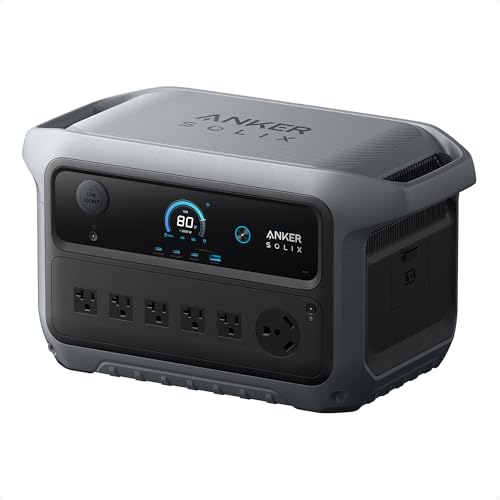
Anker SOLIX C2000 Gen 2
2,400W continuous · 4,000W surge · 2,048 Wh · 800W solar · 41.7 lb · LiFePO4
2,048Wh LiFePO4 at just 41.7 lb with 2,400W output (4,000W peak), a TT-30 RV outlet, 800W solar input and expansion to 4kWh with the BP2000 Gen 2 battery. At its full 2,400W the battery lasts about 44 minutes; at a 500W average essentials load, about 3.5 hours (formula estimates).

#3 · Best for Long Runtimes · 89/100
Bluetti Elite 300
2,400W continuous · 4,800W Power Lifting (resistive loads) · 3,014.4 Wh · 1,200W solar · 58 lb · LiFePO4
Compact 3,014.4Wh LiFePO4 station at about 58 lb with 2,400W of 120V output, a TT-30 RV outlet, a 12V/30A DC port, 1,200W solar input and a 10ms UPS, but it is 120V-only, cannot be expanded and is loud under heavy load. At its full 2,400W the battery lasts about 64 minutes; at a 500W average essentials load, about 5.1 hours (formula estimates).

#4 · Lightest 2 kWh Pick · 87/100
Jackery Explorer 2000 v2
2,200W continuous · 4,400W surge · 2,042 Wh · 400W solar · 39.5 lb · LiFePO4
2,042Wh LiFePO4 with 2,200W output (4,400W surge) at 39.5 lb — a lighter, simpler alternative to the 2000 Plus, but not expandable and limited to 400W of solar input. At its full 2,200W the battery lasts about 47 minutes; at a 500W average essentials load, about 3.5 hours (formula estimates).

#5 · Biggest Battery · 85/100
Bluetti Elite 400
2,600W continuous · 3,900W Power Lifting (resistive loads) · 3,840 Wh · 1,000W solar · 86 lb · LiFePO4
Wheeled 3,840Wh LiFePO4 station at about 86 lb with 2,600W of 120V output (3,900W Power Lifting), four 20A outlets, 1,000W solar input and a 15ms UPS, but it cannot be expanded, lacks the Elite 300's TT-30 and 12V/30A ports, and Amazon sells it only in bundles. At its full 2,600W the battery lasts about 75 minutes; at a 500W average essentials load, about 6.5 hours (formula estimates).

#6 · Current-Gen EcoFlow · 85/100
EcoFlow Delta 3 Max
2,400W continuous · 4,800W surge · 2,048 Wh · 500W solar · 45 lb · LiFePO4
2,048Wh LiFePO4 with 2,400W output and fast AC recharging, but a single 500W solar input and no battery expansion — the Delta 3 Max Plus is the expandable, higher-output sibling. At its full 2,400W the battery lasts about 44 minutes; at a 500W average essentials load, about 3.5 hours (formula estimates).

#7 · Most Expandable · 85/100
EcoFlow Delta 2 Max
2,400W continuous · 4,800W surge · 2,048 Wh · 1,000W solar · 50 lb · LiFePO4
Previous-generation 2,048Wh LiFePO4 station with 2,400W output, 1,000W dual-port solar input and expansion to 6kWh with two extra batteries — older, but still more expandable than the base Delta 3 Max. At its full 2,400W the battery lasts about 44 minutes; at a 500W average essentials load, about 3.5 hours (formula estimates).
#8 · Wheeled Pick · 82/100
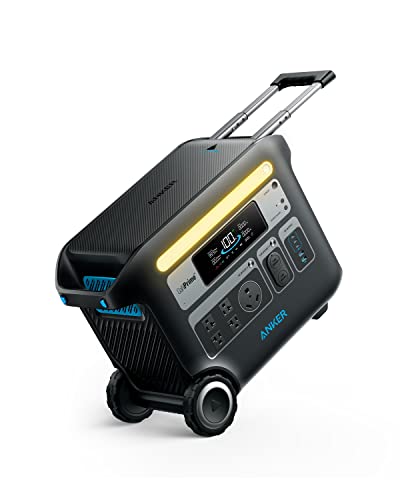
Anker SOLIX F2000 (PowerHouse 767)
2,400W continuous · 2,800W surge · 2,048 Wh · 1,000W solar · 67.2 lb · LiFePO4
Wheeled 2,048Wh LiFePO4 station with 2,400W output, a TT-30 RV outlet, 1,000W solar input and expansion to 4kWh — capable, but at 67 lb it is far heavier than the newer C2000 Gen 2. At its full 2,400W the battery lasts about 44 minutes; at a 500W average essentials load, about 3.5 hours (formula estimates).
The short version
For most households shopping the 2,000W class, the Bluetti Elite 200 V2 (91/100) is the one to price first: 2,600W continuous, 2,073.6 Wh and 1,000W of solar input at 53.4 lb. Choose the Anker SOLIX C2000 Gen 2 (90/100) instead if you want 11.7 lb less to carry.
Compact 2000 Watt Power Stations (1–1.5 kWh)
These deliver the same 2,000W-class output from a smaller battery, so they weigh less but empty faster. They suit short, heavy jobs: a microwave at a tailgate, a hair dryer in a van, a corded tool away from an outlet. For a microwave, size to the input watts on its label rather than the cooking watts on the box; our guide to how many watts a microwave uses lists both for six models. The Anker SOLIX C1000 Gen 2 carries a higher rating (92/100) than any full-size pick above; we list it here because at a steady 2,000W its battery lasts about 26 minutes by the same formula.
| Model | Continuous (W) | Surge (W) | Capacity (Wh) | At Full Output | Weight | Rating | Price |
|---|---|---|---|---|---|---|---|
| Anker SOLIX C1000 Gen 2 | 2,000W | 3,000W | 1,024 Wh | ~26 min | 24.9 lb | 92/100 | $469.99 |
| DJI Power 1000 V2 | 2,600W | 2,600W† | 1,024 Wh | ~20 min | 31.3 lb | 87/100 | $469.99 |
| Jackery Explorer 1500 v2 | 2,000W | 4,000W | 1,536 Wh | ~39 min | 31.97 lb | 87/100 | Check price at Amazon → |
| OUPES Mega 1 Lite | 2,000W | 4,500W | 1,024 Wh | ~26 min | 26.7 lb | 87/100 | $439.00 |
| Goal Zero Yeti 1500 (6th Gen) | 2,000W | 3,600W | 1,505 Wh | ~38 min | 52.75 lb | 82/100 | $1,499.95 |
† Our data holds no separate surge figure for this model, so the cell repeats its continuous rating. “At Full Output” is the same formula estimate as above, at each unit’s own continuous rating.

Best Compact 2,000W · 92/100
Anker SOLIX C1000 Gen 2
2,000W continuous · 3,000W surge · 1,024 Wh · 600W solar · 24.9 lb
Gen 2 ultra-fast ~49-minute charging, 2,000W output, 600W solar input — premium mid-capacity portable power. Pick it over a full-size unit if you need the output in short bursts and want to carry 28.5 lb less than the Bluetti Elite 200 V2. Want to stay near 1 kWh? Our best 1000Wh guide covers that class.
2000 Watt Solar Generator With Panels
A power station becomes a solar generator when you add panels, and the “2000 watt” on the box says nothing about how much solar it accepts. That is a separate spec, and among the full-size picks it runs from 400W to 1,200W.
| Model | Max Solar Input | 200W Panels to Reach It | Best-Case Refill at Max Input |
|---|---|---|---|
| Bluetti Elite 200 V2 | 1,000W | 5 | ~2.1 hrs of full sun |
| Anker SOLIX C2000 Gen 2 | 800W | 4 | ~2.6 hrs of full sun |
| Bluetti Elite 300 | 1,200W | 6 | ~2.5 hrs of full sun |
| Jackery Explorer 2000 v2 | 400W | 2 | ~5.1 hrs of full sun |
| Bluetti Elite 400 | 1,000W | 5 | ~3.8 hrs of full sun |
| EcoFlow Delta 3 Max | 500W | 2 | ~4.1 hrs of full sun |
| EcoFlow Delta 2 Max | 1,000W | 5 | ~2.0 hrs of full sun |
| Anker SOLIX F2000 (PowerHouse 767) | 1,000W | 5 | ~2.0 hrs of full sun |
Best-case refill is capacity ÷ maximum solar input, a formula estimate. Panels rarely produce their full rated watts, so expect longer. Panels must also fit each unit’s voltage and current window: Bluetti lists the Elite 200 V2’s solar input as 12–60V, 20A, 1,000W max. Check the input label before wiring panels in series.
Two 200W panels are a sensible starting kit for any unit here. If you plan to recharge mainly from the sun during a multi-day outage, favor the picks with 1,000W or more of input: the Bluetti Elite 200 V2, Bluetti Elite 300, Bluetti Elite 400, EcoFlow Delta 2 Max and Anker SOLIX F2000 (PowerHouse 767). Our best portable solar panels guide compares panels by watts, weight and connector.
Is 2000 Watts Enough for Home Backup?
For the essentials, yes. A 2000 watt solar generator for home use covers the 120V loads that matter most in an outage, as long as you run the big ones one at a time. What it cannot do is 240V: the picks on this page are 120V units, so an electric range, a central air conditioner, a 240V well pump and most electric dryers and water heaters are out of reach whatever the wattage.
A 2,000W-class unit fits if…
- Your outage list is a fridge, furnace blower, lights, router, phones and one kitchen appliance at a time
- You want something you can move without a hand truck (the full-size picks start at 39.5 lb; the top pick is 53.4 lb)
- You will plug appliances in directly or with extension cords
- You camp, tailgate or work away from outlets and need to run a microwave, kettle or corded tool
Step up to 3,000W or more if…
- A 1/2 HP sump pump or a well pump has to start while other loads are running
- You want to cover a full 30 amp RV service (up to 3,600W at 120V)
- You need 240V from the battery
- You plan to feed several home circuits through a transfer switch
The next class up is covered in our best 3000 watt solar generator guide, and 240V whole-home units in the 5000 watt guide. For hardwired circuits, use a transfer switch installed by a licensed electrician; never backfeed a house through an outlet. Our home backup guide covers which circuits to prioritize, and the refrigerator guide has fridge runtimes by battery size.
Harbor Freight 2000 Watt Power Station
Harbor Freight’s entry in this class is the Predator 2000. When we checked its product page for our Harbor Freight solar generator guide on November 9, 2026, it listed 1,545 Wh, 2,000 running watts and 4,000 starting watts at 44 lb, marked in-store only. Harbor Freight’s site blocked our re-check on November 13, so treat those figures as of the earlier date. By capacity it sits with the compact group on this page.
One thing to know if you own an early unit: on July 3, 2025 the U.S. Consumer Product Safety Commission announced recall 25-366 covering about 6,500 Predator 2000 Watt Power Stations (SKU 70084) sold from February through April 2025, because the wires in the AC outlet receptacles are reversed in Emergency Power Supply mode, a shock hazard. The remedy is a free replacement at a Harbor Freight store.
Related Buying Guides
Best 2000Wh Solar Generator
Shopping by capacity? The 2 kWh class ranked for runtime
Best 3000 Watt Solar Generator
The next output class: 3,000W-plus units for pumps, RVs and heavier loads
Bluetti Elite 200 V2 Review
Specs, runtime math and who the top pick suits
Appliance Wattage Chart
Running and starting watts, plus a calculator that totals your list
What Can a Solar Generator Run?
Runtime estimates appliance by appliance, by battery size
What Size Solar Generator Do I Need?
Sizing guide with an appliance wattage worksheet
Frequently Asked Questions
What is the best 2000 watt solar generator in 2026?
Our highest-rated full-size 2,000W-class solar generator is the Bluetti Elite 200 V2 (91/100), with 2,600W of continuous AC output and 2,073.6 Wh of capacity at 53.4 lb. If you want 2,000W in a smaller box, the Anker SOLIX C1000 Gen 2 (92/100) delivers 2,000W from a 1,024 Wh battery at 24.9 lb, but it runs for about half as long.
What will a 2000 watt power station run?
About what one household wall circuit runs: a 15 amp, 120V circuit carries 1,800 watts and a 20 amp circuit 2,400 watts. That covers a refrigerator, microwave, coffee maker, toaster, hair dryer, space heater, furnace blower, TV, router and lights, but not all the heating appliances at once. Add up the running watts of everything that will be on together and keep the total under the continuous rating. It will not run 240V appliances such as an electric dryer, range or water heater.
Will a 2000 watt solar generator run a refrigerator?
Yes. Generator sizing charts from Champion, EWEB and DR Power list a refrigerator/freezer at 400 to 700 running watts, and the Champion and EWEB charts add about 2,200 starting watts, so the peak is roughly 2,600 to 2,900 watts for a moment. The running draw is well inside a 2,000W inverter and the startup spike is under the published surge figure of most picks on this page; compare it with the surge column for the unit you choose. How long it runs depends on battery capacity, not the watt rating.
Is a 2000 watt power station the same as a 2000Wh power station?
No. Watts (W) are output: how much the inverter can deliver at once. Watt-hours (Wh) are capacity: how much energy the battery stores. The full-size picks on this page are rated 2,200W to 2,600W continuous, but their batteries range from 2,042 Wh to 3,840 Wh. The compact Anker SOLIX C1000 Gen 2 also outputs 2,000W, from a 1,024 Wh battery. Our best 2000Wh solar generator guide ranks by capacity instead.
How long will a 2000 watt solar generator run?
It depends on battery capacity and load, not the watt rating. Using rated capacity times 0.85 for inverter losses, divided by the load, the full-size picks here last about 3.5 to 6.5 hours at a 500W average load and about 0.9 to 1.6 hours at a steady 2,000W. These are formula estimates, not measured results.
Is a 2000 watt solar generator enough for home backup?
For 120V essentials, usually yes: a fridge, furnace blower, lights, router, phone charging and one kitchen appliance at a time. It is not enough for 240V loads such as a well pump on a 240V circuit, an electric dryer, a range or central air, and a single unit will not carry a whole house. If you need to run several heavy loads together or cover a 30 amp RV service, step up to the 3,000W class.
How many solar panels does a 2000 watt solar generator need?
The 2,000 watts is the AC output; the solar limit is a separate spec. The full-size picks here accept between 400W and 1,200W of solar. The Bluetti Elite 200 V2 takes up to 1,000W (5 x 200W panels at most); two 200W panels are a practical starting point. Panels must also stay inside the unit's voltage and current window, so check the input label before buying.
Is a 2400 or 2500 watt power station better than a 2000 watt one?
The extra output mainly lets you run two things together. By generator-chart figures a 1,500W space heater plus a 700W refrigerator is 2,200W, which trips a 2,000W inverter but fits a 2,400W or 2,600W one. 7 of the 8 full-size picks here are rated 2,400W or more. None of the units on this page is rated at exactly 2,500W; the nearest ratings are 2,400W and 2,600W.
What about the Harbor Freight 2000 watt power station?
Harbor Freight sells the Predator 2000, which its product page listed at 1,545 Wh with 2,000 running watts and 4,000 starting watts when we checked for our Harbor Freight guide on November 9, 2026. It was listed as in-store only. The CPSC announced recall 25-366 on July 3, 2025 for about 6,500 units sold from February through April 2025 because the outlet wiring is reversed in Emergency Power Supply mode, so check the recall notice if you own an early unit.