SolarGenAdvisor SolarGenAdvisor

Buying Decision · Updated October 31, 2026

Which Goal Zero Yeti Should You Buy?

If you want a Goal Zero, buy the Yeti 1500 (6th Gen) — or the Yeti 300 if you only charge phones, laptops and a CPAP. Goal Zero's current Yetis are the 6th Gen LiFePO4 models: the 297 Wh Yeti 300, 677 Wh Yeti 700 and 1,505 Wh Yeti 1500. They are tough, splash-resistant (IPX4) and rated for 4,000 cycles, but in our scoring they rate 76–82/100, below similarly sized Jackery, EcoFlow, Anker and Bluetti units, mainly on cost per watt-hour, weight and the lack of expansion. Below: a chooser, runtime math, Goal Zero vs its rivals at each size, and where Goal Zero is still the right call.

As an Amazon Associate, SolarGenAdvisor earns from qualifying purchases made through links on this page, at no additional cost to you.

Pick a Goal Zero Yeti by What You Need to Run

Start with the one load you care about most. The Yeti that covers it is your floor — size up only if you need longer runtime or more loads at once.

Phones, laptops, lights and a CPAP for a night

Goal Zero Yeti 300

297 Wh · 350W · 13.7 lb · 80/100

Campers and overlanders who want a small, splash-resistant box for electronics.

Check price at Amazon →

A 12V fridge or CPAP for a weekend

Goal Zero Yeti 700

677 Wh · 600W · 20.3 lb · 76/100

Goal Zero owners who want more than a 300 without stepping up to 50+ lb.

Check price at Amazon →

A household fridge through an outage, or RV and basecamp power

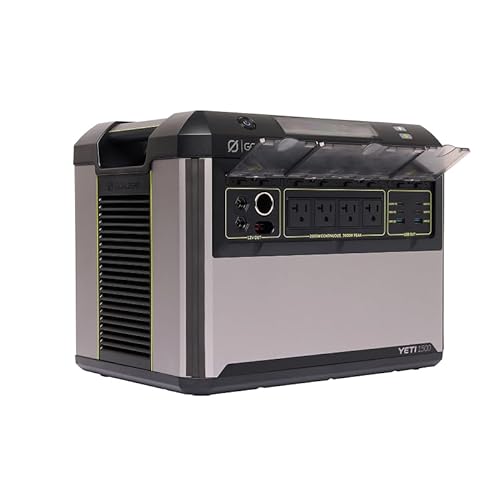
Goal Zero Yeti 1500 (6th Gen)

1,505 Wh · 2,000W · 52.75 lb · 82/100

Buyers who want a rugged 1.5 kWh unit with fast solar and do not need to carry it far.

Price: $1,499.95

Not tied to Goal Zero?

Compare the 1 kWh class first

If brand does not matter, the Jackery Explorer 1000 V2 (93/100) and Anker SOLIX C1000 Gen 2 (92/100) rate higher in our scoring than any current Yeti. See our best portable solar generator award.

Our Verdict: The Yeti 1500 Is the Goal Zero to Get

The Goal Zero Yeti 1500 (6th Gen) is the Yeti that best holds its own against rivals. Goal Zero lists 2,000W continuous output (3,600W surge), up to 900W of solar input and a 4,000-cycle LiFePO4 battery (Goal Zero; Popular Science; GearJunkie). That solar ceiling is more than double the Jackery Explorer 2000 v2's 400W. The catches, which both reviews also note, are weight (about 52.75 lb) and price. Currently $1,499.95 on Amazon, it scores 82/100 in our scoring.

What Size Goal Zero Yeti Do I Need?

Check two numbers. Output: everything running at once must stay below the Yeti's continuous rating, and motors or compressors need surge headroom to start. Capacity: multiply each load's watts by the hours you need it, add them up, and allow about 15% for inverter losses.

The table runs that arithmetic (capacity × 0.85 ÷ load) for two steady loads: about 60W (a CPAP with humidifier, Starlink, or a router plus lights) and about 150W (a refrigerator compressor while running). For other appliances, use our solar size calculator.

Model Capacity Output ~60W load ~150W load
Goal Zero Yeti 300 297 Wh 350W ~4 hrs ~2 hrs
Goal Zero Yeti 700 677 Wh 600W ~10 hrs ~4 hrs
Goal Zero Yeti 1500 (6th Gen) 1,505 Wh 2,000W ~21 hrs ~9 hrs

Continuous-draw estimates with ~15% inverter loss. A refrigerator that cycles runs noticeably longer than the 150W column suggests, but a full-size fridge's startup surge can exceed the Yeti 300's 600W surge rating — check your fridge's label. More figures in our sizing guide.

Goal Zero vs Jackery, EcoFlow and Anker at Each Size

Every rival here is already rated on our site, so the scores are directly comparable. “Wh per lb” shows how much energy you carry per pound; “$ per Wh” is calculated from today's Amazon price and is blank when no live price is available.

Small: Yeti 300 vs Jackery Explorer 300 vs EcoFlow River 3 Plus

Model Our rating Capacity Output / surge Weight Wh per lb Solar input $ per Wh Price
Goal Zero Yeti 300 80/100 297 Wh 350W / 600W 13.7 lb 22 200W — Check price at Amazon →
Jackery Explorer 300 87/100 292 Wh 300W / 300W 7.1 lb 41 100W $0.99/Wh $289.00
EcoFlow River 3 Plus 86/100 286 Wh 600W / 1,200W 10.4 lb 28 220W $1.05/Wh $299.00

The Yeti 300 is the most competitive Yeti: its 200W solar input is double the Explorer 300's and close to the River 3 Plus. It loses points for weight — 13.7 lb against 7.1 lb for the Jackery — and price, and unlike the River 3 Plus (expandable to 858 Wh with an extra battery) it cannot be expanded; Goal Zero lists it as not chainable (Goal Zero Yeti 300 specs). More small options in best solar generators under $500.

Mid-size: Yeti 700 vs the 1 kWh class

Model Our rating Capacity Output / surge Weight Wh per lb Solar input $ per Wh Price
Goal Zero Yeti 700 76/100 677 Wh 600W / 1,000W 20.3 lb 33 200W — Check price at Amazon →
Jackery Explorer 1000 V2 93/100 1,070 Wh 1,500W / 3,000W 23 lb 47 400W $0.52/Wh $559.00
Anker SOLIX C1000 Gen 2 92/100 1,024 Wh 2,000W / 3,000W 24.9 lb 41 600W $0.52/Wh $529.99
Bluetti Elite 100 V2 90/100 1,024 Wh 1,800W / 3,600W 25 lb 41 1,000W $0.49/Wh $499.00

There is no 700 Wh model among the rivals we rate, so this is the honest comparison: for roughly 3–5 extra pounds, the 1 kWh units give you about 50% more capacity, roughly 2.5 to 3.3 times the inverter output and two to five times the solar input. The Yeti 700 charges from solar through a single 8mm port capped at 200W (Goal Zero), which is why it is the lowest-rated Yeti in our scoring at 76/100. Bob Vila's review also lists “expensive for its capacity” as its main drawback (Bob Vila).

Large: Yeti 1500 (6th Gen) vs 1–2 kWh rivals

Model Our rating Capacity Output / surge Weight Wh per lb Solar input $ per Wh Price
Goal Zero Yeti 1500 (6th Gen) 82/100 1,505 Wh 2,000W / 3,600W 52.75 lb 29 900W $1.00/Wh $1,499.95
Jackery Explorer 2000 v2 87/100 2,042 Wh 2,200W / 4,400W 39.5 lb 52 400W $0.49/Wh $999.00
Anker SOLIX C1000 Gen 2 92/100 1,024 Wh 2,000W / 3,000W 24.9 lb 41 600W $0.52/Wh $529.99
Bluetti Elite 100 V2 90/100 1,024 Wh 1,800W / 3,600W 25 lb 41 1,000W $0.49/Wh $499.00

The Yeti 1500 out-specs the 1 kWh units on capacity and solar input, and its 900W solar ceiling is more than double the larger Explorer 2000 v2's. Where it falls behind is weight: the Explorer 2000 v2 stores more energy and still weighs about 13 lb less. Goal Zero also states the 6th Gen Yetis cannot use expansion batteries (Goal Zero), so the capacity you buy is the capacity you keep. For outage planning beyond 1.5 kWh, see expandable power stations.

Specs from our product database, cross-checked against manufacturer pages for the Goal Zero models. Ratings are editorial scores synthesized from published specs, logged prices and Amazon customer reviews; we score on capacity and power, value, solar charging, portability, expandability and battery chemistry (methodology). Brand-level comparisons: Jackery vs EcoFlow and our solar generator brand comparison.

When a Goal Zero Yeti Is Still the Right Call

Lower scores do not make the Yetis bad buys. They make them specific ones. A Yeti makes sense if one of these describes you:

You already own Goal Zero gear

Goal Zero says the 6th Gen Yetis work with its legacy HPP and 8mm solar panels and cables (Goal Zero). If you have Nomad or Boulder panels, a Yeti avoids buying adapters or new panels. Tank expansion batteries from older Yetis do not carry over.

Your gear lives outside

All three current Yetis are rated IPX4 against splashing water and light rain (Popular Science; Bob Vila; Goal Zero). We do not track IP ratings for the rivals in our tables, so check a rival's listing if splash resistance matters. Goal Zero still says the Yetis are not fully waterproof.

You want fast solar at 1.5 kWh

The Yeti 1500 accepts up to 900W of solar across its HPP and 8mm inputs, enough for a basecamp or RV array (GearJunkie; Popular Science). Goal Zero sells matching Nomad folding panels, so the whole kit comes from one brand.

You value a long warranty and US support

Goal Zero lists a 5-year warranty on the 6th Gen Yetis and a 4,000-cycle rating to 80% capacity (Goal Zero; Popular Science). The company is based in Utah (CPSC) and has been owned by BioLite since 2025 (BioLite; GearJunkie).

Who should skip a Yeti

If you carry your power station any distance, want the most capacity per dollar, or may add batteries later, look elsewhere. The 1 kWh Jackery, Anker and Bluetti units in the tables above rate 90–93/100 in our scoring and weigh around half as much as the Yeti 1500. For camping specifically, start with our best solar generators for camping.

Goal Zero Solar Inputs and Nomad Panels

Goal Zero uses two solar connectors: the 8mm low-voltage port and the High Power Port (HPP). Which ones a Yeti has determines which panels plug in directly.

Model Max solar input Solar ports 100W panels to reach max
Goal Zero Yeti 300 200W 8mm (12.3–28V) 2
Goal Zero Yeti 700 200W 8mm (12.3–28V) 2
Goal Zero Yeti 1500 (6th Gen) 900W HPP + 8mm 9

On the Yeti 300 and 700, Goal Zero's 200W Nomad and Boulder panels need an HPP-to-8mm adapter (Goal Zero). Third-party panels work too if their voltage sits inside the input range. Our best portable solar panels and solar panel setup guide cover matching panels to a station.

Yeti 1500X, 3000X, 6000X and PRO 4000: The Older and Larger Yetis

Search for “Goal Zero Yeti 1500X” and you will find the Yeti X line (1500X, 3000X, 6000X): part of Goal Zero's earlier Yeti generations. Earlier Yetis could add capacity with Goal Zero's Tank expansion batteries and expansion modules; Goal Zero says the 6th Gen units are not compatible with either (Goal Zero). We found no live Amazon listing for a base Yeti X unit, so we do not link or rate them here. Goal Zero has not said in anything we found that the line is discontinued; if you see one at clearance, compare it against the 6th Gen Yeti 1500's LiFePO4 battery and warranty before buying.

Yeti 3000X owners: on August 20, 2026, Goal Zero and the U.S. Consumer Product Safety Commission announced a recall of about 46,200 Yeti 3000X units because the circuit board can overheat. The remedy is a free firmware update through the Goal Zero app; owners are told to stop using the unit until it is updated (CPSC; Goal Zero recall page). If you are buying a used 3000X, confirm the update has been installed. The recall does not cover the 6th Gen Yetis in this guide.

Yeti PRO 4000 is Goal Zero's large home and RV unit: about 3,994 Wh of LiFePO4, expandable with Tank PRO batteries (Goal Zero; GearJunkie). We do not track it on Amazon, so it is not rated here. For whole-home capacity, compare it with the units in our home backup guide.

Every Current Goal Zero Yeti We Track, With Live Prices

Ratings are our editorial scores, synthesized from published specs, logged Amazon prices and Amazon customer reviews. Specs come from our product database and prices are live from Amazon.

Goal Zero Yeti 1500 (6th Gen)
Best Goal Zero overall

Goal Zero Yeti 1500 (6th Gen)

82/100
1,505 Wh 2,000W output 3,600W surge 900W solar in 52.75 lb

Rugged 1,505Wh LiFePO4 Yeti with 2,000W output (3,600W surge), up to 900W solar input, an IPX4-rated aluminum case and a 4,000-cycle rating — well built, but heavy for its capacity, not expandable, and costlier per watt-hour than most rivals.

$1,499.95Current price on Amazon
Check Price on Amazon →
Goal Zero Yeti 700
Mid-size Goal Zero

Goal Zero Yeti 700

76/100
677 Wh 600W output 1,000W surge 200W solar in 20.3 lb

Compact 677Wh LiFePO4 Yeti with 600W output (1,000W surge), IPX4 weather resistance and a 4,000-cycle rating — durable for camping, but its 200W solar input and modest inverter trail similarly priced rivals.

See today’s price on Amazon
Check Price on Amazon →
Goal Zero Yeti 300
Best small Goal Zero

Goal Zero Yeti 300

80/100
297 Wh 350W output 600W surge 200W solar in 13.7 lb

Small 297Wh LiFePO4 Yeti with 350W output (600W surge), 200W solar input, IPX4 weather resistance and a 4,000-cycle rating — tough and quick to recharge, though heavier and pricier than most 300Wh competitors.

See today’s price on Amazon
Check Price on Amazon →

Prices shown are the current Amazon price. Badges come from our own daily price log — see the solar generator price tracker; they describe what we observed on the listing, not a manufacturer claim or a prediction.

Goal Zero Yeti FAQ

Which Goal Zero Yeti should I buy?

For most people who want a Goal Zero, the Yeti 1500 (6th Gen): it is the highest-rated Yeti in our scoring at 82/100, with 2,000W output and up to 900W of solar input, but at about 52.75 lb it is not a carry-to-camp unit. For phones, laptops and a CPAP, the Yeti 300 (80/100). The Yeti 700 (76/100) suits Goal Zero owners who want more capacity at about 20.3 lb, but its 200W solar input is slow for its size.

Is Goal Zero a good brand?

Goal Zero is a long-running Utah-based portable power brand, acquired by BioLite in 2025. Its current 6th Gen Yetis use LiFePO4 batteries rated for 4,000 cycles to 80%, carry an IPX4 splash rating and a 5-year warranty according to Goal Zero. In our scoring they rate 76-82/100, below similarly sized Jackery, EcoFlow, Anker and Bluetti models (86-93/100), mainly because they cost more per watt-hour, weigh more for their capacity and cannot be expanded.

Goal Zero vs Jackery: which is better?

At the same size, Jackery rates higher in our scoring. The Jackery Explorer 300 weighs 7.1 lb against 13.7 lb for the Yeti 300, and the Explorer 1000 V2 gives more capacity than the Yeti 700 at a similar weight. Goal Zero is the better fit if you want IPX4 splash resistance, already own Goal Zero panels, or want 900W of solar input on the Yeti 1500.

What happened to the Goal Zero Yeti 1500X?

The Yeti 1500X is part of Goal Zero's earlier Yeti X line. Goal Zero's current Yeti 1500 is the 6th Gen LiFePO4 model. We did not find a live Amazon listing for a base Yeti 1500X unit, so we do not link one; Goal Zero has not said in anything we found that the 1500X is discontinued. If you are shopping used or clearance stock, check firmware support and warranty status with Goal Zero.

Can I use my old Goal Zero panels and Tank batteries with a 6th Gen Yeti?

Panels yes, Tanks no. Goal Zero says the 6th Gen Yetis work with its legacy HPP and 8mm solar panels and cables, but are not compatible with the expansion modules or external Tank batteries used on earlier Yeti generations. On the Yeti 300 and 700, Goal Zero's 200W Nomad and Boulder panels need an HPP-to-8mm adapter.

Are Goal Zero Yetis waterproof?

No. The 6th Gen Yeti 300, 700 and 1500 are rated IPX4, which means they resist splashing water and light rain. Goal Zero itself says they are not fully waterproof, so keep them out of standing water and heavy rain.

Best Goal Zero: Yeti 1500 ★
Check Amazon →