
Outage Buying Guide · Updated November 2026
Best Portable Charger for a Power Outage (2026): From Power Banks to 300 Wh Stations
The best portable charger for a power outage depends on what you need to keep running. For phones only, a 90 Wh power bank such as the EcoFlow RAPID 25K gives a large phone about three full charges by our math. For a Wi-Fi router or a CPAP through the night, step up to a 288 Wh power station: the DC-only Anker SOLIX C300 DC for USB and 12V gear, or the Bluetti Elite 30 V2 if anything needs a wall outlet. The table below shows how many phone charges, router hours and CPAP nights each one covers.
As an Amazon Associate, SolarGenAdvisor earns from qualifying purchases made through links on this page, at no additional cost to you. Scores are AI-synthesized from maker spec pages, independent published reviews, Amazon listing details and logged Amazon prices; we did not test these products.
 By
Quick Verdict
Ready.gov’s basic kit list includes a “Cell phone with chargers and a backup battery” (Ready.gov). That backup battery can be one of three sizes. If you only need phones, a 74 to 90 Wh power bank is enough for an evening or two: the EcoFlow RAPID 25K, or the UGREEN Nexode 165W if you want the cables built in. If you need the internet, a 288 Wh station runs a modem and router for about half a day by our math. If someone in the house uses a CPAP, get a station that matches the machine: the Bluetti Elite 30 V2 has AC outlets for the power brick. For a fridge, a furnace blower or a multi-day outage, none of these is big enough. See our best solar generators for power outages instead.
Which Size Portable Charger Do You Need?
Pick the smallest rung that covers every device you can’t lose. Figures are our estimates from the maker’s watt-hour rating; the runtime table shows the math.
| Rung | Capacity | Covers, by our math | Won’t do | Our pick |
|---|---|---|---|---|
| 1. Phone power bank (20,000–25,000mAh) | 74–90 Wh | 2.6–3.2 charges of a large phone; a few hours of a router, if you can connect it | CPAP, anything with a wall plug | EcoFlow RAPID 25K |
| 2. Largest carry-on bank | 99.75 Wh | About 3.5 large-phone charges; fastest to refill | CPAP, anything with a wall plug | Anker Prime 300W |
| 3a. DC power station | 288 Wh | About 12 large-phone charges; a 12V router for about 12 h; a CPAP on its DC cable | Anything with a wall plug | Anker SOLIX C300 DC |
| 3b. Small AC power station | 288 Wh | The same, plus AC outlets for a CPAP brick, router adapter or lamp | Fridge for long, space heater, furnace | Bluetti Elite 30 V2 |
Best Power Bank for a Power Outage
A power bank for a power outage is a phone charger first. These four are USB-C banks with a published maker spec, and each was in stock on Amazon when last checked on November 15, 2026. Their scores come from the power-bank rubric on our laptop power bank guide, which weights laptop output heavily. For phones only, any of the four does the job, so pick on capacity, cables and price.
1. Rung 1: Best Power Bank for Phones in an Outage

EcoFlow RAPID Power Bank (25,000mAh, 170W)
25,000mAh · 90 Wh · 140W max per port, 170W total · 565 g · Power-bank score 89/100
Price: $44.33
The EcoFlow RAPID 25,000mAh has the highest score of any power bank on the site, and it is the one we’d put in a drawer for outages. EcoFlow rates it at 90 Wh, with two 140W USB-C ports and a 33W USB-A port (170W total), so two phones and a laptop can charge at once. The display shows remaining charge, which helps when you are rationing it. At about 1.25 lb it is not tiny. By our math, explained below, it gives a 20 Wh phone about three full charges.
Ports: 2 x USB-C (140W each), 1 x USB-A (33W). Phone charges (20 Wh phone, our math): 3.2×
Pros
- ✓ Highest power-bank score on the site
- ✓ Two 140W USB-C ports: phones and a laptop
- ✓ Display shows remaining charge
- ✓ Under 100 Wh, so it can fly too
Cons
- ✗ No cables built in
- ✗ About 3 charges of a big phone, not a week of backup
- ✗ Can’t run a CPAP
2. Rung 1: Best Power Bank With Built-in Cables
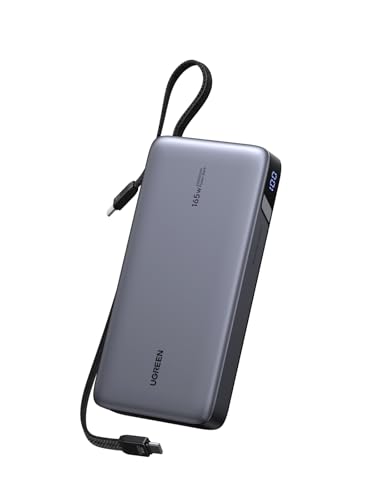
UGREEN Nexode 25,000mAh 165W Power Bank with Built-in Cables
25,000mAh · 90 Wh · 140W max per port, 165W total · 550 g · Power-bank score 83/100
Price: $69.99
In a dark house, the cable you can’t find is the problem. UGREEN’s Nexode 165W has two USB-C cables built in, one rated 140W and one 65W, plus a USB-C and a USB-A port, so it charges four devices with nothing else to pack (Notebookcheck). Like the RAPID it holds 90 Wh. It recharges at 90W in about 2 hours, UGREEN says, and weighs 550 g (about 1.2 lb). We couldn’t confirm UGREEN’s warranty term in the sources we used.
Ports: 2 built-in USB-C cables (140W and 65W), 1 USB-C (65W), 1 USB-A. Phone charges (20 Wh phone, our math): 3.2×
Pros
- ✓ Two built-in USB-C cables (140W and 65W)
- ✓ Charges four devices at once
- ✓ 90 Wh, the same as the RAPID
- ✓ About 2 h recharge at 90W (UGREEN)
Cons
- ✗ Built-in cables can’t be replaced if they wear out
- ✗ Warranty term not confirmed
- ✗ Heavier than the INIU
3. Rung 1: Best Budget Phone Charger for a Power Outage

INIU Cougar P62-E1 20,000mAh 65W Power Bank
20,000mAh · 74 Wh · 65W max per port, 65W total · 324 g · Power-bank score 78/100
Price: $39.94
If you only need to keep phones alive, the INIU Cougar P62-E1 is the low-cost pick. INIU lists it at 20,000mAh and 74 Wh, and it is the lightest bank here at about 324 g (INIU; Macworld). Its main USB-C port gives 65W, enough for phones, tablets and small laptops. It recharges at only 45W, which Macworld says takes under two hours. INIU’s listing gives a 3-year warranty, the longest of the banks here. Buy two and you have more energy than one of the 90 Wh banks.
Ports: 2 USB-C (65W and 35-36W), 1 USB-A (18W); detachable 12 cm USB-C lanyard cable. Phone charges (20 Wh phone, our math): 2.6×
Pros
- ✓ Lowest price of the banks when we logged prices
- ✓ Lightest pick, about 324 g
- ✓ 3-year warranty (INIU listing)
- ✓ Short USB-C cable included
Cons
- ✗ Smallest battery here (74 Wh)
- ✗ Slowest recharge (45W)
- ✗ 65W max: slow for big laptops
4. Rung 2: Most Energy You Can Still Carry (99.75 Wh)

Anker Prime Power Bank 26,250mAh 300W
26,250mAh · 99.75 Wh · 140W max per port, 300W total · 600 g · Power-bank score 79/100
Anker’s Prime is the top of the power-bank rung. Anker rates its 26,250mAh battery at 99.75 Wh, the most you can carry onto a plane without airline approval, with two 140W USB-C ports and 300W total (Anker). In an outage its standout is recharging. With a 140W charger in each USB-C port it takes up to 250W, which Anker says gets it to 50% in 13 minutes and 80% in 40 minutes. That matters if you top up at a warming center, in a car outdoors or from a power station. It is the most expensive bank here and weighs 1.32 lb.
Ports: 2 USB-C (140W each, two-way), 1 USB-A (22.5W). Phone charges (20 Wh phone, our math): 3.5×
Pros
- ✓ 99.75 Wh: the most in a bank that can fly
- ✓ Two 140W USB-C ports, 300W total
- ✓ 50% in 13 min with two 140W chargers (Anker)
- ✓ 24-month warranty (Amazon listing)
Cons
- ✗ Priciest bank here
- ✗ Fast recharge needs two 140W chargers
- ✗ Still can’t run a CPAP
Best Small Power Station for a Power Outage
A small power station, sometimes sold as a portable battery generator, is the next rung up. Both picks hold 288 Wh of LiFePO4, about three times the largest power bank, and make no fumes, so they can sit beside the bed. The difference is the outlets. The C300 DC has only USB and a 12V car socket. The Elite 30 V2 adds AC outlets. Both were in stock on Amazon when last checked on November 15, 2026. Their scores come from our power-station matrix, so they can’t be compared with the power-bank scores above.
5. Rung 3: Best DC Power Station for Phones, Laptops and a 12V Router

Anker SOLIX C300 DC
288 Wh LiFePO4 · No AC outlet, 300W DC · 100W solar · 6.17 lb · Station score 86/100
Price: $269.99
The Anker SOLIX C300 DC is essentially a 288 Wh LiFePO4 power bank: about three times the energy of the largest bank above, with no AC outlet. The Gadgeteer lists two 140W USB-C ports, one 100W USB-C, one 15W USB-C, a USB-A port and a 12V car socket, 300W total, and a weight of 6.17 lb (The Gadgeteer; Anker). That car socket is how it runs a router whose adapter outputs 12V, or a CPAP through the maker’s DC cable. It charges over USB-C, up to 100W of solar or a car socket. No wall charger is in the box, so pair it with any USB-C charger. The Amazon listing gives a 3-year warranty.
Pros
- ✓ 288 Wh LiFePO4 at 6.17 lb
- ✓ Four USB-C ports (two at 140W)
- ✓ 12V car socket for routers and DC CPAP cables
- ✓ Recharges from USB-C, solar or a car
Cons
- ✗ No AC outlet: no wall plugs at all
- ✗ No wall charger included
- ✗ Only 100W of solar input
6. Rung 3: Best Small Power Station With AC Outlets (CPAP, Router, Lamp)

Bluetti Elite 30 V2
288 Wh LiFePO4 · 600W AC · 200W solar · 9.5 lb · Station score 86/100
Price: $329.99
If anything you need plugs into a wall, such as a CPAP power brick, a router adapter or a lamp, get a station with AC outlets. Bluetti’s Elite 30 V2 has the same 288 Wh of LiFePO4 as the C300 DC, plus 600W of AC output from two outlets and USB-C ports rated 140W and 100W (Bluetti; MacRumors). Bluetti says it switches to battery within 10 ms when the grid drops, with up to 980W of pass-through, so a router can stay plugged in and keep running through the cut. It takes up to 200W of solar, recharges from the wall in about 70 minutes (Bluetti), weighs about 9.5 lb and carries a 5-year warranty. It can’t take an extra battery.
Pros
- ✓ 600W AC from two outlets
- ✓ Switches over within 10 ms (Bluetti)
- ✓ Up to 200W solar; about 70 min wall recharge (Bluetti)
- ✓ 5-year warranty
Cons
- ✗ Heaviest pick, about 9.5 lb
- ✗ Not expandable
- ✗ About 7 h of CPAP with full heat by our math, not a full night
Two other 300 Wh-class stations are rated on the site. The Jackery Explorer 300 (292 Wh LiFePO4, 300W AC, 7.5 lb) scores 87/100 and was in stock when last checked. It has half the Elite 30 V2’s AC output and half its solar input. The EcoFlow River 3 (245 Wh, 300W AC) scores 84/100, but Amazon showed it in low stock on November 15. Both are in the comparison table. For more stations at this price, see our best solar generators under $500.
How Many Phone Charges, Router Hours and CPAP Nights?
This is the question most outage guides skip. Our formula is usable Wh ÷ the device’s battery Wh for charges, and usable Wh ÷ average watts for hours. The assumptions:
- Usable energy. Power banks: 70% of the rated Wh. Anker’s page for its 90 Wh 25K bank says it delivers about 63 to 70 Wh to devices (Anker), and we use the low end. Power stations: 85% of rated Wh, the factor we use on every power-station page.
- Phones. iFixit’s teardown puts the iPhone 16 Pro battery at 13.94 Wh (9to5Mac), and we round it up to 14 Wh. The iPhone 16 Pro Max is about 18 Wh: 4,685mAh in Brazilian regulatory filings (MacRumors), 17.995 Wh per Macwelt. We round that up to 20 Wh as our “large phone.”
- Laptop. A 14-inch MacBook Pro holds 72.4 Wh (Apple).
- Modem + router. We use 20W. EnergySage puts a Wi-Fi router alone at 5 to 20W, about 10W on average (EnergySage). Ericsson’s study of one household measured a fiber modem and router together at a near-constant 12.7W (Ericsson). Cable modems and mesh systems can draw more, so check the watts or volts and amps on your adapters.
- CPAP. ResMed’s power sheet for the AirSense 10 AutoSet gives about 7W for the machine alone and about 34W with the heated humidifier and heated tube (ResMed; details in our CPAP battery backup guide). Your pressure, mask leak and settings change this.
| Charger (rated / usable) | Phone charges, 14 Wh | Phone charges, 20 Wh | MacBook Pro 14 (72.4 Wh) | Modem + router (20W) | CPAP, no heat (7W) | CPAP, heat + tube (34W) |
|---|---|---|---|---|---|---|
| EcoFlow RAPID Power Bank (25,000mAh, 170W) (90 Wh / ~63 Wh) | 4.5× | 3.2× | 0.9× | ~3.2 h* | Not a CPAP source | Not a CPAP source |
| UGREEN Nexode 25,000mAh 165W Power Bank with Built-in Cables (90 Wh / ~63 Wh) | 4.5× | 3.2× | 0.9× | ~3.2 h* | Not a CPAP source | Not a CPAP source |
| INIU Cougar P62-E1 20,000mAh 65W Power Bank (74 Wh / ~52 Wh) | 3.7× | 2.6× | 0.7× | ~2.6 h* | Not a CPAP source | Not a CPAP source |
| Anker Prime Power Bank 26,250mAh 300W (99.75 Wh / ~70 Wh) | 5.0× | 3.5× | 1.0× | ~3.5 h* | Not a CPAP source | Not a CPAP source |
| Anker SOLIX C300 DC (288 Wh / ~245 Wh) | 17.5× | 12.2× | 3.4× | ~12 h | ~35 h† | ~7.2 h† |
| Bluetti Elite 30 V2 (288 Wh / ~245 Wh) | 17.5× | 12.2× | 3.4× | ~12 h | ~35 h | ~7.2 h |
| Jackery Explorer 300 (292 Wh / ~248 Wh) | 17.7× | 12.4× | 3.4× | ~12 h | ~35 h | ~7.3 h |
| EcoFlow River 3 (245 Wh / ~208 Wh) | 14.9× | 10.4× | 2.9× | ~10 h | ~30 h | ~6.1 h |
Our estimates from published figures, not measurements. Each row uses one device at a time. Cold rooms, older batteries and charging while you use the phone all cut the totals, and a phone loses some energy in its own charging circuit. * Most routers run on a 12V or other DC adapter rather than USB. A power bank can only run one through a USB-C-to-DC cable that both the bank and the router support, so check your adapter’s label first. † The C300 DC has no AC outlet, so a CPAP needs the maker’s DC cable or converter for the car socket. For a ResMed AirSense 11 that is ResMed’s DC/DC converter (ResMed). Power banks can’t supply the 12V or 24V DC, or the AC, that CPAP machines need.
How to read it: a 90 Wh bank keeps one large phone going for about three days if you charge it once a day, or a family of three for one day. A 288 Wh station covers several nights of CPAP with the heat off, but only about 7 hours with the heated humidifier and tube on, or about 12 hours of internet. If you need heat on all night, size up. If you lose power often, add a UPS or a power station with UPS mode for the router so it never reboots. If your lights dim rather than go out, that is a brownout, not a blackout; our brownout vs blackout guide explains what to unplug and what protects your gear.
Power Outage Charger Comparison Table
The six picks plus the two other 300 Wh-class stations we rate. Capacity, output and weight are the maker’s published figures, checked against an independent review or retailer listing. Power banks and power stations are scored on different rubrics, so compare scores only within the same kind.
| Charger | Type | Capacity | Wall-plug (AC) outlets | Max output | Weight | Score | Price |
|---|---|---|---|---|---|---|---|
| EcoFlow RAPID Power Bank (25,000mAh, 170W) | Power bank | 90 Wh | No | 170W USB | 1.25 lb | 89/100 (bank) | $44.33 |
| UGREEN Nexode 25,000mAh 165W Power Bank with Built-in Cables | Power bank | 90 Wh | No | 165W USB | 1.21 lb | 83/100 (bank) | $69.99 |
| INIU Cougar P62-E1 20,000mAh 65W Power Bank | Power bank | 74 Wh | No | 65W USB | 0.71 lb | 78/100 (bank) | $39.94 |
| Anker Prime Power Bank 26,250mAh 300W | Power bank | 99.75 Wh | No | 300W USB | 1.32 lb | 79/100 (bank) | Check price at Amazon → |
| Anker SOLIX C300 DC | Power station | 288 Wh | No | 300W DC | 6.17 lb | 86/100 (station) | $269.99 |
| Bluetti Elite 30 V2 | Power station | 288 Wh | Yes, 600W | 600W AC | 9.5 lb | 86/100 (station) | $329.99 |
| Jackery Explorer 300 | Power station | 292 Wh | Yes, 300W | 300W AC | 7.5 lb | 87/100 (station) | $289.00 |
| EcoFlow River 3 | Power station | 245 Wh | Yes, 300W | 300W AC | 7.8 lb | 84/100 (station) | Check price at Amazon → |
Sources: EcoFlow, UGREEN, INIU and Anker product pages, with Notebookcheck and Macworld as second sources for the UGREEN and INIU; Anker and The Gadgeteer (C300 DC); Bluetti and MacRumors (Elite 30 V2). Explorer 300 and River 3: Jackery and EcoFlow listings and reviews, as cited in our under-$500 guide. Prices load live from Amazon.
Power Bank vs Power Station for a Power Outage
Choose a power bank if phones are what you’re worried about and outages where you live usually last hours, not days. It costs less, it fits in a drawer, and you can take it on a plane. Choose a power station if you need the internet, a CPAP, or a light that runs all night, or if outages last overnight. Our laptop power bank guide has more on the banks, including the FAA’s 100 Wh carry-on limit.
Power bank (74–100 Wh)
- ✓ About 1 to 1.5 lb; lives in a drawer or bag
- ✓ About 2.6 to 3.5 large-phone charges by our math
- ✓ Can go in your carry-on (under 100 Wh)
- ✗ No AC outlet or 12V socket
- ✗ Not a CPAP source
Small power station (288 Wh)
- ✓ About 12 large-phone charges by our math
- ✓ About 12 h of a modem and router
- ✓ Several CPAP nights with heat off; about 7 h with full heat
- ✓ Recharges from solar or a car
- ✗ 6 to 10 lb, and it can’t fly (over 160 Wh)
Many households end up with both: a bank in each bedroom for phones, and one station for the router or CPAP. Our power outage kit checklist covers the rest of the kit, including light, a weather radio and a battery carbon monoxide alarm. If that radio will be a hand crank radio, our emergency radio guide compares crank, solar and AA models and how much phone charge each one's battery can give.
How Long Do Outages Last? Lessons From Winter Storm Fern
Winter Storm Fern, in late January 2026, shows why a phone bank alone isn’t enough for a long outage. NRECA, the electric co-op association, reported that more than 1 million Americans were without power early in the week of the storm. On February 3, more than 110,000 were still without power, including about 45,350 co-op members in Mississippi (NRECA). The American Public Power Association, citing poweroutage.us, counted 606,000 customers out on the evening of January 26 (APPA). On the supply side, unplanned generator outages peaked at 68,169 MW on January 26, and Renewable Energy World’s summary of the FERC–NERC review concludes that “The grid can’t assume the next extreme-weather event will be as forgiving” (Renewable Energy World).
What that means for sizing: plan for at least a day per rung, and a way to recharge. A 90 Wh bank covers one person’s phone for about three days by our math. A 288 Wh station with a 100 to 200W solar panel can be topped up on clear days. A power bank's own built-in solar panel is too small to refill it during an outage, as our solar power bank guide works out, so pair a bank with a folding USB panel instead. If you charge from a car, do it outdoors: CDC says “Never run your car or truck inside a garage that is attached to a house, even with the garage door open” (CDC). For heat, the fridge and multi-day storms, see our winter storm power backup plan.
Medical devices: Ready.gov says to “Have alternate plans for refrigerating medicines or using power-dependent medical devices” (Ready.gov). Confirm your CPAP’s DC cable or converter with your equipment supplier before the storm, not during it.
Who Should Buy Which (and Who Should Skip)
Good fit
- ✓ Apartment renters with short outages: one 90 Wh bank per person
- ✓ Remote workers: a 288 Wh station for the router and laptop
- ✓ CPAP users: the Elite 30 V2 for the power brick, or the C300 DC with the right DC cable
- ✓ A gift for parents who live alone: a bank with built-in cables (UGREEN)
Skip these (and size up) if
- ✗ You need to keep a fridge cold for more than a few hours (FDA and Ready.gov: about 4 hours closed)
- ✗ You need a furnace blower, sump pump or well pump
- ✗ Outages in your area last days: start at 1 kWh
- ✗ You want electric room heat: no portable charger can run a space heater for long
For the bigger jobs, start with our power outage power station guide or run your devices through the solar generator size calculator.
How we chose and scored
Every pick is a product we already rate, with a published maker spec and a new, in-stock Amazon listing when last checked on November 15, 2026. Power banks are scored with the five-part rubric on our laptop power bank guide (laptop output, capacity, value, recharge speed and weight). Power stations are scored with the six-dimension matrix in our awards methodology. Scores are AI-synthesized from maker specs, independent published reviews, Amazon listing details and logged Amazon prices. We did not test these products, and every runtime on this page is an estimate from published figures.
Portable Charger for Power Outage FAQ
What is the best portable charger for a power outage?
For phones, a 90 Wh power bank such as the EcoFlow RAPID 25,000mAh, which has the highest power-bank score on the site, or the UGREEN Nexode 165W if you want built-in cables. For a router, laptop or CPAP, a 288 Wh power station: the Anker SOLIX C300 DC if everything charges over USB or 12V, or the Bluetti Elite 30 V2 if you need AC outlets. For a fridge or a multi-day outage, size up to 1 kWh or more.
How many times will a power bank charge my phone?
By our estimate, a 90 Wh (25,000mAh) bank charges a 14 Wh phone such as the iPhone 16 Pro about 4.5 times, and a 20 Wh large phone about 3 times. We count only 70% of the rated Wh as usable, the low end of Anker’s own figure for its 90 Wh bank. A 74 Wh (20,000mAh) bank gives about 2.6 large-phone charges, and a 288 Wh power station about 12.
Can a power bank run a Wi-Fi router during a power outage?
Sometimes, but it’s awkward. Most modems and routers run on a 12V or other DC adapter, not USB, so a power bank needs a USB-C-to-DC cable that both the bank and the router support. At a 20W draw for a modem and router, a 90 Wh bank lasts about 3 hours by our math. A 288 Wh power station with a 12V socket or AC outlet runs the same load for about 12 hours.
Can a portable charger run a CPAP machine?
A USB power bank can’t. CPAP machines need 12V or 24V DC through the maker’s cable or converter, or AC through their power brick. A 288 Wh power station can. ResMed’s figures for the AirSense 10 are about 7W with no heat and about 34W with the heated humidifier and tube, so by our math 288 Wh covers about 35 hours with no heat or about 7 hours with full heat. Confirm your machine’s cable or converter with your equipment supplier.
Is a power bank or a power station better for a power outage?
A power bank is better for phones in short outages: it costs less, weighs about a pound, and gives about three large-phone charges at 90 Wh. A power station is better if you need the internet, a CPAP or overnight light, or if outages last more than a day. A 288 Wh station holds about three times the energy of the largest carry-on bank and recharges from solar or a car.
Can I charge my phone in the car during a power outage?
Yes, but only with the car outdoors. CDC says never to run a car or truck inside a garage attached to a house, even with the garage door open, because of carbon monoxide. Charging a power bank or power station from the car’s socket while you drive or idle outside is a good way to stretch a long outage.