
Buying Guide · Updated September 2026
Best Solar Generator for Power Outages — 7 Top Picks for Emergency Backup
Power outages are becoming more frequent and lasting longer. Whether it is hurricane season, winter storms straining the grid, or rolling blackouts during extreme heat, a solar generator keeps your essential appliances running when the grid goes down. This guide ranks the seven best solar generators for power outages based on capacity, essential-appliance runtime, surge handling, and value — so you can keep your fridge cold, your sump pump running, and your family safe during any outage.
 By
By Quick Verdict: The Best Solar Generator for Power Outages in 2026
The right generator for you depends on how long outages typically last in your area and how many essentials you need to cover:
Best Overall
EcoFlow Delta Pro 3
4,096 Wh — runs fridge + sump pump + lights for 1–2 days. Smart Home Panel for automatic backup.
Best Value
Anker SOLIX F3000
3,072 Wh expandable to 24 kWh — best price per Wh for extended outage coverage. 2,400W solar input.
Best Budget
Jackery 1000 V2
1,070 Wh — runs a fridge for 18–24 hours plus phone charging at just 23 lb and $599.
What You Need: Outage Capacity Tiers
The size generator you need depends on what you want to keep running. Here are the three most common outage scenarios:
| Tier | Capacity Needed | What It Powers | Est. Outage Coverage | Best For |
|---|---|---|---|---|
| Essentials Only | 500–1,500 Wh | Fridge + router + phone charging + LED lights + CPAP | 12–24 hours | Brief outages, apartment dwellers, budget buyers |
| Partial Home | 1,500–4,000 Wh | Fridge + freezer + sump pump + furnace fan + lights + router + TV + CPAP | 1–3 days | Homeowners, storm season, weekend outages |
| Whole-Home | 4,000–12,000+ Wh | All of the above + well pump + window AC + microwave + multiple circuits via transfer switch | 3–7+ days | Hurricane-prone areas, extended outages, off-grid |
Runtime estimates assume no solar recharge. Adding portable solar panels extends coverage indefinitely during daylight hours.
The 7 Best Solar Generators for Power Outages
Each generator is rated for outage performance: how long it runs essential appliances, surge handling for motor loads, and expandability for longer events.
EcoFlow Delta Pro 3 — Best Overall for Outages
4,096 Wh | 4,000W AC | 240V split-phase | 128 lb | Expandable to 48 kWh

⚡ Outage Runtime
Runs a fridge (150W) for 20+ hours, fridge + sump pump + furnace fan + lights for 1–2 days. With solar panels, indefinite runtime.
The Delta Pro 3 is the gold standard for home outage backup. Its 4,096 Wh capacity covers all essential circuits, and the Smart Home Panel 2 provides automatic transfer switching — when the power goes out, your fridge, sump pump, and furnace never skip a beat. The 240V split-phase output powers well pumps and large appliances. Expandable to 48 kWh for multi-week outage coverage.
Pros
- ✓ Smart Home Panel for automatic outage switching
- ✓ 240V split-phase for well pumps
- ✓ 4,000W output handles multiple appliances
- ✓ Expandable to 48 kWh
- ✓ Recharges via solar in 3–4 hours
Cons
- ✗ Expensive at ~$3,000
- ✗ Heavy at 128 lb
- ✗ Overkill for apartment or small home
Anker SOLIX F3000 — Best Value for Extended Outages
3,072 Wh | 3,600W AC | 240V split-phase | 91.5 lb | Expandable to 24 kWh

⚡ Outage Runtime
Runs a fridge + freezer for 2–3 days. With 400W solar panels, indefinite outage coverage.
The Anker SOLIX F3000 offers the best price per watt-hour for extended outage coverage. Its 3,072 Wh base capacity runs a fridge and freezer for 2–3 days, and the expandable battery system scales to 24 kWh for prolonged events. The 2,400W solar input means faster solar recharging than any competitor at this price. The 6,000W hyper-fast AC recharge tops up from a wall outlet in about 2 hours — useful before a known storm hits.
Pros
- ✓ Best value per Wh in its class
- ✓ 2,400W solar input for fast solar recharge
- ✓ 6,000W hyper-fast AC charging
- ✓ Expandable to 24 kWh
- ✓ 240V split-phase for transfer switch
Cons
- ✗ Heavy at 91.5 lb
- ✗ Power Panel ecosystem is newer than EcoFlow
- ✗ Base capacity lower than Delta Pro 3
Jackery Explorer 1000 V2 — Best Budget Outage Backup
1,070 Wh | 1,500W AC | 3,000W surge | 23 lb | Not expandable

⚡ Outage Runtime
Runs a fridge for 18–24 hours. With a 100W solar panel, indefinite fridge coverage during daylight.
The Jackery Explorer 1000 V2 is the most affordable way to keep your fridge running through a short outage. At just $599 and 23 lb, it is a fraction of the cost of whole-home systems but still provides enough capacity to preserve food for a full day. The 1,500W output (3,000W surge) handles fridge startup with ease, and the carrying handle means you can grab it during an evacuation. Pair with a 100W solar panel for extended coverage.
Pros
- ✓ Most affordable serious outage backup
- ✓ Ultra-light at 23 lb
- ✓ Handles fridge startup surge easily
- ✓ Recharges via solar in 4–6 hours
- ✓ Portable enough to grab during evacuation
Cons
- ✗ Cannot run sump pump or furnace fan
- ✗ Single-day fridge coverage without solar
- ✗ Not expandable
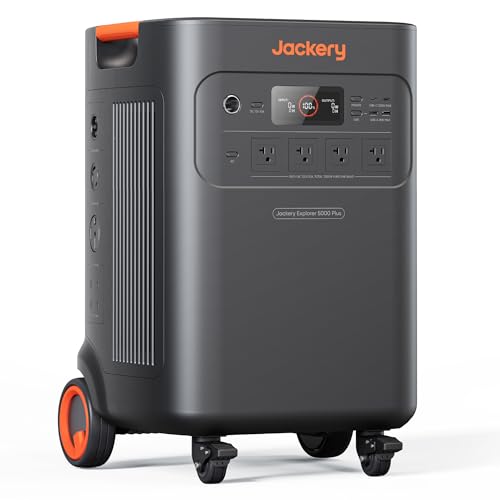
Jackery 5000 Plus — Best High-Capacity System
5,040 Wh | 7,200W AC | 240V split-phase | 105 lb | Expandable to 60 kWh
⚡ Outage Runtime
Runs fridge + freezer + sump pump + well pump + lights for 2–4 days. With solar, multi-week coverage.
The Jackery 5000 Plus is the most powerful single-unit solar generator available. Its 7,200W output handles nearly any home appliance simultaneously — refrigerator, well pump, sump pump, furnace, lights, and entertainment all at once. The 5,040 Wh base capacity provides multi-day coverage for a full home, and the expandable system scales to 60 kWh for weeks of off-grid living. Jackery's proven reliability and 5-year warranty add peace of mind for critical outage preparedness.
Pros
- ✓ Highest output: 7,200W 240V
- ✓ 5,040 Wh base capacity
- ✓ Expandable to 60 kWh
- ✓ Jackery reliability and 5-year warranty
- ✓ Runs every home essential simultaneously
Cons
- ✗ Very expensive
- ✗ Heavy at 105 lb
- ✗ Overkill for most short outages
Bluetti Elite 200 V2 — Best Mid-Range Value
2,074 Wh | 2,600W AC | 3,900W surge | 48.5 lb | Expandable to 8 kWh

⚡ Outage Runtime
Runs a fridge + freezer for 1–2 days. With 200W solar panels, extended coverage.
The Bluetti Elite 200 V2 hits a sweet spot for outage preparedness: enough capacity (2,074 Wh) to run a fridge and freezer through a 1–2 day outage, with enough output power (2,600W, 3,900W surge) to handle a sump pump or furnace fan alongside. The 50-minute AC fast charging is exceptional for this capacity tier — useful for topping up between grid failures during rolling blackouts. Expandable to 8 kWh with additional batteries.
Pros
- ✓ 50-minute ultra-fast AC charging
- ✓ 2,074 Wh at competitive price
- ✓ 3,900W surge handles sump pump
- ✓ Expandable to 8 kWh
- ✓ Strong solar input at 1,200W
Cons
- ✗ Heavier than competitors at 48.5 lb
- ✗ App experience lags EcoFlow
- ✗ No 240V split-phase option
Anker SOLIX F3800 Plus — Best Solar Recharge Speed
3,840 Wh | 6,000W AC | 240V split-phase | 154 lb | Expandable to ~53 kWh

⚡ Outage Runtime
Runs all essentials for 2–3 days. With 1,200W solar panels, indefinite coverage — recharges fully in 3–4 hours of sun.
The Anker SOLIX F3800 Plus is the fastest-solar-recharging whole-home generator on the market. Its 3,200W solar input is unmatched — paired with 1,200W of solar panels, it fully recharges in just 3–4 hours of good sun. For extended outages where grid power may be out for days or weeks, this solar recharge speed is invaluable. The 6,000W output powers any home appliance, and the expandable system scales to ~53 kWh.
Pros
- ✓ Industry-leading 3,200W solar input
- ✓ 6,000W output powers any appliance
- ✓ Fastest solar recharge in its class
- ✓ Expandable to ~53 kWh
- ✓ Anker reliability and 5-year warranty
Cons
- ✗ Heaviest option at 154 lb
- ✗ Highest price point
- ✗ Requires significant solar investment to leverage input
Jackery Explorer 2000 Plus — Best Scalable Starter
2,042 Wh | 3,000W AC | 6,000W surge | 43 lb | Expandable to 24 kWh

⚡ Outage Runtime
Runs fridge + freezer + lights for 1–1.5 days. Expand to 24 kWh for multi-week coverage.
The Jackery Explorer 2000 Plus is the best choice if you want to start small and scale up over time. Buy the base unit (2,042 Wh) now for short outage coverage, then add expansion batteries as your budget allows — scaling all the way to 24 kWh. The 3,000W output (6,000W surge) handles most home appliances, and Jackery's proven reliability makes it a safe choice for critical backup.
Pros
- ✓ Start small, scale to 24 kWh
- ✓ 6,000W surge handles heavy loads
- ✓ Lightest expandable option at 43 lb
- ✓ Proven Jackery reliability
- ✓ Solid value for expandable system
Cons
- ✗ Base capacity limited for whole-home
- ✗ Solar input limited to 1,000W
- ✗ Expansion batteries add significant cost
What to Prioritize During a Power Outage
Not all appliances are equally important during an outage. Here is what you should prioritize with your limited generator capacity:
📝 Tier 1: Life-Safety & Food Preservation
- Refrigerator / Freezer — Prevents food spoilage. A fridge uses ~150W running (1,200–2,000 Wh/day). This is the single most important appliance to prioritize.
- CPAP / Medical devices — If you or a family member relies on medical equipment, this is non-negotiable. A CPAP draws 30–60W.
- Well pump — If you have a private well, you lose water access without power. A 1/2 HP pump draws 1,000W running, 2,000–4,000W surge. Requires 240V generator.
- Sump pump — During storms, a flooded basement can cause structural damage. A 1/3 HP pump draws 800W running, 1,300–2,500W surge.
🎂 Tier 2: Comfort & Connectivity
- Furnace fan — In winter, without the fan, your furnace can't circulate heat. Draws 300–600W running. This is critical in cold climates.
- Wi-Fi router / modem — Keeps you connected for news, weather updates, and communication. Draws just 10–20W.
- LED lights — 5–10W per bulb. Run 4–5 bulbs for the whole home.
- Phone / tablet charging — 10–20W. Essential for communication.
🎨 Tier 3: Convenience
- TV / entertainment — 100W for an LED TV. Nice to have but not essential.
- Microwave — 1,000W but only for short bursts. Good for heating food.
- Coffee maker — 800–1,200W. Prioritize only if you have surplus capacity.
- Space heater — 1,500W continuous. Very inefficient for generator use. Layer clothing and use blankets instead.
How Long Will Each Generator Last During an Outage?
Estimated runtime for common outage scenarios, assuming no solar recharge:
| Scenario | Load | 1,000 Wh | 2,000 Wh | 3,000 Wh | 5,000 Wh |
|---|---|---|---|---|---|
| Fridge + lights + phones | ~200W avg | ~4 hrs | ~8 hrs | 13 hrs | 21 hrs |
| Fridge + freezer + lights | ~350W avg | 2.5 hrs | 5 hrs | 7 hrs | 12 hrs |
| Fridge + sump pump + furnace | ~1,000W avg | < 1 hr | 1.5 hrs | 2.5 hrs | 4 hrs |
| Full home (well pump + appliances) | ~2,500W avg | N/A | N/A | 1 hr | 1.5 hrs |
💡 Real-World Note
The estimates above assume continuous draw. In reality, fridges and freezers cycle on and off (25–35% duty cycle), sump pumps run intermittently, and furnace fans cycle with the thermostat. Actual runtime is typically 2–3x longer than these continuous-draw estimates. The numbers above are conservative worst-case scenarios.
Power Outage Preparedness Checklist
Use this checklist to make sure you are ready before the next outage hits:
✅ Before the Outage
- ☐ Calculate your essential load using the sizing guide
- ☐ Purchase a generator with 20% more capacity than you think you need
- ☐ Fully charge the generator before storm season or known risk periods
- ☐ Buy a 100–400W solar panel for extended outage recharge
- ☐ Test running all essential appliances before an outage occurs
- ☐ Store the generator in an accessible, cool, dry location
- ☐ Keep cables and adapters organized and easy to find
✅ During the Outage
- ☐ Prioritize Tier 1 appliances first (fridge, medical, sump pump)
- ☐ Keep fridge and freezer doors closed as much as possible
- ☐ Run the generator during the day and recharge with solar if available
- ☐ Conserve power by running only essential appliances
- ☐ Use LED lights instead of overhead fixtures
- ☐ Turn off the fridge ice maker to save power
- ☐ If using solar, maximize panel exposure during peak sun hours (10am–4pm)
More Outage & Emergency Resources
Solar Generators for Hurricanes & Outages
Storm-specific preparedness for hurricane season and extreme weather
Best Solar Generators for Home Backup
Top picks for keeping essential circuits running during outages
Can a Solar Generator Power a House?
Complete guide to home backup capacity and appliance sizing
What Size Solar Generator Do I Need?
Step-by-step sizing guide with appliance wattage worksheet
Frequently Asked Questions
What is the best solar generator for power outages in 2026?
The EcoFlow Delta Pro 3 is the best overall solar generator for power outages in 2026. Its 4,096 Wh capacity runs essential appliances (fridge, sump pump, furnace fan, lights) for 1–2 days, and the Smart Home Panel 2 provides automatic transfer switching — you do not need to be home to start the backup. For budget buyers, the Jackery Explorer 1000 V2 at $599 provides reliable fridge-only backup for under 24 hours.
How long will a solar generator power my house during an outage?
It depends on your generator capacity and what you are powering. A 1,000 Wh generator runs a fridge for 18–24 hours. A 3,000 Wh generator runs a fridge + sump pump + furnace for 1–2 days. A 5,000 Wh generator with solar panels provides indefinite backup for essential appliances. The outage runtime table above breaks this down by scenario.
Can a solar generator run a sump pump during a storm outage?
Yes, but you need a generator rated for the pump's startup surge. A 1/3 HP sump pump draws 800–1,050W running but surges to 1,300–2,500W on startup. You need a generator with at least 2,500W peak output, like the EcoFlow Delta Pro 3 (4,000W) or Anker SOLIX F3000 (4,860W surge). A smaller generator may fail to start the pump even if the running draw seems fine.
What size solar generator do I need to keep my fridge running during an outage?
A 1,000 Wh generator (like the Jackery Explorer 1000 V2) runs a standard fridge for 18–24 hours — enough for most short outages. For multi-day fridge coverage, step up to 2,000+ Wh or pair a 1,000 Wh unit with a 100–200W solar panel. The fridge's duty cycle (compressor runs ~25–35% of the time) means real-world runtime is 2–3x longer than continuous-draw estimates.
Can I use a solar generator during a power outage without solar panels?
Absolutely. A solar generator is a battery that you pre-charge from a wall outlet before the outage. Once the power goes out, you use that stored energy. Solar panels are optional — they enable indefinite runtime during extended outages but are not required for basic operation. If you expect multi-day outages, a 100–400W solar panel is a worthwhile investment for daily recharging.
Will a solar generator work during a blackout if I have a transfer switch?
Yes. Generators with 240V split-phase output (EcoFlow Delta Pro 3, Anker SOLIX F3000, Jackery 5000 Plus) can connect to a transfer switch or interlock kit installed by a licensed electrician. This lets you power hardwired circuits like a well pump, furnace, or built-in lighting directly from the generator. Models with Smart Home Panels (Delta Pro 3) provide automatic transfer switching without manual intervention.