
Buying Guide · Updated October 2026
CPAP Battery Backup: Best CPAP Batteries, Runtimes & Flying Rules
The best CPAP battery backup is one that matches your machine's DC voltage, switches over automatically when the power drops and holds enough watt-hours for a night with the heat off. Our top pick is the Freedom CPAP Battery 160 (160Wh), which ships with cables for both ResMed AirSense and Philips DreamStation machines. The Medistrom Pilot-24 Lite (95Wh) is the one to fly with, but it fits 24V machines only. For multi-night outages, a power station holds far more energy.
As an Amazon Associate, SolarGenAdvisor earns from qualifying purchases made through links on this page, at no additional cost to you. Ratings are AI-synthesized from published specs and logged Amazon prices; we did not test these batteries. This page is not medical advice.
 By
Quick Verdict
Owners of either a ResMed AirSense or a Philips DreamStation should start with the Freedom 160: it has both cables in the box and about two nights per charge with heat off, on its maker's figures. If you fly often with a 24V ResMed machine, the 95Wh Pilot-24 Lite stays under the FAA's 100Wh line. If you want the heated humidifier on, or you're planning for multi-day outages, no dedicated battery is big enough. Get a portable power station instead.
Medical equipment note
We cover power, not therapy. Before you buy a battery, confirm with your machine's maker or your equipment supplier (DME) that the battery and cable are approved for your exact model. Don't change pressure, humidity or heat settings to stretch battery life without talking to your physician. If you depend on therapy for safety, keep a written plan for outages and ask your utility whether it has a medical-needs program.
How We Score CPAP Batteries
Our power-station matrix doesn't fit small dedicated batteries, so these scores use a CPAP-battery rubric. Each score is AI-synthesized from manufacturer specs and manuals and Amazon prices checked on November 1, 2026. We did not test any battery, and we don't use Amazon star ratings because we have no reliable review data for these listings. A feature the maker doesn't publish earns no credit. Weights total 100:
- Capacity (25): watt-hours, scaled to 160Wh (the largest size the FAA allows in the cabin, with airline approval)
- Machine compatibility (20): credit for a 24V ResMed cable and a 12V Philips cable in the box
- Value (15): the lowest cost per Wh here divided by this battery's cost per Wh
- Air-travel fit (15): 100Wh or less (no airline approval) scores highest; 101–160Wh (airline approval) lower
- Outage backup (15): documented automatic switchover (pass-through) when the power drops
- Weight (10): the lightest battery here divided by this battery's weight
Power stations on this page keep their scores from our standard 6-dimension power-station matrix. The two rubrics measure different things, so don't compare a battery score with a power-station score directly.
The Best Dedicated CPAP Batteries
A dedicated CPAP battery feeds DC power straight into the machine's power socket through a model-specific cable, with no inverter in between. We cross-checked specs against each maker's page or manual (linked) and the Amazon listing. Run times are the manufacturers' claims with heat off; our own math is in the runtime table.
1. Best Overall CPAP Battery (ResMed or Philips)

Freedom CPAP Battery 160Wh
160 Wh · 12-24V DC (8A max), set by cable · 2.13 lb · Score 82/100 (CPAP-battery rubric)
Price: $349.99
The Freedom 160 is the one battery here that covers both major machine families out of the box. Its maker's manual lists a 24V cable for the ResMed AirSense 10, AirSense 11 and AirMini and a 12V cable for the Philips DreamStation 1 and 2 in the single-battery kit, and the output (12–24V DC, 8A max) is set by whichever cable you plug in. On the Amazon listing the maker rates it for up to 24 hours on an AirSense 11 and up to 19 hours on an AirSense 10 at a pressure of 10 cm H2O with no heated humidifier or heated tube. Those are manufacturer figures, not ours. It can also sit between the wall and your machine as an automatic backup: the manual says it bypasses its cells while AC is present and takes over if the power drops. Manufacturer specs.
Pros
- ✓ Ships with both 24V (ResMed) and 12V (DreamStation) cables
- ✓ 160Wh: roughly two nights with heat off at moderate pressures (maker claim)
- ✓ Automatic outage backup (pass-through) per the manual
- ✓ Lowest cost per Wh of the two dedicated batteries at logged prices
Cons
- ✗ 101–160Wh: FAA rules require airline approval to fly with it
- ✗ One-year warranty (per the manual and UK distributor)
- ✗ Heated humidifier and tube cut run time "by up to two thirds" (maker)
2. Best for Flying (24V ResMed Machines Only)
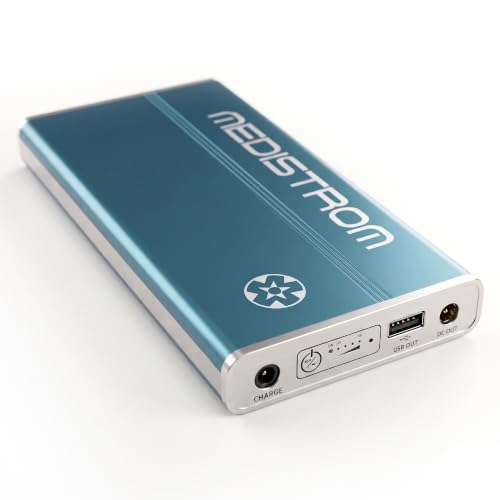
Medistrom Pilot-24 Lite 95Wh CPAP Battery (24V machines)
95 Wh · 24V DC (3.75A) · 1.3 lb · Score 70/100 (CPAP-battery rubric)
Price: $337.99
Medistrom's Pilot-24 Lite is the smallest, lightest option: 95Wh in a 1.3 lb aluminum case the size of a paperback (6.7 × 3.5 × 0.8 in, per Medistrom). At under 100Wh it falls in the FAA tier that doesn't need airline approval as a spare battery. The catch is in the name: it puts out 24V only. Medistrom lists the ResMed AirSense 10, AirSense 11, AirMini and S9 plus a few other 24V machines (only the AirSense 10 and AirMini cables are in the box), and the DreamStation Go is the only Philips model on its list. It will not run a 12V DreamStation 1 or 2. Medistrom quotes 1–2 nights "on an average pressure setting with the humidifier and heated tubing disabled." Manufacturer specs.
Pros
- ✓ 95Wh: under the FAA 100Wh threshold, no airline approval needed
- ✓ Lightest here at 1.3 lb
- ✓ Works as automatic backup when left plugged in (Medistrom)
- ✓ USB port for a phone
Cons
- ✗ 24V machines only: no DreamStation 1 or 2
- ✗ AirSense 11 and S9 need cable kits sold separately
- ✗ About one night with heat off by our math; heat is impractical
- ✗ Highest cost per Wh here
The Pilot-24 Lite listing we link was sold by a third-party seller with low stock when we checked; a second listing bundles the same battery with an S9 cable kit. The older Freedom V2 (100Wh) showed as currently unavailable on Amazon, so we haven't rated it. Its maker says V2 cables and chargers also work with the Freedom 160 (Freedom 160 manual).
Which CPAP Battery Fits Your Machine? (AirSense 10, AirSense 11, DreamStation)
The single most important spec is the DC voltage your machine takes. ResMed's AirSense machines run on 24V: the AirSense 10's 90W power supply outputs 24V at 3.75A, the same 24V, 3.75A that Medistrom lists for the Pilot-24 Lite (Medistrom). Philips' DreamStation 1 and 2 run on 12V: Philips sells a 12V DC cord with a battery adapter cable so the machine can run from a car's 12V socket or a compatible battery (Philips DC cable sheet, HH1422). Buy the wrong voltage and the battery simply won't work with your machine.
| Machine | DC input | Freedom 160 | Pilot-24 Lite | From a power station's 12V socket |
|---|---|---|---|---|
| ResMed AirSense 10 | 24V | Cable included | Cable included | Via a ResMed DC/DC converter for that model (confirm part with your supplier) |
| ResMed AirSense 11 | 24V | Cable included | Cable kit sold separately | Via ResMed's AirSense 11 DC/DC converter (ResMed) |
| ResMed AirMini | 24V | Cable included | Cable included | Via a ResMed DC/DC converter for that model (confirm part with your supplier) |
| Philips DreamStation 1 / 2 | 12V | 12V cable included | Not compatible | Philips 12V DC cord plugs straight in |
| Philips DreamStation Go | See Philips | Not on the maker's list | Cable kit sold separately | Check Philips' accessory guidance |
Sources: Freedom CPAP Battery 160 user manual and Amazon listing (cables in the single-battery kit); Medistrom Pilot-24 Lite product page and Amazon listing; ResMed AirSense 11 DC/DC converter page (12V or 24V input); Philips HH1422 DC cable sheet. The AirSense 10's 24V/3.75A supply rating appears in retailer spec listings (cpap.com, iFixit); we couldn't open ResMed's own US spec page. Compatibility lists change, so confirm the exact cable part number with your supplier.
ResMed's guidance for its AirSense 11 converter is worth knowing even if you use a dedicated battery. ResMed says the converter connects to a 12V or 24V vehicle outlet, recommends a deep-cycle battery for powering the device, and says to unplug the converter when it isn't in use so it doesn't drain the vehicle battery (ResMed AirSense 11 DC/DC converter).
Humidifier and Heated Tube: Why They Drain a CPAP Battery
Moving the air takes very little power. Heating it is what drains the battery. ResMed's own power-consumption sheet for the AirSense 10 AutoSet (AutoSet mode, 8–15 cm H2O, humidity setting 6, tube temperature 28°C) lists these average figures (ResMed, "Power consumption of Air10 devices"):
- About 7 W with the machine running alone
- About 22 W with the HumidAir heated humidifier, roughly three times as much
- About 34 W with the humidifier plus a ClimateLineAir heated tube, nearly five times as much
Battery makers say the same thing in their own words. Freedom's manual says heated humidification and tubing can cut run time "by up to two thirds" and advises turning them off or to zero for best battery life (Freedom 160 manual), and Medistrom's 1–2-night claim assumes both are disabled. ResMed's sheet is from 2015 and covers the AirSense 10 family. We didn't find an equivalent ResMed sheet for the AirSense 11, so for that machine we rely on the battery makers' run-time claims. Note that the 34 W figure is an average: a machine's power supply is sized for much higher peaks, which is why ResMed specifies a 90W supply for an AirSense 10 with a humidifier and heated tube (ResMed shop).
DC vs AC: The Inverter Loss
A dedicated CPAP battery or a power station's 12V socket feeds the machine DC through a cable or converter. Plugging the CPAP's normal power brick into a power station's AC outlet converts battery DC to 120V AC in the inverter, then back to DC in the brick. Each conversion loses some energy, and the inverter draws some power just by being switched on, which matters most when the CPAP itself only needs about 7 W. For planning, we use 85% of rated Wh on the DC path (our site-wide standard) and 70% on the AC path. The 70% is our own conservative assumption, not a published figure. Use DC whenever your machine maker sells a DC cord or converter for it.
For the full CPAP-on-solar walkthrough, including wattage by model and camping setups, see can a solar generator run a CPAP machine? What about UPS battery backups? They're built for computers, not CPAPs: CyberPower's manual for its CP-series AVR models says “do not use for medical or life support equipment” (CyberPower manual), and CyberPower lists medical equipment among the devices that void its UPS warranty (CyberPower), so use a dedicated CPAP battery or a power station instead.
How Long Will a CPAP Run on a Battery? (Our Math)
These are our calculated estimates, not measurements and not manufacturer claims: battery Wh × efficiency ÷ average watts = hours. We use ResMed's published AirSense 10 AutoSet averages as the loads. Your pressure, mask leak, altitude and room temperature will move the real number, so treat these as a planning range.
| CPAP load (AirSense 10, ResMed figure) | Pilot-24 Lite 95 Wh (DC) | Freedom 160 Wh (DC) | Anker C300 DC 288 Wh (12V socket) | EcoFlow River 3 245 Wh (AC) | Jackery 1000 V2 1,070 Wh (AC) |
|---|---|---|---|---|---|
| Machine only, no humidifier (ResMed: ~7 W) | ~12 h | ~19 h | ~35 h | ~25 h* | ~107 h* |
| With heated humidifier (ResMed: ~22 W) | ~3.7 h | ~6.2 h | ~11 h | ~7.8 h | ~34 h |
| Humidifier + heated tube (ResMed: ~34 W) | ~2.4 h | ~4.0 h | ~7.2 h | ~5.0 h | ~22 h |
DC columns use 85% of rated Wh; AC columns use 70% (our assumption for inverter plus power-brick losses). *At a 7 W load a power station's own inverter idle draw can be similar to the CPAP's, so real AC run time at this load is likely well below the math. Use the 12V socket with the correct DC cord or converter instead. A ResMed machine on a 12V socket also needs ResMed's DC/DC converter, which adds its own small loss. Divide hours by your usual sleep time (for example 8 hours) to get nights.
How this compares with maker claims: our math gives the Freedom 160 ~19 h with heat off, while its Amazon listing claims up to 24 hours on an AirSense 11 and up to 19 hours on an AirSense 10 at a pressure of 10. Its manual's table is higher still (30 hours for the AirSense 11). Medistrom's "1–2 nights" for the Pilot-24 Lite is in the same range as our ~12 hours. Makers test at their own settings, so take the lower figure if your pressure is high or your mask leaks.
Flying With a CPAP Battery: FAA 100Wh and 160Wh Rules
Lithium battery limits for passengers come from the FAA's hazardous-materials rules. The TSA handles screening. Per the FAA's PackSafe guidance for spare lithium batteries (FAA PackSafe: Lithium Batteries):
| Spare lithium-ion battery size | FAA rule | Batteries on this page |
|---|---|---|
| 100 Wh or less | Allowed in carry-on only, terminals protected from short circuit | Medistrom Pilot-24 Lite (95 Wh) |
| 101–160 Wh | With airline approval, up to two spares per person, carry-on only | Freedom CPAP Battery 160 (160 Wh) |
| Over 160 Wh | Not allowed in carry-on or checked bags | Every power station on this page (245 Wh and up) |
- Never pack a spare battery in checked luggage. The FAA says that if your carry-on gets gate-checked, take the spare batteries out and keep them with you in the cabin.
- Airlines can be stricter. The FAA notes that many carriers set tighter quantity or Wh limits. Check your airline's battery policy, and ask in advance if you plan to use the CPAP on board.
- "TSA approved" or "FAA approved" on a listing is marketing shorthand for "fits the Wh limits". Freedom's own manual puts it more precisely: it meets FAA requirements for 101–160Wh batteries in carry-on. Medistrom offers a downloadable travel letter for the Pilot-24 Lite on its site.
Wondering about a larger battery? Our guide to flying with a portable power station explains why almost every power station is grounded and what to do at your destination.
CPAP Battery vs Portable Power Station
A dedicated battery is built for one job: one machine, one or two nights, in a carry-on. A power station holds several times the energy for less per watt-hour, can run the heated humidifier, keeps a phone and a lamp going too, and recharges from solar panels. Here's how the two dedicated batteries line up against three power stations we already rate:
| Option | Capacity | Weight | CPAP connection | Can fly? | Our score | Price |
|---|---|---|---|---|---|---|
| Freedom CPAP Battery 160Wh | 160 Wh | 2.13 lb | 12V or 24V DC cable (both included) | With airline approval | 82/100 (CPAP-battery rubric) | $349.99 |
| Medistrom Pilot-24 Lite 95Wh CPAP Battery (24V machines) | 95 Wh | 1.3 lb | 24V DC cable only | Yes (under 100Wh) | 70/100 (CPAP-battery rubric) | $337.99 |
| Anker SOLIX C300 DC | 288 Wh | 6.17 lb | 12V car socket (DC cord or converter); no AC outlet | No | 86/100 (power-station matrix) | $189.99 |
| EcoFlow River 3 | 245 Wh | 7.8 lb | AC outlet or 12V car port | No | 84/100 (power-station matrix) | $249.00 |
| Jackery Explorer 1000 V2 | 1,070 Wh | 23.8 lb | AC outlet or 12V car port | No | 93/100 (power-station matrix) | $559.00 |
Power-station specs come from our product database and linked reviews. Anker's listing says the C300 DC ships without a wall charger; it charges over USB-C, a car outlet or solar.
Choose a dedicated CPAP battery if…
- ✓ You fly with your CPAP and need a battery under 100Wh or 160Wh
- ✓ You want a nightstand backup that switches over by itself if the power blinks
- ✓ You can sleep with the humidifier and heated tube off for a night or two
Choose a power station if…
- ✓ You need the heated humidifier on, or more than two nights
- ✓ You're camping for a weekend or preparing for a multi-day outage
- ✓ You want to recharge from solar and run lights, a phone or a fan too
For Multi-Night Outages and CPAP Camping, Step Up to a Power Station
A 160Wh battery with the heat on covers only part of a night by our math, so for storms, winter outages or a long weekend off-grid, plan on a power station. The Anker SOLIX C300 DC (288Wh, about 6 lb) is the budget way to get several heat-off nights through its 12V socket. The EcoFlow River 3 adds AC outlets and a UPS mode for a bedside setup. A 1kWh-class station like the Jackery Explorer 1000 V2 can run the humidifier for several nights by our math. We rank power stations specifically for CPAP use in our best solar generator for CPAP guide. For whole-house outage planning, see our best solar generators for power outages and winter storm power backup guides.
Not sure how much capacity you need for everything else in an outage? Our sizing guide walks through the load worksheet.
Who Should Buy a CPAP Battery (and Who Should Skip It)
Good fit
- ✓ Frequent flyers who want therapy in hotels, on red-eyes (with airline OK) or at a cabin
- ✓ Anyone in an area with short, frequent power blips who wants automatic bedside backup
- ✓ Tent campers who sleep fine with the heat off for a night or two
- ✓ Owners of a ResMed AirMini or AirSense who want the lightest possible kit (Pilot-24 Lite)
Skip it if
- ✗ You need heated humidity all night (get a power station)
- ✗ You're preparing for outages lasting days, not hours
- ✗ You own a 12V DreamStation and were eyeing the 24V-only Pilot-24 Lite
- ✗ Your machine maker or supplier hasn't confirmed a compatible cable
Prices on this page load live from Amazon. Power stations have historically dipped during Prime Day and Black Friday events; dedicated CPAP batteries are sold mostly through medical-supply sellers and their pricing has been less predictable.
CPAP Battery Backup FAQ
What is the best CPAP battery backup?
For most people, a dedicated CPAP battery that matches your machine's DC voltage and can sit inline as automatic backup. In our scoring the Freedom CPAP Battery 160 ranks first because it ships with cables for both ResMed AirSense (24V) and Philips DreamStation (12V) machines. The Medistrom Pilot-24 Lite is the better pick for flying with a 24V ResMed machine because it is under 100Wh. For multi-night outages, a portable power station holds far more energy. Confirm compatibility with your equipment supplier before buying.
How long will a CPAP run on a battery?
It depends mostly on heat. ResMed's published figures for an AirSense 10 AutoSet show about 7 W average with the machine alone, about 22 W with the heated humidifier and about 34 W with the humidifier and a heated tube. Using our planning formula (battery Wh x 0.85 / watts), a 160Wh battery gives roughly 19 hours with heat off but only about 4 hours with full heat. Battery makers quote longer heat-off run times at their own test settings. Your pressure, mask leak and settings change the result.
Can I take a CPAP battery on a plane? Is there a TSA-approved CPAP battery?
The battery rules come from the FAA, not the TSA. Per FAA PackSafe, spare lithium-ion batteries must be in carry-on baggage only, with terminals protected from short circuit. Batteries up to 100Wh are allowed; with airline approval you may carry up to two spares of 101 to 160Wh; anything over 160Wh is not allowed. So a 95Wh Pilot-24 Lite fits the no-approval tier and a 160Wh Freedom needs airline approval. "TSA approved" on a listing is marketing shorthand; check your airline's own policy before you fly.
Does the Medistrom Pilot-24 Lite work with a Philips DreamStation?
Not with the DreamStation 1 or DreamStation 2, which run on 12V DC. The Pilot-24 Lite outputs 24V only. Medistrom lists the DreamStation Go travel machine as compatible with a separately sold cable kit. For a 12V DreamStation, choose a battery with a 12V cable, such as the Freedom CPAP Battery 160, or use Philips' 12V DC cord with a power station's car socket.
What battery works with a ResMed AirSense 11?
Both dedicated batteries in this guide list the AirSense 11. The Freedom CPAP Battery 160 includes the 24V cable for it in the box; the Medistrom Pilot-24 Lite needs an AirSense 11 cable kit sold separately. To run an AirSense 11 from a power station's 12V car socket, ResMed sells an AirSense 11 DC/DC converter rated for 12V or 24V sources. Check the exact part with your equipment supplier.
Can I use my CPAP humidifier on battery power?
You can on some setups, but it costs a lot of runtime. Freedom's manual says heated humidification and heated tubing can cut run time by up to two thirds, and Medistrom's run-time claim assumes both are switched off. On a small dedicated battery, plan on heat off. If you need heated humidity through the night, a power station with several hundred watt-hours or more is the practical choice. Ask your physician or equipment supplier before changing therapy settings.
Is a CPAP battery or a portable power station better?
A dedicated CPAP battery is smaller, lighter, flies more easily and connects straight to the machine's DC input. A portable power station costs less per watt-hour, can run the humidifier for several nights, charges phones and lights at the same time and can be recharged from solar. Many people use a dedicated battery for travel and a power station for outages and camping.
Will a CPAP battery switch over automatically in a power outage?
Both batteries in this guide are designed to. Medistrom says the Pilot-24 Lite keeps the machine running without interruption if power is cut while it is connected as a backup, and Freedom's manual says its battery bypasses the cells while AC is present and takes over when AC is lost. Freedom also says to disconnect devices when the machine is not in use so the battery can shut down. Follow your battery's manual for the backup connection.
Sources checked October 31–November 1, 2026: FAA PackSafe, Lithium Batteries; ResMed, Power consumption of Air10 devices (2015); ResMed AirSense 11 DC/DC converter; Philips DreamStation 12V DC cable sheet (HH1422); Medistrom Pilot-24 Lite; Freedom CPAP Battery 160 manual and UK distributor spec page; Amazon listings for each product. The Freedom 160's weight is 2.13 lb in its manual and 998 g (about 2.2 lb) on the UK distributor page.