
Outage Buying Guide · Updated November 2026
Best Emergency Radio 2026: 6 NOAA Weather Radios With Crank, Solar and AA Power
An emergency radio receives NOAA Weather Radio, the National Weather Service's alert network, and keeps working when the power and cell service don't. The Midland ER310PRO earns our top score for its hand crank, solar panel and 10,000 mAh battery, though Amazon showed a 2 to 3 week ship time. The FosPower A1 adds AAA backup and an IPX3 rating for less. For alerts that wake you at night for your county only, a desktop S.A.M.E. radio such as the Midland WR120B is the better tool.
As an Amazon Associate, SolarGenAdvisor earns from qualifying purchases made through links on this page, at no additional cost to you. Scores are AI-synthesized from maker and dealer spec pages, Amazon listing details and logged Amazon prices; we did not test these radios.
 By
Quick Verdict
Most homes are best served by two radios. For the bedroom, a S.A.M.E. weather alert radio such as the Midland WR120B sounds a siren for warnings in the counties you program and switches to AA batteries when the power goes out. For the outage itself, a hand-crank and solar radio you can carry: the Midland ER310PRO if you want a real power bank and can wait for shipping, the FosPower A1 if you want AAA backup and a splash rating for less, or the AA-powered Midland ER10VP on a tight budget. Be realistic about phone charging: only the ER310PRO's battery is big enough to matter, and none of these makers says how much phone charge a minute of cranking gives.
How We Score Emergency Radios
Every radio on this page is scored with the same rubric. Scores are AI-synthesized from maker and dealer spec pages, Amazon listing details and the Amazon prices we logged on November 7, 2026. We did not test any radio, and we make no claims about reception or durability. We score only published features: a radio that lacks a feature gets a floor score, never a zero, and no radio loses points because a figure wasn't published. These scores compare these six radios with each other and aren't comparable with our power-station scores. Weights total 100:
- Alerting (25): NOAA weather alert plus S.A.M.E. county programming 90; NOAA alert mode without S.A.M.E. 75; NOAA weather band with no alert mode published 65
- Outage power (20): crank, solar, rechargeable battery and disposable-cell backup 90; crank, solar and rechargeable battery 85; AC with AA backup 70; AA cells only 70
- Phone charging (15): by published internal battery: 10,000 mAh 90; 2,000 mAh 70; 600 mAh 60; USB port but no internal battery 55; no USB output 50
- Carry and weather (15): handheld with a published IP rating 85; handheld without one 75; desktop 60
- Light and signaling (10): flashlight, SOS signal and a siren or reading lamp 90; flashlight and SOS 85; flashlight and reading lamp 75; no flashlight 50
- Value (15): 50 plus 40 × the lowest live price here divided by this radio's price, so price differences don't swamp everything else
The two desktop S.A.M.E. radios score lowest overall because this rubric weights outage power and portability. For alerting alone, they score highest of the six.
The 6 Best Emergency Radios
Every radio here receives NOAA Weather Radio and had a new-condition offer in Amazon's buy box when we checked on November 7, 2026. Where shipping was delayed, stock was low or the seller was a third party, the card says so. Specs come from the maker's or a dealer's spec page (linked), checked against the Amazon listing.
1. Top Score: Best Hand-Crank Emergency Radio
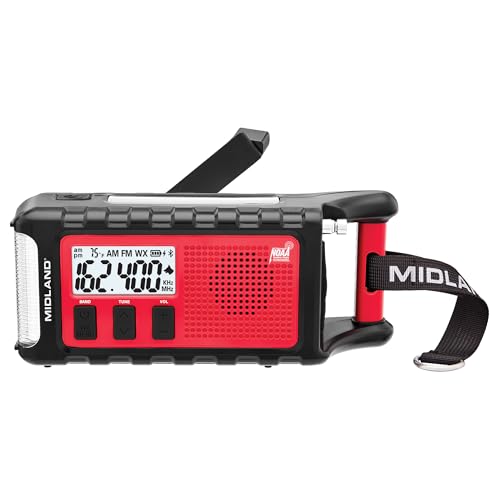
Midland ER310PRO Emergency Crank Weather Radio
AM/FM, 7 NOAA weather channels, Bluetooth · Hand crank, solar panel, USB-C, internal battery · Score 79/100
The ER310PRO is Midland's upgrade of the ER310. Midland says it has a 10,000 mAh lithium-ion battery that doubles as a power bank, "over 200 hours of radio operation", and charges by solar panel, hand crank or USB-C (Midland). Midland's Amazon listing adds a scan of 7 NOAA weather channels with an alert, a Cree LED flashlight rated at 130 lumens, an SOS beacon that flashes Morse code, a rescue-dog siren and Bluetooth streaming. GearJunkie reports that Midland chose not to IP-rate it and weighed it at 1 lb 4.8 oz (GearJunkie). It is the only radio here with a battery big enough to give a phone a meaningful charge. Two things it lacks: none of the sources we checked lists S.A.M.E. county alerting, and there is no AA or AAA backup.
Alerts: NOAA weather alert; S.A.M.E. not listed. Battery: 10,000 mAh lithium-ion (Midland). Backup cells: None listed. Water rating: None (GearJunkie: not IP-rated). Weight: 1.3 lb.
Stock note: When we checked on November 7, 2026, the Amazon offer was new and sold by Midland Radio, but it said "Usually ships within 2 to 3 weeks." Order early if you want it before a storm.
Pros
- ✓ 10,000 mAh battery: the largest here by far (Midland)
- ✓ Crank, solar and USB-C charging
- ✓ 7 NOAA weather channels with alert scan
- ✓ Flashlight, SOS beacon and rescue-dog siren
Cons
- ✗ Amazon said ships in 2 to 3 weeks when we checked
- ✗ No S.A.M.E. county alerting listed
- ✗ No AA/AAA backup; not IP-rated (GearJunkie)
- ✗ Among the highest prices here
2. Best Value Crank Radio With Battery Backup

FosPower A1 Solar Hand Crank Emergency Radio
AM/FM, NOAA weather band (162.400-162.550 MHz) · Hand crank, solar panel, USB, internal battery, AAA cells · Score 78/100
Price: $44.99
The FosPower A1 covers every power option for the money: a hand crank, a solar panel, USB charging, an internal battery and AAA cells as a backup. FosPower lists the battery as 7,400 mWh (2,000 mAh), about a fifth of the ER310PRO's. Target's listing gives an IPX3 water rating, the only published IP rating among our picks, plus the 162.400 to 162.550 MHz NOAA weather band, a 1W flashlight and a Lifetime Limited Warranty (Target). The Amazon listing adds a 4-LED reading light and an SOS alarm. Two caveats: FosPower doesn't publish a weather-alert mode, so treat it as a radio you turn on to listen rather than one that wakes you, and listings disagree on whether it takes three or four AAA cells.
Alerts: NOAA weather band; no alert mode published. Battery: 2,000 mAh / 7,400 mWh lithium-ion (FosPower). Backup cells: AAA cells (not included; count differs between listings). Water rating: IPX3 (Target listing). Weight: Not confirmed.
Stock note: When we checked, the new offer was from SF Planet, a third-party seller, and Amazon showed only 4 left in stock.
Pros
- ✓ Crank, solar, USB and AAA backup
- ✓ IPX3 rating (Target listing)
- ✓ Flashlight, reading light and SOS alarm
- ✓ Limited lifetime warranty
Cons
- ✗ No weather-alert mode published
- ✗ Only 4 left when we checked (third-party seller)
- ✗ Small 7.4 Wh battery for phone charging
- ✗ AAA count differs between listings
3. Best Multiband Radio (Shortwave + NOAA)

Kaito Voyager Pro KA600 Emergency Radio
AM/FM (RDS), shortwave, 7 NOAA weather channels · Hand crank, solar panel, AC adapter (in the listing), internal battery, AA cells · Score 74/100
The Kaito Voyager Pro KA600 is for listeners who want more than local stations. Universal Radio lists AM, FM with RDS, shortwave from 2.3 to 23 MHz and 7 NOAA weather channels, and five ways to power it: the supplied NiMH pack (3.6V, 600 mAh), solar, the hand crank, an AC adapter and three AA cells (Universal Radio). The Amazon listing includes the AC adapter and names a NOAA alert. Its USB port can charge a phone, but a 600 mAh pack is about 2.2 Wh in our math, so it is a top-up at best. It also has an LED flashlight and a 5-LED reading lamp.
Alerts: NOAA alert mode; S.A.M.E. not listed. Battery: 3.6V 600 mAh NiMH (Universal Radio). Backup cells: 3 x AA (not included). Water rating: Not published. Weight: Not confirmed.
Stock note: When we checked, the only new offer in the buy box was from Electronnix, a third-party seller, and the listing showed no stock message. Universal Radio lists the KA600 as discontinued and replaced by the KA600L.
Pros
- ✓ AM, FM, shortwave and 7 NOAA channels
- ✓ Five power options, including AA cells
- ✓ AC adapter included in this listing
- ✓ Flashlight and reading lamp
Cons
- ✗ Third-party seller; dealer lists it as discontinued
- ✗ 600 mAh battery is small for phone charging
- ✗ No S.A.M.E. or SOS signal listed
- ✗ No IP rating published
4. Best Budget Emergency Radio

Midland ER10VP E+Ready Emergency Weather Radio
AM/FM, 7 NOAA weather channels · 3 x AA (included) · Score 74/100
Price: $29.99
The ER10VP is the simplest radio here and the lowest-priced. It runs on three AA batteries, included, and has AM/FM, 7 NOAA weather channels with audible and visual alerts, and an LED flashlight with high and low settings and an SOS beacon that signals in Morse code. The dealer page lists it at 0.3 lb and 5.0 by 3.0 by 1.2 inches with a one-year warranty (BuyTwoWayRadios). There's no crank, no solar and no USB output, so keep spare AAs with it, as Ready.gov's kit list suggests.
Alerts: NOAA weather alert (audible + visual); S.A.M.E. not listed. Battery: No internal rechargeable battery. Backup cells: 3 x AA (included). Water rating: Not published. Weight: 0.3 lb.
Stock note: When we checked, it was in stock and sold by Midland Radio.
Pros
- ✓ Lowest price of our six
- ✓ NOAA weather alert with sound and light
- ✓ Flashlight with SOS beacon
- ✓ Runs on easy-to-find AA cells (included)
Cons
- ✗ No crank, solar or rechargeable battery
- ✗ Can't charge a phone
- ✗ No S.A.M.E. county alerting listed
- ✗ No IP rating published
5. Best S.A.M.E. Weather Alert Radio for the Bedroom

Midland WR120B NOAA Weather Alert Radio
7 NOAA weather channels · AC adapter with AA backup · Score 69/100
Price: $47.80
If what you want is a radio that wakes you for a tornado or blizzard warning in your county and stays quiet otherwise, a desktop S.A.M.E. radio is the right tool, not a crank radio. The WR120B is Public Alert certified, takes S.A.M.E. codes for up to 25 counties and alerts by a 90 dB siren, a voice message or a flashing LED, with three AA cells as backup when the power fails (OpticsPlanet). It has external antenna and alert jacks, and the Amazon listing describes English, Spanish and French menus. It has no flashlight, crank, solar panel or USB charging.
Alerts: S.A.M.E. (up to 25 counties); 90 dB siren, voice or flashing LED; Public Alert certified. Battery: No internal rechargeable battery. Backup cells: 3 x AA (not included). Water rating: Not published (desktop radio). Weight: Not confirmed.
Stock note: When we checked, it was in stock and sold by Midland Radio.
Pros
- ✓ S.A.M.E. for up to 25 counties
- ✓ Public Alert certified; 90 dB siren
- ✓ AA backup keeps alerts on in an outage
- ✓ External antenna jack
Cons
- ✗ Desktop radio: not built to carry
- ✗ No crank, solar or flashlight
- ✗ No AM/FM listed
- ✗ AA batteries not included
6. Best Weather Radio Alarm Clock (S.A.M.E. + AM/FM)
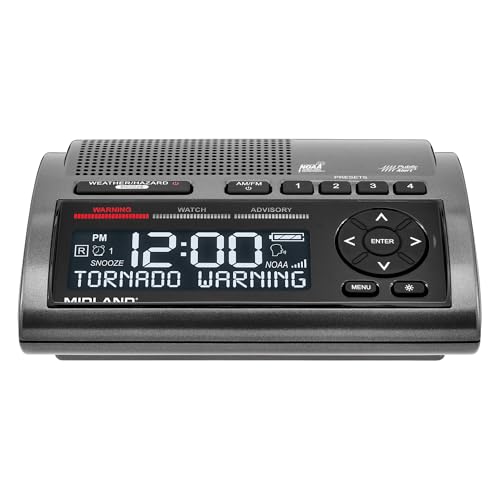
Midland WR400 Deluxe NOAA Weather Alert Radio
AM/FM, 7 NOAA weather channels · AC adapter with AA backup · Score 68/100
The WR400 is the WR120B's bigger sibling: an AM/FM alarm clock that switches to a weather alert when one arrives. The dealer page lists S.A.M.E., more than 80 alert types, an 85 dB siren, an external antenna jack, a USB charging port and four AA cells for backup (BuyTwoWayRadios), and Midland's Amazon listing says it stores up to 25 counties and can alert by siren, voice or flashing LED. It costs about twice as much as the WR120B, so buy it for the AM/FM clock and USB port, not for better alerting.
Alerts: S.A.M.E. (up to 25 counties); 85 dB siren, voice or flashing LED. Battery: No internal rechargeable battery. Backup cells: 4 x AA (not included). Water rating: Not published (desktop radio). Weight: Not confirmed.
Stock note: When we checked, it was in stock and sold by Midland Radio.
Pros
- ✓ S.A.M.E. for up to 25 counties
- ✓ AM/FM alarm clock that switches to alerts
- ✓ USB charging port and antenna jack
- ✓ Four-AA backup
Cons
- ✗ Desktop radio: not built to carry
- ✗ No crank, solar or flashlight
- ✗ Highest price of the two desktop radios
- ✗ USB output rating not published
Other radios we checked
The Supersonic SC-1078ERN Guardian, a crank, solar and rechargeable AM/FM/NOAA radio, showed "Currently unavailable" with no priced offer when we checked, so it isn't ranked. We also searched Amazon for the original Midland ER310 and the search returned only the ER310PRO, so we couldn't confirm a current listing to link. See ER310 vs ER310PRO below.
Emergency Radio Comparison Table
All six side by side. Figures come from the sources linked on each card.
| Radio | Weather alerts | Power sources | Internal battery | Backup cells | Phone charging | Light / SOS | IP rating | Score | Price |
|---|---|---|---|---|---|---|---|---|---|
| Midland ER310PRO Emergency Crank Weather Radio | NOAA weather alert; S.A.M.E. not listed | Hand crank, solar panel, USB-C, internal battery | 10,000 mAh lithium-ion (Midland) | None listed | Yes (USB-C power bank) | Cree LED flashlight (130 lm per the Amazon listing), SOS beacon, rescue-dog siren | None (GearJunkie: not IP-rated) | 79/100 | Check price at Amazon → |
| FosPower A1 Solar Hand Crank Emergency Radio | NOAA weather band; no alert mode published | Hand crank, solar panel, USB, internal battery, AAA cells | 2,000 mAh / 7,400 mWh lithium-ion (FosPower) | AAA cells (not included; count differs between listings) | Yes (power bank) | 1W flashlight, 4-LED reading light, SOS alarm | IPX3 (Target listing) | 78/100 | $44.99 |
| Kaito Voyager Pro KA600 Emergency Radio | NOAA alert mode; S.A.M.E. not listed | Hand crank, solar panel, AC adapter (in the listing), internal battery, AA cells | 3.6V 600 mAh NiMH (Universal Radio) | 3 x AA (not included) | Yes (USB phone charging) | LED flashlight, 5-LED reading lamp | Not published | 74/100 | Check price at Amazon → |
| Midland ER10VP E+Ready Emergency Weather Radio | NOAA weather alert (audible + visual); S.A.M.E. not listed | 3 x AA (included) | No internal rechargeable battery | 3 x AA (included) | No | LED flashlight (high/low), SOS beacon | Not published | 74/100 | $29.99 |
| Midland WR120B NOAA Weather Alert Radio | S.A.M.E. (up to 25 counties); 90 dB siren, voice or flashing LED; Public Alert certified | AC adapter with AA backup | No internal rechargeable battery | 3 x AA (not included) | No | No flashlight (flashing alert LED) | Not published (desktop radio) | 69/100 | $47.80 |
| Midland WR400 Deluxe NOAA Weather Alert Radio | S.A.M.E. (up to 25 counties); 85 dB siren, voice or flashing LED | AC adapter with AA backup | No internal rechargeable battery | 4 x AA (not included) | USB charging port (rating not published) | No flashlight (flashing alert LED) | Not published (desktop radio) | 68/100 | Check price at Amazon → |
Sources: Midland ER310PRO launch post, GearJunkie and BuyTwoWayRadios (ER310PRO); Target and Amazon listings (FosPower A1); Universal Radio (Kaito KA600); BuyTwoWayRadios (ER10VP, WR400); OpticsPlanet (WR120B). Midland's Amazon bullet for the WR400 says it scans "10 available weather (WX) band channels"; NOAA broadcasts on 7 frequencies, and the dealer page lists the 7 NOAA channels plus Environment Canada's, so the table shows 7.
NOAA Weather Radio Explained: The 7 Frequencies and S.A.M.E. Alerts
The National Weather Service describes NOAA Weather Radio (NWR) as "a nationwide network of radio stations broadcasting continuous weather information" from the nearest NWS office, and calls it an "All Hazards" network for weather and other emergencies. NWS says it has "more than 1000" transmitters covering all 50 states, adjacent coastal waters, Puerto Rico, the U.S. Virgin Islands and the U.S. Pacific Territories (NWS: NOAA Weather Radio). Coverage "typically extends in about a 40 mile radius from the transmitter," and some areas may have unreliable reception (NWS).
| The 7 NOAA Weather Radio frequencies (MHz) |
|---|
| 162.400 · 162.425 · 162.450 · 162.475 · 162.500 · 162.525 · 162.550 |
Source: weather.gov/nwr. Radios label these as weather or WX channels 1 to 7; the channel numbering varies by brand.
What S.A.M.E. does, and how to set it up
NWS says that before broadcasting most warnings and many watches, it sends a 1050 Hz tone alarm that tone-alert radios listen for, and that "SAME, or Specific Area Message Encoding allows you to specify the particular area for which you wish to receive alerts" (NWS: NWR receivers). Each alert carries a code with "the type of message, county(s) affected, and message expiration time," and a programmed radio alerts you only for the areas you choose (NWS: Using NWR SAME).
- Find your county's 6-digit code. NWS lists them by state at weather.gov/nwr/counties, or call 1-888-NWR-SAME (1-888-697-7263) for a voice menu. For a whole county the first digit is zero, the next two are the state and the last three are the county (NWS).
- Enter it on a S.A.M.E. radio. Add a code for each county, parish or marine area you want, following your radio's manual. The WR120B and WR400 each hold up to 25 counties.
- Pick the right transmitter. NWS warns, "Do NOT program your radio for a louder or clearer station not designated as a SAME channel," or you won't receive alerts (NWS).
NWS also notes that "Devices carrying the Public Alert logo meet certain technical standards" (CTA-2009-C), that some receivers have an external antenna jack, and that "Since power outages often occur during storms, having a receiver with battery backup can be crucial" (NWS). Among our picks, the WR120B and WR400 have S.A.M.E., battery backup and an antenna jack. The four portable radios receive the same broadcasts but don't list S.A.M.E., so they can't be set to alert for your county only, and FosPower publishes no alert mode at all for the A1.
Ready.gov's basic emergency kit lists a "Battery-powered or hand crank radio and a NOAA Weather Radio with tone alert," along with a flashlight, extra batteries and a "Cell phone with chargers and a backup battery" (Ready.gov: Build a Kit). That's the two-radio setup in our verdict.
Midland ER310 vs ER310PRO: Which Should You Buy?
The Midland ER310 is one of the most searched emergency radios, and Midland now sells the ER310PRO as an upgrade built on it. Midland says the Pro adds a longer-lasting battery, faster USB-C charging, Bluetooth streaming and louder audio (Midland). GearJunkie puts the battery jump at 2,600 mAh in the ER310 to 10,000 mAh in the Pro, about four times as much (GearJunkie). Midland doesn't say the Pro replaces the ER310.
- Buy the ER310PRO if phone charging matters to you: the larger battery is the main reason to choose it. Amazon showed a 2 to 3 week ship time when we checked.
- The original ER310 may cost less where you find it, but our Amazon search returned no listing we could confirm, so we can't link to or score it. If you buy one elsewhere, check that the seller lists it as new.
- Neither is listed with S.A.M.E. county alerting in the sources we checked. Pair either one with a desktop S.A.M.E. radio for overnight warnings.
Hand Crank, Solar, AA or Battery: How Emergency Radios Stay Powered
- Hand crank. A crank keeps a radio going when everything else is flat, but it's slow. GearJunkie reports Midland's figure for the ER310PRO as one minute of cranking for about 9 minutes of radio (GearJunkie). None of the other makers here publishes a crank figure.
- Solar. The panels on these radios are small. GearJunkie reports up to 45 minutes of radio from an hour of direct sun on the ER310PRO. That's enough to keep a radio topped up on a clear day, not to fill a large battery quickly. In a winter storm with short, cloudy days, expect less.
- AA or AAA backup. Disposable cells are the most dependable reserve because you can store spares, as Ready.gov's kit list suggests. The ER10VP runs on three AAs (included), the Kaito KA600 takes three AAs, the WR120B three and the WR400 four, and the FosPower A1 takes AAAs. The ER310PRO has no cell backup.
- Internal rechargeable battery. This is what powers the radio day to day and charges your phone. Sizes vary widely: 10,000 mAh (ER310PRO, Midland), 2,000 mAh or 7.4 Wh (FosPower A1) and 600 mAh NiMH (Kaito KA600, Universal Radio). Midland says the ER310PRO gives "over 200 hours of radio operation" on a charge; the others don't publish a runtime.
Charge the internal battery fully before storm season and again when a storm is forecast, then save the crank and solar panel for long outages.
Can an Emergency Radio Charge Your Phone? The Realistic Math
Many crank radios say "phone charger" on the box, but the battery inside sets the limit, not the crank. Here's what each published battery size works out to. The Wh, usable-energy and phone figures are our math, not measurements: we count 70% of a battery's rated energy as reaching your phone, the factor our power bank guide uses from Anker's own estimate that its 90 Wh bank delivers about 63 to 70 Wh to devices (Anker), and a 15 Wh phone battery as a round illustration (check your own phone's battery rating).
| Battery | Published capacity | Energy (Wh) | Reaches the phone at 70% (our math) | 15 Wh phone charges (our math) |
|---|---|---|---|---|
| Midland ER310PRO Emergency Crank Weather Radio | 10,000 mAh (Midland) | ~37 Wh* | ~26 Wh | ~1.7 |
| FosPower A1 Solar Hand Crank Emergency Radio | 2,000 mAh / 7,400 mWh (FosPower) | 7.4 Wh | ~5.2 Wh | ~0.3 |
| Kaito Voyager Pro KA600 Emergency Radio | 3.6V, 600 mAh NiMH (Universal Radio) | ~2.2 Wh | ~1.5 Wh | ~0.1 |
| UGREEN Nexode 25,000mAh 165W Power Bank with Built-in Cables (for comparison) | 25,000 mAh | 90 Wh | ~63 Wh | ~4.2 |
*Midland publishes mAh, not Wh. We assume a 3.7V nominal lithium-ion cell, the voltage FosPower's own 2,000 mAh = 7,400 mWh figure implies; Midland's real figure may differ. GearJunkie reports Midland's manual says the ER310PRO can "fully charge an iPhone 14 three times." The Kaito figure uses the voltage and capacity Universal Radio lists. The ER10VP and WR120B have no USB output, and Midland doesn't publish the WR400's USB rating.
What about cranking a phone? None of the six makers publishes how much phone charge a minute of cranking delivers, so we won't guess. Midland's ER310PRO figure is about running the radio, not charging a phone. Use the crank to keep the radio and light going, and charge phones from the radio's stored battery, a power bank or a power station.
Flashlight, SOS and Siren Features
A built-in light is the feature you'll use most in a blackout. Here's what each maker or dealer lists:
- Midland ER310PRO: a Cree LED flashlight (130 lumens per Midland's Amazon listing; GearJunkie notes Midland's own launch materials give no figure), an SOS beacon that flashes Morse code and a rescue-dog siren meant to help searchers find you.
- FosPower A1: a 1W flashlight (20 lumens per Target's listing), a 4-LED reading light and an SOS alarm.
- Midland ER10VP: an LED flashlight with high and low settings and an SOS beacon in Morse code.
- Kaito KA600: an LED flashlight and a 5-LED reading lamp under the solar panel. No SOS signal is listed.
- Midland WR120B and WR400: no flashlight. Their flashing LED is an alert indicator, not a light to walk by.
Lumen figures aren't published consistently across these brands, so we score light features by what's included, not by brightness. Keep a separate flashlight and spare batteries in your kit too, as Ready.gov recommends.
Are Emergency Radios Waterproof? Published IP Ratings Only
Only one of our six picks has a published water rating. Target's listing gives the FosPower A1 an IPX3 rating. In the IEC 60529 IP code, the X means no dust rating was given and a 3 means protection against spraying water at up to 60° from vertical; it isn't a submersion rating (IP code overview; DLS: IPX3 and IPX4). GearJunkie reports that Midland chose not to IP-rate the ER310PRO (GearJunkie), and we found no published rating for the ER10VP or Kaito KA600. The WR120B and WR400 are indoor desktop radios.
If you'll keep a radio in a car, a go-bag or a hurricane kit, store it in a zip-top or dry bag. Don't treat a radio without a rating as water-resistant, whatever the photos suggest.
Keep Your Emergency Radio Charged From a Power Station
If you already own a portable power station, it can recharge a radio's battery many times over, which leaves the crank and solar panel for when the station runs low. Using the same 0.85 usable-energy factor we use for every power station, and the battery sizes in the phone-charging table above, here's how many full refills two stations already rated on this site hold:
| Power station (rated on this site) | Battery | ER310PRO refills (~37 Wh*) | FosPower A1 refills (7.4 Wh) | Our score** | Price |
|---|---|---|---|---|---|
| EcoFlow River 3 Plus | 286 Wh LiFePO4 | ~7 | ~33 | 86/100 | Check price at Amazon → |
| Anker SOLIX C1000 Gen 2 | 1,024 Wh LiFePO4 | ~24 | ~118 | 92/100 | $529.99 |
Refills are estimates (station Wh × 0.85 ÷ radio battery Wh), not measurements, and ignore the station's own idle draw. *ER310PRO Wh is our 3.7V estimate from Midland's 10,000 mAh figure. **Power-station scores come from our power-station scoring and aren't comparable with the radio scores above.
A radio is the cheapest part of an outage plan, and our power outage kit list covers the rest of the essentials, from water to a CO alarm. For heat, lights and the fridge, see our winter storm power backup guide, which also covers charging lithium batteries below freezing. To size a station for the whole house, start with the best solar generators for power outages; for hurricane season, see solar generators for hurricanes. If all you need is phone and laptop charging, a laptop power bank holds several times what any radio battery here does. To keep the router and modem online, look at a UPS battery backup.
Which Emergency Radio Fits You?
Choose a portable crank and solar radio if
- ✓ You want news and weather through a multi-day outage
- ✓ You're building a go-bag or hurricane kit
- ✓ You want a flashlight and SOS signal in the same device
- ✓ You want some phone charging (the ER310PRO's battery is the only sizable one)
Choose a desktop S.A.M.E. radio if
- ✓ You live where tornado or flash-flood warnings can come overnight
- ✓ You want alerts only for your county, without false wake-ups
- ✓ You want it to stay on standby on AC with AA backup
- ✗ Skip it as your only radio if you'll need to carry it or charge a phone
Emergency Radio FAQ
What is the best emergency radio?
In our scoring, the Midland ER310PRO ranks highest: it charges by hand crank, solar panel or USB-C, receives 7 NOAA weather channels with an alert, and has a 10,000 mAh battery that can charge a phone, though Amazon showed a 2 to 3 week ship time when we checked. The FosPower A1 adds AAA backup and an IPX3 rating for less. For county-specific alerts at night, a desktop S.A.M.E. radio such as the Midland WR120B is the better choice.
What is the difference between the Midland ER310 and the ER310PRO?
Midland calls the ER310PRO an upgrade built on the ER310, with a longer-lasting battery, faster USB-C charging, Bluetooth streaming and louder audio. GearJunkie reports the battery grew from 2,600 mAh to 10,000 mAh. Neither model is listed with S.A.M.E. county alerting in the sources we checked. We couldn't confirm a current Amazon listing for the original ER310, so we don't link to it.
What is S.A.M.E. on a weather radio, and do I need it?
S.A.M.E. (Specific Area Message Encoding) lets you program a NOAA weather radio with 6-digit county codes so it alerts only for the areas you choose, according to the National Weather Service. You can find your code at weather.gov/nwr/counties or by calling 1-888-NWR-SAME. It matters most for a radio that stays on overnight to wake you for warnings. The Midland WR120B and WR400 have it; the portable crank radios on this page don't list it.
Can a hand-crank radio charge a phone?
A little, but don't count on the crank. The radio's stored battery does the charging. In our math, about 70% of the ER310PRO's estimated 37 Wh reaches a phone, roughly 1.7 charges of a 15 Wh phone battery, while the FosPower A1's 7.4 Wh battery gives about a third of a charge. None of these makers publishes how much phone charge a minute of cranking delivers. Midland's ER310PRO figure, reported by GearJunkie, is one minute of cranking for about 9 minutes of radio.
What are the 7 NOAA weather radio frequencies?
The National Weather Service lists them as 162.400, 162.425, 162.450, 162.475, 162.500, 162.525 and 162.550 MHz. NWS says NOAA Weather Radio has more than 1,000 transmitters, and coverage typically extends about 40 miles from each one. Most weather radios scan these channels and lock onto the strongest one.
Are emergency radios waterproof?
Most aren't rated. Of our six picks, only the FosPower A1 has a published rating, IPX3 on Target's listing, which covers spraying water but not submersion. GearJunkie reports the Midland ER310PRO isn't IP-rated, and we found no rating for the ER10VP or Kaito KA600. Keep any radio in a dry bag in a car or go-bag.