
Buying Guide · Updated November 2026
Best Solar Power Bank 2026: Honest Charging Times
A solar power bank is a normal power bank with a small solar panel on its case. That panel is about the size of a phone, so by our math it takes several days of clear sun to refill a 10,000mAh bank, and one to two weeks for a 20,000mAh bank. Buy one as a regular power bank that you charge at home, with the sun as an emergency backup. To actually charge from the sun, pair a power bank with a separate 20 to 30W folding USB solar panel, which can refill it in an afternoon.
As an Amazon Associate, SolarGenAdvisor earns from qualifying purchases made through links on this page, at no additional cost to you. Product information comes from maker and Amazon listing specs, independent published reviews and Amazon prices. Scores are AI-synthesized and we did not test these products. The solar power banks and the USB panel are new to our catalogue and haven't been scored yet.
 By
Quick Answer
- For an emergency kit, a glovebox or a day hike: a solar power bank such as the BLAVOR 10,000mAh is fine, as long as you charge it from the wall first. The panel only trickles in a little power.
- For a trip of several days off-grid: carry a regular power bank and a 20 to 30W folding USB panel, such as the BigBlue 30W. By our math, a clear day of sun refills a 20,000mAh bank.
- If you also charge a laptop: pick a bank with a 100W or 140W USB-C port from our best laptop power bank guide, and charge it with the panel during the day.
How Solar Power Banks Work
A solar power bank has a lithium-ion battery, a USB charging circuit and a small solar panel glued to one face. The panel feeds the battery through the same charging circuit as the USB-C input, only far more slowly. You can charge it from a wall charger, from the sun, or both. Several listings say the same thing in the small print: charge it from USB before you leave, and use solar as a backup. The YELOMIN listing on Amazon, for example, says a full solar recharge "may require dozens of hours of effective sunlight or longer".
The limit is area. Panels are rated at standard test conditions: full sun of 1,000 watts per square metre on the panel (Renogy datasheet). The BLAVOR 10,000mAh's case is about 5.9 × 3.1 inches per its Amazon listing, roughly 0.012 m². Even if that whole face were solar cells at the 24.7% that BigBlue lists for its panel, it would make about 3W in perfect sun, and the real cell area is smaller. The one panel figure we found for a BLAVOR bank, for the earlier version of this model, is 180 mA, under 1W at 5V (PowerBankExpert). Most makers don't publish a panel wattage at all. So we use 1.5 to 3W as a generous range for a built-in panel.
A folding USB panel is a different product: four or more phone-sized panels sewn into a cloth case, with no battery. The BigBlue 30W unfolds to many times the area of a built-in panel and has an 18W USB-C port. It charges a phone or a power bank only while the sun is on it.
Real Solar Charging Time: The Math
Start with watt-hours. Power banks list mAh at the cell voltage, usually 3.6 to 3.7V (Battery University), so Wh = mAh × 3.7 ÷ 1,000, as on our what is a watt-hour page. A 10,000mAh bank holds about 37 Wh and a 20,000mAh bank about 74 Wh.
Next, the energy a panel makes in a day. We use the same formula as our solar panel output calculator: Wh per day = panel watts × peak sun hours × 0.75. A clear day in much of the US gives about 5 peak sun hours. NLR solar resource data puts Atlanta at 5.09 and Chicago at 4.50 kWh/m²/day on a tilted panel (NLR). The 0.75 covers heat, angle and conversion losses. These are best-case figures: they assume the panel faces the sun all day, with no cloud.
| Bank (about Wh) | Built-in panel, 1.5W | Built-in panel, 3W | 30W folding panel (18W USB-C port) |
|---|---|---|---|
| 10,000mAh (BLAVOR PN-W05) (37 Wh) | 6.6 clear days | 3.3 clear days | ~2.7 h of full sun |
| 20,000mAh (BLAVOR PN-W39, INIU P62-E1) (74 Wh) | 13.2 clear days | 6.6 clear days | ~5.5 h of full sun |
| 25,000mAh (EcoFlow RAPID, UGREEN 165W) (90 Wh) | 16.0 clear days | 8.0 clear days | ~6.7 h of full sun |
Our estimates from published capacities, not measurements. Built-in panel columns: bank Wh ÷ (panel W × 5 peak sun hours × 0.75). Folding-panel column: bank Wh ÷ (18W × 0.75), because the BigBlue's USB-C port is rated 18W, so the port, not the 30W panel, sets the limit. The bank must also accept at least 18W of USB-C input.
What reviewers who measured found: OutdoorGearLab's solar charger tests are in line with this math, or worse. They report one 20,000mAh bank with fold-out panels would need about 29 hours of midday sun to refill itself. A 42,800mAh bank with a single built-in panel collected 105 mAh in an hour of direct sun, and a 28W BigBlue folding panel put 2,318 mAh into a battery in an hour (OutdoorGearLab). The difference between a built-in panel and a folding panel is more than twentyfold.
Solar Power Banks and Panels by Use
These are grouped by what you'll use them for, not ranked. The two BLAVOR banks and the BigBlue panel are new to our catalogue and haven't been scored yet. All three had a new, in-stock offer from the brand's own Amazon store when we checked on November 18, 2026 (the BigBlue showed low stock). Specs come from the Amazon listings, checked against a second retailer or review where one was published.
Emergency kit and day hikes: a solar power bank
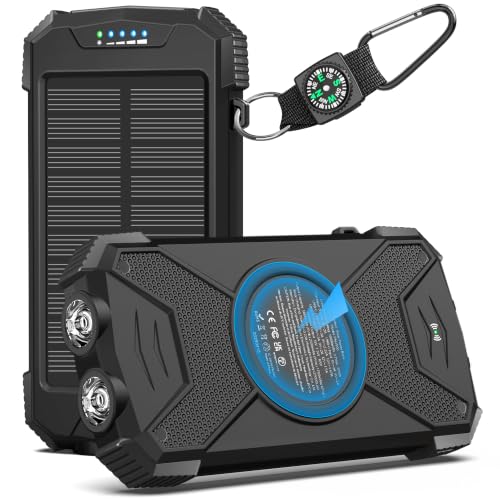
BLAVOR Solar Power Bank 10,000mAh (PN-W05)
10,000mAh · about 37 Wh · 20W USB-C · IPX5 · Two flashlights
The BLAVOR PN-W05 is the small, simple option. Its Amazon listing gives 10,000mAh, a 20W USB-C port, a Qi wireless charging pad, two flashlights, a compass carabiner and an IPX5 rating, at 0.58 lb. PowerBankExpert lists the earlier version at 37 Wh and 9.3 oz (PowerBankExpert). That review rated it IPX4, and the current listing says IPX5. It holds enough for one or two phone charges and fits in a jacket pocket. Charge it from the wall, keep it in the kit, and let the panel top it up on a sunny windowsill or pack. Don't count on the panel to refill it: by our math that takes three to seven clear days.
Ports: USB-C (20W), USB-A, Qi wireless pad.
Good for
- ✓ Pocket size: 0.58 lb (listing)
- ✓ 20W USB-C plus Qi wireless
- ✓ Two flashlights, IPX5 (listing)
Know before you buy
- ✗ Built-in panel takes days to refill it
- ✗ BLAVOR doesn't publish the panel wattage
- ✗ Too small for a laptop

BLAVOR Solar Power Bank 20,000mAh with Built-in Cables (PN-W39)
20,000mAh · about 74 Wh · 20W USB-C · IPX5 · Flashlight (3 modes) + camping light
The BLAVOR PN-W39 is for a family kit or a campsite where you don't want to hunt for cables. The Amazon listing gives 20,000mAh and four built-in cables (two USB-C, one Lightning, one USB-A), plus a 20W USB-C port, a wireless pad that charges a phone and an Apple Watch, a three-mode flashlight, a camping light, a compass and a thermometer, rated IPX5. Newegg lists the same model and cable set (Newegg). At 3.7V, 20,000mAh is about 74 Wh (our calculation; BLAVOR doesn't list the Wh), so it flies in a carry-on. We couldn't confirm its weight: listings give 1.72 lb, which may include packaging. As with every built-in panel, plan on charging it from the wall.
Ports: 4 built-in cables (2 USB-C, Lightning, USB-A), USB-C 20W port, USB-A, Lightning port, wireless pad for a phone and an Apple Watch.
Good for
- ✓ Four built-in cables: charges six devices at once (listing)
- ✓ Wireless pad for a phone and an Apple Watch
- ✓ About 74 Wh: under the FAA 100 Wh line
Know before you buy
- ✗ Built-in panel needs one to two weeks of sun to refill it
- ✗ Weight not confirmed
- ✗ 20W USB-C: slow for a tablet or laptop
Multi-day trips: a folding USB panel plus any power bank

BigBlue 30W Foldable USB Solar Charger (SP30)
30W · up to 24.7% efficiency (listing) · 1.85 lb · folded 7.95 x 12.12 x 1.46 (folded) in · IP68 panel surface
The BigBlue 30W is how you actually charge from the sun. Its Amazon listing gives 30W from monocrystalline cells rated up to 24.7%, an 18W USB-C Power Delivery port, a USB-A port and a small DC output (17.4V, 1.73A) for compact power stations. It folds to 7.95 × 12.12 × 1.46 inches and weighs 1.85 lb, the same figures Newegg lists (Newegg). It is rated IP68, but BigBlue says the junction box isn't waterproof, so keep the ports dry. It has no battery, so a cloud stops the charge. That's why it pairs with a power bank: charge the bank all day and charge your phone from the bank at night. In OutdoorGearLab's measurements, BigBlue's 28W panel put 2,318 mAh into a battery in one hour of direct sun (OutdoorGearLab). The listing showed low stock when we checked.
Good for
- ✓ Refills a 20,000mAh bank in about 5.5 h of full sun (our math)
- ✓ 18W USB-C PD, USB-A and DC outputs
- ✓ 1.85 lb: backpackable
Know before you buy
- ✗ No battery: output stops in shade
- ✗ Junction box isn't waterproof (BigBlue)
- ✗ Too small for a laptop or a big power station
For heavier panels that recharge a power station, see our best solar panels for camping and best portable solar panels guides.
Folding Panel and Power Bank Combos
Any USB-C power bank can be a solar power bank if you plug a folding panel into it. These three power banks are already scored on our laptop power bank page, using a rubric that weights laptop output heavily. Each one, paired with the BigBlue 30W, refills in about a day of clear sun by our math:
| Power bank | Capacity | Max USB-C out | Weight | Refill from the BigBlue 30W | Score | Price |
|---|---|---|---|---|---|---|
| EcoFlow RAPID Power Bank (25,000mAh, 170W) | 25,000mAh / 90 Wh | 140W | 1.25 lb | ~6.7 h of full sun | 89/100 | $44.33 |
| INIU Cougar P62-E1 20,000mAh 65W Power Bank | 20,000mAh / 74 Wh | 65W | 0.71 lb | ~5.5 h of full sun | 78/100 | $39.94 |
| UGREEN Nexode 25,000mAh 165W Power Bank with Built-in Cables | 25,000mAh / 90 Wh | 140W | 1.21 lb | ~6.7 h of full sun | 83/100 | $69.99 |
Refill estimates: bank Wh ÷ (18W × 0.75); about 5 peak sun hours make one clear day. Capacities, ports and weights from data/products.php, sourced on the laptop power bank page (EcoFlow, UGREEN and INIU product pages, ChargerLab, Notebookcheck and Macworld). Scores come from the power-bank rubric and aren't comparable with power-station or panel scores.
- Lightest kit: the INIU P62-E1 (0.71 lb, 74 Wh) plus the BigBlue 30W comes to about 2.6 lb. It holds about the same energy as the BLAVOR 20,000mAh, and by our math refills in an afternoon of full sun rather than one to two weeks.
- Phones and a laptop: the EcoFlow RAPID 25K has two 140W USB-C ports, so it can charge a MacBook at night from energy the panel collected during the day.
- No loose cables: the UGREEN Nexode 165W has two built-in USB-C cables, so the only cable you need to pack is the one between the panel and the bank.
What to Look For
- Capacity in Wh, not just mAh. 10,000mAh (about 37 Wh) covers a phone for a day or two; 20,000mAh (about 74 Wh) suits a weekend or a family. Ignore very large mAh claims on cheap solar banks unless the Wh is printed on the case.
- USB-C Power Delivery watts. 20W fast-charges most phones. A tablet wants 30W or more, and a laptop 65 to 140W. Both BLAVOR banks top out at 20W.
- IP rating. The second digit is water protection under IEC 60529: IPX4 is splashing, IPX5 is water jets, and IPX7 or IPX8 means immersion (IEC). The port covers have to be closed for the rating to apply.
- Panel watts, if it's published. A built-in panel without a published wattage is a backup feature. For real solar charging, buy a folding panel with a stated USB-C output: 18 to 20W PD is enough for phones and banks.
- Flashlight and extras. A built-in light is useful in an outage kit. Wireless pads and built-in cables add convenience but also weight.
- Recharge input. A bank that accepts 18W or more over USB-C can take the full output of a folding panel. Use our solar panel output calculator for your city's sun.
Flying With a Solar Power Bank: the 100 Wh Rule
A solar power bank is a spare lithium battery as far as the FAA is concerned. The FAA's PackSafe page says power banks must travel in carry-on baggage only, never checked. It limits lithium-ion batteries to 100 Wh each, and allows up to two spares of 101 to 160 Wh with airline approval (FAA PackSafe). Every bank on this page is under 100 Wh: the BLAVOR banks at about 37 and 74 Wh by our calculation, and the three paired banks at 74 to 90 Wh per their makers. A folding panel with no battery isn't a battery, but check your airline's rules. Our watt-hour guide converts any mAh rating to Wh.
Heat Safety: Sun, Dashboards and Hot Cars
Here's the catch with a built-in panel: it has to sit in direct sun, and so does the battery attached to it. Anker's power bank safety guide gives an operating and storage range of 32 to 95°F (0 to 35°C), and says to "avoid direct sunlight and high-temperature environments (such as inside a parked car)" (Anker). Anker's guide to heat-resistant power banks says most are designed to work up to about 40 to 45°C and warns against leaving one on a car dashboard (Anker). Even BigBlue's panel listing tells you to keep phones in the shade while they charge, because heat triggers their thermal protection.
- Don't leave a solar bank on a dashboard or in a parked car, even to charge it. Check your bank's manual for its own temperature limits.
- With a folding panel, keep the bank in the shade. Run the cable under the panel or into a pack pocket. The panel can sit in full sun while the battery stays cool, which a built-in panel can't do.
- If a bank is hot, swollen or smells odd, stop using it. Let it cool somewhere it can't ignite anything, and don't charge it again.
For a power outage at home, a bank keeps phones going for a day or two; our portable charger for power outage guide works out how far each size goes, including small power stations for a router or CPAP.
Who Should Buy One (and Who Should Skip)
A solar power bank fits
- ✓ A glovebox, go-bag or outage kit that sits charged for months
- ✓ Day hikes and festivals where a flashlight helps
- ✓ A gift for someone who wants one rugged gadget
Get a bank plus a folding panel if
- ✗ You'll be off-grid for more than two or three days
- ✗ You need to charge a tablet or laptop
- ✗ You expect to rely on solar, not just keep it as a backup
Solar Power Bank FAQ
Do solar power banks actually work?
Yes, but slowly. The built-in panel is about the size of a phone, so by our math it makes roughly 5 to 11 Wh on a clear day. That's a few days of sun to refill a 10,000mAh (37 Wh) bank, and one to two weeks for a 20,000mAh bank. They work well as regular power banks that you charge from the wall, with solar as an emergency top-up.
How long does it take to charge a solar power bank in the sun?
With a 1.5 to 3W built-in panel and about 5 peak sun hours a day, our estimate is 3.3 to 6.6 clear days for a 10,000mAh bank and 6.6 to 13.2 days for a 20,000mAh bank. A 30W folding panel with an 18W USB-C port refills a 20,000mAh bank in about 5.5 hours of full sun.
Can a solar panel charge a phone directly?
A folding USB panel can, in direct sun. The BigBlue 30W has an 18W USB-C port and a USB-A port. Charging stops when a cloud passes, and BigBlue says to keep the phone in the shade, so most people charge a power bank from the panel and the phone from the bank.
What size solar panel do I need to charge a power bank?
A 20 to 30W folding panel with an 18W or faster USB-C port is enough for a 10,000 to 25,000mAh bank. By our math it refills a 74 Wh bank in about 5.5 hours of full sun and a 90 Wh bank in about 6.7 hours. More panel doesn't help unless both the panel's port and the bank's input accept more watts.
Can I take a solar power bank on a plane?
Yes, in your carry-on only. The FAA says power banks can't go in checked bags and limits lithium-ion batteries to 100 Wh each, with up to two spares of 101 to 160 Wh allowed with airline approval. A 20,000mAh bank is about 74 Wh at 3.7V, so it's under the limit.
Is it safe to leave a solar power bank in a car to charge?
No. Anker's power bank safety guide gives an operating and storage range of 32 to 95°F and says to avoid direct sunlight and parked cars. A dashboard gets far hotter than that. To charge from the sun safely, put a folding panel in the sun and keep the bank in the shade on the end of a cable.