
Safety Buying Guide · Updated November 2026
Best Portable Carbon Monoxide Detector 2026: 3 UL 2034 Battery Alarms, Plus What Campers Need
A portable carbon monoxide detector is a battery-powered CO alarm you can set on a table or carry in a bag, so it keeps working in a power outage, a hotel room or a rental. Buy one listed to UL 2034, the U.S. CO alarm standard. The Kidde COBD earns our top score for its 5th Edition listing and backlit display. The Kidde COB is the same alarm without the display, and the First Alert CO400 was the cheapest when we checked. For a camper or RV, buy an alarm listed for RV use: Kidde says the COB isn't approved for RVs.
As an Amazon Associate, SolarGenAdvisor earns from qualifying purchases made through links on this page, at no additional cost to you. Scores are AI-synthesized from Kidde and First Alert spec sheets and product pages, Amazon listing details and logged Amazon prices; we did not test these alarms. This guide does not replace your alarm's manual or local fire code.
 By
Quick Verdict
For a bedroom during an outage, a hotel or a vacation rental, choose the Kidde COBD if you want a display you can check at night, or the Kidde COB to save a few dollars. Both are listed to the current UL 2034 5th Edition and run on AA batteries. The First Alert CO400 is a listed 9V alarm at the lowest price, but First Alert has discontinued it. None of the three is sold as an RV alarm, and all three are rated only from 40 to 100°F. For a camper, van or RV, buy an alarm the maker lists for RV use. No alarm makes it safe to run a fuel-burning heater in a tent or vehicle.
How We Score Portable CO Alarms
We score every alarm on this page with the same rubric. Scores are AI-synthesized from each maker's spec sheet and product page, Amazon listing details and the Amazon prices we logged on November 7, 2026. We did not test any alarm, and we make no claims about one sensor being more accurate than another. We score only figures every maker publishes, so no alarm loses points for missing data. These scores compare these three alarms with each other and aren't comparable with our power-station scores. Weights total 100:
- UL 2034 listing (25): listed on the maker's own spec sheet with the 5th Edition named 90; listed, edition not stated 80
- Portability (15): the maker says it works on a table or wall with no install and for travel 90; built to screw to a wall or ceiling 80
- Battery (15): two AA cells, which Kidde says need changing once a year, 85; one 9V 80
- Status readout (15): backlit display 85; three-colour status lights 70; one status light 65
- Service life (15): 10-year end-of-life signal and 10-year limited warranty 90; end-of-life signal and 7-year limited warranty 80
- Value (15): 50 plus 40 × the lowest live price here divided by this alarm's price, so price differences don't swamp everything else
The 3 Best Portable Carbon Monoxide Detectors
Every alarm here runs on batteries, is listed to UL 2034 according to its maker, and had a new, in-stock offer in Amazon's buy box when we checked on November 7, 2026. All three were sold by Amazon.com. Specs come from each maker's spec sheet or product page (linked), checked against the Amazon listing.
1. Top Score: Best Portable CO Alarm With a Display

Kidde COBD Battery CO Alarm with Digital Display
UL 2034, 5th Edition; ETL Listed (Kidde) · 2 x AA (included) · Score 87/100
The COBD earns our top score because it pairs a current listing with a display you can read at a glance. Kidde's spec sheet lists it as ETL Listed to UL 2034, 5th Edition, with an electrochemical sensor, an 85 dB horn at 10 feet, two AA batteries, a weight of 0.26 lb, an end-of-life signal after 10 years and a 10-year limited warranty that excludes batteries (Kidde COBD spec sheet). Press the button and the backlit display shows the alarm's status, even in the dark. Kidde doesn't say the display shows a live ppm reading, so don't expect one. It needs no wiring and can sit on a table or go on a wall. Kidde rates it from 40 to 100°F and says it is "intended for use in indoor residential locations", so it suits a bedroom, a rental or a cabin room, not a cold tent.
Sensor: Electrochemical. Rated range: 40 to 100°F (4.4 to 37.8°C). Weight: 0.26 lb. RV use: Not stated in the COBD brochure ("indoor residential locations").
Pros
- ✓ Listed to the current UL 2034 5th Edition (ETL)
- ✓ Backlit status display you can check in the dark
- ✓ 10-year end-of-life signal and 10-year limited warranty
- ✓ Runs on two AA batteries: no outlet needed in an outage
Cons
- ✗ Highest price of our three when we checked
- ✗ No published ppm readout
- ✗ Rated only from 40 to 100°F, for indoor residential use
2. Best Value Travel CO Alarm

Kidde COB Battery CO Alarm (AA)
UL 2034, 5th Edition; ETL Listed (Kidde) · 2 x AA (included; Kidde: change once a year) · Score 86/100
Price: $24.97
The COB is the same Kidde platform without the display: ETL Listed to UL 2034, 5th Edition, an electrochemical sensor, an 85 dB horn, two AA batteries, 0.26 lb, a 10-year end-of-life signal and a 10-year limited warranty (Kidde COB spec sheet). Green, amber and red lights show power, faults and alarms. Kidde says the batteries "only need to be changed once a year" and that the alarm slips into a suitcase. It tells you to take the batteries out for the trip and put them back on arrival. Kidde also says it is "For use in conditioned spaces only" and is "Not approved for RV or boat use" (Kidde). That makes it a hotel, vacation-rental and home-outage alarm, not a camper alarm.
Sensor: Electrochemical. Rated range: 40 to 100°F (4.4 to 37.8°C). Weight: 0.26 lb. RV use: Not approved for RV or boat use (Kidde).
Pros
- ✓ Listed to UL 2034 5th Edition (ETL)
- ✓ Pocket-size at 0.26 lb; Kidde says it fits in a suitcase
- ✓ AA batteries, changed once a year (Kidde)
- ✓ 10-year limited warranty
Cons
- ✗ Not approved for RV or boat use (Kidde)
- ✗ Status lights only, no display
- ✗ Rated only from 40 to 100°F
3. Lowest Price When We Checked
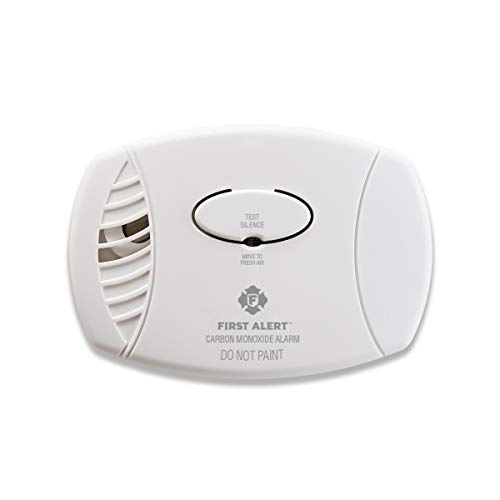
First Alert CO400 Battery CO Alarm (9V)
Listed to UL 2034 (edition not stated; First Alert) · 1 x 9V alkaline (included) · Score 79/100
Price: $21.99
First Alert lists the CO400 as "Listed to UL 2034 Standard", with an electrochemical sensor, an 85 dB horn at 10 feet, a 9V battery, an end-of-life warning and a 7-year limited warranty (First Alert). Its spec sheet adds a 40 to 100°F operating range, 5.6 oz and wall or ceiling mounting with the included screws (First Alert CO400B spec sheet). It was the cheapest of our three when we checked, sold by Amazon.com. Two caveats: First Alert's own page now marks the CO400 as discontinued, and the spec sheet doesn't name the UL 2034 edition. The Amazon listing notes that the date on the unit is the manufacture date, so check it when the alarm arrives.
Sensor: Electrochemical. Rated range: 40 to 100°F (4 to 38°C). Weight: 0.35 lb. RV use: Not stated by First Alert.
Pros
- ✓ Lowest price of our three when we checked
- ✓ Listed to UL 2034 (First Alert)
- ✓ Electrochemical sensor and end-of-life warning
- ✓ Sold by Amazon.com
Cons
- ✗ Discontinued on First Alert's site
- ✗ UL 2034 edition not stated
- ✗ Single status light; built to screw to a wall or ceiling
- ✗ 7-year warranty, shorter than Kidde's 10
Other detectors we checked
We left three in-stock detectors out of the alarm picks. The Heiman C1-R is an interconnected battery alarm whose Amazon listing says it is ETL Listed to UL 2034 5th Edition and California State Fire Marshal approved. We couldn't confirm that on a Heiman product page or a listing directory, and Amazon showed only 3 left. The TopTes S2 Multi is a rechargeable handheld tester for natural gas, propane and CO with a 0 to 999 ppm readout, according to its listing. It is a leak-checking tool with an auto power-off, and we found no UL 2034 listing for it, so don't use it as your CO alarm. The First Alert SMICO100 is a combined smoke and CO alarm listed to UL 217 and UL 2034 that mounts on a ceiling or wall (First Alert spec sheet). It's a good home alarm but not a portable one, and its Amazon title and spec sheet don't agree on the model name, so we didn't rank it.
Portable CO Detector Comparison Table
All three alarms side by side. Figures come from each maker's spec sheet or product page.
| Alarm | Listing (maker) | Power | Readout | Mounting | Rated range | Weight | End of life / warranty | RV use | Score | Price |
|---|---|---|---|---|---|---|---|---|---|---|
| Kidde COBD Battery CO Alarm with Digital Display | UL 2034, 5th Edition; ETL Listed (Kidde) | 2 x AA (included) | Backlit digital status display | Wall or tabletop; no wiring | 40 to 100°F (4.4 to 37.8°C) | 0.26 lb | End-of-life signal after 10 years; 10-year limited (batteries excluded) | Not stated in the COBD brochure ("indoor residential locations") | 87/100 | Check price at Amazon → |
| Kidde COB Battery CO Alarm (AA) | UL 2034, 5th Edition; ETL Listed (Kidde) | 2 x AA (included; Kidde: change once a year) | Green / amber / red status LEDs | Wall or tabletop; no wiring | 40 to 100°F (4.4 to 37.8°C) | 0.26 lb | End-of-life signal after 10 years; 10-year limited (batteries excluded) | Not approved for RV or boat use (Kidde) | 86/100 | $24.97 |
| First Alert CO400 Battery CO Alarm (9V) | Listed to UL 2034 (edition not stated; First Alert) | 1 x 9V alkaline (included) | Single red power / alarm LED | Wall or ceiling (screws included) | 40 to 100°F (4 to 38°C) | 0.35 lb | End-of-life signal (interval not stated); 7-year limited | Not stated by First Alert | 79/100 | $21.99 |
Sources: Kidde COB (item 21033768) and COBD (item 21033773) spec sheets and the kidde.com COB product page; First Alert CO400 product page and CO400B spec sheet (Resideo). All three use an electrochemical sensor and an 85 dB horn at 10 feet. Weight for the CO400 is the spec sheet's 5.6 oz; First Alert's product page lists 0.7 lb.
Carbon Monoxide Detector for a Camper or RV: What You Actually Need
CPSC says CO alarms "are available for boats and recreational vehicles and should be used," and that "The Recreation Vehicle Industry Association requires CO alarms in motor homes and in trailers" (CPSC). RVIA members pledge in writing to build to its adopted standards, which include NFPA 1192, the Standard for Recreational Vehicles (2026 Edition) (RVIA). UL says UL 2034 covers CO alarms "used in living spaces, including recreational vehicles," mobile homes and boats (UL Standards & Engagement). RV-industry guides describe the NFPA 1192 rule as a CO alarm listed for recreational-vehicle use under UL 2034 or CSA 6.19 and installed according to its listing (The Van Smith; RV Parts Giant). We couldn't read the standard's text ourselves, so we don't quote a section number.
- Check the alarm your RV came with. If your RV was built by an RVIA member, it should have come with a CO alarm. Test it as its manual directs and look for the manufacture date. First Alert says CO alarms should be replaced at least every seven years (First Alert).
- If you need a battery alarm for a camper or van, buy one the maker lists for RV use. One example is the First Alert CO1-B01RVA, a 9V battery alarm with an electrochemical sensor that First Alert says "is listed for both recreational vehicles and home use," with a 10-year limited warranty (First Alert). First Alert showed it as backordered and it wasn't in our Amazon stock check, so we don't link to it.
- Don't use the Kidde COB as your camper alarm. Kidde says it is "Not approved for RV or boat use" and is "For use in conditioned spaces only" (Kidde). The COBD sheet says it is intended for indoor residential locations, and First Alert doesn't say the CO400 is approved for RVs.
- Mind the cold. All three of our picks are rated only down to 40°F. A camper or van left unheated overnight in winter can drop below that, so check the rated range on any alarm you buy for a vehicle.
A propane leak is a different hazard from carbon monoxide. A CO alarm is built to sense CO, so check your RV manual for the separate LP-gas detector and how to test it. For powering an RV without running a generator next to the door, see our guide to the best solar generators for RVs and van life.
CO Detector for a Diesel, Propane or Kerosene Heater, a Generator or a Tent
CPSC is blunt: "Never use portable fuel-burning camping equipment inside a home, garage, vehicle or tent," and "A CO alarm can provide some added protection, but it is no substitute for proper use and upkeep of appliances that can produce CO" (CPSC). An alarm warns you. It doesn't make a heater safe to use somewhere it isn't designed for. Here's how that applies to each heat or power source this site covers:
- Diesel heaters. A diesel heater's exhaust must vent outdoors, and the heater's own built-in CO sensor, where it has one, is a backup rather than a room alarm. Our best diesel heater guide lists which models have one. In a van or camper, use an alarm listed for RV use, as above.
- Indoor propane and kerosene heaters. These are unvented, so they need a fresh-air opening, a CO alarm and must be off while you sleep. See the manual rules in our indoor propane heater and kerosene heater guides. A portable alarm in the same room, within its 40 to 100°F rating, is where these picks fit best.
- Gas, propane and inverter generators. CPSC says "Never use portable generators inside homes or garages, even if doors and windows are open," and that more than 100 of the more than 200 yearly U.S. deaths from consumer-product CO are linked to portable generators (CPSC). Run them outdoors, at least 20 feet from the house, with the exhaust pointed away. A generator's CO shutoff is a backup, not a substitute for an alarm indoors, and a generator tent only keeps rain off; it doesn't make a garage or porch safe. If someone in the home uses oxygen, our generator for oxygen concentrator guide explains why a battery station belongs indoors and the gas unit stays outside. Compare models in our propane generator and inverter generator guides. On construction sites, OSHA’s CO guidance for generators is quoted in our jobsite power station guide.
- Tents. Don't run a fuel-burning heater, stove or charcoal inside a tent at all, per CPSC above. Our picks are rated only down to 40°F, so they aren't made for a cold tent either. For warmth in a tent without combustion, see the battery options below.
UL 2034 Explained: When Does a CO Alarm Go Off?
UL 2034 is the Standard for Single and Multiple Station Carbon Monoxide Alarms. CPSC says its staff "worked closely with Underwriters Laboratories (UL) to help develop" it, and that CO alarms are "designed to alarm before potentially life-threatening levels of CO are reached" (CPSC). A listed alarm doesn't sound the moment it senses any CO. It responds to how much CO is present and for how long. Kidde and First Alert publish the same alarm windows for our picks (Kidde COBD; Kidde COB; First Alert CO400B):
| CO level | The alarm must sound within | What CPSC says about this level |
|---|---|---|
| 30 ppm | Won't alarm at a constant 30 ppm for 30 days (First Alert) | Most people have no symptoms from about 1 to 70 ppm, though some heart patients may have more chest pain |
| 70 ppm | 60 to 240 minutes | Above 70 ppm, symptoms such as headache, fatigue and nausea become more noticeable |
| 150 ppm | 10 to 50 minutes | At sustained levels above 150 to 200 ppm, disorientation, unconsciousness and death are possible |
| 400 ppm | 4 to 15 minutes | (above the 150 to 200 ppm danger level) |
Alarm windows: Kidde COB and COBD spec sheets and the First Alert CO400B spec sheet. Health effects: CPSC CO Questions and Answers. We couldn't read the UL 2034 text itself, so these are the windows the makers publish for their listed alarms.
Kidde lists both of its picks to the 5th Edition of UL 2034. First Alert's CO400 sheet says "Listed to UL2034 Standard" without naming the edition. When you shop, look for the listing mark and standard number on the box or the maker's spec sheet, not only in a listing title.
Low-Level CO Monitors vs UL 2034 Alarms
Because a UL 2034 alarm is built to stay quiet at low, steady levels, some people want something more sensitive. Kidde's own spec sheets say so directly: "Individuals with medical problems may consider using warning devices which provide audible and visual signals for carbon monoxide concentrations under 30 ppm" (Kidde). There are two ways to get that:
- A UL 2034 alarm with an extra low-level alert. Kidde's COBDL keeps the standard alarm and adds a separate low-level alert. Kidde lists alert times of 21 minutes or less at 70 ppm, 9 minutes or less at 150 ppm and 4 minutes or less at 400 ppm, on top of the standard alarm windows. It is still "Not approved for RV or boat use" (Kidde COBDL spec sheet). It wasn't in our Amazon stock check, so we don't link it.
- A handheld or low-level CO meter. These show a ppm number and can beep at lower levels, but a meter isn't necessarily listed to UL 2034. We found no UL 2034 listing for the TopTes S2 Multi mentioned above, and its listing describes an auto power-off. Use a meter alongside a listed alarm, never instead of one.
Kidde says children, older adults and pets are more vulnerable to low levels of CO (Kidde), CPSC notes that some heart patients may notice chest pain at low levels, and Kidde says its standard alarms "will not fully safeguard individuals with specific medical conditions." If that describes someone in your home, ask their doctor whether a low-level device makes sense.
Where to Put a Portable Carbon Monoxide Detector
The agencies agree on the basics. CPSC says to "Install battery-operated CO alarms or CO alarms with battery backup on every level of the home and outside sleeping areas" (CPSC), and CDC says to put them "near every sleeping area in your home" (CDC). CPSC also prefers interconnected alarms, "when one sounds, they all sound" (CPSC). For a portable alarm in a room or a rental:
- Put it where you sleep, or just outside the bedroom door. That's where an alarm has to wake you.
- Keep it away from heating vents and anything that could cover it. CPSC says to "Avoid locations that are near heating vents or that can be covered by furniture or draperies" (CPSC). Kidde adds: don't put it in dead-air spaces or next to a window or door (Kidde).
- Don't put it right above or beside the fuel-burning appliance. CPSC "does not recommend installing CO alarms in kitchens or above fuel-burning appliances" (CPSC). Kidde recommends additional alarms 5 to 20 feet from sources such as a furnace, water heater or fireplace (Kidde).
- Follow your alarm's manual on height. Kidde says the COB and COBD can sit on a table or go on a wall, and First Alert lists the CO400 for wall or ceiling mounting. Where a maker's manual and a general guide differ, the manual for your model wins.
- Keep it inside its rated range. All three picks are rated from 40 to 100°F and 10 to 95% humidity. That rules out garages in winter, unheated porches and steamy bathrooms.
Battery Life, Testing and When to Replace a CO Alarm
- Batteries: yearly. CPSC recommends replacing the batteries in smoke and CO alarms annually and testing the alarms monthly (CPSC). CDC suggests checking CO detector batteries when you change your clocks each spring and fall (CDC). Kidde says the COB's AA batteries "only need to be changed once a year" (Kidde). Kidde's sheets also say not to use lithium AA cells in the COB and COBD, and they name approved replacement batteries.
- The alarm itself: when it signals end of life. CO sensors wear out. Kidde's COB and COBD give an end-of-life signal 10 years after they're powered (Kidde). The CO400 has an end-of-life warning, and First Alert says CO alarms should be replaced at least every seven years (First Alert). CDC says to replace detectors as the manufacturer directs or every 5 years (CDC). When those differ, follow the maker's instructions for your model.
- Know the chirps. Kidde's COB and COBD chirp once a minute with an amber flash for a low battery, and chirp twice a minute for end of life (Kidde). An end-of-life signal means the sensor is due for replacement, so replace the whole alarm, not just the batteries.
- Discontinued stock. Because First Alert has discontinued the CO400, check the date printed on the unit when it arrives and count its service life from there.
Battery alarms matter most in an outage, when a plug-in alarm without backup goes dark and a generator may be running outside. For the rest of an outage plan, start with our power outage kit checklist, then size heat and backup power with the winter storm power backup guide.
What to Do if Your CO Alarm Goes Off
CPSC: "Never ignore an alarming CO alarm!" "Immediately move outside to fresh air," call 911 (CPSC), and "DO NOT reenter the premises until the emergency services responders have given you permission" (CPSC). CDC lists the common symptoms as headache, dizziness, weakness, upset stomach, vomiting, chest pain and confusion, and warns that people who are asleep can die before they notice anything (CDC). In a camper or tent, get everyone out first. Don't silence the alarm and go back to sleep.
CDC counts more than 400 U.S. deaths a year from unintentional, non-fire CO poisoning, plus more than 100,000 emergency-department visits and more than 14,000 hospitalizations (CDC).
The CO-Free Alternative: Battery Heat and Power
The surest way to avoid CO from a heater or generator is not to burn fuel where you sleep. A battery power station burns no fuel and makes no carbon monoxide, which is why our guide on whether you can use a solar generator indoors says yes. A heated blanket draws far less power than an electric space heater, so it suits a battery. For example, Stalwart rates its 12V heated car blanket at 50W. Using the same 0.85 usable-energy factor we use for every power station, that gives:
| Power station (rated on this site) | Battery | 50W heated blanket | Our score* | Price |
|---|---|---|---|---|
| EcoFlow River 3 Plus | 286 Wh LiFePO4 | ~4.9 h | 86/100 | Check price at Amazon → |
| Anker SOLIX C1000 Gen 2 | 1,024 Wh LiFePO4 | ~17 h | 92/100 | $529.99 |
Hours are continuous-draw estimates (Wh × 0.85 ÷ 50W, the blanket's rated draw per Stalwart's manual), not measurements. A blanket cycling on a thermostat or a low setting draws less on average. *Power-station scores come from our power-station scoring and aren't comparable with the CO-alarm scores above.
Compare cordless and 12V options in our battery heated blanket guide, see what a station can and can't heat in our battery-powered heater guide, and read our indoor-safe generator guide before buying anything with an engine. Even with a power station, keep a CO alarm in the home: the furnace, water heater and stove still burn fuel.
Who Should Buy a Portable CO Alarm (and Who Needs Something Else)
Good fit for these picks
- ✓ Travelers who want an alarm in hotels and vacation rentals
- ✓ Homes that use a generator or an indoor-rated heater during outages
- ✓ Renters who can't hardwire an alarm
- ✓ A heated cabin room or bedroom kept between 40 and 100°F
Choose something else if
- ✗ It's for a camper, van, RV or boat: buy an alarm listed for that use
- ✗ It will sit in a cold tent, garage or vehicle below 40°F
- ✗ You want whole-home coverage: CPSC prefers interconnected alarms on every level
- ✗ Someone in the home has a medical condition: ask a doctor about a low-level device
Portable Carbon Monoxide Detector FAQ
What is the best portable carbon monoxide detector?
In our scoring, the Kidde COBD ranks highest: Kidde lists it to UL 2034 5th Edition (ETL), and it has a backlit status display, two AA batteries, an 85 dB horn and a 10-year limited warranty. The Kidde COB is the same alarm without the display, and the First Alert CO400 was the lowest-priced UL 2034-listed pick when we checked, though First Alert has discontinued it. All three are rated from 40 to 100 degrees F.
Can I use a regular home CO detector in a camper or RV?
Use an alarm the maker lists for RV use. CPSC says the RV Industry Association requires CO alarms in motor homes and trailers, and RV-industry guides describe the NFPA 1192 rule as an alarm listed for RV use under UL 2034 or CSA 6.19. Kidde says its COB is not approved for RV or boat use. First Alert's CO1-B01RVA is one battery alarm First Alert lists for both RVs and homes.
Do I need a CO detector with a diesel heater?
Yes. A diesel heater's exhaust must vent outdoors, and a built-in heater CO sensor is a backup, not a room alarm. In a van or camper, use a CO alarm listed for RV use. CPSC says never to use portable fuel-burning camping equipment inside a home, garage, vehicle or tent, and that a CO alarm is no substitute for using and maintaining appliances properly.
At what CO level does a UL 2034 alarm go off?
Kidde and First Alert publish the same windows for their listed alarms: 70 ppm within 60 to 240 minutes, 150 ppm within 10 to 50 minutes and 400 ppm within 4 to 15 minutes. First Alert says its alarms won't sound at a constant 30 ppm for 30 days. If you want a warning at lower levels, look at a UL 2034 alarm with a separate low-level alert, such as the Kidde COBDL.
Where should I put a portable carbon monoxide detector?
Near where people sleep. CPSC says to put battery or battery-backup CO alarms on every level of the home and outside sleeping areas, away from heating vents and anything that could cover them, and not in kitchens or above fuel-burning appliances. Keep it within its rated temperature range, which is 40 to 100 degrees F for all three of our picks, and follow your model's manual on height.
How long do CO detector batteries last, and when should I replace the alarm?
CPSC recommends replacing the batteries in CO alarms every year and testing the alarms monthly. Kidde says the COB's AA batteries need changing once a year. Replace the whole alarm when it gives its end-of-life signal: Kidde's COB and COBD signal after 10 years, First Alert says CO alarms should be replaced at least every seven years, and CDC says to follow the maker's instructions or replace them every 5 years.