
Outage Guide · Updated November 2026
Generator for Oxygen Concentrator Backup: Battery vs Gas, and Which Is Safer
The short answer
The safest generator for oxygen concentrator backup at home is a battery power station. It burns no fuel, so it can sit beside the concentrator. A gas generator must run outdoors, more than 20 feet from windows, doors and vents (CDC). Home concentrators draw about 110–585W on the spec sheets we checked, and on our conservative estimate a 2 kWh station runs a 350W unit for about 4.7 hours.
Not medical advice
We cover power equipment, not oxygen therapy. Follow your prescriber and your oxygen supplier. Backup oxygen cylinders from your supplier should be your primary outage plan. No power station or generator is approved or certified for medical use, and none can guarantee uninterrupted oxygen.
As an Amazon Associate, SolarGenAdvisor earns from qualifying purchases made through links on this page, at no additional cost to you. Ratings are AI-synthesized from published specs, logged Amazon prices and Amazon customer reviews; we did not test these units.
 By Morgan Chen
Reviewed & approved by Juhi Sahni
|
Published: November 7, 2026
|
Updated:
|
Home backup picks
Battery vs Gas Generator for an Oxygen Concentrator: Which Is Safer?
People searching for a backup generator for an oxygen concentrator usually mean one of two very different machines: a battery power station (often sold as a “solar generator”) or a fuel-burning portable generator. Both can supply a few hundred watts. Only one can safely sit in the room with the concentrator.
| Battery power station | Gas or propane portable generator | |
|---|---|---|
| Where it can run | Indoors, beside the concentrator. No engine, no fuel burned. | Outdoors only. CDC: more than 20 feet from windows, doors and vents. CPSC: at least 20 feet from the house. |
| Carbon monoxide | None | Yes. CPSC says open doors or windows won’t prevent deadly CO levels indoors. |
| When the power fails | In UPS mode, switches the outlet to battery in a published 10–15 ms on the units below | Has to be started and connected after the outage begins. The concentrator stops in the meantime. |
| Connection | Concentrator plugs straight in, no extension cord | At 20+ feet it needs a cord, and the concentrator manuals we read say not to use extension cords |
| How long it lasts | Limited by battery size (runtime table below); recharges from the wall, solar or a generator | As long as fuel lasts, but it needs refueling and stored fuel |
Indoor generator for an oxygen concentrator: battery only
No fuel-burning generator is safe indoors, and that includes “inverter” generators. The word refers to the electronics that clean up the output, not to the engine, which still makes exhaust. The CDC says never to use a generator inside your home or garage, even if doors and windows are open (CDC). A battery power station is the only kind of “generator” that belongs inside. Our indoor-safe generator guide explains the difference in more detail.
Portable generator for an oxygen concentrator: outdoors, with CO alarms
A portable gas, propane or dual-fuel generator can still have a place in a long-outage plan, as long as it stays outside. The CPSC’s March 2026 safety tips say to operate portable generators outside only and at least 20 feet from the house, to close windows and seal vents near the exhaust path, and to look for models with a CO shut-off feature (CPSC). Whenever a generator runs, the CDC says to have a battery-powered or battery-backup CO detector in the home, and CPSC asks for alarms on each level and outside sleeping areas. Our portable carbon monoxide detector picks cover battery alarms that keep working in a blackout.
Because of the extension-cord warnings in the concentrator manuals, one setup to raise with your supplier is to run the concentrator from a battery station indoors and use the outdoor generator only to recharge the station. That keeps the engine, the fuel and the exhaust away from the oxygen. It also means the concentrator doesn’t stop when you refuel the generator.
Oxygen Fire Safety: Keep Fuel, Flames and Heat Away
Outages bring out candles, lighters, fuel heaters and generators, and those are exactly what the oxygen manuals warn about. Oxygen doesn’t burn by itself, but it makes things burn faster and hotter. The FDA notes that wherever there is a high concentration of oxygen, there is an increased risk of fire, including fires started by electrical problems, and that home patients on supplemental oxygen are at increased risk (FDA).
What the sources say
- • No smoking, no open flames: NFPA’s medical oxygen tip sheet says there is no safe way to smoke in the home when oxygen is in use, and that candles, matches and wood stoves can be ignition sources and should not be used in the home (NFPA tip sheet, text as reproduced by the Honolulu Fire Department). Philips says not to smoke, allow others to smoke or have open flames near the concentrator when it is in use (EverFlo manual). Invacare says to keep matches, lighted cigarettes, e-cigarettes and other ignition sources out of the room (Platinum 10 manual).
- • Five feet from heat and electrical devices: the same NFPA tip sheet says to keep oxygen cylinders at least five feet from a heat source, open flames or electrical devices. That applies to your backup cylinders and a power station or generator too.
- • Why it matters: the CDC notes that medical oxygen can saturate clothing, fabric and hair, and acts as an accelerant, so a fire such as a lit cigarette burns faster and hotter (CDC MMWR).
- • Away from heat sources: Invacare says to keep the tubing, cord and concentrator away from heated or hot surfaces, including space heaters and stoves, and to avoid heaters, radiators and hot-air registers. Philips says not to place the device near any heat source. In an outage, that includes fuel-burning heaters.
- • Light the house with batteries: the CDC’s power-sources sheet says to use flashlights or a battery lantern because candles pose a fire hazard (CDC).
- • Generators outdoors only: Ready.gov says generators, camp stoves and charcoal grills should always be used outdoors and at least 20 feet from windows, and to install working CO detectors on every level (Ready.gov).
Placement with a power station: both concentrator manuals say not to use extension cords. Philips also rules out electrical adapters, and Invacare asks for at least 12 inches of clearance from walls, furniture and drapes. If your supplier approves a power station, set it beside the concentrator and plug the concentrator straight into the station’s AC outlet. Don’t add a power strip. Keep the station out from under bedding and away from heaters, like the concentrator itself, and store backup cylinders at least five feet from it.
How Many Watts Does an Oxygen Concentrator Use?
Start with your concentrator maker’s power requirements, not the generator’s. A stationary concentrator runs a compressor all the time it is on, so it is one of the bigger steady loads in a home outage plan. Vitality Medical puts standard home units at about 300–600W on average, and says the figure for your machine is on its label or in its owner’s manual. These are the published numbers for four common models. They are examples, not a spec for your unit:
| Concentrator | Flow type | Published draw | Sources |
|---|---|---|---|
| Inogen At Home (GS-100), 1–5 L/min | Continuous | About 100–110W at setting 2; 275W maximum | Inogen energy calculator (100W at 2 L/min, 275W at 5 L/min); Inogen spec sheet (100–240V, 275W); Vitality Medical (110W at setting 2, 80–250W by setting) |
| Drive DeVilbiss 525DS, 0.5–5 L/min | Continuous | 310W average; 275W at low flow | Drive Medical product page (310W average, 275W at 1.2 L/min and below); iFixit (115V, 60 Hz, 3.3A; 97–127V operating range) |
| Philips Respironics EverFlo, 0.5–5 L/min | Continuous | 350W average (120V models) | Philips specifications; Philips brochure; EverFlo user manual (120 VAC, 350 W, 60 Hz) |
| Invacare Platinum 10 (IRC10LX), 2–10 L/min | Continuous | 585W typical (4.9A) | Invacare Platinum 10L user manual; Vitality Medical (585 W; 4.9 A average at 5 L/min) |
What about the Invacare Platinum 5? The figures we found disagree. iFixit lists 300W for one 5-liter model, while other listings give closer to 400W, and we could not open Invacare’s own manual for it. So it isn’t in the table. Read the rating label on your unit.
- Continuous flow vs pulse dose. Home stationary units like the four above deliver a continuous flow measured in liters per minute, and their draw rises with the setting (Vitality lists 80–250W across the Inogen At Home’s range). Portable concentrators, many of which are pulse dose (oxygen released as you inhale), run on their own batteries. For those, follow the maker’s charging guidance. This page is about the stationary unit beside the bed.
- Voltage and frequency. The US models above are rated for 115–120V at 60 Hz. A power station or generator should supply the same, with a clean sine wave (see the switchover section below).
- Start-up surge. A compressor can draw more for a moment when it starts. We could not find a start-up or inrush figure published by Philips, Inogen, Invacare or Drive DeVilbiss, so we don’t quote one. Every power station on this page has a continuous inverter rating of 1,800W or more, several times the running draws above.
- Use your own number. Check the rating label or the electrical specifications in your manual (amps × 120V gives a rough watts figure), and ask your supplier which setting you are prescribed. Our appliance wattage chart covers other loads you might add to the same battery.
Do Home Oxygen Concentrators Have Battery Backup?
The stationary models we checked don’t. They run from the wall outlet, and when the power goes they stop and sound an alarm. That is why people look for a battery backup for an oxygen concentrator in the first place. The manuals are direct about what an outage means:
- Invacare Platinum 10: the concentrator “can fail to produce oxygen due to power failure or device malfunction,” so users should “ALWAYS have a backup source of oxygen readily available.” Its spec list includes a “Battery Free Power Loss Alarm” (Invacare user manual).
- Philips EverFlo: a continuous alarm with no lights “often” means the unit isn’t plugged in or there is a power failure. If the problem continues, connect to a backup oxygen source and call your home care provider. The same manual says that where the prescribing professional has decided an interruption may have serious consequences, an alternate oxygen source should be available for immediate use (EverFlo user manual).
- Philips on UPS and batteries: in the EverFlo manual’s electromagnetic-compatibility table, Philips writes that if the user requires continued operation during power mains interruptions, it recommends powering the device from an uninterruptible power supply or a battery. That is the maker acknowledging the idea, not an endorsement of any particular power station.
- Restarting takes time: Invacare’s spec table says concentration levels are reached after an initial warm-up period of about 30 minutes. If a power gap does shut the concentrator off, it may take a while to get back to its rated output. That’s one more reason to keep a cylinder ready.
Your Outage Plan Comes Before the Generator
Federal guidance for people who use electricity-dependent medical equipment starts with a written plan, not a purchase. Here is what the agencies and utilities say, and where a power station fits.
1. Tell your supplier and doctor, and get backup cylinders
Ask your oxygen supplier (DME) how many cylinders you need for your prescribed flow and how long each lasts, where to store them, and how to switch over. Tell them and your prescriber that you are planning backup power, and ask whether your model may run from a power station. Both manuals above tell users to keep a backup oxygen source ready. PG&E’s medical-device outage guidance likewise tells oxygen users to have backup canisters available if possible, and to ask their provider whether a reduced flow rate could extend the supply. Don’t change your flow without that conversation. Cylinders are the primary plan. A battery comes after them.
2. Ask the questions the FDA lists
The FDA’s Home Use Devices power-outage booklet has you ask the maker or provider: does the device have a backup system, can it operate on another power source, could you be harmed if it stops for a short time, and how long can you manage without it. Write the answers down. FDA’s disaster tips also say to read your instructions or call the manufacturer or distributor about other power sources.
3. Register with your utility and tell the fire department
The FDA advises notifying your electric company and fire department that you have a medical device that needs power, and the CDC’s Prepare Your Health: Power Sources sheet says the same. Many utilities run medical-baseline or life-support programs. PG&E’s Medical Baseline program lists oxygen concentrators among qualifying devices, needs a medical practitioner’s certification, and sends extra alerts before planned safety shutoffs. FPL’s Medically Essential Service program says participation does not provide priority restoration or guarantee uninterrupted service, and that customers are responsible for backup equipment and power. California’s regulator describes Medical Baseline statewide. Ask your own utility what registering does and doesn’t include.
4. Plan with your medical provider
Ready.gov says to talk to your medical provider about a power-outage plan for devices powered by electricity and to have alternate plans for power-dependent medical devices. The CDC sheet calls for an emergency power plan that covers oxygen equipment and tells you to check whether the device is compatible with batteries or a generator. Decide in advance when you would leave for somewhere with power.
You may also hear about HHS emPOWER. It is a federal program that uses Medicare data to help public health officials, first responders and community groups plan for people who depend on electricity-dependent equipment and services such as home oxygen (HHS emPOWER). It is a planning tool for officials. It isn’t a service you sign up for, so it doesn’t replace calling your utility.
Where a power station fits: as a supplement that can keep the concentrator running through a short outage, or give you time to change to a cylinder without rushing. NPR’s reporting on home medical devices quotes experts saying backup power helps, but it’s not a replacement for a well-thought-out disaster plan (NPR via WHYY). Our power outage kit checklist covers the rest of the household: light, a weather radio, water and a battery CO alarm.
UPS Switchover and Pure Sine Wave: The Two Specs That Matter
With a power station in UPS (pass-through) mode, the concentrator runs on grid power through the station while the battery stays full. When the grid drops, the station switches the outlet to its battery. EcoFlow’s DELTA Pro 3 manual calls this a “standby UPS with a transfer time of 10 ms” and notes that the station needs more power from the wall than the loads use, so it can keep its own battery charged. How long that switch takes, and whether the output is a clean sine wave, are the specs to compare.
| Unit | Published switchover | Waveform (where published) | Sources |
|---|---|---|---|
| Bluetti Elite 200 V2 | 15 ms | Pure sine | StorageReview (Bluetti’s claimed figure), The Gadgeteer |
| Anker SOLIX C1000 Gen 2 | 10 ms | Pure sine, per a reviewer’s oscilloscope check; not stated on Anker’s US page | Anker spec page; The Technology Man |
| EcoFlow Delta 3 Plus | Under 10 ms | Pure sine, per The DIY Life review | EcoFlow, via StorageReview, which reports measuring just over 8 ms; The DIY Life |
| Anker SOLIX C2000 Gen 2 | 10 ms | Not confirmed by Anker or a review we could open | Anker spec page |
| EcoFlow DELTA Pro 3 | 10 ms | Pure sine on retailer spec sheets | EcoFlow launch release, EcoFlow user manual; retailer spec sheet |
- No concentrator maker we found publishes a tolerance for a 10–15 ms gap. So faster is better, but no millisecond figure is a promise that your concentrator keeps running. Ask your supplier how to test the setup. Never make the first test overnight or at a time you are relying on it, and keep your cylinder ready.
- Pure sine wave is the conservative choice. It’s the same waveform as grid power. The concentrator manuals we read don’t mention inverters at all, so this is a precaution, not a maker requirement. Where we couldn’t confirm a station’s waveform from the maker (the Anker rows above), ask before relying on it. Avoid cheap modified sine car inverters for this job.
- Turn off auto-shutoff. EcoFlow’s DELTA Pro 3 manual says the AC outlets can switch off by themselves after an idle period. For critical uses it recommends setting the AC timeout to “never” in the app. Check the equivalent eco or timeout setting on whichever station you use.
- A desktop UPS is a different tool. It switches fast but holds minutes of energy, and CyberPower lists medical equipment among the loads that void its UPS warranty (CyberPower CP1500PFCLCD page). Our power station vs UPS comparison and UPS battery backup guide cover the differences.
How Long Will a Battery Backup Run an Oxygen Concentrator?
Our estimate: runtime = battery Wh × 0.80 ÷ concentrator watts. Our site-wide formula, used in the solar size calculator, uses 0.85. For a medical load we use 0.80 to allow for inverter losses, an older battery and a cold room, which trims about 6% off each figure. These are estimates, not manufacturer runtimes. Capacities come from our product database, and the five loads are the published figures in the table above.
| Unit | Capacity | Inogen At Home, setting 2 (~110W) | Inogen At Home, max (275W) | DeVilbiss 525DS (310W avg) | Philips EverFlo (350W) | Invacare Platinum 10 (585W) |
|---|---|---|---|---|---|---|
| Bluetti Elite 200 V2 | 2,073.6 Wh | ~15.1 h | ~6.0 h | ~5.4 h | ~4.7 h | ~2.8 h |
| Anker SOLIX C1000 Gen 2 | 1,024 Wh | ~7.4 h | ~3.0 h | ~2.6 h | ~2.3 h | ~1.4 h |
| EcoFlow Delta 3 Plus | 1,024 Wh | ~7.4 h | ~3.0 h | ~2.6 h | ~2.3 h | ~1.4 h |
| Anker SOLIX C2000 Gen 2 | 2,048 Wh | ~14.9 h | ~6.0 h | ~5.3 h | ~4.7 h | ~2.8 h |
| EcoFlow Delta Pro 3 | 4,096 Wh | ~29.8 h | ~11.9 h | ~10.6 h | ~9.4 h | ~5.6 h |
What the table says: a lower-draw unit like the Inogen At Home on a low setting is the easiest case, and 1 kWh covers most of a night. At 310–350W, a 1 kWh station gives you a couple of hours, enough to change to a cylinder calmly. A 2 kWh station covers an evening. Only the 4 kWh class covers a full night. A 585W Platinum 10 cuts each 350W figure by about 40%. Anything else you plug into the same battery (a phone, a lamp, the fridge) comes out of the same budget.
If you also use a CPAP, it’s a far smaller load. Our CPAP on a solar generator guide sizes it, and the CPAP battery backup guide covers dedicated CPAP batteries.
Best Generator for Oxygen Concentrator Backup: 5 Battery Picks
We picked for this job: capacity for several hours at 300–600W, a fast published UPS switchover and documented sine wave output where we could find it. All five have continuous inverter ratings of 1,800W or more. Scores come from our awards methodology, built from published specs, logged Amazon prices and Amazon customer reviews. They rate the power station, not its suitability for your medical device. None of these units is approved or certified for medical use.
Top Pick: 2 kWh, Pure Sine

Bluetti Elite 200 V2 · Our score: 91/100
2,073.6 Wh · 2,600W output (3,900W surge) · switchover 15 ms (Bluetti) · 53.4 lb · LiFePO4
Our lead pick for most homes: a 2 kWh battery with a pure sine inverter that StorageReview and The Gadgeteer both describe, at 53.4 lb. On our estimate, 2,073.6 Wh runs a lower-draw concentrator like the Inogen At Home on setting 2 for about 15 hours, a 310W DeVilbiss 525DS for about 5.4 hours, or a 350W EverFlo for about 4.7 hours. That covers an evening, or the time it takes to reach your supplier or change to a cylinder. It is not a whole night at 350W. Bluetti’s published 15 ms switchover is slower than the EcoFlow and Anker figures, and the unit is not expandable.
Lightest Short Bridge
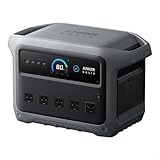
Anker SOLIX C1000 Gen 2 · Our score: 92/100
1,024 Wh · 2,000W output (3,000W surge) · switchover 10 ms (Anker) · 24.9 lb · LiFePO4
Current Price on Amazon: $529.99
The lowest-cost and lightest (24.9 lb) station on this page, with a 10 ms UPS that Anker lists for its AC outlets. Anker’s US page doesn’t state the waveform, but a reviewer at The Technology Man reports confirming pure sine output with an oscilloscope. Treat it as a bridge: about 7 hours for an Inogen At Home on setting 2 and about 2.3 hours at 350W on our estimate. That’s time to switch to a cylinder calmly, not a night of oxygen.
Best Expandable Starter (1 kWh)

EcoFlow Delta 3 Plus · Our score: 89/100
1,024 Wh · 1,800W output (3,600W surge) · switchover Under 10 ms (EcoFlow) · 27.6 lb · LiFePO4
Current Price on Amazon: $719.00
A 1 kWh unit with a fast published switchover: EcoFlow lists under 10 ms, StorageReview reports measuring just over 8 ms, and The DIY Life measured a little under 10 ms. The DIY Life describes its 1,800W inverter as pure sine wave. 1,024 Wh runs an Inogen At Home on setting 2 for about 7 hours on our estimate, but only about 2.3 hours at 350W. It accepts an extra battery to reach about 5 kWh, so you can start small and add capacity if your supplier agrees a power station fits your plan.
2 kWh With 10 ms Switchover
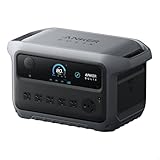
Anker SOLIX C2000 Gen 2 · Our score: 90/100
2,048 Wh · 2,400W output (4,000W surge) · switchover 10 ms (Anker) · 41.7 lb · LiFePO4
Current Price on Amazon: $1,499.00
Same 2 kWh class as the Bluetti with a faster published UPS figure: Anker’s spec page lists 10 ms. At 41.7 lb it is the lightest 2 kWh unit here, and it can add a BP2000 Gen 2 battery for about 4 kWh, which on our estimate would run a 350W concentrator for about 9 hours. One gap ranks it lower for this job: we could not confirm its waveform from Anker or from a review we could open, so ask Anker to confirm pure sine output before you rely on it.
Longest Runtime (Check Availability)

EcoFlow Delta Pro 3 · Our score: 95/100
4,096 Wh · 4,000W output (8,000W surge) · switchover 10 ms (EcoFlow) · 113.5 lb · LiFePO4
The only station here big enough to carry a 350W concentrator through a full night on our estimate: 4,096 Wh works out to about 9 hours at 350W and about 30 hours for an Inogen At Home on setting 2. EcoFlow’s manual describes a standby UPS with a 10 ms transfer time, and the 4,000W inverter leaves a wide margin for compressor start-up. It is the top-scored unit on this page, but it weighs 113.5 lb and sits at the top of the price range. Amazon listed it as currently unavailable when we checked on November 9, 2026, so check availability before planning around it.
Considering a gas inverter generator instead?
It is not an indoor option for an oxygen concentrator. Run it outdoors only, at least 20 feet from the house, choose a model with a CO shut-off feature, and keep battery CO alarms on each level and outside sleeping areas (CPSC). See our battery CO alarm picks. A generator works best here as a way to recharge one of the stations above, outside and away from the oxygen equipment.
Compare the five at a glance
| Model | Capacity | At 350W (our est.) | AC output | Switchover | Weight | Score | Price |
|---|---|---|---|---|---|---|---|
| Bluetti Elite 200 V2 | 2,073.6 Wh | ~4.7 h | 2,600W | 15 ms (Bluetti) | 53.4 lb | 91/100 | Check price at Amazon → |
| Anker SOLIX C1000 Gen 2 | 1,024 Wh | ~2.3 h | 2,000W | 10 ms (Anker) | 24.9 lb | 92/100 | $529.99 |
| EcoFlow Delta 3 Plus | 1,024 Wh | ~2.3 h | 1,800W | Under 10 ms (EcoFlow) | 27.6 lb | 89/100 | $719.00 |
| Anker SOLIX C2000 Gen 2 | 2,048 Wh | ~4.7 h | 2,400W | 10 ms (Anker) | 41.7 lb | 90/100 | $1,499.00 |
| EcoFlow Delta Pro 3 | 4,096 Wh | ~9.4 h | 4,000W | 10 ms (EcoFlow) | 113.5 lb | 95/100 | Check price at Amazon → |
Brands have historically discounted these lines around Black Friday. See what we’re tracking on the Black Friday deals hub. For larger whole-house systems, see our home battery backup guide and our best solar generators for power outages.
Who a power station suits
- Households that already have backup cylinders from their supplier and want time to switch over calmly, without the alarm going off at 2 a.m.
- Areas with frequent short outages, where hours of runtime cover most events
- Homes that want one battery for the concentrator plus lights, phones and the fridge, sized with the table above
Who should skip one, or wait
- Anyone who would rely on the battery instead of cylinders. Get the cylinders first.
- Anyone whose supplier or concentrator maker says not to run the unit from a power station
- Users of a 585W-class unit expecting a full night from a 1–2 kWh battery. On our estimate that takes about 5.9 kWh.
Recharging During a Long Outage
A concentrator running around the clock at 350W uses about 8.4 kWh a day, more than any station here holds. Recharging slows the drain, but in a long outage your cylinders and your plan to relocate matter more than the battery.
- Solar: the solar inputs in our database are 2,600W (DELTA Pro 3), 1,000W (Elite 200 V2 and Delta 3 Plus), 800W (C2000 Gen 2) and 600W (C1000 Gen 2). Winter sun is short. Use our solar size calculator to see what a panel array adds per day where you live.
- A generator: it has to run outdoors, well away from windows (CDC and CPSC both say at least 20 feet), and it can recharge the station while the station powers the concentrator indoors. Keep fuel and the generator well away from the oxygen equipment.
- Know your exit point. Decide in advance at what battery level or cylinder count you go to a place with power. Our winter storm power backup plan covers the rest of the house, and our best solar generator for CPAP picks cover lighter medical loads.
Generator for Oxygen Concentrator FAQ
Can a generator run an oxygen concentrator?
It can supply the watts a home concentrator draws (about 110–585W on the spec sheets we checked), but whether you should use one is a question for your oxygen supplier and the concentrator’s maker. The FDA’s power-outage booklet tells device users to ask whether the device can operate on another power source. Philips’ EverFlo manual says that if continued operation during mains interruptions is needed, it recommends powering the device from a UPS or a battery. Size any generator for the concentrator’s published watts plus everything else on it, with generous headroom: we could not find a start-up surge figure published by Philips, Inogen, Invacare or Drive DeVilbiss. A generator supplements backup oxygen cylinders from your supplier. It doesn’t replace them, and no generator can guarantee uninterrupted oxygen.
Can I use a generator indoors for an oxygen concentrator?
Only a battery power station. It burns no fuel, so it makes no carbon monoxide and can sit beside the concentrator. A gas, propane or dual-fuel generator, including an inverter model, must never run inside a home or garage, even with doors and windows open. The CDC says to use generators only outside, more than 20 feet from windows, doors and vents, and the CPSC says opening doors or windows won’t provide enough ventilation to prevent deadly CO levels. Keep a battery power station out from under bedding and away from heaters, and plug the concentrator straight into it.
What is the best backup generator for an oxygen concentrator?
For most homes, a battery power station with documented pure sine output, a fast UPS switchover and enough capacity for your concentrator’s watts. Our top pick is the Bluetti Elite 200 V2: 2,073.6 Wh, a pure sine inverter, and about 4.7 hours at 350W on our conservative estimate. The EcoFlow DELTA Pro 3 is the only unit here that covers a full night at 350W, but Amazon listed it as unavailable when we checked. Our scores rate the power station, not its suitability for your medical device, and none of these units is approved or certified for medical use. Ask your supplier before relying on one.
Is a portable gas generator safe to use with an oxygen concentrator?
Only outdoors, and only as part of a plan your supplier knows about. The CPSC says to operate portable generators outside only, at least 20 feet from the house, to look for models with a CO shut-off feature, and to install battery-operated or battery-backup CO alarms on each level and outside sleeping areas. A portable generator also has to be started and connected after the power fails, so the concentrator stops in the meantime. The concentrator manuals we read say not to use extension cords, which a generator 20 feet away would need. One option to discuss with your supplier is running the concentrator from a battery station indoors and using the generator outside only to recharge the station. Keep fuel and the generator well away from the oxygen equipment.
How long will a battery backup run an oxygen concentrator?
Our estimate is battery Wh × 0.80 ÷ the concentrator’s watts. That’s more conservative than the 0.85 factor we use for ordinary appliances, and it isn’t a maker figure. A 1 kWh station runs an Inogen At Home on setting 2 (about 110W) for roughly 7 hours, but a 350W Philips EverFlo for only about 2.3 hours. A 2 kWh station gives about 4.7 hours at 350W, and a 4 kWh station about 9 hours. A full 8-hour night at 350W needs about 3.5 kWh. Check the watts on your own unit’s label or manual and recalculate.
Do home oxygen concentrators have battery backup?
The stationary home units we checked do not. They run on wall power and alarm when it fails. Invacare’s Platinum 10 manual lists a “Battery Free Power Loss Alarm” and warns that the concentrator can fail to produce oxygen due to power failure, so you should always have a backup source of oxygen readily available. Philips’ EverFlo manual tells users to connect to a backup oxygen source if the device stops working. Portable concentrators are different: they are designed to run on their own batteries.
This page is general information about power equipment, not medical advice. Follow your prescriber, your oxygen supplier and your device’s manual.