
Winter Outage Guide · Updated November 2026
Battery Powered Heater: What Actually Keeps You Warm When the Power Is Out
The short answer
A battery powered heater can't heat a room for long: a typical 1,500W space heater empties a 2 kWh power station in about 1.1 hours. What works is a power station running a 50–100W heated blanket or mattress pad (a full night or more), short bursts of a heater on low, and, for room heat with no electricity at all, an indoor-rated propane heater used with ventilation and a CO alarm.
Below: the runtime math for every realistic heating load, the power stations we'd size for each strategy, the one non-electric heater we're comfortable listing (with the federal carbon-monoxide guidance that comes with it), and what works in a tent or a car.
As an Amazon Associate, SolarGenAdvisor earns from qualifying purchases made through links on this page, at no additional cost to you.
 By
Do They Make a Battery Powered Heater? Yes, and Here's the Catch
Electric heaters are resistive loads. Every watt goes straight into heat, which sounds efficient, but it means a heater draws its full rating for as long as it runs. A "1,500W" heater uses 1,500 watt-hours every hour on high. That is more energy than most portable batteries hold.
That's why the "rechargeable battery powered heaters" you see in shopping results fall into three groups, and none of them is a cordless room heater:
- Personal warmers and heated clothing. These run for hours because they use a few watts and heat only your body. Useful, but they don't warm a room.
- Propane heaters with a battery. Some tool-brand "cordless heaters" burn propane; the battery only runs the fan or igniter. The heat, and the carbon monoxide risk, come from the fuel.
- Small electric heaters with big claims. A heater that runs off a built-in battery for hours must be putting out very little heat. The math doesn't allow anything else, so we don't recommend unbranded units with unverifiable specs.
To put numbers on it: a typical 20V, 5Ah cordless-tool battery stores about 100 Wh. At 1,500W that lasts roughly 4 minutes. A 2,042 Wh power station is twenty times bigger and still only manages about an hour. The rest of this guide is about getting the most warmth out of whatever battery you have.
How Long Will a Power Station Run a Heater? The Math
Runtime = battery watt-hours × 0.85 ÷ load in watts. The 0.85 covers inverter and conversion losses; it's the same method our solar size calculator uses. Capacities and output limits below come from our product database:
| Load | EcoFlow River 3 Plus 286 Wh / 600W |
Anker SOLIX C1000 Gen 2 1,024 Wh / 2,000W |
Jackery Explorer 2000 Plus 2,042 Wh / 3,000W |
EcoFlow Delta Pro 3 4,096 Wh / 4,000W |
|---|---|---|---|---|
| Space heater on high (1,500W) | Exceeds output | ~35 min | ~1.2 h | ~2.3 h |
| Space heater on low (~750W) | Exceeds output | ~1.2 h | ~2.3 h | ~4.6 h |
| Heated over-blanket (~100W) | ~2.4 h | ~8.7 h | ~17 h | ~35 h |
| Heated mattress pad / throw (~60W) | ~4.1 h | ~15 h | ~29 h | ~58 h |
"Exceeds output" means the load is above the station's continuous AC rating. Heated blankets cycle on and off once warm, so real runtimes are often longer than shown. Check the wattage label on your own blanket or heater and redo the math.
Read the blanket rows again. The same 2 kWh station that gives you about an hour of space heater gives you a full day or more of heated-blanket warmth. Heat the person, not the room. That's the core of every strategy below, and it's why our space heater runtime guide rates a heater as the worst load you can put on a battery.
Blanket wattage varies. Heated mattress pads and throws commonly draw roughly 50–100W, while full/queen over-blankets on high can reach 100–200W (figures published by Renogy and Bluetti; your label is the final word).
Battery Powered Heater for Home: The Strategy That Works
If the goal is staying warm through a winter outage, rank your options by warmth per watt-hour:
Gas furnace blower first
If your home has a gas furnace, its burner makes the heat and electricity only runs the blower and controls, a few hundred watts for whole-house heat. That is the best heating load you can put on a battery. Wiring and sizing are covered in our power station for furnace guide.
Heated blankets and mattress pads, one per person
At 50–100W each, a 1 kWh station covers one person for a night and a 2 kWh station covers a couple with reserve. Pre-warm the bed, then drop to the lowest setting.
Shrink the space
Close off one small room, hang blankets over doorways, and cover windows. Every heating option on this page works better in 120 square feet than in 1,200.
Space heater on low, in short bursts
On a 2 kWh+ station, 30–60 minutes of a heater on low takes the chill off a bedroom before you switch to blankets. Never leave it running unattended or while sleeping (CPSC).
Indoor-rated propane for room heat with no battery
If you need real room heat for hours without electricity, an indoor-rated propane heater can do it, with strict ventilation and CO precautions (next section).
For the full outage plan (fridge, medical devices, pipes, and charging during a multi-day storm), see our winter storm power backup guide.
Battery Heat vs Propane vs 12V: Side by Side
Heat output converted to the same unit (1 watt = 3.412 BTU/h) so you can compare electric and propane directly:
| Option | Heat output | How long | Indoor use | Price |
|---|---|---|---|---|
| 2 kWh station + 1,500W heater | 1,500W (~5,100 BTU/h) | ~1.1–1.2 h on high | No fumes; standard heater fire precautions | Check price at Amazon → |
| 1 kWh station + heated blanket | ~60–100W, applied to your body | ~9–15 h | No fumes; safest overnight option | $529.99 |
| Mr. Heater Buddy (propane) | 4,000–9,000 BTU/h (~1,170–2,640W) | ~3 h high / ~6 h low per 1 lb cylinder (manufacturer) | Indoor-rated by maker; needs ventilation + CO alarm; not while sleeping | Check price at Amazon → |
| 12V plug-in car heater | Socket-limited, about 150W (~500 BTU/h) | Drains a car battery; engine needed | Spot defrosting only | Not recommended |
The propane row explains why off-grid cabins burn fuel for heat. The EIA puts propane at about 91,452 BTU per gallon. At roughly 4.2 lb per gallon, a 1 lb cylinder holds on the order of 21,000–22,000 BTU, about 6 kWh of heat. That is roughly three times what a 2 kWh battery stores, in a canister that weighs about a pound. The trade-off is combustion, which means carbon monoxide.
Best Power Stations for Battery-Powered Heating
Picked by runtime for each heating strategy and scored in our awards methodology from published specs, logged Amazon prices, and Amazon customer reviews:
Best for Heated-Blanket Nights
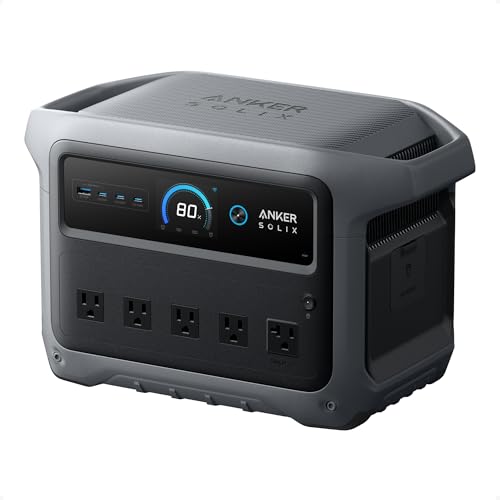
Anker SOLIX C1000 Gen 2 · Our score: 92/100
1,024 Wh · 2,000W output · 24.9 lb · LiFePO4
Current Price on Amazon: $529.99
The sweet spot for the strategy that actually works. Its 1,024 Wh runs a ~100W heated blanket for roughly 8–9 hours, or a ~60W mattress pad for about 14–15 hours — a full night of personal warmth. The 2,000W inverter will also run a 1,500W heater for about 35 minutes if you need to take the chill off a room before bed.
Best for Low-Setting Heater Bursts

Jackery Explorer 2000 Plus · Our score: 91/100
2,042 Wh · 3,000W output · 61.5 lb · LiFePO4
This is the "2 kWh station" in the math above: about 1.2 hours of a 1,500W heater, about 2.3 hours on low, or two people on heated blankets for a night with plenty left for the fridge. Expansion batteries are where it pulls ahead of fixed-capacity units if you want more heating headroom later.
Best If You Truly Need Electric Room Heat

EcoFlow Delta Pro 3 · Our score: 95/100
4,096 Wh · 4,000W output · 113.5 lb · LiFePO4
Current Price on Amazon: $2,799.00
The honest minimum for treating an electric heater as a real load. 4,096 Wh gives about 2.3 hours on high or 4.6 hours on low, and it can grow with extra batteries. Even here, a heated blanket stretches the same charge across days instead of hours.
Best for Tents and Cars (12V Blanket)

EcoFlow River 3 Plus · Our score: 86/100
286 Wh · 600W output · 10.4 lb · LiFePO4
Current Price on Amazon: $299.00
Do not plug a space heater into this one: its 600W inverter won't run a 750W or 1,500W heater. What it does well is power a 12V heated blanket from its car outlet (126W max, per EcoFlow's spec sheet) for about 4 hours at 60W, in a 10.4 lb package you can carry into a tent.
Compare the four at a glance
| Model | Capacity | AC Output | 100W Blanket | 750W Heater | Weight | Score | Price |
|---|---|---|---|---|---|---|---|
| Anker SOLIX C1000 Gen 2 | 1,024 Wh | 2,000W | ~8.7 h | ~1.2 h | 24.9 lb | 92/100 | $529.99 Check Price → |
| Jackery Explorer 2000 Plus | 2,042 Wh | 3,000W | ~17 h | ~2.3 h | 61.5 lb | 91/100 | Check price at Amazon → |
| EcoFlow Delta Pro 3 | 4,096 Wh | 4,000W | ~35 h | ~4.6 h | 113.5 lb | 95/100 | $2,799.00 Check Price → |
| EcoFlow River 3 Plus | 286 Wh | 600W | ~2.4 h | Exceeds output | 10.4 lb | 86/100 | $299.00 Check Price → |
Heating season starts right after the November sales. Brands have historically discounted these lines around Black Friday; see what we're tracking on the Black Friday deals hub.
Who should buy a power station for heat
- Households with a gas furnace that only need power for the blower
- Anyone planning to sleep under heated blankets through an outage
- Apartments and renters where fuel-burning heaters aren't allowed or wise
- Campers who want silent, fume-free warmth in a tent or van
Who should skip it
- Anyone expecting to run a 1,500W heater all night on a portable battery
- All-electric homes that need whole-house heat for days: that takes a whole-home system or a properly installed generator
- Buyers on a tight budget who only need personal warmth: a heated blanket and a smaller station cost far less
The Non-Electric Option: Mr. Heater Buddy (Propane)
If you need room heat for hours and don't have a big battery, a propane heater does what no battery can. We list one model, the Mr. Heater Portable Buddy (MH9BX), because it is designed and labeled for indoor use. Its manual calls it a "portable propane heater for recreational and emergency indoor use." It has an oxygen depletion sensor and a tip-over shutoff, and it lights with a built-in spark igniter, so it needs no electricity or batteries. Published figures: 4,000 or 9,000 BTU/h, rated for up to 225 sq ft, and about 3 hours on high or 6 hours on low from a 1 lb cylinder (sources: Mr. Heater's MH9BX owner's manual and published spec sheet as carried by retailers, the Amazon listing, and Bob Vila's review).
Non-Electric Backup Heat
Mr. Heater Buddy MH9BX + Flame King 1 lb Refill Kit
4,000 / 9,000 BTU/h · propane (1 lb cylinders) · ODS + tip-over shutoff · no electricity needed
The Amazon listing we link bundles the heater with a Flame King refill kit for refillable 1 lb cylinders. Refill only cylinders designed and certified to be refilled, and follow Flame King's instructions. This is a heater, not a power station, so it isn't scored on our power-station rating scale.
Carbon monoxide: read this before using any propane heater
"Indoor-safe" doesn't mean risk-free. The Buddy's own manual warns that it is an unvented gas-fired heater and that without adequate combustion and ventilation air it "may give off excessive carbon monoxide, an odorless, poisonous gas." The CDC's outage guidance goes further and tells people to never use propane-burning devices inside the home. If you do use an indoor-rated unit, these are the minimum precautions:
- Ventilate. Keep a window in the room open at least one inch, and keep doors open to the rest of the house (CPSC). Follow the fresh-air opening in your heater's manual.
- Install CO alarms. Use battery-operated or battery-backup CO alarms on each level and outside sleeping areas, test them monthly, and if one sounds, get outside and call 911 (CPSC, Dec 2025). An oxygen depletion sensor is not a CO alarm.
- Never while sleeping. CPSC says never leave a space heater on when you go to sleep. Run it while you're awake and watching it, then turn it off.
- Keep 3 feet of clearance from beds, curtains, and furniture, on a stable, level surface (CPSC).
- Only indoor-rated heaters. Never heat with a gas oven, grill, camp stove, or a gas generator (CDC). Generators belong outside, at least 20 feet from the house.
- Check local rules. CPSC advises not using unvented gas space heaters where local codes prohibit them. Mr. Heater notes the heater may shut off above 7,000 ft.
If any of that is impractical where you live, a battery and heated blankets are the safer path. A power station makes no fumes and is the one backup source that's safe in any room. See can you use a solar generator indoors and our indoor-safe generator guide.
Cordless Heated Blanket: How Long Will It Run on a Battery?
A cordless heated blanket is the same heating element as a plug-in blanket, powered by a battery instead of the wall: either a pack that ships with the blanket or a power station you already own. The runtime math is identical either way — battery Wh × 0.85 ÷ blanket watts — so the battery size decides everything. Throws and mattress pads commonly draw about 50–100W, and full/queen over-blankets on high about 100–200W (Renogy and Bluetti figures cited above).
| Blanket draw | 100 Wh battery pack | EcoFlow River 3 Plus (286 Wh) | Anker SOLIX C1000 Gen 2 (1,024 Wh) | Jackery Explorer 2000 Plus (2,042 Wh) |
|---|---|---|---|---|
| 50W | ~1.7 h | ~4.9 h | ~17 h | ~35 h |
| 100W | ~51 min | ~2.4 h | ~8.7 h | ~17 h |
| 150W | ~34 min | ~1.6 h | ~5.8 h | ~12 h |
| 200W | ~26 min | ~1.2 h | ~4.4 h | ~8.7 h |
Continuous-draw estimates: Wh × 0.85 ÷ watts. The 100 Wh column is an illustrative pack size, not a specific product — check the watt-hour rating printed on any blanket battery. Blankets cycle once warm, so real runtimes are often longer.
What the table says: a small pack that ships with a cordless blanket is a couple of hours of warmth on low — good for a stadium seat or a cold commute, not a night. For overnight warmth in an outage, a tent or a car, plug a 12V or 120V heated blanket into a power station: a 1 kWh station covers a 100W blanket for about 8–9 hours, and a 2 kWh station covers a couple. We don’t rate heated blankets, so we make no blanket picks here; choose one with auto shutoff and follow the maker’s instructions.
Battery Powered Heater for Camping and Tents
In a tent, the math gets easier because you only need to warm one person in a sleeping bag. A 12V heated blanket or heated sleeping pad, plugged into a small power station's car outlet, skips the inverter and delivers warmth directly. Using the table above, a River 3 Plus runs a 60W blanket for about 4 hours, and a 1 kWh station covers a whole night.
- Warm the bag before bed, then switch to low or off. A sleeping bag rated for the night's low temperature does most of the work.
- Skip space heaters in tents. They tip, they're close to fabric, and they flatten a camping battery in minutes.
- Propane in a tent: if you use an indoor-rated heater to warm up while awake, ventilate and turn it off before sleeping. The CPSC sleep rule applies with extra force in a small enclosed space.
Recharging in the cold: most LiFePO4 batteries block charging below 32°F (0°C); Renogy and Power Queen both list charging ranges that start there (Renogy, Power Queen). Warm a power station inside the car or tent before solar-charging it, and if you run a 12V camper battery, a self-heating LiFePO4 battery can accept a charge in freezing weather.
Station picks for tents and campsites are in our best solar generators for camping guide. If you're comparing against a small gas generator for camp power, read our quietest generator for camping breakdown first.
Battery Powered Heater for Car: Why 12V Heaters Disappoint
Plug-in car heaters are limited by the accessory socket. Those circuits are commonly fused around 15A, which is about 180W at 12V before any safety margin, and many plug-in heaters are rated around 150W. That's about a tenth of a household space heater, enough to clear a patch of windshield but not to warm a cabin. Check your vehicle manual for your socket's rating.
A 12V heated blanket of around 50–60W puts the same socket's power where it counts. For overnight car camping, run it from a portable power station instead of the car battery, so you can still start the engine in the morning.
Never run a car in an attached garage for heat, even with the door open. The CDC warns against it. If you're stranded and running the engine, keep the exhaust pipe clear of snow, which can block it and push carbon monoxide into the cabin (Mass.gov winter driving guidance).
Power Station Heat vs Propane Heat: Pros and Cons
Power station + heated blanket
- Pro: no fumes, no CO, safe in any room or tent
- Pro: also runs the fridge, phones, CPAP, and furnace blower
- Pro: recharges from the wall, a car, or solar
- Con: warms people, not rooms
- Con: room heat drains even large batteries in hours
Indoor-rated propane heater
- Pro: real room heat for hours, no electricity
- Pro: a 1 lb cylinder stores more energy than a 2 kWh battery
- Con: produces combustion gases, so it needs ventilation and a CO alarm
- Con: not for use while sleeping; restricted by some local codes
- Con: you have to store and handle fuel
Many households end up with both: a power station for blankets, the fridge, and the furnace fan, plus an indoor-rated propane heater for supervised daytime warmth. To size the battery for your own loads, start with what size solar generator do I need.
Battery Powered Heater FAQ
Do they make a battery powered heater?
Yes, but not one that heats a room for long on its own battery. A 1,500W heater would empty a typical 100 Wh cordless-tool battery in about 4 minutes. What exists in practice: small personal warmers and heated clothing that run for hours at a few watts, propane heaters whose battery only runs a fan or igniter, and space heaters plugged into a portable power station, where runtime depends on the station's capacity.
How long will a power station run a space heater?
Multiply the station's watt-hours by about 0.85 and divide by the heater's draw. A 1,500W heater on a 2,000 Wh station lasts about 1.1 hours; on its ~750W low setting, about 2.3 hours. A 1,000 Wh station gives roughly 35 minutes on high. Our space heater runtime guide breaks this down by battery size.
What is the best battery powered heater for a power outage?
For most homes it is not a heater at all: a 1–2 kWh power station running a 50–100W heated blanket or mattress pad keeps a person warm all night, and powering a gas furnace's blower fan heats the whole house for a few hundred watts. If you need room heat without electricity, an indoor-rated propane heater used with ventilation and a CO alarm is the alternative.
Is a battery powered heater safe in a tent?
An electric heated blanket or pad powered by a small power station is the safest way to add warmth in a tent, because nothing burns. Fuel-burning heaters are different: CPSC advises never leaving a space heater on while you sleep, and an unvented propane heater needs fresh-air ventilation. Warm the tent while awake, then switch it off before sleeping.
Can I use a battery powered heater in my car?
A 12V plug-in car heater is limited by the accessory socket, which is commonly fused around 15A, about 180W at 12V, so it can only warm a small area or defrost a patch of glass. A 12V heated blanket of around 50–60W is a more effective use of the same power. Never run a vehicle in an attached garage for heat, even with the door open (CDC).
Is the Mr. Heater Buddy safe to use indoors?
Mr. Heater sells the Buddy as a portable propane heater for recreational and emergency indoor use, with an oxygen depletion sensor and tip-over shutoff. Its manual still warns it is an unvented heater that can give off excessive carbon monoxide without adequate ventilation. Follow CPSC guidance: keep a window open at least an inch, run a battery-backed CO alarm, and never leave it on while sleeping.
How long does a cordless heated blanket last on a battery?
Divide the battery’s watt-hours by the blanket’s draw after about 15% conversion loss: runtime is roughly Wh x 0.85 / watts. A 100 Wh battery pack runs a 50W blanket for about 1.7 hours, while a 1,024 Wh power station runs the same blanket for about 17 hours and a 200W queen over-blanket on high for about 4.4 hours. Blankets cycle on and off once warm, so real runtimes are often longer; check the wattage on your blanket’s label.
How do you heat a house without power?
In order of efficiency: if you have a gas furnace, power its blower and controls from a power station; gather everyone into one small room; use heated blankets per person; and run short electric heater bursts only from a 2 kWh+ station. An indoor-rated propane heater can supplement while you are awake with ventilation and a CO alarm. Never heat with a gas oven, grill, or camp stove (CDC).