
Buying Guide · Updated November 2026
Best Inverter Generator 2026: 5 Gas & Dual Fuel Picks, and When a Power Station Fits Better
Short answer
The best inverter generator for most home-backup buyers is the Westinghouse iGen5000DFc. It is a dual fuel unit rated at 3,900 running watts, with a CO sensor that shuts it down automatically and up to 18 hours of runtime at 25% load. For camping and tailgating, the 43 lb Champion 2500 Dual Fuel with CO Shield is the easiest to carry. Every gas inverter has to run outdoors, at least 20 feet from the house (CPSC). If you need power indoors or silently, a battery power station is the better tool. We compare both below.
As an Amazon Associate, SolarGenAdvisor earns from qualifying purchases made through links on this page, at no additional cost to you. Ratings are AI-synthesized from manufacturer specs, published figures and logged Amazon prices; we did not test these generators.
 By
Carbon monoxide: read this before you buy
Every generator on this page burns fuel and makes carbon monoxide, which you cannot see or smell. CPSC says nearly 100 Americans die each year from generator-related CO poisoning (CPSC). Its guidance, which CDC echoes (CDC generator safety; CDC CO prevention):
- Never run a portable generator inside a home, garage, basement, crawlspace, shed or other enclosed space. Opening doors or windows does not make it safe.
- Run it outdoors only, at least 20 feet from the house, and point the exhaust away from doors, windows and vents.
- Install battery-operated or battery-backup CO alarms on every level. CPSC says interconnected alarms are best, so test them monthly.
- CPSC recommends choosing a generator with a CO shut-off safety feature. Four of our five picks list one. Champion notes that its CO Shield "is not a substitute for an indoor carbon monoxide alarm" (Champion).
Need power inside the house, a tent or a camper? A battery power station produces no exhaust. See our indoor-safe generator guide.
Inverter Generator Comparison: Specs Side by Side
All figures are manufacturer-published or from the Amazon listing, on gasoline unless noted. Makers measure noise and runtime at different loads and distances, so read the notes before comparing. Prices are live from Amazon.
| Generator | Running / starting W | Fuel | Runtime per tank | Noise | Weight | Parallel | CO shutoff | Price |
|---|---|---|---|---|---|---|---|---|
| Westinghouse iGen5000DFc Dual Fuel Inverter Generator (73/100) | 3,900 / 5,000 LP: 3,500 running |
Gas + propane | 18 hr at 25% load | 52 dBA | ~106 lb* | Yes (kit/cable extra) | CO sensor with automatic shutdown | $999.00 Check Price → |
| Champion 2500-Watt Dual Fuel Inverter Generator with CO Shield (66/100) | 1,850 / 2,500 LP: 1,665 running |
Gas + propane | 11.5 hr at 25% load | 53 dBA | 43.2 lb | Yes (kit/cable extra) | CO Shield automatic shutoff | $575.00 Check Price → |
| Champion 4500-Watt Electric Start Dual Fuel Inverter Generator (65/100) | 3,500 / 4,500 LP: 3,150 running |
Gas + propane | 14 hr at 25% load | 61 dBA | 99.2 lb | Yes (kit/cable extra) | CO Shield automatic shutoff | $984.82 Check Price → |
| Honda EU2200i Inverter Generator (57/100) | 1,800 / 2,200 | Gasoline | 8.1 hr at 25% load | 53 dBA | 46.5 lb | Yes (kit/cable extra) | CO-MINDER automatic shutdown | $1,199.00 Check Price → |
| WEN 56380i 3800-Watt Inverter Generator (55/100) | 3,400 / 3,800 | Gasoline | 8.5 hr at 50% load | 57 dBA | 99.2 lb | Not listed | None listed (fuel shutoff only) | $699.99 Check Price → |
Noise conditions: Champion measures at 23 ft. Honda's 53 dB and WEN's 57 dBA are at 1/4 load, and neither states a distance. Westinghouse's 52 dBA is an "as low as" figure. The WEN runtime is at half load, because WEN does not publish a 25% figure. *Westinghouse's weight is not on the spec pages we could load. A retailer lists 105.8 lb for the closely related iGen5000DFcv, and Westinghouse lists 111 lb dry for the EFI version, so check the listing. Sources: Champion 201323, Champion 201319, Westinghouse spec via Norwall, Honda EU2200i specifications, WEN 56380i spec summary, plus each product's Amazon listing.
The 5 Best Inverter Generators for 2026
Each pick is scored with the gas-generator rubric explained below. That rubric is separate from our power-station matrix, so don't compare a generator's score with a battery station's.
#1 · Best for Home Backup · 73/100

Westinghouse iGen5000DFc Dual Fuel Inverter Generator
3,900W running / 5,000W starting · Dual fuel · 52 dBA · about 106 lb
Current price on Amazon: $999.00
The most running watts in this group (3,900W on gasoline, 3,500W on propane) and the longest published runtime: up to 18 hours at 25% load on its 3.4-gallon tank, or about 22 hours on a standard propane tank. It has a CO sensor with automatic shutdown, a TT-30R RV outlet, remote key-fob start, and Westinghouse says its optional parallel kit adds a 240V outlet for a transfer switch or interlock. The trade-offs: it weighs over 100 lb, and Westinghouse marks it not for sale in California.
- 3,900 running / 5,000 peak watts on gas
- Dual fuel with CO sensor shutdown
- 18 hr at 25% load (published)
- Parallel kit adds 240V (sold separately)
- About 106 lb by retailer figures
- Not sold in California
- Costs more than the WEN
Specs: Norwall spec page, Amazon listing.
#2 · Best Lightweight Dual Fuel · 66/100

Champion 2500-Watt Dual Fuel Inverter Generator with CO Shield
1,850W running / 2,500W starting · Dual fuel · 53 dBA · 43.2 lb
Current price on Amazon: $575.00
At 43.2 lb, this is the one you can lift into a truck bed. Champion rates it at 2,500 starting and 1,850 running watts on gasoline (1,665W on propane), 53 dBA at 23 feet, and up to 11.5 hours on gas or 25 hours on a 20-lb propane tank at 25% load. CO Shield shuts the engine off if CO builds up, and an optional kit pairs it with a second Champion inverter. One 15.4A duplex outlet is the limit: this runs essentials, not a house.
- 43.2 lb, easiest to carry
- Gas or propane out of the box
- CO Shield automatic shutoff
- Parallel-ready (kit sold separately)
- 1,850 running watts covers essentials only
- One duplex outlet, no RV 30A outlet
Specs: Champion 201323 page, Norwall, Amazon listing.
#3 · Best Dual Fuel for RVs · 65/100

Champion 4500-Watt Electric Start Dual Fuel Inverter Generator
3,500W running / 4,500W starting · Dual fuel · 61 dBA · 99.2 lb
Current price on Amazon: $984.82
Electric start, a TT-30R RV outlet and 3,500 running watts on gasoline (3,150W on propane), with CO Shield shutoff and Champion's 50A ParaLINK parallel kit as an option. Champion publishes 14 hours on gas and 21 hours on a 20-lb propane tank at 1/4 load. It is the loudest pick here at a published 61 dBA from 23 feet, and at 99.2 lb it is a wheel-it-around unit.
- Electric start + TT-30R RV outlet
- Dual fuel with CO Shield
- 21 hr on a 20-lb propane tank (1/4 load)
- 61 dBA published, loudest here
- 99.2 lb
Specs: Champion 201319 page, Amazon listing.
#4 · Premium Compact Pick · 57/100

Honda EU2200i Inverter Generator
1,800W running / 2,200W starting · Gasoline · 53 dBA · 46.5 lb
Current price on Amazon: $1,199.00
Honda rates the EU2200i at 2,200W max and 1,800W rated, 46.5 lb dry, 53 dB at 1/4 load (62 dB at rated load) and 8.1 hours at 1/4 load on 0.95 gallons. The Amazon listing adds CO-MINDER automatic shutdown and Bluetooth app control, and Honda says a Companion version paired with a regular EU2200i delivers up to 4,400W. It costs more than twice as much per running watt as the Champion 2500, runs on gasoline only, and the listing says it is not available in California.
- 46.5 lb, compact
- CO-MINDER shutdown + Bluetooth app
- Parallels with the EU2200i Companion (up to 4,400W)
- Highest price per running watt here
- Gasoline only
- Not available in California (listing)
Specs: Honda technical specifications, Honda EU2200i Companion page, Amazon listing.
#5 · Best Value per Watt (Gas Only) · 55/100
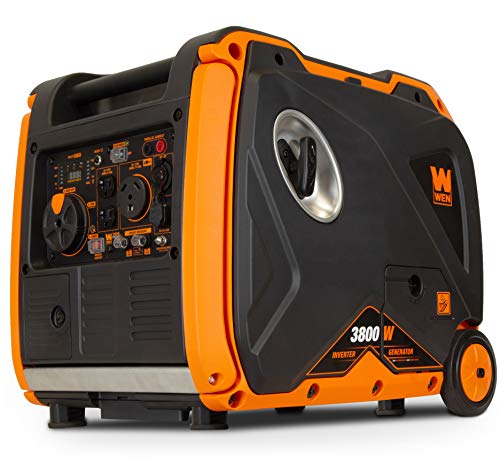
WEN 56380i 3800-Watt Inverter Generator
3,400W running / 3,800W starting · Gasoline · 57 dBA · 99.2 lb
Current price on Amazon: $699.99
The lowest price per running watt in this group: 3,400 running and 3,800 surge watts with electric start, a TT-30R RV outlet, two 120V outlets and USB. WEN lists 8.5 hours at half load and 57 dBA at 1/4 load. What it lacks matters, though. The Amazon listing names no CO shutoff sensor (only a fuel shutoff that runs the carburetor dry), no propane option and no parallel capability, so it scores lowest on safety in our rubric.
- Lowest cost per running watt here
- Electric start, TT-30R RV outlet
- EPA III compliant (listing)
- No CO shutoff sensor listed
- Gasoline only
- Only a half-load runtime is published
Specs: spec summary citing wenproducts.com, Amazon listing.
Inverter Generator vs Conventional Generator: What's the Difference?
A conventional (open-frame) generator spins its engine at a fixed speed to hold 60 Hz, whatever the load. An inverter generator lets the engine speed up and slow down with demand. It turns the raw output into DC, then back into a clean 120V AC sine wave through an electronic inverter. Three practical differences follow:
- Cleaner power. Champion and Westinghouse list less than 3% total harmonic distortion on the Amazon listings for the Champion 2500 and the Westinghouse iGen5000DFc. That is clean enough for laptops, phones and TVs.
- Quieter and thriftier at light load. The engine idles down when you're only running a fridge. Westinghouse claims its inverter design cuts fuel use by up to half compared with traditional generators. That figure comes from the manufacturer, so treat it as an upper bound.
- Fewer watts per dollar. Open-frame generators deliver far more running watts for the money. If you need 7,000W or more for central air or a 240V well pump and noise doesn't matter, a conventional unit (or two inverters in parallel) is the usual route. Our best propane generator guide compares 9,500–10,500W dual and tri fuel models for that job.
A battery power station is a third option. It produces the same kind of clean inverter output with no engine at all, which is why the noise and indoor-use rules below don't apply to it.
What Size Inverter Generator Do You Need? Running vs Starting Watts
Every generator lists two numbers. Running (rated) watts is what it can supply continuously. Starting (surge or peak) watts is the brief extra it can deliver for a second or two while a motor or compressor spins up. To size one:
- Add up the running watts of everything you want on at the same time. Use each appliance's nameplate or manual, not a guess.
- Find the single largest starting surge, usually a fridge, freezer, sump pump or AC compressor, and add only that one on top. Motors rarely start at the same moment.
- Keep the running total under about 80% of the generator's running watts, so it isn't working flat out for hours. If you plan on propane, use the propane rating, which is roughly 10% lower on our dual fuel picks.
| Size class | Typical job | Our picks |
|---|---|---|
| 1,800–2,000W running | Camping, tailgating, a fridge plus lights and chargers in an outage, a CPAP outdoors on a long cord | Champion 2500 Dual Fuel, Honda EU2200i |
| 3,400–3,900W running | Home essentials (fridge, freezer, furnace blower, lights, router), RVs with a TT-30 hookup | Westinghouse iGen5000DFc, Champion 4500, WEN 56380i |
| 240V or 7,000W+ | Well pump, central air, electric range | Two inverters in parallel, or a conventional generator, connected by an electrician |
Need typical wattages for common appliances? Our appliance wattage chart and generator wattage calculator lists running and starting draws, and our what can a generator run guide turns them into runtimes. The math is the same whether the power comes from gasoline or a battery.
Dual Fuel Inverter Generators: Is Propane Worth It?
A dual fuel inverter generator runs on gasoline or on propane from a standard 20-lb tank (the kind sold for grills). For outage prep that is a real advantage: tanks are easy to buy, store and swap, and you aren't lining up for gasoline after a storm. The cost is power. Every dual fuel pick here loses about 10% of its running watts on propane:
| Dual fuel model | Running W (gas) | Running W (propane) | Runtime on gas | Runtime on 20-lb propane |
|---|---|---|---|---|
| Westinghouse iGen5000DFc | 3,900 | 3,500 | 18 hr at 25% (3.4 gal) | About 22 hr ("standard propane tank") |
| Champion 4500 Dual Fuel | 3,500 | 3,150 | 14 hr at 1/4 load | 21 hr at 1/4 load |
| Champion 2500 Dual Fuel CO Shield | 1,850 | 1,665 | 11.5 hr at 25% (1.05 gal) | 25 hr at 25% |
Sources: Westinghouse spec via Norwall, Champion 201319, Champion 201323, Amazon listings. The WEN 56380i and Honda EU2200i run on gasoline only.
Our take: for home backup, dual fuel is worth the small premium. For camping, where you're mostly running light loads for a weekend, a gasoline-only model is fine if you'd rather save the money.
Quiet Inverter Generators: How Loud Are They Really?
"Super quiet" on a generator box means a steady engine hum, not silence. The published figures for our picks run from 52 to 61 dBA, but makers measure differently. Champion measures at 23 feet, Honda and WEN publish 1/4-load numbers without a stated distance, and Westinghouse gives an "as low as" figure. Every one of them gets louder as you add load. Honda, for example, lists 53 dB at 1/4 load and 62 dB at rated load (Honda). Because decibels are logarithmic, a 10 dB rise sounds roughly twice as loud.
Two practical rules follow. Campgrounds often set generator hours and noise limits, so check before you go. And neighbors will hear any gas generator running overnight at 20 feet from your house. If quiet hours matter, see our quietest generator for camping guide, which compares published decibel figures with battery stations whose only sound is a cooling fan.
Parallel Kits: Two Small Inverters Instead of One Big One
Parallel-capable inverters link with a second matching unit through a kit or cable, combining their output. You carry two manageable units instead of one heavy one, and you can run just one when the load is light. What each maker states:
- Champion 2500 Dual Fuel: connects to another parallel-ready Champion inverter or power station with an optional kit, model 100740 (Champion).
- Champion 4500 Dual Fuel: pairs through Champion's optional 50A ParaLINK kit, model 100319 (Champion).
- Westinghouse iGen5000DFc: pairs with a second iGen5000DFc through Westinghouse's parallel kit. The Amazon listing says that kit includes a 240V outlet, making the pair "interlock kit or transfer switch ready."
- Honda EU2200i: Honda says the EU2200i Companion version connects with a regular EU2200i for up to 4,400W, using its 30A receptacle and a simple parallel cord (Honda).
- WEN 56380i: the Amazon listing does not mention parallel capability, so we don't claim it.
Connecting an Inverter Generator to Your House: Transfer Switch or Interlock
You can always run appliances on extension cords plugged straight into the generator. Feeding your home's circuits is a different job. It needs a transfer switch, or a power inlet box with an interlock kit on your panel, installed by a licensed electrician under a permit. Never plug a generator into a wall outlet ("backfeeding"). Utilities and state fire officials warn that backfeeding can push power out onto the utility lines and endanger line workers, as well as risk fire in your home (Lake Country Power; Minnesota State Fire Marshal).
Most inverters in the 2,000–4,000W class put out 120V only. That is fine for a transfer switch feeding 120V circuits, but it won't run 240V loads like a well pump. Our transfer switch and interlock kit guide explains 120V vs 240V setups, the NEC rules an electrician will follow, and which kits fit portable generators and power stations alike. A generator interlock kit with an inlet box is the other route; kits are specific to your panel brand, and our guide covers what each documents. We don't publish wiring steps.
Gas vs Solar: Which Fits You?
We mostly cover battery power stations ("solar generators"), so here is the comparison as evenly as we can make it. Neither one wins outright. They solve different problems, and many households end up owning one of each. The full breakdown, including 5-year running costs, is in solar generator vs gas generator.
A gas inverter generator wins when…
- Outages last days. Refueling takes minutes. By our math from Westinghouse's figures, one 3.4-gallon tank at 25% load delivers about 17,500 Wh (3,900W × 25% × 18 hr), more than four times what a 4 kWh battery holds.
- You need lots of watts for the money. A 3,900W gas inverter costs a fraction of a 4,000W battery station.
- There's little sun. In winter storms solar recharging is slow, while a propane tank works in any weather.
- You're comfortable storing fuel, changing oil and running it outdoors, 20 feet from the house.
A battery power station wins when…
- You need power indoors. No exhaust means it can sit beside a CPAP, a fridge or a desk. A gas generator never can.
- Quiet matters. Apartment balconies, HOAs, campground quiet hours and overnight use.
- Outages are short. By our math, a 2 kWh station runs an average fridge for about 12 hours, and many stations switch over automatically when the grid drops.
- You want no fuel, oil changes or pull-starts, and the option to recharge from solar panels.
How Long a Battery Station Runs the Same Loads
Runtime = watt-hours × 0.85 ÷ load in watts. The 0.85 is our assumption for inverter losses. Compare these with the gas runtimes in the table above: a battery wins on convenience, and gas wins on endurance.
| Load | Anker SOLIX C1000 Gen 2 (1,024 Wh) | Bluetti Elite 200 V2 (2,074 Wh) | EcoFlow Delta Pro 3 (4,096 Wh) |
|---|---|---|---|
| Fridge (average draw) (~150W) | 5.8 hr | 11.8 hr | 23.2 hr |
| Essentials: fridge, lights, router, furnace blower (~500W) | 1.7 hr | 3.5 hr | 7.0 hr |
| Microwave or 1,500W space heater (~1,500W) | 35 min | 1.2 hr | 2.3 hr |
Battery Power Stations Rated on Our Site
Price is the honest catch. At $2,799.00 on Amazon, the EcoFlow Delta Pro 3 matches the Westinghouse's output class but costs far more, and it stores about one day of essentials rather than burning fuel indefinitely. Smaller stations cost less than a mid-size gas inverter and cover the "keep the fridge and Wi-Fi on overnight" job silently and indoors. These scores use our 6-dimension power-station matrix:
Indoor-safe essentials · 92/100 (power-station score)

1,024 Wh · 2,000W (3,000W peak) · 24.9 lb
Current price on Amazon: $529.99
1,024 Wh and 2,000W (3,000W peak) in a 24.9 lb LiFePO4 box. It covers a fridge, router, lights and a CPAP through a short outage, indoors, with no fuel or exhaust.
Closest to a 2,500W gas inverter · 91/100 (power-station score)

2,074 Wh · 2,600W (3,900W peak) · 48.5 lb
Current price on Amazon: $899.00
2,073.6 Wh and 2,600W continuous. Its running output tops the Champion 2500 and the Honda EU2200i, and it weighs 48.5 lb. It runs a fridge for most of a day on one charge and recharges from solar.
Matches a 4,000W gas inverter · 95/100 (power-station score)

4,096 Wh · 4,000W (8,000W peak) · 113.5 lb
Current price on Amazon: $2,799.00
4,096 Wh and 4,000W continuous with 120/240V output per the Amazon listing, which is in the Westinghouse's output class. It costs far more up front and holds about one day of essentials, but it can sit inside and expands with extra batteries.
More battery options for outages are in our best solar generators for home backup guide.
Who Should Buy an Inverter Generator, and Who Should Skip It
Buy one if…
- Your area sees multi-day outages and you can safely store propane or gasoline.
- You have a yard or driveway where it can run 20+ feet from the house.
- You run an RV air conditioner or power tools for long stretches away from hookups.
- You want the most running watts per dollar.
Skip it if…
- You live in an apartment or condo with no safe outdoor spot 20 feet from openings.
- You need overnight power for a CPAP or medical device beside the bed.
- Your outages are usually a few hours, which a battery station covers with no fuel.
- You don't want to maintain an engine: oil changes, fuel storage, periodic test runs.
How We Score Inverter Generators
Our 6-dimension power-station matrix measures battery capacity and solar charging, so it doesn't fit gas generators. We use a separate gas-generator rubric, and it is the same one, with the same scales, that we use for the open-frame units in our best propane generator guide, so all 10 gas generators we rate can be compared directly. Value is measured against the lowest price per running watt across all 10, which is why compact inverters score lower on value than big open-frame units. Scores are AI-synthesized from manufacturer specifications, published figures and logged Amazon prices. We did not test or measure these generators, and Amazon star ratings are not an input. A spec the maker doesn’t publish earns no credit. Prices move, so the Value scores reflect Amazon prices logged on November 1, 2026.
| Dimension | Weight | Westinghouse | Champion 2500 | Champion 4500 | Honda EU2200i | WEN 56380i |
|---|---|---|---|---|---|---|
| Running & starting output Gasoline running watts on one scale for every gas generator we rate: 1,800W = 55, 3,900W = 88, 10,500W = 95, straight-line in between |
20% | 88 | 55.8 | 81.7 | 55 | 80.1 |
| Value (price per running watt) 90 × the lowest Amazon price per running watt among all 10 gas generators we rate (Westinghouse WGen9500DF) ÷ this one’s (prices checked Nov 1, 2026) |
20% | 36.9 | 30.5 | 33.6 | 14.2 | 46 |
| Runtime & fuel flexibility 60% published gasoline runtime at 25% load (90 × hours ÷ 18, the longest we found; if the maker publishes only a 50%-load figure, that figure is used), 40% fuel options (tri fuel 90, dual fuel 80, gas only 40) |
20% | 86 | 66.5 | 74 | 40.3 | 41.5 |
| CO safety features Automatic CO shutoff stated by the maker or Amazon listing = 90; none listed = 40 |
15% | 90 | 90 | 90 | 90 | 40 |
| Noise (published dBA) 90 minus 2.5 points per dBA above 52, using the lowest figure the maker publishes; no published figure = 0 |
15% | 90 | 87.5 | 67.5 | 87.5 | 77.5 |
| Portability 90 × the lightest generator we rate (43.2 lb) ÷ this one’s weight |
10% | 36.7 | 90 | 39.2 | 83.6 | 39.2 |
| Weighted score | 100% | 73/100 | 66/100 | 65/100 | 57/100 | 55/100 |
Why the WEN scores lowest despite the best price per running watt here: its listing names no CO shutoff, it runs on gasoline only, and WEN publishes only a half-load runtime, so it earns little runtime credit. The Honda EU2200i loses most of its points on value. At the logged price it costs more than twice as much per running watt as the Champion 2500, and it also runs on gasoline only.
Inverter Generator FAQ
What is an inverter generator?
An inverter generator is a gas or propane generator that converts its engine's raw AC output to DC and then back to a steady 120V AC through an electronic inverter. The engine can then speed up and slow down with the load instead of running flat out. Champion and Westinghouse publish less than 3% total harmonic distortion for the models on this page, which is clean enough for laptops and phones, and inverter models are typically quieter and lighter than open-frame generators of the same output.
Is an inverter generator better than a regular generator?
For camping, RVs, electronics and light home backup, usually yes: inverters are quieter, lighter and more fuel-efficient at light loads, and they produce cleaner power. A conventional open-frame generator gives you more watts per dollar, so it can make more sense if you need 7,000W or more for a well pump or central air and noise is not a concern.
What size inverter generator do I need for my house?
Add up the running watts of everything you want on at once, then make sure the generator's starting (surge) watts cover the largest motor starting on top of that. For a fridge, lights, a router and a furnace blower, a 3,500 to 4,000 running-watt unit like the Westinghouse iGen5000DFc or Champion 4500 is a common fit. Running central air or a 240V well pump usually needs two units in parallel or a larger conventional generator, wired through a transfer switch by an electrician.
Is a dual fuel inverter generator worth it?
For home backup, usually yes. Propane stores in a sealed tank and is easy to swap, so you aren't hunting for gasoline after a storm. The trade-off is roughly 10% less running power on propane: Champion rates its 4500 at 3,500W on gas and 3,150W on propane, and Westinghouse rates the iGen5000DFc at 3,900W and 3,500W. Runtime on a 20-lb tank is published at 21 to 25 hours at light load for the dual fuel picks here.
Can I run an inverter generator in my garage?
No. CPSC says never to operate a portable generator inside a home, garage, basement, crawlspace, shed or other enclosed space, even with doors open. Run it outdoors only, at least 20 feet from the house, with the exhaust pointed away from doors, windows and vents, and keep battery-backed CO alarms on every level. A CO shutoff sensor is a backup, not a substitute; Champion says its CO Shield is not a substitute for an indoor CO alarm.
How far from the house should an inverter generator be?
At least 20 feet, according to both CPSC and CDC, with the exhaust directed away from your home and any doors, windows or vents. That means you need a heavy-duty outdoor extension cord long enough to reach, or an inlet box installed by an electrician.
Honda EU2200i vs Champion 2500: which is better?
On paper they are close. Champion rates its 2500 Dual Fuel at 1,850 running watts, 53 dBA at 23 feet and 43.2 lb, and it runs on gas or propane. Honda rates the EU2200i at 1,800 running watts, 53 dB at 1/4 load and 46.5 lb, gasoline only. Both have automatic CO shutoff and parallel capability. The Champion costs much less, which is why it scores higher in our rubric; the Honda adds Bluetooth app control.
Inverter generator vs portable power station: which should I buy?
Choose an inverter generator if you need many hours of high power and can store fuel and run it outdoors. Choose a battery power station if you need power indoors, silently, for a CPAP, fridge and router through outages of a day or less, or want solar recharging. Many households keep both: the generator recharges the battery during the day, and the battery runs quietly at night. See our solar generator vs gas generator comparison.
Long outages and a safe outdoor spot? Get a dual fuel inverter. Need power indoors or silently? Get a battery station.
Check live prices on both paths, or read the full gas vs solar comparison first.