
Buying Guide · Updated November 2026
Best Generator Tent 2026: 5 Running Covers for Rain and Snow
For most inverter generators, the best generator tent is the GenTent Inverter Kit Plus, a strap-on running cover for cased inverters 40 to 120 inches around. For big open-frame generators, the GenTent XL Extreme scores highest. Champion's Storm Shield covers cost less and are sized for Champion generators. A generator tent keeps rain and snow off a generator running outdoors. It does not make a garage, porch or spot near the house safe. CPSC says run it at least 20 feet from the house with the exhaust pointed away, and keep a CO alarm inside.
As an Amazon Associate, SolarGenAdvisor earns from qualifying purchases made through links on this page, at no additional cost to you. Scores are AI-synthesized from manufacturer product pages and manuals, Amazon listing details and logged Amazon prices; we did not test these covers.
 By
Quick Verdict
Start with your generator's shape, not its brand. A closed-case inverter needs a strap-on cover like the GenTent Inverter Kit Plus. A large open-frame generator needs a clamp-on cover like the GenTent XL Extreme, or the Westinghouse WGenTent XL if you own a WGen14500 or WGen20000. Champion owners can save with a Storm Shield, which Champion sizes by starting watts for its own models. All five are running covers: they're designed to stay on while the generator runs, with a door for refueling and an apron over the outlets. None of them changes where it's safe to run a generator. For which generator to buy in the first place, see our best inverter generator and best propane generator guides.
A Generator Tent Does Not Make Indoor or Garage Use Safe
- Never in a garage or any enclosed space, tent or not. CPSC says "NEVER operate a portable generator inside a home, garage, basement, crawlspace, shed or other enclosed spaces," and that "Opening doors or windows will not provide enough ventilation to prevent the buildup of lethal levels of CO" (CPSC, March 2026). CDC says the same: "Never use a generator inside your home or garage, even if doors and windows are open" (CDC).
- At least 20 feet from the house, exhaust pointed away. CPSC: "Operate portable generators outside only, at least 20 feet away from the house," and "Direct the generator's exhaust away from your home and other buildings' entrances." It also says not to run one on a porch or in a carport. CDC says to keep it at least 20 feet from any doors, windows or vents (CDC).
- Put CO alarms inside. CDC says to use a battery-powered or battery-backup CO detector in your home when you run a generator. CPSC recommends alarms certified to UL 2034 and testing the batteries monthly (CPSC safety alert). Our portable carbon monoxide detector guide compares battery alarms you can move to where you sleep.
- The cover makers say the same. GenTent says generators "should always be operated outdoors and well away from homes, garages, sheds" (GenTent). Champion's covers page says "Don't run your generator in a garage or under a porch" (Champion).
- Keep the exhaust clear. GenTent's manuals say the canopy "must be installed above the exhaust muffler," the outlet apron "should never block the exhaust," and the refueling door must never sit on the muffler side "as spilled gasoline can lead to fire" (GenTent inverter manual; open-frame manual).
If anyone feels dizzy, weak or sick while a generator is running, CPSC says to get to fresh air right away (CPSC). A generator's automatic CO shut-off is a backup, not a replacement for an alarm in the house.
How We Score Generator Tents
Each score is AI-synthesized from the maker's product page and manual, the Amazon listing and the Amazon price we logged on November 7, 2026. We did not test any cover. To avoid exaggerating small differences, relative dimensions run from 60 to 90. A rating the maker doesn't publish scores 70 to 75, never zero. Weights total 100:
- Weather rating (25): the maker's published wind rating (70 mph scores 60, 110 mph scores 90). We report rain and snow figures but don't score them, because Champion's rain figure conflicts on its own page.
- Value (20): 60 plus 30 × (lowest logged price here ÷ this cover's logged price)
- Cold rating (15): the maker's low-temperature figure (-15°F scores 75, -25°F 80, -45°F 90); no figure published scores 70
- Warranty (15): 1 year 70, 2 years 80, 3 years 90; not confirmed on a maker page 70
- Fire-rated materials (15): NFPA 701 vinyl and UL 94 V-0 parts both named scores 90; "NFPA rated" with no standard named scores 75
- Fit information (10): a published perimeter range plus a measuring guide, fit finder or named models scores 90; a starting-watt range for the maker's own generators only scores 75
Generator tent scores compare these five covers with each other. They aren't comparable with our generator or power-station scores.
The 5 Best Generator Tents and Running Covers
Each of these covers had a new, in-stock offer in Amazon's buy box when we checked on November 7, 2026. Three are sold by Amazon.com and two by GenTent's own store. Fit comes only from what each maker publishes, either a perimeter range or a starting-watt range. We don't guess compatibility. If your generator sits near the edge of a range, use GenTent's free fit finder before you buy.
1. Highest Score and Best for Large Open-Frame Generators

GenTent XL Universal Kit Extreme Running Cover (Black)
Large open frame · 110 mph wind rating · Cold: -45°F (Extreme edition, GenTent) · Score 88/100
This is GenTent's top "Extreme" edition of its XL clamp-on cover, for big open-frame home-backup generators. GenTent's product page says the XL Universal Kit "fits open framed generators with perimeters between 104 and 128 inches"; the Amazon listing (model GTXPFU) says 105 to 128 inches, so measure before you buy if your frame is right at the low end (GenTent). GenTent publishes fit by frame perimeter, not by wattage. The only generator its page names is a Generac GP18000 EFI shown in a photo. The Extreme edition carries GenTent's lowest cold rating, -45°F, and a 3-year warranty, against 1 year for the Standard edition. GenTent rates the XL for 110 mph forecast winds, a 20 in snow load and 18 in of rain per hour. Both GenTent and the listing name NFPA 701 fire-rated vinyl, and the listing adds UL 94 V-0 flame-retardant parts. Steel clamps grip the frame posts without drilling on most frames. GenTent's manual says frames with crossbars or welds on the corner posts may need an adapter kit that does need drilling (GenTent manual).
Fits: 104-128 in frame perimeter (GenTent page; Amazon listing says 105-128 in). Mount: Steel clamps on the frame posts (no drilling for most frames). Warranty: 3-year (Extreme edition, GenTent).
Pros
- ✓ Lowest published cold rating here: -45°F (Extreme edition)
- ✓ Longest warranty here: 3 years (GenTent)
- ✓ GenTent publishes 110 mph wind, 20 in snow and 18 in/h rain ratings
- ✓ Sold by GenTent's own store on Amazon
Cons
- ✗ Highest price of our picks when we checked
- ✗ Large open frames only (104-128 in perimeter); it won't fit a cased inverter
- ✗ No weight published
- ✗ Some frames need GenTent's drill-on adapter
2. Best for Inverter Generators
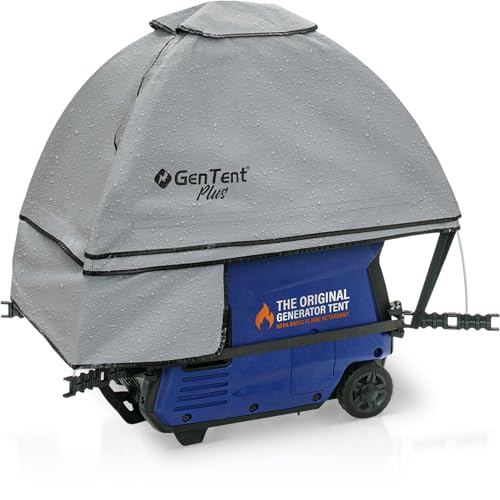
GenTent Inverter Kit Plus Running Cover (Gray)
Fully encased inverter · 110 mph wind rating · Cold: -25°F (Plus edition, GenTent) · Score 86/100
Most camping and home-backup inverters have a closed plastic case with no frame posts to clamp to. This cover uses a Kevlar ratchet strap that wraps around the case instead. GenTent's page says it fits "fully encased inverter generators with perimeters between 40 and 120 inches," and that its inverter kits suit cased inverters "from 1000w up to 9500w" (GenTent). The Amazon listing (model GTOICSMPGR) gives the same 40 to 120 inch range. The Plus edition adds UV treatment, a -25°F cold rating and a 2-year warranty. GenTent rates its inverter kit for 110 mph forecast winds, a 20 in snow load and 18 in of rain per hour. Both sources name NFPA 701 vinyl, and the listing adds UL V-0 flame-retardant parts. The listing gives 6.29 lb. The same Plus cover also comes in black and tan at the same price on Amazon when we checked.
Fits: 40-120 in case perimeter; GenTent says 1,000 to 9,500W inverters. Mount: Kevlar ratchet strap around the case (no tools or drilling). Warranty: 2-year (Plus edition, GenTent).
Pros
- ✓ Fits the widest range here: 40-120 in case perimeter (GenTent, Amazon)
- ✓ Strap mount suits closed-case inverters with no frame to clamp
- ✓ 2-year warranty and -25°F rating (Plus edition)
- ✓ Comes in gray, black or tan
Cons
- ✗ Costs more than Champion's inverter cover when we checked
- ✗ Inverters with a high exhaust may need the strap below the exhaust port, per GenTent's manual
- ✗ Sold by GenTent's store, not Amazon.com
3. Best for Westinghouse WGen14500 and WGen20000

Westinghouse WGenTent XL Running Cover
Large open frame · 110 mph wind rating · Cold: "Subzero" (no figure published) · Score 83/100
If you own one of Westinghouse's largest open-frame generators, this is the cover sold for it. The Amazon listing says it fits "all WGen20000 series and WGen14500 series generators" and "many large open frame generators with perimeter dimensions from 105 inches to 128 inches." GenTent's April 2026 launch release says GenTent built it for Westinghouse and names the same two series (GenTent release). Both sources give 110 mph winds, a 20 in snow load and 18 in of rain per hour, NFPA 701 vinyl and UL 94 V-0 parts. The listing gives 3 lb and says it handles "subzero temperatures" but doesn't give a figure. Westinghouse's own product page wouldn't load for us, so we couldn't confirm its warranty. Westinghouse doesn't list smaller models such as the WGen9500DFc, so measure your frame before assuming it fits.
Fits: Westinghouse WGen14500 and WGen20000 series; other open frames with a 105-128 in perimeter. Mount: Universal clamp system (no drilling). Warranty: Not confirmed (maker page unavailable).
Pros
- ✓ Sold for the WGen14500 and WGen20000 series by name
- ✓ Same 110 mph / 20 in snow / 18 in/h rain ratings as GenTent's XL (listing, release)
- ✓ Sold by Amazon.com
- ✓ Lightest listed weight here: 3 lb
Cons
- ✗ No numeric cold rating published
- ✗ Warranty not confirmed on a Westinghouse page
- ✗ Large open frames only
4. Best Value for Champion Open-Frame Generators
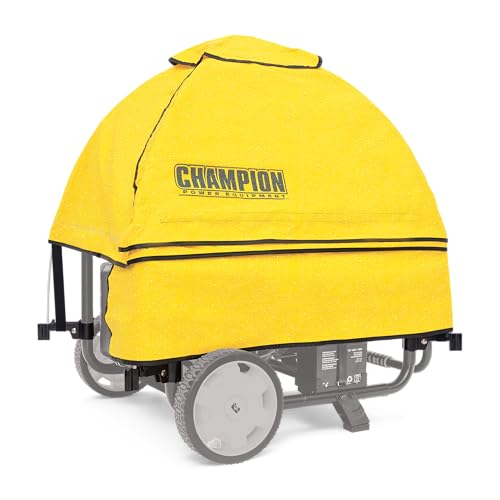
Champion Storm Shield 100376 Open Frame Generator Cover
Open frame · 70 mph wind rating · Cold: Not published · Score 73/100
Champion's Storm Shield covers are made by GenTent (the listing title says "by GenTent"), but Champion sizes them by starting watts for its own generators. Champion says the 100376 is "designed for Champion portable open frame generators from 4000 watts to 12,500 starting watts" (Champion). Its covers page and the Amazon listing give the same range, 70 mph winds, 18 in of snow per day and a 1-year limited warranty (Champion). Champion's rain rating appears as both "per hour" and "per day" on its own product page, and the listing says "per day," so we don't quote one. The listing calls the vinyl "NFPA rated" without naming the standard, and gives 4.4 lb. It had the lowest price of our picks when we checked. If your generator isn't a Champion, Champion's wattage range tells you less, so measure it against GenTent's perimeter ranges instead.
Fits: Champion open-frame generators, 4,000 to 12,500 starting watts. Mount: Self-attaching, tool-free. Warranty: 1-year limited (Champion).
Pros
- ✓ Lowest price of our picks when we checked
- ✓ Sold by Amazon.com
- ✓ Maker publishes the starting-watt range it fits (4,000-12,500 W)
- ✓ Tool-free, self-attaching install
Cons
- ✗ Fit is stated for Champion generators only
- ✗ Lower published wind rating (70 mph) than the GenTent-branded covers (110 mph)
- ✗ Rain rating conflicts; no cold rating published
- ✗ 1-year warranty
5. Best Value for Champion Inverters

Champion Storm Shield 100603 Inverter Generator Cover
Inverter (closed case) · 70 mph wind rating · Cold: Not published · Score 72/100
This is the inverter version of the Storm Shield. Champion's covers page lists the 100603 for its inverter generators from 2,000 to 8,500 starting watts, and the Amazon listing gives the same range (Champion). That covers both Champion inverters we rate, the 2500-Watt and the 4500-Watt dual fuel models. Champion and the listing's bullets give 70 mph winds, 18 in of snow per day and a 1-year limited warranty. The listing title says "Withstands 110-mph Winds," which conflicts with its own bullets and Champion's page, so we use Champion's 70 mph. The listing gives 5 lb. It cost less than the GenTent Inverter Plus when we checked.
Fits: Champion inverter generators, 2,000 to 8,500 starting watts. Mount: Self-attaching, tool-free. Warranty: 1-year limited (Champion).
Pros
- ✓ Fits Champion inverters from 2,000 to 8,500 starting watts (Champion)
- ✓ Costs less than the GenTent Inverter Plus when we checked
- ✓ Sold by Amazon.com
Cons
- ✗ Fit is stated for Champion inverters only
- ✗ Listing title (110 mph) conflicts with Champion's 70 mph
- ✗ No cold rating published; 1-year warranty
What we left out
GenTent also sells Standard-edition covers, an original-size open-frame kit for mid-size generators, and an XL inverter kit for larger cased inverters on its own site. We ranked only the five above because each had a second source for its fit and ratings and an in-stock Amazon offer. We also left out storage covers and generic "generator covers" that don't say they're designed for running. Don't run a generator under a storage cover, a tarp or a pop-up canopy unless its maker says it's designed for that.
Generator Tent Comparison Table
Fit and ratings from each maker's page and the Amazon listing. "Fits" is exactly what the maker publishes.
| Cover | Generator type | Fits (maker) | Weather (maker) | Cold rating | Warranty | Score | Price |
|---|---|---|---|---|---|---|---|
| GenTent XL Universal Kit Extreme Running Cover (Black) | Large open frame | 104-128 in frame perimeter (GenTent page; Amazon listing says 105-128 in) | 110 mph forecast winds, 20 in snow load, 18 in rain per hour (GenTent) | -45°F (Extreme edition, GenTent) | 3-year (Extreme edition, GenTent) | 88/100 | Check price at Amazon → |
| GenTent Inverter Kit Plus Running Cover (Gray) | Fully encased inverter | 40-120 in case perimeter; GenTent says 1,000 to 9,500W inverters | 110 mph forecast winds, 20 in snow load, 18 in rain per hour (GenTent) | -25°F (Plus edition, GenTent) | 2-year (Plus edition, GenTent) | 86/100 | Check price at Amazon → |
| Westinghouse WGenTent XL Running Cover | Large open frame | Westinghouse WGen14500 and WGen20000 series; other open frames with a 105-128 in perimeter | 110 mph winds, 20 in snow load, 18 in rain per hour (Amazon listing; GenTent release) | "Subzero" (no figure published) | Not confirmed (maker page unavailable) | 83/100 | Check price at Amazon → |
| Champion Storm Shield 100376 Open Frame Generator Cover | Open frame | Champion open-frame generators, 4,000 to 12,500 starting watts | 70 mph winds, 18 in snow per day (Champion); rain figure conflicts, so not shown | Not published | 1-year limited (Champion) | 73/100 | Check price at Amazon → |
| Champion Storm Shield 100603 Inverter Generator Cover | Inverter (closed case) | Champion inverter generators, 2,000 to 8,500 starting watts | 70 mph winds, 18 in snow per day (Champion); rain figure conflicts, so not shown | Not published | 1-year limited (Champion) | 72/100 | Check price at Amazon → |
Weather figures are each maker's own ratings; we couldn't confirm them independently. GenTent's XL page gives a 104 in lower limit and its Amazon listing gives 105 in. Sources: GenTent inverter and XL kit pages and installation manuals; Champion's GenTent covers page and 100376 product page; GenTent's April 2026 WGenTent XL release; Amazon listing bullets for each ASIN.
Which Generator Tent Fits My Generator?
Makers publish fit in one of two ways, and you need to know which one you're reading:
- By perimeter (GenTent and Westinghouse). GenTent's measuring guide says: "Perimeter = (Length x 2) + (Width x 2) (not including handles or wheels)." Its own example is an inverter 23.2 in long and 17.7 in wide, which comes to 81.8 in, well inside the 40 to 120 inch inverter range (GenTent measuring guide). For an open frame, measure the frame itself. The XL kits take 104 or 105 to 128 inches.
- By starting watts (Champion). Champion lists the 100376 for its open-frame generators from 4,000 to 12,500 starting watts and the 100603 for its inverters from 2,000 to 8,500 starting watts (Champion). Those ranges describe Champion's own frames. Another brand's generator with the same wattage may be a different size.
- Closed case or open frame? A cased inverter needs a strap-on cover. An open-frame generator with corner posts needs a clamp-on cover. GenTent's inverter manual says larger inverters, or ones with a high exhaust, may need the strap mounted below the exhaust port.
Champion generators we rate, and the Storm Shield Champion lists for each
| Generator | Type | Starting watts | Champion cover | Cover price |
|---|---|---|---|---|
| Champion 2500-Watt Dual Fuel Inverter Generator with CO Shield | Inverter (closed case) | 2,500 W | Champion Storm Shield 100603 Inverter Generator Cover | Check price at Amazon → |
| Champion 4500-Watt Electric Start Dual Fuel Inverter Generator | Inverter (closed case) | 4,500 W | Champion Storm Shield 100603 Inverter Generator Cover | Check price at Amazon → |
| Champion 12,500-Watt Tri Fuel Generator with CO Shield | Open frame | 12,500 W | Champion Storm Shield 100376 Open Frame Generator Cover | Check price at Amazon → |
Starting watts come from our generator data. The 12,500-Watt Tri Fuel sits at the very top of the 100376's range. For other brands we rate, such as the Westinghouse iGen5000DFc and WGen9500DFc or the Honda EU2200i, no cover maker here names the model, so measure the perimeter and check it against GenTent's ranges or its fit finder.
Can You Run a Generator in the Rain?
Only with the generator protected from water, and still outdoors and far from the house. CPSC's portable generator safety alert says generators "pose a risk of shock and electrocution, especially if they are operated in wet conditions." If you must run one when it's wet outside, it says to "protect the generator from moisture," but "without operating the generator indoors or near openings to any building that can be occupied." It adds: "Operate the generator under an open, canopy-like structure on a dry surface where water cannot reach it or puddle or drain under it. Dry your hands, if wet, before touching the generator" (CPSC Publication 5123).
That's the job a running cover is built for: an open-sided canopy that sits on the generator itself, so you don't have to put up a shelter near the house. Rain dripping off the canopy can still pool under the generator, so set it on a dry, raised, level spot rather than in a low patch of lawn. Use heavy-duty outdoor extension cords long enough to keep the generator far from windows, doors and vents, as the same CPSC alert advises. A generator interlock kit or a transfer switch installed by an electrician lets you feed house circuits through an outdoor inlet instead of running cords through a window.
Running a generator in snow
GenTent rates its canopies for a 20 in snow load and Champion for 18 in of snow per day. Snow drifting against the sides is a different matter: keep the air intake and exhaust clear of drifts, and check after every heavy snowfall. GenTent's manuals don't give snow-clearing instructions, so follow your generator's manual. Turn the generator off and let it cool before refueling. Champion says so on its covers page, and CPSC warns that "Gasoline spilled on hot engine parts could ignite." Every cover here has a refueling door so you can refuel without taking the cover off.
Will a Generator Tent Make My Generator Overheat?
We can only report what the makers say, because we haven't measured it. GenTent's Amazon listings say its "Patented design preserves natural generator airflow and cooling during operation and does not impede generator performance." Champion describes a "natural airflow design" that "allows for generator operation and maintenance while the cover is on." Both makers' claims depend on installing the cover the way their instructions say:
- The canopy goes above the exhaust muffler, and the outlet apron must never block the exhaust. On open frames, GenTent says to keep the apron at least 4 inches from the exhaust and never mount a clamp in front of the exhaust outlet (GenTent open-frame manual).
- On the exhaust side, angle the extender arms outward and set the canopy edge where exhaust can escape. That may mean sloping the canopy higher on the exhaust side (GenTent inverter manual).
- Never put the refueling door on the muffler side.
If your generator's own manual says not to cover it while running, follow the generator maker. A cover maker's claims don't override the generator's instructions, and no cover here says it's approved for use in a garage or close to the house.
GenTent vs Champion Storm Shield
They come from the same maker. Champion's listing titles say "by GenTent," Champion's covers page names GenTent, and GenTent also makes Westinghouse's WGenTent XL. The differences are in how they're sold:
- Fit: Storm Shield is sized by starting watts for Champion generators. GenTent-branded kits are sized by perimeter for any brand.
- Published weather rating: Champion gives 70 mph wind and 18 in of snow per day, and its rain figure conflicts. GenTent gives 110 mph, a 20 in snow load and 18 in of rain per hour for its current kits.
- Editions and warranty: GenTent sells Standard, Plus and Extreme editions with 1, 2 and 3-year warranties and cold ratings down to -15°F, -25°F and -45°F. Champion lists a 1-year limited warranty and no cold rating.
- Price: the Storm Shields cost less than the GenTent-branded picks when we checked: check the current Amazon price on the 100376.
If you own a Champion that's inside the range, the Storm Shield is the simpler buy. For any other brand, or for deep-cold winters, a GenTent Plus or Extreme with a published perimeter range is the safer fit.
The No-Tent Alternative: A Battery Power Station
A battery power station (a "solar generator") burns no fuel and makes no exhaust, so it can sit indoors, dry, next to the fridge or CPAP it's running. You don't need a tent, a 20-foot cord or a trip outside in the storm. The trade-off is energy: a battery holds hours of power, not days, unless you can recharge it. Solar recharging is slow under storm clouds and snow. Our estimate is battery Wh × 0.85 ÷ load watts:
| Power station | Capacity | At 150W (fridge-size load) | At 500W (fridge + furnace blower + lights) | Score | Price |
|---|---|---|---|---|---|
| Jackery Explorer 1000 V2 | 1,024 Wh | ~5.8 h | ~1.7 h | 93/100* | $559.00 |
| EcoFlow Delta Pro 3 | 4,096 Wh | ~23 h | ~7.0 h | 95/100* | Check price at Amazon → |
Estimates, not measurements. A fridge cycles on and off, so its average draw is usually well below its running watts. Check your own appliance labels. *Power-station scores come from our power-station rubric, on a different scale from the tent scores above.
For outages that last more than a day, many households use both: a gas or dual-fuel generator outside, under its cover, recharging a power station that runs the indoor loads quietly overnight. Our solar vs gas generator guide weighs the two, our winter storm power backup plan sizes a setup for a long outage, and for camping without a generator at all, see our quietest generator for camping picks.
Who Should Buy a Generator Tent (and Who Should Skip)
Good fit
- ✓ You own a gas or dual-fuel generator and storms or snow hit your area
- ✓ You can set it up in open air, at least 20 feet from the house, with the exhaust pointed away
- ✓ Your generator's size is inside a maker's published fit range
- ✓ You want to leave the cover on through an outage and refuel through its door
Skip it if
- ✗ You hoped a tent would let you run the generator in a garage, carport, porch or shed. It won't.
- ✗ Your generator's manual says not to cover it while running
- ✗ No maker publishes a fit range that includes your generator
- ✗ You only need a few hours of quiet indoor power (a battery power station needs no cover)
Every price on this page loads live from Amazon. Stock and prices change quickly, and we can't predict a price or promise a discount on any listing. Whichever you choose, fit it once in dry weather before the season, so you aren't learning the setup in a storm.
Generator Tent FAQ
What is the best generator tent?
It depends on your generator's shape. For a closed-case inverter, the GenTent Inverter Kit Plus fits cases with a 40 to 120 inch perimeter, with a 2-year warranty and a -25°F cold rating. For a large open-frame generator, the GenTent XL Extreme scores highest in our scoring, with a 104 to 128 inch fit, a 3-year warranty and a -45°F rating. Champion's Storm Shield covers cost less and are sized for Champion generators by starting watts.
Can you run a generator in the rain?
Only if it's protected from water and still outdoors, far from the house. CPSC says generators pose a shock and electrocution risk in wet conditions, and to operate one under an open, canopy-like structure on a dry surface where water can't reach it or puddle under it, but never indoors or near openings to an occupied building. A running cover provides that canopy on the generator itself. Dry your hands before touching the generator.
Does a generator tent make it safe to run a generator in a garage or near the house?
No. A tent keeps water off the generator; it does nothing about carbon monoxide. CPSC says never run a portable generator in a home, garage, basement, crawlspace, shed or other enclosed space, even with doors or windows open, and to run it at least 20 feet from the house with the exhaust pointed away. CDC gives the same 20-foot rule for doors, windows and vents. GenTent and Champion both say not to run a generator in a garage. Keep battery or battery-backup CO alarms in the house.
Will a generator tent cause overheating?
GenTent says its design preserves the generator's natural airflow and cooling, and Champion describes a natural airflow design. We haven't measured it. Both claims assume the cover is installed as instructed. GenTent's manuals say the canopy must sit above the exhaust muffler, the outlet apron must never block the exhaust, and the refueling door must never be on the muffler side. If your generator's manual says not to cover it while running, follow the generator maker.
What's the difference between GenTent and Champion Storm Shield?
GenTent makes both. Champion's Storm Shield covers are sized by starting watts for Champion generators (4,000 to 12,500 W open frame, 2,000 to 8,500 W inverter), with a 70 mph wind rating and a 1-year warranty. GenTent-branded kits are sized by perimeter for any brand, are rated by GenTent for 110 mph winds, and come in Standard, Plus and Extreme editions with 1, 2 or 3-year warranties and cold ratings down to -45°F.
How do I know which generator tent fits my generator?
Use the method the maker publishes. For GenTent and Westinghouse, measure the perimeter: GenTent says perimeter equals length times 2 plus width times 2, not including handles or wheels. Its inverter kit fits 40 to 120 inches and its XL open-frame kit 104 to 128 inches (105 on the Amazon listing). For Champion, check your Champion generator's starting watts against the cover's range. If you're near a limit, use GenTent's online fit finder.