
Buying Guide · Updated November 2026
Best Kerosene Heater 2026: 4 Indoor Kerosene Heaters, Safety Rules and Runtime
The best kerosene heater for most homes is the Sengoku HeatMate HMC-23K, a UL-listed 23,000 BTU convection heater that Sengoku rates for about 1,000 sq ft, with 9 to 12 hours on its 1.9 gallon tank. For one room, the Dyna-Glo RMC-55R7B (10,000 BTU, 11 to 14 hours per gallon) is the best value, and the Sengoku HMN-110 runs longest, at 14.5 to 16 hours per fill. Any kerosene heater indoors needs 1-K kerosene, fresh air and a CO alarm, and must be off before bed. Some places ban them in homes, including Massachusetts and New York City.
As an Amazon Associate, SolarGenAdvisor earns from qualifying purchases made through links on this page, at no additional cost to you. Scores are AI-synthesized from manufacturer manuals and spec sheets, Amazon listing details and logged Amazon prices; we did not test these heaters.
 By
Quick Verdict
For a living room or an open-plan space in a power outage, the Sengoku HMC-23K puts out the most heat here, 23,000 BTU for about 1,000 sq ft. For a single room, the Dyna-Glo RMC-55R7B costs least and has a removable tank you can carry outside to refill. If you want the fewest refills, the Sengoku HMN-110 runs 14.5 to 16 hours per fill. Any of them runs far longer per fill than a propane heater on a 1 lb cylinder (about 5.4 hours for a Mr. Heater Buddy on low). The trade-offs are the same for all four: no low-oxygen shut-off, 1-K kerosene only, and refuelling outdoors once the heater is cool. If you'd rather have a low-oxygen shut-off and disposable fuel, see our best indoor propane heater picks. Whichever fuel you choose, turn the heater off at bedtime and use a battery heated blanket for warmth while you sleep.
Before You Light Any Kerosene Heater Indoors
- Use only 1-K kerosene. Never use gasoline. CPSC says "Use only water-clear 1-K grade kerosene" and warns that even small amounts of gasoline mixed in "can substantially increase the risk of a fire or an explosion" (CPSC). Store kerosene in a blue container, never a red gasoline can.
- Refuel outdoors, only when the heater is off and cool. CPSC: "Never refuel the heater inside the home," and don't fill above the "full" mark. USFA: "Refuel your heater outside once it has cooled" (USFA).
- Ventilate. CPSC says to keep a door open to the rest of the house, or open an outside window about one inch if the door must be closed or the home is tight or winterized (CPSC). Kerosene heaters produce carbon monoxide and nitrogen dioxide even when they work properly.
- Install battery CO alarms. Put battery-operated or battery-backup CO alarms on each level and outside sleeping areas, and test them monthly (CPSC, Jan 2026; CDC). A kerosene heater's tip-over shut-off doesn't detect CO. Our portable carbon monoxide detector guide compares battery alarms listed to UL 2034.
- Off before bed. Keep 3 feet clear. The Dyna-Glo and Sengoku manuals both say to turn the heater off and make sure it's fully out "prior to going to bed," and never to leave it unattended (Dyna-Glo manual; Sengoku manual). Keep anything that can burn at least 3 feet away (USFA).
How We Score Kerosene Heaters
We use the same heater rubric and weights as our indoor propane heater guide, adapted for kerosene. As on that page, the relative dimensions compare the heaters within this guide, so a kerosene score and a propane score aren't directly comparable. Each score is AI-synthesized from the owner's manual or spec sheet, the maker's product page, Amazon listing details and the Amazon price we logged on November 6, 2026. We did not test any heater. Every input below is published for all four picks, so no score is low because of missing data. Weights total 100:
- Heating capacity (25): the maker's rated heating area, relative to the largest pick (1,000 sq ft)
- Indoor safety (25): one third each for an indoor rating from the maker, a tip-over shut-off and a low-oxygen (ODS) shut-off. Wick kerosene heaters don't have an ODS, so all four earn two of the three. (The propane Buddies earn all three.)
- Value (20): the lowest live price here divided by this heater's live price
- Runtime per fill (15): the low end of the maker's published hours per tank, relative to the longest (14.5 h)
- Fuel options (15): a single fuel container only, a remote tank option, or two ports. All four use a single tank, so all four score the same here.
Room and legal restrictions aren't in the score. We show them on every card and in the tables because they matter more than a few points. Heater scores aren't comparable with our power-station scores.
The 4 Best Indoor Kerosene Heaters
These are the indoor wick heaters we could confirm the maker sells for indoor use, with a published owner's manual or spec sheet, and with a new, in-stock offer in Amazon's buy box when we checked on November 6, 2026. One is sold by Amazon.com and three by third-party sellers on Amazon, so stock and prices can change faster than usual. Specs come from each heater's manual or spec sheet (linked), the maker's product page and the Amazon listing.
1. Best for Large Rooms and Open Floor Plans
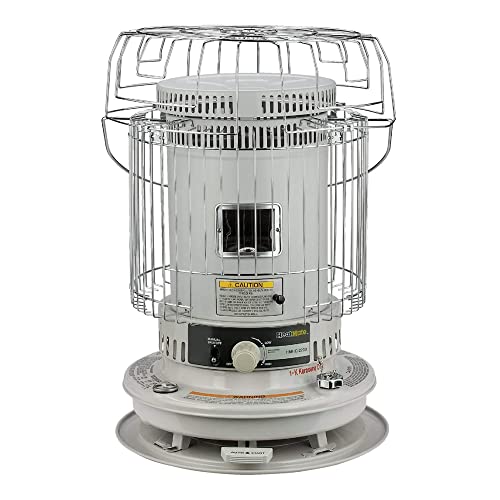
Sengoku HeatMate HMC-23K Convection Kerosene Heater (23,000 BTU)
23,000 BTU · about 1,000 sq ft · 1.9 gal tank · 9-12 h (manual) · Score 66/100
Price: $219.89
The HMC-23K is the heater to buy if you need to warm a living room plus the space around it, not just one corner. It's a round convection heater, so it sends heat out in all directions rather than forward. Sengoku's owner's manual (which covers the Mega-23K, CV-23K and HMC-23K) gives a maximum of 23,000 BTU/h, a built-in 1.9 gallon tank, 9 to 12 hours of continuous burn at 0.167 gallons per hour, two-C-cell battery ignition and "U.L. Listed: Yes" (Sengoku manual). Sengoku's product page rates it for about 1,000 sq ft and lists an automatic safety shut-off, a tip-over switch and a 2-year limited warranty (Sengoku). That page says 23,500 BTU, while the manual and the Amazon listing say 23,000, so we use 23,000. More heat means it needs more air: by the manual's rule of 200 cubic feet per 1,000 BTU/h, a room under 4,600 cubic feet needs an open door or a window cracked at least an inch.
Type: Convection (round, 360 degrees), wick, integral tank. Room limits: Not in a bathroom or any small room with the door closed; off before bed; never unattended (manual). Clearance: 36 in from top and front (manual).
Pros
- ✓ Most heat here: 23,000 BTU for about 1,000 sq ft
- ✓ UL listed, with auto shut-off and tip-over switch
- ✓ Round convection design heats in all directions
- ✓ Top score in our kerosene scoring
Cons
- ✗ Shortest runtime per fill here (9 to 12 h)
- ✗ Needs the most fresh air of our picks
- ✗ 24.3 lb empty with a built-in tank, so you carry the whole heater outside to refuel
2. Best Value for One Room

Dyna-Glo RMC-55R7B Indoor Kerosene Radiant Heater (10,000 BTU)
10,000 BTU · about 500 sq ft · 1.0 gal tank · 11-14 h (manual) · Score 61/100
The RMC-55R7B is a radiant ("radiant reflection") wick heater. A reflector pushes the heat forward, so it warms the people and things in front of it rather than the whole room evenly. Its manual's spec table gives a maximum of 10,000 BTU/h, a 1.0 US gallon removable cartridge tank, "approx. 11-14 hr" of continuous burn at 0.07 gallons per hour, battery ignition from two D cells, and "U.L. Listed: Yes" (Dyna-Glo manual). The 500 sq ft heating area comes from the Amazon listing and retailer listings (BJ's; Zoro); the manual doesn't give an area. Its main safety system shuts the heater off "should the heater be jarred or tipped over while in operation." It had the lowest price of our four picks when we checked, and it's the only one Amazon.com sells directly.
Type: Radiant (reflector), wick, removable cartridge tank. Room limits: Not in a bathroom or any small room with the door closed; off before bed; never unattended (manual). Clearance: 36 in from top and front (manual).
Pros
- ✓ Lowest price of our picks when we checked
- ✓ Removable cartridge: carry only the tank outside to refuel
- ✓ UL listed, with a tip-over / jolt shut-off
- ✓ Sold by Amazon.com
Cons
- ✗ Radiant reflector heats mostly what's in front of it
- ✗ Wick upkeep: dry burn every 2 tankfuls or weekly
- ✗ Low stock when we checked ("only 4 left")
3. Longest Runtime per Fill

Sengoku HeatMate HMN-110 Radiant Kerosene Heater (10,000 BTU)
10,000 BTU · about 400 sq ft · 1.2 gal tank · 14.5-16 h (manual) · Score 59/100
Price: $182.92
The HMN-110 goes the longest between refills. Sengoku's shared manual for the MGN-110, CTN-110 and HMN-110 gives a maximum of 10,000 BTU/h, a 1.2 US gallon cartridge, 14.5 to 16 hours of continuous burn at 0.08 gallons per hour, ignition from four C cells, a 20 lb empty weight and "U.L. Listed: Yes." It also describes a tip-over extinguishing device that can trip "if heater is given a shock by hitting or shaking" (Sengoku manual). Sengoku's product page and the Amazon listing rate it for about 400 sq ft and give up to 14 hours per fill (Sengoku). Some retailers list 380 sq ft, so we use the maker's 400. The same manual covers the KeroHeat CTN-110, which Sengoku lists with the same specs (Sengoku CTN-110). Its Amazon listing was priced higher when we checked, so we rank the HMN-110.
Type: Radiant (reflector), wick, removable cartridge tank. Room limits: Not in a bathroom or any small room with the door closed; off before bed; never unattended (manual). Clearance: 36 in from top and front (manual).
Pros
- ✓ Longest runtime here: 14.5 to 16 h per fill (manual)
- ✓ Removable 1.2 gal cartridge
- ✓ UL listed, with auto shut-off and tip-over switch
- ✓ Push-button ignition, no power needed
Cons
- ✗ Smallest rated area here (about 400 sq ft)
- ✗ Radiant reflector heats mostly what's in front of it
- ✗ Sold by a third-party seller on Amazon
4. Best Compact Convection Heater

Kero World KW-12 Compact Convection Kerosene Heater (10,500 BTU)
10,500 BTU · about 500 sq ft · 1.1 gal tank · 12-15 h (maker spec sheet) · Score 58/100
Price: $245.00
The KW-12 is a small round convection heater, around 21 inches tall and about 14 lb. Kero World's specification sheet gives a maximum of 10,500 BTU/h, a built-in 1.1 US gallon tank, approximately 12 to 15 hours of continuous burn at 0.079 gallons per hour, and two-C-cell ignition (Kero World spec sheet). World Marketing, whose site publishes that spec sheet, rates it for up to 500 sq ft and says it is UL-listed with tilt-type shut-off and tip-over protection (World Marketing). The Amazon listing says 450 sq ft, so we use the maker's figure. The same maker page says the KW-12's sale is prohibited in Massachusetts and that "The state of California prohibits the use of this product in any dwelling, house or unit."
Type: Convection (compact round), wick, integral tank. Room limits: Never unattended while burning (maker spec sheet); maker says CA prohibits use in any dwelling. Clearance: Not published in the documents we found.
Pros
- ✓ Compact and light: about 14 lb, 12.6 in wide
- ✓ About 12 to 15 h per 1.1 gal fill (maker)
- ✓ UL listed, with tip-over protection (maker)
- ✓ Round convection design heats in all directions
Cons
- ✗ Maker publishes no clearance or ventilation figures in the documents we found
- ✗ Built-in tank: carry the whole heater outside to refuel
- ✗ Maker says not for use in a California dwelling
Other kerosene heaters we checked
The Sengoku KeroHeat CTN-110 is the same heater as the HMN-110 under Sengoku's other brand name: one manual covers both, and Sengoku lists the same specs for each. Buy whichever is cheaper on the day. We didn't rank a gray 23,800 BTU Dyna-Glo convection listing because we couldn't tie its listing to a specific Dyna-Glo model and manual. We also left out the Kero World KW-11G, because we couldn't find a manufacturer manual or spec sheet for it, and a Sengoku three-pack bundle. The Dyna-Glo RMC-95C6B and WK95C8, the ivory RMC-55R7, the Sengoku CV-2230 and the Comfort Glow KW-24J were listed as currently unavailable. We also skipped the many no-name "kerosene heater and stove" listings, because we couldn't find a manufacturer manual to check their indoor rating, and their listings promote cooking on the heater, which the Dyna-Glo and Sengoku manuals prohibit.
Kerosene Heater Comparison Table (vs Propane)
The four kerosene picks, plus the two propane heaters we rate highest for outages for comparison. Figures come from each maker's manual, spec sheet or product page. Heating area is the maker's rating, and a drafty room will need more heat than the rating assumes.
| Heater | Fuel / tank | BTU/h | Area | Runtime per fill | Low-oxygen shut-off | Tip-over shut-off | Score | Price |
|---|---|---|---|---|---|---|---|---|
| Sengoku HeatMate HMC-23K Convection Kerosene Heater (23,000 BTU) | 1-K kerosene, 1.9 gal | 23,000 | ~1,000 sq ft | 9-12 h (manual) | No | Yes | 66/100 | $219.89 |
| Dyna-Glo RMC-55R7B Indoor Kerosene Radiant Heater (10,000 BTU) | 1-K kerosene, 1.0 gal | 10,000 | ~500 sq ft | 11-14 h (manual) | No | Yes | 61/100 | Check price at Amazon → |
| Sengoku HeatMate HMN-110 Radiant Kerosene Heater (10,000 BTU) | 1-K kerosene, 1.2 gal | 10,000 | ~400 sq ft | 14.5-16 h (manual) | No | Yes | 59/100 | $182.92 |
| Kero World KW-12 Compact Convection Kerosene Heater (10,500 BTU) | 1-K kerosene, 1.1 gal | 10,500 | ~500 sq ft | 12-15 h (maker spec sheet) | No | Yes | 58/100 | $245.00 |
| Mr. Heater Big Buddy MH18B, No Fan (4,000-18,000 BTU) (propane) | Propane, 1 or 2 × 1 lb cylinders | 4,000–18,000 | ~450 sq ft | ~11 h on low with two 1 lb cylinders | Yes | Yes | 80/100* | $159.00 |
| Mr. Heater Portable Buddy MH9BX (4,000-9,000 BTU) (propane) | Propane, 1 lb cylinder | 4,000–9,000 | ~225 sq ft | ~5.4 h on low per 1 lb | Yes | Yes | 75/100* | Check price at Amazon → |
*Propane scores come from our propane heater guide and are scored against the propane heaters on that page, so compare them with each other, not with the kerosene scores. Kerosene runtimes are each maker's published range. Sources: Dyna-Glo RMC-55R7/RMC-55R7B manual; Sengoku 23K and 110 manuals and product pages; Kero World KW-12 spec sheet and World Marketing product page; Mr. Heater MH18B and MH9BX manuals and spec sheets. The Mr. Heater manuals mark both Buddies "for US sale except Massachusetts" and "not for use in a 'dwelling home' in California."
Are Kerosene Heaters Safe Indoors?
Only a heater the maker sells for indoor use, run exactly as its manual says, and only where local law allows it. Portable kerosene heaters are unvented, so everything they burn ends up in the room. CPSC says that even a well-running kerosene heater produces "low levels of certain pollutants, such as carbon monoxide and nitrogen dioxide," which "may be harmful, especially to individuals with chronic respiratory or circulatory health problems" (CPSC). In its space-heater guidance, CPSC also says unvented heaters burning natural gas, liquefied petroleum and other fuels "pose the greatest threat" among space heaters, need "a constant supply of fresh air," and have been outlawed in some areas (CPSC).
The Dyna-Glo manual adds rules that many kerosene-heater guides leave out. Use it "only in well ventilated areas." Never run the wick below the LOW wick stop, because that can cause "smoke, odor, excess emissions, CO (carbon monoxide), and flare-ups." Don't use it in a bathroom or any small room with the door closed. Don't use it to cook or boil water, or in a room warmer than 86°F. Never carry it while it's lit (Dyna-Glo manual).
CO is the main danger. CDC says more than 400 Americans die each year from unintentional carbon monoxide poisoning not linked to fires, and more than 100,000 visit an emergency department (CDC). Heating fires are a separate risk: USFA estimates 32,200 home heating fires in 2021, which caused 190 deaths (USFA).
Can you sleep with a kerosene heater on?
No. The Dyna-Glo manual says to turn the heater off and check that it's "completely extinguished prior to going to bed," and USFA says to turn heaters off "when you go to bed or leave the room" (USFA). CPSC warns that carbon monoxide "can kill a sleeping person in less than two hours" (CPSC). A kerosene heater has no low-oxygen sensor and no CO sensor, so nothing on the heater will warn you.
Are Kerosene Heaters Illegal? Rules We Could Verify
Rules on unvented kerosene heaters differ by state and city. Below are only the ones we could confirm from the statute or an official fire-department source. Many other states and cities have their own fire codes, and we haven't tried to list them. Before you buy, check with your local fire department or building official, and if you rent, read your lease.
- Massachusetts: state law says "No person shall use, allow to be used, sell or offer for sale any unvented liquid fired space heater." It defines these as portable, room and similar heaters that burn kerosene, range oil or No. 1 fuel oil and have a barometric fuel control with the tank less than 42 inches from the burner. The fine is up to $100 (M.G.L. c.148 §25B). In November 2025, the State Fire Marshal said unvented kerosene space heaters "are not permitted for residential use in Massachusetts" (iBerkshires report).
- New York State: "It shall be unlawful to use any portable kerosene heater in a multiple dwelling" (RPL §239-e), which the law defines as a building occupied by three or more families living independently. In other structures, only an "approved" heater is allowed (RPL §239-b). That means a listed heater with a fuel capacity of no more than two gallons, a tip-over shut-off that puts out the flame within 10 seconds, a siphon or pump for refueling, and warning labels (RPL §239-a(7)).
- New York City: the FDNY says "The use of kerosene or propane space heaters is strictly prohibited and illegal to use in New York City" (FDNY safety tips).
This is general information, not legal advice. The kerosene heater warning label reproduced by CPSC tells owners to "Follow All Applicable Code Requirements When Using Heater" (CPSC).
How Long Does a Kerosene Heater Run?
A rough estimate is gallons in the tank × 135,000 ÷ the heater's BTU rating. EPA lists kerosene at 0.135 million BTU per gallon (EPA heat content table), which matches EIA's factor of 5.67 million Btu per 42-gallon barrel. The formula agrees with the Dyna-Glo manual: its burn rate of 0.07 gallons per hour empties the 1.0 gallon cartridge in about 14 hours, and the manual quotes 11 to 14 hours. These estimates are for a full tank and a properly set wick. The Dyna-Glo has no low setting (its manual says a kerosene heater "is either on or off," and the wick must never go below the LOW stop), so you can't stretch a tank by turning it down.
| Heater | BTU/h | Tank | Maker's figure | Our estimate per fill | Fuel for 8 h a day, 3 days |
|---|---|---|---|---|---|
| Sengoku HeatMate HMC-23K Convection Kerosene Heater (23,000 BTU) | 23,000 | 1.9 gal | 9-12 h (manual) | ~11 h | ~4.1 gal |
| Dyna-Glo RMC-55R7B Indoor Kerosene Radiant Heater (10,000 BTU) | 10,000 | 1.0 gal | 11-14 h (manual) | ~14 h | ~1.8 gal |
| Sengoku HeatMate HMN-110 Radiant Kerosene Heater (10,000 BTU) | 10,000 | 1.2 gal | 14.5-16 h (manual) | ~16 h | ~1.8 gal |
| Kero World KW-12 Compact Convection Kerosene Heater (10,500 BTU) | 10,500 | 1.1 gal | 12-15 h (maker spec sheet) | ~14 h | ~1.9 gal |
Our estimates are not measurements; they land inside or close to each maker's published range, which is the figure to plan on. One more consideration in an outage: the Dyna-Glo manual says never to use kerosene "that has been stored from one season to the next," so buy fresh 1-K each winter rather than stockpiling for years.
What Kerosene Goes in a Kerosene Heater? 1-K Only
Use only 1-K grade kerosene. CPSC says to buy it "only from a dealer who can certify that you are purchasing 1-K grade kerosene," because grades other than 1-K "can lead to a release of more pollutants in your home," and different grades can look the same (CPSC). The Dyna-Glo manual allows "water-clear 1-K kerosene or red dyed 1-K kerosene" and lists what never to use: gasoline, benzene, alcohol, white gas, camp stove fuel and paint thinners. These "are volatile fuels that can cause explosion or uncontrolled flames." The manual also says the best way to buy kerosene is in a pre-packaged blue container. Bulk kerosene is more likely to contain water, which keeps the heater from working properly (Dyna-Glo manual).
- Store it outside the living space. Keep it in a blue container clearly marked "Kerosene," never a red gasoline can, out of direct sunlight and away from heat (manual; CPSC).
- Turn the heater off and let it cool. Never remove the cartridge tank while the heater is running or still hot (manual).
- Take the cartridge outdoors and siphon-fill it. With a built-in tank (the HMC-23K and KW-12), carry the cooled heater outside instead. Stop at the full mark, because the space above it lets the fuel expand. Wipe up any spills (manual; CPSC; USFA).
- First use: wait and light it outdoors. After the first fill, wait at least 60 minutes so the wick soaks through, and light it outdoors the first time so the manufacturing oils burn off outside (manual).
Do You Need to Open a Window With a Kerosene Heater?
Often, yes. The Dyna-Glo and Sengoku manuals give the same room-size rule. If the room has less than 200 cubic feet of air for each 1,000 BTU/h, keep the doors to other rooms open or open an outside window at least 1 inch. That works out to at least 2,000 cubic feet for a 10,000 BTU heater such as the Dyna-Glo or HMN-110 (a 250 sq ft room with an 8 ft ceiling), 2,100 for the 10,500 BTU KW-12, and 4,600 for the 23,000 BTU HMC-23K. The manual says a house of typical construction lets in enough fresh air through gaps, but a tightly sealed, heavily insulated house doesn't (Dyna-Glo manual; Sengoku 23K manual). CPSC gives the same one-inch-window advice for rooms with the door closed and for homes that are new and tight or have been winterized (CPSC). Open the window whenever you're unsure. A cracked window costs a little heat, but it protects you from CO.
Clearance: the Dyna-Glo and Sengoku manuals say to keep children, clothing, furniture and anything else that can burn at least 36 inches from the top and front. The Dyna-Glo manual adds: don't place the heater under a mantel or shelf, in a doorway or other traffic area, or near curtains, and use it only on a level surface. The Kero World documents we found don't give a clearance, so use the same 36 inches, which also covers CPSC's 3-foot rule.
Kerosene heater wick care
Most smell and smoke problems start with the wick. The Dyna-Glo manual says carbon and tar build up during normal use. It calls for a "dry burn" within the first 7 days and then every 2 tankfuls or every week during the season. With the tank nearly empty, let the heater burn until the flame goes out, wait 60 minutes, relight it to burn off what's left, then brush the cooled wick. The manual says to do this outdoors on a calm day, because it causes a strong odor. Replace the wick if it stays hard. The manual lists Glowick 200-B, Kero-World 20401-U, Dura Heat DH-200 and Pick-A-Wick PW27 as replacements. Don't skip this. A gummed-up wick can stop the tip-over shut-off from dropping the wick, which the manual calls "a dangerous situation where the heater does not fully extinguish."
Radiant, Convection or Forced-Air Kerosene Heater?
Wick heaters (radiant or convection): for rooms
- ✓ Battery or match ignition, no power needed to run
- ✓ Radiant models like the Dyna-Glo use a reflector to send heat in one direction
- ✓ Round convection models like the HMC-23K (23,000 BTU) and the compact KW-12 (10,500 BTU) heat in all directions
- ✓ Look for an indoor rating, a listing such as UL, and a tip-over shut-off on the exact model
Forced-air ("torpedo"): not for homes
- ✗ Mr. Heater's forced-air kerosene manual (50,000–210,000 BTU) is labeled "NOT FOR HOME OR RECREATIONAL VEHICLE USE" (Mr. Heater manual)
- ✗ Its intended use "is primarily temporary heating of buildings under construction, alteration or repair," and all combustion products enter the heated space
- ✗ It needs 115V power, so it won't run in an outage without a generator or power station
- ✗ It burns 0.37 to 1.6 gallons per hour, depending on the model
Heating a detached garage, workshop or RV rather than a living room? A portable diesel heater pipes its exhaust outdoors instead of into the room, and runs on 12V or a power station.
Kerosene vs Propane Heater: Which Is Better for an Outage?
- Energy per fill: kerosene wins. A gallon of kerosene holds about 135,000 BTU, and a gallon of propane about 91,000 (EPA; EIA). A 1 lb propane cylinder holds about 21,600 BTU, based on Mr. Heater's own Buddy runtimes. One gallon of kerosene therefore holds about as much heat as six 1 lb propane cylinders.
- Safety features: propane wins. The Mr. Heater Buddies have a low-oxygen shut-off as well as a tip-over shut-off. All four kerosene picks have only a tip-over shut-off. Neither type detects CO, so you need an alarm with either.
- Fuel handling: propane is simpler. You screw a 1 lb cylinder on and off outdoors, and it doesn't spill. With kerosene you siphon liquid fuel outdoors, wipe up drips and store a can outside the living space. Kerosene shouldn't be kept from one season to the next.
- Room rules: both are unvented and must never run while you sleep. The propane Buddy manuals give a vent size for each heater (9 to 18 sq in). The Dyna-Glo manual uses the room-volume rule above instead. Both types are restricted in Massachusetts, and FDNY says both are illegal in New York City.
- Odor: the Dyna-Glo manual says a slight odor at start-up and shut-down is normal and should fade after 5 to 10 minutes. A strong smell usually means bad fuel or a wick that needs a dry burn.
Choose kerosene if you want long stretches of daytime heat between refills in a larger living area and you're comfortable handling liquid fuel. Choose propane for a smaller room, simpler fuel, and the added low-oxygen shut-off. Our best indoor propane heater guide covers the Buddy models in detail. The Big Buddy is currently $159.00 on Amazon.
Kerosene Heater for a Power Outage: Where It Fits
A wick kerosene heater makes heat without electricity, which is why it outlasts any battery when you're heating a room. For scale, 1 watt is 3.412 BTU/h (EIA), so the Dyna-Glo's 10,000 BTU/h is roughly the heat output of a 2,900W electric heater. A household power station can't run anything like that for long:
| Heat source | Heat output | How long it lasts | While sleeping? |
|---|---|---|---|
| Dyna-Glo RMC-55R7B, one 1 gal fill | 10,000 BTU/h (≈2,900W of heat) | 11–14 h (manual) | No (manual) |
| 1,500W space heater on a Jackery Explorer 1000 V2 (1,024 Wh) | ≈5,100 BTU/h | ~0.6 h | No (USFA: turn heaters off at bedtime) |
| 50W 12V heated blanket on the same station | Warms the person, not the room | ~17 h | Follow the blanket's manual |
Power-station runtimes are continuous-draw estimates (Wh × 0.85 ÷ W), not measurements. More battery-heater math is in our battery powered heater guide.
Most homes do best with three layers. First, if you have a gas or propane furnace, run its blower and controls from a power station. That brings back whole-home heat for a few hundred watts (can a power station run a furnace?). Second, use an indoor-rated kerosene or propane heater for supervised daytime warmth in the room you're in, with fresh air and a CO alarm. Third, at bedtime turn the heater off and switch to battery or 12V heated blankets, which give off no fumes. Never run a generator, grill or camp stove indoors for heat (CDC). A battery power station is the only indoor-safe "generator".
Furnace blower + blankets: Jackery Explorer 1000 V2
1,024 Wh and 1,500W AC, with a score of 93/100 in our power-station scoring. It runs a 50W 12V blanket for about ~17 h. Currently $559.00 on Amazon. Full review.
Preparing for a multi-day storm? Our winter storm power backup guide sizes a power station for heat, the fridge and phones together.
Kerosene Heater Buying Guide
- Check the law where you live first. Unvented kerosene heaters are banned in Massachusetts and New York City, and New York State bans them in buildings with three or more households. Other places have their own codes, so ask your local fire department.
- Buy a model the maker sells for indoor use. Look for the indoor rating, a listing such as UL, and an automatic tip-over shut-off in the exact model's manual. Skip combination "heater and stove" listings that tell you to cook on the heater.
- Size it by room. The 10,000 to 10,500 BTU heaters here are rated for about 400 to 500 sq ft, and the 23,000 BTU HMC-23K for about 1,000 sq ft. More BTU also needs more air: the Dyna-Glo manual's rule is 200 cubic feet of room per 1,000 BTU/h.
- Plan your fuel and storage. Buy fresh 1-K kerosene in a blue container, store it outside the living space, and refill the tank outdoors only when the heater is cool. Each 10,000 BTU of heat uses about 0.07 gallons an hour.
- Budget for a CO alarm and a spare wick. Put battery or battery-backup CO alarms on each level and outside sleeping areas, and test them monthly (CPSC). Keep a manual-approved replacement wick on hand.
Every price on this page loads live from Amazon. Three of the four picks are sold by third-party sellers on Amazon and stock on the Dyna-Glo was already low when we checked, so availability can change quickly. We can't predict prices or promise a discount on any listing.
Who Should Buy a Kerosene Heater (and Who Should Skip)
Good fit
- ✓ Detached homes where it's legal and winter outages are common
- ✓ People who want 11+ hours of daytime heat per fill without electricity
- ✓ Owners who will handle liquid fuel outdoors and keep up with wick care
- ✓ Households with a CO alarm, a door or window they can open, and a plan to sleep under blankets
Skip it if
- ✗ You live in Massachusetts, New York City, or a New York building with 3+ households
- ✗ You want heat while you sleep (use heated blankets on a power station instead)
- ✗ Anyone in the home has breathing problems (the Dyna-Glo manual says to consult a physician first)
- ✗ You'd rather not store or siphon liquid fuel (consider propane or a battery setup)
Kerosene Heater FAQ
Are kerosene heaters safe to use indoors?
Only a model the maker sells for indoor use, used exactly as its manual says, and only where local law allows it. Kerosene heaters are unvented, and CPSC says they produce low levels of carbon monoxide and nitrogen dioxide even when they work properly. Use only 1-K kerosene, refuel outdoors when the heater is cool, keep a door open or a window cracked about an inch, keep 3 feet of clearance, install battery CO alarms, and turn the heater off before bed.
What is the best kerosene heater for indoor use?
In our scoring, the Sengoku HeatMate HMC-23K ranks highest: a UL-listed 23,000 BTU convection heater rated for about 1,000 sq ft, with 9 to 12 hours on its 1.9 gallon tank and a tip-over shut-off. For one room, the Dyna-Glo RMC-55R7B (10,000 BTU, 11 to 14 hours per gallon) is the best value, and the Sengoku HMN-110 runs longest at 14.5 to 16 hours per fill. None of them has a low-oxygen shut-off, so ventilation and a CO alarm are essential.
How long does a kerosene heater run on a tank?
Roughly the tank's gallons times 135,000, divided by the heater's BTU rating. The Dyna-Glo RMC-55R7B's manual lists 11 to 14 hours on its 1.0 gallon cartridge at 10,000 BTU, burning about 0.07 gallons an hour. Sengoku's manuals give 9 to 12 hours for the 23,000 BTU HMC-23K on 1.9 gallons and 14.5 to 16 hours for the 10,000 BTU HMN-110 on 1.2 gallons. The Dyna-Glo has no low setting, so you can't make a tank last longer by turning it down.
Kerosene vs propane heater: which is better?
Kerosene holds more energy, about 135,000 BTU per gallon, roughly as much as six 1 lb propane cylinders, so one fill lasts much longer. Indoor propane heaters such as the Mr. Heater Buddy add a low-oxygen shut-off, and their screw-on 1 lb cylinders are simpler to handle than siphoning liquid fuel. Both are unvented, both need fresh air and a CO alarm, and neither should run while you sleep.
Can you sleep with a kerosene heater on?
No. The Dyna-Glo manual says to turn the heater off and make sure it's fully out before going to bed, and USFA says to turn heaters off when you go to bed. CPSC warns that carbon monoxide can kill a sleeping person in less than two hours. For warmth at night during an outage, use a heated blanket on a power station and keep CO alarms outside sleeping areas.
Do you need to open a window when using a kerosene heater?
Often, yes. CPSC says to keep a door open to the rest of the house, and to open an outside window about one inch if the door must be closed or the home is tight or winterized. The Dyna-Glo manual says to do the same in any room with less than 200 cubic feet of air for each 1,000 BTU/h. For a 10,000 BTU heater, that's 2,000 cubic feet.
Are kerosene heaters illegal in some states?
Yes, in some places. Massachusetts law prohibits using or selling unvented liquid-fired space heaters that burn kerosene (M.G.L. c.148 section 25B). New York bans portable kerosene heaters in buildings with three or more households and allows only approved models elsewhere (Real Property Law sections 239-b and 239-e). FDNY says kerosene space heaters are illegal in New York City. Other areas have their own fire codes, so check with your local fire department.
What kind of kerosene do you use in a kerosene heater?
Only 1-K grade kerosene. CPSC says to use water-clear 1-K bought from a dealer who can certify the grade, and the Dyna-Glo manual also allows red-dyed 1-K. Never use gasoline, camp fuel, alcohol or paint thinner. Store kerosene in a blue container marked "Kerosene," outside the living space, and don't use fuel left over from last season.