
Buying Guide · Updated November 2026
Best Diesel Heater 2026: 4 Portable All-in-One Heaters for Garage, RV, Van and Camp
The best diesel heater for most people is the Hcalory TB MAX2, an 8 kW all-in-one with a 7.9 L tank good for up to 65 hours on low and 12V, 24V or 110V power. The VEVOR XMZ-TB20 is the only pick with a built-in CO alarm, the 12V VEVOR 8 kW costs least, and the BougeRV 5 kW publishes the power figures a battery setup needs. Every diesel heater burns fuel. Its exhaust must vent outdoors, and you still need a CO alarm. In a van or camper, choose one listed for RV use, as our portable carbon monoxide detector guide explains.
As an Amazon Associate, SolarGenAdvisor earns from qualifying purchases made through links on this page, at no additional cost to you. Scores are AI-synthesized from manufacturer product pages, Amazon listing details and logged Amazon prices; we did not test these heaters.
 By
Quick Verdict
For a garage, an RV or long ice-fishing trips, the Hcalory TB MAX2 goes longest between fills and runs on DC or AC. If a heater that shuts itself off when it senses CO matters most to you, choose the VEVOR XMZ-TB20. On a tight budget, the 12V VEVOR 8 kW gives the same rated heat for less. For a tent or a small van on a power station, the BougeRV 5 kW is the easiest to size a battery for, because BougeRV publishes its startup and running watts. All four make far more heat per watt of electricity than a plug-in heater, which is why van and RV owners pair them with a battery. For a no-flame option, compare our battery powered heater guide.
Before You Light Any Diesel Heater
- The exhaust must vent outdoors, every time. Hcalory says the exhaust pipe must be tightly connected and fully discharged outside, and answers "Absolutely NOT" to running it in an enclosed indoor space (Hcalory). VEVOR says "The exhaust pipe needs to extend outdoors" (VEVOR).
- Follow CPSC's rule for fuel-burning gear. CPSC says never use portable fuel-burning camping equipment inside a home, garage, vehicle or tent unless it is specifically designed for use in an enclosed space and comes with instructions for safe use there (CPSC). If the manual's venting instructions can't be followed where you are, run the heater outside.
- Install a CO alarm where you sleep. CPSC recommends a CO alarm that meets UL 2034, battery-operated or with battery backup, on every level and outside sleeping areas, and says "CO alarms are available for boats and recreational vehicles and should be used" (CPSC; CPSC CO center). A heater with its own CO sensor still needs one.
- Never run it with the exhaust inside a room where people sleep. CPSC says "Never operate unvented fuel-burning appliances in any room where people are sleeping." An all-in-one heater whose exhaust pipe ends indoors is unvented.
- Keep 3 feet clear and refuel cold. Hcalory says to keep paper, cloth, plastic and fuel containers at least 3 feet (1 m) from the heat outlet and exhaust, which can pass 270°C (518°F), and to turn the heater off before refueling. Don't shut it off by pulling the plug: the fan needs 3 to 5 minutes to cool the burner (Hcalory).
CO symptoms CPSC lists: "headache, dizziness, weakness, nausea, vomiting, sleepiness, and confusion." If you suspect CO poisoning, get outside to fresh air immediately and call 911 (CPSC).
How We Score Diesel Heaters
Each score is AI-synthesized from the maker's product page, the Amazon listing and the Amazon price we logged on November 7, 2026. We did not test any heater. To avoid exaggerating small differences, each relative dimension runs from 60 (lowest pick) to 90 (highest pick). A spec the maker doesn't publish scores a neutral 75, never zero. Weights total 100:
- Indoor-use safety (25): 70 for an overheat shut-off plus maker instructions to vent the exhaust outdoors (all four have both); 90 if a CO alarm with automatic shut-off is built in (only the XMZ-TB20)
- Heat output (20): rated kW (5 kW scores 60, 8 kW scores 90)
- Runtime per tank (15): tank size divided by the maker's minimum burn rate
- Power options (15): 12V DC only scores 60 and 12/24V DC scores 70. A 110V AC adapter on the maker's page adds 20, or 10 if only the Amazon listing mentions it.
- Value (15): 60 plus 30 × (lowest live price here ÷ this heater's live price)
- Noise (10): the maker's published dB rating (54.6 dBA scores 90, 75 dB scores 60); not published scores 75
Diesel heater scores compare these four heaters with each other. They aren't comparable with our kerosene, propane or power-station scores.
The 4 Best Portable Diesel Heaters
These are all-in-one heaters: burner, fuel tank, pump and controls in one carry case, with an exhaust pipe you route outdoors. Each had a new, in-stock offer in Amazon's buy box when we checked on November 7, 2026. Two are sold by Amazon.com, one by BougeRV's own store and one by a third-party seller, so stock and prices can change quickly. Every load-bearing spec comes from both the Amazon listing and the maker's own page (linked). Where the two disagree, or the maker publishes nothing, we say so.
1. Best Overall and Longest Runtime

Hcalory TB MAX2 8kW All-in-One Diesel Heater (7.9L)
8 kW (~27,300 BTU/h) · 7.9 L tank · 0.12–0.35 L/h · 12V/24V DC, 110-120V AC · Score 82/100
Price: $299.99
The TB MAX2 is the one to buy if you want the fewest refills and the widest choice of power sources. Hcalory's product page lists 8 kW, a 7.9 L (2.09 gal) built-in tank, 0.12 to 0.35 L/h, up to 65 hours on one fill at the lowest setting, 215 to 289 sq ft of heating, altitude adjustment to 16,400 ft, 54.6 dBA, an IPX4 enclosure and 28 lb (Hcalory). The Amazon listing gives the same tank, runtime, altitude and noise figures. It runs on 12V or 24V DC, or on 110-120V AC. For battery users, the number that matters is on the same page: the glow plug "draws up to 12A during the 3-5 minute startup sequence," so Hcalory says the power source must supply at least 15A. Hcalory doesn't publish its running draw, and no CO alarm is listed for the MAX2. Both the maker page and the Amazon listing say the exhaust must vent outdoors.
Startup draw: Glow plug up to 12A for the 3-5 min startup; needs a 15A+ source (Hcalory). Running draw: Not published. CO alarm: Not listed for the MAX2.
Pros
- ✓ Biggest tank here: 7.9 L, up to 65 h at the lowest setting (Hcalory)
- ✓ Quietest published rating here: 54.6 dBA
- ✓ Runs on 12V, 24V or 110V AC
- ✓ Altitude mode to 16,400 ft
Cons
- ✗ Highest price of our picks when we checked
- ✗ Heaviest here at 28 lb
- ✗ No CO alarm listed for the MAX2, and no published running draw
- ✗ Sold by a third-party seller on Amazon
2. Best With a Built-In CO Alarm

VEVOR XMZ-TB20 8kW All-in-One Diesel Heater with CO Alarm
8 kW (~27,300 BTU/h) · 5 L tank · 0.18–0.4 L/h · 12V/24V DC (Amazon listing adds an adapter option) · Score 79/100
Price: $171.15
The XMZ-TB20 is the only heater here with a CO alarm built into the heater itself. VEVOR's product page says "Alerts are triggered at 300 ppm, with auto shutdown at 500 ppm," and lists 8 kW, DC 12 to 24V, 0.18 to 0.4 L/h, 75 dB or less, and 19.8 lb including accessories (VEVOR). The Amazon listing (model XMZ-TB20) gives the same output, fuel and noise figures and describes the alarm as "providing alerts or auto shut-off when needed." The built-in alarm is a backup, not a replacement for a room CO alarm. CPSC recommends a separate alarm that meets UL 2034 (CPSC). VEVOR doesn't publish a running or startup current for this model. Its page lists an altitude of 9,842.5 ft, but VEVOR's own Q&A says the unit has no plateau module, so we don't give it an altitude rating. VEVOR also says "The exhaust pipe needs to extend outdoors."
Startup draw: Not published. Running draw: Not published. CO alarm: Built in: alert at 300 ppm, auto shut-off at 500 ppm (VEVOR).
Pros
- ✓ Built-in CO alarm with automatic shut-off (VEVOR)
- ✓ 8 kW on 12V or 24V DC
- ✓ Sold by Amazon.com
- ✓ Lightest 8 kW pick here at 19.8 lb with accessories (VEVOR)
Cons
- ✗ Loudest published rating here (75 dB or less)
- ✗ No published power draw, heating area or confirmed altitude rating
- ✗ The heater's own alarm doesn't replace a UL 2034 CO alarm in the room
3. Best Budget 8 kW Heater
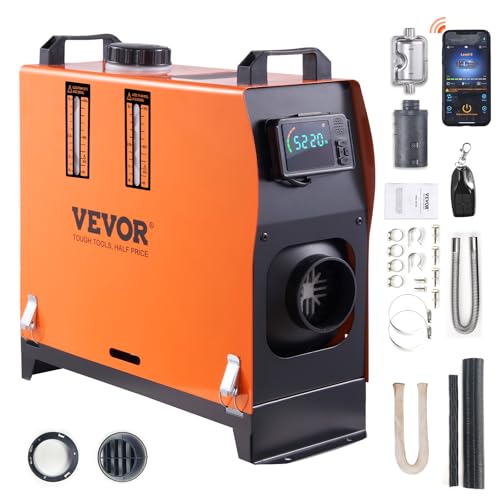
VEVOR 8kW All-in-One Diesel Heater with Bluetooth (5L, 12V)
8 kW (~27,300 BTU/h) · 5 L tank · 0.16–0.62 L/h · 12V DC · Score 75/100
Price: $118.90
This 12V VEVOR had the lowest price of our picks when we checked. The Amazon listing (model XMZ-L-D3) and VEVOR's own product page, which shows the same listing as model XMZ-D1, agree on 8 kW, 12V, a 5 L (1.3 gal) tank, 0.16 to 0.62 L/h, 215 to 269 sq ft, Bluetooth app control and overheat protection at 518°F or above. VEVOR's page adds an operating draw of "12V/3A" (about 36W) and 20.6 lb, and a VEVOR Q&A answer gives a starting current of 13A (VEVOR). The altitude claim is contradictory: the listing's marketing says 18,045 ft, but VEVOR's spec table says "Below 3000 m/9843 ft," so assume 9,843 ft unless VEVOR confirms otherwise. VEVOR's Q&A also says the included 60 cm exhaust pipe "needs to be extended to the outdoors."
Startup draw: About 13A at start (VEVOR Q&A). Running draw: 12V/3A, about 36W (VEVOR). CO alarm: Not listed.
Pros
- ✓ Lowest price of our picks when we checked
- ✓ Published running draw: 12V/3A, about 36W (VEVOR)
- ✓ 8 kW with Bluetooth, remote and LCD control
- ✓ Sold by Amazon.com
Cons
- ✗ 12V DC only, with no AC adapter listed
- ✗ Altitude rating conflicts on VEVOR's own page
- ✗ No CO alarm and no noise rating listed
- ✗ VEVOR's "up to 8 hours" per tank is far below what its fuel figures imply
4. Best for Power-Station Camping

BougeRV 5kW All-in-One Portable Diesel Heater (5L, 110V/12V)
5 kW (~17,100 BTU/h) · 5 L tank · 0.18–0.53 L/h · 12V DC, 110V AC · Score 69/100
Price: $229.99
BougeRV publishes the power figures you need to plan a battery setup. Its product page lists 12V, 5 to 6A working current ("12A when ignited"), 150W starting power, 10 to 60W operating power and 0.18 to 0.53 L/h, and says a 12V/10A (120W) cigarette-lighter port isn't enough to start it (BougeRV). The Amazon listing (model DHG101) adds 110V/12V power, a 5 L tank, altitude adjustment to 9,842 ft, an IPX4 rating for the control panel only, and "XT60 adapter requires 12V 15A+." BougeRV's November 2026 launch release gives about 9 to 27 hours per tank and says the exhaust system "directs combustion gases outside" (BougeRV release). Its September release puts the weight at about 22 lb (release). At 5 kW it puts out the least heat here, which suits a tent or a small van better than a garage. No CO alarm is listed.
Startup draw: 150W / 12A at ignition; 12V 15A+ source for the XT60 adapter (BougeRV). Running draw: 10-60W (BougeRV). CO alarm: Not listed.
Pros
- ✓ Maker publishes startup (150W) and running (10-60W) power draw
- ✓ Runs on 12V DC or 110V AC
- ✓ About 9 to 27 h per 5 L tank (BougeRV)
- ✓ Sold by BougeRV's own store on Amazon
Cons
- ✗ Least heat here: 5 kW (about 17,000 BTU/h)
- ✗ Lowest altitude rating here (9,842 ft)
- ✗ No CO alarm listed; IPX4 covers only the control panel
- ✗ A BougeRV blog post gives a different fuel figure (0.14-0.43 L/h)
Other diesel heaters we checked
We didn't rank two listings that were in stock, because we couldn't find a maker page to confirm their specs. The LF Bros 5 kW N2 (12/24V with a 110V adapter) lists 4,700 to 17,000 BTU and 0.18 to 0.53 L/h on Amazon, but LF Bros' own site publishes no specs for it. A second VEVOR 8 kW CO-alarm listing (model CY5004) gives 0.18 to 0.35 L/h, different from the XMZ-TB20, and we found no VEVOR page for that model number. We also left out split "parking heaters" that need permanent installation through a vehicle floor. They're a different job from the carry-in all-in-ones on this page.
Diesel Heater Comparison Table
Specs from each maker's page and the Amazon listing. "Hours per tank" is our arithmetic from the published tank size and burn rates (tank ÷ L/h), so it shows the range from full power to the lowest setting. It isn't a measurement.
| Heater | Heat | Tank | Fuel use | Hours per tank | Power | Altitude | Noise | CO alarm | Score | Price |
|---|---|---|---|---|---|---|---|---|---|---|
| Hcalory TB MAX2 8kW All-in-One Diesel Heater (7.9L) | 8 kW | 7.9 L | 0.12–0.35 L/h | ~23 h to ~66 h | 12V/24V DC, 110-120V AC | 16,400 | 54.6 dBA | Not listed | 82/100 | $299.99 |
| VEVOR XMZ-TB20 8kW All-in-One Diesel Heater with CO Alarm | 8 kW | 5 L | 0.18–0.4 L/h | ~13 h to ~28 h | 12V/24V DC (Amazon listing adds an adapter option) | Not confirmed | 75 dB max | Yes, auto shut-off | 79/100 | $171.15 |
| VEVOR 8kW All-in-One Diesel Heater with Bluetooth (5L, 12V) | 8 kW | 5 L | 0.16–0.62 L/h | ~8.1 h to ~31 h | 12V DC | Conflicting (9,843 ft in VEVOR spec table, 18,045 ft in its marketing) | Not published | Not listed | 75/100 | $118.90 |
| BougeRV 5kW All-in-One Portable Diesel Heater (5L, 110V/12V) | 5 kW | 5 L | 0.18–0.53 L/h | ~9.4 h to ~28 h | 12V DC, 110V AC | 9,842 | Not published | Not listed | 69/100 | $229.99 |
VEVOR's "up to 8 hours" for the 12V model and BougeRV's "about 9 to 27 hours" are each maker's own runtime claims. Hcalory's 65 hours is at 0.12 L/h. Heat conversions use 1 kW ≈ 3,412 BTU/h (EIA). Sources: Hcalory TB MAX2 page; VEVOR XMZ-TB20 and 8 kW 12V product pages; BougeRV product page and 2026 press releases; Amazon listing bullets for each ASIN.
Can a Power Station Run a Diesel Heater?
Yes, and easily once it's lit. The diesel makes the heat; the electricity only runs the fan, the fuel pump and the controls. The hard part is startup. A glow plug heats the burner until the fuel catches, and that's when the current peaks:
- BougeRV 5 kW: 150W starting power ("12A when ignited"), then 10 to 60W running. BougeRV says a 12V/10A (120W) cigarette-lighter port may not be enough to start it, and the Amazon listing says its XT60 adapter "requires 12V 15A+" (BougeRV).
- Hcalory TB MAX2: the glow plug "draws up to 12A during the 3-5 minute startup sequence," so Hcalory says the source must output at least 15A. The fan also runs 3 to 5 minutes after shut-off to cool the burner (Hcalory). Hcalory doesn't publish a running draw.
- VEVOR 8 kW 12V: "12V/3A" operating, about 36W, with a starting current of 13A in a VEVOR Q&A answer (VEVOR).
- VEVOR XMZ-TB20: VEVOR doesn't publish its current draw. Plan for a startup surge like the others (12 to 13A at 12V) until VEVOR confirms a figure.
That points to three ways to power one. Use a 12V lithium battery wired directly through a fuse, a power station with a high-current 12V port (15A or more), or a power station's AC outlet with the heater's 110V adapter. Many power stations' car sockets are rated 10A, which BougeRV says may not be enough to start its heater, so check the rating on yours before relying on it. For scale, one 8 kW heater puts out about 27,300 BTU/h. A 1,500W plug-in space heater gives about 5,100 BTU/h and would drain a 1 kWh power station in well under an hour.
How Long Will a Battery Run a Diesel Heater?
Our estimate: battery Wh × 0.85 ÷ average running watts. We use two published running draws: VEVOR's 36W for its 12V model, and 60W, the top of BougeRV's 10 to 60W range.
| Battery | Capacity | How to connect | At 36W | At 60W | Score | Price |
|---|---|---|---|---|---|---|
| Jackery Explorer 1000 V2 | 1,024 Wh | AC outlet + the heater's 110V adapter (Hcalory, BougeRV) | ~24 h | ~15 h | 93/100* | $559.00 |
| LiTime 12V 100Ah Group 24 Self-Heating Bluetooth LiFePO4 | 1,280 Wh | Direct 12V with a fused lead (100A BMS) | ~30 h | ~18 h | 81/100* | $368.99 |
| Bluetti Elite 300 | 3,014 Wh | 12V/30A DC port | ~71 h | ~43 h | 89/100* | $1,299.00 |
Estimates, not measurements. Each start adds roughly 150W for about 5 minutes (about 12 Wh) on BougeRV's figures, and running from AC through an inverter and the heater's adapter wastes more than a direct 12V connection, so treat the AC numbers as a best case. *Scores come from our power-station and 12V battery guides, on a different scale from the heater scores above. Cold matters too: lithium batteries can't take a charge below freezing unless they're self-heating, like the LiTime above, so recharge them somewhere warm.
Bluetti Elite 300: built-in 12V/30A port
3,014.4 Wh with a 12V/30A DC port, so a heater's 12 to 13A startup is well within its rating. It runs a 36W heater for about ~71 h, or about five to six 12-hour nights. It weighs about 58 lb and is 120V-only. Full review.
LiTime 12V 100Ah Group 24 Self-Heating Bluetooth LiFePO4
1,280 Wh and a 100A BMS, so the startup surge is no strain. Wire it directly to a 12V heater through an inline fuse. It runs a 36W heater for about ~30 h. Its self-heating lets it take a charge in sub-freezing weather. More options are in our best 12V lithium battery guide.
Building a full van or RV power system around the heater? See our best solar generators for RV and van life and best solar generator for van life guides.
How Much Diesel Does a Diesel Heater Use Per Night?
It depends on the setting. The published burn rates run from 0.12 L/h (Hcalory's lowest) to 0.62 L/h (the 12V VEVOR on full). Over a 10-hour night, that's about 1.2 to 6.2 L (0.3 to 1.6 gal). Most nights land in the low-to-middle part of that range, because a thermostat-controlled heater throttles down once the space is warm. VEVOR's listings say about "1 gallon per night," which sits inside that range. A tight, insulated van uses far less than a drafty garage.
- Hcalory TB MAX2: 7.9 L lasts about ~23 h on high and up to 65 h on low (Hcalory).
- VEVOR XMZ-TB20: 5 L lasts about ~13 h to ~28 h on its 0.18 to 0.4 L/h range. VEVOR's Q&A says the usable tank is about 4.5 L, so expect a little less.
- VEVOR 8 kW 12V: about ~8.1 h to ~31 h by the math. VEVOR itself claims "up to 8 hours," so plan on refilling more often than the arithmetic suggests.
- BougeRV 5 kW: about 9 to 27 h per 5 L tank (BougeRV).
Fill with diesel only, outdoors, with the heater off and cool (Hcalory says to turn the heater off before refueling). Keep the fuel can outside the living space. Hcalory and BougeRV both describe a sealed or leak-resistant fuel cap, but a tank that tips over in a vehicle can still spill.
Can You Use a Diesel Heater Indoors, in a Garage or in a Van?
Only with the exhaust routed outdoors. A diesel air heater burns fuel in a combustion chamber and blows room air across the hot outside of that chamber. The air you feel shouldn't contain exhaust, but the exhaust pipe carries carbon monoxide and must end outside. That's why Hcalory and VEVOR both say the exhaust must vent outdoors, and why CPSC says fuel-burning camping equipment doesn't belong inside a home, garage, vehicle or tent unless it's designed and instructed for that use (CPSC). We won't call any diesel heater "safe indoors." Run one only as its manual says, with the exhaust outside and a CO alarm in the space.
Diesel heater for a garage
Route the exhaust outdoors through a wall or a sealed panel in a door or window. A garage door cracked open is not a vent. If you can't route the exhaust out, set the heater outside and duct the warm air in. Keep fuel cans, rags and paint thinner at least 3 feet from the heat outlet and exhaust (Hcalory), and put a UL 2034 CO alarm inside. CPSC says never leave a car running in an attached garage, even with the door open. The same caution applies to any combustion exhaust that could drift into a garage attached to your house.
Diesel heater for a van, RV or tent
All-in-one heaters are popular in vans and RVs because the unit can sit outside, under the vehicle or in a vented locker, with the warm-air hose fed in. Hcalory's remote reads the actual room temperature, and its exhaust heat wrap protects floors and wiring from an exhaust that can reach 752°F (Hcalory, Amazon listing). Keep the exhaust well away from tent fabric, tires and dry grass. Hcalory warns to route it away from tents, vehicle tires and lawns. Use a CO alarm made for RVs inside the sleeping space (CPSC). If the exhaust can't go outside, turn the heater off before you sleep and use a 12V heated blanket instead.
Product-safety notices we could verify
We found no CPSC recall of a portable diesel air heater when we searched in November 2026. In the UK, the Office for Product Safety and Standards (OPSS) has published product safety reports on two other VEVOR portable diesel heater models: XMZ-W-D3 (published 29 November 2025) and XMZ-F-D1 (published 15 January 2026). For both, OPSS found a serious risk of suffocation because the heaters weren't supplied with appropriate safety information or instructions for use. The 2026 report notes that without proper ventilation users may be exposed to carbon monoxide. The imports were rejected at the border (OPSS 2511-0300; OPSS 2511-0312). Neither report names a model number on this page. Their main lesson applies to every brand, though: don't run a diesel heater that arrived without a full manual and venting instructions.
How Does a Diesel Heater Work?
- Preheat: an electric glow plug heats the combustion chamber. On the TB MAX2 it preheats for 1 minute before ignition and stays on 30 seconds after, and startup takes 3 to 5 minutes. This is when the current draw peaks (Hcalory).
- Fuel and burn: a small pump meters diesel into the chamber, where it burns. The steady ticking you hear is the pump. Hcalory and BougeRV both say their pumps and mufflers are designed to cut that noise.
- Heat exchange: a fan pushes room or outside air across the heat exchanger and out of the warm-air outlet. Combustion gases leave separately through the exhaust pipe, which must vent outdoors.
- Thermostat and shut-down: the controller throttles the pump and fan to hold your set temperature. When you turn it off, the fan keeps running for a few minutes to cool the burner, so leave it powered until it stops (Hcalory).
Carbon builds up in the burner over time. The TB MAX2 has a 20-minute self-cleaning cycle that Hcalory says burns off soot (Amazon listing). On other heaters, frequent short low-power runs make carbon build-up more likely, so follow the manual's cleaning schedule.
Diesel vs Propane vs Kerosene vs Battery Heat
- Diesel air heater: the exhaust is piped outside, it makes 5 to 8 kW of heat while drawing only tens of watts from a battery once running, and a tank can last a day or more. It needs 12V or AC power and a place to route the exhaust.
- Indoor-rated propane (Mr. Heater Buddy): needs no electricity and has a low-oxygen shut-off, but it's unvented and must never run while you sleep. See our best indoor propane heater guide.
- Kerosene wick heater: needs no electricity and runs a long time per gallon, but it's unvented, restricted in some states and cities, and must be off before bed. See our best kerosene heater guide.
- Battery heat (blankets, pads, small heaters): no fumes at all, but a power station can't make room-scale heat for long.
For a cabin or tiny house that's off-grid for weeks, a diesel heater paired with a solar power station covers both heat and lights. Our solar generator for a cabin or tiny house guide sizes the battery side.
Diesel Heater Buying Guide
- Plan the exhaust first. Decide where the pipe will exit: through a wall plate, a window panel, or with the heater outside. If you can't vent it outdoors, don't buy a diesel heater.
- Size the heat. 5 kW (about 17,000 BTU/h) suits tents and vans, and 8 kW (about 27,300 BTU/h) suits RVs, workshops and garages. Hcalory and VEVOR rate their 8 kW all-in-ones for about 215 to 289 sq ft.
- Match the power. Find out what your 12V source can supply at startup. Hcalory and BougeRV call for 15A or more. A 12V/10A car socket may not light it. A 110V adapter lets you use a power station's AC outlet.
- Check altitude. If you camp high, buy a heater whose maker confirms its altitude mode. Ratings here run from 9,842 ft (BougeRV) to 16,400 ft (Hcalory), and VEVOR's figures conflict.
- Budget for a CO alarm and spares. Buy a UL 2034 CO alarm (an RV-rated one for vehicles). Make sure the box includes a full manual and venting instructions.
Every price on this page loads live from Amazon. Stock and prices change quickly, and we can't predict a price or promise a discount on any listing.
Who Should Buy a Diesel Heater (and Who Should Skip)
Good fit
- ✓ Van, RV, truck-camper and ice-shack owners with a 12V battery or power station
- ✓ Detached workshops and garages where the exhaust can exit through a wall
- ✓ Cold-weather campers who can keep the unit and exhaust outside the tent
- ✓ Anyone who wants many hours of heat from a few liters of fuel and well under 100W of running power (on the published figures)
Skip it if
- ✗ You can't route the exhaust outdoors
- ✗ You want heat inside your house during an outage (see our winter storm power backup plan)
- ✗ Your only 12V source is a 10A car socket and you won't add an AC adapter or a bigger battery
- ✗ You won't buy and test a CO alarm
Diesel Heater FAQ
What is the best diesel heater?
In our scoring, the Hcalory TB MAX2 ranks highest: 8 kW, a 7.9 L tank that Hcalory says lasts up to 65 hours on low, 12V, 24V or 110V power, and a published 54.6 dBA. The VEVOR XMZ-TB20 is the only pick with a built-in CO alarm that shuts the heater off. The 12V VEVOR 8 kW costs least, and the BougeRV 5 kW publishes the clearest power figures for battery and power-station use.
Can you use a diesel heater indoors?
Only with the exhaust pipe routed outdoors, and only as the manual says. Hcalory and VEVOR both say the exhaust must vent outside. CPSC says never use portable fuel-burning equipment inside a home, garage, vehicle or tent unless it is designed for enclosed spaces and comes with instructions for safe use there. Install a CO alarm that meets UL 2034 in the space, and never run the heater with its exhaust inside a room where people sleep.
Can a power station run a diesel heater?
Yes, if it can handle the glow-plug startup. BougeRV lists 150W (12A) at ignition and 10 to 60W running, and Hcalory says its glow plug draws up to 12A for the 3 to 5 minute startup and needs a 15A-plus source. A 12V/10A car socket may not be enough, so use a 12V port rated 15A or more, a 12V lithium battery, or the AC outlet with the heater's 110V adapter. A 1,024 Wh Jackery Explorer 1000 V2 runs a 36W heater for about 24 hours by our math.
How much diesel does a diesel heater use per night?
The makers' figures run from 0.12 to 0.62 liters per hour depending on the setting, or about 1.2 to 6.2 liters (0.3 to 1.6 gallons) over 10 hours. Hcalory says its 7.9 L TB MAX2 lasts up to 65 hours on low, and BougeRV gives about 9 to 27 hours for its 5 L tank. Insulation and outside temperature make a big difference.
Can I use a diesel heater in my garage?
Only if the exhaust exits outdoors through a wall, window panel or door seal, or the heater sits outside with its warm air ducted in. A cracked garage door doesn't count as venting. Keep fuel, rags and solvents at least 3 feet from the heat outlet and exhaust, as Hcalory advises, and put a UL 2034 CO alarm in the garage. Be especially careful with a garage attached to your house.
Can you sleep with a diesel heater running in a van or RV?
Only if the exhaust is routed outside through a sealed fitting, the heater is set up as its manual says, and a working CO alarm made for RVs is in the sleeping space. CPSC says never operate unvented fuel-burning appliances in any room where people are sleeping, and an all-in-one heater whose exhaust ends inside is unvented. If you can't vent it outdoors, turn it off before bed and use a 12V heated blanket.