
Research Review · Updated November 2026
ECO-WORTHY Battery Review: Are ECO-WORTHY Lithium Batteries Good?
Yes, for budget DIY solar, with one check per model. Every ECO-WORTHY battery here uses LiFePO4 cells with a built-in BMS, and ECO-WORTHY publishes the BMS current, cut-off voltages and low-temperature charging limits. For an RV or van, the 12V 100Ah (Group 24) or the 12V 314Ah (200A BMS) covers most builds. For a 48V home or cabin system, the Cubix100 is the one with a UL 1973 listing we could trace to the certifier.
As an Amazon Associate, SolarGenAdvisor earns from qualifying purchases made through links on this page, at no additional cost to you. This is a research-based review built from ECO-WORTHY’s datasheets, listings and certification records; we did not test these batteries.
 By Taylor Kim
Reviewed & approved by Juhi Sahni
|
Published: November 15, 2026
|
Updated:
|
ECO-WORTHY brand hub
Is an ECO-WORTHY Battery Good? The Facts
“Good” for a lithium battery comes down to five things a buyer can check before paying: the cell chemistry, the BMS limits, the cycle rating, the warranty and the safety listing. Here is what ECO-WORTHY publishes for each, and where we could confirm it.
| What to check | What ECO-WORTHY publishes |
|---|---|
| Cell chemistry | Lithium iron phosphate (LiFePO4) across the 12V and 48V range; the datasheets describe “A class cells” (a maker’s claim) (ECO-WORTHY 12V 100Ah datasheet (v2.0), ECO-WORTHY 12V 280Ah datasheet (v2.0)). |
| BMS | 100A on the 12V 100Ah, 200A on the 12V 280Ah and 314Ah, 100A maximum (50A recommended) per 48V pack. The 12V BMS stops charging below -7°C (19.4°F) and resumes at -2°C, per the datasheets. |
| Cycle rating | 4,000 cycles (12V 100Ah datasheet), 6,000 (12V 280Ah datasheet), 6,000+ (Cubix100 Pro listing). None of these states a depth of discharge, and no ECO-WORTHY cycle figure is independently confirmed, so treat them as the maker’s claims. |
| Warranty | 10-year limited warranty on the 48V Cubix and wall-mount listings; 3 years on the 12V 100Ah listings we checked. Terms vary by listing, so read the warranty line before you buy. |
| Safety listing | Cubix100 (model ECO-LFP4810002): UL 1973 by Intertek, on the California Energy Commission Battery List. The Cubix100 Pro and wall-mount listings name no UL certification. The 12V datasheet labels show UN38.3 (lithium transport testing), FCC, CE and RoHS marks; we found no UL listing claimed for the 12V batteries. |
| Recalls | We found no CPSC recall of an ECO-WORTHY product when we searched cpsc.gov recalls on November 15, 2026. |
Our read: on paper, ECO-WORTHY’s batteries publish the same core specs as other budget LiFePO4 brands, and the Cubix100 is one of the few low-cost 48V rack batteries on Amazon whose UL 1973 listing we could trace. Two habits make an ECO-WORTHY purchase go well. First, match the model number to the certificate: The Solar Lab’s review of an earlier ECO-WORTHY 48V rack battery reported that it was not UL listed, while the Cubix100 listing covers model ECO-LFP4810002 specifically. Second, read the current listing, because ECO-WORTHY updates batteries under the same listing (300Ah to 314Ah, for example) and its own documents sometimes disagree on weights and expansion limits.
ECO-WORTHY says it was founded in 2007 and sells panels, kits, inverters and batteries, not only batteries. Its whole range, including the complete kits these batteries ship in, is on our ECO-WORTHY brand hub.
ECO-WORTHY Battery Lineup Compared
Specs come from our product database, which cites each figure’s source; where sources disagree we say so rather than pick one. The 12V batteries are compared on the same 12V LiFePO4 battery criteria as our best 12V lithium battery guide. The 48V batteries are not scored yet: that rubric doesn’t fit a 48V rack battery, where safety listings and inverter communication matter more, so we will score them when we add a 48V rubric.
| Battery | Voltage / Ah | kWh | Weight | Bluetooth | Self-heating | Warranty | Price |
|---|---|---|---|---|---|---|---|
| 12V 100Ah (Group 24) | 12.8V / 100Ah | 1.28 | ~21–23 lb (sources differ) | Yes | No; charge cut-off below 19.4°F | 3 yr (listings) | Check price at Amazon → |
| 12V 280Ah | 12.8V / 280Ah | 3.58 | 62.8 lb (28.5 kg, datasheet) | Yes (v2.0) | No; charge cut-off below 19.4°F | Check listing | Not tracked (see below) |
| 12V 314Ah | 12.8V / 314Ah | 4.02 | 60.4 lb | Yes | No; charge cut-off below 19.4°F | Check listing | Check price at Amazon → |
| Cubix100 (rack) | 51.2V / 100Ah | 5.12 | 103 lb | Yes + WiFi | Not listed | 10 yr limited | $859.99 |
| Cubix100 Pro (rack) | 51.2V / 100Ah | 5.12 | 103.6 lb | Yes + WiFi | No heater; ECO-WORTHY claims -4°F charging | 10 yr limited | Check price at Amazon → |
| 48V wall-mount | 51.2V / 100Ah | 5.12 | 97 lb (Amazon) | Yes + WiFi | Not listed | 10 yr | $829.99 |
| Cubix100 2-pack | 51.2V / 2 × 100Ah | 10.24 | 2 × 10³ lb | Yes + WiFi | Not listed | 10 yr limited | $1,699.99 |
| Cubix100 4-pack | 51.2V / 4 × 100Ah | 20.48 | 4 × 10³ lb | Yes + WiFi | Not listed | 10 yr limited | $3,359.99 |
Weights: 12V 100Ah 23.15 lb on Amazon and 21.2 lb on eco-worthy.com; 48V wall-mount 97 lb on Amazon and 110 lb at a US retailer. The 280Ah row comes from ECO-WORTHY 12V 280Ah datasheet (v2.0); it is not a listing we track. “Not listed” means we found no self-heating claim. Prices load live from Amazon and change often.
12V 100Ah: the RV, van, boat and trolling-motor battery

ECO-WORTHY 12V 100Ah LiFePO4 Battery with Bluetooth (Group 24)
A Group 24 case (about 10.2 × 6.6 × 8.2 in on ECO-WORTHY’s datasheet) with a 100A BMS, Bluetooth monitoring and a charging cut-off below 19.4°F (-7°C). ECO-WORTHY’s v2.0 datasheet lists 100A maximum charge and discharge, 50A recommended charging, a 14.4V absorption voltage and a 4,000-cycle rating, without saying at what depth of discharge (ECO-WORTHY 12V 100Ah datasheet (v2.0)). Weight differs by source (about 21 to 23 lb). The Amazon and UK retailer listings we checked give a 3-year warranty (YPC listing).
Best for: Fits a standard battery tray and a 1,000W-class inverter. For a bigger inverter, use two in parallel or the 314Ah.
12V 314Ah: the big single house battery

ECO-WORTHY 12V 314Ah LiFePO4 Battery with Bluetooth
ECO-WORTHY’s largest 12V battery: 314Ah, 4,019.2 Wh, a 200A BMS, Bluetooth, SOC LEDs on the case and a charging cut-off below 19.4°F, at 60.4 lb (Amazon listing; ECO-WORTHY UK’s EnergyTrek 314Ah page, where it is sold as the EnergyTrek). The Amazon listing says it moved from 300Ah to 314Ah in April 2026, so older reviews may describe the 300Ah. We could not find a cycle rating or warranty term for this model on ECO-WORTHY’s pages, so check the listing before you buy.
Best for: One battery for a 2,000W inverter in a fifth-wheel, cabin or van. It does not fit a standard Group 24/27/31 tray.
48V Cubix100: the server-rack battery with a traceable UL 1973 listing
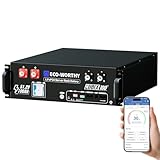
ECO-WORTHY Cubix100 48V 100Ah Server Rack LiFePO4 Battery
Not scored yet (no 48V battery rubric)
Price: $859.99
A 51.2V 100Ah (5.12 kWh) LiFePO4 pack for a 19-inch rack. Intertek’s Authorization to Mark covers model ECO-LFP4810002 to UL 1973 (Intertek Authorization to Mark (hosted by ECO-WORTHY)), and the same model is on the California Energy Commission Battery List with a certificate dated July 16, 2025. It talks to the inverter over CAN or RS485, reports over Bluetooth and WiFi, and ECO-WORTHY allows up to 32 in parallel. A retailer spec sheet lists 100A maximum continuous current, 50A recommended, and a 58.4V maximum charge (Current Connected spec sheet). The listing gives a 10-year limited warranty; it does not state a cycle rating. It weighs 103 lb.
Best for: The ECO-WORTHY 48V battery to pick when an inspector or permit asks for a UL 1973 listing.
48V Cubix100 Pro: touchscreen and a named inverter list

ECO-WORTHY Cubix100 Pro 48V 100Ah Server Rack LiFePO4 Battery
Not scored yet (no 48V battery rubric)
The same 5.12 kWh in a rack case with a 4.3-inch touchscreen, Bluetooth and WiFi, and a closed-loop list ECO-WORTHY names on the listing: EG4, Sol-Ark, DEYE, SRNE, Victron, Growatt and Sungoldpower. ECO-WORTHY claims 6,000+ cycles (depth of discharge not stated), charging down to -4°F and a 10-year limited warranty. A retailer lists the Pylon protocol as the default (Current Connected spec sheet). Its listing names no UL certification, and we did not find the model on the CEC battery list.
Best for: An off-grid cabin or shop where you have confirmed which listing, if any, your inspector requires.
48V wall-mount: 5.12 kWh without a rack

ECO-WORTHY 48V 100Ah Wall-Mount Indoor LiFePO4 Battery
Not scored yet (no 48V battery rubric)
Price: $829.99
51.2V 100Ah in an indoor wall-hung case with Bluetooth and WiFi, a built-in aerosol fire-suppression module and CAN/RS485 (Pylon protocol by default, per a Current Connected spec sheet). Amazon lists 97 lb and that retailer 110 lb, so plan for two people. The listing gives a 10-year warranty and names no UL certification.
Best for: A garage or utility-room wall in a home without a battery rack.
Need more than one Cubix100? ECO-WORTHY sells it as a 2-pack (10.24 kWh) and a 4-pack (20.48 kWh); the 4-pack listing says the parallel and communication cables are in the box.
ECO-WORTHY 280Ah Battery: What It Is
The ECO-WORTHY 12V 280Ah is a 12.8V LiFePO4 battery that stores about 3,584 Wh (12.8V × 280Ah). ECO-WORTHY’s v2.0 datasheet lists a 200A maximum discharge, 160A maximum charge (140A recommended), Bluetooth, no self-heating, a charging cut-off at -7°C that resets at -2°C, a 6,000-cycle rating and 28.5 kg (about 62.8 lb) in a 453 × 238 × 221 mm case (ECO-WORTHY 12V 280Ah datasheet (v2.0)). An ECO-WORTHY’s earlier 280Ah datasheet describes a different version, without Bluetooth or a low-temperature cut-off and in a longer 21-inch case, so two batteries both sold as “280Ah” may not be the same product. Check the listing photos and spec table for Bluetooth and the cut-off.
ECO-WORTHY has since moved several 12V batteries up to 314Ah, and we do not track a standalone 280Ah listing. For about 12% more capacity (4,019 Wh against 3,584 Wh, our arithmetic) the 12V 314Ah is the current equivalent, with the same 200A BMS. The 280Ah still ships inside ECO-WORTHY’s 400W “Ultra” complete kit, with four 100W panels, a 40A MPPT controller and a 2,000W inverter.
12V vs 48V: Which ECO-WORTHY Battery?
Pick the voltage your inverter uses, not the battery you like. At the same power, a 48V system draws a quarter of the current of a 12V one (2,000W is about 156A at 12.8V and 39A at 51.2V, our arithmetic), so cables, fuses and losses shrink as systems grow.
Choose 12V if…
- ✓ It goes in an RV, van, boat or trailer whose lights, pump and fridge already run on 12V
- ✓ Your inverter is about 2,000W or less (the 314Ah’s 200A BMS covers about 2,500W at 12.8V)
- ✓ You want a battery you can lift and replace on your own
Compare with other brands in our best 12V lithium batteries and best LiFePO4 batteries for RVs guides, and the panels to feed it in best RV solar kits.
Choose 48V if…
- ✓ It backs up a home, cabin or shop through a 48V all-in-one or hybrid inverter
- ✓ You want 5 kWh or more and will add packs later
- ✓ You want closed-loop CAN/RS485 communication with the inverter
Compare with Fortress and other 48V packs in our best lithium batteries for solar storage guide, or see complete systems in DIY solar panel kits.
Runtime, roughly: usable energy is about 85% of the rated Wh after inverter losses. A 100Ah (1,280 Wh) battery runs a 100W load for about 11 hours; a 314Ah runs it for about 34 hours; one Cubix100 (5,120 Wh) runs a 500W essentials load for about 8.7 hours (our arithmetic: Wh × 0.85 ÷ watts). For the full load worksheet, use our solar size calculator.
Series and Parallel: ECO-WORTHY’s Stated Limits
Parallel adds amp-hours at the same voltage; series adds voltage. ECO-WORTHY’s own documents give different limits for its 12V batteries, so the safe plan is the most conservative one, confirmed against the manual that comes with your battery.
- •12V 100Ah and 280Ah: the v2.0 datasheets say “up to 16 batteries can be connected in series or parallel to make a 48V battery pack”, which their diagrams show as 4 in series for 48V (ECO-WORTHY 12V 100Ah datasheet (v2.0); ECO-WORTHY 12V 280Ah datasheet (v2.0)). ECO-WORTHY’s LiFePO4 user manual adds that it does not recommend more than 4 batteries in parallel, so the auto-balancing works as intended (ECO-WORTHY LiFePO4 user manual).
- •12V 314Ah: ECO-WORTHY lists expansion up to 4P2S or 2P4S, eight batteries and 32.15 kWh in all (ECO-WORTHY UK’s EnergyTrek 314Ah page; YPC listing), and says to use the same brand and model throughout.
- •Same batteries only: the manual says not to parallel batteries of different chemistry, brand, model, rated capacity or nominal voltage, to keep the voltage difference between paralleled batteries small, and to use equal-length cables between them (ECO-WORTHY LiFePO4 user manual). In practice: charge each battery fully on its own before you connect them.
- •48V Cubix and wall-mount: these grow in parallel only. ECO-WORTHY allows up to 32 packs in parallel, with CAN/RS485 communication between them; a retailer spec sheet lists 50A recommended and 100A maximum continuous current per pack (Current Connected spec sheet). We found no ECO-WORTHY statement allowing these 51.2V packs in series. Ask ECO-WORTHY before mixing a Cubix100 and a Cubix100 Pro in one bank.
- •Fusing: ECO-WORTHY’s manual says to use breakers, fuses or disconnects sized by a certified electrician, licensed installer or local code authority (ECO-WORTHY LiFePO4 user manual). We do not publish wiring diagrams; a 48V home system usually needs a permit and an electrician.
Charge settings for each voltage, and what the BMS does when one is wrong, are in our LiFePO4 charging guide. Need a charger? See best LiFePO4 battery chargers. For what the BMS current and cut-off figures on these datasheets mean in use, see our guide to what a battery BMS does.
ECO-WORTHY Battery Warranty
At our November 15, 2026 check, the 48V Cubix100, Cubix100 Pro, 2-pack, 4-pack and wall-mount listings gave a 10-year (limited) warranty. For the 12V 100Ah, the Amazon and UK retailer listings we checked gave 3 years. We could not find a warranty term on ECO-WORTHY’s own pages for the 12V 314Ah, so read the listing before you buy. ECO-WORTHY’s UK store describes its battery warranty as limited to defects in materials, workmanship and performance during the warranty period (ECO-WORTHY UK’s EnergyTrek 314Ah page).
ECO-WORTHY’s manual also lists what the maker will not cover, including misuse, improper installation and alterations made without its written consent (ECO-WORTHY LiFePO4 user manual). Keep your proof of purchase, and photograph the label and wiring after installation.
ECO-WORTHY Battery FAQ
Is ECO-WORTHY a good battery brand?
For budget DIY solar, yes, on the published facts. ECO-WORTHY batteries use LiFePO4 cells with a built-in BMS, and ECO-WORTHY publishes BMS current, charge voltages and low-temperature charging limits. Its datasheets rate the 12V 100Ah for 4,000 cycles and the 280Ah for 6,000, the 48V Cubix listings give a 10-year limited warranty, and the Cubix100 (model ECO-LFP4810002) has a UL 1973 listing from Intertek that appears on the California Energy Commission battery list. We found no CPSC recall of an ECO-WORTHY product on November 15, 2026. Check each listing, because specs and certifications differ by model.
Which ECO-WORTHY battery should I buy?
For an RV, van, boat or trolling motor, the 12V 100Ah Group 24 with Bluetooth. For one big 12V house battery feeding an inverter up to about 2,000W, the 12V 314Ah with its 200A BMS. For a 48V home or cabin system, the Cubix100 server-rack battery if you need a UL 1973 listing, the Cubix100 Pro if you want a touchscreen and its named inverter list, or the wall-mount model if you have no rack.
What are the specs of the ECO-WORTHY 280Ah battery?
ECO-WORTHY’s v2.0 datasheet lists 12.8V and 280Ah (about 3,584 Wh), a 200A maximum discharge, 160A maximum charge, Bluetooth, a charging cut-off at -7°C, 6,000 cycles and 28.5 kg (about 62.8 lb). An earlier version had no Bluetooth or low-temperature cut-off, so check the listing. ECO-WORTHY has since moved several 12V batteries to 314Ah (4,019 Wh) with the same 200A BMS.
How many ECO-WORTHY batteries can I connect in parallel or series?
For the 12V batteries, ECO-WORTHY’s datasheets show up to 4 in series (48V) and its user manual recommends no more than 4 in parallel; for the 12V 314Ah it lists up to 4P2S or 2P4S (eight batteries). Use identical batteries of the same model. The 48V Cubix batteries connect in parallel only, up to 32 packs per ECO-WORTHY. Confirm with the manual for your model.
Do ECO-WORTHY batteries have self-heating?
Not the 12V batteries on this page. ECO-WORTHY’s datasheets list no self-heating; instead the BMS stops charging below -7°C (19.4°F) and resumes at -2°C. The 48V Cubix100 Pro has no heater either, but ECO-WORTHY claims it can charge at -4°F. If your battery must charge in freezing weather, keep it in a heated space or choose a self-heating battery from our 12V lithium battery guide.
Are ECO-WORTHY 48V batteries UL listed?
The Cubix100, model ECO-LFP4810002, is: Intertek’s Authorization to Mark covers it to UL 1973, and it is on the California Energy Commission battery list with a certificate dated July 16, 2025. The Cubix100 Pro and the 48V wall-mount listings name no UL certification, and we did not find them on the CEC list. The Cubix100 listing also claims UL 9540, which covers a battery and inverter as a system; we could not retrieve that certificate, so ask ECO-WORTHY which inverter it covers.
Do ECO-WORTHY 48V batteries work with my inverter?
Often. The Cubix batteries communicate over CAN and RS485, and ECO-WORTHY lists closed-loop pairing with EG4, Sol-Ark, DEYE, SRNE, Victron, Growatt and Sungoldpower for the Cubix100 Pro. A retailer lists the Pylon protocol as the default. Check your inverter maker’s approved battery list and set the matching protocol; in open loop, enter the battery’s own charge voltages.
How long do ECO-WORTHY lithium batteries last?
ECO-WORTHY rates the 12V 100Ah for 4,000 cycles, the 12V 280Ah for 6,000 and the Cubix100 Pro for 6,000+, without stating a depth of discharge. At one full cycle a day, 4,000 cycles is about 11 years. These are maker’s claims; heat, high charge rates and long storage at full charge shorten life.