
Battery Makers’ Docs + UL · Updated November 2026
What Is a Battery BMS? What It Does in a LiFePO4 Battery and a Power Station
The short answers
- BMS meaning
- Battery management system: the circuit board inside a lithium battery or power station that watches each cell’s voltage, the current and the temperature, and disconnects the battery when one goes past a limit [1][20].
- What it protects against
- Overcharging, over-discharging, too much current, short circuits, overheating, and charging when the cells are too cold [1][2].
- What else it does
- Balances the cells near full charge, estimates state of charge, and on “smart” batteries reports it over Bluetooth [1][2][20].
- What it can’t do
- Make charging below freezing safe. A plain BMS just blocks it; only a battery with a built-in heater can charge in the cold [3][6].
Jump to what “100A BMS” means on a spec sheet, a BMS trip that looks like a dead battery or power stations and UL 2743.
As an Amazon Associate, SolarGenAdvisor earns from qualifying purchases made through links on this page, at no additional cost to you.
 By
What a BMS Does
A 12V LiFePO4 battery is four cells in series inside one case, and the BMS sits between those cells and the terminals. Battle Born describes it as monitoring individual cell voltage, pack voltage, charge and discharge current and internal temperature, and disconnecting the battery from the load or charger when any of them leaves its safe range [1]. Battery University puts it the same way: the BMS disconnects the battery if set limits are exceeded [20]. Victron’s charger manual explains why lithium needs this: Li-ion batteries “are very sensitive to under voltage or over voltage,” so they usually carry cell balancing and under-voltage protection circuitry [17]. Battery University’s comparison table lists a protection circuit as mandatory for every lithium-ion type but not for lead-acid or nickel-based batteries, as our guide to the types of batteries explains.LiFePO4 chemistry makes thermal runaway much less likely than with NMC lithium, as our LiFePO4 solar generator guide explains, but it is still the BMS that stops a wrong charger, a short or a frozen battery from doing damage.
| Function | What the BMS does | Published examples (12V LiFePO4) |
|---|---|---|
| Over-voltage (overcharge) | Disconnects the charger when the pack or a cell goes too high. | Battle Born 14.7 V [2]; LiTime 15.0 V, resumes below 14.2 V [6] |
| Under-voltage (over-discharge) | Disconnects the load before the cells are drained far enough to be damaged. | Battle Born 10 V [2]; LiTime 10.8 V [6]; Victron 2.80 V per cell by default [15] |
| Over-current | Cuts off a load that draws more than the BMS rating for longer than it allows. | Battle Born BB10012: 100 A continuous, 200 A for 30 seconds [2] |
| Short circuit | Detects a short and disconnects almost instantly. | Listed by Battle Born [1][2]; numeric trip points are rarely published |
| High temperature | Stops charging or discharging when the cells get too hot. | Battle Born cuts off above 135 °F [2] |
| Low-temperature charge block | Refuses to charge cold cells; discharging usually continues. | Varies by maker: 24–25 °F (Battle Born), 32 °F (Renogy, Power Queen), 41 °F / 5 °C (Victron default) (details) |
| Cell balancing | Evens out the cells, usually at the top of the charge. | Battle Born balances at about 14.2–14.6 V [1][2]; Victron only during absorption [16] |
| State of charge and data | Counts amp-hours in and out; smart batteries send it to an app. | Coulomb counting [20]; Battle Born smart models report SOC history over Bluetooth [2] |
Figures are each maker’s own published settings for the models cited, not limits that apply to every battery. Check the manual for yours.
Low-Temperature Charge Cutoff
This is the BMS feature most likely to surprise a new owner. Lithium cells should not be charged below freezing: charging cold cells causes lithium plating, which permanently costs capacity, as our LiFePO4 guide explains. Victron’s charger manual puts it bluntly: never charge a Li-ion battery below 0 °C (32 °F) [17]. LiTime says not to charge normally below 0 °C and to warm the battery above 5 °C first [6]. The BMS enforces this with a temperature sensor on the cells, and the exact switch point differs by maker:
- Battle Born: its winterizing FAQ says the battery won’t accept a charge below an internal 24 °F [4], while its data sheet lists a 25–135 °F charge range and its temperature guide says about 25 °F [2][3]. Discharge continues down to -4 °F.
- Power Queen and Renogy: charging starts at 32 °F. Power Queen’s Group 24 Smart resumes at 41 °F [12][14].
- Victron Lithium Battery Smart: its BMS blocks charging below 5 °C (41 °F) by default, and Victron says setting it lower voids the warranty [15].
- Power stations: the same rule, built in. Anker lists 32–104 °F for charging the SOLIX C1000 Gen 2 but -4 to 104 °F for discharging [23][24].
A few makers set their cut-off below freezing; ECO-WORTHY’s 12V datasheets list -7 °C (19.4 °F), as covered in our ECO-WORTHY battery review. Our planning rule stays the conservative one: don’t charge a LiFePO4 battery below 32 °F (0 °C) unless it has a built-in heater. The practical effect of a cut-off is that solar or alternator charging simply stops on a cold morning. That’s normal and isn’t a fault; our guide to charging a LiFePO4 battery covers what to do about it.
Self-Heating Batteries
A self-heating battery adds heating pads inside the case, and the BMS warms the cells before it lets them charge. LiTime’s Group 24 self-heating model, for example, heats below 41 °F when a charger is connected and starts charging from 50 °F [7]. Battle Born’s heated models switch on at an internal temperature of about 35 °F and draw 28 W while heating [2].
Heat isn’t free. Battle Born’s data sheet shows its heated 100 Ah battery using about 21 Ah over 24 hours at 25 °F, 32 Ah at 15 °F and 48 Ah below 10 °F [2]. In the coldest case that’s almost half the battery in a day (our arithmetic), so a heater makes sense when you have a charging source to run it, such as solar, shore power or an alternator, and isn’t a way to store a battery in a frozen barn. If the battery lives indoors or never has to charge below freezing, a plain low-temperature cut-off does the job.
Cell Balancing: Passive vs Active
Cells are matched when a pack is built, but Texas Instruments notes that over time an imbalance in state of charge can develop between them and reduce the pack’s overall capacity [18]. That matters because the BMS acts on the first cell to reach a limit: Victron’s BMS disables the charger as soon as one cell reaches 3.75 V and turns the loads off when one cell falls to its 2.80 V setting [16][15]. Out-of-step cells end the charge early and the discharge early.
- Passive balancing bleeds a little current from the highest cells through a resistor (or bypasses current around them) so the others catch up. It works during charging, is cheap and simple, and the bled energy becomes heat. It keeps the cells even but doesn’t add run time [18][19]. Battle Born says its BMS balances passively at about 14.2–14.6 V [1].
- Active balancing moves charge from fuller cells to emptier ones, during both charge and discharge. That can increase usable capacity and cut balancing heat, but it needs a more complex, larger circuit [19]. Few 12V drop-in batteries say which method they use.
What this means for you: balancing happens near full charge, so a battery that is never fully charged never gets the chance. Victron says its batteries balance only in the absorption stage, and a big correction can take up to a few days [16]. Charge to the full absorption voltage now and then (14.2–14.6 V for most 12V LiFePO4 [2]) and let the current taper. Balancing also works only inside one battery: it can’t even out two batteries wired in series [15].
State of Charge and Bluetooth
A LiFePO4 battery’s voltage barely moves through most of its charge. LiTime’s chart has a 12V battery at about 13.4 V at 90%, 13.2 V at 50% and 13.0 V at 20% [11], so a few tenths of a volt cover most of the battery. That’s why a smart BMS counts charge instead: Battery University describes a BMS programmed with the rated capacity that measures the coulombs flowing in and out [20]. Our battery voltage chart has the voltage tables for when you only have a meter.
Don’t treat the percentage as exact. Battery University gives state-of-charge accuracy of about ±10% on a new battery, dropping to 20% or worse as it ages [20]. A Bluetooth BMS sends that estimate to a phone app, often with more detail: for LiTime’s 12V 320Ah, the app shows state of charge, cell voltages, temperature and cycle count [10]. Battle Born’s smart batteries add error warnings and list RV-C and NMEA 2000 compatibility, with some protocols still to come [2]. A battery without Bluetooth still has a BMS; you just need a shunt monitor to see the numbers.
BMS Ratings on a 12V Spec Sheet
A “100A BMS” is the continuous current the battery will deliver before it cuts off. The peak figure is for a few seconds at most, such as a motor or compressor starting, and its duration matters as much as the amps: Battle Born’s BB10012 allows 200 A for 30 seconds [2], while the batteries below list 500 A or more for about one second. To see what that means for an inverter:
We use 12 V rather than the nominal 12.8 V because the battery sags toward the end of its charge and draws more amps for the same watts; 0.85 is our planning allowance for inverter losses, not a measured figure. On that basis a 100 A BMS supports about 1,020 W of AC load and a 200 A BMS about 2,040 W. A 100 Ah battery runs a 100 W load for about 11 hours (our arithmetic). Bigger inverters need a bigger BMS or batteries in parallel; Battle Born notes that parallel batteries raise surge capacity proportionally [1].
| Battery | BMS continuous | Peak | AC load it supports | Low-temperature protection | Bluetooth | Price |
|---|---|---|---|---|---|---|
| LiTime 12V 100Ah Group 24 Self-Heating Bluetooth LiFePO41,280 Wh · 22.71 lb | 100 A | 500A / 1 s | ~1,020 W | Self-heating: heats below 41°F on a charger, charges from 50°F; charge range -4°F to 122°F | Yes | $313.64View on Amazon → |
| Power Queen 12V 100Ah Group 24 Smart Bluetooth LiFePO41,280 Wh · 22.2 lb | 100 A | 500A / 1 s | ~1,020 W | Charge cut-off below 32°F (resumes at 41°F); discharge cut-off below -4°F | Yes | $231.99View on Amazon → |
| LiTime 12V 320Ah Mini Bluetooth LiFePO4 (200A BMS)4,096 Wh · 57.17 lb | 200 A | at least 600A / 1 s (LiTime figures vary) | ~2,040 W | Charge cut-off below 32°F (charge range 32-122°F); no heater | Yes | $634.94View on Amazon → |
Specs from our product database, cross-checked against each maker’s listing [7][12][8][9]. “AC load it supports” is our arithmetic from the continuous rating, not a test result.
Two other spec-sheet lines are BMS settings too. Max charge current (Battle Born: 50 A on a 100 Ah battery [2]) caps your charger size. Charge and discharge temperature ranges are the cut-offs described above. For picks by use, see the best 12V lithium batteries and the best LiFePO4 batteries for an RV.
BMS Trips That Look Like a Dead Battery
When the BMS disconnects, the terminals can read very low or close to 0 V even though the cells are fine, and Victron notes that some chargers won’t recognize a battery whose under-voltage protection has tripped [17][6]. Match the symptom to the cause:
- Ran flat (under-voltage): Battle Born’s low-voltage disconnect typically kicks in at about 10 V, and it says to recharge promptly, ideally within five days [5].
- Overload or short: the battery cut out as a big load switched on. Battle Born says its protection resets after five seconds in most fault conditions, or when the battery is disconnected from the loads [2].
- Too cold: the battery runs loads but won’t charge. Nothing to reset; it charges once the cells warm past the cut-off [16][3].
- Wrong charger: a charger that pushes past the over-voltage limit (14.7 V on Battle Born’s BB10012, 15.0 V on LiTime) makes the BMS disconnect it [2][6]. Lead-acid repair and desulfation modes are the usual culprits; our LiFePO4 charging guide lists the settings to avoid.
How makers say to reset it
- Disconnect all loads and chargers, then wait. Battle Born says 5–10 minutes [5]; LiTime says 30 minutes, after which the battery may recover above 10 V on its own [6].
- Connect a compatible LiFePO4 charger. Battle Born says the battery typically exits low-voltage disconnect once a compatible charging source is applied [5]. If yours won’t start, LiTime says to use a charger with a lithium activation function [6]. Victron’s Blue Smart IP65 resets a tripped under-voltage protection automatically and starts from 0 V; disconnect loads first and reconnect them once bulk charging starts [17].
- Charge it all the way to full so the BMS can rebalance the cells [5].
- Know when to stop. Battle Born warns never to force-charge a deeply discharged battery from an unregulated source [5]. Victron says a cell below 2.5 V is permanently damaged and recovery is not guaranteed [16]. If the battery won’t wake, contact its maker.
Our charger guide walks through waking a LiFePO4 battery whose BMS shut off and compares the best LiFePO4 battery chargers with 0 V activation.
Series and Parallel Limits
Every battery in a bank has its own BMS, and they don’t talk to each other on most drop-in batteries, so makers cap how many you can combine:
| Maker (model) | Series | Parallel | Condition |
|---|---|---|---|
| Battle Born (BB10012) | Up to 48 V | No limit | Data sheet [2] |
| LiTime (12V range) | 4 | 4 (16 batteries max) | Identical batteries; charge each fully and connect in parallel for 12–24 hours first [6] |
| Victron (Lithium Battery Smart 12.8V) | 4 | 20 (20 total in series/parallel) | Fully charge and balance each battery before connecting in series [15] |
The series limit is the one that matters most. Each battery’s BMS only balances its own cells [15], so in a series string one battery can drift higher than the other and trip its BMS early. Victron recommends a separate battery balancer for series strings [15]. Your battery’s manual is the authority; limits differ by model even within one brand.
The BMS in a Power Station: UL 2743 and UL 9540
A portable power station has the same kind of BMS, sealed inside with the charger and inverter, so there’s nothing to set. You see it working when the station refuses to charge in a cold car, shuts off an overload, or stops at its low-battery cut-off. Anker’s SOLIX C1000 Gen 2, for example, charges only between 32 and 104 °F but discharges from -4 °F [23][24].
The safety listing you’ll see on power stations is UL 2743, the Standard for Portable Power Packs. UL describes it as covering batteries in an enclosure used as a portable power source when grid power isn’t available [22], and caps its scope at 20 kWh of lithium-ion; a larger product must be certified to UL 9540 [21]. UL 9540 is the standard for stationary energy storage systems, and UL says the model installation codes require a UL 9540 listing when batteries are installed as a home’s energy storage system [21].
- For plug-in use (camping, outages, running appliances from the outlets), UL 2743 is the relevant listing.
- For wiring into a home as stationary storage, UL says a pack certified only to UL 2743 is not certified to the correct standard, and that combining separately certified products in the field doesn’t make a certified (listed) system [21]. Ask the maker which configuration carries a UL 9540 listing, and use a licensed electrician.
- Check who certified it. UL’s guidance is to confirm a certification’s scope with the certifying organization [21]. A listing mark on the label or in the manual names the lab.
A listing doesn’t replace following the maker’s temperature and charging rules. Why most stations now use LiFePO4 cells is covered in our LiFePO4 solar generator guide.
Batteries, Chargers and a Station
Each pick below shows one of the BMS features above in a product you can buy, grouped by type. Scores come from our published methodology, synthesized from makers’ specs, logged Amazon prices and Amazon customer reviews.
12V LiFePO4 Batteries
Three ways a battery’s BMS handles the cold and high loads: a heater, a plain low-temperature cut-off, and a 200 A BMS for a big inverter.
Self-Heating BMS

LiTime 12V 100Ah Group 24 Self-Heating Bluetooth LiFePO4 · Our score 81/100
Price on Amazon: $313.64
Its BMS pauses charging in the cold and runs a built-in heater instead: LiTime lists heating below 41 °F with a charger connected and charging from 50 °F. 100 A continuous BMS (500A / 1 s peak), Bluetooth for cell voltages and state of charge, 22.71 lb in a Group 24 case. [7]
Skip it if: Your battery lives indoors or you never charge below freezing; the heater adds cost you won’t use.
Low-Temp Cut-Off + Bluetooth
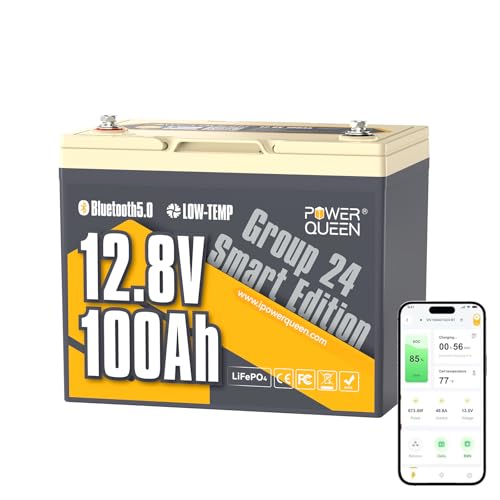
Power Queen 12V 100Ah Group 24 Smart Bluetooth LiFePO4 · Our score 82/100
Price on Amazon: $231.99
The standard arrangement without a heater: the BMS blocks charging below 32 °F and resumes at 41 °F, per Power Queen. 100 A continuous BMS (500A / 1 s), Bluetooth monitoring, Group 24 at 22.2 lb. [12]
Skip it if: You need to recharge from solar on freezing mornings: solar charging simply stops until the cells warm.
200A BMS for a Big Inverter

LiTime 12V 320Ah Mini Bluetooth LiFePO4 (200A BMS) · Our score 84/100
Price on Amazon: $634.94
A 200 A continuous BMS is the figure that matters for a larger inverter: about 2,040 W of AC load by our conservative math, against about 1,020 W for a 100 A BMS. 4,096 Wh in one case, with Bluetooth and a low-temperature charging cut-off. [8][9][10]
Skip it if: You need a standard battery box or easy lifting: it weighs 57.17 lb and has no heater.
LiFePO4 Chargers That Wake a Tripped BMS
After a low-voltage cut-off the terminals can read close to 0 V, and many chargers won’t start. Both of these are listed to start on a battery in that state.
20A Charger with 0V Wake-Up

Power Queen 12V 20A LiFePO4 Battery Charger (14.6V) · Our score 81/100
Price on Amazon: $67.99
A 14.6 V, 20 A CC/CV charger for 12V LiFePO4 whose Pre-Charge mode is listed to wake a battery whose BMS has shut off at 0 V. About 5 hours to refill 100 Ah (our arithmetic). [13]
Skip it if: You want a float stage or a weather rating: Power Queen lists a 2-stage charge and publishes no water rating.
Sealed 5A Charger That Resets UVP
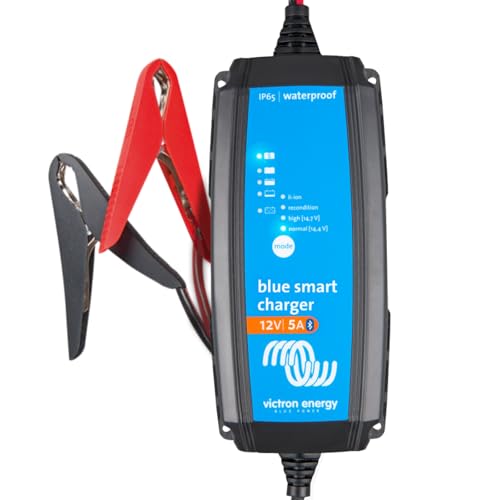
Victron Blue Smart IP65 12/5 Charger (12V 5A) · Our score 78/100
Victron’s manual says this charger automatically resets a lithium battery’s tripped under-voltage protection and starts charging from 0 V. Its Li-ion mode absorbs at 14.2 V; it is sealed to IP65 and has Bluetooth set-up. [17]
Skip it if: You want a fast recharge: 5 A takes about 20 hours to refill 100 Ah (our arithmetic).
A Power Station (BMS Built In)
A power station’s BMS, charger and inverter come as one unit, so the settings are done for you. What you still control is temperature.
Power Station

Anker SOLIX C1000 Gen 2 · Our score 92/100
Price on Amazon: $469.99
The BMS lives inside the station with the charger and inverter. Anker lists a 32–104 °F charging range and -4 to 104 °F for discharging, so it can run loads in a cold garage but will not charge there. 1,024 Wh, 2,000 W continuous, 24.9 lb. [23][24]
Skip it if: You want a 12V house battery to wire into an RV or boat; a drop-in battery and charger fit that better.
Verdict: Read the BMS Lines First
Every LiFePO4 battery and power station worth buying has a BMS; what differs is its limits. Check three lines on the spec sheet: the continuous amps against your inverter (about 1,020 W per 100 A by our math), the low-temperature charging behavior against your climate, and whether it has Bluetooth if you want to see the cells. If you charge in freezing weather, the LiTime 12V 100Ah Group 24 Self-Heating Bluetooth LiFePO4 (our score 81/100) heats itself before charging. Currently $313.64 on Amazon, it carries a 100 A BMS. Keep a charger with 0 V activation, such as the Power Queen 12V 20A LiFePO4 Battery Charger (14.6V) (81/100), for the day the BMS trips.
Battery BMS FAQ
What does BMS mean on a battery?
BMS stands for battery management system. It is the circuit board inside a lithium battery or power station that monitors each cell's voltage, the current and the temperature, and disconnects the battery from the charger or load when one of them goes outside its safe range. It also balances the cells near full charge and estimates the state of charge.
Does a LiFePO4 battery need a BMS?
Yes. Lithium cells are sensitive to over-voltage and under-voltage, so a LiFePO4 battery needs a BMS to stop overcharging, over-discharging, overloads and charging in the cold. Drop-in 12V LiFePO4 batteries have one built into the case. Some systems, such as Victron's Lithium Battery Smart, connect to a separate BMS that switches the chargers and loads instead.
How do I reset the BMS on a lithium battery?
Disconnect all loads and chargers and wait: Battle Born says 5 to 10 minutes, LiTime 30 minutes. Then connect a compatible LiFePO4 charger; Battle Born says its batteries usually exit low-voltage disconnect once charging starts. If the charger won't start because the battery reads near 0V, use a charger with lithium activation or 0V start. After an overload or short, Battle Born's BMS resets after about five seconds or when the loads are disconnected.
Why does my lithium battery read 0 volts?
Often because the BMS has disconnected the cells to protect them, typically after the battery ran flat. The cells may be fine, but some chargers won't recognize a battery in that state. Disconnect the loads, wait, and charge with a charger that has 0V activation. If it still won't wake, contact the maker: Victron says a cell below 2.5V is permanently damaged and recovery is not guaranteed.
What does a 100A BMS mean?
The battery can deliver 100 amps continuously before the BMS cuts off. On a 12V battery that supports roughly 1,000W of AC load through an inverter by our conservative math (100A × 12V × 0.85). The separate peak rating, such as 500A for one second, is only for brief starting surges. For a 2,000W inverter, look for a 200A BMS or two batteries in parallel.
Can you charge a LiFePO4 battery below freezing?
Not a standard one. Charging cold lithium cells damages them, so the BMS blocks it: Power Queen and Renogy at 32°F, Battle Born below about 24 to 25°F, and Victron at 5°C (41°F) by default. Discharging usually continues to about -4°F. A self-heating battery warms its cells with charger power first; LiTime's heats below 41°F and charges from 50°F.
What is the difference between passive and active cell balancing?
Passive balancing bleeds a little charge from the fullest cells through a resistor, as heat, while the battery charges, so the other cells catch up. It is simple and cheap but adds no run time. Active balancing moves charge from fuller cells to emptier ones during charge and discharge, which can add usable capacity but needs a more complex circuit. Either way, balancing happens near full charge, so charge fully now and then.
Do portable power stations have a BMS?
Yes, built in with the charger and inverter, so there is nothing to set. It enforces the same limits, including a charging temperature range; Anker lists 32 to 104°F for charging the SOLIX C1000 Gen 2. The safety standard for portable power stations is UL 2743, which covers up to 20 kWh of lithium-ion. A battery installed as a home's stationary energy storage system needs a UL 9540 listing, according to UL.
How many LiFePO4 batteries can I connect in series or parallel?
It depends on the maker, because each battery's BMS works on its own. LiTime recommends at most 4 in series and 4 in parallel (16 batteries). Victron allows four 12.8V batteries in series and 20 in parallel. Battle Born allows series connection up to 48V and lists no parallel limit. Use identical batteries, charged fully before you connect them, and check your model's manual.
Sources
BMS functions and settings come from battery makers’ data sheets, manuals and support pages; balancing from Texas Instruments and an article on Analog Devices’ balancers; state-of-charge accuracy from Battery University; certification scope from UL Solutions. Product specs come from our product database, cross-checked against the makers’ listings. Wattage and runtime figures are our arithmetic. Nothing here was measured by us. Last reviewed November 18, 2026.
- Battle Born Batteries, What Is a Battery Management System (BMS)? (monitors cell and pack voltage, current and internal temperature; disconnects on over-voltage, under-voltage, over-current, short circuit or unsafe temperature; passive balancing at about 14.2–14.6 V)
- Battle Born Batteries, BB10012 100Ah 12V data sheet (100 A continuous, 200 A for 30 seconds; 10 V BMS discharge cut-off; 14.7 V high-voltage protection; 25–135 °F charge range; reset after five seconds in most faults; series to 48 V, no parallel limit; heated model 28 W, on at ~35 °F)
- Battle Born Batteries, Understanding temperature limits of LiFePO4 batteries (do not charge below about 25 °F without internal heating; discharge to about -4 °F)
- Battle Born Batteries, FAQ: How to winterize your batteries (no charge if internal temperature is below 24 °F)
- Battle Born Batteries, Why is my lithium battery not charging? (low-voltage disconnect at about 10 V; exits once a compatible charger is applied; disconnect, wait 5–10 minutes, reconnect)
- LiTime, Lithium battery user manual (OVP 15.0 V / UVP 10.8 V; recovery: disconnect and wait 30 minutes, then an activation charger; 4S/4P maximum; do not charge below 0 °C)
- LiTime, 12V 100Ah Group 24 Bluetooth self-heating LiFePO4 battery product page (heats below 41 °F on a charger, charges from 50 °F)
- LiTime, 12V 320Ah Mini Bluetooth LiFePO4 battery product page (200 A BMS)
- Notebookcheck, LiTime 12.8V 320Ah Mini smart battery review (200 A max continuous discharge, low-temperature charging cut-off, Bluetooth app)
- Ritz Marine, LiTime 12V 320Ah LiFePO4 battery listing (200 A continuous BMS; app shows state of charge, cell voltages, temperature and cycle count; up to 4S4P)
- LiTime, Lithium battery voltage chart (12V LiFePO4: about 13.4 V at 90%, 13.2 V at 50%, 13.0 V at 20%)
- Power Queen, 12V 100Ah Group 24 Smart LiFePO4 battery product page (100 A BMS; charge cut-off below 32 °F, resumes at 41 °F)
- Power Queen, 14.6V 20A LiFePO4 battery charger product page (Pre-Charge wakes a 0 V BMS)
- Renogy, Core Mini 12.8V 100Ah LiFePO4 battery spec sheet (charging range from 32 °F)
- Victron Energy, Lithium Battery Smart manual: installation (BMS blocks charging below 5 °C by default; 2.80 V per cell load cut-off; up to four 12.8 V batteries in series, 20 in parallel; cell balancing works only inside one battery)
- Victron Energy, Lithium Battery Smart manual: troubleshooting (a cell below 2.5 V is permanently damaged; recovery not guaranteed; balancing only in absorption and can take days)
- Victron Energy, Blue Smart IP65 Charger 120V manual (resets a tripped Li-ion UVP automatically; starts charging from 0 V; never charge Li-ion below 0 °C / 32 °F; Li-ion mode 14.2 V)
- Texas Instruments, Cell Balancing With BQ769x2 Battery Monitors, application note SLUAA81 (cell imbalance develops over time and reduces pack capacity; passive balancing bypasses current around selected cells)
- eeNews Europe, Active battery cell balancing (on Analog Devices balancers: passive balancing bleeds charge in a resistor during charging and does not extend run time; active balancing moves charge between cells)
- Battery University, BU-908: Battery Management System (BMS) (coulomb counting; state-of-charge accuracy about ±10% when new, 20% or worse with age)
- UL Solutions Question Corner, Are portable power packs certified as energy storage systems for use in residential installations? (IAEI Magazine, Summer 2025): UL 2743 scope, 20 kWh limit, UL 9540 for stationary ESS
- UL Solutions, Portable power pack testing (UL 2743 covers batteries in an enclosure used as a portable power source when grid power is not available)
- Anker SOLIX, C1000 Gen 2 product page (1,024 Wh; charging 32–104 °F, discharging -4 to 104 °F; UPS 10 ms)
- Anker SOLIX, C1000 Gen 2 EU product page (charging 0–40 °C, discharging -20 to 40 °C)
Rather skip the wiring? The Anker SOLIX C1000 Gen 2 has its BMS, charger and inverter built in and is currently $469.99 on Amazon.
Check Price on Amazon →Save to cart