
Buying Guide · Updated November 2026
Best LiFePO4 Battery Charger 2026: 12V and 24V Lithium Chargers Compared
A LiFePO4 battery charger uses a lithium charge profile: constant current, then a constant voltage of about 14.2 to 14.6V for a 12V battery, with no equalize step and no float, or only a low one. For most 12V lithium batteries, the Power Queen 12V 20A (14.6V) is the pick: it refills a 100Ah battery in about 5 hours and wakes a battery whose BMS has shut off. For 24V systems choose the Power Queen 24V 20A (29.2V). If you need a sealed, Bluetooth charger for storage, choose the Victron Blue Smart IP65 12/5. The LiTime 20A is a close 12V alternative, and the NOCO GENIUS10 charges lithium and lead-acid batteries.
As an Amazon Associate, SolarGenAdvisor earns from qualifying purchases made through links on this page, at no additional cost to you. Scores are AI-synthesized from manufacturer manuals and product pages, Amazon listing details and logged Amazon prices; we did not test these chargers.
 By
Quick Verdict
Match the charger's voltage to the battery, and its amps to the battery size. For a 12V LiFePO4 battery of 50 to 300Ah, the Power Queen 12V 20A charges at 14.6V with no float stage and can wake a battery from 0V. For a 24V trolling-motor or off-grid battery, use the Power Queen 24V 20A at 29.2V. The Victron Blue Smart IP65 12/5 is slower but sealed, app-configurable and covered for 5 years, which suits a boat or RV battery in storage. If you also own lead-acid batteries, the NOCO GENIUS10 charges both. Charging from a vehicle's alternator instead? That needs a DC-DC charger, not an AC charger.
Before You Plug In
- Don't charge below freezing. Victron's manual says to "NEVER attempt to charge a Li-ion battery when its temperature is below 0°C (32°F)" (Victron), and LiTime puts the ideal charging range at 0–50°C (32–122°F), with charging below 0°C only with a low-temperature limit or pre-heating (LiTime battery manual). See cold-weather charging.
- Use the battery maker's voltage. Battle Born says chargers for its batteries should offer 14.2–14.6V bulk/absorption, and recommends 14.4V (Battle Born). LiTime gives 14.4–14.6V in the constant-voltage phase (LiTime). Double those figures for a 24V battery.
- No lead-acid repair modes on lithium. Equalize, recondition and desulfation steps push well above lithium limits. NOCO says its Repair mode is for lead-acid only (NOCO), and Victron doesn't offer recondition in its Li-ion mode (Victron).
- Battery first, outlet last. LiTime's charging sequence is to connect the charger to the battery first, then to mains; to disconnect, unplug from mains first, then from the battery (LiTime).
How We Score LiFePO4 Chargers
We use one rubric for the dedicated lithium chargers on this page. Each score is AI-synthesized from the maker's manual or product page, Amazon listing details and the Amazon price we logged on November 7, 2026. We did not test any charger. A feature earns credit only when the maker documents it. If a product has no published input for a dimension, we drop that dimension for that product and rescale the rest, rather than scoring it as zero. Charger scores aren't comparable with our power-station or battery scores. Weights total 100:
- Charge rate (25): 20A (90 points), 10A (70) or 5A (50). That's about 5, 10 or 20 hours for a flat 100Ah battery.
- LiFePO4 profile and BMS wake-up (25): a documented LiFePO4 CC/CV absorption inside the 14.2–14.6V window per 12V (60), plus documented 0V or BMS wake-up (+20), plus a documented no-float or float/storage at or below 13.6V (+10)
- Protection (15): 30 points each for reverse-polarity, output short-circuit and over-temperature protection
- Value (15): the lowest in-stock price we found for a charger of the same system voltage, divided by this charger's price
- Weather protection (10): IP65 or better (90), or no water rating published, or the maker says it isn't waterproof (40)
- Versatility (10): a single-chemistry, fixed-voltage charger (50), plus lead-acid modes (+20), plus an app or power-supply mode (+20)
The Victron had no Amazon price when we checked, so its value dimension is dropped and its other five are rescaled. Warranty is shown but not scored, because we couldn't confirm a warranty term on a maker page for both Power Queen chargers. The NOCO GENIUS10's 75 is the score it earned on our trickle charger and maintainer rubric; we show that score rather than create a second one for the same product.
The 5 Best LiFePO4 Battery Chargers
These are AC (wall-outlet) chargers with a documented LiFePO4 or lithium mode, and each had a new-condition offer in Amazon's buy box when we checked on November 7, 2026. The NOCO was sold by Amazon.com; the others by the brands' own Amazon stores or, for the Victron, by BrandCentric. Specs come from each maker's manual or product page and the Amazon listing (linked where a maker page was available).
1. Best 12V LiFePO4 Charger Overall

Power Queen 12V 20A LiFePO4 Battery Charger (14.6V)
20A · 12V (12.8V) LiFePO4 · Score 81/100
The Power Queen 20A is the plain, fast answer for one 12V LiFePO4 battery or a parallel 12V bank. Its listing describes a 2-stage constant current / constant voltage (CC/CV) charge to 14.6V at 20 amps, with no float stage, and a Pre-Charge function "designed to activate all types of BMS" on a battery reading down to 0V (Amazon listing; Power Queen). Power Queen says it fully charges a 12V 100Ah battery in about 5 hours, which matches the simple math (100Ah ÷ 20A). It lists over-temperature, output short-circuit, reverse-polarity and output over-voltage protection, an aluminum case with a cooling fan, an Anderson connector and 100–240V AC input. It had the lowest 12V price we found when we checked, which is why it tops our scoring. Two caveats: Power Queen publishes no water rating, so keep it dry, and we couldn't confirm its warranty term on a maker page.
Pros
- ✓ 20A: about 5 hours for a 100Ah battery
- ✓ 14.6V CC/CV with no float stage
- ✓ 0V BMS wake-up (Pre-Charge)
- ✓ Lowest 12V price we found when we checked
Cons
- ✗ No water rating published: indoor use
- ✗ LiFePO4 only, 12V only
- ✗ Warranty term not confirmed on a maker page
2. Best 24V LiFePO4 Charger (Trolling Motors, 24V Banks)

Power Queen 24V 20A LiFePO4 Battery Charger (29.2V)
20A · 24V (25.6V) LiFePO4 · Score 79/100
If your system is 24V, buy a 24V charger rather than charging two 12V batteries one at a time. Power Queen's 24V model applies the same 2-stage CC/CV method at 29.2V (twice 14.6V), which its listing says is held to ±0.2V (about 29.0 to 29.4V), at a constant 19 to 21 amps from 100–240V AC input. It has a pre-charge mode for a 0V battery whose BMS has shut off, LED status lights, an Anderson connector, and over-temperature, short-circuit, over-voltage and reverse-polarity protection (Amazon listing). Power Queen says it refills a 24V 100Ah pack in about 5 hours. Use it on a single 24V LiFePO4 battery, or on two matched 12V LiFePO4 batteries wired in series only if the battery maker approves series charging. Like the 12V model it has no published water rating, so mount it in a dry spot, not in an open boat. Redodo's 24V 20A cost less when we checked but had limited stock; see 24V chargers.
Pros
- ✓ 29.2V ±0.2V for 24V (25.6V) LiFePO4
- ✓ 20A: about 5 hours for a 24V 100Ah battery
- ✓ 0V pre-charge mode
- ✓ Four listed protections
Cons
- ✗ No water rating published
- ✗ Redodo's 24V was cheaper when we checked
- ✗ Warranty term not confirmed on a maker page
3. Best Weatherproof and Bluetooth Charger (Maintaining and Storage)
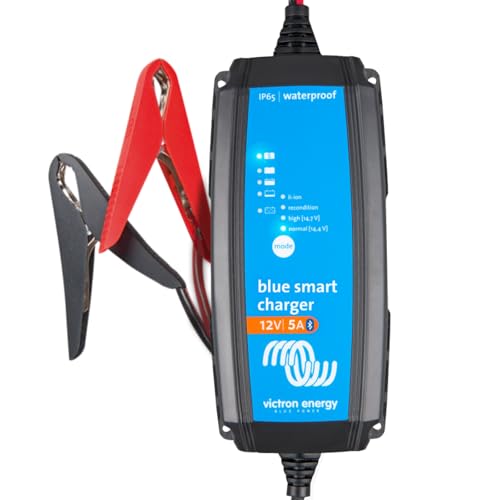
Victron Blue Smart IP65 12/5 Charger (12V 5A)
5A · 12V · Score 78/100
The Victron Blue Smart IP65 12/5 is the precision pick, and the only one here with a sealed case, an app and a 5-year warranty. Victron's US manual lists its Li-ion mode at 14.2V absorption and 13.5V float and storage. It says the charger "starts charging from down to 0 V," and that it automatically resets a lithium battery's tripped under-voltage protection, which some chargers won't recognize. Victron adds a firm rule: never charge a Li-ion battery below 32°F (Victron manual). The same charger has Normal and High lead-acid modes, an IP65 enclosure, Bluetooth setup through the VictronConnect app, a power-supply mode, a -5 to 120°F operating range and a 2 lb weight. The trade-off is speed: 5 amps takes about 20 hours to refill a 100Ah battery, so it suits maintaining a boat or RV battery in storage, or a small battery, more than daily cycling. Amazon returned no price for its new offer when we checked, so its price slot shows a link instead.
Pros
- ✓ IP65 sealed case
- ✓ Li-ion 14.2V absorption, 13.5V float
- ✓ Starts from 0V; resets a tripped BMS
- ✓ 5-year limited warranty (Victron)
Cons
- ✗ 5A: about 20 hours for a 100Ah battery
- ✗ No price returned by Amazon when we checked
- ✗ 12V only (Victron sells 24V models separately)
4. Also Great: 20A With a 2-Year Warranty

LiTime 12V 20A Lithium Battery Charger (14.6V)
20A · 12V (12.8V) LiFePO4 · Score 77/100
LiTime's 20A charger matches the Power Queen on the numbers that matter: 14.6V at 20 amps for 12V (12.8V) LiFePO4 batteries, 0V activation to wake a BMS-protected battery, and 100–240V AC input (LiTime; Amazon listing). Its listing describes an automatic switch from CC to CV and then "Float/Cut off," and six protections: over-temperature, over-voltage, short-circuit, over-current, low-voltage and reverse polarity. It also lists a 2-year warranty, an aluminum housing with a fan, and an Anderson connector. LiTime is unusually direct about one limit: the listing's first line says it is not waterproof and not suitable for boats or trolling motors. It scores a few points below the Power Queen because it cost more when we checked and LiTime doesn't publish the float voltage it uses.
Pros
- ✓ 20A at 14.6V
- ✓ 0V activation
- ✓ Six listed protections
- ✓ 2-year warranty (listing)
Cons
- ✗ Not waterproof; LiTime says not for marine use
- ✗ Float voltage not published
- ✗ Cost more than the Power Queen when we checked
5. Best If You Also Charge Lead-Acid Batteries
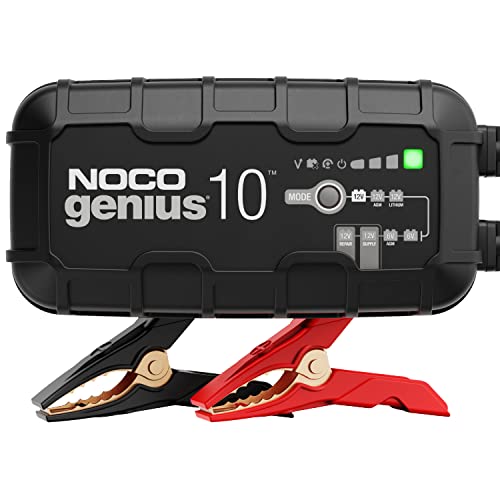
NOCO GENIUS10 10A Smart Battery Charger
10A · 6V and 12V · Score 75/100
Most households have more than one battery type. The NOCO GENIUS10 covers them all: NOCO's user guide lists a 12V Lithium mode at 14.6V and 10 amps for batteries up to 230Ah, alongside 12V, 12V AGM, 6V and 6V AGM lead-acid modes, a 13.6V power-supply mode and an IP65 case. NOCO says the lithium mode is "for use on batteries with Battery Management Systems (BMS) only" and to ask the battery maker for its recommended charging rates and voltages first (NOCO GENIUS10 guide). For a battery too flat to detect (below 1V), NOCO's Force Mode starts charging manually for five minutes, but NOCO warns that it disables the safety features. NOCO doesn't publish a lithium float voltage. At 10 amps it is half the speed of the 20A chargers, so a flat 100Ah battery takes about 10 hours. Its score comes from our trickle charger and maintainer rubric, and we kept it rather than create a second score.
Pros
- ✓ Lithium, lead-acid and AGM modes in one charger
- ✓ 14.6V lithium mode (NOCO)
- ✓ IP65 housing
- ✓ Sold by Amazon.com when we checked
Cons
- ✗ 10A: about 10 hours for a 100Ah battery
- ✗ Force Mode disables safety features
- ✗ Lithium float voltage not published
Other chargers we checked
The Renogy 12V 20A Waterproof LiFePO4 Battery Charger was in stock and sold by Amazon.com, but we left it unscored. Its Amazon title says IP65 while its bullet points say IP67, and we couldn't reach Renogy's site to confirm the rating or the exact model. We'll add it once that's settled. Victron's larger 12/15 model didn't come back as a valid Amazon listing in our check. The 24V alternatives are covered below. For 1-amp to 5-amp maintainers with lithium modes, such as the NOCO GENIUS1 and GENIUS5 and the Battery Tender Junior, see our best trickle charger guide.
LiFePO4 Charger Comparison Table
Figures come from each maker's manual or product page and the Amazon listing. "Not confirmed" means we couldn't confirm a figure on a maker page.
| Charger | Battery | Amps | Lithium charge voltage | 0V / BMS wake-up | Weather | Warranty | Score | Price |
|---|---|---|---|---|---|---|---|---|
| Power Queen 12V 20A LiFePO4 Battery Charger (14.6V) | 12V (12.8V) LiFePO4 | 20A | 14.6V CC/CV, 2-stage (no float stage listed) | Yes: Pre-Charge wakes a BMS from 0V | No water rating published | Not confirmed | 81/100 | Check price at Amazon → |
| Power Queen 24V 20A LiFePO4 Battery Charger (29.2V) | 24V (25.6V) LiFePO4 | 20A | 29.2V (+/-0.2V) CC/CV, 2-stage (no float stage listed) | Yes: pre-charge mode for a 0V BMS-protected battery | No water rating published | Not confirmed | 79/100 | Check price at Amazon → |
| Victron Blue Smart IP65 12/5 Charger (12V 5A) | 12V | 5A | Li-ion: 14.2V absorption, 13.5V float, 13.5V storage (Victron manual) | Yes: starts charging from 0V and resets a tripped lithium UVP | IP65 | 5 years (Victron) | 78/100 | Check price at Amazon → |
| LiTime 12V 20A Lithium Battery Charger (14.6V) | 12V (12.8V) LiFePO4 | 20A | 14.6V CC/CV, then float or cut-off (float voltage not published) | Yes: 0V activation | Not waterproof (LiTime): not for marine use | 2 years (listing) | 77/100 | Check price at Amazon → |
| NOCO GENIUS10 10A Smart Battery Charger | 6V/12V lead-acid; 12V lithium | 10A | 12V Lithium mode: 14.6V (float not published) | Force Mode below 1V (disables safety features) | IP65 | 3 years (NOCO) | 75/100* | Check price at Amazon → |
*Scored on our trickle charger and maintainer rubric. Sources: Power Queen and LiTime product pages and Amazon listings; Victron Blue Smart IP65 Charger 120V manual; NOCO GENIUS10 North American user guide. The Victron 12/5 weighs 2 lb and operates from -5 to 120°F, with full output up to 85°F (Victron). NOCO lists -4 to 104°F. Power Queen and LiTime don't publish an operating range in the sources we could open.
What Voltage Should a LiFePO4 Charger Be? The 14.6V CC/CV Profile Explained
A LiFePO4 charger works in two steps. In the constant-current (bulk) step it pushes its full rated amps while the battery voltage rises. In the constant-voltage (absorption) step it holds a set voltage while the current tapers off. Battle Born explains that a lead-acid charger then drops to a third, float stage, because lead-acid batteries lose charge when the charger is off. It says "float charging is not necessary for Battle Born LiFePO4 batteries," although a float under 13.6V is fine (Battle Born). LiTime says the same in its battery manual: "no permanent float charging; if necessary, limit to 13.4–13.6 V" (LiTime).
| Source | Absorption (12V) | Float / storage (12V) | Other settings |
|---|---|---|---|
| Battle Born (battery maker) | 14.2–14.6V; 14.4V recommended | Not needed; under 13.6V is fine | — |
| LiTime (battery maker) | 14.4–14.6V; AC charger mode "LiFePO4 / 14.6 V" | No permanent float; if needed, 13.4–13.6V | Temperature compensation off or minimal; full at about 0.02C residual current |
| Victron Blue Smart IP65 (charger maker) | Li-ion mode: 14.2V | 13.5V float and 13.5V storage (US manual); newer manual shows float disabled, 13.5V storage | No recondition and no temperature compensation in Li-ion mode |
| NOCO GENIUS10 (charger maker) | 12V Lithium mode: 14.6V peak | Not published | BMS-equipped batteries only |
Sources: Battle Born, "The Basics of Charging LiFePO4 Batteries"; LiTime lithium battery user manual; Victron Blue Smart IP65 Charger 120V manual and online manual; NOCO GENIUS10 user guide. For 24V batteries, double every voltage (Victron: "multiply all voltage values by 2").
So is a 14.6V charger right for my battery? For most 12V LiFePO4 batteries, yes. 14.6V is the top of Battle Born's range and LiTime's recommended AC-charger setting, and both Power Queen and LiTime sell 14.6V chargers for their own batteries. If your battery maker specifies a lower absorption voltage, such as Battle Born's 14.4V, an adjustable charger like the Victron (14.2V by default, configurable in the app) gives you that control. The battery's label or manual is the final word. For the settings to enter on a solar controller, DC-DC charger or RV converter, plus a 12V, 24V and 48V voltage chart, see our guide to charging a LiFePO4 battery.
Can I Charge a LiFePO4 Battery With a Lead-Acid Charger?
Only if its settings fall inside the lithium window and it has no automatic equalize or desulfation step. Battle Born says lead-acid algorithms typically use 14.0–14.8V bulk and absorption and 13.2–13.8V float, and that any charger offering 14.2–14.6V absorption and a 13.6V float will work with its batteries (Battle Born). Many older lead-acid chargers don't let you check or change those values. Here's what can go wrong:
- Too much voltage from equalize or recondition steps. Victron's lead-acid recondition step charges to 16.2–16.5V (Victron). For its LiFePO4 batteries, LiTime tells owners to set solar controllers and inverter-chargers to an over-voltage disconnect of about 15.0V, and says plainly: "Do not use high-current chargers without LiFePO₄ mode" (LiTime). A 16V step is well past that, which leaves the battery's BMS as the only safeguard.
- Temperature compensation raises the voltage in the cold. Victron's lead-acid modes adjust by 16 mV per °C, and Victron applies this to lead-acid batteries only (Victron). By our arithmetic, that adds about 0.4V at 0°C (25°C below the reference), taking a 14.4V setting to about 14.8V, above Battle Born's 14.6V limit. LiTime says compensation should be "off or minimal" for LiFePO4 (LiTime).
- A float held for months. A lead-acid float of up to 13.8V, held continuously, is above the 13.6V ceiling Battle Born and LiTime give for lithium. LiTime lists "permanently high voltage (float)" as a problem to fix by deactivating float or setting it to 13.4–13.6V.
- Undercharging. A lead-acid setting at the low end of the range, such as 14.0V, sits below the 14.2V minimum Battle Born gives, so the battery may never reach a full charge.
- It may not charge a sleeping battery at all. Victron notes that "some reverse polarity protected chargers will not recognize a battery" when its under-voltage protection has tripped (Victron). A dedicated lithium charger with 0V activation solves that (next section).
A multi-chemistry smart charger with a dedicated lithium mode, such as the NOCO GENIUS10 or Victron here, avoids all of this as long as you select that mode. For the full list of maintainers with lithium modes, see our trickle charger guide. If you're upgrading an RV from lead-acid, check the converter and solar controller too. Our best 12V lithium battery guide covers what to change.
0V Activation: Waking a LiFePO4 Battery Whose BMS Shut Off
A LiFePO4 battery's battery management system (BMS) disconnects the cells when the battery is over-discharged, overloaded or too cold. The terminals can then read close to 0V even though the cells are fine. LiTime says that when a battery "can't be charged, or the voltage is below 9V, there is about an 85% chance that the BMS has shut it off for protection" (LiTime). Many chargers see no voltage and refuse to start, which is why "0V activation" matters.
- Disconnect everything and wait. LiTime's first step is to cut all connections and leave the battery for 30 minutes; it may recover above 10V on its own.
- Use a charger with activation. If it doesn't recover, LiTime says to use "a charger with lithium battery activation function" (or briefly connect a LiFePO4-capable solar controller in sun). All four dedicated chargers here list it: Power Queen's Pre-Charge, LiTime's 0V activation and Victron's "starts charging from down to 0 V," which also resets a tripped under-voltage protection automatically.
- Disconnect loads before charging. Victron says to disconnect all loads before recharging a lithium battery whose under-voltage protection has tripped, and reconnect once bulk charging has started (Victron).
- Know when to stop. NOCO's Force Mode will start a battery below 1V, but it runs for five minutes with the safety features disabled and live power at the clamps (NOCO). If a battery won't wake after these steps, contact its maker before trying anything else.
Cold is a common cause of a "dead" lithium battery in winter: the BMS blocks charging until the cells warm up. That isn't a fault, and 0V activation won't override it.
Charging LiFePO4 in Cold Weather: The 32°F Rule
Don't charge a LiFePO4 battery below 32°F (0°C) unless it heats itself. Victron's charger manual says so in capital letters (Victron), and LiTime puts its charging range at 0–50°C, allowing charging below 0°C only with a low-temperature limit or pre-heating (LiTime). Battle Born says that to protect its batteries in cold weather, their temperature needs to stay above 35°F, and it sells heated versions for that reason (Battle Born). Discharging is less limited: Power Queen's 12V 100Ah battery only cuts off discharge below -4°F (Power Queen).
None of the chargers' documents describe measuring the battery's temperature for lithium charging. The Victron's temperature compensation applies to lead-acid only. The protection has to come from the battery itself:
- Low-temperature charge cut-off: the BMS stops charging in the cold and resumes when the cells warm. Power Queen's 12V 100Ah battery stops below 32°F and resumes at 41°F (Power Queen).
- Self-heating: the battery uses charger power to warm its cells first. LiTime's self-heating 12V 100Ah warms the cells when a charger is connected below 41°F and starts charging once they reach 50°F (LiTime). Heating draws from the charger, so a bigger charger finishes sooner.
- No protection listed: keep the battery somewhere above freezing while it charges, or bring it inside.
Winter-storing a boat or RV? A small charger like the Victron at 13.5V storage can stay connected, but only while the battery is above freezing. Compare cold-weather battery features in our 12V lithium battery guide, see which RV house batteries heat themselves in our best LiFePO4 battery for RV picks and, for boats, the lithium trolling motor battery picks.
Charger Amps vs Battery Ah: How Long to Charge a 100Ah LiFePO4 Battery
LiFePO4 charges almost linearly, so the math is simple. Victron says a Li-ion battery is "more than 95% charged at the beginning of the absorption period" and full after about 30 minutes of absorption (Victron). That gives a quick estimate: hours ≈ amp-hours to put back ÷ charger amps + about 0.5 hour. A flat 100Ah battery on a 20A charger takes about 5.5 hours, in line with Power Queen's "only needs 5 hours."
| Battery (fully discharged) | 5A (Victron 12/5) | 10A (NOCO GENIUS10) | 20A (Power Queen, LiTime) |
|---|---|---|---|
| 12V 50Ah | ~11 h | ~5.5 h | ~3.0 h |
| 12V 100Ah | ~21 h | ~11 h | ~5.5 h |
| 12V 200Ah | ~41 h | ~21 h | ~11 h |
| 12V 300Ah | ~61 h | ~31 h | ~16 h |
| 24V 100Ah | Needs a 24V charger | Needs a 24V charger | ~5.5 h (Power Queen 24V) |
Our estimates, not measurements: Ah ÷ A + 0.5 h. Real times run longer if loads are on during charging, if the cables are long or thin, or if a cold battery is warming itself first. A 300Ah battery is above NOCO's 230Ah rating for the GENIUS10.
How many amps do I need?
- Overnight for a 100Ah battery: 10 to 20 amps.
- 200 to 300Ah banks: 20 amps, or more from an inverter-charger or a larger charger.
- Storage and maintaining: 5 amps is plenty, and a low storage voltage like Victron's 13.5V is gentler than holding 14.6V.
- Check the battery's limit. Look up its recommended and maximum charge current in the battery manual, and make sure the BMS rating exceeds the charger's amps. Power Queen says its 20A charger is for "LiFePO4 batteries 20 amp hours and above."
24V and 36V LiFePO4 Chargers
A 24V LiFePO4 battery (25.6V nominal) charges at 29.2V, twice the 12V figure. Victron's manual says to "multiply all voltage values by 2" for its 24V chargers (Victron). A single 24V battery needs a 24V charger. Two 12V batteries in series can be charged by a 24V charger if their maker allows it and the batteries are matched, or one at a time, or by a multi-bank charger that treats each 12V battery separately. Our lithium trolling motor battery guide lists the charger each 24V and 36V battery maker recommends: LiTime and Redodo specify 29.2V, 20A for their 24V 100Ah batteries, and Power Queen 43.8V, 25A for its 36V 50Ah.
Besides our scored Power Queen 24V, two other 24V 20A chargers were in stock when we checked. We haven't scored them:
Redodo 24V 20A LiFePO4 Battery Charger (29.2V)
The Amazon listing describes 0V activation, smart 3-stage charging, LED indicators, a fan, a mounting bracket and six protections. Stock was limited when we checked.
LiTime 24V 20A Lithium Battery Charger (29.2V)
The Amazon listing describes 0V activation, 3-stage charging, an Anderson connector and an LED indicator. It cost the most of the three 24V chargers when we checked.
We didn't find a 36V LiFePO4 AC charger with a confirmed listing in this check, so we don't recommend one here. Use the charger your 36V battery's maker specifies.
Which Charger for Your Battery? Pairings With Our Rated Batteries
Three batteries we've already rated, with a matching charger and its estimated charge time:
| Battery (our score) | Cold-weather charging | Matching charger | Flat to full | Battery price |
|---|---|---|---|---|
| Power Queen 12V 100Ah Group 24 Smart Bluetooth LiFePO4 (82/100) | Charge cut-off below 32°F, resumes at 41°F (Power Queen) | Power Queen 12V 20A LiFePO4 Battery Charger (14.6V) | ~5.5 h | $289.99 |
| LiTime 12V 100Ah Group 24 Self-Heating Bluetooth LiFePO4 (81/100) | Self-heating: warms the cells first when a charger is connected below 41°F (LiTime) | Power Queen 12V 20A LiFePO4 Battery Charger (14.6V) | ~5.5 h | $368.99 |
| LiTime 24V 100Ah LiFePO4 Battery (100A BMS) (72/100) | 32–122°F charge range (LiTime) | Power Queen 24V 20A LiFePO4 Battery Charger (29.2V) | ~5.5 h | Check price at Amazon → |
Battery scores come from our 12V lithium battery and trolling motor battery rubrics and aren't comparable with charger scores. Charge times use our Ah ÷ A + 0.5 h estimate.
AC charger vs DC-DC charger vs solar vs a power station
- AC LiFePO4 charger (this page): charges from a wall outlet, shore power or a generator. It's the right tool at home, at a campground hookup or in the garage.
- DC-DC charger: charges a house battery from the vehicle's alternator while you drive, with a lithium profile and current limit. See our best DC-DC charger picks.
- Solar charge controller: charges from panels; choose one with a LiFePO4 setting. Our RV solar kit guide covers complete setups.
- Portable power station: if you'd rather not wire a battery, inverter and chargers at all, a power station has all of them built in. Our LiFePO4 solar generator guide explains the trade-off.
Who Should Buy a Dedicated LiFePO4 Charger (and Who Should Skip)
Good fit
- ✓ RV, van, cabin or off-grid owners with a 12V or 24V LiFePO4 bank and an outlet
- ✓ Trolling-motor owners who recharge at the dock or in the garage
- ✓ Anyone whose old charger has no lithium mode, or a forced equalize step
- ✓ Batteries that sometimes trip their BMS and need a 0V wake-up
Skip it (or choose something else) if
- ✗ Your lead-acid charger already offers 14.2–14.6V and a float of 13.6V or less, with no forced equalize
- ✗ You charge from an alternator: get a DC-DC charger
- ✗ You only maintain a small lithium powersports battery: a 1A maintainer is enough
- ✗ The charger would sit in an unheated space below freezing with a battery that has no heater
LiFePO4 Battery Charger FAQ
What is the best LiFePO4 battery charger?
For most 12V LiFePO4 batteries, the Power Queen 12V 20A: it charges at 14.6V using constant current then constant voltage, with no float stage, wakes a battery from 0V, and refills a 100Ah battery in about 5 hours. For 24V batteries, the Power Queen 24V 20A charges at 29.2V. The Victron Blue Smart IP65 12/5 is the sealed, Bluetooth option with a 5-year warranty, and the NOCO GENIUS10 suits households that also charge lead-acid batteries.
What voltage should I charge a 12V LiFePO4 battery at?
Use your battery maker's figure, which is usually 14.2 to 14.6 volts in the absorption stage. Battle Born recommends 14.4V and accepts 14.2 to 14.6V. LiTime gives 14.4 to 14.6V and no permanent float, or 13.4 to 13.6V if a float is needed. Victron's Li-ion mode uses 14.2V absorption and 13.5V storage. For a 24V battery, double these figures, for example 29.2V.
Can I charge a LiFePO4 battery with a lead-acid charger?
Only if its absorption voltage is 14.2 to 14.6V, its float is 13.6V or lower, and it has no automatic equalize, recondition or desulfation step. Victron's lead-acid recondition step reaches 16.2 to 16.5V, well above the roughly 15V over-voltage disconnect LiTime recommends for its batteries. Lead-acid temperature compensation can also push the voltage too high in the cold, and some lead-acid chargers won't start on a lithium battery whose BMS has shut off. A charger with a dedicated lithium mode avoids these problems.
What is 0V activation on a lithium battery charger?
It lets the charger start on a LiFePO4 battery whose BMS has disconnected the cells, so the terminals read near 0 volts. Ordinary chargers often see no battery and won't start. LiTime says a battery that reads below 9V or won't charge has most likely been shut off by its BMS, and recommends waiting 30 minutes with everything disconnected, then using a charger with an activation function. The Power Queen, LiTime and Victron chargers on this page all list this feature.
How long does it take to charge a 100Ah LiFePO4 battery?
Roughly the amp-hours divided by the charger's amps, plus about half an hour. A flat 100Ah battery takes about 5.5 hours on a 20A charger, about 10.5 hours on a 10A charger and about 20.5 hours on a 5A charger. Power Queen says its 20A charger fully charges a 12V 100Ah battery in about 5 hours. Victron says a lithium battery is over 95 percent charged when absorption begins and full after about 30 minutes of it.
Can you charge a LiFePO4 battery below freezing?
Not a standard one. Victron says never to charge a lithium battery below 32 degrees F, and LiTime allows charging below 0 degrees C only with a low-temperature limit or pre-heating. Batteries with a low-temperature cut-off simply stop charging until they warm up. Self-heating batteries, such as LiTime's self-heating 12V 100Ah, use charger power to warm the cells first and then charge. The chargers on this page don't measure battery temperature for lithium, so the battery's own protection is what counts.
Do LiFePO4 batteries need a float charge?
No. Battle Born says float charging is not necessary for its LiFePO4 batteries, though a float under 13.6V is fine. LiTime advises against permanent float charging and suggests 13.4 to 13.6V if one is needed. Power Queen's 20A chargers use a 2-stage charge with no float stage, and Victron's Li-ion mode holds a lower 13.5V storage voltage.