
RV Buying Guide · Updated November 2026
LiFePO4 Battery RV Guide: The 5 Best 12V LiFePO4 Batteries for RV House Power (2026)
Short answer
The best LiFePO4 battery RV owners can drop into a standard tray is the Power Queen 12V 100Ah Group 24 Dual-Mode Self-Heating battery. It has a 100A BMS, Bluetooth and a heater that lets it charge below 32°F. For days of boondocking, the LiTime 12V 320Ah Mini holds 4,096 Wh with a 200A BMS in one 57 lb box. Before you swap, check that your converter and alternator charging can handle lithium.
As an Amazon Associate, SolarGenAdvisor earns from qualifying purchases made through links on this page, at no additional cost to you. Ratings are AI-synthesized from manufacturer specs and logged Amazon prices; we did not test these batteries.
 By
12V LiFePO4 Battery for RV Comparison
All five are 12.8V nominal LiFePO4 batteries with a built-in BMS and some form of cold-weather charging protection, which we required for an RV house battery. Specs are the manufacturer's published figures, cross-checked against each Amazon listing. Prices load live from Amazon.
| Battery | Capacity | BMS (cont. / surge) | Charging below 32°F | Bluetooth | Case / fit | Weight | Price |
|---|---|---|---|---|---|---|---|
| Power Queen 12V 100Ah Group 24 Dual-Mode Self-Heating Bluetooth LiFePO4 (81/100) | 100Ah / 1,280 Wh | 100A / not published | Yes, self-heating | Built in | Group 24: drops into most RV battery trays | 22.71 lb | $287.99 |
| LiTime 12V 320Ah Mini Bluetooth LiFePO4 (200A BMS) (84/100) | 320Ah / 4,096 Wh | 200A / at least 600A / 1 s (LiTime figures vary) | No: charge cut-off below 32°F | Built in | Not a BCI group size (14.49 × 7.44 in): measure the bay | 57.17 lb | $746.99 |
| LiTime 12V 100Ah Group 24 Self-Heating Bluetooth LiFePO4 (81/100) | 100Ah / 1,280 Wh | 100A / 500A / 1 s | Yes, self-heating | Built in | Group 24: drops into most RV battery trays | 22.71 lb | $368.99 |
| Power Queen 12V 100Ah Group 24 Smart Bluetooth LiFePO4 (82/100) | 100Ah / 1,280 Wh | 100A / 500A / 1 s | No: charge cut-off below 32°F | Built in | Group 24; Power Queen says it fits Group 24/27/31 compartments | 22.2 lb | $289.99 |
| Renogy 12V 100Ah Core Mini LiFePO4 (76/100) | 100Ah / 1,280 Wh | 100A / 300A / 5 s | No: charge cut-off below 32°F | Optional shunt | Group 22NF size (9.02 × 5.43 in): smaller than Group 24 | 21.8 lb | $289.99 |
Scores use the same battery rubric as our best 12V lithium battery guide (capacity & value 25, BMS & current 20, cold-weather 15, cycle life & warranty 15, size & weight 15, monitoring 10), AI-synthesized from spec sheets and Amazon prices logged November 8, 2026. Amazon star ratings aren't an input, and a spec the maker doesn't publish earns no credit. The Power Queen Dual-Mode and LiTime 320Ah scores are new this month. That guide also covers non-RV uses and two budget Redodo batteries we left out here because Redodo lists no low-temperature charging protection for them.
The 5 Best LiFePO4 Batteries for RVs in 2026
We ordered the list by how well each battery suits a typical RV house-battery swap, not strictly by score. A Group 24 battery that fits your existing tray beats a bigger one that needs a new bay. All five were in stock on Amazon when we checked on November 8, 2026.
#1 · Best Overall for RVs (Self-Heating + Bluetooth) · 81/100

Power Queen 12V 100Ah Group 24 Dual-Mode Self-Heating Bluetooth LiFePO4
100Ah · 1,280 Wh · 100A BMS · Self-heating · 22.71 lb
Fit: Group 24: drops into most RV battery trays
Current price on Amazon: $287.99
This one checks every RV box: a standard Group 24 case, a 100A BMS, built-in Bluetooth and a heater, so it can take a charge from solar or the converter on a frosty morning. Power Queen lists two heating modes. The battery heats itself automatically when it is charging below 41°F, or you can start a preheat from the app before you plug in. Its spec page lists 4,000 cycles at 100% depth of discharge, a 5-year warranty and 22.71 lb in a 10.24 × 6.61 in case. The one gap is surge: Power Queen publishes no peak-current rating for this model, which costs it points in our scoring. If you run a 1,000W+ inverter with a microwave or other motor loads, the LiTime self-heating battery (#3) publishes 500A for 1 second.
- Self-heating, automatic or app-started
- Bluetooth app shows charge, voltage and heater status
- Group 24 drop-in; up to 4 in series and 4 in parallel
- No published surge rating
- IP rating listed as IP65 on Amazon, IP67 on Power Queen's site
Specs: Power Queen spec page, Amazon listing.
#2 · Best for Boondocking (320Ah in One Box) · 84/100

LiTime 12V 320Ah Mini Bluetooth LiFePO4 (200A BMS)
320Ah · 4,096 Wh · 200A BMS · Low-temp cut-off · 57.17 lb
Fit: Not a BCI group size (14.49 × 7.44 in): measure the bay
Current price on Amazon: $746.99
One LiTime 320Ah Mini stores as much as three 100Ah batteries: 4,096 Wh, with a 200A BMS that supports about 2,560W of continuous load at 12.8V, enough for a 2,000W inverter. It adds Bluetooth and a low-temperature charging cut-off, and it scores highest in our rubric on the lowest cost per kWh among these picks plus its 200A BMS. One box also means no parallel cabling to balance. The catches: about 57 lb, a case that matches no standard battery box, and no heater. If it sits in an unheated bay in freezing weather, solar and alternator charging stop until the cells warm above 32°F. LiTime’s sources disagree on peak current (600A or 1,000A for 1 second), so we credit only the lower figure.
- 4,096 Wh replaces three 100Ah batteries
- 200A BMS for a 2,000W inverter
- Bluetooth + low-temp charge cut-off
- Lowest cost per kWh of these picks
- About 57 lb
- Non-standard case
- No self-heating
Specs: LiTime product page, Ritz Marine spec table, Notebookcheck, Amazon listing.
#3 · Self-Heating with a Published Surge Rating · 81/100

LiTime 12V 100Ah Group 24 Self-Heating Bluetooth LiFePO4
100Ah · 1,280 Wh · 100A BMS · Self-heating · 22.71 lb
Fit: Group 24: drops into most RV battery trays
Current price on Amazon: $368.99
The other self-heating Group 24 battery here. LiTime says its BMS warms the cells when a charger is connected below 41°F and starts charging once they reach 50°F. It adds Bluetooth and, unlike the Power Queen, publishes a 500A one-second surge rating, which matters for inverter start-up loads. It costs more per kWh than the Power Queen at the prices we logged, so it lands a spot lower. LiTime lists a 5-year warranty and 4,000+ cycles at 100% depth of discharge.
- Self-heating for sub-freezing charging
- Built-in Bluetooth
- 500A / 1 s surge rating published
- Higher cost per kWh than the Power Queen
- Heater runs on charger power before charging starts
Specs: LiTime spec page, Amazon listing.
#4 · Best for Warm Climates or Heated Bays · 82/100
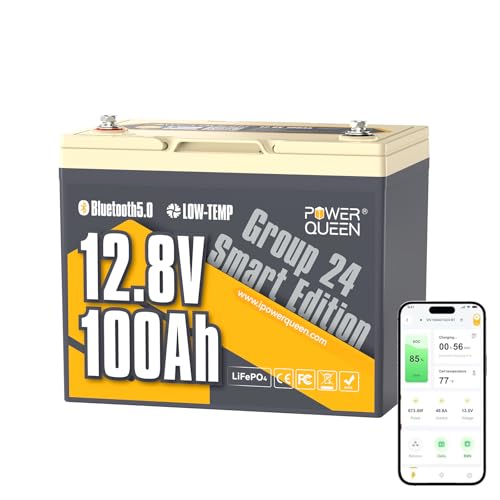
Power Queen 12V 100Ah Group 24 Smart Bluetooth LiFePO4
100Ah · 1,280 Wh · 100A BMS · Low-temp cut-off · 22.2 lb
Fit: Group 24; Power Queen says it fits Group 24/27/31 compartments
Current price on Amazon: $289.99
If your battery lives inside the heated living space, or you travel south for the winter, you don't need a heater. You do need the cut-off. Power Queen's Amazon listing says charging stops below 32°F and discharging stops below -4°F, and its spec page lists a 100A BMS with a 500A one-second surge, Bluetooth and a 5-year warranty. In our scoring it edges the self-heating Group 24 batteries on value, losing points only on cold-weather charging.
- Bluetooth at a mid-range price
- Low-temperature charge cut-off
- 500A / 1 s surge rating published
- No heater: no charging below 32°F
- Charging resumes only above 41°F
Specs: Power Queen spec page, Amazon listing.
#5 · Best Compact (Small Trailers, Tight Boxes) · 76/100
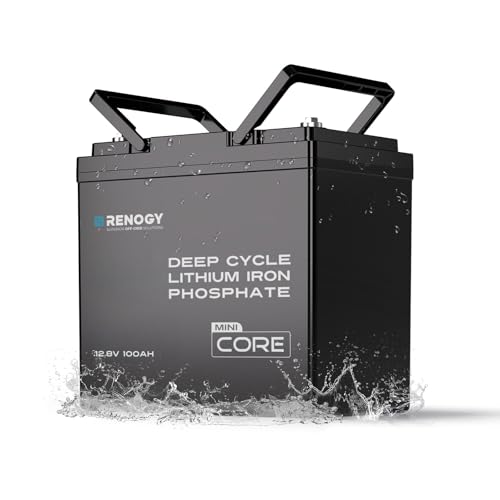
Renogy 12V 100Ah Core Mini LiFePO4
100Ah · 1,280 Wh · 100A BMS · Low-temp cut-off · 21.8 lb
Fit: Group 22NF size (9.02 × 5.43 in): smaller than Group 24
Current price on Amazon: $289.99
Teardrops, pop-ups and truck campers often have a battery box that won't take a Group 24. Renogy's Core Mini fits 100Ah into a 9.02 × 5.43 × 8.39 in case, and Renogy says it can be mounted in any orientation except upside down. It has a 100A BMS, low-temperature charging protection and a 5,000-cycle rating at 80% depth of discharge. Bluetooth isn't built in. App monitoring needs Renogy's 300A shunt, sold separately, and the 5-year warranty is prorated.
- Smallest 100Ah case here
- Low-temperature charge protection
- Mounts in any orientation but upside down
- App monitoring needs a separate shunt
- Prorated warranty
- Lower surge rating (300A / 5 s)
Specs: Renogy spec page, Amazon listing.
Want 200Ah?
The simplest 200Ah RV bank is two identical 100Ah batteries in parallel: 2,560 Wh, and their BMS current limits add up to 200A (see the wiring rules below). Two single-box 200Ah batteries with self-heating, LiTime's 12V 200Ah Plus Self-Heating and Renogy's 12V 200Ah Pro, both showed as currently unavailable on Amazon when we checked on November 8, 2026, so we left them out. The Redodo 200Ah Plus in our 12V lithium battery guide has a 200A BMS, but Redodo lists no low-temperature protection for it, so it only suits a bay that stays above freezing.
12 Volt LiFePO4 Battery Math: Ah to Usable Wh
A 12 volt LiFePO4 battery is four cells in series at 3.2V each, so its nominal voltage is 12.8V. Multiply amp-hours by 12.8 to get watt-hours: 100Ah × 12.8V = 1,280 Wh. LiFePO4 makers rate their batteries for 100% depth of discharge, but inverter and wiring losses eat some of that, so we plan on 85%: usable Wh = Wh × 0.85. DC loads that skip the inverter, like a 12V fridge, lights and the water pump, get a little more.
| Bank | Rated Wh | Usable Wh (× 0.85) | 12V fridge, 45W avg | Lights, fan, pump, devices (~20W avg) |
|---|---|---|---|---|
| 1 × 100Ah | 1,280 Wh | 1,088 Wh | ~1.0 days | ~2.3 days |
| 2 × 100Ah in parallel (200Ah) | 2,560 Wh | 2,176 Wh | ~2.0 days | ~4.5 days |
| 3 × 100Ah in parallel (300Ah) | 3,840 Wh | 3,264 Wh | ~3.0 days | ~6.8 days |
| 1 × LiTime 320Ah Mini | 4,096 Wh | 3,482 Wh | ~3.2 days | ~7.3 days |
The load figures are typical values we assume for illustration. Check your fridge's published energy use and your own habits. Our LiFePO4 chemistry guide explains why lithium iron phosphate is rated for full depth of discharge, and how that compares with lead-acid batteries, which are usually run to only about half their capacity.
How Many LiFePO4 Batteries for Boondocking?
Size the bank from your daily energy use, not from the number of batteries you had before. The method:
- Add up a day's watt-hours. For each load, multiply watts by hours of use. Compressor fridges cycle, so use the average draw, not the label maximum.
- Multiply by the days between recharges. That's how long you go without driving, shore power or useful sun. We use 2 days below.
- Divide by about 1,088 usable Wh per 100Ah battery (1,280 Wh × 0.85) and round up.
| Use profile (our assumptions) | Per day | 2 days, no charging | 100Ah batteries | or LiTime 320Ah |
|---|---|---|---|---|
| Weekend, light use LED lights 30W × 5 h, roof fan 25W × 6 h, water pump 60W × 0.5 h, phones and a laptop 150 Wh |
~480 Wh | ~960 Wh | 1 | 1 |
| Typical boondocking with a 12V fridge The light-use loads plus a 12V compressor fridge averaging 45W for 24 h (1,080 Wh) |
~1,560 Wh | ~3,120 Wh | 3 | 1 |
| Heavy use The typical loads plus a CPAP 40W × 8 h, TV 100W × 3 h and a 1,000W microwave for 15 min |
~2,430 Wh | ~4,860 Wh | 5 | 2 |
Solar changes the math. Every watt-hour your roof panels replace during the day is one the bank doesn't have to carry, so a 300Ah bank with a few hundred watts of solar can keep going through a run of sunny days. Our best RV solar kit guide matches panel and charge-controller sizes to battery banks. If you need hours of rooftop air conditioning, no 12V bank on this page is enough on its own. Our best generator for RV guide covers the gas and dual fuel options, and many RVers carry both.
Will My RV Converter Charge a LiFePO4 Battery?
Your RV's converter/charger turns shore or generator power into 12V DC and charges the house battery. Many were built with lead-acid profiles. Here is what to check before you swap batteries:
- Charge voltage. LiTime's manual calls for 14.4–14.6V in the constant-voltage phase and says to avoid permanent float charging. If float is necessary, it says to limit it to 13.4–13.6V (LiTime manual). Progressive Dynamics, a major RV converter maker, notes that many battery makers specify less than 14.6V, and its own lithium profile charges at 14.4V, then idles at 13.6V while the RV is on shore power (Progressive Dynamics PD9300 lithium profile).
- A lithium mode, or a replacement. Some converters have a lithium setting. Progressive Dynamics lists older models that can be switched to lithium and says it "can provide Lithium Converter Models to replace most of the Lead/Acid units presently in the field" (Progressive Dynamics). For a WFCO WF-9865 owner going lithium, etrailer recommended the Progressive Dynamics PD79RR, which it says is compatible with lead acid, AGM and LiFePO4 batteries (etrailer).
- No equalize or desulfation modes. Turn off lead-acid maintenance modes on any charger connected to a LiFePO4 battery. LiTime's manual says to use LiFePO4 batteries "only with a suitable charger."
- Solar charge controller and battery monitor. Set the controller to a LiFePO4 or user profile that matches the battery's charge voltage. Voltage-based gauges read lithium poorly because its voltage stays flat. The Bluetooth app on four of these picks gives a real state of charge.
Need a portable charger for winter storage or a weak converter? Our best LiFePO4 battery charger picks are 14.6V chargers with a lithium profile. Replacing a converter means working inside the RV's power center, so have a qualified RV technician do it.
Alternator Charging: Why RVs Need a DC-DC Charger
Motorhomes, and trailers wired to the tow vehicle, can charge the house battery while you drive. With lead-acid that was a simple connection. With lithium it usually isn't. Battle Born, an RV lithium battery maker, says factory alternators and wiring were designed around lead-acid starting batteries, and that "lithium batteries can accept sustained high current, which may overheat or damage charging equipment." It calls a DC-DC charger the best option for most vehicles (Battle Born). LiTime's manual likewise describes alternator charging of a LiFePO4 house battery through a DC-DC charger with a LiFePO4 charge curve (LiTime manual).
- What it does: a DC-DC charger sits between the vehicle's electrical system and the house battery. It caps the current, applies a lithium profile, and charges only while the engine is running (Battle Born). Renogy's 40A unit, for example, lists LiFePO4 among its battery types and caps output at 40A (Renogy).
- Sizing: Battle Born's rule of thumb is that an alternator can handle about half its rated amps continuously, so check your alternator rating and existing load before choosing a 20A, 30A or 40A charger.
- Bigger banks charge slowly from the alternator: a 40A charger puts back roughly 500 Wh an hour (40A × about 13V), so refilling a 320Ah battery takes a full day of driving. Solar and shore power do the heavy lifting.
Our best DC-DC charger guide compares 30–40A units, including solar-plus-alternator combos. Have an installer size the cabling and fusing.
Charging Below 32°F: Self-Heating vs Low-Temp Cut-Off
LiFePO4 cells shouldn't be charged below freezing. LiTime's manual says not to charge normally below 0°C (32°F) and to warm the battery above 5°C (41°F) first (LiTime manual). Renogy lists a 32–122°F charging range for the Core Mini (Renogy). How each type of battery handles that limit:
Low-temperature cut-off
The BMS blocks charging below freezing to protect the cells. Power Queen's Group 24 Smart stops charging below 32°F and resumes at 41°F (Power Queen). Your battery is safe, but on a cold morning the solar panels and alternator put nothing back until the battery warms up. This is fine if the battery sits inside the heated living space or you rarely camp below freezing. Picks #2, #4 and #5.
Self-heating
A heater inside the case uses charger power to warm the cells, then charging starts. Power Queen's Dual-Mode heats below 41°F or on an app-started preheat (Power Queen). LiTime's heats below 41°F and starts charging at 50°F (LiTime). Buy this type if the battery lives in an outside compartment and you camp, ski or store the RV with solar charging in winter. Picks #1 and #3.
Discharging is a different matter. LiTime, Power Queen and Renogy list discharge down to -4°F, so the furnace fan and lights keep running on a cold night. The limit applies only to putting energy back in, and battery makers draw that line in slightly different places; our guide on how to charge a LiFePO4 battery compares their cold-charging rules. Storing the RV for winter? Our LiFePO4 charger guide covers storage charging.
Wiring RV Lithium Batteries in Parallel or Series
Almost every RV runs a 12V house system, so you add batteries in parallel. That adds amp-hours at the same voltage (two 12V 100Ah = 12V 200Ah), and Battle Born notes that current limits add up too, so two 100A-BMS batteries can deliver about 200A together (Battle Born manual). Series wiring adds voltage (two 12V 100Ah = 24V 100Ah) and is only for 24V or 48V systems. The rules battery makers publish:
- Identical batteries only. LiTime requires "identical batteries with the same capacity and same state of charge" and says to combine only identical types and capacities (LiTime manual). Don't mix brands, ages, heated and non-heated models, or 100Ah with 200Ah.
- Match the state of charge first. LiTime says to fully charge every battery and equalize them in parallel for 12–24 hours. Battle Born says batteries for a series string should be at the same state of charge, fully charged individually before you connect them.
- Respect the limit. LiTime recommends at most 4 in series and 4 in parallel (16 batteries). Power Queen's listings give the same 4S4P limit.
- Never mix in lead-acid. LiTime says not to connect LiFePO4 in parallel with lead-acid or gel batteries.
- Fuse it. Battle Born recommends appropriate fuses and circuit breakers to protect downstream components. Use equal-length cables to each battery, and have a qualified installer size the fusing and cabling. We don't publish wiring diagrams.
Group 24, 27 or 31: Will It Fit Your Battery Box?
BCI group numbers describe the case footprint, not the capacity. Standard sizes, in inches, from LiTime’s group-size chart (exact dimensions vary slightly by maker):
| Size | L × W × H (in) | Picks that fit |
|---|---|---|
| Group 24 | 10.25 × 6.81 × 8.88 | Power Queen Dual-Mode, LiTime self-heating, Power Queen Smart (each 10.24 × 6.61 in) |
| Group 27 | 12.06 × 6.81 × 8.88 | Any Group 24 pick, with a hold-down that clamps the shorter case |
| Group 31 | 13.00 × 6.72 × 9.44 | Any Group 24 pick, secured the same way |
| Non-standard | LiTime 320Ah Mini: 14.49 × 7.44 × 10.04 (Ritz Marine; LiTime's Amazon listing says 10.63 tall) | Needs a bay longer and taller than a Group 31 |
Power Queen's Amazon listing for the Group 24 Smart says it fits Group 24, 27 and 31 compartments. A smaller lithium battery in a bigger tray works as long as it is clamped so it can't slide on the road. Measure the tray, the lid clearance and terminal height before you buy.
RV House Battery vs a Portable Power Station
A house battery wires into the RV's existing 12V system, so the lights, water pump, furnace fan and slide-outs run from it with no extension cords. To run 120V outlets from it you also need an inverter, plus fusing and cabling. A power station puts the battery, inverter, solar controller and outlets in one box, but it powers only what you plug into it. Here is our boondocking battery next to a power station we have already rated:
| LiTime 12V 320Ah Mini (battery) | Anker SOLIX F3000 (power station) | |
|---|---|---|
| Capacity | 4,096 Wh | 3,072 Wh |
| Weight | 57.17 lb | 91.5 lb |
| 120V AC output | None (inverter sold separately) | 3,600W built in |
| Solar charging | Needs a charge controller | 2,400W built in |
| Runs RV 12V circuits | Yes, wired in | Only through a shore-power adapter or its DC ports |
| Our score | 84/100 (battery rubric) | 93/100 (review) |
| Price | $746.99 | $1,699.99 |
Battery and power-station scores use different rubrics and aren't directly comparable.
Rent, lease or don't want to rewire? Our guide to the best solar generators for RVs covers plug-and-play power stations, including models with a TT-30 outlet for your shore cord. For a teardrop, pop-up, truck camper or camper van, our solar generator for camper guide sizes a portable station to a 12V fridge, a roof fan and a small roof. For a battery used outside an RV, such as a boat, shed or cabin, our best 12V lithium battery guide ranks the same batteries for general use.
Who Should Switch to a LiFePO4 RV Battery, and Who Should Wait
Switch if…
- You boondock or dry camp and run out of battery before the weekend ends.
- Your lead-acid batteries are due for replacement anyway.
- You have, or will add, rooftop solar and want to use the whole bank.
- Weight matters: a 100Ah LiFePO4 weighs about 22 lb.
Wait or plan more if…
- You stay at full-hookup campgrounds, where the battery barely works.
- Your converter has no lithium mode and you won't replace it.
- You charge from the alternator and won't add a DC-DC charger.
- The battery sits in an unheated bay in winter and you're looking at a non-heated model.
LiFePO4 RV Battery FAQ
What is the best LiFePO4 battery for an RV?
For most RVs, a 12V 100Ah LiFePO4 battery in a Group 24 case with a 100A BMS, Bluetooth and self-heating. Our top pick is the Power Queen 12V 100Ah Group 24 Dual-Mode Self-Heating battery, which can heat itself before charging below 41°F. For multi-day boondocking, the LiTime 12V 320Ah Mini puts 4,096 Wh and a 200A BMS in one box, but it weighs about 57 lb and needs a bay larger than a standard battery tray.
Will my RV converter charge a LiFePO4 battery?
It will charge it, but a converter built for lead-acid may not charge it fully or hold it at the right voltage. LiTime and Power Queen specify about 14.4V for charging, and LiTime's manual says to avoid permanent float charging. Check whether your converter has a lithium mode. Progressive Dynamics says it can supply lithium converter models to replace most lead-acid units in the field, and its lithium profile charges at 14.4V before dropping to 13.6V.
How many lithium batteries do I need for boondocking?
Add up your daily watt-hours, multiply by the days between recharges, and divide by about 1,088 usable Wh per 100Ah battery (1,280 Wh x 0.85). With a 12V compressor fridge, lights, a fan and devices at roughly 1,600 Wh a day, two days without solar or driving needs about 3,100 Wh: three 100Ah batteries or one 320Ah battery. Rooftop solar shrinks that number on sunny days.
Can you charge a LiFePO4 RV battery below freezing?
Not a standard one. LiFePO4 makers list a charging range that starts at 32°F (0°C), and batteries with low-temperature protection stop charging below it. Power Queen's non-heated Group 24 Smart, for example, stops charging below 32°F and resumes at 41°F. Self-heating batteries such as the Power Queen Dual-Mode and the LiTime self-heating model warm their cells with charger power first, then charge. Discharging is allowed down to about -4°F on these batteries.
Do I need a DC-DC charger for a lithium RV battery?
For alternator charging, usually yes. Battle Born advises against connecting lithium house batteries directly to the alternator in most vehicles, because lithium can accept sustained high current that may overheat the alternator or wiring. A DC-DC charger sits between the vehicle and the house battery, caps the current and applies a lithium charging profile. Have a qualified installer size and fit it.
Can I mix a new lithium battery with my old RV batteries?
No. LiTime's manual says not to connect LiFePO4 in parallel with lead-acid or gel batteries, and to combine only identical batteries of the same type and capacity at the same state of charge. Replace the whole bank at once, fully charge each new battery before connecting it, and fuse the bank as the battery manual specifies.
Standard tray and cold mornings? A self-heating Group 24. Multi-day boondocking? One 320Ah battery or three 100Ah in parallel.
Battery prices move often, and like other solar gear they have historically dipped during Prime Day and Black Friday events. Every price on this page loads live from Amazon.