
Buying Guide · Updated November 13, 2026
Best Lithium Batteries for Solar Power Storage: 48V Server-Rack and Wall-Mount Picks
For a home or cabin solar system, the lithium battery to buy is a 48V (51.2V nominal) LiFePO4 pack of about 5 kWh that talks to your inverter over CAN or RS485 and carries a UL 1973 listing you can trace to the certifier. On Amazon, the ECO-WORTHY Cubix100 is the budget server-rack battery we could match to an Intertek UL 1973 certificate and the California Energy Commission list. Fortress Power’s previous-generation eFlex 5.4 is the other listed option, at a far higher cost per kWh, and the in-stock Cubix100 Pro adds a touchscreen.
As an Amazon Associate, SolarGenAdvisor earns from qualifying purchases made through links on this page, at no additional cost to you.
 By Taylor Kim
Reviewed & approved by Juhi Sahni
|
Published: November 12, 2026
|
Updated:
|
Home battery backup guide
Solar Lithium Battery Storage on Amazon: What Is Actually Available
Search Amazon for a 48V solar battery and you get dozens of near-identical 51.2V 100Ah rack packs. We checked the brands solar buyers ask about against Amazon’s own product data on November 12, 2026, then looked each listed model up on the California Energy Commission’s battery list, which records the UL 1973 certificate behind each entry.
| Battery | Amazon status (Nov 12) | UL 1973 we could trace | Amazon price |
|---|---|---|---|
| ECO-WORTHY Cubix100 | Orderable, ships later; sold by ECO-WORTHY US | Yes: Intertek, model ECO-LFP4810002, on the CEC list | Check price at Amazon → |
| ECO-WORTHY Cubix100 Pro | In stock; sold by ECO-WORTHY US | None named on the listing; not on the CEC list | Check price at Amazon → |
| ECO-WORTHY 48V wall-mount | Orderable, ships later; sold by ECO-WORTHY US | None named on the listing; not on the CEC list | Check price at Amazon → |
| Fortress Power eFlex 5.4 | In stock; seller “Fortress Power Batteries” | Yes: Intertek, on the CEC list | Check price at Amazon → |
| LiTime 51.2V 100Ah, Jakiper 48V 230Ah | “Currently unavailable” | Not checked (not linked) | Not available |
| SOK 48V 100Ah, Renogy 48V 50Ah | Sold on Amazon, but the listing IDs we had did not resolve in Amazon’s product data, so we could not confirm stock | Not checked (not linked) | Not linked |
| EG4 LifePower4 and wall-mount, Ampace | No EG4- or Ampace-branded Amazon listing found in our searches; EG4 batteries are sold through Signature Solar and solar dealers | Several EG4 rack and wall-mount models, and one Ampace pack, are on the CEC list | Not on Amazon |
Stock, seller and listing text come from Amazon’s product data on November 12, 2026. UL 1973 entries come from the California Energy Commission Battery List (data as of Nov 2, 2026). Prices are live and change often.
Why the listing check matters: two batteries can share a model name and differ in certification. The Solar Lab’s review of an earlier ECO-WORTHY 48V rack battery reported that it was not UL listed; the Cubix100 entry on the CEC list is a specific model number, ECO-LFP4810002, which is the number on the Amazon listing we link. Match the model number on the box to the certificate before an inspection.
Our Picks: Lithium Ion Batteries for Solar Storage
Specs come from each maker’s Amazon listing and spec sheets, safety listings from the certifier or the CEC list. These four are unrated: our battery scoring was built for 12V batteries and does not measure inverter communication or safety listings, which decide a 48V purchase (see why).
Best overall for a permitted home install: UL 1973 listed
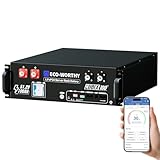
ECO-WORTHY Cubix100 48V 100Ah Server Rack LiFePO4 Battery
5,120 Wh · 51.2V nominal · 100A continuous · 103 lb · unrated
Orderable on Amazon for later shipment in our November 12 check.
One of the two batteries here whose safety listing we could trace to the certifier, and by far the lower-cost of the two. Intertek’s Authorization to Mark covers model ECO-LFP4810002 to UL 1973 (Intertek Authorization to Mark, report 241210206GZC-001 (hosted by ECO-WORTHY)), and the same model sits on the California Energy Commission Battery List (data as of Nov 2, 2026) with an Intertek UL 1973 certificate dated July 16, 2025. It talks to the inverter over CAN or RS485, reports to an app over Bluetooth and WiFi, and ECO-WORTHY allows up to 32 units in parallel. The listing title also claims UL 9540 and UL 9540A; we could not retrieve those documents, so ask ECO-WORTHY which inverter its UL 9540 system listing covers before you rely on it for a permit.
Best in stock now for closed-loop inverter setups

ECO-WORTHY Cubix100 Pro 48V 100Ah Server Rack LiFePO4 Battery
5,120 Wh · 51.2V nominal · 100A continuous · 103.6 lb · unrated
In stock on Amazon in our November 12 check.
The newer Cubix100 Pro adds a 4.3-inch touchscreen, 3A active balancing (from September 10 production, per ECO-WORTHY) and a named closed-loop list: EG4, Sol-Ark, DEYE, SRNE, Victron, Growatt and Sungoldpower. ECO-WORTHY claims it can charge at -4°F using a low-temperature electrolyte, rates it for 6,000+ cycles and states a 10-year limited warranty. Its listing names no UL certification, and we did not find the model on the CEC battery list, so it suits an off-grid cabin or shop where you have confirmed with your inspector what listing, if any, is required.
Best wall-mount option for a garage or utility room

ECO-WORTHY 48V 100Ah Wall-Mount Indoor LiFePO4 Battery
5,120 Wh · 51.2V nominal · 100A continuous · 97 lb · unrated
Orderable on Amazon for later shipment in our November 12 check.
The same 51.2V 100Ah capacity in a wall-hung case, for a home without a rack. ECO-WORTHY lists Bluetooth and WiFi monitoring, a built-in aerosol fire-suppression module and a pre-charge circuit, and a retailer spec sheet adds CAN/RS485 with the Pylon protocol by default and indoor-only installation (Current Connected spec sheet). Amazon lists it at 97 lb; that retailer lists 110 lb, so plan for two people and a wall that takes the load. Like the Pro, its listing names no UL certification.
Fortress Power on Amazon: installer-grade, indoor or outdoor

Fortress Power eFlex 5.4 kWh 48V LFP Battery
5,400 Wh · 51.2V nominal · 60A continuous · 116 lb · unrated
In stock on Amazon from a seller named Fortress Power Batteries in our November 12 check.
An IP65 aluminum-cased 5.4 kWh battery that mounts on a wall, a floor stand or a 19-inch rack, with closed-loop CAN and Modbus. Fortress rates it for 8,000 cycles at 80% depth of discharge with a 10-year warranty (Fortress eFlex datasheet), and the CEC list shows its Intertek UL 1973 certificate. Two cautions: Fortress now labels this model “Previous Model” and says it is not compatible with the newer eFlex MAX (Fortress Power’s eFlex 5.4 page), so a bank you plan to grow later should be all one generation; and it costs several times more per kWh than the server-rack picks.
48V Solar Storage Battery Comparison
The four batteries side by side, from our product database. Cost per kWh is today’s Amazon price divided by rated capacity.
| Spec | Cubix100 | Cubix100 Pro | Wall-mount | Fortress eFlex 5.4 |
|---|---|---|---|---|
| Amazon price | Check price at Amazon → | Check price at Amazon → | Check price at Amazon → | Check price at Amazon → |
| Cost per kWh | — | — | — | — |
| Capacity | 5,120 Wh | 5,120 Wh | 5,120 Wh | 5,400 Wh |
| Continuous current | 100A (50A recommended) | 100A (50A recommended) | 100A (50A recommended) | 60A discharge, 100A charge |
| Voltage | 40-58.4V (retailer spec sheets) | 58.4V maximum charge (retailer spec sheet) | 58.4V maximum charge (retailer spec sheet) | 48-55V operating; 54.4V recommended charge (Fortress) |
| Inverter link | CAN, RS485 (closed-loop); Bluetooth + WiFi app | CAN, RS485, RS232 (Pylon protocol by default); Bluetooth + WiFi; 4.3-in touchscreen | CAN, RS485, RS232 (Pylon protocol by default); Bluetooth + WiFi | CANbus, Modbus, WiFi (closed loop) |
| Units in parallel | Up to 32 | Up to 32 | Up to 32 | Up to 30 |
| Mounting | 19-inch server rack (22.09 x 19.02 x 5.63 in) | 19-inch server rack (21.7 x 19.02 x 6.06 in) | Wall-mount or floor-standing, indoor only | Wall, floor or 19-inch rack; IP65 aluminum case (21.5 x 17.5 x 7.2 in) |
| Weight | 103 lb | 103.6 lb | 97 lb (110 lb per one retailer) | 116 lb (108 lb on its datasheet) |
| Cycle rating (maker) | Not stated on ECO-WORTHY's Amazon listing | 6,000+ (ECO-WORTHY listing; DoD not stated) | Not stated on ECO-WORTHY's Amazon listing | 8,000 at 80% DoD (Fortress product page and datasheet) |
| Warranty (maker) | 10-year limited | 10-year limited | 10-year (listing) | 10-year; read Fortress’s warranty letter for cycle terms |
| Safety listing | UL 1973 (Intertek, report 241210206GZC-001, Jul 16 2025; on the CEC Battery List). UL 9540A test and UL 9540 system claims are ECO-WORTHY's; certificates not retrieved. | None published on the Amazon listing or found on the CEC Battery List (Nov 2026 data) | None published on the Amazon listing or found on the CEC Battery List (Nov 2026 data) | UL 1973 (Intertek, on the CEC Battery List, Ed. 2:2018); Fortress also lists UL 9540 / UL 9540A |
Sources: ECO-WORTHY and Fortress Amazon listings (Nov 12, 2026); Current Connected spec sheets for ECO-WORTHY current and voltage figures (Current Connected spec sheet, Current Connected spec sheet); Fortress Power’s eFlex 5.4 page and Fortress eFlex datasheet; the California Energy Commission Battery List (data as of Nov 2, 2026). We could not retrieve ECO-WORTHY’s own spec pages (its site refused our requests), so ECO-WORTHY cycle figures appear only where its Amazon listing states one. The Amazon listing for the eFlex 5.4 gives its warranty as “10 year or 6000 cycles at 80% DoD.”
How Many kWh of Solar Battery Storage Do You Need?
Start from what you want to run, not the whole house. The average U.S. home used 863 kWh a month in 2024 (U.S. EIA), about 28.4 kWh a day by our arithmetic; covering a full day from batteries takes about 7 of the 5.12 kWh packs below. Most buyers size for an essentials load overnight instead. Our household electricity use guide breaks the average down by appliance.
| Bank (51.2V 100Ah packs) | Stored | At 500W (fridge, router, lights) | At 1,000W (adds a well pump or furnace fan) | At 2,000W |
|---|---|---|---|---|
| 1 pack | 5.12 kWh | ~8.7 h | ~4.4 h | ~2.2 h |
| 2 packs | 10.24 kWh | ~17.4 h | ~8.7 h | ~4.4 h |
| 3 packs | 15.36 kWh | ~26.1 h | ~13.1 h | ~6.5 h |
| 4 packs | 20.48 kWh | ~34.8 h | ~17.4 h | ~8.7 h |
Runtime = rated Wh × 0.85 ÷ load, our arithmetic. The 0.85 allows for inverter losses and a reserve you leave unused. Loads are averages; a well pump or AC starting up draws a brief surge that your inverter, not the battery, must be sized for.
- •Current sets the power ceiling. ECO-WORTHY recommends 50A per pack, roughly 2.5 kW at 51.2V, with 100A as the maximum. Packs in parallel share the load, so a 5 kW inverter running near full output needs at least two packs to stay at the recommended current (our arithmetic: 5,000W ÷ 51.2V ≈ 98A).
- •Solar refills it. One 5.12 kWh pack needs roughly 1.5 kW of panels and four good sun hours to refill (our arithmetic, allowing about 15% for losses). Our solar size calculator works out panels and storage from your appliance list.
- •Budget the whole system. Batteries are one line; the inverter, wiring, disconnects and permit are the rest. Our whole-house solar generator cost breakdown prices each tier.
Inverter Compatibility: Closed-Loop CAN and RS485
A 48V rack battery does nothing on its own; it needs a hybrid or off-grid inverter-charger. The single most important question before you buy is whether the two can talk.
Closed loop
The battery’s BMS sends state of charge, voltage, temperature and its charge limits to the inverter over a CAN or RS485 cable, and the inverter charges to the battery’s request. Victron, for example, requires the BMS to adjust the charge voltage limit to restrict power into the battery (Victron Energy).
Open loop
No data cable: you type the battery’s charge and cut-off voltages into the inverter and it works from voltage alone. Solis calls this mode “sub-optimal” and says “closed-loop is always preferred” (Solis).
Four checks before you order
- 1.The bus your inverter supports. Not every inverter speaks both. Solis says one of its hybrid models “does not support RS485 closed-loop communication with any batteries” and accepts only approved CAN protocols (Solis).
- 2.The protocol, not just the plug. ECO-WORTHY ships its packs set to the Pylon protocol by default and lets you change it on the screen or in its software (Current Connected spec sheet). Victron lists Pylontech among its tested batteries; ECO-WORTHY, Fortress, EG4, SOK and LiTime were not on that page when we checked (Victron Energy), and Victron says batteries off its list may still be used with support from the battery supplier.
- 3.The inverter’s own approved-battery list. Solis warns that a non-approved battery on CAN “can lead to improper charging, battery damage, or system-wide faults” and that doing it without its test report voids the inverter warranty (Solis). The CEC list records Fortress’s eFlex 5.4 with JA12 control strategies certified on Sol-Ark 5K to 15K inverters (California Energy Commission Battery List (data as of Nov 2, 2026)).
- 4.The voltage window. “48V” batteries do not all charge to the same voltage. Fortress recommends 54.4V charging within a 48 to 55V operating range (Fortress eFlex datasheet; Fortress Power’s eFlex 5.4 page), while retailer spec sheets list a 58.4V maximum charge for the ECO-WORTHY packs. In open loop, use the numbers in your battery’s manual, never a generic 48V preset. Our LiFePO4 charging guide has the 48V voltage chart and explains what the BMS does when a setting is wrong.
Never mix generations or brands in one bank unless both makers say it is supported. Fortress, for example, says the eFlex 5.4 and the newer eFlex MAX are not compatible with each other (Fortress Power’s eFlex 5.4 page).
UL 9540, UL 9540A and UL 1973: What Each Listing Means
Battery listings use three different standards that cover different things, and listings blur them together all the time.
| Standard | What it covers | What it means for you |
|---|---|---|
| UL 1973 | The battery itself, for stationary uses such as photovoltaic systems (UL’s standards catalog) | The listing to look for on a battery you buy on its own. The CEC list records the UL 1973 certifier and date for every battery on it. |
| UL 9540 | The energy storage system: charging and discharging, protection, controls and communication, and it references UL 1973 for the battery (UL Solutions) | A system listing covers a specific combination. A battery with UL 1973 used with an inverter it was never listed with is not a UL 9540 system; UL notes that “simply combining individual, independently certified products in the field does not result in a certified (Listed) system” (UL Code Authority). |
| UL 9540A | A test method for thermal runaway fire propagation, at cell, module, unit and installation level (UL Solutions on UL 9540A) | A test report, not a listing. Fire officials use the results; “9540A tested” does not mean listed. |
Why it matters at home: the 2021 International Residential Code section R328.2 requires a residential ESS to be “listed and labeled in accordance with UL 9540,” and R328.4 limits where it can go: detached garages and accessory structures, attached garages separated from living space by gypsum board, outside walls at least three feet from openings into the home, and certain utility closets, basements and storage spaces that do not open directly into a bedroom (IAEI Magazine (Doug Smith, Jan 2025)). Inside living space, UL 9540 calls for the cell-level UL 9540A performance criteria to be met, and IAEI advises inspectors to ask for the actual test report when a maker claims a battery can go there. Whether your area has adopted that code edition, and how it applies to a battery bank you assemble yourself, is your local inspector’s call.
How to verify a claim yourself: find the exact model number on the listing, look it up on the California Energy Commission Battery List (data as of Nov 2, 2026) (a free spreadsheet that names the UL 1973 certifier and date), and ask the seller for the certificate. For the Cubix100, the certificate ECO-WORTHY hosts is Intertek’s Authorization to Mark for report 241210206GZC-001, issued July 16, 2025, for model ECO-LFP4810002 to ANSI/CAN/UL 1973:2022 (Intertek Authorization to Mark, report 241210206GZC-001 (hosted by ECO-WORTHY)).
Installation, Code and Permits
A 48V battery bank stores enough energy to start a fire and deliver dangerous fault current. In the U.S., permanently installed energy storage falls under the National Electrical Code (NFPA 70), including Article 706 on energy storage systems, which requires the system to be listed (IAEI Magazine (Doug Smith, Jan 2025)), plus your state’s fire and residential codes, and the local building department (the authority having jurisdiction, or AHJ) decides what applies to your home. Plan on a permit, and have a licensed electrician do or check the work. This page is not legal or electrical advice.
- •Install standard. NFPA’s fact sheet points anyone installing energy storage in new construction or a renovation to NFPA 855, the Standard for the Installation of Energy Storage Systems (NFPA’s ESS safety fact sheet (Feb 2024)).
- •Why the rules exist. NFPA describes thermal runaway as a chain reaction from cell to cell that can end in fire or explosion, and warns that a battery can hold stranded energy and reignite hours or days after a fire. It lists overcharging, charging too fast and charging at too high a voltage among the failure triggers, which is what closed-loop communication guards against (NFPA’s ESS safety fact sheet (Feb 2024)).
- •Location. A garage or utility room is the usual home for a rack or wall-mount pack, subject to the location rules your AHJ enforces (see the IRC summary above). The ECO-WORTHY wall-mount is rated for indoor installation only; Fortress rates the eFlex 5.4 IP65 for indoor or outdoor mounting (Fortress eFlex datasheet).
- •Weight and handling. Every pack here weighs about 100 lb or more. Use the rack rails or the maker’s wall bracket, anchor to studs or masonry, and lift with two people.
- •Grid-tied systems. If the inverter connects to the grid, your utility’s interconnection rules apply as well. Installed whole-home systems, their permits and the federal tax credit are covered in our home battery backup guide.
Fortress Batteries: Mostly Installer-Sold, One Model on Amazon
Fortress Power is a Southampton, Pennsylvania battery maker (Fortress eFlex datasheet) that sells mainly through installers and distributors: its site cites more than 500 installer partners and 100 distributor partners, sends shoppers to a “Find an Installer Near You” page and runs a certified-installer program (Fortress Power). Its current batteries include the eFlex MAX 5.4 kWh and the eVault and eVault MAX 18.5 kWh, plus larger commercial systems.
| Fortress model | Key published specs | Where to buy |
|---|---|---|
| eFlex 5.4 (previous model) | 5.4 kWh, 105 Ah, 60A continuous discharge, 8,000 cycles at 80% DoD, IP65, 10-year warranty; UL 1973 on the CEC list (Fortress Power’s eFlex 5.4 page) | Amazon (in stock Nov 12), installers and distributors |
| eFlex MAX 5.4 | Current 5.4 kWh model; UL 1973 (Ed. 3) on the CEC list. Not compatible with the eFlex 5.4. | Installers and distributors; no Amazon listing found |
| eVault MAX 18.5 | 18.5 kWh, 51.2V, 180A charge and discharge, 8,000+ cycles at 80% DoD, 10-year warranty, 520 lb; UL 1973 and UL 9540 per Fortress (Fortress Power’s eVault MAX page); on the CEC list | Installers and distributors; no Amazon listing found |
Should you buy the eFlex on Amazon? It is a sound fit if you are adding to an existing eFlex 5.4 bank, need an outdoor-rated case, or run a Sol-Ark inverter with the pairing recorded on the CEC list. For a new system it costs several times more per kWh than the ECO-WORTHY picks (— against — today), and Fortress’s current models come with installer support that an Amazon purchase does not include. It ships from a seller named Fortress Power Batteries.
12V and 24V Lithium Batteries for Small Solar Systems
Below about 2 kW of inverter, a 48V rack battery is more than you need. A shed, van, small cabin or RV runs on 12V or 24V, where one battery in a standard case does the job and charge controllers are cheaper. These two are rated on our 12V battery scale; the full comparison, including Bluetooth and self-heating models, is in our best 12V lithium batteries guide, and RV house banks are in our LiFePO4 RV battery guide.
| Battery | Capacity | Best for | Our rating | Amazon price |
|---|---|---|---|---|
| Redodo 12V 200Ah Plus LiFePO4 (200A BMS) | 2,560 Wh at 12V, 200A BMS | A 12V system with a 2,000W-class inverter in a warm space (no low-temperature protection listed) | 72/100 | Check price at Amazon → Check price → |
| LiTime 24V 100Ah LiFePO4 Battery (100A BMS) | 2,560 Wh at 24V, 100A BMS | A 24V cabin or shed system; one box instead of two 12V batteries in series | 72/100 | Check price at Amazon → Check price → |
Ratings from our 12V battery scoring (capacity and value, BMS, cold weather, cycle life and warranty, size and weight, monitoring), built from published specs and live prices. Runtime for these: the 12V 200Ah stores enough for a 200W load for about 10.9 hours.
Rack Battery Bank vs an All-in-One Home Battery
A rack battery is one part of a system you assemble. An all-in-one unit like the EcoFlow Delta Pro 3, our highest-rated home backup station, builds the battery, inverter and solar charger into one box. Here is how one Cubix100 compares, using our product data.
| Spec | ECO-WORTHY Cubix100 | EcoFlow Delta Pro 3 |
|---|---|---|
| Amazon price | Check price at Amazon → | Check price at Amazon → |
| Stored energy | 5,120 Wh | 4,096 Wh |
| AC output | None: needs a separate 48V inverter-charger | 4,000W built in |
| Solar charging | Through the inverter or a charge controller | Built in |
| Weight | 103 lb | 113.5 lb |
| Installation | Permanent wiring, disconnects, permit | Plugs in; a transfer switch or panel for house circuits |
| Our rating | Unrated (no 48V rubric yet) | 95/100 |
Rack batteries win on cost per kWh at scale and on flexibility: add packs as you need them and choose any compatible inverter. The all-in-one wins on simplicity: no inverter to match, no communication cable to configure, and it is portable. If you are not planning a wired system with an electrician, read our Delta Pro 3 review first. On chemistry, every product on this page is LiFePO4; why that matters for daily cycling is in our LiFePO4 vs NMC comparison.
Who Should Buy a 48V Rack Battery, and Who Should Skip
A 48V LiFePO4 bank makes sense if…
- •You have, or are buying, a 48V hybrid or off-grid inverter that lists closed-loop support for the battery’s protocol.
- •You want 10 kWh or more and expect to add packs later.
- •An electrician will wire it and you will pull a permit.
- •You have a garage, utility room or outbuilding that suits a 100 lb-per-pack bank.
Skip it if…
- •You want backup without any wiring work: a power station plugs in (see our home battery backup options).
- •Your system is 12V or 24V: buy a battery for that voltage instead (section above).
- •You rent, or cannot install permanently.
- •You need a server or network rack UPS: that is a different product, covered in our rack mount UPS guide.
Verdict: The Best Lithium Battery for Solar Storage
For a permitted home solar system, buy the ECO-WORTHY Cubix100 48V 100Ah Server Rack LiFePO4 Battery. It is the budget server-rack battery whose UL 1973 listing we could trace to Intertek and the CEC list, it talks closed-loop over CAN or RS485, and it works out to — at today’s price, against — for the listed Fortress eFlex 5.4. It was orderable for later shipment when we checked. If you need a battery now for an off-grid build where you have confirmed the listing requirements, the in-stock Cubix100 Pro adds the touchscreen and a named inverter list. Whichever you choose, confirm your inverter’s protocol first.
Lithium Solar Storage Battery FAQ
What is the best lithium battery for solar power storage?
For a home or cabin system with a 48V inverter, a 51.2V LiFePO4 battery of about 5 kWh with closed-loop CAN or RS485 communication and a traceable UL 1973 listing. On Amazon, the ECO-WORTHY Cubix100 (model ECO-LFP4810002) is the lower-cost battery we could match to an Intertek UL 1973 certificate and the California Energy Commission battery list; the Fortress eFlex 5.4 is the other, at a much higher cost per kWh. For 12V or 24V systems, a single 12V or 24V LiFePO4 battery is the better fit.
Is a lithium-ion battery good for solar storage, and is LiFePO4 lithium-ion?
Yes on both counts. LiFePO4 (lithium iron phosphate, LFP) is a lithium-ion chemistry; NFPA groups LFP with other lithium-ion energy storage systems in its safety guidance. It is the usual choice for solar storage because it handles daily charge and discharge cycles well, and makers rate the batteries on this page for thousands of cycles.
How many 48V 100Ah batteries do I need for solar storage?
Each 51.2V 100Ah pack stores 5.12 kWh. After about 15% for inverter losses and reserve, one pack runs a 500W essentials load for about 8.7 hours, and two run it for about 17. The average U.S. home used about 28 kWh a day in 2024, so covering a full day takes about seven packs; most people size for essentials overnight and let solar refill the bank by day.
Do 48V server-rack batteries work with any inverter?
They work in open loop with most 48V inverters if you enter the battery’s own charge and cut-off voltages, but closed-loop communication over CAN or RS485 needs a matching protocol. Some inverters support only CAN, and some, such as Solis, warn that connecting a battery that is not on their approved list can cause faults and void the inverter warranty. Check the inverter maker’s battery list before you buy.
Does a home solar battery need to be UL 9540 listed?
Often, yes. The 2021 International Residential Code requires residential energy storage systems to be listed and labeled to UL 9540, and limits where they can be installed. UL 9540 covers the whole system; UL 1973 covers the battery; UL 9540A is a fire test method, not a listing. Requirements depend on the code edition your area has adopted, so ask your local building department before you buy.
Are Fortress Power batteries sold on Amazon?
One model is. In our November 12, 2026 check, the previous-generation Fortress eFlex 5.4 kWh was in stock on Amazon from a seller named Fortress Power Batteries. Fortress sells its current eFlex MAX and eVault batteries mainly through installers and distributors, and it says the eFlex 5.4 and eFlex MAX are not compatible with each other.
How We Built This Page, and Why These Batteries Are Unrated
Stock, sellers and listing claims come from Amazon’s product data, checked November 12, 2026. Specs come from the makers’ listings, datasheets and retailer spec sheets, each cited where it is used; safety listings come from the certifier’s document or the California Energy Commission battery list. We did not test these batteries. Our ratings are AI-synthesized from published specs, logged Amazon prices and Amazon customer reviews, and the only battery scoring we publish was built for 12V batteries: it scores BMS current against a 12V reference, which every 48V pack maxes out; it rewards standard battery-box sizes, which rack and wall-mount cases do not use; and it has no measure for inverter communication or safety listings. Rather than publish numbers that would not mean what our other ratings mean, we have left the 48V batteries unrated until we publish a scoring method for them. The 12V and 24V batteries in the small-systems section carry their existing ratings.