
Buying Guide · Updated October 2026
Best Power Inverter 2026: Pure Sine Wave 12V Inverters for Car, Truck, RV & Outages
The best power inverter for most RVs, vans and trucks is a 12V 2,000W pure sine wave inverter listed to UL 458 and wired directly to a lithium battery bank. Our top pick is the Renogy Pro 2000W for its low idle draw, GFCI outlets and Bluetooth monitoring. The Giandel PS-2000SDR is the budget 2,000W pick, and if you only need to charge a laptop from the car, the plug-in BESTEK 300W pure sine is enough.
As an Amazon Associate, SolarGenAdvisor earns from qualifying purchases made through links on this page, at no additional cost to you. Ratings are AI-synthesized from published specs and logged Amazon prices; we did not test these inverters.
 By
Quick Verdict
Buy pure sine wave, size the inverter to your largest simultaneous load plus about 25%, and make sure your battery can supply the current: about 93A for 1,000W, 185A for 2,000W and 278A for 3,000W at 12V. Anything above roughly 150W must be wired to the battery, not plugged into a cigarette-lighter socket. If you don't have a battery bank yet, a portable power station is usually the simpler buy.
How We Score Power Inverters
Our power-station matrix doesn't fit bare inverters, so these scores use an inverter-specific rubric. Each score is AI-synthesized from manufacturer spec sheets, retailer spec tables and Amazon prices checked on November 1, 2026. We did not bench-test any inverter, and we don't use Amazon star ratings because we have no reliable review data for these listings. Weights total 100:
- Power (20): continuous rating scaled to 3,000W, averaged with surge headroom (2× or more with a published duration scores highest)
- Safety & certification (20): a full UL 458 / CSA listing, GFCI outlets; UL-listed parts alone earn partial credit
- Value & warranty (20): three parts the lowest cost per continuous watt here divided by this inverter's, one part warranty length
- Efficiency & idle draw (15): published peak efficiency and no-load draw (what it wastes while switched on)
- Waveform & output quality (15): pure sine, plus credit for a published THD under 3%
- Features (10): hardwire terminals, remote, app, USB-C, display
A spec the maker doesn't publish scores as unknown (low), never as a pass. Inverter scores aren't comparable with our power-station scores.
The 6 Best Pure Sine Wave Power Inverters
All six run from a 12V battery and output 120V pure sine wave AC. Specs come from the manufacturer page or a retailer spec table (linked), cross-checked against the Amazon listing. Where a figure isn't published, we say so.
1. Best Overall 2,000W Inverter

Renogy Pro 2000W Pure Sine Wave Inverter with Bluetooth
2,000W continuous · Peak: 4,000W for 150 ms · ~185A at full load · Score 78/100
Price: $333.99
Renogy's newer Pro series fixes the two things that annoy people about older 2,000W inverters: idle draw and safety at the outlet. Renogy lists a no-load draw under 9.6W and up to 92% efficiency, so the inverter wastes less of your battery when it sits switched on. The AC outlets are GFCI-protected, and there are 45-degree terminals for wiring to an RV sub-panel. Built-in Bluetooth shows input voltage, output watts and fault alerts in the Renogy app. The 4,000W surge rating is for 150 ms (per the spec table at Off Grid Stores), which is enough for most compressor starts but not a substitute for a soft starter on a rooftop AC. Spec source.
Pros
- ✓ Lowest published idle draw here (under 9.6W)
- ✓ GFCI outlets plus AC terminals
- ✓ Bluetooth monitoring with no add-on module
- ✓ 2-year warranty per Renogy
Cons
- ✗ Costs more than the P2 and Giandel 2,000W units
- ✗ Amazon stock has been thin; check availability
- ✗ Needs a 200A-class battery bank and a hardwired install
2. Best High-Power (3,000W)
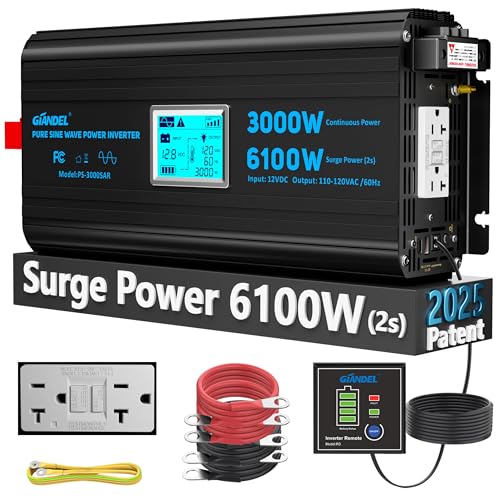
Giandel 3000W Pure Sine Wave Inverter (PS-3000SAR)
3,000W continuous · Peak: 6,100W for 2 s · ~278A at full load · Score 76/100
Price: $349.95
The pick for big loads such as a 1,500W microwave, an induction plate plus a coffee maker, or a well-sized battery bank backing up a fridge and freezer. Giandel lists 3,000W continuous with a 6,100W surge for two seconds, over 91% efficiency, two UL-listed 20A GFCI outlets and an LCD that shows input voltage, output watts and fault codes. You can set the battery type (including LiFePO4) and the low-voltage cut-off from 9.5V to 11.5V. The catch is current: at 3,000W it pulls roughly 275A from a 12V battery, so this belongs on a large lithium bank with heavy cabling installed by someone qualified. Spec source.
Pros
- ✓ 6,100W two-second surge for motor starts
- ✓ Selectable battery type and low-voltage cut-off
- ✓ GFCI outlets, LCD and 30 ft wired remote
- ✓ Lowest cost per continuous watt here
Cons
- ✗ About 275A draw at full load on 12V
- ✗ Standby draw listed at 0.9–2.5A
- ✗ 18-month warranty (shorter than Renogy Pro)
3. Best Proven 2,000W (Sold by Amazon)

Renogy P2 2000W Pure Sine Wave Inverter
2,000W continuous · Peak: 4,000W peak · ~185A at full load · Score 70/100
Price: $285.99
Renogy's P2 has been the default 2,000W inverter in RV and van builds for years, and the listing is sold and shipped by Amazon. You get 2,000W continuous and 4,000W peak, three AC outlets, an AC terminal block, a wired remote and a pair of 1/0 AWG battery cables in the box (per the listing). It is ETL listed to UL 458, the standard for mobile inverters. Compared with the Pro, it draws more at idle (under 2A, roughly 24W, per Off Grid Stores' spec table), has no GFCI on the outlets and carries a one-year warranty. Spec source.
Pros
- ✓ Sold and shipped by Amazon
- ✓ ETL listed to UL 458 and CSA
- ✓ Three outlets plus a hardwire terminal
- ✓ Cables and remote included
Cons
- ✗ Higher idle draw than the Pro
- ✗ No GFCI outlets or app
- ✗ 1-year warranty
4. Best 1,000W for Vans & One Battery

Renogy P2 1000W Pure Sine Wave Inverter
1,000W continuous · Peak: 2,000W peak · ~93A at full load · Score 67/100
Price: $175.99
Most vans and small campers don't need 2,000W. A 1,000W inverter covers laptops, a TV, a CPAP, camera and tool-battery chargers, a blender and a small rice cooker, and at about 93A full-load draw it stays within a single 100Ah lithium battery's 100A BMS. Renogy's P2 1000W lists 1,000W continuous and 2,000W peak, GFCI protection, a hardwire terminal, a 16.4 ft remote and 4 AWG cables, and it is UL 458 and CSA certified per the listing. It will not run a full-size microwave or a 1,200W coffee maker. Spec source.
Pros
- ✓ Fits a single 100Ah / 100A BMS battery
- ✓ GFCI protection and hardwire terminal
- ✓ UL 458 and CSA per the listing
- ✓ Sold and shipped by Amazon
Cons
- ✗ Too small for microwaves and coffee makers
- ✗ Idle draw and weight not published on the listing
- ✗ Warranty term not stated on the listing
5. Best Budget 2,000W

Giandel 2000W Pure Sine Wave Inverter (PS-2000SDR)
2,000W continuous · Peak: Not published on the listing · ~185A at full load · Score 59/100
Price: $229.95
The cheapest 2,000W pure sine inverter here from an established inverter brand. Giandel's PS-2000SDR adds modern charging ports (USB-C PD30W and two QC3.0), a 20A hardwire block and a 15 ft remote, and the fan only runs above 95°F or 800W, which keeps it quiet at light loads. The listing says the design meets UL 458 with UL-listed components. Two things hold it back in our scoring: Giandel doesn't publish a surge rating or idle draw on the listing, and efficiency is listed as "up to 90%", slightly below the Renogy units. Spec source.
Pros
- ✓ Lowest price for 2,000W pure sine here
- ✓ USB-C PD30W and QC3.0 ports
- ✓ Quiet fan logic at light loads
- ✓ 18-month warranty
Cons
- ✗ Surge rating not published on the listing
- ✗ No GFCI outlets
- ✗ Idle draw not published
6. Best Car Plug-In Inverter

BESTEK 300W Pure Sine Wave Car Inverter
300W continuous · Peak: 700W peak · ~28A at full load · Score 45/100
Price: $41.99
If you just want to charge a laptop, camera batteries or a drone on the road, a plug-in inverter is all you need, and this one has a pure sine output. BESTEK lists 300W continuous and 700W peak, two AC outlets and two USB ports, an 11–17V input range and a 40A internal fuse. Be realistic about the 300W: through a car's 12V accessory socket you'll get closer to 120–150W before the socket fuse blows (see why below), and the listing doesn't include battery clamps. Spec source.
Pros
- ✓ Pure sine output at a plug-in price
- ✓ Two AC outlets plus two USB ports
- ✓ No installation: plugs into the 12V socket
- ✓ 18-month warranty
Cons
- ✗ Socket limits real output to about 120–150W in most cars
- ✗ No battery clamps listed in the box
- ✗ Efficiency not published
Power Inverter Comparison Table
Figures are as published by each brand or its listing. "Full-load draw" is our estimate: continuous watts ÷ 12V ÷ 0.9 efficiency.
| Inverter | Continuous / peak | Full-load draw | Efficiency / idle | Outlets | Certification | Warranty | Score | Price |
|---|---|---|---|---|---|---|---|---|
| Renogy Pro 2000W Pure Sine Wave Inverter with Bluetooth | 2,000W / 4,000W | ~185A | Up to 92%; Under 9.6W | 2 GFCI AC outlets, AC terminal block, 18W USB | UL 458, CSA C22.2 No. 107.1 | 2 yr | 78/100 | $333.99 |
| Giandel 3000W Pure Sine Wave Inverter (PS-3000SAR) | 3,000W / 6,100W | ~278A | Over 91%; 0.9-2.5A (about 11-30W) | 2 UL-listed 20A GFCI outlets, hardwire terminal, USB | UL-listed GFCI outlets and main components (per Giandel) | 18 months | 76/100 | $349.95 |
| Renogy P2 2000W Pure Sine Wave Inverter | 2,000W / 4,000W | ~185A | Over 90%; Under 2A (about 24W) | 3 AC outlets, AC terminal block, 2.1A USB | ETL listed to UL 458 and CSA C22.2 No. 107.1 | 1 yr | 70/100 | $285.99 |
| Renogy P2 1000W Pure Sine Wave Inverter | 1,000W / 2,000W | ~93A | Over 90%; Not published on the listing | 2 AC outlets, AC terminal block, 2.1A USB | UL 458 and CSA C22.2 No. 107.1 (per listing) | Not stated on listing | 67/100 | $175.99 |
| Giandel 2000W Pure Sine Wave Inverter (PS-2000SDR) | 2,000W / Not published | ~185A | Up to 90%; Not published on the listing | 2 AC outlets, 20A hardwire block, USB-C PD30W, 2x QC3.0 | Listing says it meets UL 458 with UL-listed components | 18 months | 59/100 | $229.95 |
| BESTEK 300W Pure Sine Wave Car Inverter | 300W / 700W | ~28A | Not published; Not published | 2 AC outlets, 2 USB-A (4.8A total) | Not stated on the pure sine listing | 18 months | 45/100 | $41.99 |
Warranty terms are as published by each brand or listing; read the warranty document before buying. Renogy Pro surge (150 ms) and P2 idle draw come from Off Grid Stores' published spec tables; Giandel PS-3000SAR figures from giandel.com.
Pure Sine Wave vs Modified Sine Wave: Which Devices Need Pure Sine?
A pure sine wave inverter produces AC that closely matches grid power. A modified sine wave inverter approximates it with a stepped square wave, which is cheaper to build but harder on some electronics. Inverter manufacturer Samlex, which makes both types, lists these as the loads that may not work properly or may be damaged on modified sine wave (Samlex FAQ):
- Laser printers, photocopiers and magneto-optical drives
- Rechargers for power-tool battery packs
- Dimmers and ceiling-fan or motor speed controls
- Built-in clocks in clock radios, alarm clocks and coffee makers, which may not keep time
- Motors and microwaves, which Samlex says run hotter on modified sine (and faster, quieter and cooler on pure sine)
Tool makers say similar things about their own modified-sine products. DeWalt's manual for its DCB1800 modified-sine power station states it is not intended for medical or other critical devices (see our tool-battery power station guide). For a CPAP or any medical device, follow the device maker's power guidance. Many CPAP makers also sell a DC converter, such as ResMed's Air11 DC/DC converter for 12V or 24V vehicle outlets, which skips the inverter entirely. Our CPAP power guide covers runtime.
Pure sine models now cost little more than modified sine at the same wattage, so we no longer recommend modified sine for anything except the simplest resistive loads, which is why every pick on this page is pure sine.
What Size Inverter Do I Need? Continuous vs Surge Watts
Every inverter has two ratings. Continuous watts is what it can deliver indefinitely (within its temperature limits). Surge or peak watts is a short burst for motor and compressor start-up, and the duration matters: Renogy publishes 4,000W for 150 milliseconds on its Pro 2000W, while Giandel publishes 6,100W for two seconds on the PS-3000SAR. A spec without a duration tells you less.
- List what will run at the same time and add up the running watts from each appliance label.
- Add 20–25% headroom so the inverter isn't running flat out.
- Check that the surge rating covers the biggest motor start (fridge, pump, compressor).
- Then confirm your battery can supply the current (next section).
| If you want to run… | Typical draw | Inverter size |
|---|---|---|
| Phone, laptop, camera batteries | 20–100W | 150–300W plug-in |
| CPAP (no humidifier), TV, router | 40–150W | 300W pure sine (hardwired if over ~150W) |
| Blender, tool chargers, small rice cooker | 300–800W | 1,000W |
| Microwave (1,000W cooking) or coffee maker | 1,200–1,500W input | 2,000W |
| Microwave + coffee maker, induction plate, larger tools | 2,000W+ | 3,000W and a large lithium bank |
A microwave's "1,000W" is usually its cooking power; it draws more from the outlet, so check the input rating on the label. Wattages are typical figures. For a full load worksheet, see our sizing guide, and for rooftop AC start-up, our RV air-conditioner guide.
How Many Amps Does an Inverter Draw at 12V?
Divide the AC load by the battery voltage, then by the inverter's efficiency: amps ≈ watts ÷ 12 ÷ 0.9. At 12V, current is ten times what the same appliance draws at 120V, which is why inverter cables are so thick.
| AC load | Battery current at 12V | What that means |
|---|---|---|
| 150W | ~14A | About the limit of a typical 15A accessory socket |
| 300W | ~28A | Too much for most sockets; needs a direct battery connection |
| 1,000W | ~93A | Near a single 100A-BMS battery's limit |
| 2,000W | ~185A | Needs a 200A-class battery or bank |
| 3,000W | ~278A | Large lithium bank and professional install |
Why Big Inverters Can't Use a Cigarette-Lighter Socket
A car's 12V accessory socket sits on a small fused circuit, usually 10, 15 or 20 amps. Mazda's owner's manual, for example, says to use only accessories with a maximum power consumption of 120 W (12V, 10A) or below (Mazda owner's manual). Some vehicles allow more and some less, and running a socket with the engine off drains the starter battery. Plug-in inverter manuals set a similar ceiling. Pyle's PINV-series manual says the lighter plug supports loads up to 150 watts and tells you to use battery clips above that (Pyle manual). Your vehicle's manual and fuse chart give the real figure for your socket. Never fit a larger fuse to make an inverter work.
So a "300W" plug-in inverter is really a 120–150W inverter in most cars, and anything from 1,000W up must be wired to a battery. Running a big inverter off the starter battery with the engine off can also leave you unable to start the vehicle. In vans and RVs, large inverters belong on a separate house battery that a DC-DC charger or solar keeps topped up.
Safety: fusing, cables and installation
Large inverters need a correctly sized fuse or breaker close to the battery, cables of the gauge and length the manufacturer specifies, a battery disconnect and a ventilated mounting spot. The right sizes depend on the inverter, cable run and battery, so follow the inverter's manual or have a qualified RV technician or electrician install it. We don't publish wiring or fuse-size instructions. Never connect an inverter to a home's wiring through an outlet ("backfeeding"); a home connection needs a transfer switch installed by a licensed electrician to code. Our transfer switch guide explains the options.
Battery Pairing: How Long Will an Inverter Run?
An inverter stores nothing; the battery decides runtime. We estimate battery Wh × 0.85 ÷ load watts, which allows for inverter and wiring losses. A 12V 100Ah LiFePO4 battery stores about 1,280 Wh; a 200Ah battery (or two 100Ah in parallel) about 2,560 Wh.
| Load | 100Ah lithium (1,280 Wh) | 200Ah lithium (2,560 Wh) |
|---|---|---|
| CPAP, no humidifier (40W) | ~27 hours | ~54 hours |
| Laptop + router (60W) | ~18 hours | ~36 hours |
| TV + streaming box (100W) | ~11 hours | ~22 hours |
| Full-size fridge (~150W average) | ~7 hours | ~14.5 hours |
| Microwave (1,000W input) | ~65 minutes* | ~2.2 hours |
| Coffee maker (1,200W) | Not recommended* | ~1.8 hours |
*Loads near 1,000W and above pull 90A or more, at or past a single 100A BMS limit. Use a 200A BMS battery or a parallel bank for kitchen appliances. Remember that the inverter's own idle draw (under 10W to about 30W on these picks) runs down the battery whenever it is switched on, so turn it off when you aren't using it.
Our best 12V lithium battery guide compares 100Ah and 200Ah LiFePO4 batteries by BMS current. That rating, not capacity alone, decides which inverter a battery can feed. If you're also adding roof panels, the best RV solar kit guide covers the charging side.
Power Inverter vs Portable Power Station
An inverter only converts power, so you still need a battery, a way to charge it, fusing, cabling and an install. A portable power station puts a LiFePO4 battery, inverter, solar charge controller, wall charger and outlets in one box. Here's our top inverter plus a 100Ah battery compared with two power stations we rate:
| Renogy Pro 2000W + LiTime 100Ah | Jackery Explorer 1000 V2 | EcoFlow Delta 3 Plus | |
|---|---|---|---|
| AC output | 2,000W (battery BMS limits it to about 1,000W on one 100Ah) | 1,500W | 1,800W |
| Capacity | 1,280 Wh (expandable bank) | 1,070 Wh | 1,024 Wh |
| Charging | Separate charger, DC-DC charger and/or solar controller | Wall, car, 400W solar built in | Wall, car, 1000W solar built in |
| Installation | Hardwired, fused, mounted | Plug and play | Plug and play |
| Our score | 78/100 inverter rubric; 81/100 battery rubric | 93/100 (review) | 89/100 (review) |
| Price | Inverter $333.99 Battery $368.99 |
$559.00 | $719.00 |
Inverter, battery and power-station scores use different rubrics and aren't directly comparable. The inverter-plus-battery column also needs a charger, fuse, disconnect and cabling, which are not priced here.
Choose an inverter if…
- ✓ Your RV, van, truck or boat already has a house battery bank
- ✓ You need 2,000–3,000W from a large lithium bank
- ✓ You want a permanent install with outlets where you need them
Choose a power station if…
- ✓ You don't have a battery bank and don't want to wire one
- ✓ You'll use it in the house during outages as well as on the road
- ✓ You want UPS-style switchover for a desk or medical device (see power station vs UPS). If you only need a few minutes to save work and shut a PC down, a desktop UPS battery backup costs far less.
Shopping power stations instead? Start with our best solar generator for van life picks or the broader RV and van-life roundup.
Who Should Buy a Power Inverter (and Who Should Skip)
Good fit
- ✓ RV and van owners adding 120V outlets to a lithium house battery
- ✓ Truckers and contractors running tools or a microwave from a battery bank
- ✓ Road-trippers charging laptops (a 300W plug-in is enough)
- ✓ Off-grid cabins and sheds with a battery bank and charge controller
Skip it if
- ✗ You have no battery bank and want home outage backup (buy a power station)
- ✗ You plan to run 1,000W+ from a car's starter battery or lighter socket
- ✗ You aren't prepared to have it fused and installed properly
- ✗ You want to plug it into a house outlet to power the home (never backfeed)
Inverter prices move often. Like other 12V gear, they have historically dipped during Prime Day and Black Friday events. Every price on this page loads live from Amazon.
Power Inverter FAQ
What is the best power inverter?
For an RV, van or truck with a lithium battery bank, a 12V 2,000W pure sine wave inverter listed to UL 458 suits most people. In our scoring the Renogy Pro 2000W ranks first for its low idle draw, GFCI outlets and Bluetooth monitoring. The Giandel PS-3000SAR is the pick for 3,000W loads, and the BESTEK 300W pure sine is the pick if you only need a plug-in car inverter.
Do I need a pure sine wave inverter?
For anything beyond basic chargers and resistive heaters, yes. Inverter maker Samlex lists laser printers, power-tool battery chargers, dimmers and motor speed controls, and appliance clocks among the devices that may not work properly or may be damaged on a modified sine wave, and says motors and microwaves run hotter on it. Medical devices such as CPAP machines should follow the device maker's power guidance. Pure sine inverters now cost little more, so we only recommend pure sine models.
What size inverter do I need?
Add up the running watts of everything you will use at the same time, add about 20 to 25 percent headroom, and check that the inverter's surge rating covers the largest motor start-up. Laptops, CPAP and TVs fit a 300W to 1,000W inverter. A microwave or coffee maker needs 1,500W to 2,000W, and running several kitchen loads together needs 3,000W and a large battery bank.
How many amps does a 2000W inverter draw at 12V?
About 185 amps at full load. Divide the AC watts by the battery voltage and by the inverter efficiency: 2,000W divided by 12V divided by 0.9 is roughly 185A. A 1,000W inverter draws about 93A and a 3,000W inverter about 278A. That is why large inverters need short, heavy cables, a correctly sized fuse and a battery whose BMS can deliver that current.
Can I plug an inverter into my car's cigarette lighter?
Only a small one. Vehicle accessory sockets are fused at roughly 10 to 20 amps; Mazda's owner's manual, for example, limits its sockets to accessories of 120 watts (10 amps) or less, and plug-in inverter manuals typically cap lighter-plug use at about 150W. Anything larger must be wired directly to the battery with its own fuse, following the inverter manual or a qualified installer.
What size battery do I need for a 2000W inverter?
A battery bank that can deliver about 200 amps continuously, such as one 12V 200Ah LiFePO4 battery with a 200A BMS or two 100Ah batteries with 100A BMS each in parallel. Capacity then sets runtime: a 2,560Wh bank runs a 1,000W load for roughly two hours after inverter losses.
Is a power inverter better than a portable power station?
It depends on whether you already have a battery. An inverter is the cheaper way to get 120V AC from an existing RV or van battery bank, but it needs a battery, fusing, cabling and an install. A portable power station combines the battery, inverter, chargers and outlets in one box with no wiring, and moves between the vehicle, the house and a campsite.
Can a power inverter run a CPAP machine?
Yes, a pure sine wave inverter of 300W or more can run a typical CPAP from its normal AC power supply, and our CPAP guide covers runtime. A DC route is often more efficient: ResMed, for example, sells an Air11 DC/DC converter for running AirSense 11 machines from a 12V or 24V vehicle outlet. Check your machine's manual for approved power options.