
Buying Guide · Updated November 2026
Best Lithium Trolling Motor Battery (12V, 24V & 36V) for 2026
The best lithium trolling motor battery is a LiFePO4 battery that matches your motor's voltage and has a BMS rated above the motor's maximum amp draw. For 12V motors up to 55 lb, our pick is the Power Queen 12V 100Ah Group 24, or the LiTime 12V 100Ah self-heating battery if you charge in freezing weather. For 24V motors, the LiTime 24V 100Ah replaces two batteries. For 36V motors, the Power Queen 36V 50Ah replaces three in one Group 31 case.
As an Amazon Associate, SolarGenAdvisor earns from qualifying purchases made through links on this page, at no additional cost to you. Ratings are AI-synthesized from published specs, logged Amazon prices and Amazon customer reviews; we did not test these batteries.
 By Taylor Kim
Reviewed & approved by Juhi Sahni
|
Published: 2026-10-31
|
Updated:
|
12V Lithium Batteries
Quick Verdict
Start with the voltage printed on your motor: 12V for 55 lb thrust or less, 24V for 68–80 lb and 36V for 101–115 lb (Minn Kota buying guide). Then buy a LiFePO4 battery whose BMS continuous rating beats your motor's maximum amp draw, with a low-temperature charging cut-off, or self-heating if you charge below freezing. A single 24V or 36V lithium battery saves the weight and wiring of two or three 12V batteries, but a 36V 50Ah pack has half the energy of three 12V 100Ah batteries.
How We Score Trolling Motor Batteries
These batteries use the same battery rubric as our best 12V lithium battery guide, so the scores can be compared across both pages. Each score is AI-synthesized from manufacturer spec pages and logged Amazon prices. We did not bench-test any battery, and Amazon star ratings are not an input. Weights total 100:
- Capacity & value (25): cost per kWh at logged Amazon prices, relative to the cheapest battery we score
- BMS & continuous current (20): continuous power (amps × volts) plus a published surge rating; specs a maker doesn't publish earn no credit
- Cold-weather protection (15): self-heating > low-temp charge cut-off > none listed
- Cycle life & warranty (15): published cycle rating and warranty length (manufacturer claims)
- Size & weight (15): standard BCI case versus a non-standard one, and watt-hours per pound
- Monitoring (10): built-in Bluetooth app, optional add-on, or none
The 6 Best Lithium Trolling Motor Batteries by Voltage
Two picks for each motor voltage. Every pick is a LiFePO4 battery with a built-in BMS and a published IP65 case. Specs come from each manufacturer's spec page (linked), cross-checked against the Amazon listing. Where the two disagree, we say so.
1. Best 12V (Motors up to 55 lb)
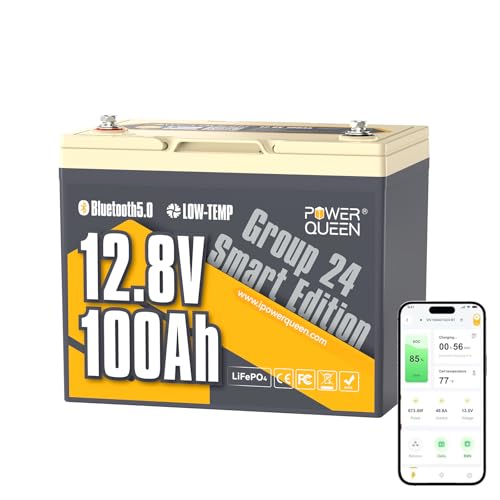
Power Queen 12V 100Ah Group 24 Smart Bluetooth LiFePO4
12V · 30–55 lb · 1,280 Wh (12.8V 100Ah) · 100A BMS · Group 24 · 22.2 lb · Score 82/100
Price: $289.99
Most bow and transom motors of 55 lb thrust or less run on one 12V battery, and this Group 24 Power Queen is the value pick with Bluetooth. Its 100A BMS has twice the headroom of the 50A maximum draw Minn Kota lists for its 50–55 lb motors. It stops charging below 32°F and resumes at 41°F, and at about 22 lb it weighs about a third as much as a 64 lb 100Ah AGM. Manufacturer specs.
Pros
- ✓ 100A BMS: double a 55 lb motor's 50A max draw
- ✓ Bluetooth state-of-charge app
- ✓ Group 24 case fits most trays
- ✓ Published 5-year warranty
Cons
- ✗ No self-heating
- ✗ Smaller than a Group 27/31 box, so it may need a spacer or different hold-down
2. Best for Cold-Weather & Early-Season Fishing (12V)

LiTime 12V 100Ah Group 24 Self-Heating Bluetooth LiFePO4
12V · 30–55 lb · 1,280 Wh (12.8V 100Ah) · 100A BMS · Group 24 · 22.7 lb · Score 81/100
Price: $368.99
This is the 12V battery to pick if your boat sits on a charger in an unheated garage or you launch in March. LiTime says its BMS warms the cells when a charger is connected below 41°F and starts charging once they reach 50°F. Otherwise it matches the Power Queen: Group 24 case, 100A BMS, Bluetooth and a 500A one-second surge rating. You pay extra for the heater. Manufacturer specs.
Pros
- ✓ Self-heating, so it can accept a charge in freezing weather
- ✓ Built-in Bluetooth app
- ✓ 100A BMS, 500A / 1 s surge
Cons
- ✗ Highest cost per kWh of the picks
- ✗ Heater draws from the charger before charging starts
3. Best 24V (68–80 lb Motors)
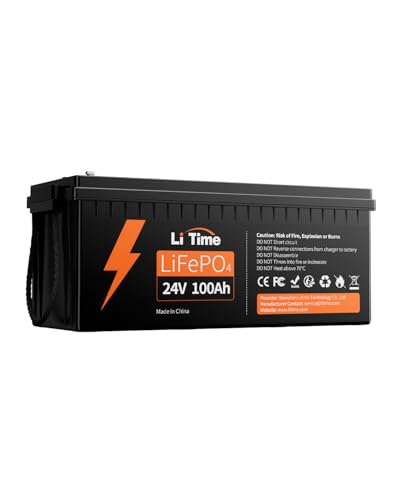
LiTime 24V 100Ah LiFePO4 Battery (100A BMS)
24V · 68–80 lb · 2,560 Wh (25.6V 100Ah) · 100A BMS · Non-standard (20.95 x 8.15 x 8.5 in) · 45.9 lb · Score 72/100
Price: $519.99
One box replaces two 12V batteries and the series jumper: 2,560 Wh at 25.6V with a 100A BMS. Minn Kota lists a 56A maximum draw for its 80 lb, 24V Terrova, well inside that limit. LiTime's Amazon listing advertises a low-temperature charging cut-off, but LiTime's own spec page only lists a 32–122°F charging range, so don't charge it below freezing. The catch is the case: about 21 × 8.2 × 8.5 in, so it won't drop into a Group 27 or 31 box. Manufacturer specs.
Pros
- ✓ Replaces two 12V batteries
- ✓ 100A BMS vs an 80 lb motor's 56A max draw
- ✓ IP65 case
- ✓ 5-year warranty (LiTime spec page)
Cons
- ✗ Non-standard 21-inch case
- ✗ No Bluetooth
- ✗ Low-temp cut-off not confirmed on LiTime's own spec page
- ✗ Surge rating not confirmed
4. Best Value 24V

Redodo 24V 100Ah LiFePO4 Battery (100A BMS)
24V · 68–80 lb · 2,560 Wh (25.6V 100Ah) · 100A BMS · Non-standard (20.95 x 8.15 x 8.5 in) · 45.6 lb · Score 69/100
Price: $449.99
Same 2,560 Wh, 100A BMS, IP65 rating and 21-inch case as the LiTime at a lower price. At logged prices it ties for the lowest cost per kWh of any battery we score, and Redodo recommends it for 70–100 lb trolling motors. Redodo doesn't describe any low-temperature charging protection for this model, so only charge it above freezing. Manufacturer specs.
Pros
- ✓ Lowest cost per kWh in our battery scoring
- ✓ 100A BMS
- ✓ IP65 case, 5-year warranty
Cons
- ✗ No low-temperature charge protection listed
- ✗ No Bluetooth
- ✗ Non-standard 21-inch case
5. Best 36V (101–115 lb Motors)

Power Queen 36V 50Ah Smart Bluetooth LiFePO4 Trolling Motor Battery
36V · 101–115 lb · 1,920 Wh (38.4V 50Ah) · 50A BMS · Group 31 · 33.1 lb · Score 82/100
Price: $429.99
A 36V motor normally needs three 12V batteries. This Power Queen replaces them with one Group 31 case of about 33 lb, and adds Bluetooth and a low-temperature charging cut-off (stops below 32°F, resumes above 41°F). Power Queen rates it for 100–120 lb motors and lists 50A continuous, 60A for 30 minutes and 250A for 1 second. Watch that 50A continuous figure: Minn Kota lists 46–52A maximum draw for its 101–112 lb 36V motors. If you run at full throttle for long stretches, two in parallel double both current headroom and runtime. Manufacturer specs.
Pros
- ✓ Replaces three 12V batteries
- ✓ Group 31 case, about 33 lb
- ✓ Bluetooth and a low-temp charge cut-off
- ✓ 60A for 30 min, 250A for 1 s
Cons
- ✗ 50A continuous BMS is close to a 112 lb motor's max draw
- ✗ 1,920 Wh is half of three 12V 100Ah batteries (3,840 Wh)
- ✗ Not for series connection (per Power Queen)
6. Best Value 36V

Redodo 36V 50Ah LiFePO4 Trolling Motor Battery
36V · 101–115 lb · 1,920 Wh (38.4V 50Ah) · 50A BMS · Group 31 · 32.8 lb · Score 78/100
Price: $369.99
It matches the Power Queen on the basics: 1,920 Wh, Group 31 size, a 50A BMS (60A for 30 minutes, 250A peak) and a charging cut-off below 32°F that resumes above 41°F. It costs less but has no Bluetooth. Redodo designed it for 100–120 lb motors and says its white case stays cooler in direct sun than a black one. Manufacturer specs.
Pros
- ✓ Lower cost per kWh than the other 36V pick
- ✓ Low-temp charge cut-off
- ✓ Group 31, about 33 lb
- ✓ 5-year warranty (Redodo listing)
Cons
- ✗ No Bluetooth app
- ✗ Same 50A continuous limit as other 36V 50Ah packs
- ✗ 250A peak is listed without a duration
Shopping for an RV or van house battery instead? The two 12V picks above also appear in our best 12V lithium battery roundup, alongside a compact Group 22NF option and a 200Ah battery for big inverters.
12V vs 24V vs 36V Lithium Trolling Motor Batteries Compared
Every figure is the manufacturer's published number. "Motor class" is Minn Kota's thrust-to-voltage guidance, not a battery rating.
| Battery | Motor class | Energy | BMS (cont. / surge) | Cold-weather charging | Case / weight | Bluetooth | Score | Price |
|---|---|---|---|---|---|---|---|---|
| Power Queen 12V 100Ah Group 24 Smart Bluetooth LiFePO4 | 12V · 30–55 lb | 1,280 Wh (12.8V 100Ah) | 100A / 500A / 1 s | Charge cut-off below 32°F (resumes at 41°F); discharge cut-off below -4°F | Group 24, 22.2 lb | Built in | 82/100 | $289.99 |
| LiTime 12V 100Ah Group 24 Self-Heating Bluetooth LiFePO4 | 12V · 30–55 lb | 1,280 Wh (12.8V 100Ah) | 100A / 500A / 1 s | Self-heating: heats below 41°F on a charger, charges from 50°F; charge range -4°F to 122°F | Group 24, 22.7 lb | Built in | 81/100 | $368.99 |
| LiTime 24V 100Ah LiFePO4 Battery (100A BMS) | 24V · 68–80 lb | 2,560 Wh (25.6V 100Ah) | 100A / not published | Low-temp charge cut-off per LiTime's Amazon listing; litime.com lists a 32-122°F charge range | Non-standard (20.95 x 8.15 x 8.5 in), 45.9 lb | No | 72/100 | $519.99 |
| Redodo 24V 100Ah LiFePO4 Battery (100A BMS) | 24V · 68–80 lb | 2,560 Wh (25.6V 100Ah) | 100A / not published | Not listed by Redodo for this model; do not charge below 32°F | Non-standard (20.95 x 8.15 x 8.5 in), 45.6 lb | No | 69/100 | $449.99 |
| Power Queen 36V 50Ah Smart Bluetooth LiFePO4 Trolling Motor Battery | 36V · 101–115 lb | 1,920 Wh (38.4V 50Ah) | 50A / 60A for 30 min; 250A / 1 s | Charge cut-off below 32°F (resumes above 41°F); discharge cut-off below -4°F | Group 31, 33.1 lb | Built in | 82/100 | $429.99 |
| Redodo 36V 50Ah LiFePO4 Trolling Motor Battery | 36V · 101–115 lb | 1,920 Wh (38.4V 50Ah) | 50A / 60A for 30 min; 250A peak | Charge cut-off below 32°F (resumes above 41°F); discharge cut-off below -4°F | Group 31, 32.8 lb | No | 78/100 | $369.99 |
All six list 4,000 or more cycles at 100% depth of discharge (manufacturer claims) and a 5-year warranty; read each warranty document before buying. Redodo's 36V weight is 32.8 lb on redodopower.com and 32.7 lb on Amazon.
Which Voltage Do You Need? 12V, 24V or 36V by Thrust
The motor sets the voltage, not the battery. Minn Kota's buying guide puts motors of 55 lb thrust or less on 12V (one battery), 68–80 lb on 24V (two) and 101–115 lb on 36V (three) (Minn Kota). To pick the thrust, Minn Kota's rule of thumb is at least 2 lb of thrust per 100 lb of fully loaded boat weight (fuel, gear and people included), with more if you fish in wind or current (Minn Kota thrust guide). A boat that weighs 2,500 lb loaded needs about 50 lb of thrust, so 12V. At 3,800 lb you need about 76 lb, so 24V. If you already own the motor, MotorGuide's owner's manuals point you to the voltage decal on the motor head and warn against exceeding the maximum supply voltage (MotorGuide manual).
| Minn Kota thrust | Voltage | Max amp draw* | Lead-acid setup | One-box lithium option |
|---|---|---|---|---|
| 30 lb | 12V | 30A | One 12V battery | 12V 100Ah, 100A BMS |
| 40–45 lb | 12V | 42A | One 12V battery | 12V 100Ah, 100A BMS |
| 50–55 lb | 12V | 50A | One 12V battery | 12V 100Ah, 100A BMS |
| 70 lb | 24V | 42A | Two 12V in series | 24V 100Ah, 100A BMS |
| 80 lb | 24V | 56A | Two 12V in series | 24V 100Ah, 100A BMS |
| 101 lb | 36V | 46A | Three 12V in series | 36V 50Ah, 50A BMS |
| 112 lb | 36V | 50–52A | Three 12V in series | Two 36V 50Ah in parallel for long full-throttle runs |
*Maximum amp draw from Minn Kota's battery and wiring chart. The 112 lb figure is 50A in that chart and 52A on the current Terrova 112 listing; the Terrova 80 lists 56A at 24V. Minn Kota notes that these maximums "only occur intermittently" and are not continuous loads. Other brands publish their own figures, so check your motor's manual.
One 24V/36V Battery or Several 12V Batteries?
You can reach 24V or 36V by wiring 12V lithium batteries in series (LiTime and Power Queen allow up to four of their 12V 100Ah batteries in series), or buy one battery built for the voltage. Minn Kota's chart says batteries in a series bank must be the same make, type, size and age. Here is how the two approaches compare for a 36V motor, using batteries we already score:
| 3 × Power Queen 12V 100Ah (series) | 1 × Power Queen 36V 50Ah | 2 × Power Queen 36V 50Ah (parallel) | |
|---|---|---|---|
| Energy | 3,840 Wh | 1,920 Wh | 3,840 Wh |
| Continuous current | 100A | 50A | 100A |
| Total weight | 66.6 lb | 33.1 lb | 66.3 lb |
| Battery spaces | Three Group 24 | One Group 31 | Two Group 31 |
| Price per battery | $289.99 × 3 | $429.99 | $429.99 × 2 |
The single 36V battery wins on weight and space. Three 12V batteries win on energy and current, and each one can be reused on a 12V boat later. Interconnects, fusing and cable sizing should follow the battery and motor manuals or be done by a qualified marine technician; we don't publish wiring instructions.
How Long Will a 100Ah Lithium Battery Run a Trolling Motor?
Runtime is usable amp-hours divided by average current. We plan on 85% of rated capacity, the same margin as our Wh × 0.85 ÷ load watts rule, to leave room for wiring losses and the BMS cut-off. A 100Ah battery gives about 85 usable amp-hours, so a 55 lb motor at its 50A maximum runs about 1.7 hours. Motor makers publish only the maximum draw, not the draw at each speed setting. The half and quarter columns below are illustrative averages, not specific dial settings. Most anglers spend much of the day well below full throttle, but wind, current and boat weight change the real draw.
| Motor (Minn Kota max draw) | Battery | At max draw | At half (avg) | At quarter (avg) |
|---|---|---|---|---|
| 30 lb, 12V (30A) | 12V 100Ah | ~2.8 h | ~5.7 h | ~11.3 h |
| 55 lb, 12V (50A) | 12V 100Ah | ~1.7 h | ~3.4 h | ~6.8 h |
| 80 lb, 24V (56A) | 24V 100Ah | ~1.5 h | ~3.0 h | ~6.1 h |
| 112 lb, 36V (50A) | 36V 50Ah | ~51 min | ~1.7 h | ~3.4 h |
| 112 lb, 36V (50A) | 2 × 36V 50Ah (parallel) | ~1.7 h | ~3.4 h | ~6.8 h |
Math: 85 usable Ah ÷ 50A = 1.7 h; 42.5 usable Ah (36V 50Ah) ÷ 50A = 0.85 h. Redodo's own listing estimates 4.8 hours at 400W and 2.4 hours at 800W for its 36V 50Ah battery, which uses the full 1,920 Wh; with our 85% margin that becomes about 4.1 and 2.0 hours. For a full day of fishing, size for your average draw, not the maximum, and keep a margin for the run back to the ramp.
How Many Amp-Hours Do You Need?
Minn Kota recommends a deep-cycle marine battery of at least 110 amp-hours, usually Group 27 or larger, for its motors (Minn Kota battery chart). That guidance is written for lead-acid. Because LiFePO4 makers rate their batteries for 100% depth of discharge, while lead-acid is commonly run to about 50% to protect its life (Northern Arizona Wind & Sun deep-cycle FAQ), a 100Ah lithium battery delivers more usable energy than a 110Ah lead-acid battery. For 36V motors that run hard all day, budget for two 36V 50Ah batteries in parallel, or three 12V 100Ah batteries in series.
LiFePO4 vs AGM Trolling Motor Batteries: Weight and Usable Energy
Weight is the biggest everyday difference. Renogy lists its 12V 100Ah deep-cycle AGM at 63.9 lb (Renogy spec), and other 100Ah Group 31 AGMs are in the same 60–65 lb range. Here is the same motor voltage on lead-acid and on our lithium picks:
| Motor voltage | 12V 100Ah AGM bank | Lithium pick | Weight saved |
|---|---|---|---|
| 12V | 1 × AGM = 63.9 lb (1,200 Wh rated, about 600 Wh at 50%) | Power Queen 12V 100Ah Group 24 Smart Bluetooth LiFePO4: 22.2 lb (1,280 Wh) | ~41.7 lb |
| 24V | 2 × AGM = 127.8 lb (2,400 Wh rated, about 1,200 Wh at 50%) | LiTime 24V 100Ah LiFePO4 Battery (100A BMS): 45.9 lb (2,560 Wh) | ~82 lb |
| 36V | 3 × AGM = 191.7 lb (3,600 Wh rated, about 1,800 Wh at 50%) | Power Queen 36V 50Ah Smart Bluetooth LiFePO4 Trolling Motor Battery: 33.1 lb (1,920 Wh) | ~158.6 lb |
AGM energy uses 12V × 100Ah = 1,200 Wh per battery. Lithium voltage stays flatter as it drains, so the motor holds its speed until the BMS cuts off, rather than slowing as a lead-acid battery sags. AGM still has two advantages: a lower purchase price and the ability to charge in freezing weather. For the chemistry background, see our LiFePO4 guide and LiFePO4 vs NMC.
Charging a Lithium Trolling Motor Battery
- Use a LiFePO4 profile at the maker's voltage. LiTime and Power Queen specify 14.4V ± 0.2V for their 12V batteries. LiTime and Redodo recommend a 29.2V, 20A lithium charger for their 24V 100Ah batteries, and Power Queen recommends a 43.8V, 25A charger for its 36V 50Ah. Lead-acid chargers with equalize or desulfation modes can push past lithium limits.
- Onboard chargers charge per 12V bank. A two- or three-bank onboard charger charges each 12V battery separately. Swap to a single 24V or 36V lithium battery and you need a charger built for that voltage with a lithium profile; check your charger's manual before reusing it.
- Alternator charging needs a DC-DC charger. If you top up from the outboard's alternator, a DC-DC charger limits the current and applies a lithium profile. Our best DC-DC charger guide compares 12V units. Confirm the output voltage matches your trolling bank.
- Solar on the boat. A small panel and a charge controller with a LiFePO4 setting can top up a trolling battery at the dock. Our best flexible solar panel picks cover panels that fit curved decks and T-tops.
- Keep the trolling bank separate. Minn Kota recommends a separate deep-cycle battery for the trolling motor if a cranking battery starts your outboard (Minn Kota). None of these batteries is a starter battery. If you also want 120V on board, run an inverter from a 12V house battery instead; see our best power inverter guide.
Cold Weather: Don't Charge Below 32°F Without Self-Heating
LiFePO4 cells shouldn't be charged below freezing. Power Queen's 36V battery stops charging below 32°F and resumes above 41°F (Power Queen), and Redodo lists the same thresholds for its 36V model (Redodo). LiTime's 24V spec page lists a 32–122°F charging range (LiTime). A cut-off protects the cells, but charging simply stops until the battery warms. A self-heating battery uses charger power to warm its cells first; LiTime lists heating below 41°F and charging from 50°F on its 12V self-heating model. None of the 24V or 36V picks here has a heater. If you ice fish or store the boat in an unheated garage on a charger, plan around that or look for a self-heating version. Discharge is less limited: Power Queen and Redodo list discharge down to -4°F.
Marine Checks: IP Rating, BMS Current and Safe Installation
- IP65 is splash-proof, not submersible. Under IEC 60529, the first digit 6 means dust-tight and the second digit 5 means protected against water jets. Temporary immersion is a 7 (IEC IP ratings). All six picks list IP65, so mount them in a dry, secured battery box or compartment, not in standing bilge water. Minn Kota also says to install batteries in a ventilated compartment.
- BMS current vs motor draw. Compare the BMS continuous rating with your motor's maximum draw from the table above. The 100A BMS on the 12V and 24V picks leaves wide headroom. The 36V picks list 50A continuous and 60A for 30 minutes, which is close to a 112 lb motor's 50–52A maximum. If the BMS trips under load, the motor simply stops.
- Circuit breaker or fuse is required. Minn Kota says an over-current device must be used and cites Coast Guard requirements (33 CFR 183) for a manually reset, trip-free breaker or fuse on each ungrounded conductor. Its chart lists 50–60A breakers for most motors, sized by model (Minn Kota wiring chart).
- Follow ABYC standards. Minn Kota recommends rigging to American Boat and Yacht Council (ABYC) standards and having a qualified marine technician alter boat wiring. LiTime and Redodo say their marine batteries meet ABYC standards, and LiTime cites ABYC E-13, ABYC's lithium battery standard.
- Check the case size. The 36V picks are Group 31 size. The 24V picks are about 21 in long, so measure the compartment and hold-down before ordering.
Who Should Buy a Lithium Trolling Motor Battery (and Who Should Skip)
Good fit
- ✓ Kayak, jon-boat and bass-boat anglers who lift batteries in and out
- ✓ 24V and 36V boats that want to drop 80–160 lb of lead-acid
- ✓ Anglers who fish long days and want the motor to hold speed as the battery drains
- ✓ Owners replacing worn AGMs who can add a lithium-compatible charger
Skip it if
- ✗ You need a cranking battery for the outboard (these are deep-cycle only)
- ✗ You charge in freezing temperatures and the battery has no heater
- ✗ Your onboard charger has no LiFePO4 profile and you won't replace it
- ✗ You fish a few times a year and a lower-priced AGM already does the job
Battery prices move often, and lithium batteries have historically dipped during Prime Day and Black Friday events. Spring is peak trolling-motor season, so compare the live prices on this page before you buy.
Lithium Trolling Motor Battery FAQ
What is the best lithium trolling motor battery?
It depends on your motor's voltage. For 12V motors up to 55 lb thrust, a 12V 100Ah LiFePO4 battery with a 100A BMS such as the Power Queen 12V 100Ah Group 24 is the value pick, and the LiTime 12V 100Ah self-heating model is the one to buy if you charge in freezing weather. For 24V motors, a single 24V 100Ah battery like the LiTime 24V 100Ah replaces two 12V batteries. For 36V motors, a 36V 50Ah battery such as the Power Queen 36V 50Ah replaces three.
What size lithium battery do I need for my trolling motor?
Match the battery voltage to the motor first. Minn Kota's buying guide pairs 55 lb of thrust or less with 12V, 68-80 lb with 24V and 101-115 lb with 36V. Then size amp-hours for runtime: usable amp-hours divided by the motor's average current draw gives hours. A 100Ah LiFePO4 battery gives about 85 usable amp-hours after a 15% margin.
How long will a 100Ah lithium battery run a trolling motor?
About 1.7 hours at the 50A maximum draw Minn Kota lists for a 55 lb, 12V motor, roughly 3.4 hours at an average of 25A and about 6.8 hours at 12.5A, using 85 usable amp-hours. Real draw depends on throttle, boat weight, wind and current, and motor makers usually publish only the maximum draw.
Is LiFePO4 better than AGM for a trolling motor?
For most anglers, yes. A 12V 100Ah LiFePO4 battery weighs about 22 lb versus 63.9 lb for Renogy's 12V 100Ah AGM, and lithium makers rate their batteries for 100% depth of discharge, while lead-acid batteries are commonly run to about 50% to protect their life. LiFePO4 also holds a flatter voltage, so the motor doesn't slow as the battery drains. AGM costs less up front and can be charged in freezing weather.
Is one 36V lithium battery better than three 12V batteries?
A single 36V 50Ah battery is lighter (about 33 lb), takes one Group 31 space and needs no series jumpers, but it stores 1,920 Wh with a 50A BMS. Three 12V 100Ah lithium batteries in series store 3,840 Wh with a 100A BMS and weigh about 67 lb. If you run a 112 lb motor hard all day, three 12V 100Ah batteries or two 36V 50Ah batteries in parallel give more runtime and current headroom.
Can I use my old trolling motor charger on a lithium battery?
Only if it has a LiFePO4 charging profile at the battery maker's charge voltage. Lead-acid chargers with equalize or desulfation modes can exceed lithium limits. Also note that a multi-bank onboard charger charges each 12V battery separately, so a single 24V or 36V lithium battery needs a charger made for that voltage, such as the 29.2V chargers LiTime and Redodo recommend for their 24V batteries or the 43.8V charger Power Queen recommends for its 36V battery.
Can you charge a lithium trolling motor battery below freezing?
Not a standard LiFePO4 battery. Power Queen and Redodo stop charging their 36V batteries below 32°F and resume above 41°F. A self-heating battery such as the LiTime 12V 100Ah self-heating model warms its cells with charger power first, then charges once they reach 50°F. Discharging is less limited: these makers list discharge down to -4°F.
Do I need a 50A or 100A BMS for my trolling motor?
Compare the BMS continuous rating with your motor's maximum amp draw. Minn Kota lists 30-50A for its 12V motors, 42-56A for 24V and 46-52A for 36V. A 100A BMS on a 12V or 24V battery leaves plenty of headroom. A 36V 50Ah battery's 50A BMS is close to a 112 lb motor's maximum, although Power Queen and Redodo list 60A for 30 minutes. Two in parallel double the headroom.