
Buying Guide · Updated October 2026
Best 12V Lithium Battery (LiFePO4) for RV, Van & Solar in 2026
The best 12V lithium battery for most RVs and vans is a 12V 100Ah LiFePO4 battery (1,280 Wh) with a 100A BMS, low-temperature charging protection and Bluetooth monitoring. Our top pick is the LiTime 12V 100Ah Group 24 self-heating battery because it can charge below freezing. The Power Queen Group 24 Smart is the better value if your battery stays above 32°F, and the Renogy Core Mini is the one to buy for a tight battery box.
As an Amazon Associate, SolarGenAdvisor earns from qualifying purchases made through links on this page, at no additional cost to you. Ratings are AI-synthesized from published specs, logged Amazon prices and Amazon customer reviews; we did not test these batteries.
 By
Quick Verdict
Buy a self-heating battery if it will ever need to charge below 32°F (winter camping, unheated storage with solar). Otherwise a Group 24 100Ah battery with a low-temperature cut-off and Bluetooth covers most RVs and vans. For inverters above about 1,200W, step up to a 200A BMS battery or a parallel pair. If you don't want to wire anything, a portable power station is the simpler alternative.
How We Score 12V Batteries
Our power-station scoring matrix doesn't fit bare batteries, so these scores use a battery-specific rubric. Each score is AI-synthesized from manufacturer spec sheets, logged Amazon prices and Amazon customer reviews. We did not bench-test any battery. Weights total 100:
- Capacity & value (25): Wh delivered and cost per kWh at logged Amazon prices
- BMS & continuous current (20): continuous amps and published surge rating
- Cold-weather protection (15): self-heating > low-temp charge cut-off > none listed
- Cycle life & warranty (15): published cycle rating and warranty length (manufacturer claims, so weighted lightly and never used alone to rank)
- Size & weight (15): case size versus standard battery boxes, and weight per kWh
- Monitoring (10): built-in Bluetooth app, optional add-on, or none
The 5 Best 12V LiFePO4 Batteries
All five are 12.8V nominal LiFePO4 batteries with a built-in BMS and published IP65 cases. Specs come from each manufacturer's spec page (linked) cross-checked against the Amazon listing. Where the two disagreed, we say so.
1. Best Overall & Best for Cold Weather

LiTime 12V 100Ah Group 24 Self-Heating Bluetooth LiFePO4
1,280 Wh · 100Ah · 100A BMS · Group 24 · 22.71 lb · Score 83/100
Price: $368.99
The only battery here that can accept a charge in freezing weather. LiTime says its BMS starts warming the cells when a charger is connected below 41°F and begins charging once they reach 50°F, and it adds Bluetooth monitoring and a 500A one-second surge rating in a standard Group 24 case. That feature makes it noticeably more expensive than the non-heated 100Ah batteries here; compare the live prices in the table below. Manufacturer specs.
Pros
- ✓ Self-heating for sub-freezing charging
- ✓ Built-in Bluetooth app
- ✓ Group 24 fits most RV trays
- ✓ 500A / 1 s surge rating
Cons
- ✗ Highest cost per kWh of the 100Ah picks
- ✗ Heater draws from the charger before charging starts
2. Best Value with Bluetooth
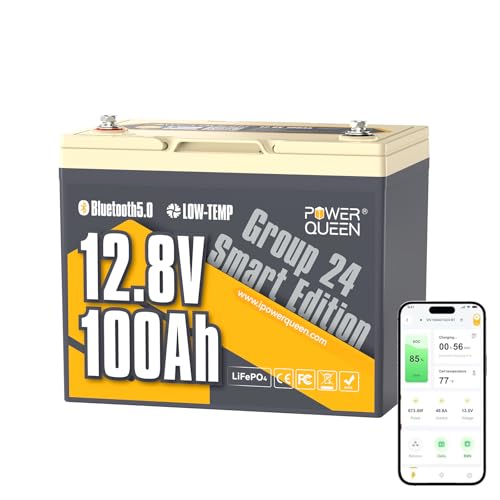
Power Queen 12V 100Ah Group 24 Smart Bluetooth LiFePO4
1,280 Wh · 100Ah · 100A BMS · Group 24 · 22.2 lb · Score 83/100
Same Group 24 size, 100A BMS and 500A surge rating as the LiTime, plus Bluetooth, for less money. The trade-off is cold weather: Power Queen's BMS stops charging below 32°F and resumes at 41°F, but there is no heater. In a climate where the battery rarely sits below freezing, this is the 100Ah battery to beat. Manufacturer specs.
Pros
- ✓ Bluetooth app at a mid-range price
- ✓ Low-temperature charge cut-off
- ✓ Published 5-year warranty
Cons
- ✗ No self-heating
- ✗ Charging pauses until the battery warms above 41°F
3. Best Compact (Tight Battery Boxes)
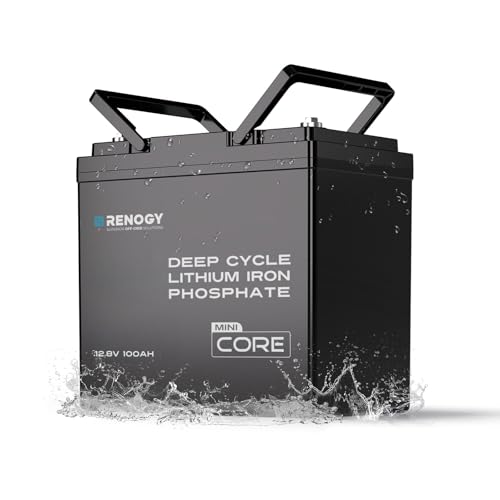
Renogy 12V 100Ah Core Mini LiFePO4
1,280 Wh · 100Ah · 100A BMS · Group 22NF · 21.8 lb · Score 79/100
Renogy's Core Mini packs 100Ah into a 9.02 × 5.43 × 8.39 in case (Group 22NF), about an inch shorter than a Group 24, so it fits where the others won't. It has a 100A BMS, low-temperature charging protection and a 5,000-cycle rating at 80% depth of discharge. Bluetooth isn't built in; app monitoring needs Renogy's shunt, sold separately. Manufacturer specs.
Pros
- ✓ Smallest 100Ah case in this guide
- ✓ Low-temperature charge protection
- ✓ Can be mounted in any orientation except upside down (per Renogy)
Cons
- ✗ App monitoring costs extra (shunt)
- ✗ Lower surge rating (300A / 5 s)
- ✗ Warranty is prorated
4. Best High-Capacity (200Ah)

Redodo 12V 200Ah Plus LiFePO4 (200A BMS)
2,560 Wh · 200Ah · 200A BMS · Non-standard (20.95 x 8.15 x 8.5 in) · 45.59 lb · Score 74/100
One battery with 2,560 Wh and a 200A BMS, so it can feed a 2,000W-class inverter without paralleling two 100Ah units. It has the lowest cost per kWh in this guide. The catches: about 46 lb, a 21-inch case that fits no standard battery box, and no low-temperature protection listed by Redodo, so keep it somewhere heated in winter. Manufacturer specs.
Pros
- ✓ 200A continuous / 400A 5 s BMS
- ✓ Lowest cost per kWh here
- ✓ Replaces a parallel pair of 100Ah batteries
Cons
- ✗ About 46 lb
- ✗ No Bluetooth
- ✗ No low-temp protection listed
5. Best Budget 100Ah

Redodo 12V 100Ah Group 31 LiFePO4
1,280 Wh · 100Ah · 100A BMS · Group 31 · 25 lb · Score 70/100
The cheapest way into a 12V 100Ah LiFePO4 battery: Group 31 size and a 100A BMS. Redodo's own comparison table calls this the "Basic" model with no low-temperature protection and no Bluetooth. It works for warm-climate RVs, boats and solar sheds where the battery never has to charge below freezing. Manufacturer specs.
Pros
- ✓ Lowest price for 100Ah
- ✓ Group 31 size drops into older marine/RV trays
- ✓ 5-year warranty per Redodo
Cons
- ✗ No low-temperature charge protection
- ✗ No Bluetooth or app
- ✗ Weight differs by source (22–25 lb)
12V 100Ah and 200Ah Lithium Battery Comparison
Every figure below is the manufacturer's published number. Cycle ratings use different depth-of-discharge baselines (100% vs 80%), so don't compare them directly.
| Battery | Energy | BMS (cont. / surge) | Cold-weather charging | Size / weight | Bluetooth | Cycles / warranty | Price |
|---|---|---|---|---|---|---|---|
| LiTime 12V 100Ah Group 24 Self-Heating Bluetooth LiFePO4 | 1,280 Wh (100Ah) | 100A / 500A / 1 s | Self-heating: heats below 41°F on a charger, charges from 50°F; charge range -4°F to 122°F | Group 24, 22.71 lb | Built in | 4,000+ at 100% DoD (manufacturer claim); 5-yr warranty | $368.99 |
| Power Queen 12V 100Ah Group 24 Smart Bluetooth LiFePO4 | 1,280 Wh (100Ah) | 100A / 500A / 1 s | Charge cut-off below 32°F (resumes at 41°F); discharge cut-off below -4°F | Group 24, 22.2 lb | Built in | 4,000 at 100% DoD (manufacturer claim); 5-yr warranty | Check price at Amazon → |
| Renogy 12V 100Ah Core Mini LiFePO4 | 1,280 Wh (100Ah) | 100A / 300A / 5 s | Charge cut-off below 32°F; charge range 32-122°F, discharge -4-140°F | Group 22NF, 21.8 lb | Optional shunt | 5,000 at 80% DoD (manufacturer claim); 5-yr warranty (prorated) | Check price at Amazon → |
| Redodo 12V 200Ah Plus LiFePO4 (200A BMS) | 2,560 Wh (200Ah) | 200A / 400A / 5 s | Not listed by Redodo for this model; do not charge below 32°F | Non-standard (20.95 x 8.15 x 8.5 in), 45.59 lb | No | 4,000+ (manufacturer claim); 5-yr warranty | Check price at Amazon → |
| Redodo 12V 100Ah Group 31 LiFePO4 | 1,280 Wh (100Ah) | 100A / not published | None (Redodo lists this Basic model as having no low-temp protection) | Group 31, 25 lb | No | 4,000 at 100% DoD (manufacturer claim); 5-yr warranty | Check price at Amazon → |
Warranty terms are as published by each brand; read the warranty document before buying. Redodo's Group 31 weight is listed as 22.04 lb on Amazon and 25 lb on redodopower.com; we use the higher figure.
How Long Will a 12V 100Ah Lithium Battery Last?
Multiply amp-hours by 12.8V to get watt-hours: 100Ah × 12.8V = 1,280 Wh. LiFePO4 batteries are rated for 100% depth of discharge, but inverter and wiring losses eat some of that, so we plan on about 85%: Wh × 0.85 ÷ load watts = hours. DC-only loads such as a 12V fridge or fan run a little longer than shown because they skip the inverter.
| Load (average draw) | 100Ah (1,280 Wh) | 200Ah (2,560 Wh) |
|---|---|---|
| LED lights + roof fan (25W) | ~43 hours | ~87 hours |
| CPAP, no humidifier (40W) | ~27 hours | ~54 hours |
| 12V compressor fridge (45W avg) | ~24 hours | ~48 hours |
| Laptop + router (60W) | ~18 hours | ~36 hours |
| TV + streaming box (100W) | ~11 hours | ~22 hours |
| Microwave (1,000W) | ~65 minutes* | ~2.2 hours |
*A 1,000W microwave pulls roughly 85–90A from a 12V battery through an inverter, which is close to a 100A BMS limit. Start-up surges can trip it. For microwaves, induction plates or a coffee maker, use a 200A BMS battery or two 100Ah batteries in parallel. Appliance wattages are typical figures; check your appliance's label. For whole-system sizing, our sizing guide walks through the load worksheet.
How to Choose a 12V LiFePO4 Battery
Ah vs Wh: Compare Watt-Hours
Amp-hours only compare batteries of the same voltage. Watt-hours (Ah × volts) let you compare a 12V battery with a power station or a 24V bank. A 12.8V 100Ah LiFePO4 battery stores 1,280 Wh. Lead-acid batteries are usually run to only about half their rated capacity to protect cycle life, while LiFePO4 makers rate their batteries for 100% depth of discharge. That is why one 100Ah lithium battery is often sold as a replacement for two 100Ah lead-acid batteries. Our LiFePO4 chemistry guide explains why.
BMS Current: What the "100A" Means
The built-in battery management system (BMS) caps continuous current. A 100A BMS supports about 1,280W of continuous load at 12.8V, enough for a 1,000W inverter with headroom. The surge rating matters for motor and compressor start-up: LiTime and Power Queen publish 500A for 1 second, and Renogy publishes 300A for 5 seconds. Redodo's 200Ah Plus doubles the continuous rating to 200A, enough for a 2,000W inverter.
Series vs Parallel (the Basics)
Parallel connections add amp-hours at the same voltage (two 12V 100Ah = 12V 200Ah). Series connections add voltage (two 12V 100Ah = 24V 100Ah). All five batteries here allow up to four in series and four in parallel, according to their manufacturers. Manufacturers generally require identical batteries at the same state of charge. Follow your battery's manual or use a qualified installer for interconnects, fusing and cable sizing. We don't publish wiring instructions.
Group 24, 27 and 31 Battery Sizes
BCI group numbers describe the case footprint, not the capacity. A Group 24 case is about 10.2 in long (LiTime and Power Queen list 10.24 × 6.61 in), and a Group 31 case is about 13 in long (Redodo lists 13 × 6.77 in). Group 27 falls in between at roughly 12 in. Lithium "mini" batteries such as Renogy's Core Mini (Group 22NF, 9.02 in) are smaller again. Measure your tray and hold-down, then compare against the published dimensions including terminal height.
Self-Heating vs Low-Temperature Cut-Off
LiFePO4 cells shouldn't be charged below freezing. Renogy and Power Queen both list a charging range that starts at 32°F (0°C), and their BMS blocks charging below it (Renogy spec sheet, Power Queen spec sheet). A low-temp cut-off protects the cells, but solar or alternator charging simply stops until the battery warms up. A self-heating battery uses charger power to warm its cells first; LiTime lists heating below 41°F and charging from 50°F. Renogy also sells a self-heating DuoHeat version of the Core Mini on its own site. Discharging is a different matter: LiTime, Power Queen and Renogy list discharge down to -4°F.
Drop-In Replacement for Lead-Acid: The Caveats
- Charger and converter profile. LiTime and Power Queen specify 14.4V ± 0.2V charging and Redodo specifies 14.6V. A lead-acid charger with equalize or desulfation modes can push past that. Older RV converters may never reach full lithium voltage, so look for a LiFePO4 setting or a lithium-compatible replacement.
- Alternator charging needs a DC-DC charger. LiFePO4 accepts high current, so the usual approach is a DC-DC charger between the alternator and the house battery. It caps the current and applies a lithium profile. Renogy's 40A unit, for example, lists LiFePO4 among its battery types and caps output at 40A (Renogy spec). Size and install it with an installer or the vehicle maker's guidance.
- Solar charge controller. Set it to a LiFePO4 or user profile matching the battery's charge voltage. Old PWM controllers without a lithium mode may need replacing.
- Not a starter battery. LiTime and Redodo state on their listings that these deep-cycle batteries are not for engine starting. Treat any deep-cycle LiFePO4 battery the same way unless its maker sells it as dual-purpose.
- Battery monitors and gauges. Voltage-based gauges read lithium poorly because its voltage stays flat. Bluetooth batteries or a shunt-based monitor give a real state of charge.
Pairing a battery with roof solar? Our solar panel setup guide covers panel sizing. Rewiring an RV's 12V system is a job for a qualified installer.
12V Lithium Battery vs Portable Power Station
A bare 12V battery is the cheaper way to buy watt-hours, but it is only the battery. To run 120V appliances you also need an inverter, a charger or DC-DC charger, fuses, a disconnect and cabling, all installed correctly. A portable power station puts a LiFePO4 battery, inverter, MPPT solar controller, wall charger and outlets in one box you can carry into a cabin or tent. Here is how our top battery compares with two power stations we rate:
| LiTime 12V 100Ah (battery) | Jackery Explorer 1000 V2 | EcoFlow Delta 3 Plus | |
|---|---|---|---|
| Capacity | 1,280 Wh | 1,070 Wh | 1,024 Wh |
| Weight | 22.71 lb | 23 lb | 26 lb |
| 120V AC output | None (inverter sold separately) | 1,500W built in | 1,800W built in |
| Solar charging | Needs a separate charge controller | 400W MPPT built in | 1000W MPPT built in |
| Installation | Wiring, fusing, mounting | Plug and play | Plug and play |
| Our score | 83/100 (battery rubric) | 93/100 (review) | 89/100 (review) |
| Price | $368.99 | $559.00 | $719.00 |
Battery and power-station scores use different rubrics and aren't directly comparable.
Choose a 12V battery if…
- ✓ You're upgrading an RV, van or boat that already has a 12V system and a battery tray
- ✓ You want the lowest cost per kWh and plan to expand into a bank
- ✓ You have roof solar or a DC-DC charger, or an installer to fit them
Choose a power station if…
- ✓ You want no wiring, just outlets, solar input and a wall charger in one box
- ✓ You'll move it between the RV, the house in an outage and a campsite
- ✓ You rent, lease or don't want to modify the vehicle
Shopping power stations instead? Start with our best solar generators for RV and van life, the van-life picks, or our cabin and tiny-house guide. If you're weighing chemistries, see LiFePO4 vs NMC.
Building out the rest of the 12V system? Our best RV solar kit guide covers the roof panels and charge controller that keep this battery topped up, and the best 12V fridge guide covers the load most battery banks are sized around.
Who Should Buy a 12V Lithium Battery (and Who Should Skip)
Good fit
- ✓ RV and travel-trailer owners replacing worn lead-acid house batteries
- ✓ Van builds with a planned 12V system and DC-DC charging
- ✓ Trolling-motor and marine house-battery use (check thrust guidance)
- ✓ Off-grid solar sheds and cabins with a charge controller and inverter
Skip it if
- ✗ You need an engine starting battery (these are deep-cycle only)
- ✗ You want home outage backup without an installer (get a power station)
- ✗ Your converter, alternator and controller can't be set for lithium and you won't upgrade them
- ✗ It will charge in freezing weather and you're buying a non-heated model
Battery prices move often. Like other solar gear, they have historically dipped during Prime Day and Black Friday events. Every price on this page loads live from Amazon.
12V Lithium Battery FAQ
What is the best 12V lithium battery?
For most RV and van owners, a 12V 100Ah LiFePO4 battery in a Group 24 case with a 100A BMS, low-temperature protection and Bluetooth monitoring. In our scoring the LiTime 12V 100Ah self-heating battery ranks first because it can accept a charge below freezing, with the Power Queen 12V 100Ah Group 24 Smart as the better value where winters are mild.
Is a LiFePO4 battery the same as a 12V lithium battery?
Almost always, for deep-cycle use. Nearly every 12V "lithium" drop-in battery sold for RVs, boats and solar uses lithium iron phosphate (LiFePO4) cells: four cells in series give a 12.8V nominal battery. LiFePO4 trades some energy density for long cycle life and thermal stability compared with NMC lithium-ion.
How long will a 12V 100Ah lithium battery last?
Per charge, a 12V 100Ah LiFePO4 battery stores about 1,280 Wh. After roughly 15% inverter and wiring losses that is about 1,090 usable Wh, or around 18 hours for a 60W load. Over its life, manufacturers rate these batteries for about 4,000 cycles at 100% depth of discharge, but cycle counts are manufacturer claims rather than independent results.
Can you charge a lithium battery below freezing?
Not a standard LiFePO4 battery. Manufacturers list a charging range starting at 32°F (0°C), and the BMS on batteries with low-temperature protection blocks charging below that. Self-heating batteries such as the LiTime 12V 100Ah self-heating model warm the cells with charger power first, then charge once the cells are above freezing.
Can I replace my RV lead-acid battery with a lithium battery?
Usually yes, if it fits the tray and your charging sources can be set for lithium. Check that the converter, solar charge controller and any battery monitor have a LiFePO4 profile, and use a DC-DC charger rather than a direct alternator connection. Deep-cycle LiFePO4 batteries are not starter batteries, and a qualified installer should handle any rewiring.
Is a 12V lithium battery better than a portable power station?
It depends on whether you want a permanent install. A 12V battery is cheaper per kWh and integrates with an RV's existing 12V system, but it needs a separate inverter, charger, fusing and wiring. A portable power station bundles the battery, inverter, chargers and outlets in one plug-and-play box with no wiring.
What does a 100A BMS mean?
The battery management system allows up to 100 amps of continuous charge or discharge current, about 1,280W at 12.8V. Above that the BMS shuts the battery off to protect the cells. To run a 2,000W inverter you need a battery or bank rated for about 200A, such as a 200A-BMS battery or two 100A batteries in parallel.