
Battery Makers’ Data · Updated November 2026
Battery Voltage Chart: Car Battery, AGM and 12V LiFePO4
The short answers (12V, at rest)
- Car battery, engine off
- About 12.6V or more when fully charged; 12.2V is about half; 12.0V is quite discharged [8][10][2].
- Car battery, engine running
- About 13.7–14.7V at the battery terminals while the alternator charges [9]; Haynes and Jiffy Lube give 13.8–14.4V and 13.5–14.5V [10][11].
- AGM battery
- Full is about 12.8V, and a new one reads 13.0V or more; about 12.2V is half [3][5].
- 12V LiFePO4
- Full is about 13.3–13.6V, and half is only about 13.0–13.2V, so a battery monitor beats a voltmeter [15][17].
Jump to the 12V chart, car battery readings or LiFePO4 at 12V, 24V and 48V.
As an Amazon Associate, SolarGenAdvisor earns from qualifying purchases made through links on this page, at no additional cost to you. Voltages are published figures from battery makers and the sources cited; product scores are AI-synthesized from specs and logged Amazon prices, not from testing.
 By
12V Battery Voltage Chart: Flooded, AGM and LiFePO4
Resting voltage tells you roughly how full a 12V battery is, but the numbers depend on the chemistry. A LiFePO4 battery at 20% reads higher than a full lead-acid one. Each column below is one maker’s published table: Trojan for flooded lead-acid [1], Lifeline for AGM [3] and Renogy for LiFePO4 [15]. All are open-circuit readings, taken after the battery has rested with nothing connected (how long below).
| State of charge | Flooded lead-acid (car, deep cycle) | AGM | LiFePO4 (12.8V) |
|---|---|---|---|
| 100% | 12.73V | >12.78V | 13.6V |
| 90% | 12.62V | 12.66V | 13.4V |
| 80% | 12.50V | 12.54V | 13.3V |
| 70% | 12.37V | 12.42V | 13.2V |
| 60% | 12.27V | 12.30V | 13.1V |
| 50% | 12.10V | 12.18V | 13.0V |
| 40% | 11.89V | 12.06V | 13.0V |
| 30% | 11.81V | 11.94V | 12.9V |
| 20% | 11.66V | 11.82V | 12.8V |
| 10% | 11.51V | 11.70V | 12.0V |
| 0% | — | <11.58V | 10.0V |
Volts at rest. Trojan’s table stops at 10%; Battery University’s BCI table puts 0% at 11.89V [1][2]. Lifeline says its figures are for aged batteries and a new AGM reads higher, 13.0V or more when full [3]. A LiFePO4 battery on its charger reads about 14.6V; that is charge voltage, not a resting reading [15]. Your battery’s own manual overrides any chart, including this one.
Two quick rules fall out of the table. For lead-acid, every tenth of a volt matters: 12.6V and 12.2V are roughly full and half. For LiFePO4, almost everything from 90% down to 20% sits between 13.4V and 12.8V, which is why voltage alone is a rough gauge (see why). Charging a lithium battery? Our LiFePO4 charging guide has the charge and float settings.
Car Battery Voltage: Engine Off, Running and Cranking
A 12V car battery is six lead-acid cells in series. Most are flooded or AGM, so the lead-acid columns above apply. In a car, you get three different readings depending on what the engine is doing:
| Reading | What it means | Source |
|---|---|---|
| 13.7–14.7Vengine running | The alternator is charging the battery. Haynes gives 13.8–14.4V at idle and Jiffy Lube 13.5–14.5V; a reading that barely rises above the engine-off figure points at the charging system. | [9][10][11] |
| 12.6V or moreengine off, rested | Fully charged. Optima’s REDTOP reads about 12.6–12.8V full and its AGM YELLOWTOP 13.0–13.2V, so an AGM car battery can read higher than this. | [8][7][10] |
| about 12.4V | About 75% (12.45V in the BCI table). Give it a charge; BCI advises a freshening charge below 12.4V. | [2][6] |
| about 12.2V | About half charged. Charge it soon; Lifeline says a battery that is repeatedly left short of a full recharge sulfates and fails early. | [10][2][3] |
| 12.0V or less | “Quite discharged” in Optima’s words; about 11.9V is 0% in the BCI table. It may still crank on a warm day, but recharge it with a charger. | [8][2] |
| 10.5–11.0V | Discharged, and possibly a bad cell. Below 10.5V is severely discharged. | [8] |
| 9.6V or moreunder a load test | The pass line for the standard load test: half the battery’s CCA rating for 15 seconds at 70°F. The minimum drops in the cold, to 8.5V at 0°F. | [12][13] |
The cranking dip
Voltage drops sharply while the starter turns the engine, then rises to the charging range once the engine runs. Shops test this properly with a load tester: DENSO’s procedure applies half the battery’s cold cranking amp (CCA) rating for 15 seconds and expects at least 9.6V at 70°F, with a lower minimum in colder weather [12]. Discover Battery says to recharge and repeat a failed test, and to replace the battery if it fails again [13]. A starter is not a calibrated load, so a multimeter reading while someone cranks the engine is only a rough comparison with that 9.6V line (our note, not a published test). For a more definite answer than a voltmeter gives, Optima recommends a load test by a battery professional, which it says retailers often offer free [8].
If a flat battery leaves you stuck, a jump pack gets the car started; our best jump starter guide compares engine ratings. Then recharge the battery with a charger. Optima says a deeply discharged battery should be recharged fully with a charger rather than the alternator, which can take 12–24 hours or longer [8].
Lead-Acid Battery Voltage Chart (12V, 24V, 48V)
For a flooded (wet-cell) battery, the most precise state-of-charge reading is the specific gravity of the electrolyte, measured with a hydrometer, and Trojan publishes both [1]. Trojan corrects specific gravity to 80°F: add 0.004 for every 10°F above 80°F and subtract 0.004 for every 10°F below it.
| State of charge | Specific gravity (80°F) | 12V | 24V | 48V |
|---|---|---|---|---|
| 100% | 1.277 | 12.73V | 25.46V | 50.93V |
| 90% | 1.258 | 12.62V | 25.24V | 50.47V |
| 80% | 1.238 | 12.50V | 25.00V | 49.99V |
| 70% | 1.217 | 12.37V | 24.74V | 49.49V |
| 60% | 1.195 | 12.27V | 24.48V | 48.96V |
| 50% | 1.172 | 12.10V | 24.20V | 48.41V |
| 40% | 1.148 | 11.89V | 23.92V | 47.83V |
| 30% | 1.124 | 11.81V | 23.63V | 47.26V |
| 20% | 1.098 | 11.66V | 23.32V | 46.63V |
| 10% | 1.073 | 11.51V | 23.02V | 46.03V |
Source: Trojan Battery [1], as published (its 60% row is 12.27V at 12V and 24.48V at 24V).
The BCI table is slightly different
Battery University reproduces the Battery Council International (BCI) table, read at 26°C (79°F) after a 24-hour rest [2]. It runs a little higher than Trojan’s in the lower half: 50% is 12.24V against Trojan’s 12.10V.
| State of charge | BCI (Battery University) | Trojan flooded | Trojan AGM |
|---|---|---|---|
| 100% | 12.65V | 12.73V | 12.84V |
| 75% | 12.45V | — | 12.54V |
| 50% | 12.24V | 12.10V | 12.24V |
| 25% | 12.06V | — | 11.94V |
| 0% | 11.89V | — | 11.64V |
12V, at rest. Trojan’s flooded table has no 75%, 25% or 0% rows, so those cells are blank [2][1][5].
AGM Battery Voltage Chart (12V, 24V, 48V)
AGM batteries are sealed lead-acid batteries, so you can’t use a hydrometer; voltage is the gauge. Lifeline publishes the fullest table. It measures after at least four hours at rest, with the battery disconnected from charger and load, at a 77°F reference [3].
| State of charge | Per 2V cell | 12V | 24V | 48V |
|---|---|---|---|---|
| 100% | >2.13V | >12.78V | >25.56V | >51.12V |
| 90% | 2.11V | 12.66V | 25.32V | 50.64V |
| 80% | 2.09V | 12.54V | 25.08V | 50.16V |
| 75% | 2.08V | 12.48V | 24.96V | 49.92V |
| 70% | 2.07V | 12.42V | 24.84V | 49.68V |
| 60% | 2.05V | 12.30V | 24.60V | 49.20V |
| 50% | 2.03V | 12.18V | 24.36V | 48.72V |
| 40% | 2.01V | 12.06V | 24.12V | 48.24V |
| 30% | 1.99V | 11.94V | 23.88V | 47.76V |
| 25% | 1.98V | 11.90V | 23.76V | 47.52V |
| 20% | 1.97V | 11.82V | 23.64V | 47.28V |
| 10% | 1.95V | 11.70V | 23.40V | 46.80V |
| 0% | <1.93V | <11.58V | <23.16V | <46.32V |
Source: Lifeline AGM Technical Manual [3]. Lifeline says these voltages apply to aged batteries and a new battery reads somewhat higher, typically 13.0V or more at 100% [3][4].
Other AGM makers land close by. Trojan’s AGM data sheet lists 12.84V full, 12.24V at 50% and 11.64V empty (table above) [5], and Optima says its AGM YELLOWTOP reads about 13.0–13.2V when fully charged [7]. Lifeline treats 11.6V (1.93V per cell) as deeply discharged, and asks for a boost charge in storage when a 12V battery drops to 12.5V, about 75% [3]. Gel batteries are a third lead-acid type with their own tables; use the maker’s figures for those.
LiFePO4 Voltage Chart (12V, 24V, 48V)
A “12V” LiFePO4 battery is four 3.2V cells in series, nominally 12.8V; a 24V battery has eight cells (25.6V) and a 48V battery sixteen (51.2V). So each column below is the cell voltage times 4, 8 or 16. These are the Renogy figures used on our LiFePO4 charging guide [15]. LiTime’s manual takes its state-of-charge readings after at least 3 hours at rest [17].
| State of charge | 1 cell (3.2V) | 12V (12.8V) | 24V (25.6V) | 48V (51.2V) |
|---|---|---|---|---|
| 100% (charging) | 3.65V | 14.6V | 29.2V | 58.4V |
| 100% (at rest) | 3.40V | 13.6V | 27.2V | 54.4V |
| 90% | 3.35V | 13.4V | 26.8V | 53.6V |
| 80% | 3.32V | 13.3V | 26.6V | 53.1V |
| 70% | 3.30V | 13.2V | 26.4V | 52.8V |
| 60% | 3.27V | 13.1V | 26.1V | 52.3V |
| 50% | 3.26V | 13.0V | 26.1V | 52.2V |
| 40% | 3.25V | 13.0V | 26.0V | 52.0V |
| 30% | 3.22V | 12.9V | 25.8V | 51.5V |
| 20% | 3.20V | 12.8V | 25.6V | 51.2V |
| 10% | 3.00V | 12.0V | 24.0V | 48.0V |
| 0% | 2.50V | 10.0V | 20.0V | 40.0V |
Source: Renogy LiFePO4 voltage chart [15]. The charging row is the charge voltage, not a resting reading.
Makers disagree by a few tenths (12V, at rest)
| State of charge | Renogy | Power Queen | LiTime manual (3 h rest) |
|---|---|---|---|
| 100% | 13.6 | 13.33 or more | about 13.33 |
| about 75% | 13.2–13.3 (70–80%) | 13.3–13.33 | 13.2–13.3 |
| 50% | 13.0 | 13.15–13.2 | 13.1–13.2 |
| about 25% | 12.8–12.9 (20–30%) | 13.0–13.15 | 13.0–13.1 |
| 0% | 10.0 | 10–12 | 10–12 |
Volts [15][16][17]. Use your own battery maker’s chart if it publishes one.
Shopping for a battery rather than reading one? Our best 12V lithium battery guide compares Group 24 and larger packs, and best LiFePO4 battery for RV covers converter swaps and tray sizes.
Why Voltage Is a Poor LiFePO4 Fuel Gauge
Battery University puts it plainly: the discharge curve of Li-phosphate is very flat, so voltage only shows full and low charge, and “the important middle section cannot be estimated accurately” [2]. The charts show the scale. Between 70% and 30%, the resting voltage changes by about:
- 0.14V per 10% for flooded lead-acid (Trojan), 0.96V from 90% to 20%.
- 0.12V per 10% for AGM (Lifeline), 0.84V from 90% to 20%.
- about 0.07V per 10% for LiFePO4 (Renogy), 0.6V from 90% to 20%, and its 40% and 50% rows are the same 13.0V.
That is our arithmetic on the published charts. On a LiFePO4 battery, a meter that reads 0.1V off, or a battery that hasn’t fully rested, can move the estimate by 10–20 points, and the makers’ own charts already differ by that much at 50%. RELiON says a voltage-based gauge built for lead-acid “will not accurately display” a LiFePO4 battery’s state of charge [18].
Use a shunt monitor or the battery’s Bluetooth
The accurate method is coulomb counting: measure the current flowing in and out and keep a running total, which Battery University says works well with lithium because of its high efficiency and low self-discharge [2]. A shunt-type battery monitor does this. Victron’s SmartShunt, for example, measures battery voltage and current and calculates state of charge and time remaining [19]. A LiFePO4 battery with built-in Bluetooth reports from its own management system. Battery University still recommends periodic calibration, which in practice means charging to full now and then so the monitor can reset its 100% point [2].
Voltage is still useful at the ends. About 13.3–13.6V at rest means a 12V LiFePO4 is full, and below about 12V it is nearly empty [15][17].
From Voltage to Runtime: What 50% Means
A state-of-charge reading becomes useful once you turn it into energy. Battery energy is volts × amp-hours, in watt-hours (our what is a watt-hour guide explains the unit).
Worked example: a 12.8V 100Ah LiFePO4 battery holds 1,280 Wh. At 50% (about 13.0–13.2V at rest) about 640 Wh is left. Through an inverter, with our 0.85 planning allowance for inverter losses (not a measured figure), that is about 544 Wh, or roughly 5.4 hours of a 100 W load. A 12V DC load skips the inverter, so it gets closer to the full 640 Wh.
Lead-acid is different because you shouldn’t drain it. Lifeline recommends sizing an AGM bank at twice the capacity the load needs, which limits the average depth of discharge to 50% and “will dramatically extend the life of the battery” [3]. So a 12V 100Ah AGM (about 1,200 Wh) is usually planned as about 600 Wh of usable energy: stop at about 12.2V at rest.
How to Check Battery Voltage With a Multimeter
- Let the battery rest. Turn off the engine or charger and disconnect loads if you can (see the rest times below).
- Set the meter to DC volts (the “V” with a straight line), on the 20V range if it isn’t auto-ranging.
- Measure at the battery terminals, not a dash gauge or a lighter socket. Touch the black lead to the negative (−) terminal and the red lead to the positive (+) [7].
- Read it against the right column of the chart for your battery’s chemistry, and note the temperature if it is cold.
- For a car, start the engine and read again. You should see the charging range, about 13.7–14.7V [9].
How long to rest the battery first
Right after charging or a drive, a lead-acid battery carries a surface charge that reads high, and Battery University says a brief discharge before measuring counters it [2]. The makers’ rest times:
| Source | Battery | Rest before reading |
|---|---|---|
| Trojan [1] | Flooded deep cycle | At least 6 hours idle, preferably 24 |
| Battery University [2] | Lead-acid | At least 4 hours; makers recommend 24 |
| Lifeline [3] | AGM | At least 4 hours, off charger and load |
| Optima [7] | Car battery (AGM) | 12–24 hours on a bench, or run the headlights for 30 seconds with the engine off |
| Haynes [10] | Car battery | At least an hour; overnight is better |
| LiTime [17] | 12V LiFePO4 | At least 3 hours |
For a car you drive every day, the practical version is Haynes’: check it first thing in the morning before you start it [10]. If a rested battery reads full but the car keeps going flat, the battery may not be holding its charge or something in the car may be draining it; a load test and a parasitic-draw check at a shop will tell you which.
When to Charge or Replace a 12V Battery
- Lead-acid or AGM below about 12.4V: charge it. BCI advises a freshening charge below 12.4V [6]; Trojan says to charge a flooded battery that reads 0–70% and to charge after every period of use [1]; Lifeline asks for a boost charge in storage at 12.5V [3].
- LiFePO4: no rush. RELiON says LiFePO4 is not damaged by sitting partly charged and can be recharged after each use or at 20% [18]. Recharge before the battery’s BMS cuts it off near empty.
- Consider replacing a lead-acid battery if it fails a load test twice after a full recharge [13], or if it reads 10.5–11.0V after charging, which Optima says can mean a bad cell [8]. A battery that reads full on a meter but cranks weakly also needs a load test, because resting voltage doesn’t show lost capacity.
Charging voltage by chemistry (12V, at 77°F)
Charge voltage is higher than any resting reading, and it has to match the chemistry. These are the same figures as our RV battery charging guide:
| Battery | Absorption (charge) | Float | Source |
|---|---|---|---|
| Flooded deep cycle | 14.1–14.7V (14.8V bulk) | 13.5V, if desired | Trojan, via our RV guide |
| AGM | 14.2–14.4V | 13.2–13.4V | Lifeline (14.3 ± 0.1V, 13.3 ± 0.1V) [3] |
| LiFePO4 | 14.2–14.6V (14.4V recommended) | None, or under 13.6V | Battle Born [20] |
For a parked car or a stored lead-acid battery, a smart maintainer holds it near full so it never drifts down to 12.4V. Our best trickle charger guide compares them, and the gear section below lists one for each battery type.
Cold Weather and Battery Voltage
The resting reading barely changes. Battery University says cold lowers a lead-acid battery’s voltage slightly [2], and Lifeline puts its AGM temperature coefficient at 0.10 millivolts per cell per °F, so its chart holds at other temperatures [3]. That works out to about 24 mV, or 0.02V, on a 12V battery for a 40°F drop (our arithmetic). A low reading on a cold morning is usually a low charge, not the cold.
What the cold does reduce is capacity and cranking power. Lifeline says to expect 10–30% less available capacity below 32°F, and more than 40% less at -4°F under high loads [4]. That is why car batteries are rated in cold cranking amps, measured at 0°F for 30 seconds while staying at or above 7.2V [14]. NAPA adds that cold thickens engine oil, so the starter has to work harder at the same time. The load-test pass line drops with temperature too, from 9.6V at 70°F to 8.5V at 0°F [12].
A discharged lead-acid battery can freeze
As a lead-acid battery discharges, its electrolyte becomes more like water and freezes at a higher temperature. Lifeline’s AGM figures [3]:
| State of charge | 12V AGM reading (Lifeline chart) | Electrolyte freezes at about |
|---|---|---|
| 100% | >12.78V | -94°F (-70°C) |
| 75% | 12.48V | -53°F (-47°C) |
| 50% | 12.18V | -13°F (-25°C) |
| 25% | 11.90V | 9°F (-13°C) |
| 0% | <11.58V | 21°F (-6°C) |
Lifeline Technical Manual [3]. Trojan’s BCI-based flooded figures are similar: -92°F fully charged and +19°F at 20% [6].
Lifeline says a frozen battery may be permanently damaged and should be thawed at room temperature for at least 24 hours before charging, and replaced if its case is cracked [3]. Keep lead-acid batteries charged through winter.
LiFePO4: the limit is charging, not voltage
LiFePO4 batteries generally allow discharging well below freezing (Power Queen’s Group 24 battery cuts off discharge only below -4°F [21]) but shouldn’t be charged below freezing. LiTime says not to charge normally below 0°C (32°F) and to warm the battery above 5°C first [17], and Power Queen’s Group 24 battery stops charging below 32°F and resumes at 41°F [21]. Self-heating batteries warm themselves first, using charger power. Our LiFePO4 charging guide covers the cold rules in full.
Batteries, Chargers and Maintainers by Battery Type
Grouped by job, not ranked against each other: a charger and a battery do different things. Scores, where shown, are from our scoring for that category, AI-synthesized from published specs and logged Amazon prices; nothing here was tested by us.
12V LiFePO4 batteries
Both have built-in Bluetooth, which reads the battery’s own management system instead of leaving you to estimate charge from a flat voltage curve. More options: Best 12V lithium batteries.
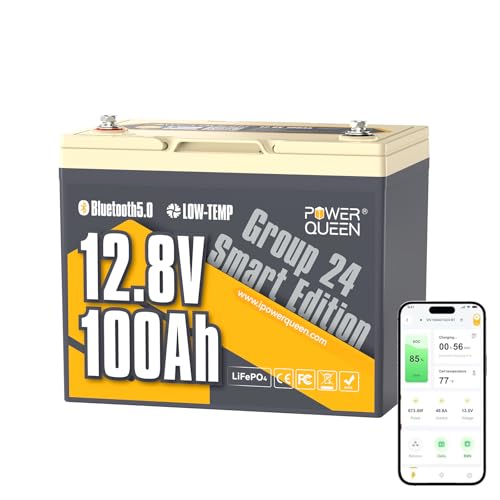
Power Queen 12V 100Ah Group 24 Smart Bluetooth LiFePO4 · Our score 82/100
Bluetooth · charging stops below 32°F and resumes at 41°F · no heater [21]
Price on Amazon: $231.99
A Group 24 drop-in with a 100A BMS and Bluetooth at a mid-range price. Fully charged, expect about 13.3–13.6V at rest on the charts above.
Skip it if: You charge below freezing: it has no heater, so it won’t accept a charge until it warms up.

LiTime 12V 100Ah Group 24 Self-Heating Bluetooth LiFePO4 · Our score 81/100
Bluetooth · self-heating: warms itself on a charger below 41°F, charges from 50°F [22]
Price on Amazon: $313.64
The same size and BMS rating with a built-in heater, so it can take a charge in a cold RV or van once the heater has warmed the cells.
Skip it if: You never charge in the cold; it costs more than a non-heated 100Ah battery.
LiFePO4 chargers
A LiFePO4 battery needs a charger that stops at the right voltage (14.2–14.6V for 12V) and has no equalize or desulfation step. More options: Best LiFePO4 battery chargers.

Power Queen 12V 20A LiFePO4 Battery Charger (14.6V) · Our score 81/100
14.6V CC/CV · 20A · wakes a BMS from 0V (Amazon listing)
Price on Amazon: $67.99
A dedicated 14.6V, 20-amp charger for 12V LiFePO4 only: about 5 hours for a 100Ah battery by the simple Ah ÷ amps rule.
Skip it if: You also charge lead-acid batteries; it has one lithium profile and no published water rating.
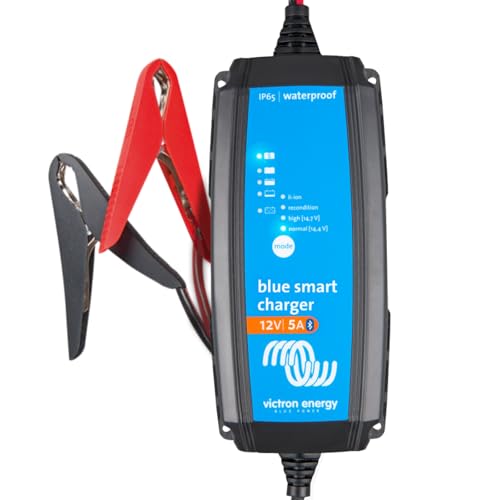
Victron Blue Smart IP65 12/5 Charger (12V 5A) · Our score 78/100
Li-ion mode 14.2V absorption, 13.5V float and storage · IP65 · lead-acid modes too [23]
A sealed 5-amp charger with a lithium mode and lead-acid modes, suited to keeping a battery topped up in storage.
Skip it if: You need a fast refill: 5 amps takes about 20 hours to refill a 100Ah battery.
Car and lead-acid battery maintainers
A smart maintainer keeps a parked car or stored lead-acid battery near full, so it never sits at the 12.4V-and-below readings where a freshening charge is due. More options: Best trickle chargers.

NOCO GENIUS5 5A Smart Battery Charger · Our score 75/100
5A · 12V 14.5V, AGM 14.8V and 12V lithium 14.6V modes · charges up to 120Ah, maintains any size · IP65 [24]
Price on Amazon: $69.95
Enough current to recharge a typical car battery, with separate AGM and lithium modes and a thermal sensor.
Skip it if: You only maintain a motorcycle or mower battery; the GENIUS1 below is smaller.
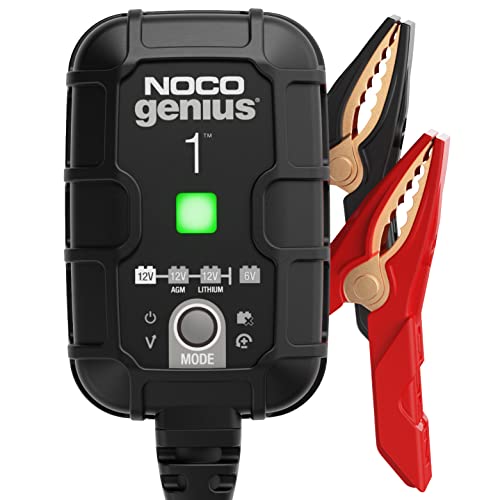
NOCO GENIUS1 1A Smart Battery Charger · Our score 75/100
1A · charges up to 30Ah, maintains any size · IP60 (not water-rated) [25]
Price on Amazon: $29.95
A small maintainer for a car in storage or a small battery, with the same chemistry modes as the GENIUS5.
Skip it if: The battery is already flat: 1 amp is slow on a car battery, and the case isn’t water-rated.
Jump starter
If your reading is under about 12V and the car won’t crank, a jump pack gets you started; then recharge the battery properly with a charger. More options: Best jump starters.

VTOMAN X7 4250A Jump Starter with Air Compressor
Rated for 12V gas and diesel engines up to 10 liters · 88.8 Wh · 160 PSI air compressor (VTOMAN manual) [26]
A jump pack with a built-in tire inflator, which covers the two most common roadside problems with one box.
Skip it if: You want a published cell chemistry or IP rating; VTOMAN publishes neither.
At a glance
| Type | Product | Key voltage spec | Price | Link |
|---|---|---|---|---|
| 12V LiFePO4 batteries | Power Queen 12V 100Ah Group 24 Smart Bluetooth LiFePO4 | Bluetooth · charging stops below 32°F and resumes at 41°F · no heater | $231.99 | View on Amazon → |
| 12V LiFePO4 batteries | LiTime 12V 100Ah Group 24 Self-Heating Bluetooth LiFePO4 | Bluetooth · self-heating: warms itself on a charger below 41°F, charges from 50°F | $313.64 | View on Amazon → |
| LiFePO4 chargers | Power Queen 12V 20A LiFePO4 Battery Charger (14.6V) | 14.6V CC/CV · 20A · wakes a BMS from 0V (Amazon listing) | $67.99 | View on Amazon → |
| LiFePO4 chargers | Victron Blue Smart IP65 12/5 Charger (12V 5A) | Li-ion mode 14.2V absorption, 13.5V float and storage · IP65 · lead-acid modes too | Check price at Amazon → | View on Amazon → |
| Car and lead-acid battery maintainers | NOCO GENIUS5 5A Smart Battery Charger | 5A · 12V 14.5V, AGM 14.8V and 12V lithium 14.6V modes · charges up to 120Ah, maintains any size · IP65 | $69.95 | View on Amazon → |
| Car and lead-acid battery maintainers | NOCO GENIUS1 1A Smart Battery Charger | 1A · charges up to 30Ah, maintains any size · IP60 (not water-rated) | $29.95 | View on Amazon → |
| Jump starter | VTOMAN X7 4250A Jump Starter with Air Compressor | Rated for 12V gas and diesel engines up to 10 liters · 88.8 Wh · 160 PSI air compressor (VTOMAN manual) | Check price at Amazon → | View on Amazon → |
Verdict: Read the Right Column, at Rest
For a car battery, remember three numbers: about 12.6V or more at rest is full, about 12.2V is half, and 13.7–14.7V with the engine running means the alternator is charging. AGM batteries read a little higher than flooded ones. For a 12V LiFePO4 battery, voltage only tells you full (13.3–13.6V) or nearly empty (about 12V); for anything in between, use a shunt monitor or a Bluetooth battery. To keep a parked car’s battery out of the 12.4V-and-below zone, the NOCO GENIUS5 5A Smart Battery Charger (our score 75/100 among maintainers) has separate lead-acid, AGM and lithium modes. Currently $69.95 on Amazon, it charges batteries up to 120Ah and maintains any size. For a LiFePO4 battery, the Power Queen 12V 20A LiFePO4 Battery Charger (14.6V) (81/100 among LiFePO4 chargers) charges to the 14.6V a 12V LiFePO4 needs.
Battery Voltage FAQ
What voltage should a car battery be?
About 12.6 volts or more with the engine off and the battery rested, which means fully charged. With the engine running it should read about 13.7 to 14.7 volts at the terminals, per Optima, because the alternator is charging it. An AGM car battery can read higher at rest; Optima's AGM YELLOWTOP reads about 13.0 to 13.2 volts when full.
What voltage is a dead car battery?
At rest, about 11.9 volts is 0% charge in the Battery Council International table, and Optima calls 12.0 volts quite discharged. A reading of 10.5 to 11.0 volts means the battery is discharged and may have a bad cell, and below 10.5 volts it is severely discharged. Recharge it fully with a charger, then have it load-tested.
What should battery voltage be with the engine running?
About 13.7 to 14.7 volts at the battery terminals, according to Optima. Haynes gives 13.8 to 14.4 volts at idle and Jiffy Lube 13.5 to 14.5 volts. If the reading barely rises above the engine-off voltage, the alternator, belt or wiring may not be charging the battery.
How low should a car battery drop when cranking?
The standard load test applies half the battery's cold cranking amp rating for 15 seconds, and a good battery stays at or above 9.6 volts at 70°F. The minimum is lower in the cold, down to 8.5 volts at 0°F on DENSO's table. If a battery fails, recharge it and test again; Discover Battery says to replace it if it fails a second time.
Is 12.4 volts good for a car battery?
It's usable but not full: 12.45 volts is about 75% in the BCI table. Battery Council International advises a freshening charge when a 12V battery drops below 12.4 volts, so put it on a charger or maintainer, or take a longer drive. About 12.2 volts is half charged.
What is the voltage of a fully charged 12V LiFePO4 battery?
About 13.3 to 13.6 volts at rest, depending on the maker's chart: Renogy lists 13.6 volts, and LiTime and Power Queen about 13.33 volts. On the charger it reads about 14.6 volts. At 50% it reads only about 13.0 to 13.2 volts. For 24V and 48V LiFePO4, multiply the 12V figures by 2 and 4.
What voltage is 50% on a 12V battery?
It depends on the chemistry. Flooded lead-acid: 12.10 volts on Trojan's chart, or 12.24 volts in the BCI table. AGM: 12.18 volts on Lifeline's chart and 12.24 volts on Trojan's AGM data sheet. LiFePO4: about 13.0 to 13.2 volts. All are resting readings.
How long should a battery rest before checking its voltage?
For lead-acid, at least 4 to 6 hours and ideally 24: Trojan says at least 6 hours, preferably 24, and Lifeline uses at least 4 hours for AGM. In a car, Haynes suggests at least an hour, or checking first thing in the morning, and Optima says running the headlights for 30 seconds with the engine off removes the surface charge. LiTime uses at least 3 hours for LiFePO4.
Can I check a LiFePO4 battery's charge with a voltmeter?
Only roughly. Its resting voltage changes by well under a tenth of a volt per 10% across the middle of the range, so a small meter error or an unrested battery can shift the estimate by 10 to 20 points. Battery University says voltage only shows full and low charge on Li-phosphate. A shunt battery monitor, which counts current in and out, is the accurate gauge; a battery with built-in Bluetooth reports from its own battery management system.
Does cold weather lower battery voltage?
Only slightly at rest: Lifeline's temperature coefficient works out to about 0.02 volts on a 12V battery for a 40°F drop. Cold does cut capacity, by 10 to 30% below 32°F per Lifeline, and makes the starter work harder, which is why car batteries are rated in cold cranking amps at 0°F. A discharged lead-acid battery can also freeze: Lifeline lists about 21°F at 0% charge against -94°F when full.
Sources
Voltage tables are battery makers’ published figures, copied as printed. Slopes, watt-hours, runtimes and the temperature example are our arithmetic on those figures. Product specs come from our product database, cross-checked against the makers’ pages listed. Nothing here was measured by us. Last reviewed November 18, 2026.
- Trojan Battery, Battery maintenance: flooded state of charge vs specific gravity and open-circuit voltage (12V, 24V, 48V); rest at least 6 hours, preferably 24; charge at 0–70%
- Battery University, BU-903: How to measure state-of-charge (BCI lead-acid open-circuit voltage table after a 24-hour rest; Li-phosphate’s flat curve; coulomb counting)
- Lifeline (Concorde) AGM Technical Manual, Doc. 6-0101 Rev. G: SOC vs OCV table (2V–48V, after 4 hours at rest), charging voltages, electrolyte freezing points, temperature coefficient
- Lifeline Batteries, FAQs: 13.0V or higher after 4 hours of rest means full; 10–30% less capacity below 32°F
- Trojan T1275-AGM Reliant data sheet: AGM state of charge by open-circuit voltage (12.84V full) and 14.1–14.7V absorption (RES Supply copy)
- Trojan Battery, Deep-Cycle Battery Storage white paper (BCI freezing points; freshening charge below 12.4V) (RES Supply copy, as cited on our RV charging page)
- OPTIMA Batteries, How do you measure battery voltage? (REDTOP 12.6–12.8V, YELLOWTOP 13.0–13.2V; surface charge; 12–24 hours on a bench or 30 seconds of headlights)
- OPTIMA Batteries, How can you tell if there is a problem with a car battery with just a voltmeter? (12.6V full; 12.0V quite discharged; 10.5–11.0V possible bad cell)
- OPTIMA Batteries, How do you tell if it’s the alternator or the battery? (at least 12.6V engine off; about 13.7–14.7V running)
- Haynes, How to test a car battery with a multimeter (12.6V healthy; 12.2V is 50%; 13.8–14.4V at idle; rest at least an hour)
- Jiffy Lube, Car battery voltage (12.6V resting; 13.5–14.5V with the engine running)
- DENSO, Battery visual inspection & performance testing: half-CCA load for 15 seconds, 9.6V minimum at 70°F, temperature table
- Discover Battery, Load testing your battery (9.6V on load for 15 seconds; recharge and retest; replace on a second fail)
- NAPA Know How, What are cold cranking amps? (0°F, 30 seconds, at least 7.2V)
- Renogy, LiFePO4 voltage chart (1 cell, 12V, 24V, 48V; as cited on our LiFePO4 charging page, checked Nov 8, 2026)
- Power Queen, Guide to lithium battery voltage charts (as cited on our LiFePO4 charging page, checked Nov 8, 2026)
- LiTime, Lithium battery user manual: SOC by open-circuit voltage after at least 3 hours at rest; no normal charging below 0°C
- RELiON, How to successfully charge RELiON batteries (voltage-based lead-acid gauges will not accurately display LiFePO4 state of charge; as cited on our LiFePO4 charging page)
- Victron Energy, SmartShunt manual: measures battery voltage and current and calculates state of charge and time to go
- Battle Born Batteries, Charging Battle Born LiFePO4 batteries (14.2–14.6V, 14.4V recommended; as cited on our charging pages)
- Power Queen, 12V 100Ah Group 24 Smart LiFePO4 product page (Bluetooth; charging stops below 32°F, resumes at 41°F)
- LiTime, 12V 100Ah Group 24 Bluetooth self-heating battery product page
- Victron Energy, Blue Smart IP65 charger manual (Li-ion: 14.2V absorption, 13.5V float and storage)
- NOCO, GENIUS5 user guide (12V 14.5V, AGM 14.8V, lithium 14.6V modes)
- NOCO, GENIUS1 user guide
- VTOMAN, X7 jump starter user manual
Charging in the cold? The self-heating LiTime 12V 100Ah is currently $313.64 on Amazon.
Check Price on Amazon →Save to cart