
How-To Guide · Updated November 2026
How to Keep an RV Battery Charged: Every Charging Method (2026)
To keep an RV battery charged, plug into shore power (the RV’s converter charges it), charge from the alternator while driving, add solar panels and a charge controller, or run a generator. In storage, keep a smart maintainer on lead-acid, or fully charge a lithium battery and disconnect it. Lithium (LiFePO4) batteries need about 14.2–14.6V, which many stock lead-acid converters don’t hold, and most can’t take a charge near or below freezing unless they are self-heating. Jump to every method compared.
As an Amazon Associate, SolarGenAdvisor earns from qualifying purchases made through links on this page, at no additional cost to you. Product scores are AI-synthesized from published specs and logged Amazon prices; we did not test these products.
 By
Every RV Battery Charging Method Compared
Most RVs use two or three of these. The house battery doesn’t care where the current comes from; what matters is that the source reaches the right voltage for your battery type and puts back what you use. Times are for a 12V 100Ah LiFePO4 battery taken from 20% to 100% (about 80Ah), using our arithmetic of amp-hours ÷ charger amps; see how long it takes for the assumptions.
| Method | Charges when | Lithium needs | 80Ah back in | Best for |
|---|---|---|---|---|
| Shore power converter | Plugged in | Lithium profile (14.4–14.6V) | ~2.3 h (35A converter) | Campgrounds, home driveway |
| Alternator / DC-DC | Engine running | DC-DC charger with LiFePO4 mode | ~2.0 h (40A DC-DC) | Travel days, motorhomes, vans |
| Solar + controller | Daylight | Controller set to LiFePO4 | ~4.0 h of strong sun (400W) | Boondocking, offsetting drains |
| Generator | Generator running | Same as shore power | Converter rate | Cloudy dry camping |
| Portable power station | Any time (limited energy) | LiFePO4 charger on its AC outlet | Limited by station size | Backup when the house battery dies |
| Maintainer in storage | Plugged in, parked | Lithium mode, or disconnect instead | ~16 h (5A); built to maintain | Winter storage, lead-acid |
Quick Answer
Have a lithium battery and an older lead-acid converter? The simplest fix is a dedicated 14.6V LiFePO4 charger for shore power, or a lithium-profile converter. Storing a lead-acid RV for winter? Fully charge it and keep a smart maintainer on it. For boondocking, add roof solar and a DC-DC charger for travel days.
Shore Power: How the Converter Charges
When you plug into a campground pedestal or a house outlet, 120V AC feeds the RV’s converter (often called the converter/charger). It powers the 12V lights, fans and controls and charges the house battery at the same time. WFCO, a common factory converter, notes that the converter supplies the RV’s loads first and the battery gets the remainder, so turning loads off makes the battery charge faster (WFCO FAQ). An inverter does the opposite job and drains the battery rather than charging it, as our RV converter vs inverter guide explains.
The three lead-acid stages
- WFCO: 13.6V “absorption” is the normal mode. When a low battery pulls the converter’s full current, it switches to a 14.4V bulk mode until current falls to about 5 amps or four hours pass, then returns to 13.6V. After about 44 hours with no significant change in load it drops to a 13.2V float (WFCO WF-8900-AD manual; WFCO FAQ).
- Progressive Dynamics Charge Wizard: 14.4V boost, 13.6V normal and 13.2V storage, with a 14.4V equalizing boost of about 15 minutes every 21 hours while in storage mode (Progressive Dynamics).
Why stock converters undercharge lithium
Battle Born recommends a 14.4V bulk and absorption charge for its LiFePO4 batteries (14.2–14.6V range) (Battle Born). A lead-acid converter spends most of its time at 13.6V and only goes to 14.4V while the current is maxed out, for no more than four hours on WFCO’s design. A lithium battery will take some charge at 13.6V, but it is unlikely to reach full, and the battery monitor may never see a full charge. Lithium-profile converters fix this:
- WFCO’s auto-detect (-AD) converters detect lead-acid, AGM or lithium. For lithium they boost to 14.6V for one to four hours to fill and balance the cells, then hold 13.6V; WFCO says power-cycling the converter resets the timer for banks over 200Ah (WFCO).
- Progressive Dynamics’ two-stage lithium models charge at 14.4V, then idle at 13.6V (Progressive Dynamics), and the company says it can supply lithium converter models to replace most lead-acid units in the field (Progressive Dynamics).
- Or leave the converter alone and plug a dedicated 14.6V LiFePO4 charger into an outlet when you need a full charge. Our best LiFePO4 battery charger guide compares them, and how to charge a LiFePO4 battery covers every setting.
Replacing a converter means working inside the RV’s 120V distribution panel. WFCO’s manual says the product should be installed and serviced by a certified or licensed electrician (WFCO), so have a qualified RV technician do it.
Shore-Power LiFePO4 Chargers
Specs are from each maker’s manual or listing. These chargers are scored against other battery chargers only.
Fastest 12V LiFePO4 top-up

Power Queen 12V 20A LiFePO4 Battery Charger (14.6V)
Score 81/100 (compared with other products of this type only)
Price: $67.99
A 14.6V, 20-amp constant-current/constant-voltage charger for 12V LiFePO4 batteries only. Its Pre-Charge mode can wake a battery whose BMS has shut off at 0V, and 20 amps puts back 80Ah in about 4 hours. Power Queen lists no float stage and publishes no water rating, so keep it in a dry bay or use it at the campsite. Use it when your RV converter is a lead-acid model that never fills a lithium battery.
Sealed charger and maintainer, either chemistry
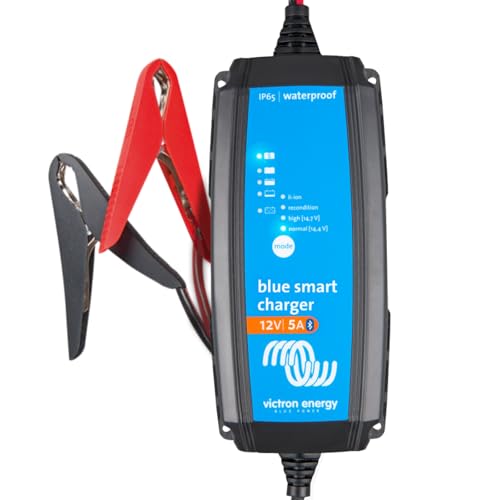
Victron Blue Smart IP65 12/5 Charger (12V 5A)
Score 78/100 (compared with other products of this type only)
Victron’s IP65 charger has a Li-ion mode (14.2V absorption, 13.5V float and storage) plus lead-acid modes, starts from 0V and carries a 5-year warranty per Victron. At 5 amps it is slow, about 16 hours to put back 80Ah, so it suits keeping a battery full in storage or between trips more than a fast refill.
20A alternative

LiTime 12V 20A Lithium Battery Charger (14.6V)
Score 77/100 (compared with other products of this type only)
Price: $79.89
Another 14.6V, 20-amp LiFePO4 charger, with 0V activation, six listed protections and a 2-year warranty on its listing. LiTime says it is not waterproof and not for marine use, and it publishes no float voltage.
Driving: Alternator and DC-DC Charging
Motorhomes charge the house battery from the engine’s alternator, and a travel trailer can charge through the tow vehicle’s plug if that circuit is wired and fused. With lead-acid that was usually enough to top up on travel days. With lithium it often isn’t:
- Lithium pulls hard. Battle Born says a large lithium bank can draw sustained high current and should not be connected directly to a factory alternator without proper control. Its rule of thumb is that an alternator can supply only about half its rated amps continuously (Battle Born).
- Trailer wiring is thin. Battle Born also says most factory wiring to the RV or trailer plug “is not going to be large enough for serious lithium charging” (Battle Born). Expect a trailer’s plug to maintain, not refill, a lithium bank.
- The fix is a DC-DC charger. Battle Born calls it the best alternator charging solution for most vehicles: it limits current, applies a lithium profile and protects the alternator and wiring (Battle Born). A 40A unit puts back 80Ah in about 2.0 h of steady driving.
We compare 30–40A units, dual-input alternator-plus-solar chargers and alternator chargers for power stations in our best DC-DC charger guide, including how to size one against your alternator. The install involves high-current cable and fuses at both batteries, so follow the charger manual or use a qualified installer.
Solar: Panels and a Charge Controller
Roof or portable panels charge the house battery through a charge controller, which sets the charge voltage. Solar is the only method that keeps working while you’re parked off-grid, and a small array also offsets the parasitic draws that flatten a stored RV’s battery. Three things to get right:
- The battery-type setting. Many controllers ship set for lead-acid. For LiFePO4, choose the lithium preset or enter about 14.2–14.6V and turn equalization off; our LiFePO4 charging guide lists the settings by brand.
- MPPT vs PWM. MPPT controllers harvest more from the same panels, especially in cold or changing light; PWM is cheaper.
- Array size. As a planning assumption (ours, not a maker’s figure), expect about 70% of the panels’ rated watts in strong midday sun. A 400W array then makes roughly 280W, or about 20A into a 12V battery, which refills 80Ah in about 4.0 h of strong sun. Winter sun, shade and flat-mounted panels give much less.
Our best RV solar kit guide compares complete kits and controllers, and the solar size calculator sizes an array to your daily use.
RV Solar Kits
400W MPPT roof kit

ECO-WORTHY 400W Premium Solar Kit (40A MPPT)
Score 83/100 (compared with other products of this type only)
Price: $459.99
Four 100W rigid panels, a 40A MPPT controller with a Bluetooth module, Y-branch cables and Z-brackets. That is enough array to refill a 100Ah battery on a good sunny day (see the timing table below). No battery or fuse hardware is listed, so budget for fuses and have the install checked by someone qualified.
Budget 200W starter kit

Renogy 200W Solar Starter Kit (30A PWM)
Score 76/100 (compared with other products of this type only)
Price: $194.64
Two 100W rigid panels with a Wanderer 30A PWM controller, cables and Z-brackets. It is the cheaper way to offset parasitic draws and top up a battery while parked. PWM harvests less than MPPT, and there is no app. Before connecting a lithium battery, check that the controller’s battery-type setting matches it.
Generator Charging
Plugging the RV’s shore cord into a generator, or starting an onboard generator, powers the converter exactly as a campground pedestal does; WFCO’s manual treats the shore cord and an onboard generator as the two AC sources for its converters (WFCO). So the battery charges at the converter’s rate, with the same lithium caveat as shore power.
Skip the 12V DC outlet on a portable generator for an RV house battery. Honda’s EU2000i manual says its DC output “is not regulated” and should only be used for 12-volt automotive-type batteries (Honda EU2000i manual). For a lithium battery, plug a 14.6V LiFePO4 charger into the generator’s AC outlet: a 20A charger delivers about 290W of DC (20A × 14.6V, our arithmetic), well within a small inverter generator. Sizing a generator for an RV air conditioner is a separate question; see our best generator for RV guide.
Portable Power Station as a Backup
A portable power station is a second, self-contained battery. It can run a CPAP, laptop, fridge or lights directly when the house battery is flat, and it recharges from its own solar input, a car socket or an outlet. It can also put charge back into a dead house battery: plug a 12V LiFePO4 charger (or a maintainer for lead-acid) into its AC outlet.
The energy is limited. Using our usable-energy rule (Wh × 0.85 for inverter losses), a 1,024Wh station delivers about 870 Wh, roughly two-thirds of a 12V 100Ah LiFePO4 battery’s 1,280Wh before the charger’s own losses. Treat it as a get-out-of-trouble option, or as the main power for a van or small trailer with no house battery at all. Our best solar generators for RV and van life covers stations sized for RV fridges and rooftop AC.
Charge Voltages: Lead-Acid vs AGM vs LiFePO4
Every charging source above needs to be set for your battery’s chemistry. These are 12V figures from each maker’s own documentation; your battery’s manual wins if it differs.
| Battery type | Bulk / absorption | Float | Equalize | Source |
|---|---|---|---|---|
| Flooded lead-acid (deep cycle) | 14.8V bulk; 14.1–14.7V absorption (at 77°F) | 13.5V, if desired | 16.2V, only when needed | Trojan |
| AGM | 14.2–14.4V | 13.2–13.4V | Never (Trojan, for AGM and gel) | Lifeline; Trojan |
| LiFePO4 (lithium) | 14.2–14.6V (Battle Born recommends 14.4V) | Not needed; under 13.6V is fine (Battle Born). Victron Li-ion mode: 13.5V | Off | Battle Born; Victron |
Lifeline strongly recommends temperature compensation for AGMs, and Victron recommends it for lead-acid batteries that run below about 50°F or above about 85°F (Lifeline; Victron). Trojan says to equalize flooded batteries only when specific gravity is low or uneven, and never AGM or gel (Trojan). An automatic equalize or desulfation step is one reason not to leave a lead-acid-only charger on a lithium battery.
LiFePO4 RV House Batteries We Rate
If you’re replacing lead-acid, these are 12V LiFePO4 batteries from our best LiFePO4 battery for RV guide. The main charging difference between them is cold weather: two have heaters, two don’t. Battery scores compare batteries only.
Most capacity in one box

LiTime 12V 320Ah Mini Bluetooth LiFePO4 (200A BMS)
Score 84/100 (compared with other products of this type only)
Price: $634.94
A 12V 320Ah (4,096Wh) battery with a 200A BMS and Bluetooth that replaces three 100Ah batteries for boondocking. It weighs about 57 lb, fits no standard battery box and has no heater: charging stops below 32°F until the cells warm.
Group 24, no heater
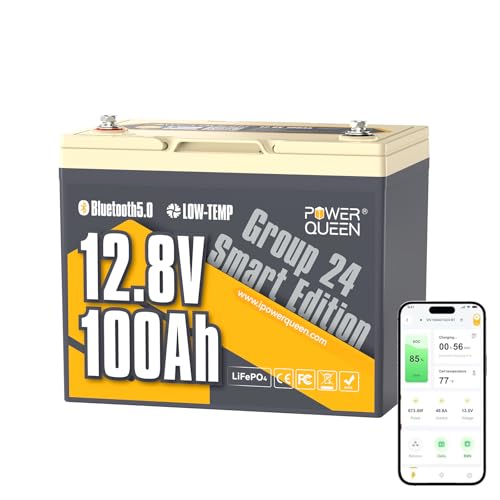
Power Queen 12V 100Ah Group 24 Smart Bluetooth LiFePO4
Score 82/100 (compared with other products of this type only)
Price: $231.99
A Group 24 12V 100Ah battery with a 100A BMS and Bluetooth. Power Queen’s BMS stops charging below 32°F and resumes at 41°F, so it suits a battery that lives inside the heated coach or an RV that is stored or used in mild weather.
Group 24, self-heating

LiTime 12V 100Ah Group 24 Self-Heating Bluetooth LiFePO4
Score 81/100 (compared with other products of this type only)
Price: $313.64
The same 100Ah Group 24 format with a built-in heater. LiTime says it heats below 41°F when a charger is connected and starts charging from 50°F, so solar or the alternator can refill it in freezing weather, at the cost of some charging energy and a higher price.
Group 24, self-heating (two modes)

Power Queen 12V 100Ah Group 24 Dual-Mode Self-Heating Bluetooth LiFePO4
Score 81/100 (compared with other products of this type only)
Price: $259.19
Power Queen’s self-heating 100Ah heats automatically below 41°F when charging, or can be preheated from the app; charging resumes at 41°F. Power Queen publishes no surge rating for it.
| Battery | Energy | Cold charging | Weight | Price |
|---|---|---|---|---|
| LiTime 12V 320Ah Mini Bluetooth LiFePO4 (200A BMS) | 4,096 Wh | Charge cut-off below 32°F (charge range 32-122°F); no heater | 57.17 lb | $634.94 |
| Power Queen 12V 100Ah Group 24 Smart Bluetooth LiFePO4 | 1,280 Wh | Charge cut-off below 32°F (resumes at 41°F); discharge cut-off below -4°F | 22.2 lb | $231.99 |
| LiTime 12V 100Ah Group 24 Self-Heating Bluetooth LiFePO4 | 1,280 Wh | Self-heating: heats below 41°F on a charger, charges from 50°F; charge range -4°F to 122°F | 22.71 lb | $313.64 |
| Power Queen 12V 100Ah Group 24 Dual-Mode Self-Heating Bluetooth LiFePO4 | 1,280 Wh | Self-heating: heats automatically below 41°F when charging, or preheat from the app; charging resumes at 41°F | 22.71 lb | $259.19 |
How Long to Charge an RV Battery
The rule of thumb is hours ≈ amp-hours to put back ÷ charger amps. A 12V 100Ah LiFePO4 battery from 20% to 100% needs about 80Ah. A 100Ah lead-acid battery is usually used only down to about 50%, so it needs about 50Ah, but the last stretch is slow: Trojan’s charging profile shows the current tapering to a small fraction of the bulk rate once the battery reaches about 90% (Trojan). Both figures below are bulk-only, before any RV loads.
| Source | Amps | LiFePO4: 80Ah back | Lead-acid: 50Ah back (bulk only) |
|---|---|---|---|
| Battery maintainer (NOCO GENIUS5, Victron 12/5) | 5A | 16 h | 10 h, plus absorption |
| LiFePO4 charger (Power Queen, LiTime) | 20A | 4.0 h | LiFePO4-only chargers |
| 400W solar, strong sun (our 70% assumption) | ~20A | 4.0 h of strong sun | 2.5 h, plus absorption |
| Converter, e.g. WFCO WF-8935 (35A rated) | 35A | 2.3 h with a lithium profile | 1.4 h, plus absorption |
| 40A DC-DC charger while driving | 40A | 2.0 h | 1.3 h, plus absorption |
The WF-8935’s 35A rating is from WFCO’s spec table (WFCO). WFCO notes the converter powers RV loads before the battery, so a running furnace fan or lights slow charging (WFCO FAQ). A lead-acid-only converter charging lithium mostly at 13.6V will take longer than this table and may stop short of full. Trojan’s own table for its batteries runs to about 13 hours at 10 amps from 50% (Trojan).
Parasitic Draws and the Disconnect Switch
An RV battery that goes flat in storage usually wasn’t “doing nothing.” Detectors, stereo memory, control boards and an inverter left on standby all draw a little current around the clock. That’s why Battle Born’s storage steps include powering down every load, smoke and CO detectors included, before storage (Battle Born).
- The disconnect switch cuts charging too, on many RVs. If it sits in the battery’s positive lead, “off” isolates the battery from the converter as well as the loads; WFCO lists an open fuse or a disconnect switch in the positive lead as a reason a battery isn’t charging (WFCO FAQ). Leave it on when plugged in if you want the battery charged, and check your owner’s manual for how your RV is wired.
- Some circuits may bypass the switch. If the battery still drains with the switch off, have the wiring checked. Battle Born says to disconnect the batteries with a disconnect switch or by removing the positive main cable (Battle Born).
- Or out-produce the drain. A maintainer on shore power or a small solar panel keeps up with parasitic loads. Battle Born also suggests a battery guardian that disconnects lithium batteries from parasitic loads at 11.5V (Battle Born).
Winter Storage and Cold-Weather Charging
LiFePO4: no charging near or below freezing
A lithium battery can power the RV in the cold, but it shouldn’t be charged when the cells are below freezing, and its BMS will usually refuse. Power Queen’s Group 24 stops charging below 32°F and resumes at 41°F (Power Queen). Battle Born’s internal protection blocks charging below 24°F, and it lists a storage range of -15 to 140°F, advising you to move batteries somewhere warmer if it will drop below -10°F (Battle Born). Self-heating batteries warm their cells first; LiTime’s heats below 41°F with a charger connected and starts charging from 50°F (LiTime).
To store a LiFePO4 battery: Battle Born says to fully charge it, disconnect solar, shore power, generators and chargers, disconnect the battery from the system, and that its batteries don’t need a trickle charge. Self-discharge averages about 2–3% a month (Battle Born). Never store one fully drained.
Lead-acid and AGM: a discharged battery can freeze
Lead-acid electrolyte becomes more like water as the battery discharges, so it freezes at a higher temperature (Victron). Freezing usually causes irreparable damage to the plates and case, and Trojan says batteries exposed to freezing should be stored fully charged or at a high state of charge (Trojan):
| State of charge | Specific gravity | Electrolyte freezes at |
|---|---|---|
| 100% | 1.280 | -92°F |
| 85% | 1.250 | -62°F |
| 62% | 1.200 | -16°F |
| 40% | 1.150 | +5°F |
| 20% | 1.100 | +19°F |
Source: Trojan’s Deep-Cycle Battery Storage white paper, citing the BCI Battery Service Manual.
To store lead-acid or AGM: charge fully first. Trojan says to check stored flooded batteries every 4–6 weeks (every 2–4 weeks above 90°F) and recharge at or below 70% state of charge (Trojan); its storage paper cites Battery Council International’s advice to give a freshening charge when a 12V battery drops below 12.4V (Trojan). Lifeline puts AGM self-discharge at about 2–3% a month at 77°F and says to top off every 3–6 months or keep the battery on a smart float or maintenance charger (Lifeline). The easy way to do all of that is a smart maintainer left connected, which our best trickle charger guide compares.
Storage Battery Maintainers
Charging lead-acid batteries gives off hydrogen (CCOHS), and NOCO says not to run its chargers in a closed-in area or with restricted ventilation (NOCO GENIUS5 guide). Specs below are from NOCO’s user guides (GENIUS1 guide).
Maintainer for an RV house battery

NOCO GENIUS5 5A Smart Battery Charger
Score 75/100 (compared with other products of this type only)
Price: $69.95
NOCO rates the GENIUS5 to charge batteries up to 120Ah and maintain any size, with 12V (14.5V), AGM (14.8V) and 12V lithium (14.6V) modes, a thermal sensor and an IP65 case, per its user guide. NOCO’s lithium mode is for LiFePO4 batteries with a built-in BMS. It has a 3-year warranty.
Budget maintainer

NOCO GENIUS1 1A Smart Battery Charger
Score 75/100 (compared with other products of this type only)
Price: $29.95
The 1-amp GENIUS1 maintains a battery of any size but NOCO rates it to charge only up to 30Ah, so it keeps a full battery full rather than refilling a flat 100Ah one. Its IP60 case is dust-tight but not water-rated, so use it under cover.
Which Setup Do You Need?
Campground and weekend RVers
- ✓ The converter does the work on shore power
- ✓ Lithium? Confirm the converter has a lithium profile, or carry a 14.6V charger
- ✓ A maintainer or a full charge-and-disconnect between trips
Boondockers and full-timers
- ✓ Roof solar with an MPPT controller set for your battery
- ✓ A DC-DC charger to refill on travel days
- ✓ A self-heating battery if the bay freezes
RV gear prices move often and have historically dipped around Prime Day and Black Friday; every price on this page loads live from Amazon.
RV Battery Charging FAQ
Does my RV battery charge when plugged into shore power?
Yes, as long as the battery is connected. Plugging in powers the RV's converter/charger, which runs the 12V system and charges the house battery. WFCO's converters charge at 14.4V when the battery is low, hold 13.6V in normal mode and drop to 13.2V after about 44 hours with almost no load. If the battery is not charging, WFCO says to check for an open fuse or a battery disconnect switch in the battery's positive lead. Lithium batteries need a converter with a lithium profile to charge fully.
Does the RV battery charge while driving?
Usually, but slowly unless the RV is set up for it. Motorhomes charge the house battery from the engine alternator, and trailers can charge through the tow vehicle's plug if that circuit is wired. Battle Born warns that most factory wiring to the RV or trailer plug is not large enough for serious lithium charging, and that a large lithium bank should not be connected directly to a factory alternator. It calls a DC-DC charger the best alternator charging solution for most vehicles.
Does an RV battery charge on a generator?
Yes. Plugging the RV into a generator, or running an onboard generator, powers the converter exactly like shore power, so the battery charges at the converter's rate. Avoid relying on a portable generator's 12V DC outlet: Honda's EU2000i manual says that output is not regulated and is only for 12-volt automotive-type batteries. For a lithium battery, plug a LiFePO4 charger into the generator's AC outlet instead.
How long does it take to charge an RV battery?
Divide the amp-hours you need to put back by the charger's amps. A 100Ah LiFePO4 battery taken from 20% to 100% needs about 80Ah: roughly 2.3 hours on a 35-amp converter with a lithium profile, 4 hours on a 20-amp charger and 16 hours on a 5-amp charger. Lead-acid batteries take longer than the arithmetic suggests because the current tapers during the absorption stage, and the converter feeds RV loads before the battery, per WFCO.
Can I leave my RV plugged in all the time?
With a modern multi-stage converter, generally yes. WFCO converters drop to a 13.2V float after about 44 hours with almost no load, and Progressive Dynamics' lithium models idle at 13.6V and top the battery off periodically. Check the water level in flooded lead-acid batteries regularly, because long charging uses water. Battle Born says a lithium float under 13.6V is fine, but for long storage it recommends fully charging and disconnecting the battery instead.
Will a lead-acid RV converter charge a lithium battery?
It will charge it, but usually not fully. A lead-acid WFCO converter spends most of its time at 13.6V and only reaches 14.4V for up to four hours while the current is at its maximum, while Battle Born recommends a 14.4V charge (14.2 to 14.6V range) for LiFePO4. The fix is a lithium-profile converter (WFCO auto-detect models charge lithium at 14.6V; Progressive Dynamics sells lithium models that charge at 14.4V) or a dedicated 14.6V LiFePO4 charger.
How do I keep my RV battery charged in storage?
For lead-acid or AGM, fully charge it and either leave it on a smart maintainer or check it every month or so. Trojan says to recharge stored flooded batteries at or below 70% state of charge, and Lifeline says to top AGMs off every 3 to 6 months or keep them on a smart float or maintenance charger. For LiFePO4, Battle Born says to fully charge the battery, disconnect it from all loads and chargers, and that its batteries do not need a trickle charge.
Can you charge an RV battery below freezing?
Not a standard LiFePO4 battery. Most makers block charging around freezing: Power Queen's BMS stops charging below 32°F and Battle Born's internal protection below 24°F. Self-heating batteries warm themselves first, using charging power. Lead-acid batteries can be charged in the cold, but a discharged one can freeze: Trojan lists electrolyte freezing at +19°F at 20% charge versus -92°F when fully charged.
Should the battery disconnect switch be on or off when plugged in?
On, if you want the battery to charge. On many RVs the disconnect switch sits in the battery's positive lead, so turning it off isolates the battery from the converter as well as from the loads; WFCO lists a disconnect switch in the positive lead as a cause of no charging. Wiring varies by RV maker, so check your owner's manual.