
Battery Units Explained · Updated November 2026
What Is a Watt-Hour? Wh, kWh, Amp-Hours and mAh Explained
The short answers
- Watt-hour (Wh)
- The energy of one watt used for one hour: Wh = watts × hours. A 100 W load running 3 hours uses 300 Wh [3][1].
- kWh
- 1 kWh = 1,000 Wh. Your electric bill counts kWh; a 1,024 Wh power station holds about 1 kWh [3].
- Amp-hours and mAh
- Charge, not energy. Multiply by the battery’s nominal voltage: Wh = Ah × V, or mAh × V ÷ 1,000 [10][5].
- Runtime
- Hours ≈ Wh × 0.85 ÷ load watts, allowing for inverter losses [14][13].
Use the watt-hour calculator, or jump to mAh to Wh, what an amp-hour means or airline Wh limits.
As an Amazon Associate, SolarGenAdvisor earns from qualifying purchases made through links on this page, at no additional cost to you.
 By
What Is a Watt-Hour?
A watt-hour (Wh) is an amount of energy: one watt of power used for one hour. The U.S. Energy Information Administration defines it exactly that way [3]. Because a watt is one joule per second and an hour is 3,600 seconds, one watt-hour is 3,600 joules [1][2]. You don’t need joules for anything on this page; the point is that watt-hours measure how much, while watts measure how fast.
So a 10 W LED bulb on for 6 hours uses 60 Wh, and a 60 W laptop charger working for 1 hour uses the same 60 Wh. EIA’s own example: a 40 W bulb used for five hours is 200 Wh, or 0.2 kWh [3]. A battery’s watt-hour rating is the same idea in reverse: the energy stored inside it, before any conversion losses.
Watt-Hour Calculator: mAh, Ah and Wh
Two tools. The first converts between mAh, amp-hours and watt-hours at the voltage you choose and shows where the result sits against the FAA’s airline limits. The second estimates how long a power station runs a load. Results update as you type and show the arithmetic; the example in each box is what you see before you change anything.
Wh vs kWh vs Watts
Watts and watt-hours are easy to mix up because they share a name. Think of a watt as speed and a watt-hour as distance. EIA puts it this way: electricity is measured in units of power called watts, one kilowatt is 1,000 watts, and one kilowatt-hour is one kilowatt used for one hour [3].
| Unit | Measures | Where you see it | Conversion |
|---|---|---|---|
| Watt (W) | Power: how fast energy is used | Appliance labels; a power station’s AC output and surge ratings | 1 W = 1 joule per second |
| Kilowatt (kW) | Power | Generators, EV chargers, whole-home loads | 1 kW = 1,000 W |
| Watt-hour (Wh) | Energy: how much was used or stored | Power banks, power stations, laptop batteries, airline rules | 1 Wh = 1 W for 1 h = 3,600 J |
| Kilowatt-hour (kWh) | Energy | Your electric bill, home batteries, EVs | 1 kWh = 1,000 Wh |
The practical upshot for a power station: its watts tell you what it can run (a 300 W inverter won’t start a 1,500 W kettle), and its watt-hours tell you for how long. To convert any figure between W, kW, Wh and kWh, use the watts to kWh calculator; to get amps from watts at 120 V or 12 V, use the watts to amps calculator.
What Is an Amp-Hour?
An amp-hour (Ah) is a quantity of electric charge: one amp flowing for one hour. A milliamp-hour (mAh) is a thousandth of that, so 1,000 mAh = 1 Ah. On a battery label, amp-hours tell you how much current the battery can deliver over time at its own voltage. A 100 Ah battery could, in principle, supply 1 A for 100 hours or 10 A for 10 hours.
What amp-hours don’t tell you on their own is energy. That depends on voltage, which is why the FAA’s instruction for working out a battery’s size is to “multiply the battery voltage by the Amp hours” [10], and why Battery University and Jackery give the same formula [5][14]:
That is why amp-hours only compare batteries of the same voltage. A 100 Ah, 12.8 V LiFePO4 battery stores 1,280 Wh; a 100 Ah, 3.6 V lithium-ion cell would store 360 Wh; and a 25,000 mAh power bank (25 Ah) stores only 90 Wh. Convert everything to watt-hours and the comparison becomes fair.
mAh to Watt-Hours: Power Banks and Phones
Power banks, phones and laptops use lithium-ion cells, and their mAh is quoted at the cell voltage, about 3.6–3.7 V, not at the 5, 9, 20 or 28 V their USB ports put out. Panasonic’s NCR18650B cell, for example, is rated 3.6 V nominal [6], and Battery University notes some makers list 3.70 V for the same chemistry [5]. Both appear on real labels: a 25,000 mAh, 90 Wh bank works out at 3.6 V, and INIU rates its 20,000 mAh P62-E1 at 74 Wh, which is 3.7 V [16][18].
| Capacity (mAh) | Wh at 3.6 V | Wh at 3.7 V | Airline tier (FAA) |
|---|---|---|---|
| 5,000 mAh | 18 Wh | 18.5 Wh | Up to 100 Wh: carry-on |
| 10,000 mAh | 36 Wh | 37 Wh | Up to 100 Wh: carry-on |
| 20,000 mAh | 72 Wh | 74 Wh | Up to 100 Wh: carry-on |
| 25,000 mAh | 90 Wh | 92.5 Wh | Up to 100 Wh: carry-on |
| 26,800 mAh | 96.48 Wh | 99.16 Wh | Up to 100 Wh: carry-on |
| 27,000 mAh | 97.2 Wh | 99.9 Wh | Up to 100 Wh: carry-on |
| 40,000 mAh | 144 Wh | 148 Wh | 101–160 Wh: airline approval |
Our arithmetic: Wh = mAh × V ÷ 1,000. Airline tiers per the FAA [10][11]; a bank whose label prints a Wh figure is judged on that figure, so read the label rather than working it out.
Why a 10,000 mAh bank won’t give your phone 10,000 mAh
A 10,000 mAh bank holds 36–37 Wh (our arithmetic). Getting that energy out through a USB port means boosting the voltage, and some of it is lost as heat. ChargerLab’s teardown of EcoFlow’s 25,000 mAh RAPID shows both numbers on one label: 90 Wh of cells, and a rated capacity of 14,500 mAh at 5 V [16]. That is 72.5 Wh at the port, about 81% of the cell energy, by our arithmetic. Anker says the same about its own 90 Wh bank: about 63–70 Wh actually reaches devices [15]. Plan on roughly 70–80% of a power bank’s Wh. For laptop-sized banks and how many charges each gives, see our best laptop power bank guide.
Nominal Voltage by Battery Type
To turn amp-hours into watt-hours you need the battery’s nominal voltage: the average voltage across a discharge, which is the figure manufacturers rate capacity at. A battery’s actual voltage rises above it when full and falls below it when nearly empty. These are the nominal figures to use:
| Battery | Nominal voltage | How it’s built | 100 Ah stores |
|---|---|---|---|
| Lithium-ion cell (NMC/NCA: phones, power banks, laptops)Source [5][6][16] | 3.6 Vsome makers list 3.7 V | Single cell; packs wire cells in series and parallel | 360 Wh (370 at 3.7 V) |
| LiFePO4 cellSource [5][7] | 3.2 VBattery University gives 3.20–3.30 V | Single cell | 320 Wh |
| “12 V” LiFePO4 batterySource [7][19] | 12.8 V | 4 cells in series (4 × 3.2 V) | 1,280 Wh |
| “24 V” LiFePO4 batterySource [7] | 25.6 V | 8 cells in series | 2,560 Wh |
| “48 V” LiFePO4 batteryOur arithmetic from the cell voltage | 51.2 V | 16 cells in series (16 × 3.2 V) | 5,120 Wh |
| 12 V lead-acid (flooded, AGM, gel)Source [5][8] | 12 V2 V per cell | 6 cells in series; about 13.0 V at rest when full (2.17 V per cell) | 1,200 Wh rated, but see depth of discharge below |
“100 Ah stores” is our arithmetic (Ah × nominal V). Real cells come in far smaller sizes than 100 Ah; the column just makes the voltages comparable. For resting voltage against state of charge for each chemistry, see our battery voltage chart.
The cell voltage is also one of the differences between the two lithium chemistries in power stations. A LiFePO4 cell runs at a lower voltage than an NMC cell, so it needs more amp-hours to store the same watt-hours; our LiFePO4 vs NMC comparison covers the trade-offs in weight, cycle life and safety.
Amp-hours to watt-hours at common battery voltages
| Amp-hours | 12 V lead-acid | 12.8 V LiFePO4 | 25.6 V LiFePO4 | 51.2 V LiFePO4 |
|---|---|---|---|---|
| 20 Ah | 240 Wh | 256 Wh | 512 Wh | 1,024 Wh |
| 50 Ah | 600 Wh | 640 Wh | 1,280 Wh | 2,560 Wh |
| 100 Ah | 1,200 Wh | 1,280 Wh | 2,560 Wh | 5,120 Wh |
| 200 Ah | 2,400 Wh | 2,560 Wh | 5,120 Wh | 10,240 Wh |
| 280 Ah | 3,360 Wh | 3,584 Wh | 7,168 Wh | 14,336 Wh |
| 300 Ah | 3,600 Wh | 3,840 Wh | 7,680 Wh | 15,360 Wh |
Our arithmetic: Wh = Ah × nominal V. Lead-acid figures are rated energy; see the next sections for how much of it you can use.
Worked Examples: Real Batteries
Four conversions people look up most, each checked against a real product’s published rating.
1. Power bank: 25,000 mAh to watt-hours
25,000 mAh ÷ 1,000 = 25 Ah × 3.6 V = 90 Wh
That matches the 90 Wh printed on EcoFlow’s RAPID 25,000 mAh bank [16][17]. Its label shows the same energy a second way: 5,000 mAh at 18 V, because its five 3.6 V, 5,000 mAh cells add up to 18 V × 5 Ah = 90 Wh. The 25,000 mAh headline is the five cells’ capacities added together at 3.6 V. Either way it is 90 Wh, under the FAA’s 100 Wh carry-on line [10].

2. 12 V battery: 100 Ah to watt-hours
100 Ah × 12.8 V = 1,280 Wh
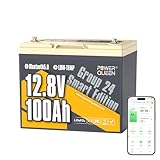
A “12 V 100 Ah” LiFePO4 battery is four 3.2 V cells in series, 12.8 V nominal, and Victron lists its own 12.8 V, 100 Ah battery at exactly 1,280 Wh [7]. Power Queen rates its Group 24 Smart battery at 12.8 V and 100 Ah, the same 1,280 Wh [19][20]. A 12 V 100 Ah lead-acid battery is 1,200 Wh on paper (12 V × 100 Ah), but makers recommend using only part of it; more on that below. For the full field of drop-in batteries, see the best 12V lithium battery guide.
3. Power station: watt-hours to runtime
1,024 Wh × 0.85 ÷ 100 W = 8.7 hours
The Anker SOLIX C1000 Gen 2 stores 1,024 Wh [23]. Run a steady 100 W load from its AC outlets and our 0.85 allowance gives about 8.7 hours. Jackery publishes the same 0.85 runtime formula, and Anker says conversion efficiency is about 85% under normal conditions [14][13]. Loads that cycle, like a fridge, average far fewer watts than their running draw, so use the average: our guide to how many watts a refrigerator uses has those figures.
4. Airline limit: how many mAh is 100 Wh?
100 Wh ÷ 3.6 V × 1,000 = 27,778 mAh
At 3.7 V it is 27,027 mAh. So the largest power banks you can carry on without approval are labelled around 26,000–27,000 mAh. The 160 Wh ceiling is 44,444 mAh at 3.6 V (43,243 at 3.7 V), by our arithmetic. The rules are in the flying section below.
Why Usable Wh Is Less Than Rated
A battery’s Wh rating is the energy stored in its cells. What reaches your device is lower, for three reasons.
1. Conversion losses
A power station’s inverter turns low-voltage DC from the battery into 120 V AC, and some energy becomes heat. Anker puts energy conversion efficiency at about 85% under normal conditions, and Jackery’s runtime formula multiplies capacity by 0.85 [13][14]. That is the allowance we use on every runtime figure on this site. Power banks lose energy the same way when they step 3.6 V cells up to USB voltages: about 70–80% reaches the device, from the EcoFlow and Anker figures above [16][15]. The station’s own screen, fans and idle inverter draw also use some battery while it runs.
2. Depth of discharge
Depth of discharge (DoD) is how much of a battery’s capacity you use before recharging. Lead-acid batteries last longer when you use only part of their capacity. Lifeline (Concorde) recommends an average depth of discharge no greater than 50%, and Trojan recommends discharging 20–50% of rated capacity for optimum life, though its batteries can be cycled to 80% [8][9]. Planned that way, a 12 V 100 Ah lead-acid battery gives you about 600 Wh of its 1,200 Wh rating (our arithmetic), about half of what a 12.8 V 100 Ah LiFePO4 battery gives. Victron also rates LiFePO4 round-trip efficiency at 92% against about 80% for the average lead-acid battery [7].
Power stations handle this for you: the battery management system stops the discharge when the pack reaches its cutoff, and the Wh on the spec sheet is the figure the maker rates. You can’t tell from the outside how much reserve a given model keeps, so plan on the rated Wh times our 0.85 allowance.
3. Battery age
Batteries hold less as they age. Makers state cycle life as the number of cycles until capacity falls to a set share of the original; the Bluetti Elite 30 Mini, for example, is rated for more than 6,000 cycles to 70% [22]. A battery late in its rated life holds noticeably fewer Wh than its label, so leave yourself headroom rather than planning to empty it to the last watt-hour.
Watt-Hour Limits for Flying: 100 and 160 Wh
Airline rules for lithium-ion batteries are written in watt-hours, which is the main reason Wh is printed on power banks. Per the FAA’s PackSafe guidance [10][11][12]:
| Battery size | Spare battery or power bank | Roughly, in mAh (3.6–3.7 V) |
|---|---|---|
| Up to 100 Wh | Carry-on only; no approval needed | Up to about 27,000–27,800 mAh |
| 101–160 Wh | Carry-on only, with airline approval; up to two spares per person | About 27,800–44,400 mAh |
| Over 160 Wh | Not allowed on passenger aircraft | Above about 43,200–44,400 mAh; every power station on this page is far above it |
Spares must never go in checked bags, and if a carry-on is checked at the gate, the batteries come out and stay with you [10]. The FAA also notes that many airlines set stricter limits, so check with yours [10]. Even the smallest station above, the 288 Wh Bluetti Elite 30 Mini, is well over the 160 Wh ceiling. Our guide to flying with a portable power station covers what happens at security and the alternatives.
kWh on Your Electric Bill
Utilities meter and bill electricity in kilowatt-hours [3]. EIA reports that U.S. residential customers used an average of 865 kWh a month in 2024, at an average 16.5 cents per kWh, for a $144 average monthly bill [4]. That is about 28.4 kWh, or 28,400 Wh, a day (our arithmetic).
Put a power station next to that number and its size makes sense. A 1,024 Wh station holds about 3.6% of an average home’s daily use, and a 2,042 Wh station about 7.2%. Filling the 1,024 Wh battery once takes roughly 17 cents of electricity at the 2024 average rate, before charging losses. Portable stations are for essentials during an outage (fridge, lights, router, phones, a CPAP), not the whole house.
Power Stations by Watt-Hours
Three sizes, each about double or more the one before, so you can see what the watt-hours buy you. Every runtime below is our arithmetic, Wh × 0.85 ÷ load, not a measurement.
~300 Wh: Phones, Laptops, CPAP
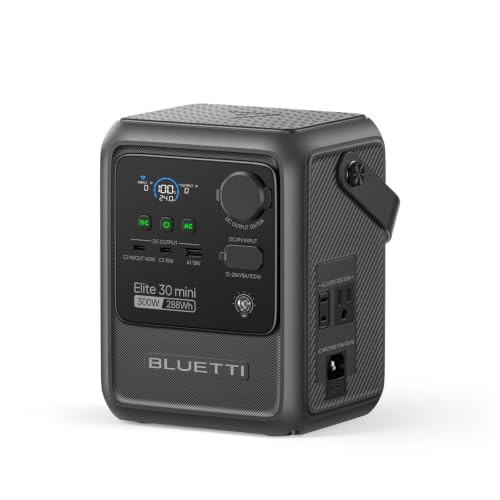
Bluetti Elite 30 Mini · Our score 85/100
288 Wh · 300 W continuous · 600 W surge · UPS under 10 ms · 7.3 lb · LiFePO4 [21][22]
Price on Amazon: $219.99
The smallest of the three: 288 Wh, or about 245 Wh after our 0.85 allowance. That is ~4.9 h at 50 W or ~2.4 h at 100 W by our math, at 7.3 lb. It is still 2.9 times the FAA’s 100 Wh line, so it stays home when you fly.
Skip it if: You need to run anything over 300 W continuously (a kettle, a microwave, a space heater) or keep a fridge going overnight.
~1 kWh: Outages and Camping

Anker SOLIX C1000 Gen 2 · Our score 92/100
1,024 Wh · 2,000 W continuous · 3,000 W surge · UPS 10 ms · 24.9 lb · LiFePO4 [23][24]
Price on Amazon: $469.99
About one kilowatt-hour: 870 Wh usable by our 0.85 allowance, or ~8.7 h at a steady 100 W. Its 2,000 W inverter covers most single kitchen appliances, and the battery, not the inverter, is what limits how long they run.
Skip it if: You want a full day of a refrigerator plus other loads; at 1 kWh that needs solar top-ups or a larger battery.
~2 kWh: Fridge for a Day

Jackery Explorer 2000 v2 · Our score 87/100
2,042 Wh · 2,200 W continuous · 4,400 W surge · UPS 20 ms or less · 39.5 lb · LiFePO4 [25][26]
Price on Amazon: $999.00
Twice the energy at 2,042 Wh (1,736 Wh usable by our allowance): ~17 h at 100 W, or roughly a day of a full-size fridge on our refrigerator figures. Its 4,400 W surge rating clears a compressor start.
Skip it if: You carry it often (39.5 lb), want to add batteries later (it is not expandable), or need fast solar recharging; it accepts 400 W.
Runtime by load
| Steady load | Bluetti Elite 30 Mini288 Wh / 300 W | Anker SOLIX C1000 Gen 21,024 Wh / 2,000 W | Jackery Explorer 2000 v22,042 Wh / 2,200 W |
|---|---|---|---|
| 10 W | ~24 h | ~87 h | ~174 h |
| 50 W | ~4.9 h | ~17 h | ~35 h |
| 100 W | ~2.4 h | ~8.7 h | ~17 h |
| 300 W | ~49 min | ~2.9 h | ~5.8 h |
| 500 W | Over its output | ~1.7 h | ~3.5 h |
| 1,000 W | Over its output | ~52 min | ~1.7 h |
| 1,500 W | Over its output | ~35 min | ~1.2 h |
| 2,000 W | Over its output | ~26 min | ~52 min |
Our arithmetic: rated Wh × 0.85 ÷ load watts, for a steady AC load. “Over its output” means the load exceeds the station’s continuous AC rating. Capacities and output ratings come from our product database, cross-checked against the sources listed.
Side by side
| Station | Rated / usable energy | Continuous / surge | Weight | Wh per lb | Price | Link |
|---|---|---|---|---|---|---|
| Bluetti Elite 30 Mini | 288 / ~245 Wh | 300 / 600 W | 7.3 lb | 39 | $219.99 | View on Amazon → |
| Anker SOLIX C1000 Gen 2 | 1,024 / ~870 Wh | 2,000 / 3,000 W | 24.9 lb | 41 | $469.99 | View on Amazon → |
| Jackery Explorer 2000 v2 | 2,042 / ~1,736 Wh | 2,200 / 4,400 W | 39.5 lb | 52 | $999.00 | View on Amazon → |
Not sure how many watt-hours you need? Add up your devices in the solar size calculator; it returns the battery Wh, inverter watts and solar panel size for your list.
Verdict: Compare Batteries in Watt-Hours
A watt-hour is one watt for one hour, and it is the only battery number that compares fairly across a phone bank, a 12 V battery and a power station. Convert mAh or amp-hours with Wh = Ah × nominal volts (3.6–3.7 V for lithium-ion cells, 12.8 V for a 12 V LiFePO4 battery, 12 V for lead-acid), then estimate runtime with Wh × 0.85 ÷ watts. For most outage and camping use, a station around 1 kWh is the practical middle. The Anker SOLIX C1000 Gen 2 (our score 92/100) stores 1,024 Wh. Currently $469.99 on Amazon, it runs a steady 100 W for about 8.7 hours by our math. Go smaller with the Bluetti Elite 30 Mini for devices, or larger with the Jackery Explorer 2000 v2 for a fridge.
Watt-Hour FAQ
What is a watt-hour?
A watt-hour (Wh) is a unit of energy: one watt of power used for one hour. Watt-hours = watts × hours, so a 100 W device running for 3 hours uses 300 Wh. Battery capacity is rated in Wh, and 1,000 Wh is one kilowatt-hour (kWh), the unit on your electric bill.
What is the difference between watts and watt-hours?
Watts measure power, how fast energy is used at a moment. Watt-hours measure energy, how much is used or stored over time. A power station's watt rating tells you what it can run; its watt-hour rating tells you for how long.
What does amp-hour mean on a battery?
An amp-hour (Ah) is the charge a battery delivers: one amp for one hour. A 100 Ah battery could supply about 1 A for 100 hours or 10 A for 10 hours at its own voltage. Amp-hours only compare batteries of the same voltage; to compare any two, convert to watt-hours with Wh = Ah × nominal volts.
How do I convert mAh to watt-hours?
Multiply mAh by the battery's nominal voltage and divide by 1,000. Power banks and phones use lithium-ion cells rated at about 3.6 to 3.7 V, so 10,000 mAh is 36 to 37 Wh, 20,000 mAh is 72 to 74 Wh, and 25,000 mAh at 3.6 V is 90 Wh.
How many watt-hours is a 100Ah battery?
It depends on the voltage. A 12 V LiFePO4 battery is 12.8 V nominal, so 100 Ah is 1,280 Wh. A 12 V lead-acid battery is 1,200 Wh on paper, but makers such as Lifeline recommend using no more than about 50% on average, so plan on roughly 600 Wh. A 24 V (25.6 V) LiFePO4 100 Ah battery is 2,560 Wh.
How long will a 1,000 Wh power station last?
Divide about 85% of its watt-hours by the load. A 1,000 Wh station gives about 850 Wh usable: roughly 8.5 hours at 100 W, 17 hours at 50 W, or under an hour at 1,000 W. Loads that cycle, like a fridge, average far fewer watts than their running draw, so they last longer than the running watts suggest.
How many mAh is 100 Wh, and can I fly with it?
100 Wh is about 27,800 mAh at 3.6 V or 27,000 mAh at 3.7 V. The FAA allows spare lithium-ion batteries and power banks up to 100 Wh in carry-on bags without approval, up to two spares of 101 to 160 Wh with airline approval, and nothing over 160 Wh. Spares are never allowed in checked bags, and airlines can be stricter.
Why does my power bank give less than its rated capacity?
Its mAh is rated at the 3.6 to 3.7 V cell voltage, and boosting that to USB voltage loses energy as heat. EcoFlow's 90 Wh RAPID bank lists a rated capacity of 14,500 mAh at 5 V, about 81% of the cell energy, and Anker says about 63 to 70 Wh of its 90 Wh bank reaches devices. Plan on 70 to 80% of the Wh rating.
Sources
Unit definitions come from NIST and the EIA; nominal voltages from Battery University and cell and battery makers’ datasheets; depth-of-discharge guidance from lead-acid makers; airline limits from the FAA and TSA; and household use from EIA. Product capacities and ratings come from our product database, cross-checked against the listings below. Conversions, runtimes and percentages are our arithmetic on those figures; nothing here was measured by us. Last reviewed November 18, 2026.
- NIST Special Publication 811, Chapter 4: SI derived units (watt, W = J/s)
- NIST Special Publication 811, Chapter 5: units accepted for use with the SI (1 h = 3,600 s)
- U.S. Energy Information Administration, Electricity Explained: Measuring electricity (one watthour is one watt used for one hour; one kilowatt is 1,000 watts; utilities measure electricity in kWh)
- U.S. EIA, Today in Energy, May 12, 2025: residential customers averaged 865 kWh a month in 2024 at an average 16.5 cents per kWh, a $144 average monthly bill
- Battery University, BU-303: Confusion with voltages (lead-acid 2 V per cell; cobalt-based Li-ion 3.60 V per cell, some makers list 3.70 V; phosphate Li-ion 3.20–3.30 V; Wh = Ah × V)
- Panasonic NCR18650B lithium-ion cell datasheet: nominal voltage 3.6 V, typical capacity 3,350 mAh (Battery Junction copy)
- Victron Energy, 12.8 & 25.6 Volt lithium iron phosphate batteries Smart datasheet: an LFP cell is 3.2 V nominal; a 12.8 V battery is 4 cells in series, 25.6 V is 8; 12.8 V / 100 Ah = 1,280 Wh nominal energy; round-trip efficiency 92% LFP vs about 80% lead-acid
- Lifeline (Concorde) Batteries FAQ: average depth of discharge no greater than 50% of the 20-hour rating; full charge at rest is 2.17 V per cell, 13.0 V for a 12-volt battery
- Trojan Battery FAQ: for optimum life, discharge 20–50% of rated capacity; capable of being cycled to 80%
- FAA PackSafe, Lithium batteries: spares in carry-on only; lithium-ion limited to 100 Wh per battery; up to two spares of 101–160 Wh with airline approval; “To calculate Wh, multiply the battery voltage by the Amp hours (Ah)”
- FAA PackSafe, Power stations flyer: lithium battery-powered devices of more than 160 Wh are not allowed on passenger aircraft; do not pack power stations in checked baggage
- TSA, What Can I Bring? Lithium batteries with more than 100 watt hours: carry-on only, up to two spares of 101–160 Wh with airline approval
- Anker SOLIX, How long will a portable power station run? (runtime = Wh ÷ W in theory; energy conversion efficiency approximately 85%)
- Jackery, What is a watthour? (Working time = capacity Wh × 0.85 ÷ operating wattage; watt-hours = amp-hours × volts)
- Anker, Power Bank 25,000mAh 165W (A1695): 25,000 mAh rated cell capacity equal to 90 Wh; usable output about 63–70 Wh in real-world charging
- ChargerLab, Teardown of EcoFlow RAPID 170W 25000mAh power bank (EF-HB-002): label 5,000 mAh 18 V / 90 Wh; total cell capacity 25,000 mAh (5 × 5,000 mAh); INR21700-5000 cells, 3.6 V nominal; rated capacity 14,500 mAh at 5 V 3 A
- Digitec retail listing, EcoFlow RAPID Powerbank 25,000 mAh, 170 W, 90 Wh
- INIU, P62-E1 20,000mAh 65W power bank product page (20,000 mAh, 74 Wh; as cited on our laptop power bank guide)
- Power Queen, 12V 100Ah Group 24 Smart LiFePO4 battery product page (12.8 V rated voltage, 100 Ah)
- Power Queen Canada, 12V 100Ah Group 24 Smart deep-cycle lithium battery (LiFePO4 prismatic cells)
- BLUETTI, Elite 30 Mini product page (288 Wh, 300 W rated AC, 600 W Power Lifting, 7.3 lb, UPS under 10 ms)
- Homecrux, BLUETTI Elite 30 Mini launch report (288 Wh LiFePO4, 300 W, 7.3 lb; rated for more than 6,000 cycles to 70% capacity)
- B&H Photo spec listing, Anker SOLIX C1000 Gen 2 (1,024 Wh, 2,000 W continuous, 3,000 W surge; read Nov 16, 2026)
- Anker SOLIX support, C1000 Gen 2 UPS ports and switchover time (10 ms; read Nov 16, 2026)
- Jackery, Explorer 2000 v2 product page (2,042 Wh LiFePO4, 2,200 W output, 4,400 W surge; read Nov 16, 2026)
- The Solar Lab, Jackery Explorer 2000 v2 review (read Nov 16, 2026)
Want about 2 kWh for a fridge? The Jackery Explorer 2000 v2 is currently $999.00 on Amazon.
Check Price on Amazon →Save to cart