
Buying Guide · Updated November 2026
Best Jump Starter: 6 Portable Jump Starters Ranked by Engine Size, Not Peak Amps
The best jump starter is the portable pack its maker rates for your engine size, because peak-amp numbers have no common test. For most cars (up to 6.0L gas or 3.0L diesel), the AstroAI S8 is the budget pick. The VTOMAN X7 earns our top score: it's rated for 10L gas and diesel engines and adds a 160 PSI air compressor. For V8 SUVs and pickups, choose the NOCO GB70. The NOCO GB150 is the NOCO for diesel trucks, and the GBX45 adds 60W USB-C.
As an Amazon Associate, SolarGenAdvisor earns from qualifying purchases made through links on this page, at no additional cost to you. Scores are AI-synthesized from manufacturer user guides, data sheets and product pages, Amazon listing details and logged Amazon prices; we did not test these jump starters.
 By
Quick Verdict
Start with your engine. If it's 6.0 liters gas or 3.0 liters diesel or smaller, which covers most cars and small SUVs, the AstroAI S8 carried a matching maker rating for the least money when we checked, with a 2-year warranty. The NOCO GB40 has the same rating with NOCO's IP65 housing and published starts-per-charge figure. For V8 SUVs and pickups, step up to the NOCO GB70. If you also want to top up tires, the VTOMAN X7 is the only pick with a built-in air compressor, and its 10-liter gas and diesel rating is the largest here, which is why it scores highest. If you'd rather buy from Amazon.com with an IP65 rating for a diesel truck or RV, choose the NOCO GB150. If you'd use the pack as a phone and laptop charger too, the NOCO GBX45 is the only one with 60W USB-C in and out. In deep cold, see the cold-weather limits: every lithium pick here is rated only down to -4°F, and none can be recharged below freezing.
Before You Clamp On
- 12V lead-acid batteries only. NOCO's guides say each Boost is "for jump starting 12-volt lead-acid batteries only" and to check the battery's chemistry and voltage first (NOCO GB40 guide). If your car has a lithium 12V battery, ask the battery maker before you jump it. AAA says to confirm both vehicles use 12V batteries, because a 24V truck system can damage a car (AAA).
- Never jump a frozen, cracked or leaking battery. NOCO and Clore both say not to jump a frozen battery (NOCO; Clore manual). AAA says to replace a battery with cracks, bulging sides or a rotten-egg smell rather than jump it.
- Wear eye protection and work in open air. NOCO's guides warn that batteries "can explode and cause flying debris" and say to operate the pack only in well-ventilated areas.
- Treat manual override as a last resort. NOCO's guides say manual override "disables all safety measures," including spark-proof and reverse-polarity protection, so check the polarity twice before you use it.
- Rest the pack between tries. NOCO says no more than five attempts in 15 minutes, then a 15-minute rest. VTOMAN's X7 manual is stricter: no more than three starts in a row, two minutes between each, and take the clamps off within 30 seconds of the engine starting (VTOMAN X7 manual). Clore says to let the JNC660 cool for 3 minutes if the engine doesn't start within 6 seconds.
How We Score Jump Starters
We use one rubric for every jump starter on this page. As on our heater guides, the relative dimensions compare the picks with each other on this page, so a jump-starter score isn't comparable with a power-station score. Each score is AI-synthesized from the maker's user guide or manual, data sheet and product page, Amazon listing details and the Amazon price we logged (November 6, 2026 for the five original picks, November 8 for the VTOMAN X7). We did not test any jump starter. Every input below is published by the maker for all six picks, so no score is low because of missing data. Peak amps are deliberately not scored (why). Weights total 100:
- Engine coverage (35): the maker's gas and diesel engine ratings, each relative to 9.0L gas and 7.0L diesel (the NOCO GB150) and capped at full marks, averaged. The X7's 10L ratings exceed both, so it gets full marks rather than a bonus.
- Value (20): the lowest logged price here divided by this pack's logged price
- Battery energy (15): the maker's Wh rating relative to 88 Wh, capped at full marks. More energy means more starts per charge and more phone charging.
- Device charging (15): a USB port of about 10W only (45 points), USB plus a 12V accessory output such as NOCO's 12V 15A or VTOMAN's 15V 10A port (65), or 60W USB-C Power Delivery in and out (90)
- Warranty (15): the maker's warranty in years, relative to the longest (2 years); VTOMAN's 18 months counts as 1.5
Every pick is rated to operate down to the same -4°F, so cold-weather rating doesn't separate them, and we don't score it. We cover it in the cold-weather section instead. Weight isn't scored either, because makers publish it on different bases (unit only, or with clamps). The air compressor isn't scored, because only one pick has one. The Clore JNC660 is shown but not scored, because Clore publishes no engine-size rating, and the VTOMAN X1 isn't scored because VTOMAN's documents give conflicting battery figures for it (details).
The 6 Best Portable Jump Starters
These are 12V lithium jump starters with a published manufacturer user guide or manual, and all six had a new, in-stock offer in Amazon's buy box when we checked on November 8, 2026. Four were sold by Amazon.com when we checked on November 6. The AstroAI S8 is sold by AstroAI Direct and the VTOMAN X7 by VTOMAN, both third-party sellers on Amazon. Specs come from each maker's guide or manual (linked), data sheet and product page.
1. Top Score: Best Jump Starter With Air Compressor

VTOMAN X7 4250A Jump Starter with Air Compressor
Up to 10.0L gas / 10.0L diesel · 88.8 Wh Lithium (cell type not published) · 160 PSI air compressor · 18-month warranty · Score 72/100
The X7 scores highest in our scoring because it combines the largest engine rating on this page with an 18-month warranty, and it cost less than the NOCO GB70 and GB150 when we checked on November 8. VTOMAN's manual rates it for 12V gas and diesel engines up to 10 liters, with up to 70 starts per charge, and lists an 88.8 Wh battery, a 1,548 g (about 3.4 lb) unit, a 9V 2A input that recharges it in around 7 hours, USB fast-charging up to 18W and a 15V 10A DC output for 12V accessories (VTOMAN X7 manual). It is also the only pick here with a built-in tire inflator, rated to 160 PSI in both the manual and the Amazon listing. One review site lists the X7 at 99.2 Wh (The Drive), but we use the manual's 88.8 Wh; either figure gets the same battery score. The manual says it takes about 2 minutes to inflate a typical car tire to 20 PSI. Unusually, VTOMAN publishes a starting-current figure as well as peak amps: 800A for 3 seconds against 4,250A peak. Know the trade-offs before you buy. VTOMAN doesn't publish its cell chemistry or an IP rating, it is sold on Amazon by VTOMAN as a third-party seller, and its manual allows no more than three starts in a row, with two minutes between them.
Device charging: USB fast charge out up to 18W (5V 3A / 9V 2A / 12V 1.5A); USB-C 9V 2A in; 15V 10A DC out. Recharge: Around 7 h on a 9V 2A charger (user manual). Protections: Smart clamps (solid green = correct, red = reversed), BOOST for very flat batteries; maker lists spark-proof, reverse-polarity and low/high-temperature protection.
Pros
- ✓ Largest engine rating here: 10L gas / 10L diesel (VTOMAN)
- ✓ Built-in 160 PSI inflator with a preset auto-stop
- ✓ Publishes a starting current: 800A for 3 s
- ✓ 18-month warranty; top score in our jump-starter scoring
Cons
- ✗ No published cell chemistry or IP rating
- ✗ Sold by VTOMAN through Amazon, so returns follow the seller’s policy
- ✗ Only three starts in a row, then a 2-minute rest (manual)
- ✗ Inflating draws from the same battery you need for starting
2. Best NOCO for Diesel Trucks and Big V8s

NOCO Boost Pro GB150 3000A Jump Starter
Up to 9.0L gas / 7.0L diesel · 88 Wh Lithium-ion · 1-year warranty · Score 64/100
The GB150 is the NOCO to buy if you start a full-size diesel pickup, a big V8, an RV or a fleet of vehicles. NOCO rates it for gas engines up to 9.0 liters and diesels up to 7.0 liters, with up to 80 starts per charge (NOCO), the most starts per charge published for any pick here. Its data sheet lists an 88 Wh lithium-ion battery, a 6 lb unit (7.5 lb with clamps and accessories) and a 500-lumen light (NOCO data sheet). The user guide adds a 12V 15A accessory output, a 12V 60W fast-charge input that refills it in about 2 to 3 hours, IP65 protection with the ports closed, a -4 to 122°F operating range and a 1-year limited warranty (NOCO user guide). It scores below the VTOMAN X7 because the X7 has a larger published engine rating, costs less and has a longer warranty. Choose the GB150 if you want a pack sold by Amazon.com with an IP65 rating. Most drivers don't need this much. It costs the most of our six, and on a standard USB charger the guide puts a full recharge at about 11 hours.
Device charging: USB 5V 2.1A in/out; 12V 15A out; 12V 5A in. Recharge: About 11 h from a 2A USB charger, or 2-3 h with 12V fast charge (60W) (user guide). Protections: Spark-proof, reverse-polarity protection (UltraSafe); manual override for batteries below 2V.
Pros
- ✓ 9.0L gas / 7.0L diesel rating (NOCO)
- ✓ 88 Wh battery, up to 80 starts per charge
- ✓ 12V 15A output runs 12V accessories; IP65 with ports closed
- ✓ Sold by Amazon.com
Cons
- ✗ Highest price of our picks
- ✗ Heaviest here: 7.5 lb with clamps
- ✗ Only a 5V 2.1A USB port for phones
- ✗ 1-year warranty
3. Best Budget Jump Starter for Most Cars

AstroAI S8 1500A Jump Starter
Up to 6.0L gas / 3.0L diesel · 29.6 Wh Lithium NMC · 2-year warranty · Score 60/100
Price: $42.19
AstroAI rates the S8 for the same engines as the NOCO GB40, up to 6.0 liters gas and 3.0 liters diesel, and its product page lists a lithium NMC battery and a 0.95 lb weight (AstroAI). It had the lowest price of our picks when we checked, and its manual gives a 2-year limited warranty, twice NOCO's. The manual's spec table lists 29.6 Wh, a 5V 2A USB-C input, a 5V 2.1A USB-A output, a -4 to 122°F operating range and a 32 to 113°F charging range (AstroAI S8 manual). The smart clamps light red if you reverse them, and a Boost button handles batteries too flat to detect. AstroAI asks for at least 75% charge before a jump. One caveat: another copy of an S8 manual online lists 37 Wh, so we score the lower figure from the manual we could open. AstroAI doesn't publish a starts-per-charge figure.
Device charging: USB-C in 5V 2A; USB-A out 5V 2.1A. Recharge: Not published. Protections: Smart clamps: red light for reversed polarity, Boost button for batteries under about 9V.
Pros
- ✓ Same 6.0L gas / 3.0L diesel rating as the GB40
- ✓ Lowest price of our picks when we checked
- ✓ 2-year warranty, the longest here
- ✓ Lightest pick: 0.95 lb (AstroAI)
Cons
- ✗ Smallest battery of our picks except the GB40 (29.6 Wh in its manual)
- ✗ Basic 5V USB charging only
- ✗ Sold by AstroAI Direct through Amazon, so returns follow the seller’s policy
4. Best for SUVs, Pickups and Mid-Size Diesels

NOCO Boost HD GB70 2000A Jump Starter
Up to 8.0L gas / 6.0L diesel · 56 Wh Lithium-ion · 1-year warranty · Score 56/100
The GB70 sits between the compact Boosts and the GB150. NOCO rates it for gas engines up to 8.0 liters and diesels up to 6.0 liters, with up to 40 starts per charge (NOCO), which covers many V8 SUVs and pickups. Check your engine's displacement in the owner's manual first. The data sheet lists a 56 Wh lithium-ion battery, a 4 lb unit (5 lb with clamps) and a 400-lumen light (NOCO data sheet). The user guide gives a 12V 15A accessory output, a 36W 12V fast-charge input (about 2 to 3 hours, or about 7 hours from a 2A USB charger), the same -4 to 122°F operating range and a 1-year warranty (NOCO user guide).
Device charging: USB 5V 2.1A in/out; 12V 15A out; 12V 3A in. Recharge: About 7 h from a 2A USB charger, or 2-3 h with 12V fast charge (36W) (user guide). Protections: Spark-proof, reverse-polarity protection (UltraSafe); manual override for batteries below 2V.
Pros
- ✓ 8.0L gas / 6.0L diesel rating (NOCO)
- ✓ 56 Wh battery, up to 40 starts per charge
- ✓ 12V 15A accessory output and 12V fast charging
- ✓ IP65 with ports closed
Cons
- ✗ 5 lb with clamps: trunk-sized, not glove-box-sized
- ✗ Costs considerably more than the compact picks
- ✗ 1-year warranty
5. Best Jump Starter + Power Bank (USB-C)

NOCO Boost X GBX45 1250A Jump Starter
Up to 6.5L gas / 4.0L diesel · 31 Wh Lithium-ion · 1-year warranty · Score 51/100
The GBX45 is the pick if you want the pack to earn its place in your bag between jump starts. It's the only one here with USB-C Power Delivery 3.0 in both directions, up to 60W (5 to 20V at 3A), so it can top up a phone, tablet or USB-C laptop and refill from a laptop charger in about 0.8 hours (NOCO user guide). NOCO rates it for gas engines up to 6.5 liters and diesels up to 4.0 liters (NOCO). Its data sheet lists a 31 Wh battery and a 1.3 lb weight (NOCO data sheet). The guide adds hot and cold warning LEDs and a 60-second boost timeout, and says to power it off as soon as the engine starts. 31 Wh is still a small battery: at our 0.85 efficiency factor, that's about 26 Wh of usable energy, or less than half an hour for a laptop drawing 60W.
Device charging: USB-C PD 3.0 in/out up to 60W (5-20V 3A); USB-A out 5V 2.1A (10W). Recharge: About 0.8 h on a 60W USB-C PD charger; 4 h at 10W (user guide). Protections: Spark-proof, reverse-polarity protection (UltraSafe 2.0); hot and cold warning LEDs; 60-second boost timeout; manual override below 3V.
Pros
- ✓ 60W USB-C PD in and out, the only one here
- ✓ Fast recharge: about 0.8 h on a 60W USB-C charger
- ✓ Compact: 1.3 lb (NOCO)
- ✓ 6.5L gas / 4.0L diesel rating
Cons
- ✗ 31 Wh is small for laptop top-ups
- ✗ NOCO doesn't publish a starts-per-charge figure for it
- ✗ 1-year warranty
6. Compact NOCO for Small and Mid-Size Cars
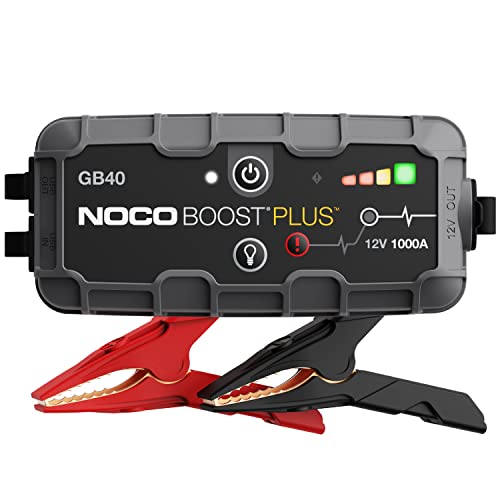
NOCO Boost Plus GB40 1000A Jump Starter
Up to 6.0L gas / 3.0L diesel · 24 Wh Lithium-ion · 1-year warranty · Score 42/100
The GB40 is NOCO's compact Boost. NOCO rates it for gas engines up to 6.0 liters and diesels up to 3.0 liters, with up to 20 starts per charge (NOCO). Its data sheet lists a 24 Wh lithium-ion battery, a 1.65 lb unit (2.4 lb with clamps) and a 100-lumen light (NOCO data sheet). The user guide gives a 5V 2.1A USB input and output, about 3 hours to recharge from a 2A charger, IP65 with the ports closed, spark-proof and reverse-polarity protection, a manual override for batteries below 2 volts and a 1-year warranty (NOCO user guide). It ranks last in our scoring for a simple reason: the AstroAI S8 has the same engine rating, a slightly larger battery and twice the warranty, and cost less when we checked. Choose the GB40 if you'd rather have NOCO's published starts-per-charge figure, IP65 rating and support.
Device charging: USB 5V 2.1A in; USB 5V 2.1A out. Recharge: About 3 h on a 2A USB charger (user guide). Protections: Spark-proof, reverse-polarity protection (UltraSafe); manual override for batteries below 2V.
Pros
- ✓ 6.0L gas / 3.0L diesel rating (NOCO)
- ✓ Up to 20 starts per charge, IP65 housing
- ✓ Spark-proof and reverse-polarity protection
- ✓ Sold by Amazon.com
Cons
- ✗ Smallest battery here: 24 Wh
- ✗ Basic 5V 2.1A USB port
- ✗ Same engine rating as the cheaper S8, half the warranty
Not scored: the shop-style lead-acid alternative
Clore Automotive Jump-N-Carry JNC660
Clore markets the JNC660 to service garages, dealerships and towing operations, and it's the only model we checked that publishes a cranking-amp figure: 1,700 peak amps and 425 cranking amps. It has a sealed lead-acid battery, 46-inch #2 AWG welding-cable leads, a built-in automatic charger, a voltmeter, a 12V DC outlet, an 18 lb weight and a 1-year limited warranty (Clore Automotive). Its manual says to recharge it after every use and every three months in storage, and never to leave it fully discharged (Clore manual). We don't score it, because Clore doesn't publish an engine-size rating, and that's our main scoring dimension. Its storage advice also differs from the lithium packs: Clore says not to store it below 50°F when you're using it as a jump starter, for best performance, and that temperatures above 70°F reduce its output. Choose it if you jump vehicles often, have a garage to keep it in, and don't need it to fit in a glove box.
Other jump starters we checked
We left out the GOOLOO GP4000, which was in stock, because the manual we found gives no engine-size rating and GOOLOO's site wouldn't load for us to check the listing's "all gas and 10L diesel" claim. We skipped a Clore JNC660-plus-charger bundle in favour of the standalone unit. We also passed over the many budget listings that advertise 5,000 to 7,000 peak amps from packs weighing about a pound. We rank only models with a manufacturer guide or manual we could check, and we didn't verify one for those listings. Their headline figure is also exactly the kind of number the next section explains you can't compare.
Best Jump Starter With Air Compressor
A jump starter with an air compressor puts a tire inflator and a jump pack in one box, sharing one battery. Of our six picks, only the VTOMAN X7 has one. Its manual rates the inflator at 160 PSI and says it takes about 2 minutes to inflate a typical car tire to 20 PSI, and you can preset a target pressure so it stops by itself (VTOMAN X7 manual). Its Amazon listing gives a faster figure, about 1 minute to take a 30-inch tire from 30 to 35 PSI. That's a smaller top-up than the manual's figure, so the two numbers don't conflict, but neither is a test we can check. Three things to know before you buy one:
- The inflator and the jump starter share the battery. VTOMAN's X7 manual says to make sure 3 to 4 charge indicators are lit before you start a car, and its X1 manual asks for more than 2 bars (VTOMAN X1 manual). After inflating a tire, check the charge before you rely on the pack to start the car.
- Don't run the pump nonstop. VTOMAN's Amazon listings say not to use the air pump continuously and to let it cool for a few minutes when it gets hot. VTOMAN doesn't publish a duty cycle (minutes on, minutes off).
- It's a top-up pump, not a shop compressor. It's for topping up car, SUV and bike tires and inflatables. If you air down off-road and refill four big tires regularly, a dedicated 12V compressor is the better tool.
VTOMAN jump starter: X7 or X1?
VTOMAN, which also makes portable power stations, sells several jump starters on Amazon. We ranked the X7 because its maker manual and the Amazon listing agree on its key figures: 10L gas and 10L diesel, 4,250A peak, up to 70 starts, a 160 PSI inflator and an 18-month warranty. The manual adds 88.8 Wh and 800A starting current for 3 seconds. The X1 is the budget alternative, below.
Not scored: the budget compressor option
VTOMAN X1 2500A Jump Starter with Air Compressor
The Amazon listing rates the X1 for 12V engines up to 8.5L gas and 6.0L diesel, with 2,500A peak, a 150 PSI inflator, up to 50 starts per charge and an 18-month warranty, and it cost less than the X7 when we checked. We don't score it because VTOMAN's documents disagree about its battery. The listing sold today (model JS-577) says LiFePO4 cells but gives no Wh figure. The X1 manual on VTOMAN's site covers model JS-211 and says lithium polymer (VTOMAN X1 manual), and that manual's specification table lists 44.4 Wh and 400A starting current for 3 seconds (ManualsLib copy). VTOMAN's specification page lists the VX1 at 66.6 Wh with a 100 PSI pump (VTOMAN specifications). Battery energy is one of our scoring inputs, so we can't score the X1 until VTOMAN publishes one figure for the version on sale. Choose it if you want a compressor-and-jump-pack combo for a car or small SUV at a lower price, and check the manual in the box.
We also saw VTOMAN's X3, X5, X5 Cross and X7 Pro on Amazon. We didn't rank them, because we couldn't open a VTOMAN manual for those listings, and the X7 Pro wasn't in stock when we checked.
Jump Starter Comparison Table
The six scored picks and the unscored Clore JNC660. Engine ratings, battery and temperature figures come from each maker's guide, data sheet or product page. Peak amps are shown because makers print them, but they aren't comparable between brands.
| Jump starter | Engine rating (gas / diesel) | Peak A (maker) | Battery | Device charging | Operating / charging temp | Warranty | Score | Price |
|---|---|---|---|---|---|---|---|---|
| VTOMAN X7 4250A Jump Starter with Air Compressor | 10.0L / 10.0L | 4,250 (800A for 3 seconds starting) | 88.8 Wh Lithium (cell type not published) | USB fast charge out up to 18W (5V 3A / 9V 2A / 12V 1.5A); USB-C 9V 2A in; 15V 10A DC out; 160 PSI air compressor | -4 to 140°F (-20 to 60°C) / 32 to 140°F (0 to 60°C) | 18 mo | 72/100 | Check price at Amazon → |
| NOCO Boost Pro GB150 3000A Jump Starter | 9.0L / 7.0L | 3,000 | 88 Wh Lithium-ion | USB 5V 2.1A in/out; 12V 15A out; 12V 5A in | -4 to 122°F (-20 to 50°C) / 32 to 104°F (0 to 40°C) | 1 yr | 64/100 | Check price at Amazon → |
| AstroAI S8 1500A Jump Starter | 6.0L / 3.0L | 1,500 | 29.6 Wh Lithium NMC | USB-C in 5V 2A; USB-A out 5V 2.1A | -4 to 122°F (-20 to 50°C) / 32 to 113°F (0 to 45°C) | 2 yr | 60/100 | $42.19 |
| NOCO Boost HD GB70 2000A Jump Starter | 8.0L / 6.0L | 2,000 | 56 Wh Lithium-ion | USB 5V 2.1A in/out; 12V 15A out; 12V 3A in | -4 to 122°F (-20 to 50°C) / 32 to 104°F (0 to 40°C) | 1 yr | 56/100 | Check price at Amazon → |
| NOCO Boost X GBX45 1250A Jump Starter | 6.5L / 4.0L | 1,250 | 31 Wh Lithium-ion | USB-C PD 3.0 in/out up to 60W (5-20V 3A); USB-A out 5V 2.1A (10W) | -4 to 122°F (-20 to 50°C) / 32 to 104°F (0 to 40°C) | 1 yr | 51/100 | Check price at Amazon → |
| NOCO Boost Plus GB40 1000A Jump Starter | 6.0L / 3.0L | 1,000 | 24 Wh Lithium-ion | USB 5V 2.1A in; USB 5V 2.1A out | -4 to 122°F (-20 to 50°C) / 32 to 104°F (0 to 40°C) | 1 yr | 42/100 | Check price at Amazon → |
| Clore Jump-N-Carry JNC660 (lead-acid) | Not published | 1,700 (425 cranking) | Sealed lead-acid (no Wh published) | 12V DC outlet | Store at 50°F or warmer for best performance (manual) | 1 yr | Not scored | Check price at Amazon → |
Sources: NOCO GB40, GB70, GB150 and GBX45 user guides, data sheets and product pages (no.co); AstroAI S8 user manual and product page (astroai.com); VTOMAN X7 user manual (linked from vtoman.com) and Amazon listing; Clore Automotive JNC660 product page and operator's manual. Temperatures: NOCO lists -20 to 50°C operating and 0 to 40°C charging; AstroAI lists -20 to 50°C operating and 0 to 45°C charging; VTOMAN lists -4 to 140°F operating and says to charge at 32 to 140°F.
How Many Amps Does a Jump Starter Need? Use the Engine Rating Instead
You can't answer this in peak amps, because peak amps aren't measured the same way from brand to brand. Rick's Free Auto Repair Advice puts it bluntly: "There's no standardized testing for peak amps, so you can't use the number to compare one pack to another." It recommends looking instead for cranking amps, starting amps or starting-assist amps "when manufacturers provide them" (Rick's Free Auto Repair Advice). The makers' own manuals show the gap. Clore rates the JNC660 at 1,700 peak amps but 425 cranking amps, a quarter of its peak number (Clore). VTOMAN's X7 manual lists 4,250A peak but a starting current of 800A for 3 seconds, under a fifth of the peak (VTOMAN X7 manual). The two aren't measured the same way, so don't compare 425 with 800 either. NOCO and AstroAI publish peak amps but no cranking figure for these models.
What the makers do publish, and stand behind, is an engine-size rating. Use it like this:
| Your engine (check the owner's manual) | Smallest pick rated for it | Maker's rating |
|---|---|---|
| 4-cylinder or V6 car, small SUV: up to 6.0L gas or 3.0L diesel | AstroAI S8 or NOCO GB40 | 6.0L gas / 3.0L diesel |
| Up to 6.5L gas or 4.0L diesel, and you want USB-C charging | NOCO GBX45 | 6.5L gas / 4.0L diesel |
| V8 SUV or pickup, mid-size diesel: up to 8.0L gas or 6.0L diesel | NOCO GB70 | 8.0L gas / 6.0L diesel |
| Heavy-duty diesel pickup, big V8, RV: up to 9.0L gas or 7.0L diesel | NOCO GB150 | 9.0L gas / 7.0L diesel |
| Diesel larger than 7.0L, up to 10L gas or diesel, or you want an air compressor | VTOMAN X7 | 10L gas / 10L diesel |
These are maker ratings, and there's no common test behind them either. The X7 and GB150 have almost the same battery (88.8 Wh and 88 Wh), and the two makers publish different engine ratings for them (10 liters diesel for the X7, 7 liters for the GB150). We can't check either rating, so we take each maker's figure as published. If your engine sits right at a pack's limit, the headroom rule below matters more than the brand.
Leave headroom for cold and for diesels. Every pack here is rated for a smaller diesel than gas engine (3.0L versus 6.0L on the GB40), because diesels are harder to crank. Cold makes it worse on both sides. AAA's Jana Tidwell said "at 0 degrees, a car battery loses 60 percent of its strength, and at 32 degrees a battery is 35 percent weaker" (CBS Philadelphia). In January 2026, AAA in Ohio added that an engine needs 1.5 times as much power to start at 32°F and twice as much at 0°F (Spectrum News). That's our reason for suggesting that, if you live where winter mornings drop below freezing, you buy one step above your engine size. That's our rule of thumb, not a maker figure.
Peak amps vs cranking amps vs cold cranking amps
- Peak amps: the largest momentary current the maker claims. There's no shared test, so you can't compare it across brands.
- Cranking amps (CA): for lead-acid packs, the current delivered at 32°F for 30 seconds while holding a set voltage (Rick's). It's the figure Clore publishes for the JNC660.
- Cold cranking amps (CCA): a car battery rating from Battery Council International tests: the current a new, fully charged battery delivers at 0°F for 30 seconds while staying at or above 7.2 volts (Optima; NAPA). NAPA says most passenger cars use batteries of around 350 to 650 CCA. It describes your car's battery, not the jump starter.
Best Jump Starter for Your Car Battery: Check the Battery First
The best jump starter for a car battery is one made for that battery's voltage and chemistry. Check three things in your owner's manual before you choose:
- It's a 12V battery. Every pick here starts 12V vehicles only. VTOMAN's X7 manual says it "can only be used to start 12V cars" (VTOMAN). AAA warns that a 24V truck system can damage a car (AAA).
- It's lead-acid, or the maker approves jumping it. NOCO's guides say each Boost is for 12V lead-acid batteries only (NOCO). If yours is a lithium starter battery, ask its maker first. A deep-cycle LiFePO4 house battery is a different product; see our best 12V lithium battery guide for those and our LiFePO4 battery charger picks for charging them.
- It isn't frozen, cracked or swollen. NOCO and Clore both say never to jump a frozen battery, and AAA says to replace a cracked or bulging one.
Then match the engine size, using the table above. If the battery goes flat again within days, a jump starter only treats the symptom. Have the battery tested, as AAA suggests, and if the car sits for weeks, keep it topped up with a maintainer from our best trickle charger guide.
Jump Starter for Cold Weather: What the Specs Allow
Every lithium pick on this page shares the same two cold limits: it works down to -4°F (-20°C) but charges only above 32°F (0°C). NOCO's guides give a -4 to 122°F operating range and 32 to 104°F for charging, and say "do not operate outside of temperature ranges" (NOCO). AstroAI's manual gives the same operating range, with charging from 32 to 113°F (AstroAI). VTOMAN's X7 manual lists -4 to 140°F and says to charge it at 32 to 140°F (VTOMAN). The GBX45 has a blue LED that lights when the pack is too cold (NOCO GBX45 guide). We found no published cold-cranking test for any of these lithium packs, so we can't tell you how much of their rating is left at -4°F.
A "LiFePO4" label doesn't lift the charging limit. Some jump starters, including VTOMAN's X1 listing, advertise LiFePO4 cells. The cold rule still applies: as our 12V lithium battery guide explains, LiFePO4 makers list a charging range that starts at 32°F (0°C), and only self-heating batteries charge below it. None of the jump starters here lists a heater. Follow the charging range in your pack's own manual, and bring it indoors to recharge.
- Keep it charged, and charge it indoors. A lithium pack left in a car below freezing can still start the engine, if it's within its operating range, but it can't take a charge until it warms up.
- Below -4°F, bring it inside overnight. Below that, these packs are outside their rated range. Carry the pack out to the car with you in the morning.
- Size up for diesels and old batteries. See the headroom rule above. A battery that's more than three years old or keeps going flat should be tested, AAA says, because a short drive "won't save an old battery" (AAA).
- Never jump a frozen battery. NOCO and Clore both say so.
Facing a multi-day winter storm, not just a cold morning? Our winter storm power backup guide covers keeping phones, a fridge and heat going at home.
How to Use a Jump Starter Safely, Step by Step
These steps follow NOCO's user guides, which give the same sequence for every Boost on this page (NOCO GB40 guide; GBX45 guide), with notes from the Clore and AstroAI manuals. Your vehicle's owner's manual comes first: some cars have remote jump posts under the hood, away from the battery.
- Charge the pack before you need it. NOCO packs ship partially charged and need a full charge before use. AstroAI asks for more than 75% before a jump.
- Turn the ignition and every load off: headlights, radio, heater fan.
- Plug the clamps into the pack (NOCO's 12V OUT port).
- Red clamp to the positive (+) terminal.
- Black clamp to the negative (−) terminal or bare metal. NOCO allows either the negative terminal or the vehicle chassis. Clore's manual specifies the vehicle ground, "a non-moving metal part, such as the vehicle frame," and says to keep cables clear of belts and fans (Clore). Don't clamp to the carburetor, fuel lines or thin sheet metal (NOCO).
- Power on and check the light. On NOCO packs, a white Boost LED means you're ready and a red LED means the clamps are reversed. AstroAI's clamps glow green when correct and red when reversed.
- Start the engine. If it doesn't start, NOCO says to wait 20 to 30 seconds before trying again, and to make no more than five attempts in 15 minutes.
- Disconnect in reverse order: power the pack off, remove the black clamp first and then the red one (NOCO; Clore).
- Recharge the pack and get the battery tested. A jump only gets you started. AAA suggests driving straight to a shop to have the battery tested.
If the battery is too flat for the pack to detect (below 2 volts on the GB40 and GB70, or 3 volts on the GBX45), NOCO's manual override forces power on, with the safety features off. AstroAI's Boost button does a similar job for batteries under about 9 volts. Use either only after checking the polarity twice.
Jump Starter vs Jumper Cables: Which Should You Carry?
Jumper cables cost little and never need charging, but they only work if another running car can park close enough. AAA's recommended cable order uses four connections: red to the dead battery's positive, red to the good battery's positive, black to the good battery's negative, and the last black clamp to "a clean, unpainted piece of metal" on the dead car, such as an engine bolt, to keep the final spark away from the battery (AAA). AAA also recommends heavy-duty 6-gauge, 16-foot cables, because thin cables often fail with V6 and V8 engines and in sub-freezing weather.
| Portable jump starter | Jumper cables | |
|---|---|---|
| Needs a second car? | No | Yes, a running vehicle with a 12V battery |
| Connections | Two clamps, with reverse-polarity protection on every pick here | Four clamps, in a set order, with no protection |
| Upkeep | Recharge every few months; Clore and AstroAI say every 3 months | None |
| Cold limits | Lithium picks are rated to -4°F and charge only above 32°F | Limited by the donor car's battery and the cable gauge |
| Extras | USB charging, a flashlight, 12V accessory output on the GB70, GB150 and X7, and a tire inflator on the X7 | None |
If you drive alone, park in places where another car can't reach you, or drive in winter, a jump starter is the better first choice. Cables make a cheap backup that never runs flat. If a car sits for weeks between drives, a plug-in maintainer from our best trickle charger guide helps prevent the flat battery in the first place.
Can a Portable Power Station Jump-Start a Car?
Usually not, unless its manual lists a jump-start function. EcoFlow says camping power stations "are not typically designed for that," and that trying "can destroy the unit or void the warranty" (EcoFlow). We cover the exceptions in can a power station jump-start or charge a car? The two devices do different jobs. A jump starter stores just enough energy for a few seconds of very high current. A power station stores far more energy and delivers it slowly. Here's the difference in numbers, using the same 0.85 usable-energy factor we use for every power station:
| Device | Battery | 60W laptop | Jump-starts a car? | Price |
|---|---|---|---|---|
| NOCO Boost X GBX45 1250A Jump Starter | 31 Wh | ~0.4 h | Yes, up to 6.5L gas / 4.0L diesel (NOCO) | Check price at Amazon → |
| NOCO Boost Pro GB150 3000A Jump Starter | 88 Wh | ~1.2 h (USB is only 10W) | Yes, up to 9.0L gas / 7.0L diesel (NOCO) | Check price at Amazon → |
| Anker SOLIX C300 DC (power station, 86/100*) | 288 Wh LiFePO4 | ~4.1 h | Not sold as a jump starter | $199.99 |
Laptop hours are continuous-draw estimates (Wh × 0.85 ÷ 60W), not measurements. The GB150's USB port tops out at 5V 2.1A, so in practice it charges a laptop slowly, if at all. *The C300 DC score comes from our power-station scoring and isn't comparable with jump-starter scores.
For road trips and tailgates, many people carry both: a small jump starter for the car, and a power station for everything else. See our tailgating power station picks. If you'd rather keep a house or camper battery charged from the alternator while you drive, read our DC-DC charger guide. To run 120V gear from the car's battery with the engine on, see our best power inverter picks. And if you've seen DeWalt's jump-starter "power station," we explain how it differs from a tool-battery inverter in our tool battery power station guide.
Can You Leave a Jump Starter in Your Car? Storage and Airline Rules
Heat is the bigger risk. NOCO's guides give a storage range of -4 to 122°F (-20 to 50°C), with a daily average of 32 to 77°F (0 to 25°C), and say never to let the pack go above 176°F (80°C) "under any condition." The same guides say the device "is intended to be stored indoors when not in use" (NOCO GB40 guide). A parked car can go well past 122°F. In an Arizona State University study, cabin air in cars parked in the sun averaged 116°F after one hour, and dashboards averaged 157°F (ASU). If you keep a pack in the car, keep it off the dashboard and out of direct sun, ideally in the trunk. In a heat wave, bring it indoors. AstroAI's manual also says not to store or use the S8 at high temperatures, and VTOMAN's X7 manual says not to expose it to heat over 158°F.
Recharge on a schedule. Clore, AstroAI and VTOMAN all say to recharge every three months. NOCO packs show their charge level on four LEDs, so check them when you change the clocks.
Flying with one. The FAA says spare lithium-ion batteries, "including power banks," must go in carry-on baggage only, with the terminals protected from short circuits. Batteries up to 100 Wh are allowed, and two larger spares from 101 to 160 Wh need airline approval. Airlines may set stricter limits (FAA PackSafe). Every lithium pick here is below 100 Wh; the VTOMAN X7 is the largest at 88.8 Wh, just ahead of the GB150 at 88 Wh. We found no FAA guidance that names jump starters specifically, and VTOMAN's X7 manual says the product "is prohibited on airplanes or ships" without saying whether that covers carrying it (VTOMAN). Check with your airline before you pack any of them. Our flying with a power station guide covers the Wh limits in more detail.
Is a Jump Starter a Good Gift?
For a new driver, a college student, someone with an older car or a long winter commute, it's one of the most useful car gifts you can give, because it means not waiting for help with a dead battery. Match it to the car. For a typical sedan or small SUV, the AstroAI S8 or NOCO GB40 covers it. For someone who lives on their phone and laptop, the GBX45 doubles as a USB-C power bank. For a pickup or diesel owner, choose the GB70 or GB150. For someone who'd also use a tire inflator, the VTOMAN X7 combines both. Charge it fully before you wrap it, since NOCO packs ship only partly charged. For bigger power gifts, see our solar generator gift guide.
Jump Starter Buying Guide
- Match the maker's engine rating to your engine. Use separate gas and diesel figures, and buy one step up for diesels, cold climates or tired batteries.
- Ignore peak-amp comparisons. A cranking or starting-current figure is more useful when a maker publishes one. Clore does for the JNC660 and VTOMAN for the X7; NOCO and AstroAI don't for these models.
- Check the safety features. Look for reverse-polarity and spark protection. Every lithium pick here has reverse-polarity protection or a warning light. Rick's also suggests looking for UL 2743, the safety standard for portable power packs, but we couldn't confirm a UL 2743 listing for any of these six from the maker documents, so we don't claim one.
- Check the temperature ranges, not just the amps. All the lithium picks here operate down to -4°F and charge only above 32°F.
- Decide if it should double as a power bank or tire inflator. Only the GBX45 has 60W USB-C PD, and only the VTOMAN X7 has an air compressor. The others have a basic 5V USB port, or 12V output on the GB70 and GB150. If laptop charging matters most, compare our laptop power bank picks too.
- Compare warranties. AstroAI gives 2 years on the S8 and VTOMAN 18 months on the X7. NOCO and Clore give 1 year.
Every price on this page loads live from Amazon. We can't predict prices or promise a discount on any listing.
Who Should Buy a Jump Starter (and Who Should Skip)
Good fit
- ✓ Anyone who drives alone, at night or in places another car can't reach
- ✓ Owners of cars that sit for weeks, or of older batteries in cold climates
- ✓ People who'll remember to recharge the pack every few months
- ✓ Truck, RV and boat owners who pick a pack rated for their engine
Skip it (or choose something else) if
- ✗ Your battery keeps going flat: test or replace it, or use a charger or maintainer
- ✗ Your vehicle uses a 24V system, or a lithium 12V battery the maker hasn't approved for jumping
- ✗ You need hours of power for devices: a power station is the right tool
- ✗ It would sit in a hot car all summer with no shade or trunk space
Jump Starter FAQ
What is the best jump starter?
The best jump starter is the one its maker rates for your engine. In our scoring, the VTOMAN X7 ranks highest: VTOMAN rates it for 10L gas and diesel engines, and it adds a 160 PSI air compressor and an 18-month warranty. For engines up to 6.0L gas or 3.0L diesel, the AstroAI S8 is the budget pick and the NOCO GB40 the compact NOCO. The NOCO GB70 suits V8 SUVs and pickups, the NOCO GB150 is the NOCO for diesel trucks, and the NOCO GBX45 adds 60W USB-C charging.
What is the best portable jump starter?
If portable means small enough for a glove box, the AstroAI S8 (0.95 lb, per AstroAI) and the NOCO GBX45 (1.3 lb) are the lightest picks here. Both are rated for most cars: 6.0L gas / 3.0L diesel for the S8 and 6.5L gas / 4.0L diesel for the GBX45. The GBX45 also charges phones and laptops over 60W USB-C. For bigger engines, the VTOMAN X7 weighs about 3.4 lb in its manual, and the NOCO GB150 weighs 7.5 lb with clamps.
What is the best jump starter with an air compressor?
Of the packs we checked, the VTOMAN X7 is the one we rank. Its manual lists a 160 PSI inflator, a 10L gas and diesel engine rating, 88.8 Wh and an 18-month warranty. The VTOMAN X1 is a cheaper option rated for 8.5L gas and 6.0L diesel with a 150 PSI pump, but we don't score it because VTOMAN's documents give conflicting battery figures. With either one, the pump and the jump starter share one battery, so check the charge after inflating, and let the pump cool rather than running it nonstop.
Is a VTOMAN jump starter any good?
On published specs, the VTOMAN X7 scores highest of our six picks. It has the largest engine rating here (10L gas and diesel), an 88.8 Wh battery, a 160 PSI air compressor and an 18-month warranty, and it's the only lithium pick here whose maker publishes a starting-current figure (800A for 3 seconds). The trade-offs are that VTOMAN doesn't publish its cell chemistry or an IP rating, it's sold on Amazon by VTOMAN as a third-party seller, and its manual allows only three starts in a row. We didn't test it; our score comes from the manual, the listing and the price we logged.
What is the best jump starter for a car battery?
First confirm the car has a 12V lead-acid battery that isn't frozen, cracked or swollen. Every pick here is for 12V vehicles, and NOCO's guides say its packs are for 12V lead-acid batteries only. Then choose by engine size: the AstroAI S8 or NOCO GB40 for most cars up to 6.0L gas or 3.0L diesel, the NOCO GB70 for V8 SUVs and pickups, and the NOCO GB150 or VTOMAN X7 for big diesels. If the battery keeps going flat, have it tested rather than jumping it again.
How many amps do I need in a jump starter?
Size it by the maker's engine rating rather than amps, because peak amps have no standard test and can't be compared across brands. Check your engine size in the owner's manual and choose a pack rated for it, with separate figures for gas and diesel. Then go one step up for a diesel or a cold climate. AAA says a battery loses about 60% of its strength at 0 degrees F.
Are peak amps the same as cranking amps?
No. Peak amps are a momentary maximum that each maker measures its own way. Cranking amps are current delivered at 32 degrees F for 30 seconds while holding a set voltage. Clore rates its JNC660 at 1,700 peak amps but 425 cranking amps, and VTOMAN's manual lists the X7 at 4,250A peak but 800A starting current for 3 seconds. Cold cranking amps (CCA) is a car-battery rating, tested at 0 degrees F for 30 seconds at 7.2 volts or more.
Do jump starters work in cold weather?
Yes, within their rated range. The NOCO and AstroAI lithium packs here are rated to operate from -4 to 122 degrees F, and the VTOMAN X7 from -4 to 140 degrees F, but none of them can be charged below 32 degrees F. Below -4 degrees F, bring the pack indoors and carry it out when you need it. Cold also weakens the car's battery, so choose a pack rated above your engine size if you live somewhere with hard winters. Never jump a frozen battery.
Is a jump starter better than jumper cables?
For most drivers, yes, because it doesn't need a second car, it uses two clamps instead of four, and the picks here protect against reversed clamps. Jumper cables never need charging, so they make a good backup. If you use cables, AAA's order is red to the dead battery's positive, red to the good battery's positive, black to the good battery's negative, then the last black clamp to unpainted metal on the dead car.
Can you leave a jump starter in your car?
In mild weather, generally yes, but heat is the main risk. NOCO lists a storage range of -4 to 122 degrees F with a daily average of 32 to 77 degrees F, and says never to let the pack exceed 176 degrees F. In an Arizona State University study, sunlit car cabins averaged 116 degrees F after an hour and dashboards 157 degrees F. Keep the pack in the trunk or out of the sun, bring it inside during heat waves, and recharge it every three months.
Can a portable power station jump-start a car?
Usually not, unless its manual lists a jump-start function. EcoFlow warns that trying with a camping power station can destroy the unit or void the warranty. A power station can run a plug-in battery charger to bring a flat battery back, but for a quick start you need a jump starter or jumper cables.
Can you take a jump starter on a plane?
The FAA allows spare lithium-ion batteries, including power banks, in carry-on bags only, up to 100 Wh each, with airline approval needed for 101 to 160 Wh. Every lithium jump starter on this page is under 100 Wh (the largest, the VTOMAN X7, is 88.8 Wh). We found no FAA rule that names jump starters specifically, VTOMAN's X7 manual says it "is prohibited on airplanes or ships" without explaining further, and airlines can be stricter, so check with your airline first.