
Buying Guide · Updated November 2026
Best Trickle Charger 2026: 5 Smart Battery Maintainers for Cars, Motorcycles, Boats and RVs
A trickle charger keeps a parked vehicle's battery from going flat. Most popular chargers sold under that name, including all five here, are smart battery maintainers. They charge the battery, then switch to a float or maintenance mode, so they can stay connected all winter. For most cars, the NOCO GENIUS5 (5A, charges up to 120Ah) is the pick. The NOCO GENIUS1 is the budget choice and ties for our top score. For boats, RVs and deep-cycle batteries, choose the NOCO GENIUS10. Classic-car owners with lead-acid batteries get a 5-year warranty with the CTEK MXS 5.0, and lithium motorcycle batteries suit the Battery Tender Junior 800mA.
As an Amazon Associate, SolarGenAdvisor earns from qualifying purchases made through links on this page, at no additional cost to you. Scores are AI-synthesized from manufacturer user guides, data sheets and product pages, Amazon listing details and logged Amazon prices; we did not test these chargers.
 By
Quick Verdict
Match the charger's amps to the battery, and its modes to the chemistry. For a car, SUV or truck, the NOCO GENIUS5 charges batteries up to 120Ah, has lead-acid, AGM and lithium modes and an IP65 case. If the car only needs keeping topped up, or you're maintaining a motorcycle, mower or ATV, the NOCO GENIUS1 does it for the least money when we checked. Boat and RV owners with big deep-cycle batteries should step up to the NOCO GENIUS10. If your batteries are all 12V lead-acid and you want the longest warranty in a sealed case, choose the CTEK MXS 5.0. For a lithium (LiFePO4) motorcycle or powersports battery kept indoors, the Battery Tender Junior 800mA has a 5-year warranty. Charging outdoors with no outlet? See the solar trickle charger section.
Before You Plug In
- Lead-acid batteries give off hydrogen while charging. Canada's occupational safety agency says charging lead-acid batteries generates hydrogen, which is explosive at 4.1 to 72 percent in air, and it sets ventilation rules to keep hydrogen well below that level (CCOHS; Cornell EHS). NOCO and Battery Tender both say not to operate their chargers in a closed-in area or with restricted ventilation (NOCO; Battery Tender). A ventilated garage is fine; a closet or a sealed box isn't.
- Don't charge lithium below freezing. Battle Born says LiFePO4 batteries "should not be charged below approximately 25°F unless they are equipped with internal heating," and that low-temperature charging can damage the cells (Battle Born). NOCO's lithium mode is only for 12V lithium batteries with a built-in battery management system (BMS), and NOCO says to ask the battery maker for its charging rates and voltages first (NOCO).
- Never charge a frozen battery. NOCO, Battery Tender and CTEK all say so.
- Clamps first, outlet last. NOCO says not to plug in the AC cord "until all other connections are made." On a vehicle, both NOCO and Battery Tender say red to the positive terminal first, then black to the chassis or engine block away from the battery. Unplug first when you disconnect (step-by-step).
- Pick the right mode. AGM, flooded and lithium batteries use different charge voltages. NOCO's 12V mode tops out at 14.5V, AGM at 14.8V and lithium at 14.6V (NOCO guide).
How We Score Trickle Chargers and Battery Maintainers
We use one rubric for every charger on this page. As on our jump starter and heater guides, the relative dimensions compare the picks with each other on this page. A charger score isn't comparable with a power-station score. Each score is AI-synthesized from the maker's user guide or manual, data sheet or product sheet and product page, Amazon listing details and the Amazon price we logged on November 6, 2026. We did not test any charger. A feature earns credit only when the maker documents it, and every input below is published for all five picks. A small charger isn't marked down for being small: fit-for-purpose dimensions carry 75 of the 100 points and raw charge rate only 15. Weights total 100:
- Chemistry support (25): 12V lead-acid with an AGM setting (60 points), plus a 12V lithium (LiFePO4) mode (+20), plus a 6V mode (+10)
- Protection and automation (20): 30 points each for reverse-polarity protection, an automatic maintenance mode the maker says can stay connected long-term, and maker-documented temperature compensation
- Warranty (15): the maker's warranty in years, relative to the longest (5 years)
- Value (15): the lowest live price here divided by this charger's live price
- Charge rate (15): the maker's charge current, in bands: up to 1A (55 points), 4 to 5A (75), 10A (90)
- Weather protection (10): IP65 (90), IP60 dust-tight only (50), or a manual that says to keep it out of rain and snow, with no IP rating (30)
The three NOCO GENIUS models round to the same 75. They share chemistry modes, protections and warranty, and the trade between them is price against charge rate. We rank them by the unrounded score (GENIUS1 75.4, GENIUS10 75.2, GENIUS5 74.6), but choose by battery size, not by the decimal. Weight isn't scored, because Battery Tender and CTEK don't publish it in the documents we used. The SUNER solar maintainer is shown but not scored, because SUNER publishes no charge-current figure.
The 5 Best Trickle Chargers and Battery Maintainers
These are plug-in smart chargers with a published manufacturer user guide, manual or product sheet and a new, in-stock offer in Amazon's buy box when we checked on November 6, 2026. Four are sold by Amazon.com and the CTEK MXS 5.0 by Aftermarket Parts!, a third-party seller on Amazon. Specs come from each maker's documents (linked).
1. Top Score: Best Budget, and for Motorcycles and Mowers

NOCO GENIUS1 1A Smart Battery Charger
1A · 6V and 12V · Charges up to 30Ah; maintains all sizes · 3-year warranty · Score 75/100
Price: $29.95
The GENIUS1 is the cheapest charger here and ties for our top score, because it has everything the bigger NOCOs have except speed. NOCO's user guide lists 6V and 12V modes for wet, gel, AGM, EFB and calcium batteries, a 12V lithium mode for LiFePO4 batteries with a built-in BMS, and a Force Mode that starts charging a battery below 1 volt (NOCO GENIUS1 guide). Its 1 amp is rated to charge batteries up to 30Ah and maintain batteries of any size, so it can keep a parked car topped up even though it would take a day or more to refill a flat car battery. The data sheet lists a 15W maximum draw, a 0.77 lb unit, an integrated thermal sensor and an IP60 rating (NOCO data sheet). IP60 means dust-tight with no water rating, so keep it dry. NOCO gives it a 3-year warranty.
Chemistries: Wet, gel, AGM, EFB, calcium, maintenance-free; 12V lithium (LiFePO4, BMS-equipped only). Temperature compensation: Yes: integrated thermal sensor. Weather: IP60 (dust-tight; not water-rated).
Pros
- ✓ Lowest price of our picks when we checked
- ✓ 6V, 12V, AGM and 12V lithium (LiFePO4) modes
- ✓ Thermal compensation and Force Mode down to 0V
- ✓ Maintains any battery size (NOCO)
Cons
- ✗ 1 amp: charges only up to 30Ah
- ✗ IP60: dust-tight, not water-rated
- ✗ 3-year warranty (Battery Tender and CTEK give 5)
2. Best for Boats, RVs and Deep-Cycle Batteries
NOCO GENIUS10 10A Smart Battery Charger
10A · 6V and 12V · Charges up to 230Ah; maintains all sizes · 3-year warranty · Score 75/100
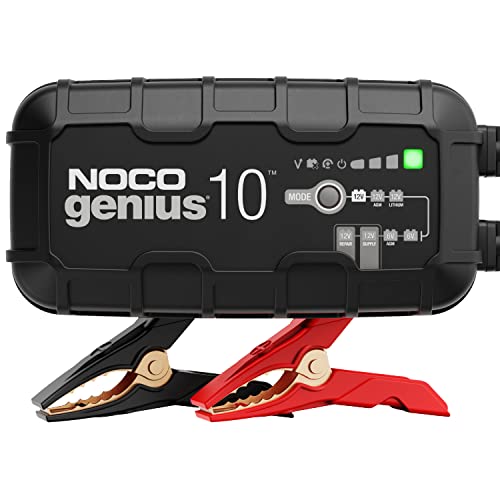
The GENIUS10 is the one to buy for big batteries. At 10 amps it is rated to charge batteries up to 230Ah, and NOCO's data sheet puts a half-discharged 100Ah battery at about 7 hours and a 230Ah battery at about 17.3 hours (NOCO data sheet). That covers a deep-cycle boat or RV house battery that a 1-amp maintainer could never refill between trips. The user guide adds a 6V AGM mode and a 13.6V, 10A power-supply mode that can keep a vehicle's settings alive while you swap a battery (NOCO warns that this mode disables the safety features) (NOCO GENIUS10 guide). It has the same IP65 case, thermal sensor, lithium mode and 3-year warranty as the GENIUS5. It ties for our top score: the highest charge rate offsets a price about three times the GENIUS1's when we checked.
Chemistries: Wet, gel, AGM, EFB, calcium, maintenance-free; 12V lithium (LiFePO4, BMS-equipped only). Temperature compensation: Yes: integrated thermal sensor. Weather: IP65.
Pros
- ✓ 10A: charges batteries up to 230Ah
- ✓ IP65 housing and thermal compensation
- ✓ 13.6V 10A power-supply mode
- ✓ Lead-acid, AGM (6V and 12V) and 12V lithium modes
Cons
- ✗ Priciest of the NOCOs when we checked
- ✗ More charger than a motorcycle needs
- ✗ No 24V mode (6V and 12V only)
3. Best for Cars, SUVs and Trucks

NOCO GENIUS5 5A Smart Battery Charger
5A · 6V and 12V · Charges up to 120Ah; maintains all sizes · 3-year warranty · Score 75/100
Price: $69.95
For most car owners the GENIUS5 is the sweet spot: 5 amps, rated to charge batteries up to 120Ah, which covers most car, SUV and pickup starting batteries, and it maintains any size. NOCO's data sheet puts a half-discharged 40Ah battery at about 6 hours and an 80Ah battery at about 12 hours (NOCO data sheet). The user guide lists 6V, 12V, 12V AGM and 12V lithium modes, Force Mode and a 12V Repair mode for sulfated lead-acid batteries. NOCO says to disconnect the battery from the vehicle before using Repair, because it uses a high voltage (NOCO GENIUS5 guide). NOCO's product page says the thermal sensor avoids under-charging in cold weather down to -4°F and over-charging up to 104°F (NOCO). The case is IP65 and the warranty 3 years. In our scoring it lands within a point of the GENIUS1 and GENIUS10; it's our pick for a typical car because it can actually refill a car battery overnight.
Chemistries: Wet, gel, AGM, EFB, calcium, maintenance-free; 12V lithium (LiFePO4, BMS-equipped only). Temperature compensation: Yes: integrated thermal sensor. Weather: IP65.
Pros
- ✓ 5A: charges up to 120Ah, most car batteries
- ✓ IP65 housing and thermal compensation
- ✓ 6V, 12V, AGM and 12V lithium modes
- ✓ Repair (desulfation) and Force Mode
Cons
- ✗ Cost over twice the GENIUS1 when we checked
- ✗ 3-year warranty
- ✗ No 24V mode
4. Best for Classic Cars and Lead-Acid Storage

CTEK MXS 5.0 4.3A Battery Charger and Maintainer
4.3A · 12V only · Charges 1.2-110Ah; maintains up to 160Ah · 5-year warranty · Score 71/100
The CTEK MXS 5.0 is a lead-acid specialist. CTEK's US product sheet lists 12V lead-acid batteries only (with AGM and EFB charging), a maximum 4.3A charge, charging from 1.2 to 110Ah and maintenance up to 160Ah, an IP65 sealed case, a built-in temperature sensor and a 5-year warranty (CTEK product sheet). Its 8-step program runs desulphation, soft start, bulk, absorption, an analyse step that tests whether the battery holds charge, a recond step for deeply discharged batteries, then float and pulse maintenance that keeps the battery at 95 to 100%. The manual's spec table for the North American model gives a -4 to 122°F operating range (CTEK manual). It has no lithium or 6V mode, which is the main reason it scores below the NOCOs. It was also the only pick sold by a third-party seller, with limited stock, when we checked.
Chemistries: 12V lead-acid: wet, MF, Ca/Ca, AGM, EFB, gel (no lithium). Temperature compensation: Yes: built-in temperature sensor. Weather: IP65.
Pros
- ✓ 5-year warranty, IP65 sealed case
- ✓ Temperature compensation and 8-step program
- ✓ Maintains batteries up to 160Ah
- ✓ Recond mode for deeply discharged lead-acid batteries
Cons
- ✗ 12V lead-acid only: no lithium, no 6V
- ✗ Sold by a third-party seller (Aftermarket Parts!) when we checked
- ✗ One of the two priciest picks when we checked
5. Best for Lithium Motorcycle and Powersports Batteries
Battery Tender Junior 800mA Lead-Acid/Lithium Charger
800mA · 12V only · No maximum published; Battery Tender's example: a flat 15Ah battery reaches 80% in about 15 h · 5-year warranty · Score 66/100
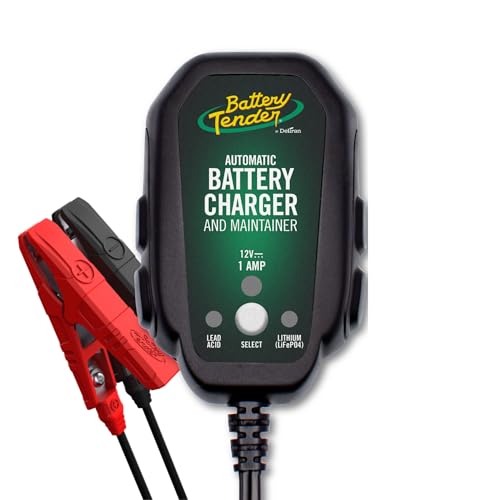
The Battery Tender Junior 800mA is the long-warranty choice for a motorcycle, ATV, scooter or personal watercraft that sits all winter. Its owner's manual describes a SELECT button that switches between 12V lead-acid/AGM and 12V lithium iron phosphate (LiFePO4), a lithium recovery mode for LiFePO4 batteries that have sagged to 4 to 8 volts, spark-free clips, and safety timers of 80 hours (lead-acid) and 18 hours (lithium) if a battery won't reach full voltage (Battery Tender manual). Battery Tender gives it a 5-year warranty (Battery Tender). The trade-offs show in our scoring. It has no 6V mode, the manual doesn't list temperature compensation, and it says not to expose the charger to rain or snow. It won't start on a battery below 3 volts. At 800mA, Battery Tender's own example puts a flat 15Ah battery at about 15 hours to reach 80%.
Chemistries: 12V lead-acid/AGM (six-cell) and 12V LiFePO4 (four-cell), selected with a button. Temperature compensation: Not listed in the manual. Weather: None published; manual says not to expose it to rain or snow.
Pros
- ✓ 5-year warranty (Battery Tender)
- ✓ Lead-acid/AGM and LiFePO4 modes
- ✓ Lithium recovery mode and spark-free clips
- ✓ Sold by Amazon.com
Cons
- ✗ 12V only (no 6V)
- ✗ No temperature compensation listed in the manual
- ✗ Indoor use: keep out of rain and snow
Other chargers we checked
We left out the Battery Tender Plus 1.25A (022-0185G). It was in stock, but its listing describes it for AGM and flooded batteries only, and it cost more than the lithium-capable Junior when we checked. We also skipped the Schumacher SC1281. It's a 30-amp boost charger and 100-amp engine starter rather than a maintainer, its Amazon title says "6A," and we couldn't reach Schumacher's product page to settle the charge rates. The CTEK MXS 5.0 Test & Charge adds a battery tester for about two and a half times the price of the plain MXS 5.0. None of our picks charges a 24V system. The NOCOs do 6V and 12V, while CTEK and Battery Tender do 12V only. For a 24V truck or trolling-motor bank, use a charger the maker rates for 24V, or a multi-bank charger that treats each 12V battery separately. For 24V LiFePO4 batteries, our LiFePO4 charger guide covers 29.2V chargers.
Trickle Charger Comparison Table
The five scored chargers. Every figure comes from the maker's guide, manual, data sheet or product sheet; "not published" means we couldn't find it in the maker's documents.
| Charger | Charge rate | Voltages | Battery size | Lithium (LiFePO4) | Temp. comp. | Weather | Warranty | Score | Price |
|---|---|---|---|---|---|---|---|---|---|
| NOCO GENIUS1 1A Smart Battery Charger | 1A | 6V and 12V | Charges up to 30Ah; maintains all sizes | Yes | Yes: integrated thermal sensor | IP60 (dust-tight; not water-rated) | 3 yr | 75/100 | $29.95 |
| NOCO GENIUS10 10A Smart Battery Charger | 10A | 6V and 12V | Charges up to 230Ah; maintains all sizes | Yes | Yes: integrated thermal sensor | IP65 | 3 yr | 75/100 | Check price at Amazon → |
| NOCO GENIUS5 5A Smart Battery Charger | 5A | 6V and 12V | Charges up to 120Ah; maintains all sizes | Yes | Yes: integrated thermal sensor | IP65 | 3 yr | 75/100 | $69.95 |
| CTEK MXS 5.0 4.3A Battery Charger and Maintainer | 4.3A | 12V only | Charges 1.2-110Ah; maintains up to 160Ah | No | Yes: built-in temperature sensor | IP65 | 5 yr | 71/100 | Check price at Amazon → |
| Battery Tender Junior 800mA Lead-Acid/Lithium Charger | 800mA | 12V only | No maximum published; Battery Tender's example: a flat 15Ah battery reaches 80% in about 15 h | Yes | Not listed in the manual | None published; manual says not to expose it to rain or snow | 5 yr | 66/100 | Check price at Amazon → |
Sources: NOCO GENIUS1, GENIUS5 and GENIUS10 North American user guides, data sheets and product pages (no.co); Battery Tender P/N 022-0199 owner's manual and product page; CTEK MXS 5.0 US product sheet and manual specification table. NOCO lists a -4 to 104°F operating range for all three GENIUS models; CTEK lists -4 to 122°F; Battery Tender's manual gives no range.
Trickle Charger vs Battery Maintainer: What's the Difference?
A classic trickle charger pushes a small, constant current into the battery whether it needs it or not. Rick's Free Auto Repair Advice says trickle chargers supply "a very small (sometimes less than 0.03-amps) of constant current," normally without voltage regulation. Used for a long time, that "may cause lead plate grid corrosion, ultimately damaging the battery." Rick's calls the trickle charger "an obsolete device, being replaced by modern battery maintainers" (Rick's Free Auto Repair Advice).
A battery maintainer (often just called a “battery tender,” after the brand) watches the battery's voltage. It charges in stages, then drops to a float or pulse mode that only replaces what the battery loses to self-discharge, which Rick's puts at up to 4% a month. Every pick on this page is a maintainer: NOCO says the GENIUS "can be left connected to the battery indefinitely" (NOCO), Battery Tender says the Junior can "maintain the battery for an indefinite period of time" (Battery Tender), and CTEK's step 8 keeps the battery at 95 to 100% (CTEK). Amazon listings use "trickle charger" for both kinds, so check for a float or maintenance mode before you buy.
| Classic trickle charger | Smart battery maintainer | |
|---|---|---|
| How it charges | Small constant current, usually unregulated | Charge stages, then float or pulse maintenance |
| Leave it on for months? | No: watch it, or it can overcharge | Yes, per NOCO, Battery Tender and CTEK |
| Chemistry modes | Usually one setting | AGM and, on four picks here, lithium (LiFePO4) |
| Protections | Often none | Reverse-polarity protection on every pick here |
How Many Amps Do You Need? Match the Charger to the Battery
Check the amp-hour (Ah) rating on your battery's label, then pick a charger rated to charge that size. The makers' own ratings work out to roughly 1 amp for every 23 to 30Ah: the GENIUS1 (1A) charges up to 30Ah, the GENIUS5 (5A) up to 120Ah, the CTEK (4.3A) up to 110Ah and the GENIUS10 (10A) up to 230Ah. Any of them can maintain a bigger battery, since maintenance needs very little current: NOCO says all three GENIUS models maintain "all battery sizes," and CTEK maintains up to 160Ah. They just can't refill a flat one in a reasonable time.
How long does it take to charge a car battery with a trickle charger?
NOCO publishes charge times for a battery that's half discharged (50% depth of discharge). Here they are side by side:
| Battery (half discharged) | Typical use | GENIUS1 (1A) | GENIUS5 (5A) | GENIUS10 (10A) |
|---|---|---|---|---|
| 12Ah | Motorcycle, mower | ~9 h | Not listed | Not listed |
| 20 to 24Ah | Large motorcycle, ATV, small car | ~18 h (24Ah) | ~3 h (20Ah) | ~1.5 h (20Ah) |
| 40Ah | Car | Above its 30Ah rating | ~6 h | ~3 h |
| 80Ah | Truck, SUV, marine starting | Above its 30Ah rating | ~12 h | ~6 h |
| 100Ah | Deep-cycle, RV house | Above its 30Ah rating | ~15 h | ~7 h |
| 230Ah | Large deep-cycle bank | Above its rating | Above its 120Ah rating | ~17.3 h |
Source: NOCO GENIUS1, GENIUS5 and GENIUS10 data sheets ("approximate charging times at 50% depth of discharge... results may vary"). "Not listed" means NOCO's table doesn't include that size.
A quick estimate for any charger. NOCO's tables work out to about 1.5 times the simple math. That's hours ≈ 1.5 × (amp-hours to put back ÷ charger amps). For example, an 80Ah battery at half charge needs 40Ah, and 40 ÷ 5A = 8, times 1.5 is 12 hours, matching NOCO's figure. The 1.5 factor is our reading of NOCO's tables, not a maker rule, and the last stretch of any charge is slower. Battery Tender gives its own example: at 800mA, a fully discharged 15Ah battery takes "approximately 15 hours to recharge to 80% capacity" (Battery Tender manual).
Is it charged? Battery Tender's manual says a fully charged 12V lead-acid battery rests at about 12.9 volts and a fully discharged one at about 11.4 volts. A battery under 9 volts at rest is probably defective.
Flooded, AGM or Lithium: Which Mode Does Your Battery Need?
Battery chemistries need different top-off voltages, which is why a smart charger asks you to choose a mode. These are the published charge voltages:
| Battery | NOCO GENIUS mode | CTEK MXS 5.0 | Battery Tender Junior |
|---|---|---|---|
| 12V flooded (wet), gel, EFB, calcium | 12V: 14.5V | Normal: 14.4V | Lead-acid/AGM setting |
| 12V AGM | 12V AGM: 14.8V | AGM: 14.7V | Lead-acid/AGM setting |
| 12V lithium (LiFePO4) with BMS | 12V Lithium: 14.6V | Not supported | Lithium setting |
| 6V lead-acid (classic cars, some tractors) | 6V: 7.25V (GENIUS10 6V AGM: 7.40V) | Not supported | Not supported |
Sources: NOCO user guides (peak voltage at 25°C); CTEK product sheet; Battery Tender manual (it doesn't publish voltages). CTEK's 15.8V is its recond step, not a mode for everyday use.
Lithium needs extra care. NOCO's guide says its lithium mode "should only be used with 12-volt lithium batteries that have a built-in battery management system (BMS)," and to ask the battery maker for its recommended charging rates and voltages (NOCO). Never use a lead-acid repair or recond mode on lithium. NOCO's Repair mode is "for 12-volt lead-acid batteries only." For winter, remember the freezing limit: Battle Born says LiFePO4 can discharge down to about -4°F but shouldn't be charged below about 25°F without internal heating (Battle Born). If your lithium battery lives in an unheated garage or boat, bring it inside to charge, or choose a self-heating battery from our best 12V lithium battery guide. To refill a big LiFePO4 house or trolling-motor battery rather than just maintain it, a dedicated 20-amp lithium charger is about twice as fast as the GENIUS10; see our best LiFePO4 battery charger picks.
How Long Can You Leave a Trickle Charger On? (And All Winter?)
A smart maintainer can stay on all winter. A basic trickle charger shouldn't. All five picks here are designed to stay connected. NOCO says so of the GENIUS ("indefinitely"), Battery Tender of the Junior ("for an indefinite period of time"), and CTEK calls the MXS 5.0 "connect and forget." An unregulated trickle charger keeps pushing current into a full battery, which is the overcharging and plate corrosion Rick's warns about. Overcharging a lead-acid battery also makes more gas: CCOHS says it can produce hydrogen sulfide as well as hydrogen (CCOHS).
- Charge fully, then let it maintain. Battery Tender's manual says the battery can come off at the flashing green light (over 80%) if you need it, but to leave it on until the light is solid green.
- Check flooded batteries now and then. Battery Tender's manual says to top up cells with distilled water to the battery maker's level before charging, and not to overfill. For sealed batteries without removable caps, it says to follow the battery maker's recharging instructions instead.
- Keep the charger dry and off the battery. Battery Tender says never to place the charger directly above the battery, because the gases corrode it. The Junior and GENIUS1 aren't water-rated, so mount them indoors.
- Mind the cold. NOCO's GENIUS chargers operate from -4 to 104°F and compensate for temperature. Don't charge a frozen battery, and don't charge lithium below its maker's limit.
- Watch for a battery that never finishes. Battery Tender's chargers time out after 80 hours (lead-acid) or 18 hours (lithium) if the battery doesn't reach full voltage. Its manual says that usually means the battery is defective. CTEK's analyse step tests whether the battery holds its charge.
Storing a portable power station for the winter too? It needs different handling (partial charge, not a maintainer), covered in our power station storage and maintenance guide. For keeping the house running through an outage, see our winter storm power backup guide.
How to Hook Up a Trickle Charger Safely, Step by Step
These steps follow the North American NOCO GENIUS guides and the Battery Tender manual, which give the same sequence for a negative-ground vehicle (most cars) (NOCO; Battery Tender). Your vehicle's owner's manual comes first.
- Work in a ventilated space with the charger unplugged. Wear eye protection and remove metal jewelry. NOCO and Battery Tender both warn that a dropped tool can spark or short a battery.
- Route the cables away from the hood, fan blades, belts and pulleys.
- Find the terminals. Positive is marked POS, P or + and is usually the larger post.
- Red clamp to the positive (+) terminal.
- Black clamp to the chassis or engine block, away from the battery. Both manuals say to use a heavy-gauge metal part of the frame or engine block, never the carburetor, fuel lines or sheet-metal body parts.
- Choose the battery type where the charger asks. On the Battery Tender Junior, select lead-acid or lithium after the charger has AC power but before you connect it to the battery; the setting can't be changed once both are connected.
- Plug the charger into the outlet last. Don't face the battery when you do. On the NOCOs, press MODE to pick 12V, AGM, lithium or 6V.
- To disconnect, reverse the order: unplug from the outlet, remove the black clamp from the chassis, then the red clamp from the battery.
Battery out of the vehicle, or on a boat? Battery Tender's manual says to attach a 24-inch or longer 6 AWG insulated cable to the negative post, connect red to positive, then connect the black clip to the far end of that cable while standing as far from the battery as possible. It also says "a marine (boat) battery must be removed and charged on shore." For a battery you maintain all season, the GENIUS chargers include ring-terminal eyelets you can leave bolted to the terminals.
Can you charge a car battery indoors or in a garage? In a ventilated garage, with the charger below and away from the battery, yes, per the makers' instructions. Don't charge a lead-acid battery in a closed room. Workplace rules show why: U.S. construction rules require ventilation "to ensure diffusion of the gases from the battery and to prevent the accumulation of an explosive mixture" (29 CFR 1926.441). For lithium batteries, follow the battery maker's charging-temperature limits as well.
Solar Trickle Chargers: Do They Work?
Yes, for keeping a battery topped up where there's no outlet: a boat on a mooring, a trailer in a field, a tractor in a barn. But a small panel makes very little power, and only in sun. Here is the math for a 12W panel. If it got 4 hours of full, direct sun a day (an assumption for illustration; real output is usually lower), it would make at most 12W × 4 h = 48 Wh, or about 3.3Ah at 14.4V, before controller and wiring losses. That's plenty to offset normal self-discharge. At Rick's 4% a month, a 60Ah battery loses about 2.4Ah a month. It won't refill a flat battery quickly or keep up with a vehicle that has a large parasitic drain. Size the panel to the drain, and use a plug-in charger for recovery.
Not scored: a solar maintainer option
SUNER POWER 12W Solar Battery Charger & Maintainer Pro
SUNER POWER's product page for the BC-12W Pro describes a 12W panel with a built-in MPPT charge controller, a three-stage charging algorithm, protection against overcharge, over-voltage, over-discharge, short circuit and reversed polarity, a waterproof and spark-proof design, and a 12-month warranty (SUNER POWER). The Amazon listing adds suction-cup mounting and lists flooded, gel, AGM and LiFePO4 batteries. We couldn't find lithium compatibility on SUNER's own page, so confirm it with SUNER before you use it on a lithium battery. We don't score it, because SUNER publishes no charge-current figure or IP rating, so it can't be compared on our rubric. Two more caveats: the listing's model field reads "BC-50W-P," although the title, wattage and photos match the 12W Pro, and it's sold by SUNER POWER as a third-party seller. If you want a bigger solar setup, our best portable solar panels guide covers panels from about 100W up.
Trickle Charger vs Jump Starter (and Running One From a Power Station)
They solve different problems. A jump starter gets a flat battery started once, in seconds, on the road. A maintainer prevents the flat battery in the first place, at home. If a car sits for weeks, a maintainer is the better fix. If you drive alone in winter, carry a jump starter too: see our best jump starter picks. Neither replaces a battery that's worn out.
No outlet nearby? A portable power station can run a plug-in maintainer for a while. Here's how long, using the charger's maximum draw from NOCO's data sheets and the same 0.85 usable-energy factor we use for every power station:
| Charger (max draw) | On a 288 Wh power station | Charger price |
|---|---|---|
| NOCO GENIUS1 (15W) | ~16 h at full draw | $29.95 |
| NOCO GENIUS5 (75W) | ~3.3 h at full draw | $69.95 |
| NOCO GENIUS10 (150W) | ~1.6 h at full draw | Check price at Amazon → |
Power station: the Anker SOLIX C300 DC (288 Wh, 86/100 in our power-station scoring, which isn't comparable with charger scores). Hours are continuous-draw estimates (Wh × 0.85 ÷ max watts), not measurements. A charger in maintenance mode draws far less than its maximum. To charge a camper's house battery from the alternator while driving, a DC-DC charger is the better tool.
Trickle Charger Buying Guide
- Size the amps to the battery. About 1A for motorcycles, mowers and ATVs (up to about 30Ah), about 5A for cars and trucks (up to about 120Ah), and 10A for deep-cycle boat and RV batteries. Any of them can maintain a bigger battery.
- Match the chemistry. Look for an AGM mode if your car has an AGM battery, and a lithium (LiFePO4) mode for lithium batteries with a BMS. Four of our five picks have one; the CTEK doesn't.
- Check the voltage. 6V for some classic cars and tractors (the NOCOs only, here). None of our picks charges 24V.
- Look for temperature compensation if it lives in a cold garage. The NOCOs and CTEK have it; Battery Tender's manual for the Junior doesn't list it.
- Check the weather rating. The GENIUS5, GENIUS10 and CTEK are IP65. The GENIUS1 is IP60 (dust only), and the Junior should be kept out of rain and snow.
- Compare warranties. CTEK and Battery Tender give 5 years; NOCO gives 3.
Shopping for a gift? A maintainer is a useful, inexpensive gift for anyone with a motorcycle, classic car or boat. For bigger power gifts, see our solar generator gift guide. Every price on this page loads live from Amazon. We can't predict prices or promise a discount on any listing.
Who Should Buy a Battery Maintainer (and Who Should Skip)
Good fit
- ✓ Cars, motorcycles, boats and RVs that sit for weeks or over winter
- ✓ Classic cars and second cars that are driven only on short trips
- ✓ Lawn tractors, ATVs and personal watercraft stored off-season
- ✓ Anyone with a garage outlet near the vehicle (or a sunny spot, for solar)
Skip it (or choose something else) if
- ✗ The battery won't hold a charge at all: test or replace it
- ✗ You need a start on the road: get a jump starter
- ✗ Your system is 24V: buy a charger rated for 24V
- ✗ The vehicle is driven daily and the battery is healthy
Trickle Charger FAQ
What is the best trickle charger?
For most cars, the NOCO GENIUS5: it charges batteries up to 120Ah at 5 amps, has 6V, 12V, AGM and lithium modes, and has an IP65 case. The NOCO GENIUS1 is the budget pick and ties for our top score; it charges up to 30Ah but can maintain any size. Choose the NOCO GENIUS10 for boat and RV deep-cycle batteries, the CTEK MXS 5.0 for 12V lead-acid batteries with a 5-year warranty, and the Battery Tender Junior 800mA for lithium motorcycle batteries.
What is the difference between a trickle charger and a battery maintainer?
A classic trickle charger supplies a small constant current, usually without voltage regulation, so it can overcharge a battery left on too long. A battery maintainer monitors the voltage, charges in stages and then switches to a float or pulse mode that only replaces self-discharge, so it can stay connected for months. Most chargers sold as trickle chargers today, including every pick on this page, are maintainers.
How long does it take to charge a car battery with a trickle charger?
It depends on the charger's amps and how flat the battery is. NOCO's data sheets put a half-discharged 40Ah battery at about 6 hours on the 5-amp GENIUS5 and an 80Ah battery at about 12 hours, or about 6 hours on the 10-amp GENIUS10. A 1-amp maintainer is rated to charge only batteries up to 30Ah. Battery Tender says its 800mA Junior takes about 15 hours to bring a flat 15Ah battery to 80%.
Can you leave a trickle charger on all winter?
A smart maintainer, yes. NOCO says its GENIUS chargers can be left connected indefinitely, Battery Tender says the Junior can maintain a battery for an indefinite period, and CTEK describes the MXS 5.0 as connect and forget. Don't leave an old unregulated trickle charger on for months, because it can overcharge the battery. Check the water level in flooded batteries now and then, keep the charger dry, and never charge a frozen battery.
Can I use a trickle charger on a lithium battery?
Only if it has a lithium mode and the battery maker approves. The NOCO GENIUS1, GENIUS5 and GENIUS10 and the Battery Tender Junior 800mA have 12V lithium (LiFePO4) settings; the CTEK MXS 5.0 doesn't. NOCO says its lithium mode is only for 12V lithium batteries with a built-in BMS. Don't charge LiFePO4 below freezing: Battle Born says not below about 25 degrees F unless the battery has internal heating.
Do you connect a trickle charger to positive or negative first?
Positive first. With the charger unplugged, connect the red clamp to the positive terminal, then the black clamp to the vehicle chassis or engine block away from the battery, and plug the charger in last. To disconnect, unplug the charger, remove the black clamp, then the red one. NOCO and Battery Tender give this sequence for negative-ground vehicles, which covers most cars.
Is it safe to charge a car battery in the garage?
In a ventilated garage, following the charger maker's instructions, yes. Lead-acid batteries give off hydrogen while charging, which Canada's CCOHS says is explosive at 4.1 to 72 percent in air. NOCO and Battery Tender say not to use their chargers in a closed-in area or with restricted ventilation. Keep the charger below and away from the battery, keep sparks and flames away, and wear eye protection.
Do solar trickle chargers work?
Yes, for maintaining a battery where there's no outlet, but only in sun and only slowly. By our estimate, a 12W panel with four hours of full sun makes at most about 48 Wh, around 3.3 amp-hours at 14.4 volts before losses. That's enough to offset normal self-discharge, but not to refill a flat battery or keep up with a large parasitic drain. Use one with a charge controller that stops at full charge.