
Unit Converter · Updated November 2026
Watts to kWh Calculator: Convert Watts, Kilowatts and Kilowatt-Hours
The short answers
- Watts to kWh
- kWh = watts × hours ÷ 1,000. A 100 W device running 10 hours uses 1 kWh.
- kW to watts
- 1 kW = 1,000 W, so multiply kW by 1,000. One watt is 0.001 kW.
- kWh to kW
- kW = kWh ÷ hours. 30 kWh used over 24 hours averages 1.25 kW.
- Watt vs kWh
- A watt measures power (how fast energy is used); a kilowatt-hour measures energy (how much was used). Your bill and a battery’s size are energy.
Use the five converters below, or scan the watts-to-kWh table for 100–5,000 W over 1–24 hours.
As an Amazon Associate, SolarGenAdvisor earns from qualifying purchases made through links on this page, at no additional cost to you.
 By
Watts to kWh Calculator and Unit Converters
Each box answers one question. Results update as you type, and every result shows the arithmetic so you can check it. The example in each box is what you see before you change anything.
How to Convert Watts to kWh
kWh = watts × hours ÷ 1,000
Multiply the device’s watts by the hours it runs to get watt-hours, then divide by 1,000 because a kilowatt is 1,000 watts. That is the formula DOE-program guidance gives for daily appliance energy use [7]. The EIA uses the same arithmetic in its own example: a 40 W bulb used for five hours uses 200 Wh, or 0.2 kWh [4].
- Find the watts. It’s on the nameplate or charger. If the label only lists amps, multiply by volts (120 V for most U.S. outlets): 10 A × 120 V = 1,200 W.
- Multiply by hours of use. 1,200 W × 0.5 h = 600 Wh.
- Divide by 1,000. 600 Wh ÷ 1,000 = 0.6 kWh.
Two things trip people up. First, the watts on a label are usually a maximum, so a TV or laptop often draws less. Second, fridges, freezers and AC units cycle on and off, so multiplying their running watts by 24 hours overstates the day. For those, the yellow EnergyGuide label’s kWh per year ÷ 365 is the better daily figure. The appliance wattage chart lists typical running and starting watts for more than 50 appliances.
Watts to kWh Conversion Table (100–5,000 W, 1–24 Hours)
Each cell is watts × hours ÷ 1,000. Read across for longer run times; read down for bigger loads.
| Load | 1 h | 2 h | 4 h | 8 h | 12 h | 24 h |
|---|---|---|---|---|---|---|
| 100 W | 0.1 kWh | 0.2 kWh | 0.4 kWh | 0.8 kWh | 1.2 kWh | 2.4 kWh |
| 200 W | 0.2 kWh | 0.4 kWh | 0.8 kWh | 1.6 kWh | 2.4 kWh | 4.8 kWh |
| 300 W | 0.3 kWh | 0.6 kWh | 1.2 kWh | 2.4 kWh | 3.6 kWh | 7.2 kWh |
| 500 W | 0.5 kWh | 1 kWh | 2 kWh | 4 kWh | 6 kWh | 12 kWh |
| 750 W | 0.75 kWh | 1.5 kWh | 3 kWh | 6 kWh | 9 kWh | 18 kWh |
| 1,000 W | 1 kWh | 2 kWh | 4 kWh | 8 kWh | 12 kWh | 24 kWh |
| 1,500 W | 1.5 kWh | 3 kWh | 6 kWh | 12 kWh | 18 kWh | 36 kWh |
| 2,000 W | 2 kWh | 4 kWh | 8 kWh | 16 kWh | 24 kWh | 48 kWh |
| 3,000 W | 3 kWh | 6 kWh | 12 kWh | 24 kWh | 36 kWh | 72 kWh |
| 5,000 W | 5 kWh | 10 kWh | 20 kWh | 40 kWh | 60 kWh | 120 kWh |
A few rows worth reading in words: a 1,500 W space heater for 8 hours uses 12 kWh, more than five times what a 2 kWh power station holds. A 100 W load for 24 hours uses 2.4 kWh. A 5,000 W load for one hour uses 5 kWh, which is why 240 V appliances like electric water heaters are a whole-home battery job.
kW to Watts: How Many Watts in a Kilowatt?
There are 1,000 watts in a kilowatt, because the SI prefix kilo (k) means 10³, or 1,000 [3]. EIA states it the same way: one kilowatt equals 1,000 watts [4]. So 1 kW = 1,000 W, 1.5 kW = 1,500 W and 3 kW = 3,000 W.
How many kilowatts are in a watt?
One watt is 0.001 kW (one thousandth of a kilowatt). To convert watts into kilowatts, divide by 1,000: 750 W ÷ 1,000 = 0.75 kW. A 2,000 W power station is a 2 kW inverter.
| Kilowatts (kW) | Watts (W) | Typical example |
|---|---|---|
| 0.001 kW | 1 W | One watt |
| 0.01 kW | 10 W | A 10 W LED bulb |
| 0.1 kW | 100 W | A 100 W solar panel at its rated output |
| 0.25 kW | 250 W | A 250 W load |
| 0.5 kW | 500 W | A 500 W load |
| 1 kW | 1,000 W | A coffee maker (900–1,200 W) [7] |
| 1.5 kW | 1,500 W | A portable heater at its top setting (750–1,500 W) [7] |
| 2 kW | 2,000 W | The 2,000 W continuous output of the Anker SOLIX C1000 Gen 2 |
| 2.5 kW | 2,500 W | A 2,500 W load |
| 3 kW | 3,000 W | A 3,000 W inverter |
| 5 kW | 5,000 W | Around one electric water heater (4,500–5,500 W) [7] |
| 10 kW | 10,000 W | A 10 kW rooftop solar array at its rated output |
Examples are illustrative ranges, not measurements of a specific product; check the label on yours.
Watt vs kWh: Power vs Energy
A watt (W) is a unit of power: one joule of energy per second [1]. A kilowatt-hour (kWh) is a unit of energy: one kilowatt used for one hour [4]. Since a kilowatt is 1,000 joules per second and an hour is 3,600 seconds [2], one kWh is 3.6 million joules.
The car comparison works: watts are like speed and kWh are like miles driven. A 1,500 W heater and a 15 W router are very different “speeds”, but if the router runs 100 times longer, both use the same 1.5 kWh.
| Unit | Measures | Where you see it |
|---|---|---|
| Watt (W) | Power (rate) | Appliance labels, inverter output limits, solar panel ratings |
| Kilowatt (kW) = 1,000 W | Power (rate) | Home solar arrays, EV chargers, generator ratings |
| Watt-hour (Wh) | Energy (amount) | Power station and power bank capacity |
| Kilowatt-hour (kWh) = 1,000 Wh | Energy (amount) | Your electric bill, home batteries, EnergyGuide labels |
For a power station you need both numbers. The watt rating (continuous output) decides whether it can run an appliance at all; the Wh or kWh capacity decides how long. A 2,000 W station can run a 1,500 W kettle; a 1 kWh battery runs it for well under an hour.
kWh to kW: You Need a Time Period
You can’t turn kWh into kW on its own, any more than you can turn miles into miles per hour without knowing how long the trip took. With a time period it’s one division: kW = kWh ÷ hours.
- A day’s use of 30 kWh ÷ 24 h = 1.25 kW average.
- A 2 kWh battery emptied in 4 hours delivered 2 ÷ 4 = 0.5 kW (500 W) on average.
- A month’s 900 kWh ÷ 720 hours (30 days) = 1.25 kW average.
How many kW are in a kWh?
The question mixes power and energy, so there’s no fixed number. The useful reading is: one kWh is what a 1 kW load uses in one hour, a 2 kW load uses in 30 minutes, or a 100 W load uses in 10 hours.
kWh to Wh, and Wh to kWh
1 kWh = 1,000 Wh. Multiply kWh by 1,000 for Wh; divide Wh by 1,000 for kWh. For a battery labelled in amp-hours, Wh = amp-hours × volts.
| Watt-hours (Wh) | Kilowatt-hours (kWh) |
|---|---|
| 100 Wh | 0.1 kWh |
| 300 Wh | 0.3 kWh |
| 500 Wh | 0.5 kWh |
| 1,000 Wh | 1 kWh |
| 1,024 Wh | 1.024 kWh |
| 2,048 Wh | 2.048 kWh |
| 3,600 Wh | 3.6 kWh |
| 5,000 Wh | 5 kWh |
| 10,000 Wh | 10 kWh |
How Many kWh Does a House Use?
U.S. residential customers bought an average of 865 kWh a month in 2024, according to the EIA [5]. That works out to about 28.4 kWh a day (865 × 12 ÷ 365, our arithmetic), or an average draw of about 1.2 kW. Location matters a lot: in EIA’s 2022 figures, the average Louisiana customer used 14,774 kWh for the year and the average Hawaii customer 6,178 kWh [6]. These are electricity purchases from utilities, so where rooftop solar is common they understate how much homes actually use. For the full breakdown by state, home size, season and appliance, see how much electricity a house uses.
Put that next to a battery: even the 4.096 kWh EcoFlow Delta Pro 3 holds about 14% of an average home’s day. Portable stations back up the essentials (fridge, router, lights, a CPAP, a furnace blower), not the whole house. Can a solar generator power a house? covers what it takes to get closer.
What This Means for a Power Station: 1, 2 and 4 kWh
Power station capacity is printed in Wh, so divide by 1,000 to compare it with your kWh math. Usable energy at the outlet is roughly Wh × 0.85. Each station below is rated in our 2026 scoring, which is synthesized from published specs, logged Amazon prices and Amazon customer reviews.
| Station | Capacity | Usable (× 0.85) | Continuous output | 100 W load runs | Price | Link |
|---|---|---|---|---|---|---|
| Anker SOLIX C1000 Gen 21 kWh class | 1,024 Wh1.024 kWh | ~0.87 kWh | 2,000 W2 kW | ~8.7 h | $529.99 | View on Amazon → |
| Bluetti Elite 200 V22 kWh class | 2,073.6 Wh2.0736 kWh | ~1.76 kWh | 2,600 W2.6 kW | ~18 h | $898.99 | View on Amazon → |
| EcoFlow Delta Pro 34 kWh class | 4,096 Wh4.096 kWh | ~3.48 kWh | 4,000 W4 kW | ~35 h | Check price at Amazon → | View on Amazon → |
1 kWh class
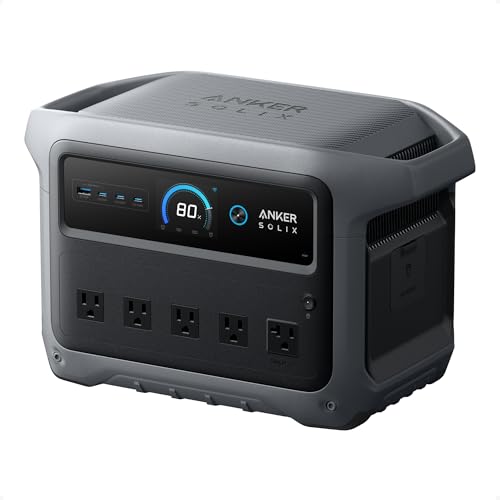
Anker SOLIX C1000 Gen 2 · Our score 92/100
1,024 Wh · 2,000 W continuous · 3,000 W surge · 24.9 lb · LiFePO4
Price on Amazon: $529.99
Fits: A CPAP for a night, a router and lights through an evening outage, or a 1,500–1,800 W kitchen appliance in short bursts.
About one kilowatt-hour of storage with a 2,000 W inverter, so the high-watt loads people look up on this page (kettles, air fryers, hair dryers) fit the output limit. The battery is the constraint: a 1,500 W load empties it in under an hour.
Worked example: 1,024 Wh × 0.85 ÷ 1,500 W = ~35 min of a 1,500 W heater; ÷ 56 W = ~16 h of a 56 W CPAP.
2 kWh class

Bluetti Elite 200 V2 · Our score 91/100
2,073.6 Wh · 2,600 W continuous · 3,900 W surge · 53.4 lb · LiFePO4
Price on Amazon: $898.99
Fits: A full-size fridge for about a day (two 25 cu ft EnergyGuide labels work out to about 1.7 kWh a day), or a router, lights and phones for several days.
Two kilowatt-hours is where a full day of a refrigerator just fits on one charge: about 1.76 kWh usable against roughly 1.7 kWh of fridge, so add solar or an expansion battery for anything more. Its 2,600 W continuous output and 3,900 W surge rating clear a compressor start.
Worked example: 2,073.6 Wh × 0.85 ÷ 1,500 W = ~1.2 h of a 1,500 W heater; ÷ 56 W = ~31 h of a 56 W CPAP.
4 kWh class

EcoFlow Delta Pro 3 · Our score 95/100
4,096 Wh · 4,000 W continuous · 8,000 W surge · 113.5 lb · LiFePO4
Fits: Fridge and freezer together, a sump or well pump, a furnace blower; 120/240 V circuits through a transfer switch.
Four kilowatt-hours with expandable batteries and 4,000 W continuous output. It is still about a seventh of an average U.S. home’s daily use (see the EIA figures below), so it covers essential circuits, not the whole house.
Worked example: 4,096 Wh × 0.85 ÷ 1,500 W = ~2.3 h of a 1,500 W heater; ÷ 56 W = ~62 h of a 56 W CPAP.
CPAP figure: 56 W is the typical draw used on our appliance wattage chart. Want more options at one size? See the best 1,000 Wh and best 2,000 Wh roundups, or what can a solar generator run for appliance-by-appliance runtimes.
Which Calculator Do You Need?
- Converting a number from one unit to another (W, kW, Wh, kWh): this page.
- Adding up several appliances with starting watts, using typical figures for 50+ appliances: the appliance wattage chart and generator wattage calculator.
- Picking a power station and solar panel size for days of backup: the solar size calculator. It assumes about 90% usable battery capacity rather than the 0.85 outlet factor used here, so for the same load its battery estimate comes out a little smaller than this page’s.
Watts and kWh FAQ
How do I convert watts to kWh?
Multiply watts by hours of use and divide by 1,000: kWh = W × h ÷ 1,000. A 100 W device running 10 hours uses 1 kWh, and a 1,500 W heater running 2 hours uses 3 kWh.
How many watts are in a kilowatt?
1,000. The prefix kilo means one thousand, so 1 kW = 1,000 W and 1 W = 0.001 kW. To convert kW to watts, multiply by 1,000; to convert watts to kW, divide by 1,000.
What is the difference between a watt and a kWh?
A watt is power, the rate energy is used (one joule per second). A kilowatt-hour is energy, the amount used: one kilowatt for one hour, or 3.6 million joules. Appliance labels and inverter limits are in watts; electric bills and battery capacity are in kWh or Wh.
How do I convert kWh to kW?
Divide by the number of hours: kW = kWh ÷ h. Without a time period there is no conversion, because kWh is energy and kW is power. For example, 30 kWh used over 24 hours is an average of 1.25 kW.
How many kWh does an average U.S. home use?
EIA reports that residential customers averaged 865 kWh a month in 2024, which is about 28 kWh a day. It varies widely by state: in EIA's 2022 data, Louisiana customers averaged 14,774 kWh for the year and Hawaii customers 6,178 kWh.
How long will a 1 kWh power station run a 100 W load?
About 8.7 hours for a 1,024 Wh station: 1,024 Wh × 0.85 ÷ 100 W. The 0.85 is a planning allowance for inverter losses, not a measured figure. A 2 kWh station runs the same load about twice as long, and loads that cycle on and off, like fridges, run longer than this continuous estimate.
Sources
Unit definitions come from NIST and the EIA; household figures come from the EIA. Conversions on this page are arithmetic on those definitions, and station specs come from our product database. Nothing here was measured by us. Last reviewed November 12, 2026.
- NIST Special Publication 811, Chapter 4: SI derived units (watt, W = J/s)
- NIST Special Publication 811, Chapter 5: units accepted for use with the SI (1 h = 3,600 s)
- NIST, Metric (SI) Prefixes (kilo, k = 10³; mega, M = 10⁶)
- U.S. Energy Information Administration, Electricity Explained: Measuring electricity
- U.S. EIA, Today in Energy, May 12, 2025: residential customers averaged 865 kWh a month in 2024
- U.S. EIA FAQ: How much electricity does an American home use? (2022 data)
- Virginia Cooperative Extension, “Estimating Appliance and Home Electronic Energy Use” (DOE Building Science program): wattage × hours ÷ 1,000 = daily kWh
Need about 2 kWh? That is roughly one day of a full-size fridge. The Bluetti Elite 200 V2 is currently $898.99 on Amazon.
Check Price on Amazon →