
Unit Converter · Updated November 2026
Watts to Amps Calculator (and Amps to Watts)
The short answers
- Watts to amps
- Amps = watts ÷ volts. A 1,500 W heater is 12.5 A at 120 V and 6.25 A at 240 V [1][17].
- Amps to watts
- Watts = amps × volts. A 15 A, 120 V circuit carries 1,800 W; a 20 A circuit 2,400 W [2][3].
- AC with power factor
- Watts = volts × amps × power factor. Heaters and kettles are about 1; motors and electronics can be lower [4][5].
- From a 12 V battery
- An inverter draws about 10× the 120 V amps, plus losses: 1,500 W is about 139 A at 90% efficiency.
Use the calculator, or scan the watts to amps chart for 12, 24, 120 and 240 V.
As an Amazon Associate, SolarGenAdvisor earns from qualifying purchases made through links on this page, at no additional cost to you.
 By
Watts to Amps Calculator
Pick the system, then the value you want. Results update as you type and show the arithmetic. The worked example in each box is what you see before you change anything.
Formulas: Watts, Amps and Volts
Power in watts is volts times amps [1]. That is also how DOE-program guidance tells you to get an appliance’s watts when its label lists only amps: multiply the amps by the voltage [2]. Rearrange it for whichever number you are missing.
- Watts to amps: 1,200 W ÷ 120 V = 10 A.
- Amps to watts: 20 A × 120 V = 2,400 W, the same example DR Power’s generator worksheet uses [3].
- Volts to watts: you can’t convert volts alone. You need the amps too: 12 V × 5 A = 60 W.
- Watts and amps to volts: 60 W ÷ 5 A = 12 V.
Two practical notes. The “120 V” at a U.S. outlet is a nominal figure: ANSI C84.1 lets a typical 120 V residential supply vary by ±5%, from 114 to 126 V [8], so real current shifts a little with it. And the watts on a label are usually the maximum, not what the device draws all the time. For running and starting watts of 50+ appliances, see the appliance wattage chart. For energy over time (watt-hours and kWh), use the watts to kWh calculator.
Watts to Amps Chart: 12 V, 24 V, 120 V and 240 V
Each cell is watts ÷ volts, with a power factor of 1. The last column is what an inverter pulls from a 12 V battery to deliver that many AC watts at 90% efficiency.
| Watts | 12 V | 24 V | 120 V | 240 V | 12 V via inverter |
|---|---|---|---|---|---|
| 100 W | 8.33 A | 4.17 A | 0.83 A | 0.42 A | ~9 A |
| 200 W | 16.67 A | 8.33 A | 1.67 A | 0.83 A | ~19 A |
| 300 W | 25 A | 12.5 A | 2.5 A | 1.25 A | ~28 A |
| 500 W | 41.67 A | 20.83 A | 4.17 A | 2.08 A | ~46 A |
| 750 W | 62.5 A | 31.25 A | 6.25 A | 3.13 A | ~69 A |
| 1,000 W | 83.33 A | 41.67 A | 8.33 A | 4.17 A | ~93 A |
| 1,200 W | 100 A | 50 A | 10 A | 5 A | ~111 A |
| 1,500 W | 125 A | 62.5 A | 12.5 A | 6.25 A | ~139 A |
| 1,800 W | 150 A | 75 A | 15 A | 7.5 A | ~167 A |
| 2,000 W | 166.67 A | 83.33 A | 16.67 A | 8.33 A | ~185 A |
| 2,400 W | 200 A | 100 A | 20 A | 10 A | ~222 A |
| 3,000 W | 250 A | 125 A | 25 A | 12.5 A | ~278 A |
| 5,000 W | 416.67 A | 208.33 A | 41.67 A | 20.83 A | ~463 A |
Rows worth reading in words: 1,500 W is 12.5 A at 120 V, which is why most plug-in space heaters are rated 1,500 W and 12.5 A [17]. 2,000 W is 166.7 A at 12 V for a DC load, or about 185 A through an inverter. A 5,000 W load such as an electric water heater (4,500–5,500 W [2]) is about 21 A at 240 V. Most microwaves draw 1,350–1,600 W from the outlet, more than the cooking watts on the box, so about 11–13.5 A; see how many watts a microwave uses for the model-by-model figures [18][19].
Amps to Watts Chart
Each cell is amps × volts, power factor 1. Use it to turn the amps on a rating plate, a charger or a breaker into watts.
| Amps | 12 V | 24 V | 120 V | 240 V |
|---|---|---|---|---|
| 1 A | 12 W | 24 W | 120 W | 240 W |
| 2 A | 24 W | 48 W | 240 W | 480 W |
| 5 A | 60 W | 120 W | 600 W | 1,200 W |
| 10 A | 120 W | 240 W | 1,200 W | 2,400 W |
| 12 A | 144 W | 288 W | 1,440 W | 2,880 W |
| 15 A | 180 W | 360 W | 1,800 W | 3,600 W |
| 16 A | 192 W | 384 W | 1,920 W | 3,840 W |
| 20 A | 240 W | 480 W | 2,400 W | 4,800 W |
| 25 A | 300 W | 600 W | 3,000 W | 6,000 W |
| 30 A | 360 W | 720 W | 3,600 W | 7,200 W |
| 40 A | 480 W | 960 W | 4,800 W | 9,600 W |
| 50 A | 600 W | 1,200 W | 6,000 W | 12,000 W |
| 100 A | 1,200 W | 2,400 W | 12,000 W | 24,000 W |
For a battery rated in amp-hours, the same multiplication gives energy instead of power: amp-hours × volts = watt-hours, so a 12 V-class 100 Ah lithium iron phosphate battery, which is nominally 12.8 V, holds about 1,280 Wh [15]. Our guide to what a watt-hour is explains the difference between watts and watt-hours.
120 V Circuits: How Many Watts on 15 A and 20 A?
Multiply the breaker’s amps by the voltage: a 15 A, 120 V circuit carries 1,800 W and a 20 A circuit 2,400 W [2][3]. That is the total for everything on the circuit, not per outlet.
The 80% rule for continuous loads
The National Electrical Code treats a load whose maximum current is expected to last 3 hours or more as continuous. NEC 210.20(A) says the branch-circuit overcurrent device must be rated at least the noncontinuous load plus 125% of the continuous load, and 210.19(A)(1) applies the same 125% to the conductors [9][10][11]. Turned around, that limits a continuous load to 80% of the breaker rating [9]. The code has an exception for equipment assemblies listed for operation at 100% of their rating [10].
| Circuit | Full rating | Continuous (80%) |
|---|---|---|
| 15 A, 120 VStandard 120 V circuit | 1,800 W | 12 A = 1,440 W |
| 20 A, 120 V120 V circuit, often kitchens and garages | 2,400 W | 16 A = 1,920 W |
| 20 A, 240 V240 V circuit | 4,800 W | 16 A = 3,840 W |
| 30 A, 240 V240 V circuit | 7,200 W | 24 A = 5,760 W |
Our arithmetic on the circuit rating. These rules govern how circuits are designed and installed; check your local code and use a licensed electrician for wiring work.
In practice: a 1,500 W space heater draws 12.5 A, which a 15 A circuit carries, but it is over the 12 A continuous figure if it runs all evening, and there is little left for anything else on that circuit. Vornado, for one, says not to use its heaters with extension cords, surge protectors, timers or smart plugs [17]; our space heater wattage guide has the rest. A microwave plus a toaster on one 15 A circuit is the classic tripped breaker.
240 V Split-Phase: Half the Amps
A typical U.S. home has a 120/240 V single-phase, three-wire service: each of the two hot conductors is 120 V to neutral, and they are 240 V to each other [7][8]. Ordinary outlets use one hot and the neutral (120 V). Big appliances such as water heaters and clothes dryers connect across both hots for 240 V [2].
At twice the voltage, the same watts need half the current: amps = watts ÷ 240. A 4,500 W water heater element is 18.75 A at 240 V; at 120 V the same power would be 37.5 A. For a 240 V load, the current you calculate is what flows through each hot leg, not split between them.
For battery backup this matters twice. A 240 V well pump or dryer needs a backup system that lists 240 V output; the inverters and power stations on this page are 120 V products. And a 4,500 W element would empty a 2 kWh battery in well under an hour (our arithmetic). Our appliance wattage chart marks which common appliances are 240 V.
12 V DC: Why an Inverter Draws 10× the Amps
For a 12 V DC device, such as a 12 V fridge, a fan or LED lights, the formula is the same: amps = watts ÷ 12. A 60 W device draws 5 A. Real battery voltage moves with the state of charge, so the current shifts a little; 12 V is the standard planning figure.
An AC appliance run from a 12 V battery through an inverter is different. The inverter delivers the same watts at 120 V, but it has to take those watts from the battery at one-tenth the voltage, so the battery current is about 10× the AC current, plus the inverter’s losses:
We use 90% because inverter makers publish peak efficiencies of 91–92%: up to 92% for Renogy’s Pro series, over 91% for Giandel’s PS-3000SAR, and 91% maximum for Victron’s Phoenix 12 V 1200 VA [12][13][14]. It is the same planning figure our power inverter guide uses. On top of that, a switched-on inverter uses some power with nothing plugged in: Renogy lists under 9.6 W, Giandel 0.9–2.5 A, Victron 7 W [12][13][14].
| AC load | 120 V side | 12 V battery | 24 V battery | 48 V battery |
|---|---|---|---|---|
| 300 W | 2.5 A | ~28 A | ~14 A | ~7 A |
| 1,000 W | 8.3 A | ~93 A | ~46 A | ~23 A |
| 1,500 W | 12.5 A | ~139 A | ~69 A | ~35 A |
| 2,000 W | 16.7 A | ~185 A | ~93 A | ~46 A |
| 3,000 W | 25 A | ~278 A | ~139 A | ~69 A |
Our arithmetic at 90% efficiency, idle draw not included.
A caution on wire size
High current is why inverter cables are so thick. Victron’s wiring guide explains that a thinner or longer cable has more resistance, that more current means more voltage drop and more heat, and that the higher the system voltage, the lower the current for the same power; it advises aiming for no more than 2.5% voltage drop [16]. That is also the case for 24 V or 48 V systems on big inverters: half or a quarter of the 12 V current. We don’t give cable or fuse sizes here, because they depend on the inverter, the cable length and the installation. Follow the inverter manual’s cable and fuse table, or have a qualified installer do it. Charging a house battery from the alternator raises the same questions; see our DC-DC charger guide.
Power Factor Basics
On AC, volts × amps gives apparent power in volt-amperes (VA). The watts that actually do work, real power, can be lower. Power factor is the ratio of the two: PF = watts ÷ VA [5]. For a purely resistive load such as a heater element, the power factor is 1, so watts and VA are the same [4]. Motors, compressors and many power supplies have a power factor below 1, so they draw more amps than watts ÷ volts suggests. Motors are usually rated in horsepower of shaft output, not input watts; our HP to watts calculator converts the plate figure and estimates the running and starting amps.
Example: GE’s JVM6175 microwave rating plate lists 120 V, 13.5 A and 1.58 kW [19]. 120 × 13.5 = 1,620 VA, so the plate implies a power factor of about 0.98 (our arithmetic on rated figures, not a measurement). A plug-in meter such as the Kill A Watt P4400 shows watts, VA and power factor side by side [6], which is the easy way to get a real PF for your own appliance.
Why it matters for backup power: inverters and UPS units are sometimes rated in VA as well as watts (Victron’s Phoenix 12 V model is a 1200 VA unit [14]), and a load with a low power factor uses up more of the VA rating than its watts suggest. Our VA to watts guide covers converting between the two.
Inverters and Power Stations by Amp Draw
If you are doing this math to size an inverter for a 12 V bank, the two inverters below are the in-stock picks from our best power inverter guide. If you would rather not wire anything, the two power stations put battery, inverter and outlets in one box. Scores come from our scoring, which is synthesized from published specs, logged Amazon prices and Amazon customer reviews.
| Product | Continuous / surge | At full output (120 V) | From a 12 V battery | Price | Link |
|---|---|---|---|---|---|
| Renogy Pro 2000W Pure Sine Wave Inverter with BluetoothInverter | 2,000 / 4,000 W | 16.7 A | ~185 A | Check price at Amazon → | View on Amazon → |
| Giandel 3000W Pure Sine Wave Inverter (PS-3000SAR)Inverter | 3,000 / 6,100 W | 25 A | ~278 A | Check price at Amazon → | View on Amazon → |
| Anker SOLIX C1000 Gen 21,024 Wh power station | 2,000 / 3,000 W | 16.7 A | Built in (no wiring) | $469.99 | View on Amazon → |
| Jackery Explorer 2000 v22,042 Wh power station | 2,200 / 4,400 W | 18.3 A | Built in (no wiring) | $999.00 | View on Amazon → |
Current figures are our arithmetic: output ÷ 120 V, and output ÷ 12 V ÷ 0.90 for the inverters. Specs from our product database, cross-checked against the sources listed.
2,000 W Inverter for a 12 V Bank

Renogy Pro 2000W Pure Sine Wave Inverter with Bluetooth · Our score 78/100
12V DC · 2,000 W continuous · 4,000W for 150 ms · Up to 92% efficiency · idle Under 9.6W [12]
At its full 2,000 W it pulls about 185 A from a 12 V battery by our math, versus 16.7 A on the 120 V side. Renogy lists up to 92% efficiency and an idle draw under 9.6 W, the lowest idle figure in our inverter guide, so less of the battery goes to keeping the inverter switched on. GFCI outlets and an AC terminal block are built in.
Skip it if: Your battery bank cannot deliver about 200 A continuously. A single 100 A-BMS battery limits it to roughly 1,000 W.
3,000 W Inverter for a Big 12 V Bank
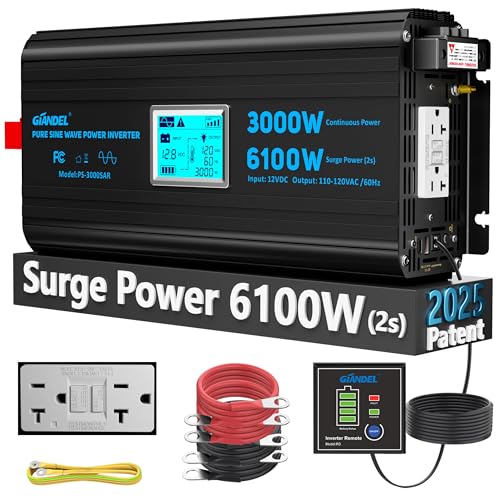
Giandel 3000W Pure Sine Wave Inverter (PS-3000SAR) · Our score 76/100
12V DC (9.8-16V) · 3,000 W continuous · 6,100W for 2 s · Over 91% efficiency · idle 0.9-2.5A (about 11-30W) [13]
For 3,000 W loads such as a microwave plus a coffee maker. At full output that is about 278 A from 12 V by our math (only 25 A at 120 V), and Giandel lists over 91% efficiency and a 6,100 W surge for two seconds for motor starts.
Skip it if: You have one or two batteries, or no qualified installer: almost 280 A needs a large lithium bank and heavy cabling. Giandel lists a standby draw of 0.9–2.5 A.
No Battery Wiring: 2,000 W in One Box

Anker SOLIX C1000 Gen 2 · Our score 92/100
1,024 Wh · 2,000 W continuous · 3,000 W surge · 24.9 lb · LiFePO4 [20]
Price on Amazon: $469.99
If the amp numbers above put you off, a power station skips the battery-side wiring altogether: the battery, inverter and 120 V outlets come in one box. Its 2,000 W output is 16.7 A at 120 V, enough for a 1,500 W heater or microwave, and its 1,024 Wh battery runs a 1,500 W load for ~35 min by our math.
Skip it if: You need more than about a kilowatt-hour per charge, or 240 V output.
2 kWh Power Station

Jackery Explorer 2000 v2 · Our score 87/100
2,042 Wh · 2,200 W continuous · 4,400 W surge · 39.5 lb · LiFePO4 [21]
Price on Amazon: $999.00
Twice the battery with 2,200 W of output (18.3 A at 120 V) and a 4,400 W surge rating. A 1,500 W load runs for ~1.2 h, and a 100 W load for ~17 h by our math.
Skip it if: You want a fast solar refill: it accepts 400 W of solar.
Also on one 100 Ah battery

Renogy P2 1000W Pure Sine Wave Inverter
If your bank is a single 100 Ah lithium battery, a 1,000 W inverter fits it better than a 2,000 W one: about 93 A at full output by our math, under a 100 A battery BMS limit if that is what your battery lists. Renogy lists 1,000 W continuous, 2,000 W peak and over 90% efficiency. It will not run a full-size microwave.
Verdict: Amps = Watts ÷ Volts
Divide watts by volts for amps, multiply amps by volts for watts, and add the power factor on AC loads that aren’t heaters. At 120 V, 1,500 W is 12.5 A, a 15 A circuit carries 1,800 W and a 20 A circuit 2,400 W, with 80% of that the ceiling for loads that run 3 hours or more. At 12 V everything is ten times bigger and then some: a 2,000 W inverter pulls about 185 A. For that job, the Renogy Pro 2000W Pure Sine Wave Inverter with Bluetooth (our score 78/100) is our in-stock 2,000 W pick for a bank that can deliver it. If you would rather skip the battery wiring, the Anker SOLIX C1000 Gen 2, currently $469.99 on Amazon, delivers 2,000 W at 120 V from one box.
Watts to Amps FAQ
How many amps is 1500 watts?
12.5 amps at 120 volts (1,500 ÷ 120), which is why 1,500 W space heaters are labelled 12.5 A. At 240 V it is 6.25 A. As a 12 V DC load it is 125 A, and an inverter running a 1,500 W appliance from a 12 V battery pulls about 139 A at 90% efficiency.
How many amps is 2000 watts at 12 volts?
About 167 amps for a 12 V DC load (2,000 ÷ 12). Through an inverter it is about 185 A from the battery, because the inverter loses roughly 10%: 2,000 ÷ 12 ÷ 0.9. At 24 V the inverter current halves to about 93 A, and at 120 V the same 2,000 W is 16.7 A.
How do I convert watts to amps?
Divide watts by volts: amps = watts ÷ volts. For example, 1,200 W ÷ 120 V = 10 A. For AC loads that are not purely resistive, divide by volts times the power factor: amps = watts ÷ (volts × PF).
How do I convert amps to watts?
Multiply amps by volts: watts = amps × volts. A 10 A appliance at 120 V uses about 1,200 W, and a 5 A device at 12 V uses 60 W. On AC, multiply by the power factor as well for real watts; with a power factor of 1, as for heaters, the result is the same.
How many watts can a 15 amp circuit handle?
1,800 watts at 120 V (15 × 120). For a continuous load, one expected to run 3 hours or more, the National Electrical Code's 125% sizing rule works out to 80% of the breaker rating: 12 A, or 1,440 W. That total covers everything on the circuit, not each outlet.
How many watts can a 20 amp circuit handle?
2,400 watts at 120 V (20 × 120), or 16 A and 1,920 W for a continuous load under the 80% rule. A 20 A circuit at 240 V carries 4,800 W, or 3,840 W continuous.
How many amps does a 1000 watt inverter draw at 12 volts?
About 93 amps at full output: 1,000 W ÷ 12 V ÷ 0.9 efficiency. At half load it is about 46 A. The inverter also draws a little power with nothing plugged in; the makers cited here list idle figures from 7 W to about 30 W.
How do I convert volts to watts?
You need the current as well: watts = volts × amps. Volts alone don't tell you the power. A 120 V appliance could use 60 W or 1,800 W depending on how many amps it draws, so read the amps or watts on its rating label.
How many amps is 3000 watts at 240 volts?
12.5 amps (3,000 ÷ 240). At 120 V the same 3,000 W would be 25 A, more than a standard 20 A circuit carries, which is one reason large appliances such as water heaters and dryers run on 240 V.
What is power factor?
The ratio of real power in watts to apparent power in volt-amperes (VA): PF = W ÷ VA. Heaters and other purely resistive loads have a power factor of 1, so watts equal volts × amps. Motors and many electronics are below 1, so they draw more amps for the same watts.
Sources
Formulas come from physics references and DOE-program guidance; electrical code rules from the IAEI and EC&M articles cited, which quote and explain NFPA 70 (we did not have the code book itself); inverter figures from manufacturer pages and spec listings; appliance figures from manufacturer documents. Conversions, current figures and runtimes are our arithmetic. Nothing here was measured by us. Last reviewed November 18, 2026.
- HyperPhysics (Georgia State University), DC electric power: for a resistor in a DC circuit, power is the product of applied voltage and current, P = VI
- Virginia Cooperative Extension, Estimating appliance and home electronic energy use: find the current draw in amperes and multiply it by the appliance voltage; portable heater 750–1,500 W, 40-gallon water heater 4,500–5,500 W, clothes dryer 1,800–5,000 W
- DR Power, Generator wattage worksheet: watts = volts × amps, example 20 A × 120 V = 2,400 W (as cited on our appliance wattage chart)
- HyperPhysics (Georgia State University), Power factor for AC power: average AC power includes the power factor term; for a purely resistive AC circuit the power factor = 1
- Fluke, Power factor: what it is and how to calculate it: PF = real power (kW) ÷ apparent power (kVA); kVA = V × A
- P3 International, P4400 Kill A Watt operation manual: displays volts, amps, watts, VA and power factor; 0–15 A, 0–1,875 W (as cited on our freezer page)
- IAEI Magazine, David Young, “Basic Electricity, Part 10” (Jan. 2006): on a single-phase three-wire service, 120 V from each phase conductor to neutral and 240 V between the two phase conductors
- EC&M, Joe Jancauskas, P.E., “Voltage Variations” (Apr. 18, 2019): ANSI C84.1 service voltage; typical 120 V residential supply allowed ±5%, 114–126 V; single-phase written 120/240 V
- IAEI Magazine, Thomas A. Domitrovich, “100% vs 80%: Choosing the right OCPD solution” (2016): quotes NEC 210.20(A), overcurrent device not less than the noncontinuous load plus 125% of the continuous load; continuous load = maximum current expected to continue 3 hours or more; this applies the device at 80% of its rating
- EC&M, “NEC: Branch-Circuit Overcurrent Protection” (June 9, 2015): the 125% rule for continuous loads (three hours or more); exception for assemblies listed for 100% operation
- EC&M, Mark Lamendola, “The NEC and Branch-Circuit Ratings, Part 1” (Dec. 7, 2021): under 210.19(A)(1), conductor ampacity at least the noncontinuous load plus 125% of the continuous load
- Renogy, Pro 12V 1000W/2000W/3000W pure sine wave inverter with Bluetooth: up to 92% efficiency, no-load draw under 9.6 W (as listed in our product data and inverter guide; Renogy’s page rate-limited our re-check on Nov 18, 2026)
- Giandel, PS-3000SAR 3000W pure sine wave inverter: efficiency >91%, 3,000 W continuous, 6,100 W for 2 s, standby 0.9–2.5 A
- Current Connected spec listing, Victron Energy Phoenix 12V 1200VA 120V inverter: maximum efficiency 91%, zero-load power 7 W, input 9.2–17 V DC
- Victron Energy, 12.8 & 25.6 Volt lithium iron phosphate batteries Smart datasheet: a 12.8 V battery is 4 LFP cells in series; 12.8 V × 100 Ah = 1,280 Wh nominal (as cited on our watt-hour guide)
- Victron Energy, Wiring Unlimited, chapter 2, Theory: a thin or long cable has more resistance; more current means more voltage drop and heat; the higher the voltage, the lower the current; aim for a voltage drop no bigger than 2.5%
- Vornado, Heater FAQs: most Vornado heaters use a maximum 1,500 W (12.5 A) on high and 750 W (6.25 A) on low (as cited on our space heater page)
- Toshiba, ML-EM25P(SS) countertop microwave spec sheet: 120 V 60 Hz, rated input 1,350 W, output 900 W (as cited on our microwave page)
- GE JVM6175 over-the-range microwave owner’s manual: product rating 120 V AC, 60 Hz, 13.5 A and 1.58 kW (as cited on our microwave page)
- B&H Photo spec listing, Anker SOLIX C1000 Gen 2 (1,024 Wh, 2,000 W continuous, 3,000 W surge)
- Jackery, Explorer 2000 v2 product page (2,042 Wh LiFePO4, 2,200 W output, 4,400 W surge)