
Makers’ Datasheets + Battery University · Updated November 2026
Types of Batteries: Lithium, LiFePO4, AGM, NiMH and More, Compared
The short answer
- Single-use (primary)
- Alkaline, lithium AA/AAA (Li/FeS2), zinc-carbon and lithium coin cells. Never recharge them [12][10].
- Rechargeable (secondary)
- NiMH, lead-acid (flooded, AGM, gel), lithium-ion (NMC, NCA, LCO), LiFePO4, and the newer sodium-ion [1][2].
- Which to pick
- Alkaline for remotes and clocks, lithium AA for cold or high-drain gear, NiMH for anything you swap weekly, lead-acid for starting a car, LiFePO4 for power stations and RV house banks.
Jump to the battery types chart, lithium vs alkaline, NiMH vs lithium or which battery for which job.
As an Amazon Associate, SolarGenAdvisor earns from qualifying purchases made through links on this page, at no additional cost to you.
 By
Battery Types Chart
Every battery is one of two kinds. A primary battery is used once and discarded; a secondary (rechargeable) battery is charged again and again. Within each, the chemistry sets the voltage per cell, how much energy fits in a given weight, how it copes with cold and how fast it loses charge on the shelf. Every figure below comes from a maker’s datasheet or Battery University, cited in the row.
| Type | Nominal cell voltage | Energy density | Cycle life | Cold performance | Self-discharge / shelf life | Typical uses |
|---|---|---|---|---|---|---|
| Single-use (primary) | ||||||
| AlkalineZn/MnO2 | 1.5 V [15][12] | ~143 Wh/kg (AA at ~200 mA) [10] | Single use | −18 to 55 °C (Energizer); −20 to 54 °C (Duracell); weak at heavy loads in cold [12][15] | About 2–3% a year; 7–10 year shelf life [9][12] | Light loads: remotes, flashlights, toys [3] |
| Lithium AA/AAALi/FeS2, e.g. Energizer Ultimate Lithium | 1.5 V (about 1.8 V fresh, open circuit) [11][10] | ~297 Wh/kg (AA at ~200 mA) [10] | Single use | −40 to 60 °C [11][10] | Lithium-metal primaries: about 10% in 5 years [9] | High-drain and cold-weather devices [3][10] |
| Zinc-carbon“Heavy duty” zinc chloride | 1.5 V per cell (over 1.6 V fresh) [13] | About 2–2.5 Wh per cubic inch [13] | Single use | Loses more than alkaline at heavy drains in the cold [13] | 65–80% of service left after 4 years at 21 °C [13] | Low and moderate drains: clocks, remotes [13] |
| Lithium coinLi/MnO2, e.g. CR2032 | 3.0 V [14] | Tiny cell; rated in mAh, not Wh/kg | Single use | −30 to 60 °C [14] | About 1% a year [14] | Watches, key fobs, small electronics |
| Rechargeable (secondary) | ||||||
| NiMHe.g. Panasonic eneloop | 1.2 V [7][6] | 60–120 Wh/kg [1] | 300–500 (generic, 80% DoD) [1]; eneloop up to 2,100 (Panasonic test) [16][17] | Charge 0–45 °C, discharge −20 to 65 °C [8] | Standard: about 30% a month [1]; eneloop: up to 70% kept after 10 years [17] | AA/AAA replacements, game controllers, solar garden lights [18] |
| Lead-acidFlooded, AGM, gel | 2 V (a 12 V battery is 6 cells) [7][1] | 30–50 Wh/kg [1] | 200–300 deep cycles (80% DoD); more at shallow depths [1][4] | Charge and discharge −20 to 50 °C; works well in cold [8][4] | About 5% a month [1] | Car starting, UPS, marine, older RV banks [5] |
| Lithium-ionNMC, NCA, LCO | 3.6–3.7 V [2][7] | 150–260 Wh/kg depending on type [2] | 500–2,000 depending on type [2] | No charging below 0 °C; discharge −20 to 60 °C [8][1] | 1–2% a month, plus about 3% for the protection circuit [9] | Phones, laptops, power banks, e-bikes, EVs [2] |
| LiFePO4 (LFP)Lithium iron phosphate | 3.2–3.3 V (a 12.8 V battery is 4 cells) [2][7] | 90–120 Wh/kg [2][1] | 2,000 and higher [2]; 12V makers rate 4,000 at 100% DoD [28] | Same Li-ion rule: no charging below 0 °C unless heated [8][29] | Under 5% a month (Li-ion group) [1] | Power stations, RV house banks, solar storage [2] |
| Sodium-ionEmerging | Varies by maker | Up to 175 Wh/kg (CATL claim) [26][27] | Maker claims only | Over 90% capacity at −40 °C (CATL claim) [26][27] | Not yet published for consumer cells | First deployments in vehicles [27] |
Cycle life depends on depth of discharge: shallow cycles last longer than full ones [1]. Battery University’s cycle figures assume 80% depth of discharge; makers’ figures use their own test conditions, so compare like with like. Ranges are typical, not limits for every product.
Single-Use Battery Types
Alkaline
The default AA and AAA. Alkaline cells are rated at 1.5 V and hold their charge well on a shelf: Energizer says they lose about 3% of their capacity a year at 20 °C [12], and Battery University gives a 7–10 year shelf life [9]. Their weakness is high internal resistance, which Battery University says limits alkaline to light loads like remote controls and flashlights [3]. The voltage also slopes down steadily as the cell empties, so a device that needs a high minimum voltage leaves charge behind [12].
Lithium AA and AAA (not lithium-ion)
Batteries such as Energizer Ultimate Lithium use a lithium/iron disulfide chemistry built to replace alkaline at the same 1.5 V rating [11][10]. Energizer is clear that these “should not be confused with lithium ion rechargeable batteries”: they are single-use cells containing lithium metal, while lithium-ion cells contain none [10]. They cost more than alkaline but weigh less, store longer and work in deep cold (details in lithium vs alkaline below).
Zinc-carbon (“heavy duty”)
The oldest, cheapest dry cell. Energizer describes its zinc chloride carbon-zinc batteries as less expensive than alkaline and economical on moderate drains, with a sloping discharge curve [13]. The gap with alkaline widens as the load rises, and shelf life is shorter: Energizer lists 65–80% of fresh service after four years at 21 °C [13]. Fine for a wall clock; a poor choice for a toy with a motor.
Lithium coin and button cells
Most coin cells are 3 V lithium/manganese dioxide. Energizer’s CR2032 sheet lists 3.0 V, −30 to 60 °C operation and self-discharge of about 1% a year [14]. They are dangerous if swallowed: the same datasheet warns that swallowing can cause serious injury or death [14]. Under Reese’s Law, the CPSC now requires products that use button or coin cells to secure the battery compartment against children six and under, and requires warning labels on the battery packaging [22][23]. Store spares out of reach, and tape used ones before recycling (see safety and disposal).
Rechargeable Battery Types
NiMH (nickel-metal hydride)
The rechargeable AA and AAA. NiMH cells run at 1.2 V [7][6] and handle high drains well. Standard NiMH loses charge quickly, about 30% a month in Battery University’s table [1], which is why low self-discharge types such as Panasonic’s eneloop took over: the current eneloop AA keeps up to 70% of its charge after 10 years in storage and is rated for up to 2,100 recharges in Panasonic’s IEC-based testing [17][16].
Lead-acid: flooded, AGM and gel
Each lead-acid cell is 2 V, so a 12 V battery has six [7]. It is heavy (30–50 Wh/kg) and short-lived when deep cycled: 200–300 cycles at 80% depth of discharge [1], or 400–500 at 50% for a deep-cycle battery [4]. But it is cheap, forgiving and works well in the cold [4]. Three builds:
- Flooded (wet): the cheapest, needs topping up with water, and most types take 14–16 hours to fully charge [4].
- AGM (absorbent glass mat): sealed, spill-proof and maintenance-free; Battery University says AGM is specified at 80% depth of discharge where flooded needs 50% to reach the same cycle life, and charges up to five times faster [5]. Used in start-stop cars, boats, motor homes and UPS units [5].
- Gel: electrolyte set in a silica gel; costs more than AGM, holds its performance and then drops off sharply near end of life [4].
Lithium-ion: NMC, NCA and LCO
“Lithium-ion” is a family. The cobalt- and nickel-based types run at 3.6–3.7 V per cell and pack the most energy: Battery University lists 150–200 Wh/kg for LCO (phones, laptops), 150–220 for NMC (e-bikes, EVs) and 200–260 for NCA [2]. The trade-off is cycle life (500 for NCA, 500–1,000 for LCO, 1,000–2,000 for NMC) and a lower thermal runaway temperature: about 150 °C for LCO and NCA and 210 °C for NMC [2]. Every lithium-ion type needs a protection circuit [1]; our explainer on what a battery BMS does covers it.
LiFePO4 (lithium iron phosphate)
The lithium-ion type inside most current power stations and 12V drop-in batteries. Cells are 3.2–3.3 V, energy density is lower at 90–120 Wh/kg, and cycle life is “2000 and higher” in Battery University’s table [2]; 12V battery makers rate theirs at 4,000 cycles at 100% depth of discharge [28]. Its thermal runaway threshold is about 270 °C [2], which makes thermal runaway much less likely than with NMC, though a damaged or badly charged LiFePO4 cell can still overheat. Like every lithium-ion battery, it must not be charged below 0 °C (32 °F) unless it has a built-in heater [8][29]. Our LiFePO4 solar generator guide and LiFePO4 vs NMC comparison go deeper.
Sodium-ion (emerging)
Sodium-ion swaps lithium for sodium. CATL says its Naxtra sodium-ion cell reaches up to 175 Wh/kg, comparable to LFP, and keeps over 90% of its capacity at −40 °C; the first deployments are in vehicles in China [26][27]. These are maker claims, not independent figures. Our sodium-ion battery explainer tracks where it stands.
Lithium vs Alkaline Batteries
For an AA, lithium (Li/FeS2) beats alkaline on every measure except price. Both are rated 1.5 V and fit the same devices, but Energizer’s figures show the lithium cell storing about twice the energy per kilogram, weighing a third less and working 22 °C colder:
| AA cell | Lithium (Energizer L91) | Alkaline |
|---|---|---|
| Chemistry | Lithium/iron disulfide [11] | Zinc/manganese dioxide [15] |
| Nominal voltage | 1.5 V; 1.79–1.83 V fresh, open circuit [10] | 1.5 V; about 1.6 V fresh, open circuit [12] |
| Weight | 14.5 g [11] | About 24 g (Duracell Coppertop) [15] |
| Energy per kg (~200 mA) | ~297 Wh/kg [10] | ~143 Wh/kg [10] |
| Operating temperature | −40 to 60 °C (−40 to 140 °F) [11] | −18 to 55 °C (Energizer); −20 to 54 °C (Duracell) [12][15] |
| Storage | About 95% of capacity after 20+ years (handbook); 15-year shelf life on the datasheet [10][11] | Loses about 3% a year at 20 °C; 7–10 year shelf life [12][9] |
| High-drain test (1.3 W pulses) | 690 pulses [3] | 85 pulses (NiMH: 520) [3] |
| Leakage resistance (Energizer’s rating) | Superior [10] | Good [10] |
The two Energizer documents give different storage figures for the same chemistry (20+ years in the handbook, 15 years on an older datasheet); we show both. The pulse test is Battery University’s digital-camera simulation, not ours.
When alkaline is the smarter buy: low-drain devices that sit indoors, such as remotes, wall clocks and kitchen scales. The lithium cell’s advantages barely show at light loads, and Energizer notes the gap grows as power demand rises [10]. When lithium earns its price: anything outdoors in winter, high-drain gear like cameras and headlamps, and emergency kits where a battery may sit for years.
Lithium-ion batteries vs alkaline
A different comparison. Lithium-ion is rechargeable and runs at 3.6–3.7 V per cell [7], so a bare lithium-ion cell is not a drop-in for a 1.5 V alkaline AA. It powers devices built around it: phones, laptops, power banks and tools. Alkaline is single-use, cheap and suited to light loads [3]. Charging an alkaline cell to try to reuse it can cause leakage or rupture, according to Energizer [12].
NiMH vs Lithium
“Lithium” can mean a single-use lithium AA or a rechargeable lithium-ion cell, so the answer depends on which you mean:
| NiMH AA (eneloop) | Lithium AA (single-use) | Lithium-ion cell | |
|---|---|---|---|
| Voltage | 1.2 V [7] | 1.5 V [11] | 3.6–3.7 V, not AA-compatible [7] |
| Rechargeable | Up to 2,100 times (Panasonic) [16][17] | No | 500–2,000+ cycles by type [2] |
| Capacity | 2,000 mAh minimum ≈ 2.4 Wh [17] | Depends on load; best at high drains [10] | Sized per device |
| Storage | Up to 70% kept after 10 years [17] | About 95% after 20+ years [10] | 1–2% a month plus protection circuit [9] |
| Cold | Usable to −20 °C; charge at 0–45 °C [16][8] | −40 °C [11] | Discharge to −20 °C; no charging below 0 °C [8] |
| High drain (1.3 W pulses) | 520 pulses [3] | 690 pulses [3] | n/a |
Pick NiMH for anything you replace often: game controllers, toys, cameras you shoot weekly. One eneloop can be recharged up to 2,100 times in Panasonic’s testing [16], so it replaces a drawer of single-use cells. Pick lithium AA for devices that sit for months or work in deep cold: emergency flashlights, outdoor sensors, a winter headlamp. Watch the 1.2 V: Panasonic notes that many devices show a low-battery warning or switch off below 1.1 V [16], so a few gadgets tuned for alkaline report NiMH as low early. Check the manual if a device says “alkaline only.”
Compare Capacity in Watt-Hours
mAh and Ah ratings can’t be compared across chemistries because the cell voltages differ. Multiply by voltage to get watt-hours, the energy actually stored, as our watt-hour explainer shows:
- eneloop AA: 2.0 Ah × 1.2 V = 2.4 Wh.
- 25,000 mAh power bank: 25 Ah × 3.6 V = 90 Wh, which is how EcoFlow’s and UGREEN’s banks below are rated.
- 12V 100Ah LiFePO4: 100 Ah × 12.8 V = 1,280 Wh, enough to run a 100 W load for about 11 hours through an inverter.
- 12V 100Ah lead-acid: also 1,200 Wh on paper, but at the 50% depth of discharge that flooded batteries are specified for, only about half is usable for a normal cycle life [5].
Arithmetic is ours; 0.85 is our planning allowance for inverter losses, not a measured figure. For voltage-to-charge tables see the battery voltage chart.
Which Battery for Which Job
The device’s manual always wins. Where it allows a choice:
| Job | Battery type | Why |
|---|---|---|
| Smoke alarms | The type printed on the alarm: a 9-volt, or a sealed 10-year lithium alarm | The U.S. Fire Administration says to replace 9-volt and hardwired-backup batteries at least once a year, test monthly, and replace the alarm 10 years from its manufacture date [19][20]. |
| Solar garden lights | NiMH at the voltage and at least the mAh the maker lists | The light recharges its battery every day. Exhart’s instructions say to use only a rechargeable 1.2 V Ni-MH cell [18], and Energizer warns that charging single-use batteries can cause leakage or explosion [12]. |
| Remotes, wall clocks | Alkaline (or zinc-carbon) | Light loads are where alkaline works best, and it keeps for years on a shelf [3][9]. |
| Cold or high-drain AA gear | Lithium AA | Rated to −40 °C and the best performer in Battery University’s high-drain test [11][3]. |
| Controllers, toys, cameras | Low self-discharge NiMH | Strong under load and rechargeable up to 2,100 times [3][16]. |
| Phones and laptops on the go | Lithium-ion power bank, 100 Wh or less | The highest energy per pound [2]; 100 Wh or less is allowed on passenger flights, and spare power banks must go in carry-on bags [24][25]. |
| Portable power station | LiFePO4 | Built for high load currents and endurance, with 2,000+ cycles [2]. See how long solar generators last. |
| RV or van house bank | 12V LiFePO4 (AGM on a tight budget) | LiFePO4 makers rate 4,000 cycles at 100% depth of discharge [28]; AGM is specified at 80% [5]. Choose a self-heating LiFePO4 if you charge below freezing [29]. Picks: best 12V lithium batteries. |
| Starting a car | Lead-acid: flooded, or AGM where the car calls for it | Starter batteries are rated by cold-cranking amps at −18 °C (0 °F) [4]; AGM is used in start-stop cars [5]. Match the type your vehicle specifies. |
| Watches, key fobs | Lithium coin cell (e.g. CR2032) | 3 V and about 1% self-discharge a year [14]; keep away from children [22]. |
LiFePO4 and Lithium-Ion Picks
Rechargeable lithium products we cover, grouped by battery type. Scores come from our published methodology, synthesized from makers’ specs, logged Amazon prices and Amazon customer reviews; specs come from our product database, cross-checked against each maker’s listing.
12V LiFePO4 Batteries (RV, Van, Boat, Solar Storage)
Four 3.2 V lithium iron phosphate cells in series make a 12.8 V battery that drops into a lead-acid battery’s place.
12V LiFePO4, Low-Temp Cut-Off
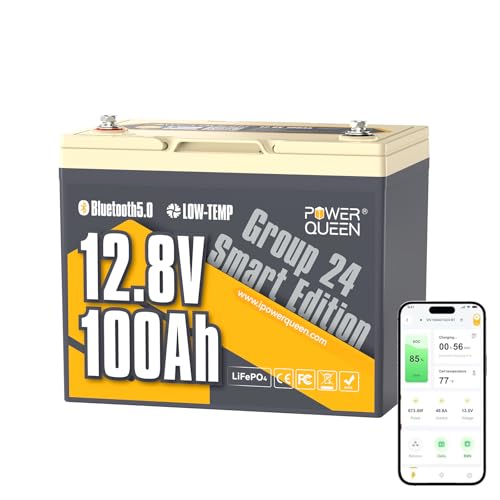
Power Queen 12V 100Ah Group 24 Smart Bluetooth LiFePO4 · Our score 82/100
Price on Amazon: $231.99
1,280 Wh (100 Ah at 12.8 V) in a Group 24 case at 22.2 lb, a 100 A BMS and Bluetooth. Power Queen rates it for 4,000 cycles at 100% depth of discharge and stops charging below 32 °F. Runs a 100 W load for about 11 hours through an inverter (our arithmetic). [28]
Skip it if: You must charge it below freezing: with no heater, charging simply stops until the cells warm.
12V LiFePO4, Self-Heating

LiTime 12V 100Ah Group 24 Self-Heating Bluetooth LiFePO4 · Our score 81/100
Price on Amazon: $313.64
The same 12.8 V, 1,280 Wh format with a built-in heater: LiTime says it warms below 41 °F when a charger is connected and charges from 50 °F, which solves lithium’s no-charging-below-freezing rule. 100 A BMS, Bluetooth, 22.71 lb. [29]
Skip it if: The battery lives indoors or never charges in the cold; the heater adds cost you won’t use.
LiFePO4 Power Stations
The same chemistry with the BMS, charger and inverter built in, so it runs household plugs.
LiFePO4 Power Station, 1 kWh

Anker SOLIX C1000 Gen 2 · Our score 92/100
Price on Amazon: $469.99
1,024 Wh of LiFePO4 with 2,000 W of AC output (3,000 W surge) and up to 600 W of solar input, 24.9 lb. Anker lists charging at 32–104 °F, the standard lithium limit, but discharging down to −4 °F. [30]
Skip it if: You need a 12V house battery wired into an RV or boat; a drop-in LiFePO4 battery fits that job better.
Small LiFePO4 Power Station

Jackery Explorer 300 · Our score 87/100
Price on Amazon: $289.00
A small LiFePO4 station: 292 Wh, a 300 W AC outlet (600 W surge) and 7.5 lb. Enough for phones, a laptop and lights for a weekend; a 30 W load runs about 8 hours (our arithmetic).
Skip it if: You need to run a fridge, coffee maker or anything over 300 W.
Lithium-Ion Power Banks
Lithium-ion cells (3.6–3.7 V class) keep a laptop bank light enough to carry; both stay under the 100 Wh carry-on limit.
Li-ion Laptop Power Bank

EcoFlow RAPID Power Bank (25,000mAh, 170W) · Our score 89/100
Price on Amazon: $44.33
25,000 mAh is 90 Wh at the 3.6 V lithium-ion cell voltage (25 Ah × 3.6 V), under the 100 Wh carry-on limit. Two 140 W USB-C ports and 170 W total for laptops; 1.25 lb. [24][25]
Skip it if: You only charge a phone; a smaller, lighter bank does that.
Li-ion Power Bank, Built-in Cables
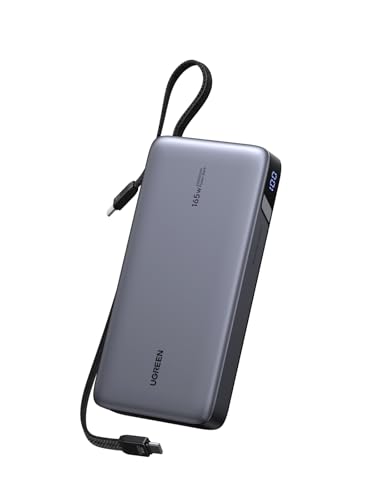
UGREEN Nexode 25,000mAh 165W Power Bank with Built-in Cables · Our score 83/100
Price on Amazon: $69.99
25,000 mAh (90 Wh) with two built-in USB-C cables, one rated 140 W, and 165 W total output. Also under 100 Wh, so it flies in a carry-on; 1.21 lb. [24][25]
Skip it if: You want the lightest laptop bank; at 550 g it is not small.
Battery Safety and Disposal
- Never recharge single-use batteries. Energizer warns it can cause explosion or leakage [12].
- Don’t charge lithium-ion below freezing. Battery University says no charging is permitted below 0 °C (32 °F) [8]; power stations and LiFePO4 batteries enforce it with their BMS [30][28].
- Keep coin cells from children. Reese’s Law exists because of ingestion injuries [22][14].
- Alkaline and zinc-carbon: the EPA says most communities allow them in household trash but recommends sending them to battery recyclers [21].
- Lithium (single-use and lithium-ion), coin cells and rechargeables: never in household trash or curbside recycling. The EPA says to tape the terminals or bag each battery separately, because a damaged lithium battery or touching terminals can spark a fire [21].
- Lead-acid: return it to the battery retailer or a household hazardous waste program [21].
For drop-off options and how to prepare a large lithium battery or power station, see our guide to lithium battery disposal.
Verdict: Match the Chemistry to the Load
For small cells, the job decides: alkaline for light indoor loads, lithium AA for cold and long storage, NiMH for anything you swap weekly. For storing real energy, lithium iron phosphate is the long-life choice: about 2,000 cycles or more against 200–300 for deep-cycled lead-acid [2][1], at roughly a quarter to half the weight per Wh [1]. For a 12V system, the Power Queen 12V 100Ah Group 24 Smart Bluetooth LiFePO4 (our score 82/100) is a straightforward drop-in. Currently $231.99 on Amazon, it stores 1,280 Wh. If you’d rather plug in than wire, the Anker SOLIX C1000 Gen 2 (92/100) puts the same chemistry behind household outlets.
Types of Batteries FAQ
What are the main types of batteries?
Batteries are either primary (single-use) or secondary (rechargeable). The common single-use types are alkaline, lithium AA/AAA (lithium/iron disulfide), zinc-carbon and lithium coin cells. The common rechargeable types are NiMH, lead-acid (flooded, AGM and gel), lithium-ion (NMC, NCA and LCO) and LiFePO4, with sodium-ion emerging.
Are lithium batteries better than alkaline?
For high-drain, cold or long-storage uses, yes. Energizer's figures put its lithium AA at about 297 Wh/kg versus about 143 Wh/kg for alkaline at a 200 mA load, a third lighter, rated from -40 to 60°C versus -18 to 55°C, and able to store for 20+ years. For low-drain indoor devices like remotes and clocks, alkaline does the job for less money.
Is a lithium AA the same as a lithium-ion battery?
No. A lithium AA such as Energizer Ultimate Lithium is a single-use lithium/iron disulfide cell rated at 1.5 V. A lithium-ion cell is rechargeable and runs at 3.6 to 3.7 V, so it is not a drop-in replacement for an AA. Energizer notes that lithium-ion batteries contain no metallic lithium, while its single-use lithium cells do.
Is NiMH or lithium better?
NiMH is better for devices you use and recharge often: Panasonic rates eneloop for up to 2,100 recharges and says it keeps up to 70% of its charge after 10 years. Single-use lithium AA is better for deep cold (-40°C versus about -20°C for eneloop) and for devices that sit unused for years. NiMH runs at 1.2 V rather than 1.5 V, which a few devices read as low.
What is the difference between AGM and lithium (LiFePO4)?
AGM is a sealed lead-acid battery: 2 V cells, 30 to 50 Wh/kg, specified at 80% depth of discharge, and it charges in the cold. LiFePO4 is a lithium-ion type: 3.2 V cells, 90 to 120 Wh/kg, 12V makers rate 4,000 cycles at 100% depth of discharge, but it must not be charged below freezing unless it has a heater. LiFePO4 costs more up front and weighs far less.
Which battery type lasts the longest?
In charge cycles, LiFePO4 among common types: Battery University lists 2,000 and higher, and 12V battery makers rate 4,000 at full depth of discharge, against 200 to 300 for deep-cycled lead-acid and 300 to 500 for standard NiMH. On the shelf, single-use lithium lasts longest: Energizer says its lithium AA keeps about 95% of its capacity after 20+ years.
What batteries do solar lights use?
Most use rechargeable NiMH cells, usually 1.2 V AA or AAA, because the light recharges the battery every day. Replace them with NiMH of the same voltage and at least the listed mAh. Don't use alkaline: it isn't rechargeable, and Energizer warns that charging single-use batteries can cause leakage or explosion.
What type of battery is in a portable power station?
Most current power stations use LiFePO4 (lithium iron phosphate) cells, which Battery University lists at 2,000+ cycles with a thermal runaway threshold around 270°C, versus about 210°C for NMC. That makes thermal runaway much less likely, though not impossible. Some older and lighter models use NMC lithium-ion, which is lighter but has a shorter cycle life.
How do I dispose of different battery types?
The EPA says most communities allow alkaline and zinc-carbon batteries in household trash but recommends recycling them. Lithium batteries (single-use and lithium-ion), coin cells and other rechargeables should never go in the trash or curbside recycling: tape the terminals or bag each one and take it to a battery recycler. Return lead-acid batteries to the retailer or a household hazardous waste program.
Sources
Cell figures come from battery makers’ datasheets and handbooks (Energizer, Duracell, Panasonic) and from Battery University; safety and disposal guidance from the EPA, U.S. Fire Administration, Red Cross, FAA, TSA and the Federal Register. Product specs come from our product database, cross-checked against the makers’ listings. Watt-hour and runtime figures are our arithmetic. Nothing here was measured by us. Last reviewed November 18, 2026.
- Battery University, BU-107: Comparison Table of Secondary Batteries (specific energy, cycle life at 80% DoD, self-discharge, nominal cell voltage and charge/discharge temperatures for lead acid, NiCd, NiMH and Li-ion)
- Battery University, BU-205: Types of Lithium-ion (LCO, NMC, NCA, LFP, LTO: voltage, specific energy, cycle life, thermal runaway temperature, applications)
- Battery University, BU-106: Advantages of Primary Batteries (alkaline limited to light loads; 1.3 W pulse test: alkaline 85, NiMH 520, Li-FeS2 690 pulses)
- Battery University, BU-201: How does the Lead Acid Battery Work? (deep-cycle 200–300 cycles; cycles by depth of discharge; flooded, AGM and gel; SAE J537 cold-cranking test at −18 °C)
- Battery University, BU-201a: Absorbent Glass Mat (AGM) (80% depth of discharge vs 50% for flooded; start-stop, marine, motor-home and UPS use)
- Battery University, BU-203: Nickel-based Batteries (NiMH 1.2 V; standard NiMH self-discharge; Eneloop low self-discharge)
- Battery University, BU-303: Confusion with Voltages (lead acid 2 V/cell, NiMH 1.2 V, Li-ion 3.6 V, LiFePO4 3.2–3.3 V)
- Battery University, BU-410: Charging at High and Low Temperatures (charge and discharge limits by chemistry; no Li-ion charging below freezing)
- Battery University, BU-802b: What does Elevated Self-discharge do? (alkaline 2–3% per year, 7–10 year shelf life; lithium-metal primary 10% in 5 years; Li-ion 1–2% per month plus about 3% for the protection circuit)
- Energizer, Cylindrical Primary Lithium (Li/FeS2) Handbook and Application Manual (~297 Wh/kg vs ~143 Wh/kg alkaline at ~200 mA; −40 to 60 °C; 33% lighter than alkaline; about 95% capacity after 20+ years of storage; 1.8 V open circuit)
- Energizer, L91 Ultimate Lithium AA product datasheet (distributor copy: Li/FeS2, 1.5 V, 14.5 g, −40 to 60 °C operating, 15-year shelf life at 21 °C)
- Energizer, Alkaline Handbook and Application Manual (−18 to 55 °C recommended operating range; about 3% capacity lost per year at 20 °C; warning that charging primary batteries may cause explosion or leakage)
- Energizer, Carbon Zinc Handbook and Application Manual (zinc chloride system; economical on moderate drains; 90–100% of service after 1 year, 65–80% after 4 years at 21 °C)
- Energizer, CR2032 lithium coin datasheet (distributor copy: Li/MnO2, 3.0 V, −30 to 60 °C, about 1% self-discharge per year, swallowing warning)
- Duracell, Coppertop MN1500 AA datasheet (distributor copy: Zn/MnO2, 1.5 V, about 24 g, −20 to 54 °C operating)
- Panasonic, eneloop catalogue (distributor copy: up to 2,100 recharges per IEC 61951-2 testing; usable down to −20 °C; many devices cut off below 1.1 V)
- Wikipedia, Eneloop (fifth generation BK-3MCD, 2022: 2,000 mAh minimum, 2,100 cycles, up to 70% charge kept after 10 years at 20 °C)
- Exhart, solar garden light instructions, model 06063-RS (only use a rechargeable 1.2 V Ni-MH battery of at least the listed capacity)
- U.S. Fire Administration, Smoke alarms (9-volt or sealed 10-year lithium; replace 9-volt and backup batteries at least once a year; replace alarms 10 years from manufacture)
- American Red Cross, Fire safety equipment (replace smoke alarm batteries at least once a year; replace alarms every 10 years per NFPA and CPSC)
- U.S. EPA, Used Household Batteries (disposal and recycling guidance by battery type; tape terminals or bag lithium batteries)
- Federal Register (Sept. 21, 2023): CPSC direct final rule under Reese’s Law adopting UL 4200A-2023 for products with button or coin batteries (secured battery compartments, warnings)
- Federal Register (Sept. 21, 2023): CPSC final rule on warning labels for button cell and coin battery packaging under Reese’s Law
- FAA PackSafe, Airline Passengers and Batteries (rechargeable batteries 0–100 Wh allowed; carry-on recommended)
- TSA, Lithium batteries with 100 watt hours or less (spares and power banks in carry-on only; lithium-ion limited to 100 Wh per battery)
- New Atlas, CATL Naxtra sodium-ion battery (175 Wh/kg; over 90% of capacity retained at −40 °C, per CATL)
- CnEVPost, CATL sodium-ion batteries begin deployment in production passenger vehicles (Feb. 2026; up to 175 Wh/kg, comparable to LFP)
- Power Queen, 12V 100Ah Group 24 Smart LiFePO4 battery product page (100 A BMS; 4,000 cycles at 100% DoD; charge cut-off below 32 °F)
- LiTime, 12V 100Ah Group 24 Bluetooth self-heating LiFePO4 battery product page (heats below 41 °F on a charger, charges from 50 °F)
- Anker SOLIX, C1000 Gen 2 product page (1,024 Wh LiFePO4; charging 32–104 °F, discharging −4 to 104 °F)
Need a laptop battery you can fly with? The EcoFlow RAPID 25,000mAh is 90 Wh and currently $44.33 on Amazon.
Check Price on Amazon →Save to cart