
Converter + UPS Sizing · Updated November 2026
VA vs Watts: Convert VA and kVA to Watts and Amps
The short answers
- What VA stands for
- Volt-amperes: volts × amps, the apparent power a circuit carries. Watts are the real power that does work [1][3].
- VA to watts
- Watts = VA × power factor. A heater has a power factor of 1, so VA = watts; a 1500VA UPS rated 900 W works at 0.6 [2][15].
- kVA to amps
- Single-phase: kVA × 1,000 ÷ volts. Three-phase: kVA × 1,000 ÷ (volts × 1.732). 10 kVA at 240 V is 41.7 A [10].
Use the VA, watts and amps converter, see why a UPS lists both numbers, or jump to the kVA to amps table.
As an Amazon Associate, SolarGenAdvisor earns from qualifying purchases made through links on this page, at no additional cost to you.
 By
VA to Watts Calculator (and kVA to Amps)
Three converters. Results update as you type and show the arithmetic; the example in each box is what you see before you change anything. They work the same for kVA and kW (just 1,000 times bigger).
Formulas: Schneider Electric White Paper 17 and Hammond Power Solutions [1][10]. 1.732 is the square root of 3; Hammond rounds it to 1.73, which changes the answer by under 0.2%.
VA vs Watts: Apparent and Real Power
On a DC circuit, power is simply volts × amps. On AC, some current flows into the load and back out each cycle without delivering energy. Volts × amps then gives an apparent power, written in volt-amperes (VA), that is larger than the real power in watts. The ratio between them is the power factor: watts ÷ VA, a number from 0 to 1 [1][3]. The current that does no work is called reactive power and is measured in volt-amperes reactive (VAR) [3].
Low power factor does not mean wasted energy on your bill; it means extra current. The U.S. Department of Energy puts it plainly for motors: the energy in the excess current is stored in the windings’ magnetic field and handed back to the line each cycle, but the wiring still has to be sized to carry it [8]. That is why wires, breakers, UPS inverters and generator alternators care about VA, and your electric meter and battery care about watts.
Power factor by type of load
| Load | Power factor | What it means |
|---|---|---|
| Heaters, incandescent bulbs (resistive) | 1.0 | VA and watts are identical [2]. A 1,500 W space heater is 1,500 VA. |
| Older PC with a capacitor-input supply (no PFC) | ~0.650.55–0.75 range | VA about 50% above watts. APC cites a PC Magazine study putting typical PCs at 0.65 [1][2]. |
| Active-PFC power supply (current PCs, servers, network gear) | 0.9–1.0APC: 0.99–1.0 | VA and watts nearly equal. 80 PLUS certification requires a true power factor of 0.9 or higher; APC puts PFC supplies at 0.99–1.0, and CyberPower notes ENERGY STAR computers use Active PFC [5][2][4]. |
| Induction motors (pumps, fans, compressors) | Below 1lower at light load | Winding inductance delays the current; DOE says power factor degrades below about 50% load [8]. Read the motor nameplate or measure it. |
| Small UPS (its watt rating ÷ VA rating) | ~0.6our picks: 0.6–0.67 | APC calls about 60% a de facto industry standard for small UPS systems [2]. |
| Three-phase standby generator (rating basis) | 0.8 | kW = kVA × 0.8 on the spec sheet [12][11]. See generator kVA. |
Not sure of your device’s power factor? A plug-in meter such as P3’s Kill A Watt shows watts, VA and power factor side by side [9]. For watts to amps at a known voltage, the watts to amps calculator does the conversion, and what is a watt-hour covers the step from watts to battery energy.
VA to watts at common UPS sizes
| VA | Watts at PF 0.6 | Watts at PF 0.7 | Watts at PF 0.9 | Watts at PF 1.0 | Amps at 120 V |
|---|---|---|---|---|---|
| 600 VA | 360 W | 420 W | 540 W | 600 W | 5.0 A |
| 850 VA | 510 W | 595 W | 765 W | 850 W | 7.1 A |
| 1,000 VA | 600 W | 700 W | 900 W | 1,000 W | 8.3 A |
| 1,350 VA | 810 W | 945 W | 1,215 W | 1,350 W | 11.3 A |
| 1,500 VA | 900 W | 1,050 W | 1,350 W | 1,500 W | 12.5 A |
| 2,000 VA | 1,200 W | 1,400 W | 1,800 W | 2,000 W | 16.7 A |
| 3,000 VA | 1,800 W | 2,100 W | 2,700 W | 3,000 W | 25.0 A |
Our arithmetic: watts = VA × PF; amps = VA ÷ 120. A UPS’s real limit is the watt figure its maker prints, not a power factor you assume.
Why a UPS Lists Both VA and Watts
A UPS has two separate limits. Its watt rating is how much real power the inverter and battery can deliver; its VA rating is how much current it can push. Neither may be exceeded, APC says, so check both [1][2]. The VA number is the big one on the box, which is why a “1500VA” UPS can carry only 900 or 1,000 W [15][16][14]. CyberPower’s own example is a 1000VA / 700W unit, a power factor of 0.7 [3].
| UPS | VA | Watts | W ÷ VA | 80% of watts |
|---|---|---|---|---|
| CyberPower CP1500PFCLCD PFC Sinewave UPS (1500VA/1000W) [14] | 1,500 | 1,000 W | 0.67 | 800 W |
| APC Back-UPS Pro BR1500MS2 Sine Wave UPS (1500VA/900W) [16] | 1,500 | 900 W | 0.60 | 720 W |
| CyberPower CP1500AVRLCD3 Intelligent LCD UPS (1500VA/900W) [15] | 1,500 | 900 W | 0.60 | 720 W |
| CyberPower CP2000PFCRM2U PFC Sinewave Rack UPS (2000VA/1200W, 2U) [17] | 2,000 | 1,200 W | 0.60 | 960 W |
| CyberPower CP1500PFCRM2U PFC Sinewave Rack UPS (1500VA/1000W, 2U) [18] | 1,500 | 1,000 W | 0.67 | 800 W |
VA and watt ratings from our product database, cross-checked against the maker pages cited. Ratios and 80% lines are our arithmetic.
Two more traps. First, runtime charts: APC warns that some makers quote full-load runtime at full VA load with a low power factor in the fine print, which can be well under the full watt load, so always read runtime against watts [1]. Second, the wall outlet. A 15 A, 120 V circuit is 1,800 VA, and the National Electrical Code’s 80% rule leaves 1,440 VA for continuous loads; APC says its UPS ratings and input plugs already account for that rule [7]. That is why a 2000VA unit such as CyberPower’s CP2000PFCRM2U ships with a 20 A NEMA 5-20P plug [17].
How to Size a UPS in Watts
- List each device’s watts. Use the maker’s documentation or nameplate. If it lists only amps, multiply by the voltage; Tripp Lite notes that gives an estimate (it is really VA, so it errs high) [6].
- Add them up. That total must fit under the UPS’s watt rating, not its VA rating [6][1].
- Add headroom. Tripp Lite says makers typically recommend keeping IT loads to 80% of capacity, to leave room for start-up inrush [6]; CyberPower suggests a UPS watt capacity 20–30% above your total [3]. If you can’t pin down the watts, APC’s safe shortcut is a UPS whose watt rating is at least the load’s VA [1].
- Then pick runtime. Battery runtime is set by the watt load [1]. Check the maker’s runtime chart at your wattage.
Worked example: a home office desk
| Desktop PC | 300 W |
|---|---|
| Two monitors | 60 W |
| Router + modem | 20 W |
| Total load | 380 W |
| At 80% load (Tripp Lite) | 380 ÷ 0.8 = 475 W minimum UPS watt rating |
| 20–30% above (CyberPower) | 456–494 W |
Illustrative loads, not measurements; meter your own. Any of the 900–1,000 W 1500VA units below clears 475 W. Runtime is the real question: CyberPower lists about 10 minutes at half load (500 W) for the CP1500PFCLCD [14], enough to save and shut down. For hours instead of minutes, a power station with UPS mode does the job (see power station vs UPS). By our math, a 1,024 Wh station runs this 380 W desk for about 2.3 hours (Wh × 0.85 ÷ watts). Sizing for a shop or office with several stations? See backup power for small business.
kVA to Amps: Single-Phase and Three-Phase
One kVA is 1,000 VA. Divide the VA by the voltage for single-phase amps; for three-phase, divide by the line-to-line voltage times 1.732 (the square root of 3) [10]. Generac’s SG080 sheet shows the formula at work: its 100 kVA rating appears as 120 A at 277/480 V and 278 A at 120/208 V three-phase [11], which is 100,000 ÷ (480 × 1.732) = 120.3 and 100,000 ÷ (208 × 1.732) = 277.6 by our arithmetic.
| kVA | 120 V 1-phase | 240 V 1-phase | 208 V 3-phase | 480 V 3-phase |
|---|---|---|---|---|
| 1 kVA | 8.3 A | 4.2 A | 2.8 A | 1.2 A |
| 2 kVA | 16.7 A | 8.3 A | 5.6 A | 2.4 A |
| 3 kVA | 25.0 A | 12.5 A | 8.3 A | 3.6 A |
| 5 kVA | 41.7 A | 20.8 A | 13.9 A | 6.0 A |
| 7.5 kVA | 62.5 A | 31.3 A | 20.8 A | 9.0 A |
| 10 kVA | 83.3 A | 41.7 A | 27.8 A | 12.0 A |
| 15 kVA | 125 A | 62.5 A | 41.6 A | 18.0 A |
| 20 kVA | 167 A | 83.3 A | 55.5 A | 24.1 A |
| 25 kVA | 208 A | 104 A | 69.4 A | 30.1 A |
| 30 kVA | 250 A | 125 A | 83.3 A | 36.1 A |
| 45 kVA | 375 A | 188 A | 125 A | 54.1 A |
| 50 kVA | 417 A | 208 A | 139 A | 60.1 A |
| 75 kVA | 625 A | 313 A | 208 A | 90.2 A |
| 100 kVA | 833 A | 417 A | 278 A | 120 A |
| 150 kVA | 1,250 A | 625 A | 416 A | 180 A |
Our arithmetic with the formulas above. These are full-load currents. Breaker and wire sizing follows the electrical code and the equipment’s instructions, so have an electrician size the circuit.
Generator kVA Ratings and 0.8 Power Factor
Commercial standby generators are often listed in both kW and kVA, and the gap is a power factor of 0.8. Kohler’s KD2000 sheet states that “all three-phase units are rated at 0.8 power factor” and lists the set at 2,000 kW / 2,500 kVA standby [12]. Generac lists its SG080 at 80 kW / 100 kVA, with three-phase currents at 0.8 pf and the single-phase 120/240 V rating at 1.0 pf [11]. Cummins gives standby ratings as kWe (kVA), such as 1,000 (1,250) and 600 (750), the same 0.8 ratio by our arithmetic [13].
- A 100 kVA three-phase generator is an 80 kW generator. Size its real load in kW, and check that the kVA (current) also covers it.
- Single-phase ratings can use 1.0. Generac rates the SG080
- Single-phase ratings are usually at 1.0. On the Generac sheet, 80 kW single-phasersquo;s single-phase output at 1.0
- Single-phase ratings are usually at 1.0. On the Generac sheet, 80 kW single-phasenbsp;pf, so 80
- Single-phase ratings are usually at 1.0. On the Generac sheet, 80 kW single-phasenbsp;kW single-phase at 240 V is 333 A, which is 80,000 ÷ 240 [11].
- Battery power stations are rated in watts only. Anker lists the SOLIX C1000 Gen 2 at 2,000 W continuous and does not publish a VA figure in the sources we checked [19].
UPS Picks by VA and Watt Rating
Grouped by type, each with its VA, watts and the ratio between them. Specs come from our product database, cross-checked against the maker pages cited; scores are our editorial ratings from published specs and Amazon customer reviews.
Desktop UPS (tower)
For a PC, monitors and network gear on a desk. Battery runtime is minutes, enough to save work and shut down. More in our best UPS battery backups.
Sine-Wave Desktop UPS

CyberPower CP1500PFCLCD PFC Sinewave UPS (1500VA/1000W) · Our score 89/100
1,500 VA / 1,000 W (ratio 0.67) · Line-interactive · Pure sine · transfer 4 ms typical · 6 battery outlets · 24.9 lb [14]
The highest watt rating of the 1500VA desktop units here: 1,000 W, a 0.67 watt-to-VA ratio, and sine-wave output for active-PFC computers. CyberPower lists about 10 minutes at half load.
Skip it if: Your load is under about 500 W of ordinary electronics; a simulated-sine 900 W unit also covers that.
APC Sine-Wave Alternative

APC Back-UPS Pro BR1500MS2 Sine Wave UPS (1500VA/900W) · Our score 80/100
1,500 VA / 900 W (ratio 0.60) · Line-interactive · Pure sine · transfer 8 ms typical, 10 ms max · 6 battery outlets · 27.6 lb [16]
The same 1500VA badge with a 900 W limit (a 0.6 ratio), sine-wave output and an LCD. APC rates it at up to 73 minutes at 100 W on its Amazon listing.
Skip it if: You want the most watts per VA; the CyberPower above carries 100 W more on the same VA rating.
Value 1500VA / 900W

CyberPower CP1500AVRLCD3 Intelligent LCD UPS (1500VA/900W) · Our score 78/100
1,500 VA / 900 W (ratio 0.60) · Line-interactive · Simulated sine · transfer 4 ms typical · 6 battery outlets · 23.8 lb [15]
1500VA / 900W with AVR, six battery-backed and six surge-only outlets, and a user-replaceable battery. Its simulated-sine output suits most electronics.
Skip it if: You run an active-PFC PC; CyberPower steers those to its sine-wave models.
Rack-mount UPS (2U)
For a network closet, NAS or small server rack. Same VA and watt arithmetic, in a 19-inch rack case. More in our best rack-mount UPS guide.
2000VA Rack UPS
CyberPower CP2000PFCRM2U PFC Sinewave Rack UPS (2000VA/1200W, 2U) · Our score 81/100
2,000 VA / 1,200 W (ratio 0.60) · Line-interactive · Pure sine · transfer 8 ms typical · 8 battery outlets · 28.68 lb [17]
Price on Amazon: $449.95
2000VA / 1200W in a short-depth 2U case with sine-wave output and a hot-swappable battery. At 120 V, 2,000 VA is about 16.7 A, more than a 15 A circuit allows, so it uses a NEMA 5-20P plug.
Skip it if: Your rack only has standard 15 A receptacles; the 1500VA model below plugs into those.
1500VA Rack UPS (15 A plug)
CyberPower CP1500PFCRM2U PFC Sinewave Rack UPS (1500VA/1000W, 2U) · Our score 79/100
1,500 VA / 1,000 W (ratio 0.67) · Line-interactive · Pure sine · transfer 8 ms typical · 8 battery outlets · 26.8 lb [18]
Price on Amazon: $359.95
1500VA / 1000W, sine-wave output, eight battery-backed outlets and a standard NEMA 5-15P plug. CyberPower lists 10.2 minutes at 500 W.
Skip it if: Your rack load is above about 800 W; that is the 80% line on its 1,000 W rating.
Power station with UPS mode
Rated in watts only, with a far bigger battery. Runtime is hours, not minutes, at the cost of a slower switchover than most UPS units. More in our power station vs UPS comparison.
UPS-Mode Power Station
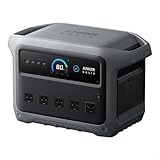
Anker SOLIX C1000 Gen 2 · Our score 92/100
1,024 Wh · 2,000 W continuous · 3,000 W surge · UPS 10 ms · LiFePO4 · 24.9 lb [19][20]
Price on Amazon: $469.99
2,000 W continuous and 1,024 Wh, with a 10 ms UPS switchover on its AC ports per Anker. By our math (Wh × 0.85 ÷ load) it runs a 300 W desk for about 2.9 hours.
Skip it if: Your equipment needs a sub-10 ms transfer or network shutdown signalling; a line-interactive UPS lists 4–8 ms and has management software.
Side by side
| Model | Type | VA / watts | Waveform | Transfer | Price | Link |
|---|---|---|---|---|---|---|
| CyberPower CP1500PFCLCD PFC Sinewave UPS (1500VA/1000W) | Desktop UPS (tower) | 1,500 VA / 1,000 W | Pure sine | 4 ms typical | Check price at Amazon → | View on Amazon → |
| APC Back-UPS Pro BR1500MS2 Sine Wave UPS (1500VA/900W) | Desktop UPS (tower) | 1,500 VA / 900 W | Pure sine | 8 ms typical, 10 ms max | Check price at Amazon → | View on Amazon → |
| CyberPower CP1500AVRLCD3 Intelligent LCD UPS (1500VA/900W) | Desktop UPS (tower) | 1,500 VA / 900 W | Simulated sine | 4 ms typical | Check price at Amazon → | View on Amazon → |
| CyberPower CP2000PFCRM2U PFC Sinewave Rack UPS (2000VA/1200W, 2U) | Rack-mount UPS (2U) | 2,000 VA / 1,200 W | Pure sine | 8 ms typical | $449.95 | View on Amazon → |
| CyberPower CP1500PFCRM2U PFC Sinewave Rack UPS (1500VA/1000W, 2U) | Rack-mount UPS (2U) | 1,500 VA / 1,000 W | Pure sine | 8 ms typical | $359.95 | View on Amazon → |
| Anker SOLIX C1000 Gen 2 | Power station with UPS mode | 2,000 W (no VA listed) | See review | 10 ms | $469.99 | View on Amazon → |
Transfer times as listed by each maker (typical figures). For the power stationThe power station’s waveform cell reflects that it has an inverter output; confirm details on thersquo;s inverter details, see the full review.
Verdict: Size by Watts, Check VA
VA is volts times amps; watts are VA times power factor. For a UPS, add up your devices in watts, keep the total near 80% of the UPS’s watt rating, and treat the VA number as a second limit, not the capacity. For a desk with a modern active-PFC PC, the CyberPower CP1500PFCLCD PFC Sinewave UPS (1500VA/1000W) (our score 89/100) has the highest watt rating of the 1500VA desktop units here (1,000 W) with sine-wave output. It gives about 10 minutes at 500 W per CyberPower. If you need hours rather than minutes, the Anker SOLIX C1000 Gen 2 (92/100) switches over in 10 ms per Anker. For kVA, remember the 0.8: a 100 kVA three-phase generator is 80 kW.
VA, Watts and kVA FAQ
What does VA stand for?
VA stands for volt-amperes (volt-amps): volts multiplied by amps. It measures apparent power, the total current an AC circuit or a UPS has to carry. kVA is 1,000 VA. Watts measure real power, the part that does work.
Is VA the same as watts?
Only when the power factor is 1, as with heaters and incandescent bulbs. Otherwise watts are lower: watts = VA × power factor. An older PC without power factor correction runs at about 0.65, so its VA is roughly 50% above its watts; an active-PFC supply is close to 1.
How do I convert VA to watts?
Multiply VA by the power factor. 1,000 VA at a power factor of 0.7 is 700 W. To go from watts to VA, divide by the power factor: 525 W at 0.7 is 750 VA. For a UPS, don't guess the power factor; use the watt rating the maker prints next to the VA rating.
How many watts is a 1500VA UPS?
Usually 900 to 1,000 W. CyberPower's CP1500AVRLCD3 and APC's BR1500MS2 are 1500VA / 900W, and CyberPower's CP1500PFCLCD is 1500VA / 1000W. APC describes a watt rating of about 60% of VA as a de facto standard for small UPS systems.
How do I convert kVA to amps?
Single-phase: amps = kVA × 1,000 ÷ volts. Three-phase: amps = kVA × 1,000 ÷ (volts × 1.732), using the line-to-line voltage. 10 kVA is 41.7 A at 240 V single-phase, 27.8 A at 208 V three-phase and 12.0 A at 480 V three-phase.
Why are generators rated in kVA at 0.8 power factor?
Commercial three-phase generator sets are rated at 0.8 power factor, as Kohler and Generac state on their spec sheets, so kW = kVA × 0.8. A 100 kVA set is 80 kW and a 2,500 kVA set is 2,000 kW. The kVA figure tells you how much current the alternator can carry; the kW figure is the real load it can run.
What size UPS do I need?
Add up the watts of everything you will plug into its battery outlets, then pick a UPS whose watt rating is comfortably above that: Tripp Lite says makers typically recommend loading IT equipment to 80% of capacity, and CyberPower suggests 20–30% headroom. A 380 W desk needs at least a 475 W rating. Then check runtime at that wattage.
What power factor should I use if I don't know it?
Measure it if you can: a plug-in meter such as the Kill A Watt shows watts, VA and power factor. Otherwise use 1.0 for heaters and bulbs, about 0.9–1.0 for current computers with active-PFC (80 PLUS) supplies, and about 0.65 for older PCs without PFC. For a UPS's own rating, read its printed watt figure.
Can a power station replace a UPS?
For many home offices, yes, if it has a UPS mode with a fast enough switchover. Power stations are rated in watts, not VA, and hold far more energy: a 1,024 Wh station runs a 300 W load for about 2.9 hours by our math, against roughly 10 minutes at half load for a 1500VA desktop UPS. Line-interactive UPS units list faster transfers (4–8 ms) and network shutdown software.
Sources
Definitions and sizing rules come from UPS makers’ white papers and support articles, the 80 PLUS program and the U.S. Department of Energy; formulas from a transformer maker’s FAQ; generator ratings from the makers’ spec sheets, as cited. Tables, ratios, amps and runtimes are our arithmetic on those figures. Product specs come from our product database, cross-checked against the listings below. Nothing here was measured by us. Last reviewed November 18, 2026.
- Schneider Electric (APC) Data Center Science Center, White Paper 17 Rev 1, Understanding Power Factor, Crest Factor, and Surge Factor (N. Rasmussen): actual power = VA × power factor; neither the watt nor the VA rating of a UPS can be exceeded; PCs with capacitor-input supplies about 0.65; PFC IT equipment a linear load
- Schneider Electric (APC) White Paper 15, Watts and Volt-Amps: Powerful Confusion (UCLA knowledge-base copy): heaters and incandescent bulbs have equal watt and VA ratings; PFC supplies 0.99–1.0; capacitor-input supplies 0.55–0.75 of VA; small UPS watt rating about 60% of VA
- CyberPower, Watts vs. volt-amperes (VA): key power ratings for choosing the right UPS (power factor = watts ÷ VA; 1000VA/700W example; UPS watt capacity 20–30% above the total load)
- CyberPower Power Blog, How to choose the right UPS for ENERGY STAR rated desktop computers (ENERGY STAR computers use Active PFC power supplies; sine-wave output recommended)
- 80 PLUS program (CLEAResult), Program details: certified power supplies must have a true power factor of 0.9 or higher
- Tripp Lite by Eaton, Article 000117, How much UPS capacity (wattage) do I need? (total the watts; amps × volts to estimate; makers typically recommend limiting IT loads to 80% of capacity for inrush; 10,000 VA at 0.7 vs 0.9 power factor)
- APC by Schneider Electric FAQ FA173063: why a UPS is derated to 80% of the circuit’s capacity (National Electrical Code 80% rule)
- U.S. Department of Energy, Motor Challenge fact sheet, Determining Electric Motor Load and Efficiency (power factor glossary; power factor degrades below about 50% load)
- P3 International, P4400 Kill A Watt operation manual: shows watts, VA and power factor
- Hammond Power Solutions FAQ, How are single-phase and three-phase load amps and load kVA calculated? (kVA × 1,000 ÷ volts; three-phase uses volts × 1.73)
- Generac Industrial Power, SG080 80 kW gaseous generator spec sheet: standby 80 kW / 100 kVA; three-phase amps at 0.8 pf, single-phase 120/240 V at 1.0 pf (333 A)
- Kohler Power, KD2000 industrial diesel generator set spec sheet G5-626: standby 2,000 kW / 2,500 kVA; “All three-phase units are rated at 0.8 power factor”
- Cummins, Bulletin S-6786, Centum S17 diesel generator set spec sheet (Rev. 5/25): emergency standby ratings in kWe (kVA), e.g. 1,000 (1,250) and 600 (750)
- CyberPower, CP1500PFCLCD product page (1500VA / 1000W, sine wave)
- CyberPower, CP1500AVRLCD3 product page (1500 VA / 900 W)
- APC by Schneider Electric, BR1500MS2 product datasheet (1500VA / 900W)
- CyberPower, CP2000PFCRM2U product page (2000VA / 1200W, NEMA 5-20P plug)
- CyberPower, CP1500PFCRM2U product page (1500VA / 1000W)
- B&H Photo spec listing, Anker SOLIX C1000 Gen 2 (1,024 Wh, 2,000 W continuous, 3,000 W surge)
- Anker SOLIX support, C1000 Gen 2 UPS ports and switchover time (10 ms)
Backing up a rack or network closet? The CyberPower CP2000PFCRM2U (2000VA / 1200W) is currently $449.95 on Amazon.
Check Price on Amazon →Save to cart