
Buying Guide · Updated November 2026
Solar Kit for Shed and Garage Power: The 4 Best Kits Sized to Your Loads (2026)
Short answer
The right solar kit for shed lights, a fan and tool charging is about 200W of panels with an MPPT controller, one 12V 100Ah LiFePO4 battery and a 1,000W pure sine inverter. Our pick is the ECO-WORTHY 200W kit with a 20A Bluetooth MPPT controller. A garage workshop that runs corded tools needs about 400W and twice the battery: the ECO-WORTHY 400W complete kit ships with both batteries and a 2,000W inverter. No shed kit runs a space heater.
As an Amazon Associate, SolarGenAdvisor earns from qualifying purchases made through links on this page, at no additional cost to you. Scores are AI-synthesized from manufacturer specs, Amazon listing contents, logged Amazon prices and Amazon customer reviews; we did not install or test these kits.
 By
Shed Solar Panel Kit Comparison
This page covers the 100–400W scale: a garden shed, workshop or detached garage that needs lights, a fan, tool charging and a few 120V outlets. That is smaller than a cabin you sleep in, which our solar generator for a cabin or tiny house guide covers, and it uses roof-mounted kits rather than the power-station-plus-folding-panel bundles in our solar generator kits guide. Specs come from the manufacturer pages and each Amazon listing. Prices load live from Amazon.
| Kit | Panels | Controller | Battery / inverter | Best for | Price |
|---|---|---|---|---|---|
| ECO-WORTHY 200W Solar Kit (20A Bluetooth MPPT) (76/100) | 2 × 100W rigid | 20A MPPT, Bluetooth | Not included | Best for Most Sheds (Lights, Fan, Tool Charging) | $271.99 |
| ECO-WORTHY 400W Complete Kit (Battery + 2000W Inverter) (82/100) | 4 × 100W rigid | 40A MPPT, Bluetooth | 2,560 Wh LiFePO4 / 2,000W inverter | Best All-in-One for a Garage Workshop | Check price at Amazon → |
| Renogy 400W Premium Solar Kit (40A MPPT) (84/100) | 4 × 100W rigid | 40A MPPT, Bluetooth | Not included | Best 400W Panel Kit (Bring Your Own Battery) | Check price at Amazon → |
| Renogy 200W Solar Starter Kit (30A PWM) (76/100) | 2 × 100W rigid | 30A PWM | Not included | Best Budget Kit (Lights and Battery Top-Up) | Check price at Amazon → |
Kit scores use the same rubric as our best RV solar kit guide (controller and harvest 25, value 20, kit completeness 15, panel build 15, expandability 15, documentation and Amazon customer reviews 10), AI-synthesized from specs, listing contents and logged prices. Batteries, inverters, panels and power stations each have their own rubric, so compare scores within a category. All four kits showed in stock on Amazon when we checked on November 8, 2026.
The 4 Best Solar Panel Kits for a Shed or Garage
Ordered by how well each kit fits a typical shed or garage job, not strictly by score. Three of the four ship without a battery or inverter, so each card says what to add.
#1 · Best for Most Sheds (Lights, Fan, Tool Charging) · 76/100

ECO-WORTHY 200W Solar Kit (20A Bluetooth MPPT)
In the box: 2 x 100W rigid N-type panels, 20A MPPT controller with built-in Bluetooth, mounting brackets, cables, connectors
Add: Add one 12V 100Ah LiFePO4 battery and a 1,000W pure sine inverter (below).
Current price on Amazon: $271.99
Two 100W N-type rigid panels, a 20A MPPT controller with Bluetooth built in, mounting brackets and cables, per the Amazon listing. Two hundred watts is the right size for a shed that runs LED lights, a fan, a radio and a cordless-tool charger: tilted toward the south it makes roughly 600–1,000 Wh on an average day across most of the US (see the sun-hour table below). MPPT matters here because shed systems spend the winter in weak, low-angle light, where MPPT recovers more energy than PWM. A 20A controller tops out at about 280W on a 12V battery (20A × ~14V), so this is a kit you size right once rather than grow.
- MPPT plus app monitoring at the 200W size
- Brackets, cables and connectors included
- Works with 12V or 24V batteries
- No battery or inverter in the box
- Little room to add panels at 12V
- Specs come only from the Amazon listing; we couldn’t cross-check a second source
#2 · Best All-in-One for a Garage Workshop · 82/100

ECO-WORTHY 400W Complete Kit (Battery + 2000W Inverter)
In the box: 4 x 100W bifacial panels, 40A MPPT controller, 2000W pure sine inverter, 2 x 12V 100Ah lithium batteries, Bluetooth module
Add: Everything is in the listing; budget for fuses, a disconnect and mounting the batteries.
The whole system in one order: four 100W bifacial panels, a 40A MPPT controller, a 2,000W pure sine inverter, two 12V 100Ah lithium batteries with built-in BMS and a Bluetooth module, per the Amazon listing; the product images label the batteries 12.8V 100Ah LiFePO4. Two 12.8V 100Ah batteries store about 2,560 Wh, and the “1.6KWH” in the listing title is ECO-WORTHY’s claimed daily solar output, not battery capacity. The 2,000W inverter has the headroom a 12V 1,000W unit lacks for corded tools like a circular saw. ECO-WORTHY sells several similar complete kits with different battery and inverter combinations, so confirm the contents before you order.
- Panels, controller, storage and 120V inverter in one order
- About 2.5 kWh of storage and 2,000W of AC
- MPPT with Bluetooth monitoring
- Needs a permanent install with proper fusing and battery mounting
- Two-battery 12V bank must be wired and fused per the manuals
- Inverter surge rating not published on the listing
#3 · Best 400W Panel Kit (Bring Your Own Battery) · 84/100

Renogy 400W Premium Solar Kit (40A MPPT)
In the box: 4 x 100W rigid panels, Rover 40A MPPT controller, Bluetooth module, adaptor kit, tray cable, Z-brackets
Add: Add one or two 12V 100Ah LiFePO4 batteries and an inverter sized to your tools.
Four 100W rigid panels, Renogy’s Rover 40A MPPT controller, a Bluetooth module, cabling and Z-brackets (Amazon listing; Renogy’s product page also lists a short fuse cable). It scores highest of these kits in our rubric because it pairs MPPT, monitoring and well-documented parts. Renogy publishes about 520W of panel capacity for the Rover 40A at 12V, so 400W leaves a little headroom. Choose it over the complete kit if you already own a battery, want to pick your own inverter, or would rather build the battery bank in stages.
- MPPT controller and Bluetooth module included
- Rigid glass panels with Z-brackets for a shed roof
- Works with 12V or 24V battery banks
- No battery or inverter in the box
- Higher price per watt than ECO-WORTHY’s 400W Premium kit in our October 31 price log
- Four panels need more roof than two
#4 · Best Budget Kit (Lights and Battery Top-Up) · 76/100

Renogy 200W Solar Starter Kit (30A PWM)
In the box: 2 x 100W rigid panels, Wanderer 30A PWM controller, adaptor kit, tray cable, Z-brackets
Add: Add a battery; skip the inverter if every load is 12V DC.
Two 100W rigid panels, a Wanderer 30A PWM controller, cables and Z-brackets. Renogy says the Wanderer can handle up to 400W of panels, so you can double this kit later without replacing the controller. It is the cheapest way into a roof-mounted shed system from a major brand. The trade-off is PWM: it harvests less than MPPT, especially in cold weather and low winter light, and it has no app. It fits a shed with 12V LED lights and a battery you top up, rather than a garage running 120V tools every day.
- Lowest-cost kit here
- Controller handles 400W, so you can add two panels later
- Lithium and lead-acid charge modes
- PWM harvests less than MPPT in winter
- No Bluetooth or app monitoring
- No battery or inverter in the box
Add-Ons: Battery, Inverter, Panels and Controller
A panel-only kit is the charging half of a shed system. The other half is a battery to store the energy and an inverter if you want 120V outlets. These are the parts we would pair with the kits above, or use to build a system from parts. Our best 12V lithium battery and best power inverter guides compare more options.
Battery: 12V 100Ah LiFePO4 · 82/100 (battery rubric)
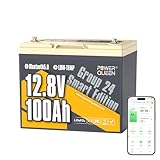
Power Queen 12V 100Ah Group 24 Smart Bluetooth LiFePO4
Current price on Amazon: $289.99
A Group 24 12V 100Ah LiFePO4 battery with a 100A BMS (Power Queen lists a 500A, 1-second surge), Bluetooth and a low-temperature charging cut-off: it stops charging below 32°F and resumes at 41°F, which protects the cells in an unheated shed. 1,280 Wh rated, about 1,088 Wh usable at our 85% planning factor. The 100A BMS covers a 1,000W inverter; for a 2,000W inverter, use two in parallel.
Inverter: 12V 1,000W pure sine · 67/100 (inverter rubric)

Renogy P2 1000W Pure Sine Wave Inverter
Current price on Amazon: $175.99
Renogy lists 1,000W continuous and 2,000W peak, GFCI protection, a hardwire terminal, a remote and 4 AWG cables, with UL 458 and CSA certification on the listing. That runs LED lights, fans, radios, chargers and a drill. It will not run a 1,400W circular saw or a 1,500W heater. Renogy doesn’t publish its idle draw, which matters if the inverter stays on around the clock for a garage door opener (see the load table).
Panels: 2 × 200W rigid bifacial · 77/100 (panel rubric)

Callsun 400W N-Type Bifacial Solar Panel (2 x 200W)
Current price on Amazon: $319.99
Two 200W N-type bifacial glass panels with MC4 connectors, about 23.8 lb each. Callsun lists an open-circuit voltage of 27.31V per panel, so two in series reach about 54.6V. That stays inside a 100V MPPT controller’s limit and lets you run the panel-to-controller wire at higher voltage and lower current, which helps on a long run from a ground mount. Bifacial panels collect some reflected light from the back, which pays off on a raised ground mount over light gravel more than flat on a roof.
Controller: 30A MPPT (100V) · 84/100 (controller rubric)

Victron SmartSolar MPPT 100/30
Victron’s datasheet rates the SmartSolar 100/30 for 440W of panels on a 12V battery or 880W on 24V, with a 100V maximum PV input and Bluetooth built in. It is the controller to pair with the Callsun panels for a build-from-parts system.
When we checked on November 8, 2026, Amazon showed this controller with a future availability date rather than in stock. The 40A MPPT controllers in the Renogy and ECO-WORTHY 400W kits are alternatives; our RV solar kit guide compares them.
A shed battery charges from the solar controller, so the controller’s LiFePO4 profile has to match the battery. Our guide on how to charge a LiFePO4 battery lists the charge and float voltages battery makers publish, and what to set on an MPPT controller.
How Big a Solar Kit Does a Shed Need? The Daily Wh Math
Size a shed system from a day’s watt-hours (watts × hours of use for each load), not from the roof. Here are common shed and garage loads. Where a published figure exists we cite it; the hours, and the figures marked as assumptions, are ours. Replace them with your own nameplate numbers.
| Load | Draw | Daily use | Wh / day |
|---|---|---|---|
| LED shop lights (2 fixtures) | ~40W each (our assumption; check the label) | 3 h | ~240 |
| Box or window fan | 55–250W (VCE range); we use 100W (source) | 2 h | ~200 |
| Cordless tool battery charger | 210W (EGO standard charger) (source) | 1 h | ~210 |
| Radio, phone charging, Wi-Fi camera | ~10–20W combined (our assumption) | a few hours | ~60 |
| Corded circular saw | 1,400–1,500W running, more to start (generator charts) (source) | 15 min | ~360 |
| Garage door opener | Varies widely by model; we assume up to ~800W while moving | 6 cycles × 15 s | ~20 |
| Inverter left on 24 h (for the opener) | ~7–8W idle on a Victron Phoenix 12/1200 datasheet (source) | 24 h | ~190 |
| Full-size fridge or freezer | EnergyGuide label: 615 kWh/yr (source) | 24 h, cycling | ~1,700 |
| Space heater | 750–1,500W (VCE) (source) | 1 h on high | ~1,500 |
Garage door openers range from older AC chain drives to newer DC belt drives, and we found no single published figure that covers them, so check the nameplate: amps × 120 = watts. Generator charts such as Champion’s list motor loads with a starting surge above their running watts, so size the inverter’s surge rating, not just its continuous rating. The fridge figure is a 25 cu ft side-by-side’s EnergyGuide label (615 kWh ÷ 365 ≈ 1.7 kWh a day); a smaller or newer fridge uses less, and an unheated garage in summer can push it higher.
Sun Hours: What 100–400W of Panels Actually Makes
Panel output depends on peak sun hours: the day’s solar energy expressed as hours of full 1,000 W/m² sun. We pulled average daily figures for six cities from the National Solar Radiation Database through the Solar Resource API run by the National Laboratory of the Rockies, the DOE lab formerly called NREL (NSRDB). “Tilted” is a panel tilted at the local latitude; “flat” is a horizontal panel, closer to a low-pitch shed roof. We then budget 75% of rated watts for heat, angle and wiring losses, the same factor as our RV kit guide:
Daily Wh from solar ≈ panel watts × peak sun hours × 0.75
Panel watts needed ≈ daily Wh ÷ (peak sun hours × 0.75)
| City | Sun hrs: year, tilted | Sun hrs: Dec, tilted | Sun hrs: Dec, flat | 200W kit: year / Dec tilted | 400W kit: year / Dec tilted |
|---|---|---|---|---|---|
| Phoenix, AZ | 6.68 | 5.53 | 3.18 | ~1,000 / ~830 Wh | ~2,000 / ~1,660 Wh |
| Atlanta, GA | 5.09 | 3.79 | 2.34 | ~760 / ~570 Wh | ~1,530 / ~1,140 Wh |
| Denver, CO | 5.85 | 4.64 | 2.26 | ~880 / ~700 Wh | ~1,760 / ~1,390 Wh |
| Chicago, IL | 4.50 | 2.65 | 1.45 | ~680 / ~400 Wh | ~1,350 / ~800 Wh |
| Boston, MA | 4.57 | 3.18 | 1.60 | ~690 / ~480 Wh | ~1,370 / ~950 Wh |
| Seattle, WA | 3.98 | 1.65 | 0.84 | ~600 / ~250 Wh | ~1,190 / ~500 Wh |
Source: NSRDB averages (kWh/m²/day) returned by the NLR Solar Resource API for each city’s coordinates, queried November 8, 2026. For your own address, enter it in PVWatts, the lab’s free calculator. Harvest columns are our calculation.
Two things stand out. First, winter output drops hard in the north. A tilted panel makes about 60% of its annual-average output in a Chicago December, 70% in Boston and about 40% in Seattle, so a shed you use all winter needs roughly 1.5 to 2.5 times the panel you would size for the yearly average. Second, tilt matters most in winter: in Chicago a flat panel gets 1.45 December sun hours against 2.65 tilted, about a third of the annual tilted figure. If your shed roof is nearly flat, tilt brackets or a south-facing wall or ground mount will recover a lot of winter output.
Three Shed and Garage Profiles, Sized
| Profile (our assumptions) | Wh / day | Panels at 5 sun hrs | Panels at 3 sun hrs (winter) | 12V 100Ah batteries for 1 day |
|---|---|---|---|---|
| Lights-and-charging shed LED lights, fan, tool charging, radio and phone |
~710 | ~190W | ~316W | 1 (1,088 usable Wh each) |
| Garage workshop The shed loads plus 15 min of a circular saw and a door opener with the inverter left on |
~1,280 | ~342W | ~569W | 2 (1,088 usable Wh each) |
| Garage with a second fridge The workshop loads plus a full-size fridge |
~2,980 | ~795W | ~1,325W | 3 (1,088 usable Wh each) |
Usable battery energy is rated Wh × 0.85 to allow for inverter and wiring losses (a 12.8V 100Ah battery is 1,280 Wh, so about 1,088 Wh usable). The first profile is a 200W kit and one battery for most of the year, and a 400W kit for winter. The workshop is a 400W kit with two batteries, which is what the ECO-WORTHY complete kit ships with; in a northern winter, expect to saw less or add panels. The fridge profile needs 1,000W or more of panels in winter: past the scale of a shed kit. Want to add your own appliances? Our solar size calculator and appliance wattage chart do the math.
What a Shed Solar Kit Can’t Run: Heaters, Fridges and Big Compressors
Space heaters: don’t
A portable electric heater draws 750–1,500W (Virginia Cooperative Extension). One hour on high is about 1,500 Wh: more than a 200W kit makes on an average day almost anywhere in the table above, and more than one 100Ah battery holds. Heat is the one shed job solar at this scale can’t do. Insulate the shed, heat yourself rather than the room, or have an electrician run a circuit from the house. Our solar generator for a space heater guide runs the numbers on lower-watt options.
Full-size fridges and freezers: usually not
At about 1.7 kWh a day from its EnergyGuide label, a full-size fridge alone uses more than the whole workshop profile. It runs 24 hours, including the cloudy weeks when a 400W array makes a few hundred Wh a day. A 12V compressor fridge uses far less; our best 12V fridge guide lists published average draws.
Corded tools: only with the right inverter
Generator charts list a circular saw at 1,400–1,500 running watts and a table saw around 1,800W, each with a starting surge on top. A 1,000W inverter won’t start them. A 2,000W inverter on two parallel 100Ah batteries, or a power station rated 1,800W or more, will run short cuts; the battery then recharges over the next sunny day.
Cordless tools: the solar-friendly option
Charging tool batteries spreads a small load over the day. EGO lists 210W for its standard charger (EGO), so an hour of charging is about 210 Wh. Our tool battery power station guide covers stations that run on the tool packs you already own.
Garage Solar Panels: Kit + Battery vs a Power Station + Panels
There are two ways to put solar power in a shed or garage. A component kit is panels, a charge controller, a 12V LiFePO4 battery and an inverter, wired together and mounted. A power station puts the battery, controller, inverter and outlets in one box, and you plug portable or rigid panels into it. Here is the complete ECO-WORTHY kit next to a power station we have already reviewed, paired with a same-brand panel:
| ECO-WORTHY 400W Complete Kit | EcoFlow Delta 3 Plus + NextGen 220W | |
|---|---|---|
| Storage | ~2,560 Wh (2 × 12V 100Ah) | 1,024 Wh, expandable with an extra battery |
| AC output | 2,000W inverter | 1,800W (3,600W surge) |
| Solar | 400W rigid panels included, 40A MPPT | Up to 1,000W input; one 220W folding panel (15.9 lb) |
| Install | Permanent: mount, wire, fuse | None: plug in; the station is 27.6 lb and portable |
| Our score | 82/100 (kit rubric) | 89/100 (review) + 82/100 panel |
| Price | Check price at Amazon → | Station: $719.00 Panel: Check price at Amazon → |
Kit, power-station and panel scores use different rubrics and aren’t directly comparable. When we checked on November 8, 2026, Amazon listed the Delta 3 Plus with a future availability date rather than in stock; the panel was in stock. Our solar generator kits guide lists other matched station-and-panel pairs.
Choose a component kit if…
- The panels will live on the shed roof and the system stays put
- You want more storage per dollar and room to add batteries
- You’ll wire and fuse it to the manuals, or hire an electrician
Choose a power station + panels if…
- You want no fixed wiring and nothing to permit up front
- You’ll carry it to job sites, campsites or into the house in an outage
- You rent, or the shed may move
Mounting Shed Solar Panels and Planning the Wire Runs
- Roof, wall or ground. The Renogy and ECO-WORTHY kits ship with Z-brackets for a flat mount on a roof. Check that the shed’s rafters and sheathing can carry the panels plus your area’s wind and snow loads, fasten into framing rather than bare sheathing, and seal every penetration. A low-pitch roof gives up winter output (see the flat vs tilted columns above), so a tilted ground or wall mount facing south is worth considering. PVWatts uses an azimuth of 180°, due south, as its default for US systems.
- Keep the battery close to the loads. Put the battery, inverter and controller inside the shed, near each other. Victron’s wiring guide says to keep high-current cables such as battery-to-inverter runs as short as possible and to aim for no more than 2.5% voltage drop (Victron Wiring Unlimited). A 1,000W inverter at full load pulls roughly 90A from a 12V battery, which is why its cables are short and thick.
- Run long distances at higher voltage. If the panels sit away from the shed, the panel-to-controller run carries the least current at the highest voltage. Victron notes that the higher the circuit voltage, the lower the voltage drop for the same power. Wiring panels in series raises that voltage, within the MPPT controller’s maximum PV input. Don’t try to run 12V DC from a battery in the house out to a detached shed; the current is too high for a long run.
- Use outdoor-rated PV wire and conduit. Article 690 of the National Electrical Code has a part on PV wiring methods. Use the sunlight-resistant cable and MC4 connectors your kit specifies, protect runs from mowers and foot traffic, and follow the kit manual for cable gauge.
Our solar panel setup guide covers angle, placement and series vs parallel wiring for portable setups, and our best 400 watt solar panel guide compares rigid panels with their open-circuit voltages. To size a kit from 100W to 1,000W by daily watt-hours, see our 400 watt solar panel kit guide.
Fuses, Disconnects and Grounding
A lithium battery can deliver very high current into a short circuit, and most shed kits don’t include every fuse or breaker their manuals call for. We don’t publish fuse sizes or wiring diagrams, because the right values depend on your battery, inverter and cable runs. What the manuals and wiring guides agree on:
- A main fuse near the battery positive. LiTime’s battery manual says to install an appropriate fuse or circuit breaker close to the battery positive (LiTime manual). Victron says a DC system should always contain a main fuse, and that in every lithium installation at least one fuse must have an interrupt rating equal to or greater than the battery bank’s maximum short-circuit current (Victron).
- A fuse for every circuit. Victron’s guide says each consumer connected to a battery needs its own fuse in the positive cable, no matter how small. That includes the inverter, the charge controller and any 12V lighting circuit. Battle Born’s manual likewise recommends appropriate fuses and circuit breakers to protect downstream components (Battle Born manual).
- A way to switch the panels off. Panels make voltage whenever light hits them. The NEC’s PV article requires a PV disconnecting means, and overcurrent devices listed for PV in the DC circuits (IAEI, on NEC 690). A DC breaker between the panels and the controller does both jobs on most small systems; ask your inspector what your edition requires.
- Ground the metal. Article 690 includes a full part on grounding and bonding: panel frames, racking and metal enclosures are bonded to an equipment grounding conductor. Victron’s guide notes that good earth wiring is essential to electrical safety, with thick enough cable and tight connections. If the inverter has a chassis ground terminal, its manual explains how to connect it. Article 690 also has rules for PV grounding electrodes (690.47), and how they apply to a detached shed is a question for an electrician.
- GFCI on the AC side. The Renogy P2 inverter lists GFCI protection on its outlets. Sheds and garages have damp floors and metal tools, so protected outlets are worth having whatever your code says.
NEC 690, Permits and Inspection: Check Local Code First
In the US, electrical installations follow the National Electrical Code, NFPA 70 (NFPA). We aren’t electricians and this isn’t code advice, but these are the parts of the code a shed system touches, at a high level:
- Article 690, Solar Photovoltaic Systems: circuit sizing and overcurrent protection (690.9), disconnecting means, wiring methods and grounding. Its rapid-shutdown section, 690.12, covers PV circuits installed on or in buildings (IAEI). Whether that applies to panels on a detached shed depends on your code edition and how your inspector reads it.
- Article 706, Energy Storage Systems: in the 2020 NEC it applies to permanently installed energy storage systems with a capacity greater than 1 kWh (Mike Holt, 2020 NEC). One 12.8V 100Ah battery is 1.28 kWh, so even a one-battery shed system can be over that threshold. When the article first appeared in the 2017 NEC, its scope used a voltage threshold instead (more than 50V AC or 60V DC), per IAEI.
- Editions differ by state. States and cities adopt different NEC editions on their own schedules and can amend them. NFPA keeps an NEC enforcement map by state.
Questions to ask your building department before you buy
- Does an off-grid PV system with a battery on an accessory building need an electrical permit and inspection?
- Which NEC edition do you enforce, and with what local amendments?
- Do roof-mounted panels on a shed trigger rapid-shutdown or roof setback rules?
- Is a plug-in power station with portable panels treated differently from a hardwired system?
- Does an HOA or historic district approval apply to visible panels?
We don’t list permit rules here because they vary by city and county and we can’t verify them for every reader. If the answer is “permit required,” a licensed electrician can pull it and handle the inspection. Tying a shed system into your house wiring or panel is a different, larger job: see our transfer switch guide for how that works with a power station.
Winter in an Unheated Shed: Charging Below 32°F
LiFePO4 batteries shouldn’t be charged below freezing. LiTime’s manual says not to charge normally below 0°C (32°F) (LiTime manual). The Power Queen battery above protects itself with a cut-off: it stops charging below 32°F and resumes at 41°F, so on a cold morning the panels put nothing back until the shed warms up. That is safe, but in a northern winter it can mean days of lost charging. Power stations have limits too; Anker, for example, lists a 32–104°F charging range for its SOLIX C1000 (Anker).
If the shed stays below freezing for weeks and you need solar charging through it, choose a self-heating battery, which warms its cells with charger power before charging. Our best LiFePO4 battery for RV guide compares two self-heating Group 24 models; the same batteries work in a shed. Discharging is allowed well below freezing on these batteries, so lights and tools still run on a cold day.
Who Should Buy a Shed Solar Kit, and Who Should Skip One
Buy one if…
- Your shed or detached garage has no power and you want lights, a fan and outlets.
- Your loads are mostly LEDs, chargers, small tools and electronics.
- You have a roof, wall or patch of ground with clear southern sun.
- You’ll follow the manuals on fusing, or hire an electrician.
Skip it or plan bigger if…
- You need heat, a full-size fridge or a large air compressor every day.
- The shed sits in shade for much of the winter.
- You live in it: see our cabin and tiny house guide.
- You want portable power for camping and outages too: a solar generator kit does both.
Shed Solar Panel Kits: FAQ
What size solar kit do I need for a shed?
Add up your daily watt-hours, then divide by your peak sun hours times about 0.75. A shed running LED lights, a fan, a cordless-tool charger and a radio uses roughly 700 Wh a day; with 5 sun hours that needs about 700 / (5 x 0.75) = 190W, so a 200W kit covers an average day and a 400W kit covers short winter days. Pair it with a 12V 100Ah LiFePO4 battery (about 1,088 usable Wh) and a 1,000W pure sine inverter for 120V outlets.
Can a solar panel kit for a shed run power tools?
Cordless tools are easy: charging the batteries takes a few hundred watts. Corded tools need a bigger inverter and battery. Generator wattage charts list a circular saw at about 1,400 to 1,500 running watts with more to start, which is beyond a 1,000W inverter. For corded tools, plan on a 2,000W inverter on two 100Ah batteries in parallel, as in the ECO-WORTHY 400W complete kit, or a power station rated 1,800W or more. Short bursts are fine; all-day sawing will drain the battery faster than 400W of panels refills it.
Can a shed solar kit run a space heater?
Not in any useful way. A portable space heater draws 750 to 1,500 watts, so one hour on high uses about 1,500 Wh: more than a 200W kit makes on an average day and more than one 100Ah battery holds. Heating is the job solar kits at shed scale cannot do. Insulate the shed, dress for the cold, or have an electrician run a dedicated circuit from the house if you need heat.
Do I need a permit to put solar panels on a shed?
It depends on where you live, so ask your local building department before you buy. In the US, PV wiring falls under Article 690 of the National Electrical Code (NFPA 70), batteries over 1 kWh can fall under Article 706 in the 2020 edition, and states and cities adopt different editions and add their own rules. Ask whether a fixed off-grid system on an accessory building needs an electrical permit and inspection, which code edition they enforce, and whether an HOA approval applies.
Can garage solar panels run a garage door opener?
Yes, but the inverter is the hidden cost. An opener only runs for seconds at a time, so its own energy use is small, but it needs 120V power around the clock, so the inverter stays on 24 hours a day. Victron lists about 7 to 8 watts of no-load draw for its Phoenix 12/1200 inverter, roughly 170 to 190 Wh a day before the door moves. Check your opener nameplate for amps (amps x 120 = watts) and your inverter manual for idle draw and surge before you size the system.
Should I buy a shed solar panel kit or a power station?
Buy a panel kit with a 12V battery and inverter if you want a permanent setup with roof panels, the lowest cost per stored watt-hour and room to expand, and you are comfortable with fusing and wiring or will hire an electrician. Buy a power station and portable panels if you want no wiring, need to carry the power to a job site or into the house in an outage, or rent your home. Both use LiFePO4 batteries; the power station puts the controller, inverter and outlets in one box.
Lights, a fan and tool charging? A 200W MPPT kit and one 100Ah battery. Corded tools in a garage? 400W, two batteries and a 2,000W inverter.
Solar kit prices move often, and like other solar gear they have historically dipped during Prime Day and Black Friday events. Every price on this page loads live from Amazon.